
Life, 1910-01-20 · page 14 of 36
Life — January 20, 1910 — page 14: what you’re looking at
What you’re looking at
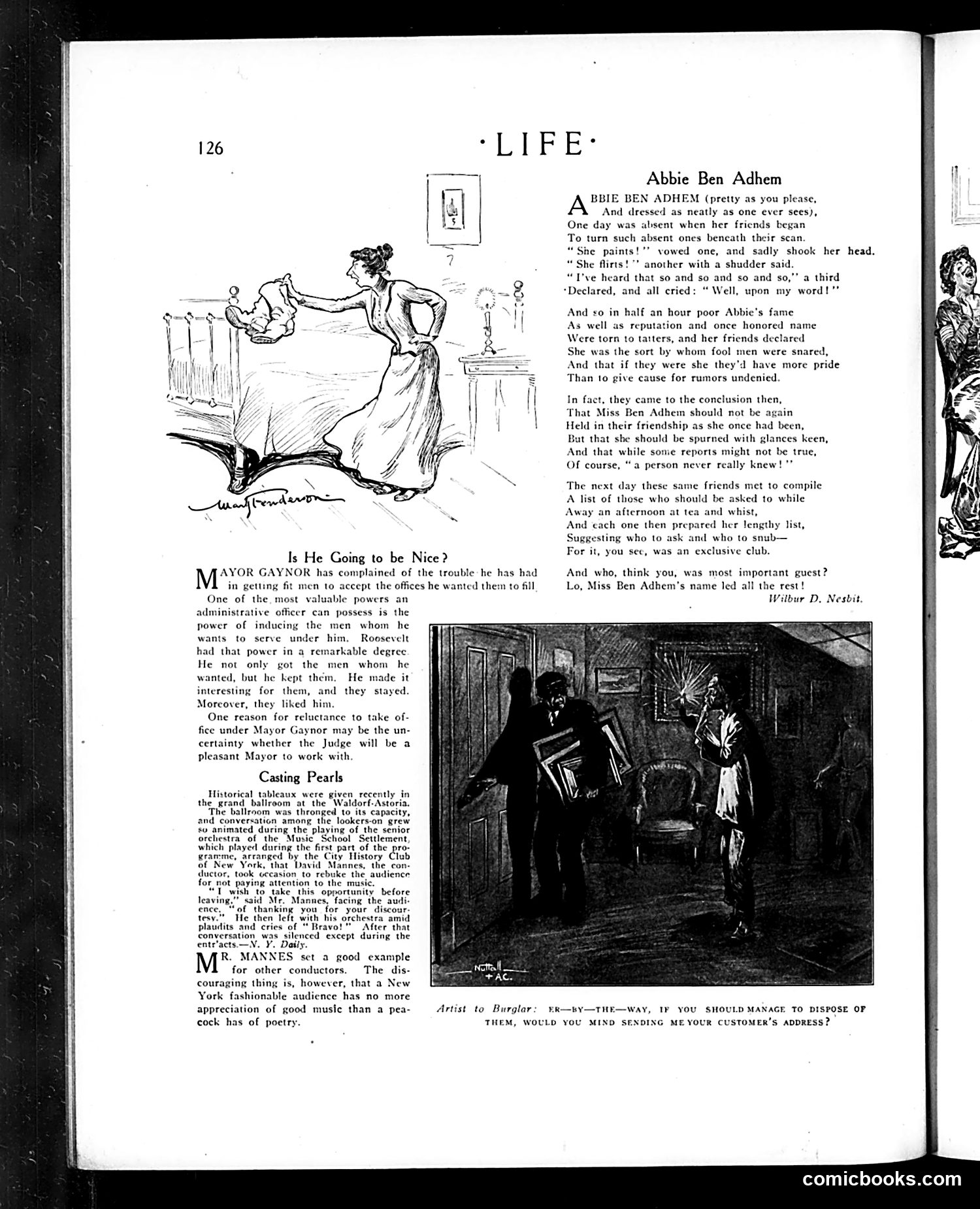
This page contains two distinct satirical pieces: **"Abbie Ben Adhem"** (poem by Wilbur D. Nesbit): A narrative poem mocking social hypocrisy and clique behavior. When a woman is absent from friends' gathering, they gossip viciously about her, spreading rumors about her character. Yet when compiling their exclusive guest list for a tea party, Abbie's name "led all the rest"—revealing that social status matters more than the moral judgments they'd just made. The satire targets women's social circles for superficiality and two-faced behavior. **"Is He Going to be Nice?"**: Commentary on Mayor Gaynor's difficulty finding qualified people to fill city offices. It compares him unfavorably to Theodore Roosevelt, who possessed the "power of inducing men" to serve and kept them satisfied. The piece suggests Gaynor's reluctance to fill positions may stem from uncertainty whether he'll be a pleasant person to work under—a subtle dig at his personality. A small cartoon captioned "Casting Pearls" depicts an artist offering a burglar his client's address, satirizing both the artist's commercial desperation and society's indifference to art.
📄 Transcribed text from this page (OCR, searchable)
Machine-transcribed from the original scan — historical spelling and the odd misread are preserved.
“LIFE: Is He Going to be Nice? YOR GAYNOR has complained of the trouble he has had in getting fit men to accept the offices he wanted them to fill *Declared, and all crie: One of the most valuable powers an Abbie Ben Adhem BBIE BEN ADHEM (pretty as you please, And dressed as neatly as one ever sees), One day was absent when her fricnds began To turn such absent ones beneath their scan. “She paints!’’ vowed one, and sadly shook her “She flirts!” another with a shudder said I've heard that so and so and so and so,’’ a third Well, upon my word!"* And so in half an hour poor Abbie’s fame As well as reputation and once honored name Were torn to tatters, and her friends declared She was the sort by whom fool men were snared, And that if they were she they’d have more pride Than to give cause for rumors undenied. In fact, they came to the conclusion then, That Miss Ben Adhem should not be again Held in their friendship as she once had been, ut that she should be spurned with glances keen, And that while some reports might not be true, Of course, “a person never really knew! "? The next day these same friends met to compile A list of these who should be asked to while Away an afternoon at tea and whist, And cach one then prepared her lengthy list, Suggesting who to ask and who to snub— For it, you sec, was an exclusive club. And who, think you, was most important guest? Lo, Miss Ben Adhem’s name led all the rest! Wilbur D. Nesbit. administrative officer can possess is the power of inducing the men whom he wants to serve under him, Roosevelt had that power in a remarkable degree He not only got the men whom he wanted, but he kept them, He made it interesting for them, and they stayed. Morcover, they liked him. One reason for reluctance to take of- fice under Mayor Gaynor may be the un- certainty whether the Judge will be a pleasant Mayor to work with Casting Pearls Historical tableaux were given recently in the grand ballroom at the Waldorf-Astoria. The ballroom was thronged to its capacity, and conversation among the lookers-on grew so animated during the playing of the senior orchestra of the Music School Settlement which played during the first part of the pro: gramme, arranged by the City History Club of New’ York, that David Mannes, the con- ductor, took occasion to rebuke the audience for not paying attention to the music. “T wish to take this opportunity before "said Mr. Mannes, facing the audi- of thanking you for your discour- He then left with his orchestra amid plaudits and cries of “ Bravo!" conversation was silenced except dur entr'acts.—V. Y. Daily. R. MA set_a good example for other conductors. The dis- couraging thing is, however, that a New York fashionable audience has no more appreciation of good muste than a pea- cock has of poetry. Artist to Burglar: ¥k—wy—THE—Way, IF YOU SHOULD MANAGE TO DISPOSE OF THEM, WOULD YOU MIND SENDING ME YOUR CUSTOMER'S ADDRESS? comicbooks.com