
Life, 1910-01-20 · page 22 of 36
Life — January 20, 1910 — page 22: what you’re looking at
What you’re looking at
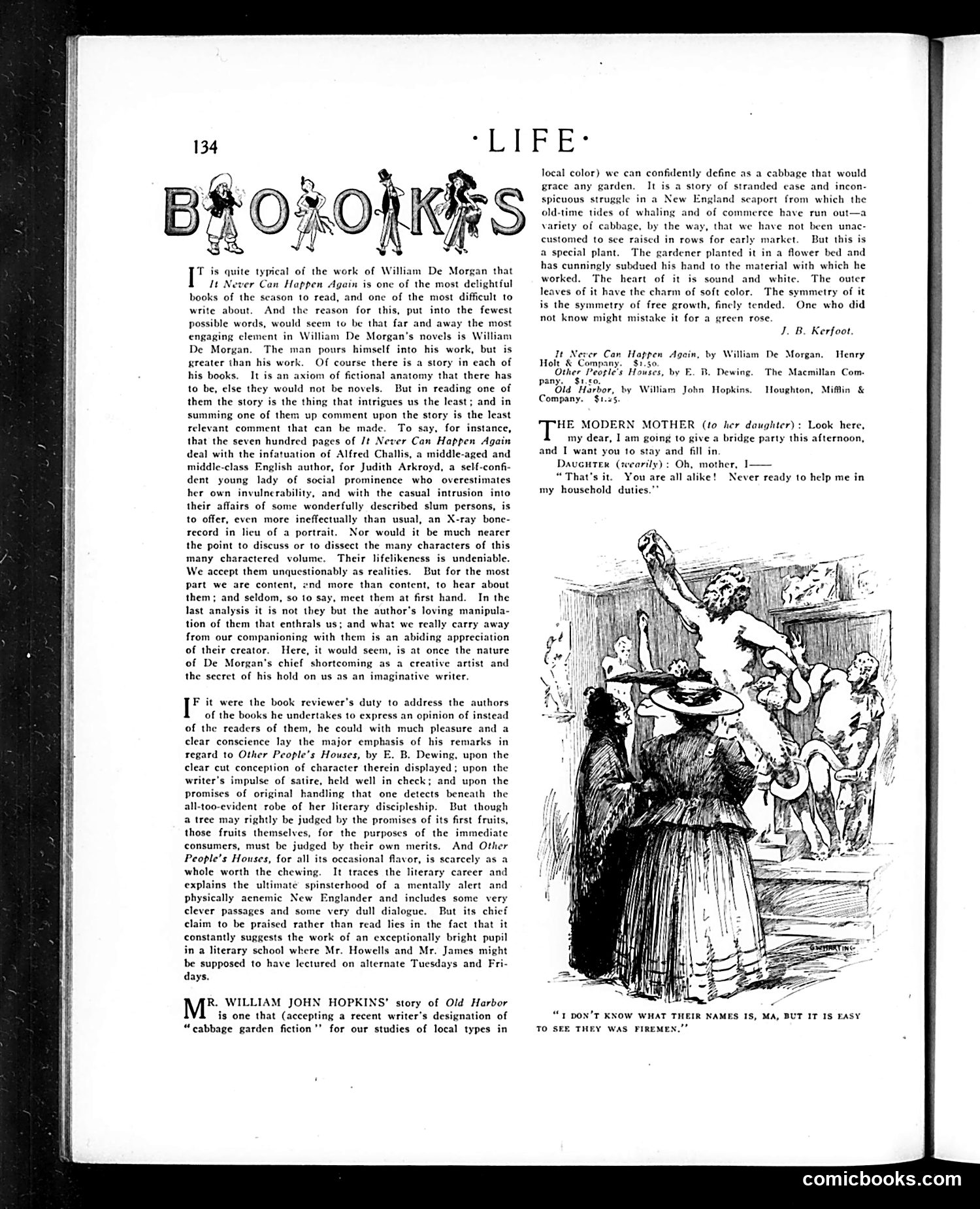
This is a **book review section** discussing three recent novels. The page contains one illustration depicting a domestic scene—likely from one of the reviewed books. **The main content** critiques: 1. **"It Never Can Happen Again"** by William De Morgan—praised primarily for De Morgan's personality and prose style rather than plot. The reviewer notes the actual story (about a middle-aged author's infatuation) matters less than the author's engaging narrative voice. 2. **"Other People's Houses"** by E.B. Dewing—a mixed review of a novel about a "mentally alert and physically anemic New Englander." The reviewer suggests it shows promise but lacks merit on its own terms, comparing it unfavorably to works by Howells and James. 3. **"Old Harbor"** by William John Hopkins—described as "cabbage garden fiction" (local color realism), praised as a worthy example of the genre depicting "stranded case and inconspicuous struggle in New England." The **illustration** shows what appears to be a domestic interior scene, likely supporting one of these narratives. The quote beneath reads: "I DON'T KNOW WHAT THEIR NAMES IS, MA, BUT IT IS EASY TO SEE THEY WAS FIREMEN."
📄 Transcribed text from this page (OCR, searchable)
Machine-transcribed from the original scan — historical spelling and the odd misread are preserved.
*LIP.E° oni vN T is quite typical of the work of William De Morgan that It Never Can Happen Again is one of the most delightful books of the scason to read, and one of the most difficult to write about. And the reason for this, put into the fewest possible words, would scem to be that far and away the most engaging clement in William De Morgan's novels is William De Morgan. The man pours himself into his work, but is greater than his work. Of course there is a story in each of his books. It is an axiom of fictional anatomy that there has to be, else they would not be novels. But in reading one of them the story is the thing that intrigues us the least; and in summing one of them up comment upon the story is the least relevant comment that can be made. To say, for instance, that the seven hundred pages of Jt Never Can Happen Again deal with the infatuation of Alfred Challis, a middle-aged and middle-class English author, for Judith Arkroyd, a self-confi- dent young lady of social prominence who overestimates her own invulnerability, and with the casual intrusion into their affairs of some wonderfully described slum persons, is to offer, even more ineffectually than usual, an X-ray bone- record in licu of a portrait. Nor would it be much nearer the point to discuss or to dissect the many characters of this many charactered volume. Their lifelikeness is undeniable. We accept them unquestionably as realities. But for the most part we are content, end more than content, to hear about them; and seldom, so to say, meet them at first hand. In the last analysis it is not they but the author's loving manipula- tion of them that enthrals us; and what we really carry away from our companioning with them is an abiding appreciation of their creator. Here, it would seem, is at once the nature of De Morgan's chief shortcoming as a creative artist and the secret of his hold on us as an imaginative writer. F it were the book reviewer's duty to address the authors of the books he undertakes to express an opinion of instead of the readers of them, he could with much pleasure and a clear conscience lay the major emphasis of his remarks in regard to Other People’s Houses, by E. B. Dewing, upon the clear cut conception of character therein displayed; upon the writer's impulse of satire, held well in check; and upon the Promises of original handling that one detects beneath the all-too-evident robe of her literary discipleship. But though a tree may rightly be judged by the promises of its first fruits, those fruits themselves, for the purposes of the immediate consumers, must be judged by their own merits. And Other People’s Houses, for all its occasional flavor, is scarcely as a whole worth the chewing. It traces the literary career and explains the ultimate spinsterhood of a mentaily alert and physically anemic New Englander and includes some very clever passages and some very dull dialogue. But its chief claim to be praised rather than read lies in the fact that it constantly suggests the work of an exceptionally bright pupil in a literary school where Mr. Howells and Mr. James might be supposed to have lectured on alternate Tuesdays and Fri- days. R. WILLIAM JOHN HOPKINS’ story of Old Harbor is one that (accepting a recent writer's designation of “cabbage garden fiction’ for our studies of local types in local color) we can confidently define as a cabbage that would grace any garden. It is a story of stranded case and incon- spicuous struggle in a New England seaport from which the old-time tides of whaling and of commerce have run out—a variety of cabbage, by the that we have not been unac- customed to sce raised in rows for carly market. But this i a special plant. The gardener planted it in a flower bed and has cunningly subdued his hand to the material with which he worked. The heart of it is sound and white. The outer leaves of it have the charm of soft color. The symmetry of it is the symmetry of free growth, fincly tended. One who did not know might mistake it for a green rose. J. B. Kerfoot. It Never Can Happen Again, by William De Morgan, Henry Holt & Company. $1.50. Other Peogle's Houses, by E. 1, Dewing. The Macmillan Com. pany. Sr.co, Old “Harbor, by William John Hopkins. Houghton, Mifflin & Company. $1.45. HE MODERN MOTHER (to her daughter): Look here, my dear, I am going to give a bridge party this afternoon, and I want you to stay and fill in Davcuter (searily) ; Oh, mother, I— “That's it. You are all alike! Never ready to help me in my houschold duties.” comicbooks.com