
Life, 1910-01-20 · page 8 of 36
Life — January 20, 1910 — page 8: what you’re looking at
What you’re looking at
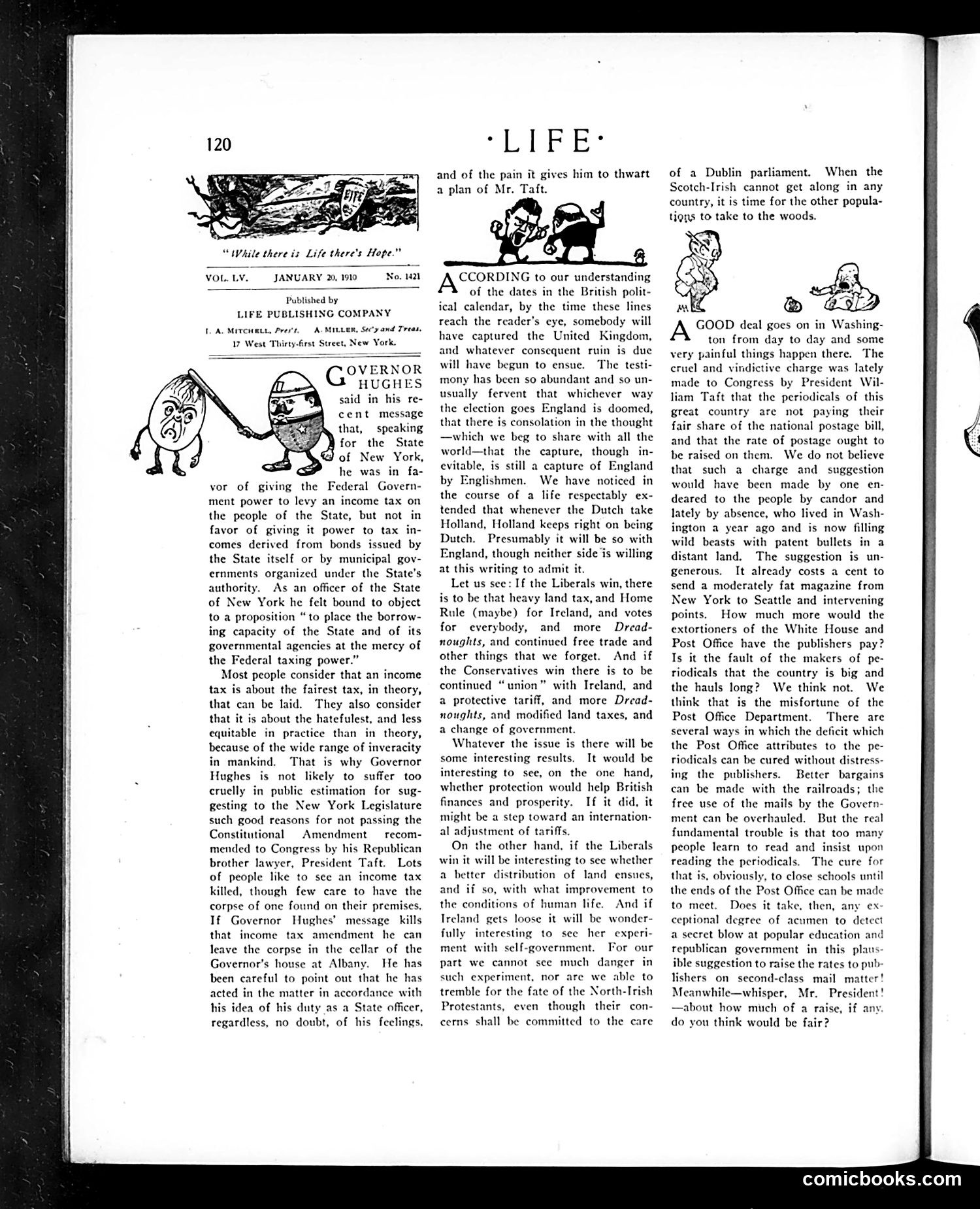
The top cartoon depicts "Governor Hughes" (Charles Evans Hughes, New York's governor) in a tug-of-war with a figure labeled "State of New York," illustrating the political tension over income tax authority. The satire criticizes Hughes's proposal to give the Federal Government power to levy income taxes on state residents—a controversial expansion of federal power that the magazine opposed on states' rights grounds. The accompanying article discusses British and Irish politics, tariff debates, and postal service inefficiencies. The cartoons and text together satirize government overreach and advocate for maintaining state autonomy against federal expansion, reflecting early-1900s Progressive Era debates about federalism.
📄 Transcribed text from this page (OCR, searchable)
Machine-transcribed from the original scan — historical spelling and the odd misread are preserved.
“While there is Life there's Hope.” VOL. LY. No. 421 JANUARY 20, 1910 Published by LIFE PUBLISHING COMPANY TAL MITCHRLL, Pret AO MILLER, Stc‘y and Treas, V7 West Thirty-frst few York. OVERNOR HUGHES said in his re- cent message that, speaking for the State of New York, he was in fa- vor of giving the Federal Govern- ment power to levy an income tax on the people of the State, but not in favor of giving it power to tax in- comes derived from bonds issued by the State itself or by municipal gov- ernments organized under the State's authority. As an officer of the State of New York he felt bound to object to a proposition “to place the borrow- ing capacity of the State and of its governmental agencies at the mercy of the Federal taxing power.” Most people consider that an income tax is about the fairest tax, in theory, that can be laid. They also consider that it is about the hatefulest, and less equitable in practice than in theory, because of the wide range of inveracity in mankind. That is why Governor Hughes is not likely to suffer too cruelly in public estimation for sug- gesting to the New York Legislature such good reasons for not passing the Constitutional Amendment — recom- mended to Congress by his Republican brother lawyer, President Taft. Lots of people like to see an income tax killed, though few care to have the corpse of one found on their premises, If Governor Hughes’ message kil that income tax amendment he can leave the corpse in the cellar of the Goyernor’s house at Albany. He has been careful to point out that he has acted in the matter in accordance with his idea of his duty as a State officer, regardless, no doubt, of his feelings, “LIFE: and of the pain it gives him to thwart a plan of Mr. Taft. CCORDING to our understanding of the dates in the British polit- ical calendar, by the time these lines reach the reader's eye, somebody will have captured the United Kingdom, and whatever consequent ruin is due will have begun to ensue. The testi- mony has been so abundant and so un- usually fervent that whichever way the election goes England is doomed, that there is consolation in the thought —which we beg to share with all the world—that the capture, though in- evitable, is still a capture of England by Englishmen. We have noticed in the course of a life respectably ex- tended that whenever the Dutch take Holland, Holland keeps right on being Dutch. Presumably it will be so with England, though neither side is willing at this writing to admit it. Let us see: If the Liberals win, there is to be that heavy land tax, and Home Rule (maybe) for Ireland, and votes for everybody, and more Dread- noughts, and continued free trade and other things that we forget. And if the Conservatives win there is to be continued “union” with Ireland, and a protective tariff, and more Dread- noughts, and modified land taxes, and a change of government. Whatever the issue is there will be some interesting results. It would be interesting to see, on the one hand, whether protection would help British finances and prosperity. If it did, it might be a step toward an internation- al adjustment of tariffs. On the other hand, if the Liberals win it will be interesting to see whether a better distribution of land ensues, and if so, with what improvement to the conditions of human life. And if Ireland gets loose it will be wonder- fully interesting to see her experi- ment with self-government. For our part we cannot sce much danger in such experiment, nor are we able to tremble for the fate of the North-Trish Protestants, even though their con- cerns shall be committed to the care of a Dublin parliament. When the Scotch-Irish cannot get along in any country, it is time for the other popula- tions to take to the woods. AN (63) GOOD deal goes on in Washing- ton from day to day and some very painful things happen there. The cruel and vindictive charge was lately made to Congress by President Wil- liam Taft that the periodicals of this great country are not paying their fair share of the national postage bill, and that the rate of postage ought to be raised on them. We do not believe that such a charge and suggestion would have been made by one en- deared to the people by candor and lately by absence, who lived in Wash- ington a year ago and is now filling wild beasts with patent bullets in a distant land. The suggestion is un- generous. It already costs a cent to send a moderately fat magazine from New York to Seattle and intervening points. How much more would the extortioners of the White House and Post Office have the publishers pay? Is it the fault of the makers of pe- riodicals that the country is big and the hauls long? We think not. We think that is the misfortune of the Post Office Department. There are several ways in which the deficit which the Post Office attributes to the pe- riodicals can be cured without distress- ing the publishers. Better bargains can be made with the railroads; the free use of the mails by the Govern- ment can be overhauled. But the real fundamental trouble is that too many people learn to read and insist upon reading the periodicals. The cure for that is, obviously, to close schools until the ends of the Post Office can be made to meet. Does it take. then, any ex- ceptional degree of acumen to detect a secret blow at popular education and republican government in this plaus ible suggestion to raise the rates to pub lishers on second-class mail matter! Meanwhile—whisper, Mr. President! —about how mich of a raise, if any. do you think would be fair? comicbooks.com