
Life, 1910-01-20 · page 12 of 36
Life — January 20, 1910 — page 12: what you’re looking at
What you’re looking at
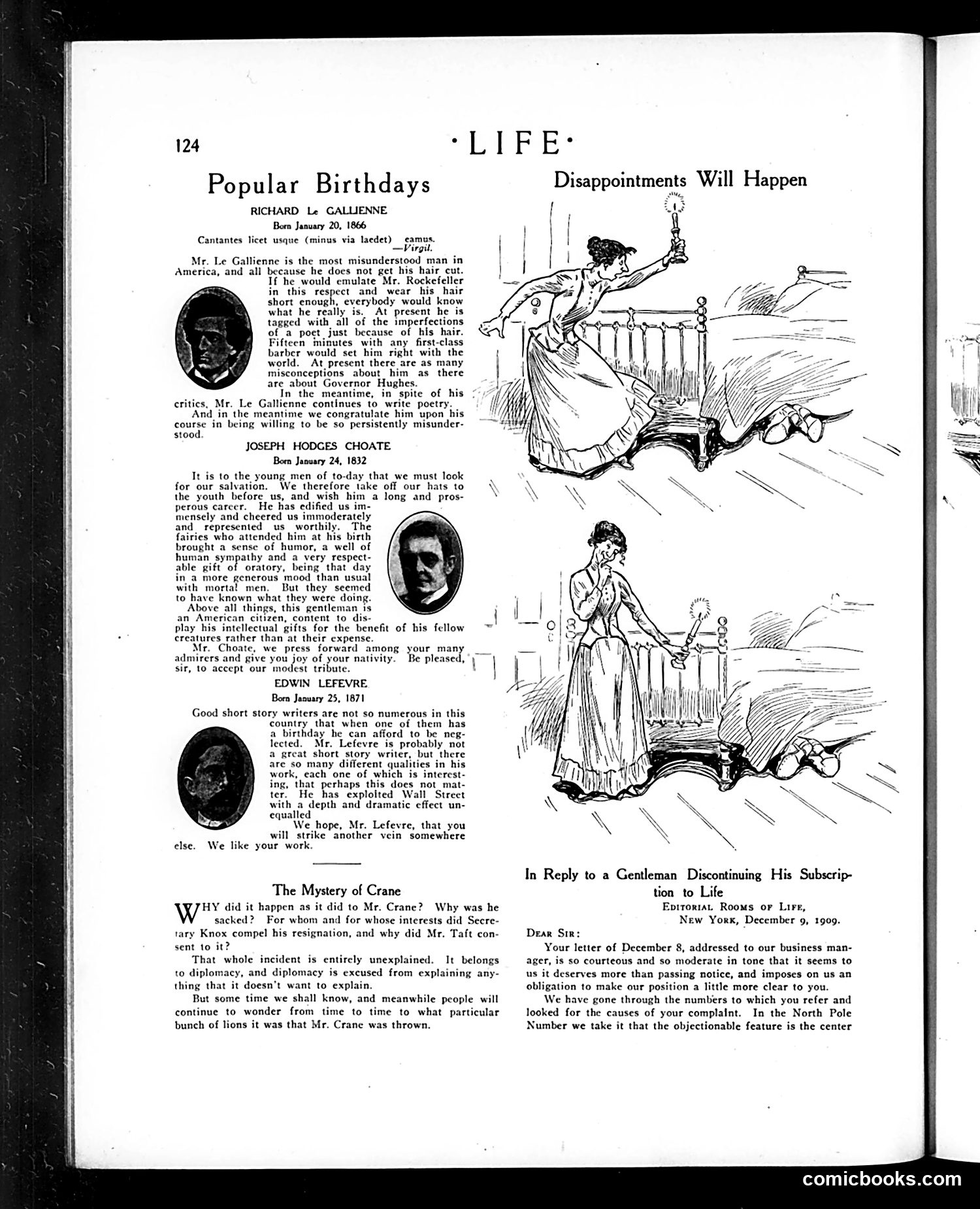
This page contains **"Popular Birthdays"** featuring three biographical sketches with portrait photographs, and **"Disappointments Will Happen,"** an illustrated cartoon. The cartoon depicts a woman at a railing, apparently experiencing romantic disappointment—a man appears to be leaving or departing. The illustration's title and the woman's dramatic gesture suggest the satire concerns failed romantic expectations. The biographical section celebrates three men: Richard Le Gallienne (writer), Joseph Hodges Choate (likely a public figure), and Edwin Lefèvre (writer). The text praises their accomplishments in literature and public service. Below appears an editorial response addressing subscription complaints about a feature called "The Mystery of Crane," suggesting reader engagement with serialized magazine content was active and sometimes contentious.
📄 Transcribed text from this page (OCR, searchable)
Machine-transcribed from the original scan — historical spelling and the odd misread are preserved.
124 *LIFE: Popular Birthdays RICHARD Le GALLIENNE Born January 20, 1866 Cantantes licet usque (minus via laedet) camus. —Virgil. Mr. Le Gallienne is the most misunderstood man in America, and all because he does not get his hair cut. If he would emulate Mr. Rockefeller in this respect and wear his hair short enough, everybody would know what he really is.” At present he is tagged with all of the imperfections of a poct just because of his hair. Fifteen ininutes with any first-class barber would set him right with the world. At present there are as many misconceptions about him as there are about Governor Hughe: In the meantime, ins critics, Mr. Le Gallienne continues to write poetry. And in the meantime we congratulate him upon his course in being willing to be so persistently misunder- stood JOSEPH HODGES CHOATE Born January 24, 1832 It is to the young men of to-day that we must look for our salvation. We therefore take off our hats to the youth before us, and wish him a long and pros- perous career. He has edified us im- mensely and cheered us immoderately represented us worthily. The who attended him at his birth brought a sense of humor, a well of human sympathy and a very respect- able gift of oratory, being that day in a more generous mood than usual with mortal men, But they seemed to have known what they were doing. Above all things, this gentleman is an American citizen, content to dis- play his intellectual gifts for the benefit of his fellow rather than at their expense. . Choate, we press forward among your many admirers and give you joy of your nai Be pleased, sir, to accept our modest tribute. \ EDWIN LEFEVRE Born Jaouary 25, 1871 Good short story writers are not so numerous in this country that when one of them has a birthday he can afford to be neg- lected. Mr. Lefevre is probably not a great short story writer, but there are so many different qualities in his work, each one of which is interest- ing, that perhaps this does not_mat- ter. He has exploited Wall Street with a depth and dramatic effect un- equalled We hope, Mr. Lefevre, that you will strike another vein somewhere else. We like your work The Mystery of Crane HY did it happen as it did to Mr. Crane? Why was he sacked? For whom and for whose interests did Secre- tary Knox compel his resignation, and why did Mr. Taft con- sent to it? That whole incident is entirely unexplained. It belongs to diplomacy, and diplomacy is excused from explaining any- thing that it doesn’t want to explain. But some time we shall know, and meanwhile people will continue to wonder from time to time to what particular bunch of lions it was that Mr. Crane was thrown. Disappointments Will Happen In Reply to a Gentleman Discontinuing His Subscrip- tion to Life Epitoriat. Rooms or Lire, New Yorx, December 9, 1909. Dear Sir: Your letter of December 8, addressed to our business man- ager, is so courteous and so moderate in tone that it seems to us it deserves more than passing notice, and imposes on us an obligation to make our position a little more clear to you. We have gone through the numbers to which you refer and looked for the causes of your complaint. In the North Pole Number we take it that the objectionable feature is the center comicbooks.com