
Life, 1910-01-20 · page 9 of 36
Life — January 20, 1910 — page 9: what you’re looking at
What you’re looking at
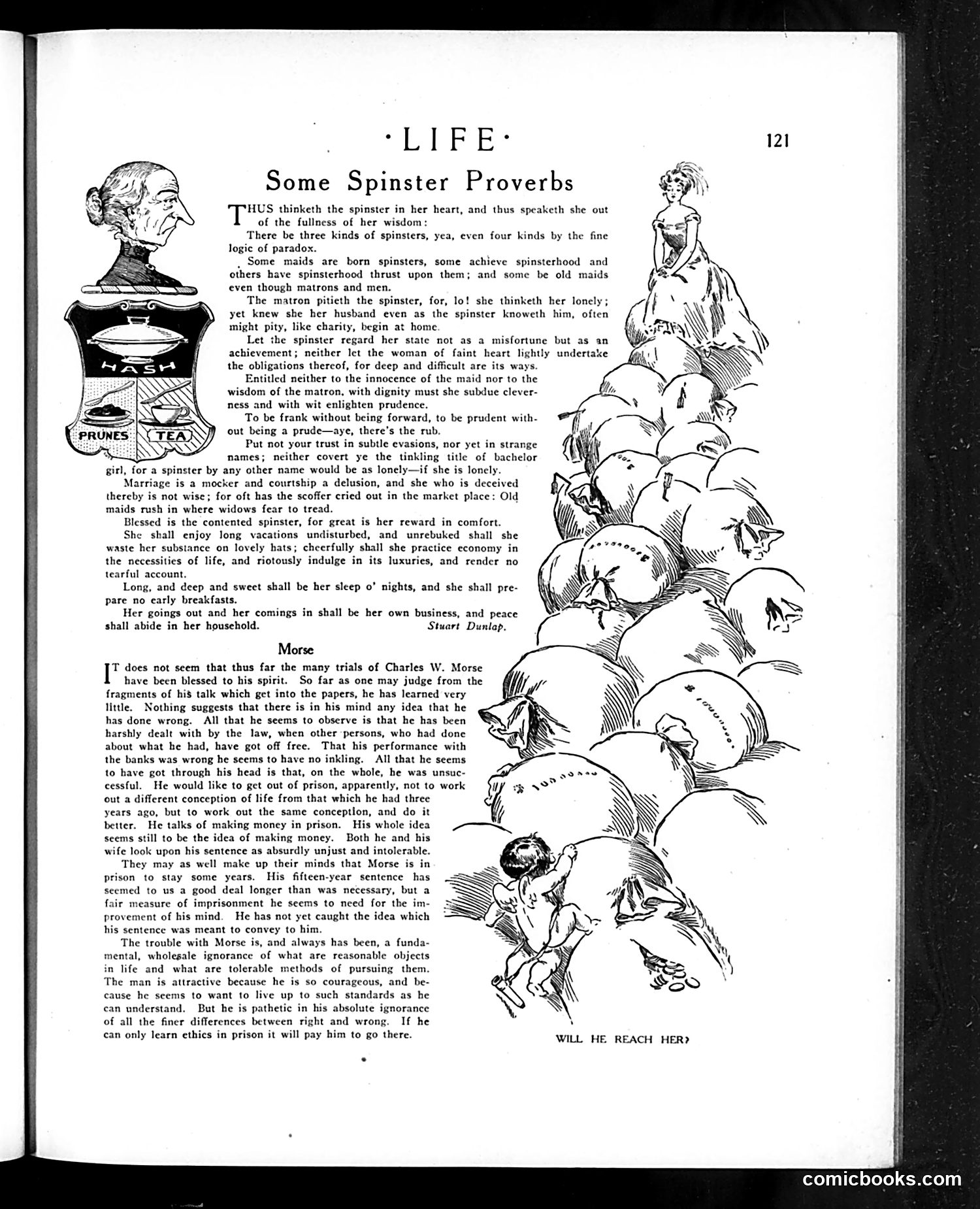
This page contains two distinct pieces: **"Some Spinster Proverbs"** (top left): A satirical essay mocking unmarried women, with a caricatured female head as decoration. The text ironically presents "wisdom" for spinsters, sarcastically suggesting they should accept their unmarried status with dignity and find contentment in solitude and modest work—reflecting late 19th/early 20th-century dismissive attitudes toward single women. **"Morse"** (bottom): A critique of Charles W. Morse, a businessman apparently imprisoned for banking fraud. The article condemns Morse's apparent lack of remorse or understanding of his wrongdoing, suggesting his fundamental ignorance prevents rehabilitation. The accompanying illustration titled "WILL HE REACH HERE?" appears to show Morse struggling up a difficult slope, sarcastically questioning whether he can achieve moral improvement. Both pieces use satire to mock their subjects' perceived failings.
📄 Transcribed text from this page (OCR, searchable)
Machine-transcribed from the original scan — historical spelling and the odd misread are preserved.
“LIFE: Some Spinster Proverbs HUS thinketh the spinster in her heart, and thus speaketh she out of the fullness of her wisdom: There be three kinds of spinsters, yea, even four kinds by the fine logic of paradox. , Some maids are born spinsters, some achieve spinsterhood and others have spinsterhood thrust upon them; and some be old maids even though matrons and men. The matron piticth the spinster, for, lo! she thinketh her lonely; yet knew she her husband even as the spinster knoweth him, often might pity, like charity, begin at home Let the spinster regard her state not as a misfortune but as an achievement; neither let the woman of faint heart lightly undertake the obligations thercof, for deep and difficult are its ways. Entitled neither to the innocence of the maid nor to the wisdom of the matron, with dignity must she subdue clever- ness and with wit enlighten prudence. To be frank without being forward, to be prudent with- out being a prude—aye, there's the rub. Put not your trust in subtle evasions, nor yet in strange 3 J names; neither covert ye the tinkling title of bachelor girl, for a spinster by any other name would be as lonely—if she is lonely. Marriage is a mocker and courtship a delusion, and she who is deceived thereby is not wise; for oft has the scoffer cried out in the market place: Old maids rush in where widows fear to tread. Blessed is the contented spinster, for great is her reward in comfort. She shall enjoy long vacations undisturbed, and unrebuked shall she waste her substance on lovely hats; cheerfully shall she practice economy in the necessities of life, and riotously indulge in its luxuries, and render no tearful account. Long, and deep and sweet shall be her sleep o’ nights, and she shall pre- pare no carly breakfasts. Her goings out and her comings in shall be her own business, and peace shall abide in her household. Stuart Dunlap. Morse r does not scem that thus far the many trials of Charles W. Morse have been blessed to his spirit. So far as one may judge from the fragments of hi8 talk which get into the papers, he has learned very little. Nothing suggests that there is in his mind any idea that he has done wrong. All that he seems to observe is that he has been harshly dealt with by the law, when other ‘persons, who had done about what he had, have got off free. That his performance with the banks was wrong he seems to have no inkling. All that he seems to have got through his head is that, on the whole, he was unsuc- cessful. He would like to get out of prison, apparently, not to work out a different conception of life from that which he had three years ago, but to work out the same conception, and do it better. He talks of making money in prison. His whole idea seems still to be the idea of making money. Both he and his wife look upon his sentence as absurdly unjust and intolerable. They may as well make up their minds that Morse is in prison to stay some years. His fifteen-year sentence has seemed to us a good deal longer than was necessary, but a fair measure of imprisonment he seems to need for the im- provement of his mind. He has not yet caught the idea which his sentence was meant to convey to him. The trouble with Morse is, and always has been, a funda- mental, wholesale ignorance of what are reasonable objects in life and what are tolerable methods of pursuing them. The man is attractive because he is so courageous, and be- cause he seems to want to live up to such standards as he can understand, But he is pathetic in his absolute ignorance of all the finer differences between right and wrong. If he can only learn ethics in prison it will pay him to go there. WILL HE REACH HER? comicbooks.com