
A complete issue · 52 pages · 1909
Life — April 1, 1909
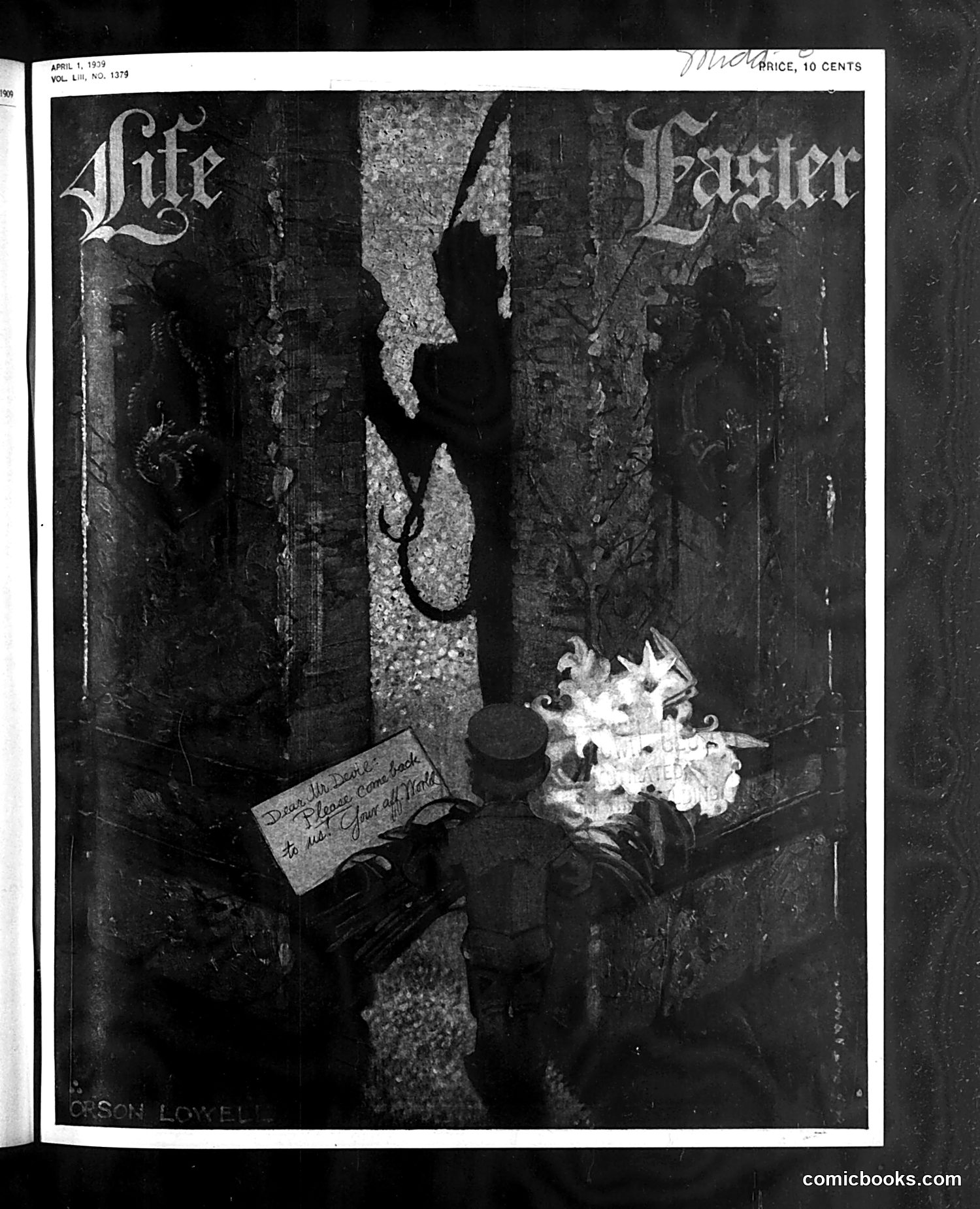
This appears to be a Life magazine cover from April 1, 1929, themed around Easter. The image shows a darkly humorous still-life composition featuring a noose, a top hat, flowers, and what appears to be a note or card—all arranged in a coffin or box-like setting. The stark visual juxtaposition of Easter symbols (flowers, formal attire) with symbols of death (noose, coffin) suggests dark satire about societal troubles. Given the 1929 date, this likely references the recent stock market crash (October 1929) or broader economic anxieties of the late 1920s, using Easter's themes of death and resurrection ironically to comment on contemporary despair. The composition is credited to "Ceslaw Lowell" at bottom.
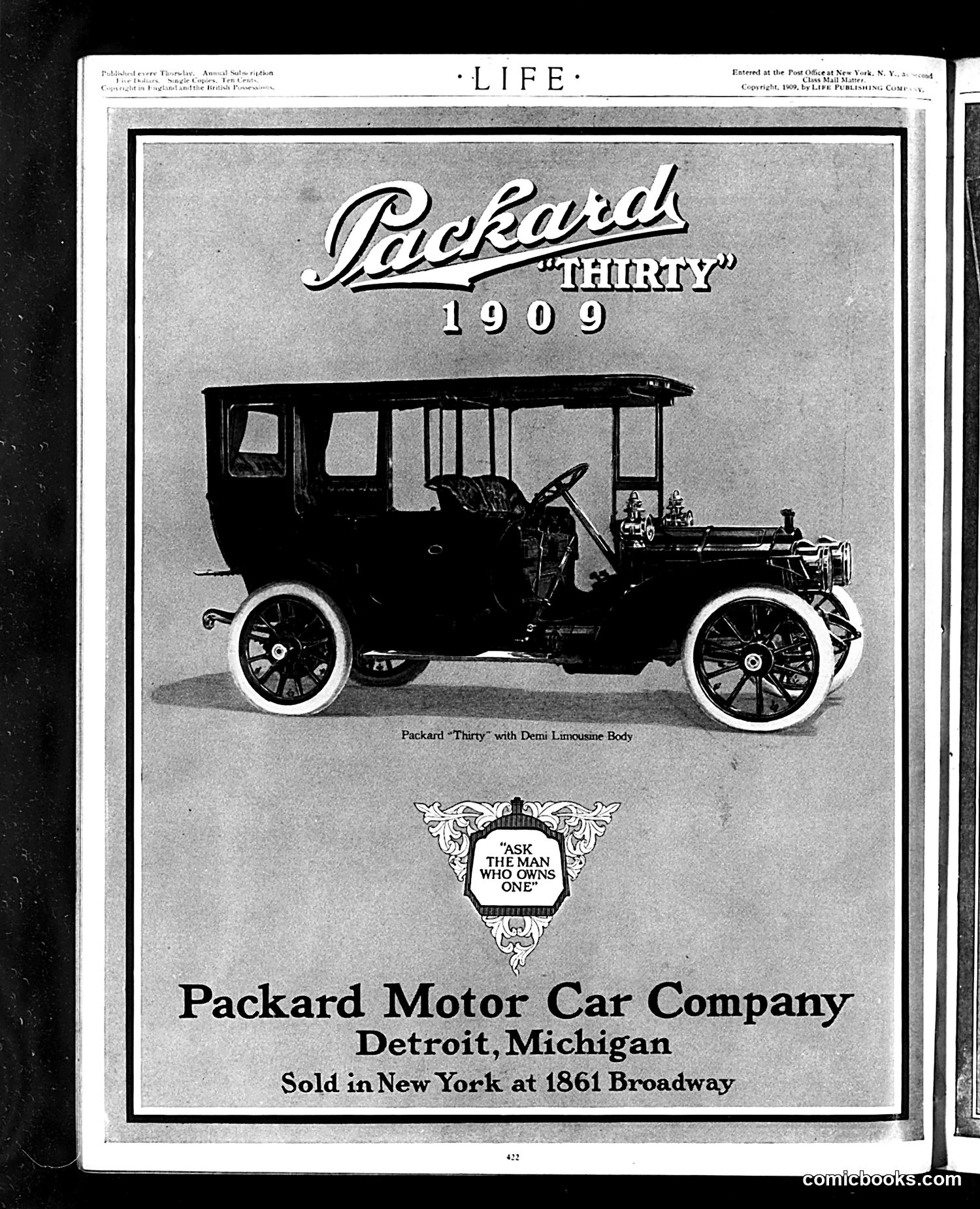
This page is **primarily an advertisement**, not satirical content. It promotes the Packard "Thirty" automobile from 1909, manufactured by the Packard Motor Car Company in Detroit, Michigan. The ad features a side-view illustration of the vehicle with a demi-limousine body—a closed passenger compartment with an open driver's area. The car displays typical early-1900s design: spoke wheels, an external engine, and an enclosed cabin for passengers. The tagline "Ask the Man Who Owns One" was Packard's actual marketing slogan, appealing to exclusivity and owner satisfaction rather than technical specifications. This suggests Packard positioned itself as a luxury brand for affluent buyers. The notation of New York sales at 1861 Broadway indicates the company's East Coast distribution network. There is no political or social satire evident on this page.
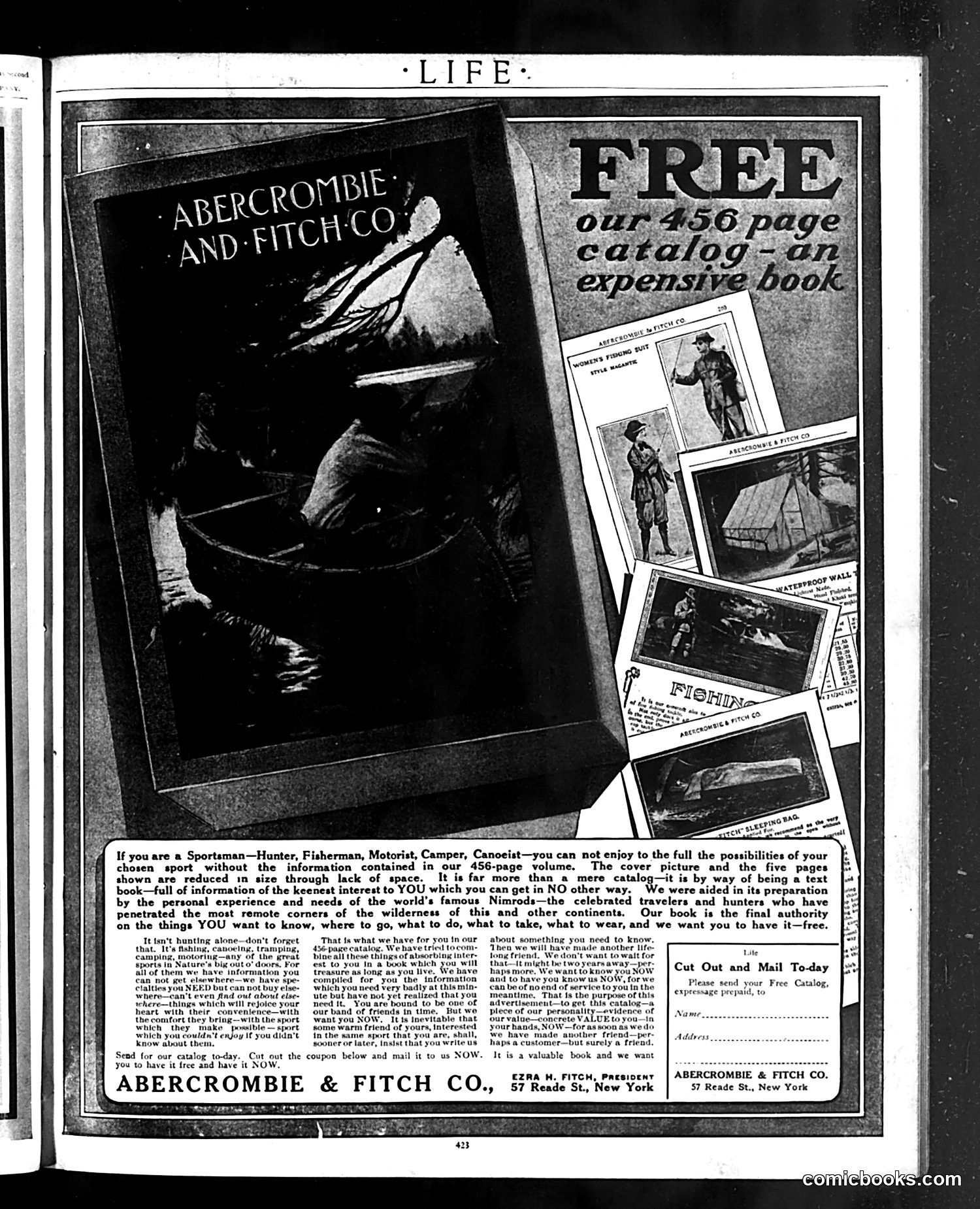
This page is primarily **advertising**, not editorial content or political satire. It's a full-page advertisement for Abercrombie & Fitch Co., a sporting goods retailer. The ad promotes a **free 456-page catalog** described as "an expensive book." The left side shows dramatic imagery of outdoor activities (hunting, fishing, camping), while the right displays sample catalog pages featuring clothing and equipment. The copy emphasizes the catalog's authority and comprehensiveness, claiming it's written by "Nimrods"—celebrated hunters and travelers—and serves as the ultimate guide for sportsmen. The ad positions the catalog as essential for anyone pursuing outdoor recreation, positioning A&F as the authoritative source for sporting goods and advice. The bottom includes a mail-in coupon for requesting the free catalog.
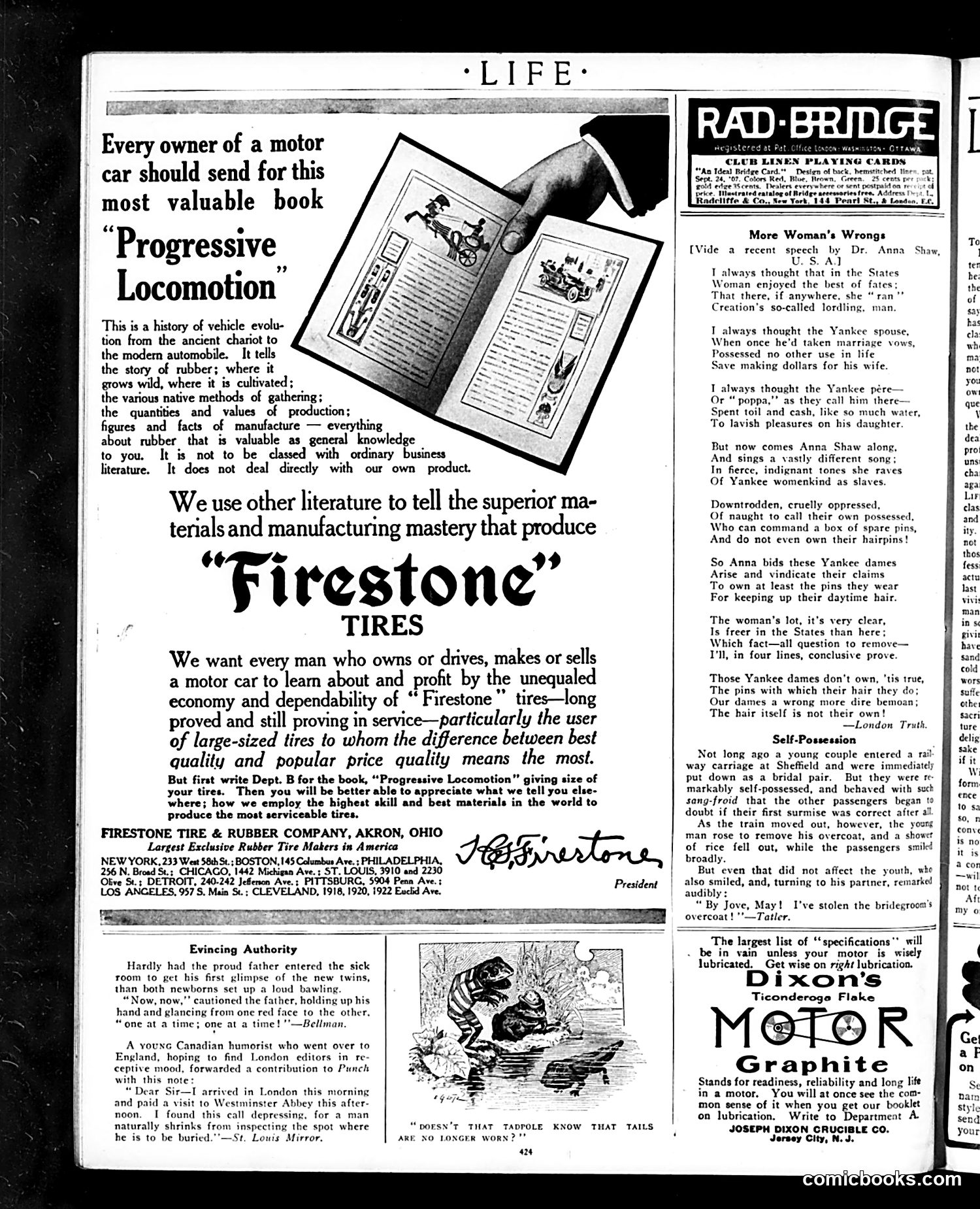
This page is primarily **advertising content** rather than political satire. The main advertisements are: 1. **Firestone Tires** - A major ad promoting their reliability and economy, targeting automobile owners 2. **Rad-Bridge** - A card game product advertised at top right 3. **Dixon's Motor Graphite** - A motor lubricant product The only actual editorial cartoon appears at bottom left, titled "Evicting Authority," depicting what appears to be a humorous domestic scene with a couple and their newborn twins. The accompanying text describes a Canadian anecdote about visiting Westminster Abbey. The page's "More Woman's Wrongs" column on the right contains satirical verse about American women's treatment and rights, but this is social commentary rather than political cartooning. Overall, this is a typical mixed editorial/advertising magazine page from the early automotive era.
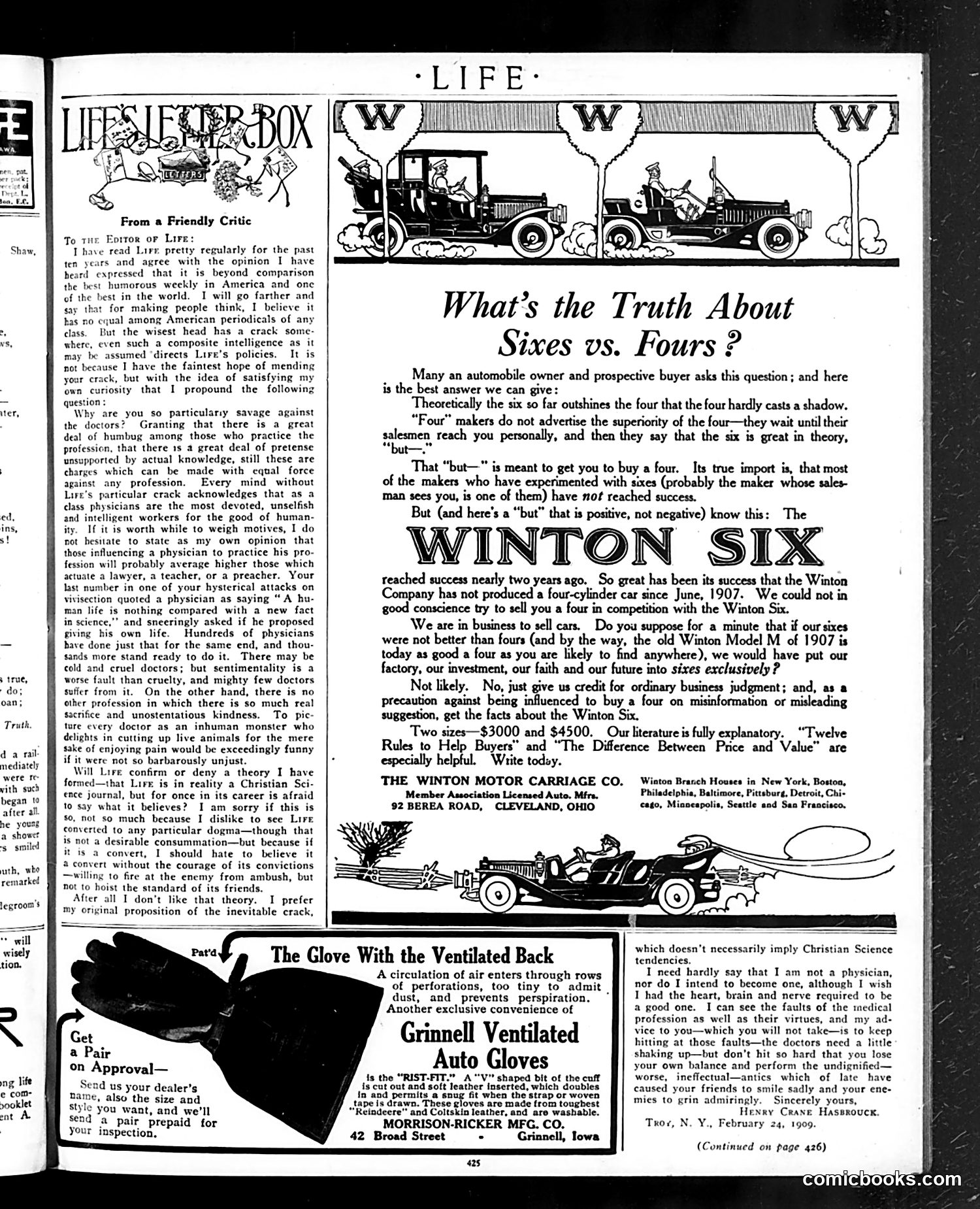
This page primarily contains **advertising and editorial content** rather than political satire. The main feature is an advertisement for **Winton Six automobiles**, responding to consumer questions about "Sixes vs. Fours." The ad argues that six-cylinder engines are superior to four-cylinder models, claiming the Winton Six has been so successful that the company hasn't produced a four-cylinder car since 1907. Secondary advertisements include **Grinnell Ventilated Auto Gloves** (featuring a hand illustration) and a "Get a Pair on Approval" promotion. The upper cartoons show early automobiles with passengers, likely illustrating the advertisement's messaging about vehicle types. The page date is **February 24, 1909**, contextualizing this as early automotive industry competition during the transition from hand-crank to self-starting vehicles.
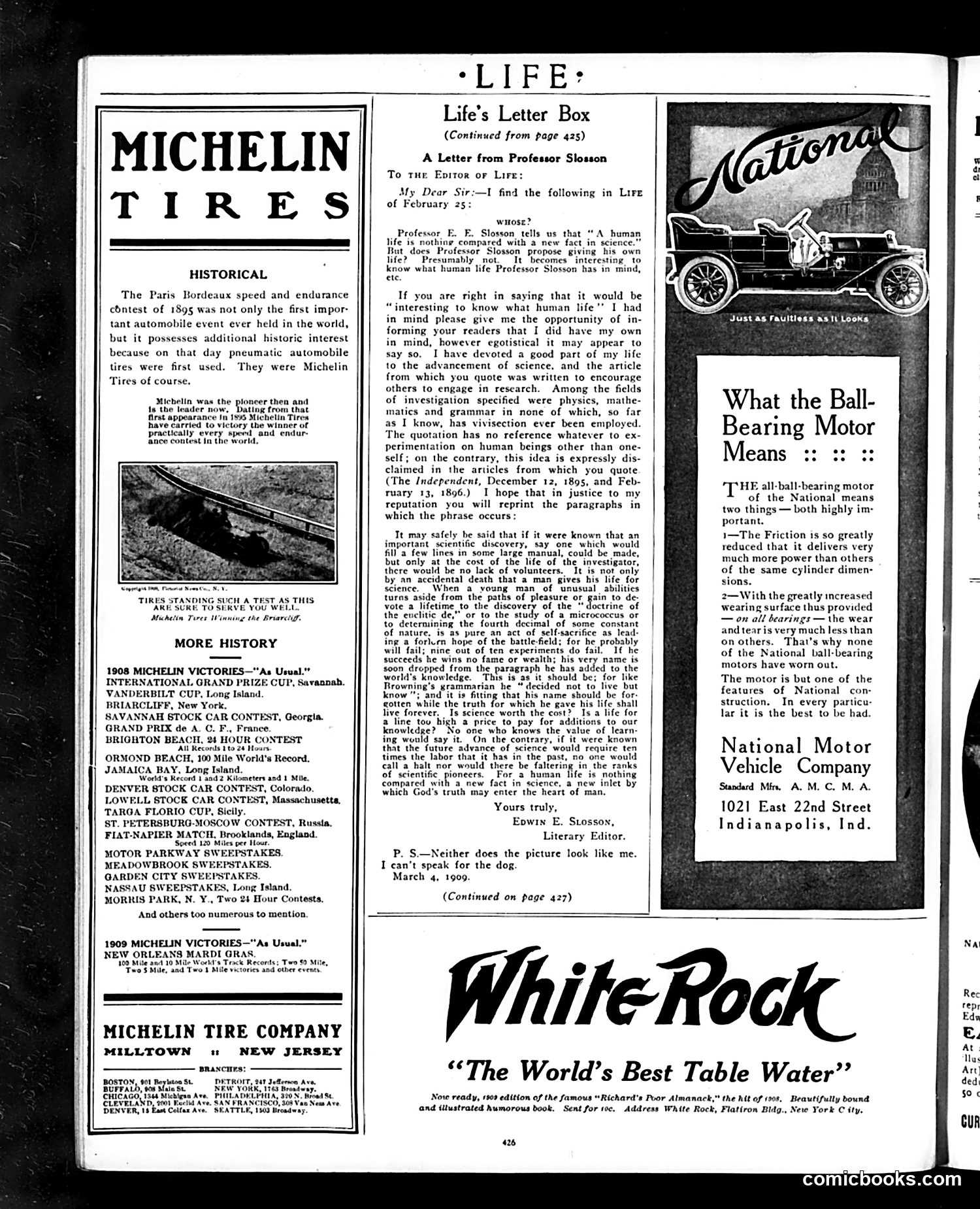
This page is primarily **advertising and commercial content** rather than political satire or editorial cartoons. The main elements are: 1. **Michelin Tires advertisement** (left): Emphasizes Michelin's racing victories and historical significance in automobile competitions, including the 1895 Paris-Bordeaux race. 2. **National Motor Vehicle Company advertisement** (right): Promotes their ball-bearing motor technology, claiming reduced friction and increased efficiency. 3. **White Rock water advertisement** (bottom): Markets "The World's Best Table Water." 4. **Letter to the editor** (center): Professor E.F. Slosson discusses scientific methodology and disputes claims about vivisection in earlier articles. The page reflects early 1900s American consumer culture focused on emerging automobile technology and patent innovations, with minimal satirical content.
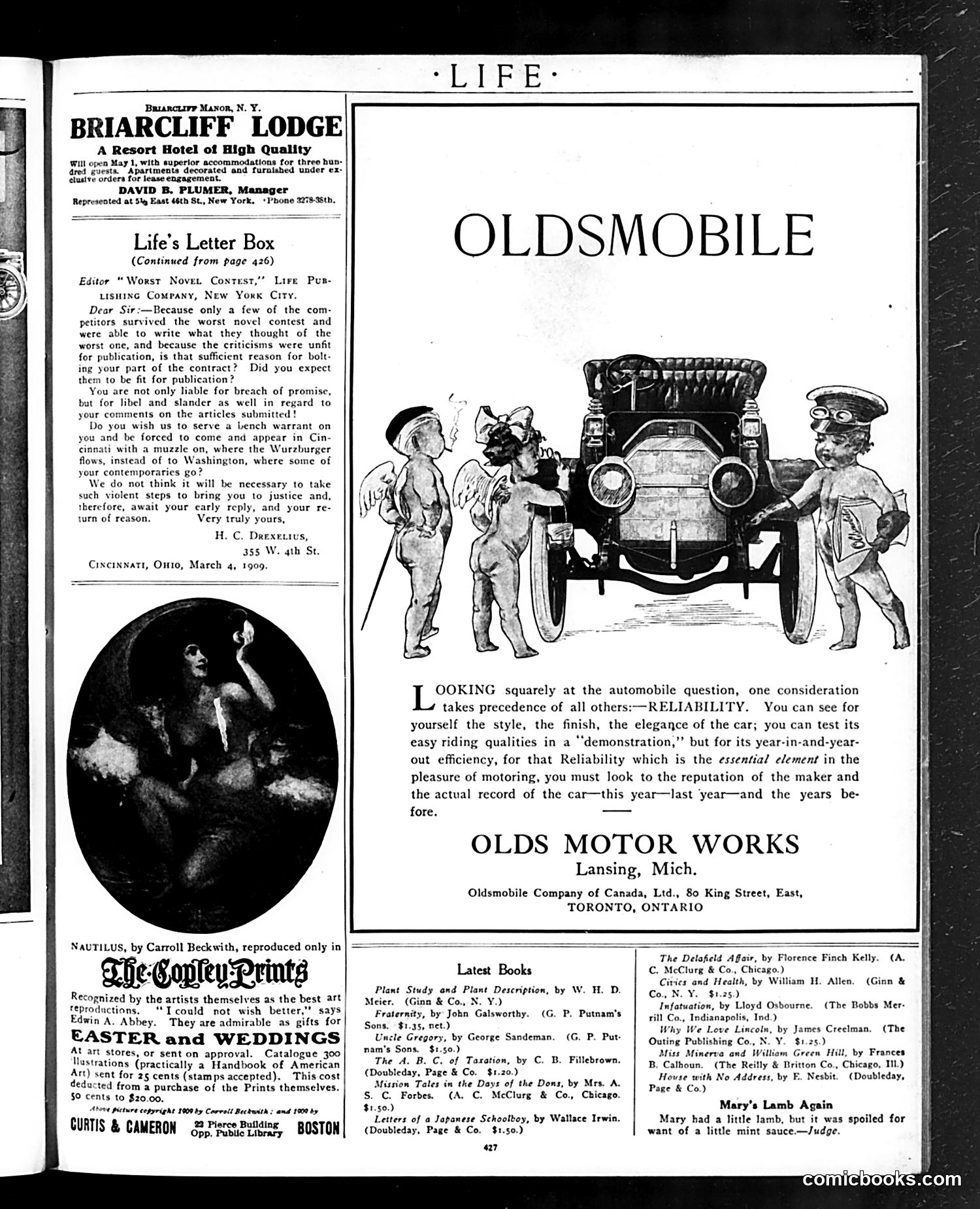
This page is primarily a full-page advertisement for Oldsmobile automobiles, published by Olds Motor Works in Lansing, Michigan. The illustration shows what appears to be anthropomorphized animals (possibly dogs or similar creatures) examining or posing with an early automobile, suggesting the novelty and curiosity the vehicle inspires. The advertisement's key message emphasizes "RELIABILITY" as the essential consideration when purchasing an automobile. The text argues that while style and finish matter, the car's actual performance record and the manufacturer's reputation are what truly determine value for buyers. The satire is gentle—depicting animals inspecting the car humorously emphasizes how remarkable automobiles were to contemporary observers. This reflects the early 1900s context when automobiles were still relatively novel technological marvels worth marvel-worthy attention.
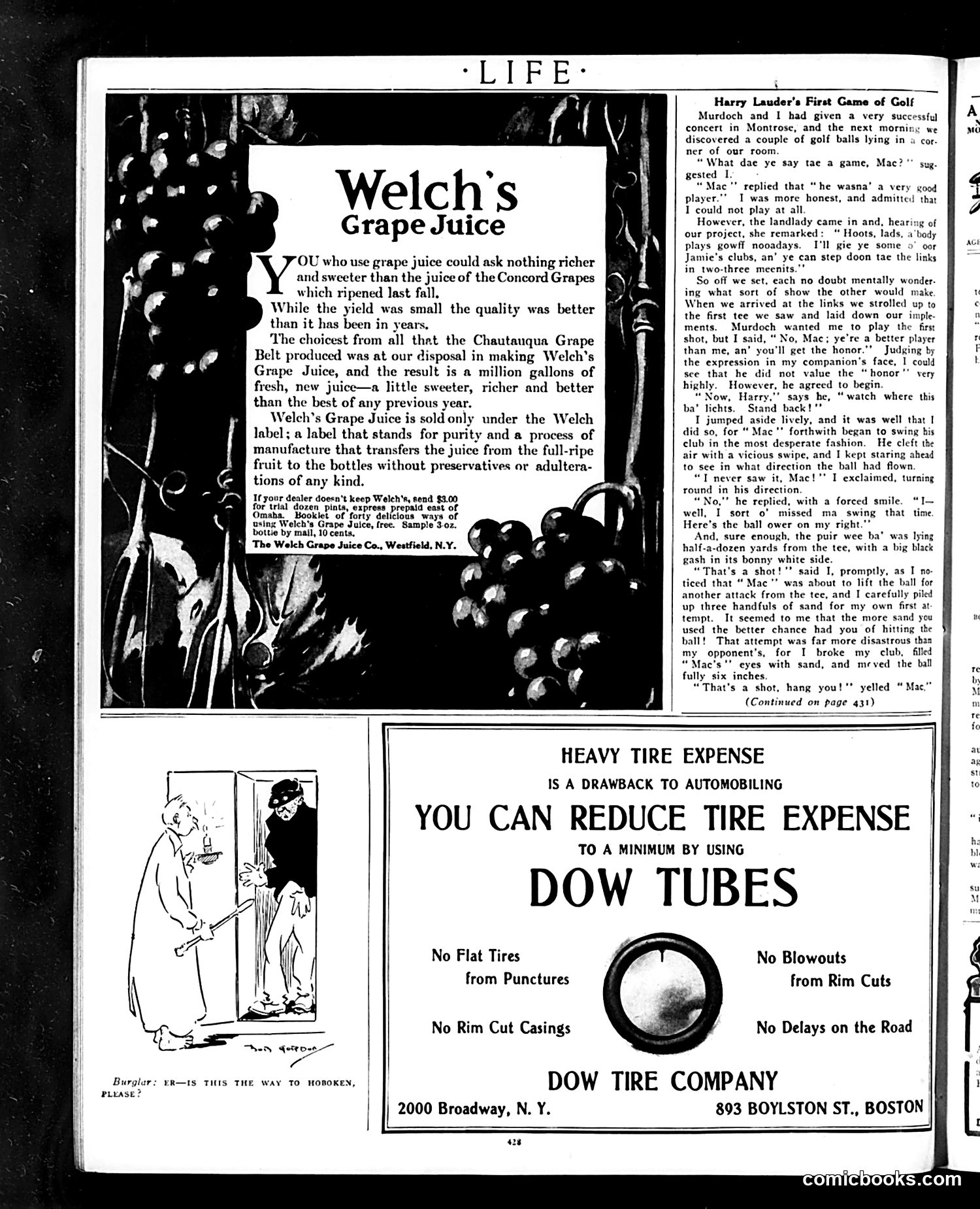
This page contains two separate pieces: **Top: "Welch's Grape Juice" Advertisement** A straightforward product ad emphasizing the quality and purity of Welch's grape juice, made from Concord grapes. No satire or political content. **Bottom: "Heavy Tire Expense" - DOW Tubes Advertisement** A humorous cartoon shows a burglar at a homeowner's door with the caption "SIR—IS THIS THE WAY TO HOBOKEN, PLEASE?" The joke appears to be that a burglar is brazenly asking directions while committing a crime, playing on the absurdity of criminals being polite or lost. Below this is a straightforward advertisement for DOW tire tubes, claiming they prevent punctures, blowouts, and rim damage. Neither piece contains political satire or caricature worthy of historical analysis—the page is primarily advertising with a single generic humor cartoon.
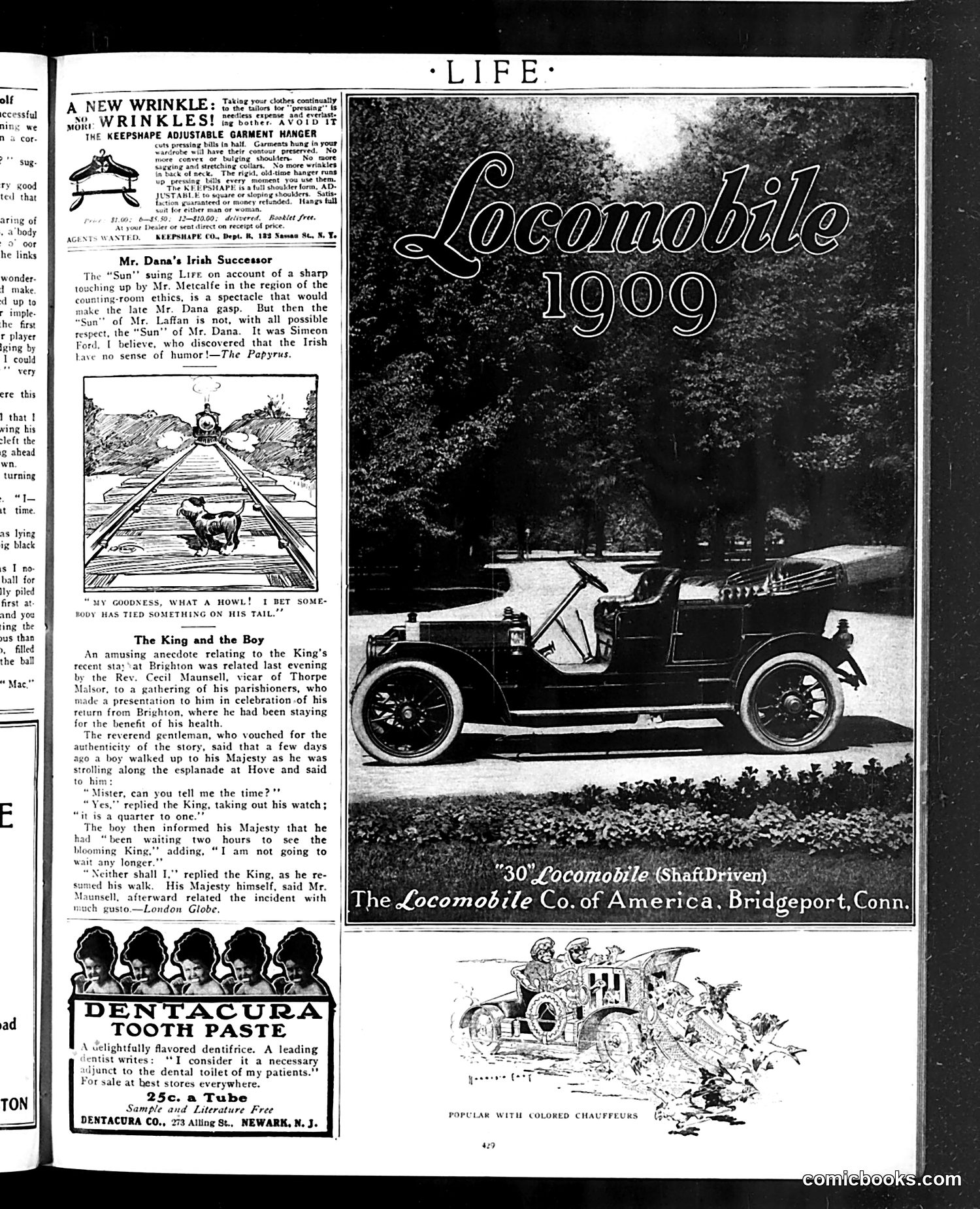
This page is primarily **advertising and editorial content** rather than political satire. The dominant feature is a full-page advertisement for the **Locomobile automobile** (1909 model, shaft-drive version), manufactured by The Locomobile Co. of America in Bridgeport, Connecticut. The ad shows a luxury car in an outdoor setting. The left column contains humorous anecdotes: one about an Irish character's perceived lack of humor, and another titled "The King and the Boy"—a supposedly authentic story about a boy informing the British King he wouldn't wait to see him bloom into a "blooming King." Below is an advertisement for **Dentacura Tooth Paste** (25 cents per tube). The cartoon at bottom right, captioned "Popular with Colored Chauffeurs," appears to be a period automobile illustration but is too small to interpret clearly.
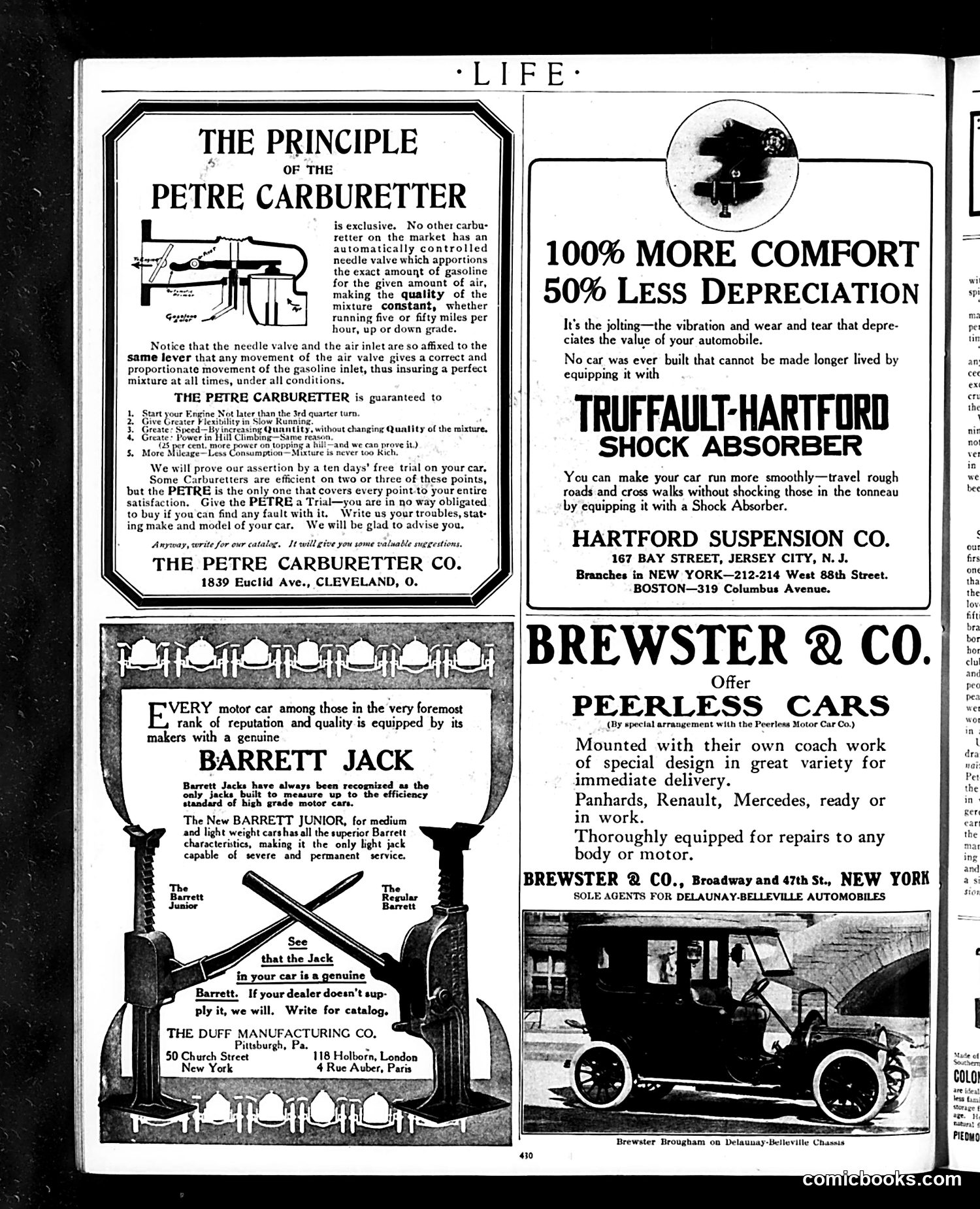
This page consists entirely of **automobile advertisements**, not satirical cartoons or political content. The ads promote four early automotive products: 1. **Petre Carburetter** — a fuel mixture valve device claiming superior performance and reliability 2. **Truffault-Hartford Shock Absorber** — suspension technology marketed to reduce wear and vibration 3. **Barrett Jack** — a mechanical lifting device for automobiles, emphasizing durability and light weight 4. **Brewster & Co.** — a luxury car manufacturer offering "peerless cars" with custom coach work, featuring Panhard, Renault, and Mercedes vehicles These advertisements reflect the early 1900s automotive industry, when basic mechanical components and accessories were major selling points. The emphasis on reliability, comfort, and quality indicates cars were still novel, expensive luxury items requiring specialized equipment and maintenance services.
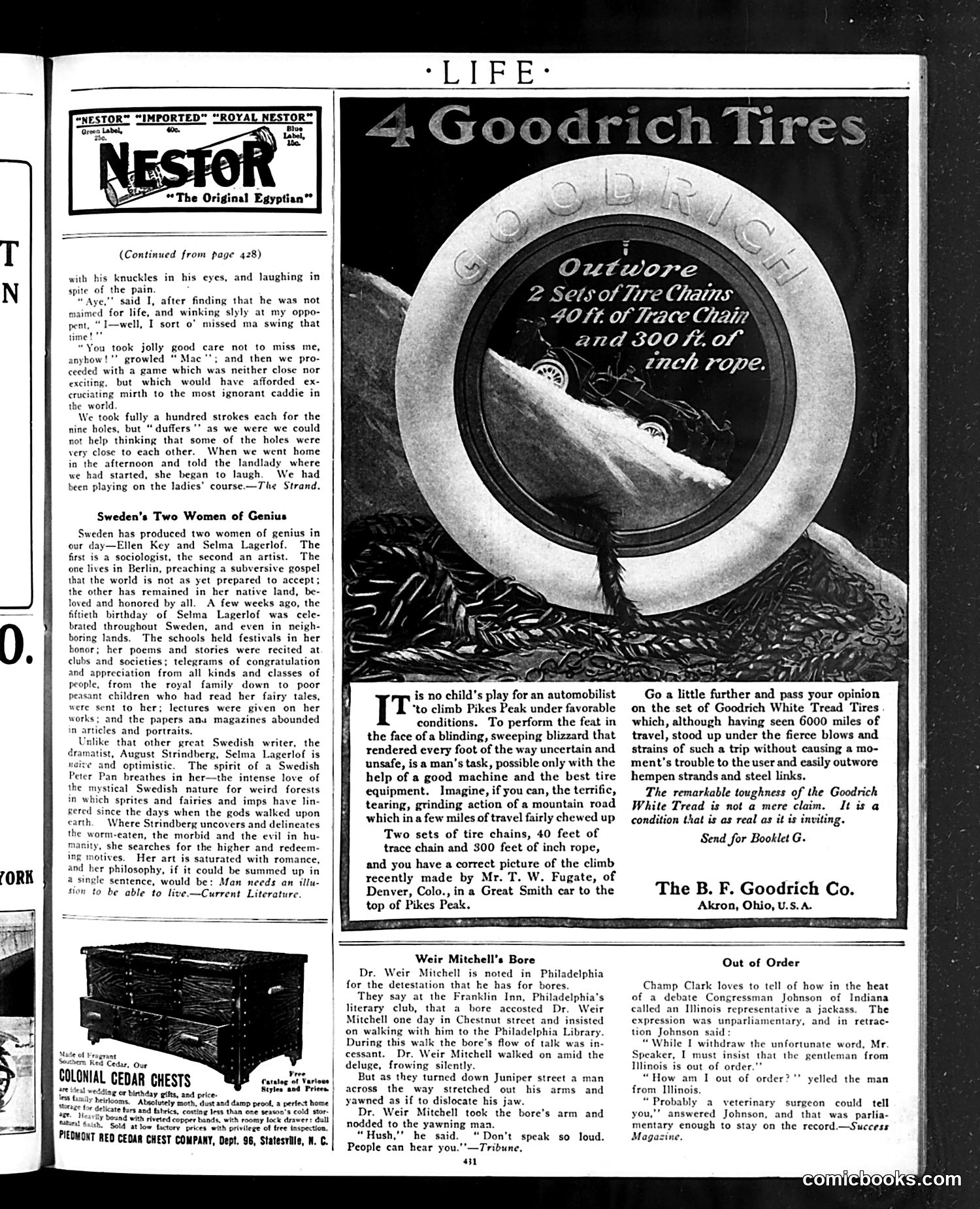
This page contains primarily **advertisements and feature articles** rather than political cartoons. The main visual content is a **Goodrich Tires advertisement** featuring a large tire with text about climbing Pikes Peak. The ad emphasizes the tire's durability and includes a testimonial from "Mr. T. W. Fugate, of Denver, Colo., a Great Smith car to the top of Pikes Peak." Left-side content includes: - A **Nestor automobile ad** ("The Original Egyptian") - An article titled **"Sweden's Two Women of Genius"** discussing Ellen Key and Selma Lagerlöf - A **Colonial Cedar Chests advertisement** Lower right contains brief humorous anecdotes ("Weir Mitchell's Bore," "Out of Order"). This is a typical early 20th-century magazine page mixing commerce, culture, and light humor.
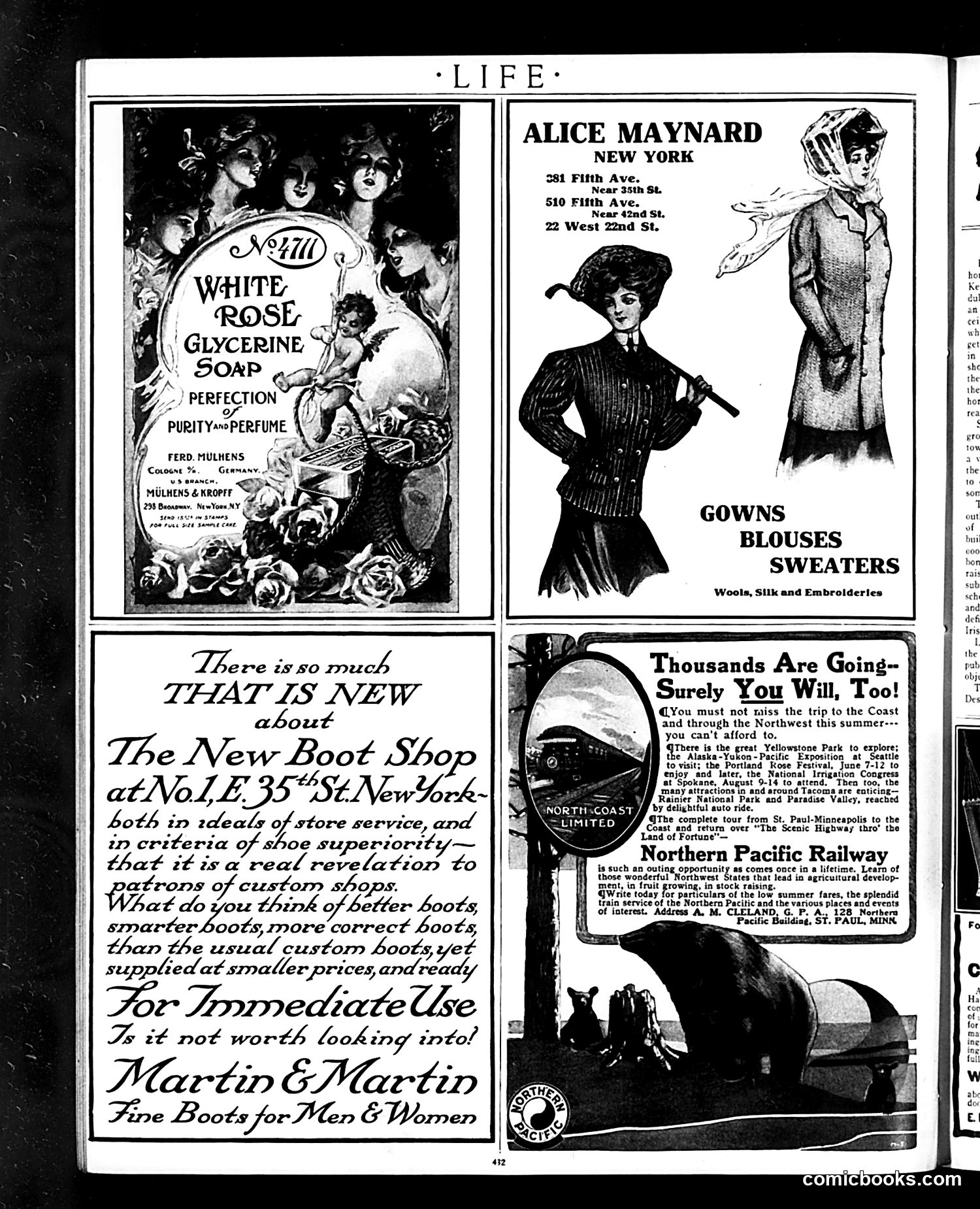
This page consists primarily of **advertisements** rather than satirical content. The ads include: 1. **White Rose Glycerine Soap** - featuring decorative imagery of women and cherubs, emphasizing "purity and perfume" 2. **Alice Maynard** (New York fashion retailer) - advertising gowns, blouses, and sweaters in wools and silk 3. **The New Boot Shop** - promoting custom boots with superiority claims over standard footwear 4. **Northern Pacific Railway** - encouraging travel to the Pacific Northwest, mentioning Yellowstone Park and the Portland Rose Festival The railway ad includes a scenic photograph of mountains/landscape and references summer travel opportunities. No political cartoons or satirical commentary appear on this page. It represents typical early 20th-century magazine advertising aimed at middle-class consumers.
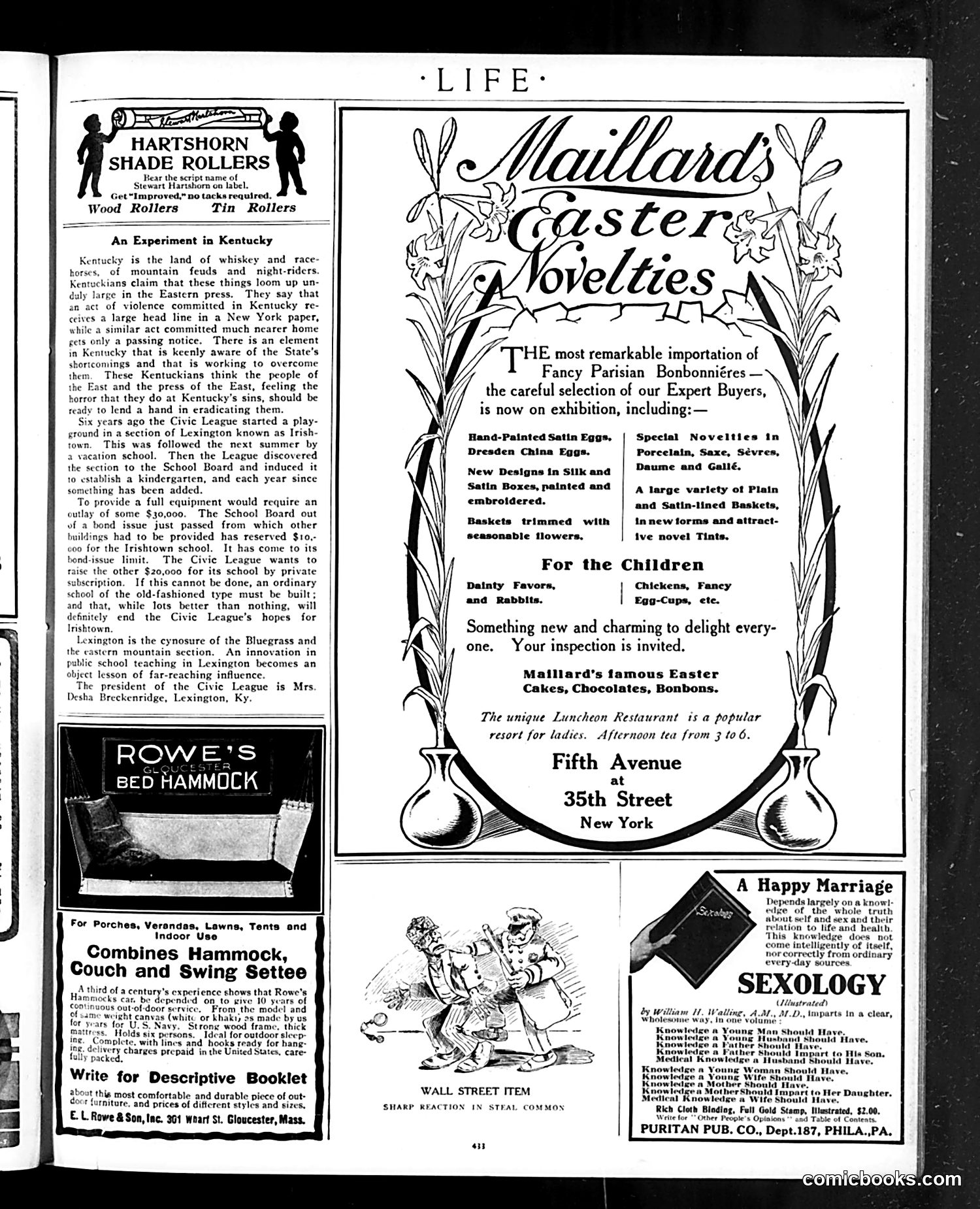
This page is **primarily advertising** with one small cartoon. The main content features Mailliard's Easter Novelties advertisement (center) promoting fancy imported goods, children's toys, and their restaurant on Fifth Avenue at 35th Street in New York. The only cartoon appears lower left: **"Wall Street Item: Sharp Reaction in Steel Common."** It depicts two figures in what appears to be a physical altercation or struggle, likely satirizing stock market volatility. The caption suggests a sharp drop in steel stock prices, personified as a "sharp reaction." The cartoon humorously visualizes financial losses as literal physical conflict. The page also includes ads for Rowe's Bed Hammock and a book titled "Sexology," alongside a brief article about Kentucky education reform.
This page is a straightforward advertisement, not satirical content. The Gorham Company advertised their printing and stationery services, specializing in wedding-related materials like invitations and announcements. Located on prestigious Fifth Avenue in New York, they marketed themselves as offering superior quality and prompt service, with samples available upon request. This appears in *Life* magazine as a paid advertisement targeting affluent readers who would commission elaborate wedding stationery. There is no cartoon, caricature, or satirical commentary on this particular page—it is purely commercial advertising.
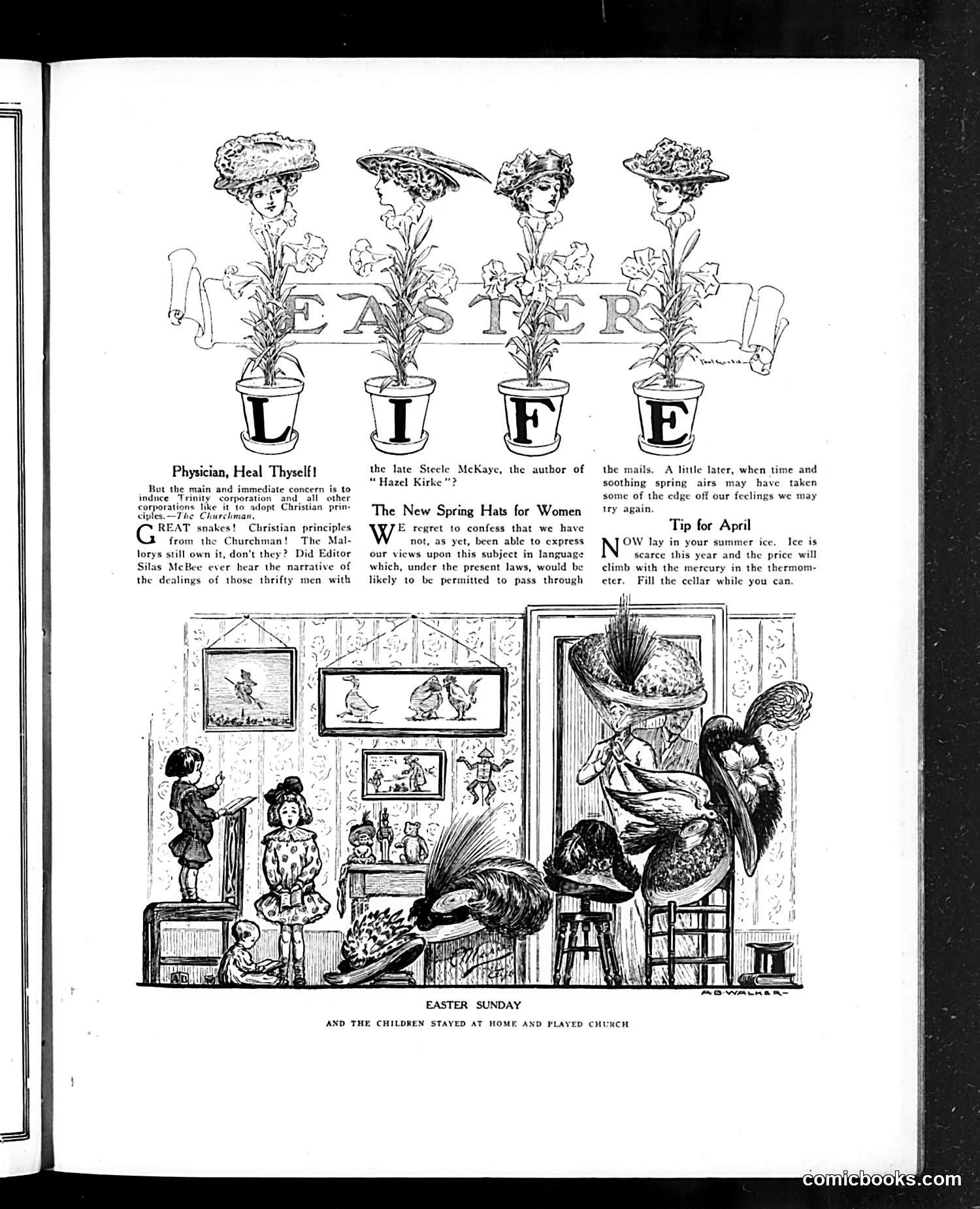
This page from *Life* magazine contains three distinct satirical pieces: **"Physician, Heal Thyself!"** mocks the hypocrisy of *The Churchman* magazine calling for corporations to adopt Christian principles. The satire points out that *The Churchman* itself is owned by the Mallory family, who allegedly treated playwright Steele McKaye unethically—making them hypocrites preaching morality while practicing exploitation. **"The New Spring Hats for Women"** is a joke about censorship. The author claims spring hats are so ugly they cannot describe them in language the U.S. Post Office would permit through the mails—implying the hats are obscene or ridiculous. **The illustration** captioned "Easter Sunday—And the Children Stayed at Home and Played Church" shows children mimicking religious rituals indoors while parents remain absent. This likely satirizes either religious hypocrisy or the commercialization of Easter, suggesting family religion has become superficial performance rather than genuine faith.
This page from Life magazine (April 1, 1912) critiques arguments for women's suffrage, particularly responding to statements by Mrs. Mackay published in the Evening Journal. **The Satire's Target:** Life's editors mock pro-suffrage claims that women voters would be morally superior lawmakers, especially regarding children's welfare. They argue women lack the practical expertise and business knowledge necessary for governance. **Key Arguments Attacked:** - That mothers naturally understand what children need better than fathers - That women's votes would improve legislation for future generations - That women excel at all forms of municipal governance **Life's Counterargument:** While acknowledging women can effectively serve on school boards and factory inspections (domestic/social matters), the editors insist most women lack the judgment for broader political decisions. They illustrate this with hospital signs women supposedly mandated—which people ignore because they're "not reasonable." **Context:** This represents anti-suffrage sentiment common before women gained voting rights (1920). The magazine frames opposition as practical rather than ideological, though this masks resistance to women's political equality.
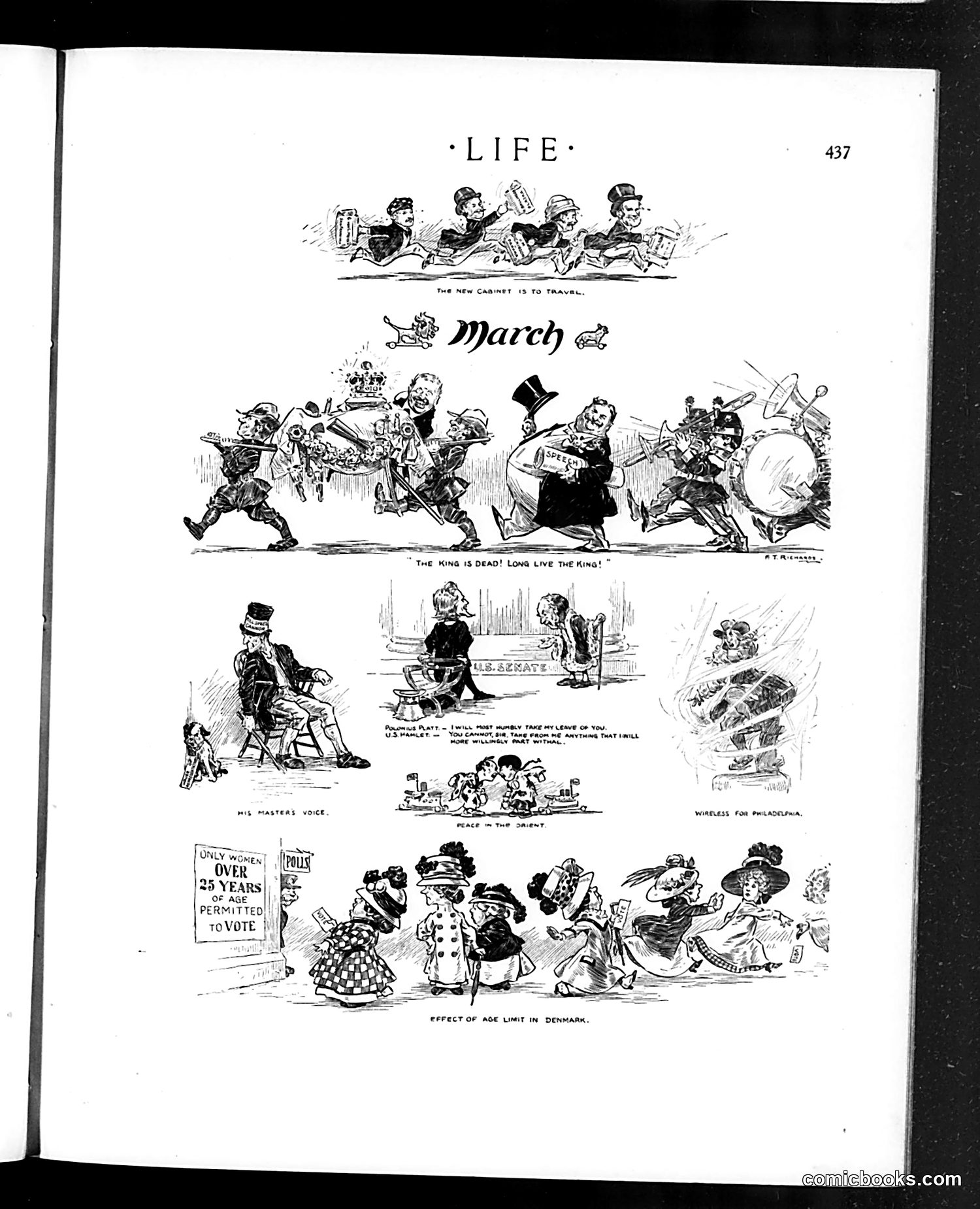
This page presents political satire centered on the month of March, traditionally associated with political upheaval ("the king is dead, long live the king"). The cartoons mock contemporary political issues: The top illustration depicts a chaotic government transition with exaggerated figures engaged in mayhem—likely satirizing political instability or cabinet changes. The bottom panel, titled "Effect of Age Limit in Denmark," shows women of various ages gathered around a voting-age restriction sign reading "Only Women Over 25 Years of Age Permitted to Vote." This satirizes Denmark's restrictive voting qualifications for women, mocking the absurdity of age-based suffrage discrimination. The caricatured women's reactions suggest frustration with these arbitrary political barriers—a commentary on early 20th-century women's voting rights debates.
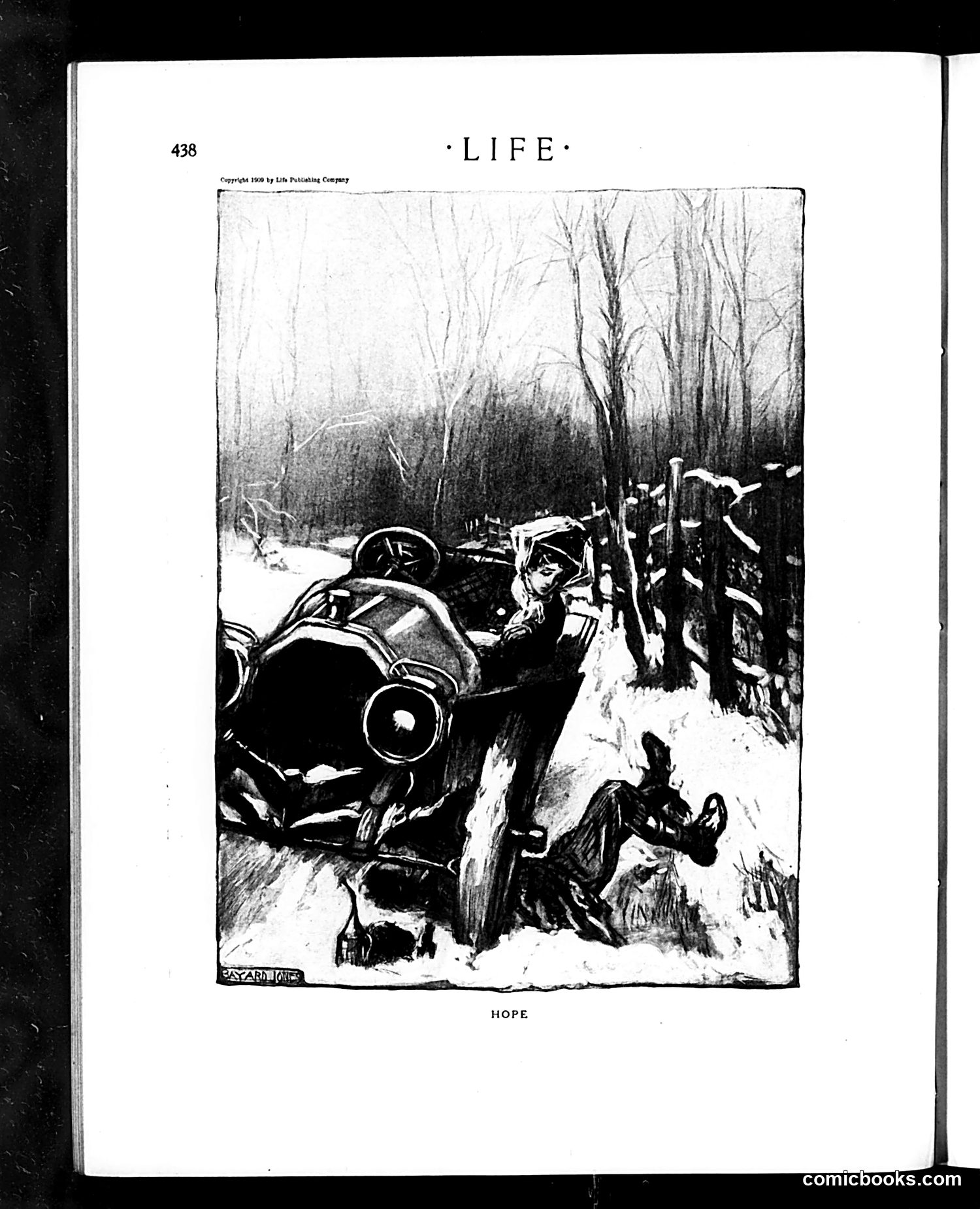
This single illustration, titled "HOPE," depicts a winter scene with a broken-down automobile stuck in snow. A figure sits in the disabled vehicle while another stands nearby, apparently stranded on a rural road lined with bare trees and a fence. The cartoon likely satirizes early automobile culture and the unreliability of early motorized transportation. The titled "Hope" suggests ironic commentary—the stranded motorists' only hope presumably being rescue or the vehicle's repair. The stark winter setting emphasizes their predicament. Without additional context or visible signatures clearly identifying the cartoonist's intended targets, the exact political or social reference remains unclear, though it appears to mock automotive failures or the false promises of automobile convenience prevalent in early 20th-century America.
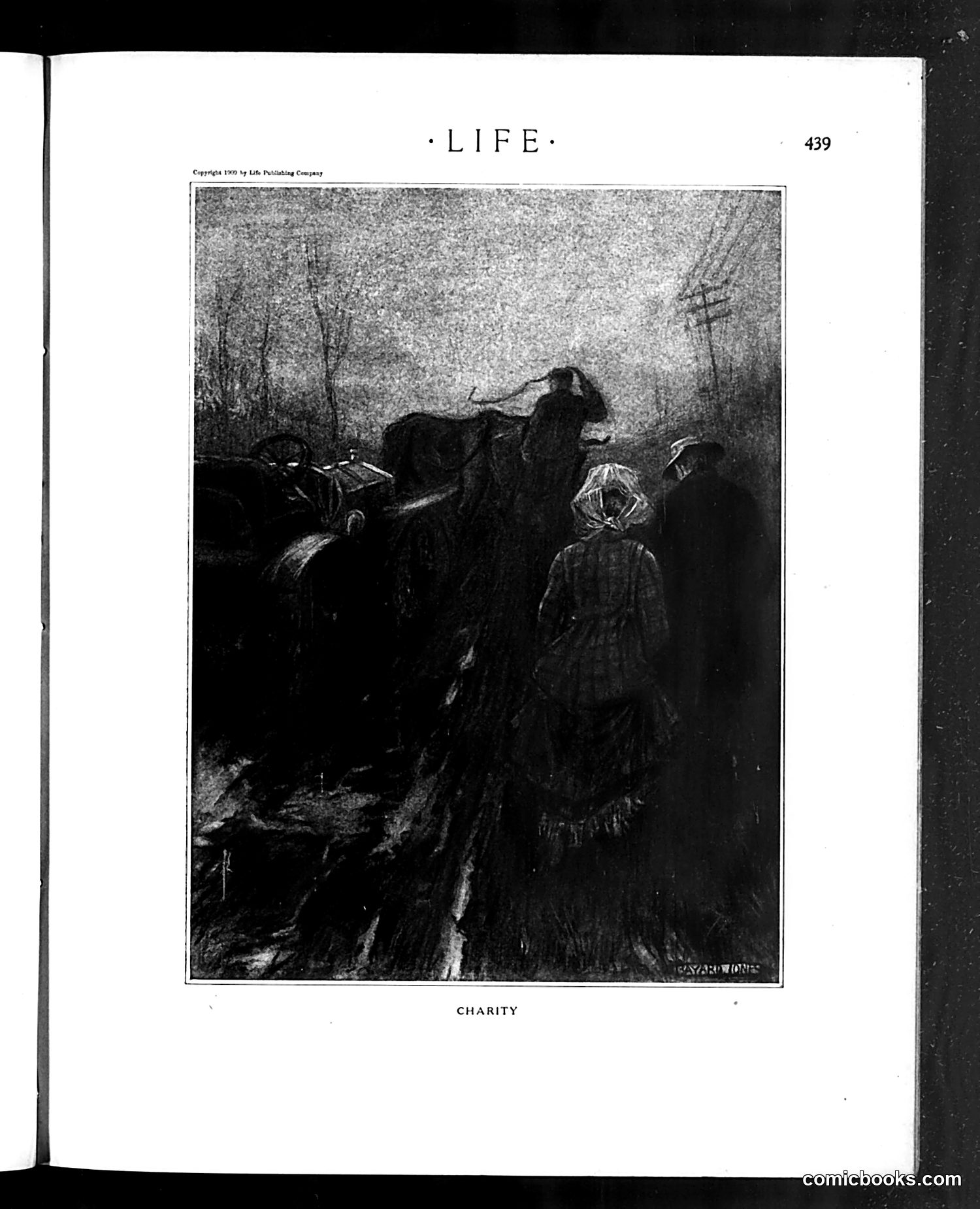
This illustration depicts a nighttime street scene with figures in dark clothing. A person in tattered garments appears to be begging or in distress, while other figures stand nearby observing. The composition uses heavy shadows and sketchy linework characteristic of early 20th-century satirical art. The title "CHARITY" likely critiques contemporary attitudes toward poverty and charitable giving. The scene suggests the disconnect between those with means and the destitute—possibly satirizing superficial or performative charity versus genuine compassion. The grim, expressionistic style emphasizes the harsh realities of poverty that society overlooks. Without additional context about the specific date or artist signature, the precise social commentary remains somewhat unclear, but the overall message appears critical of indifference to urban poverty.
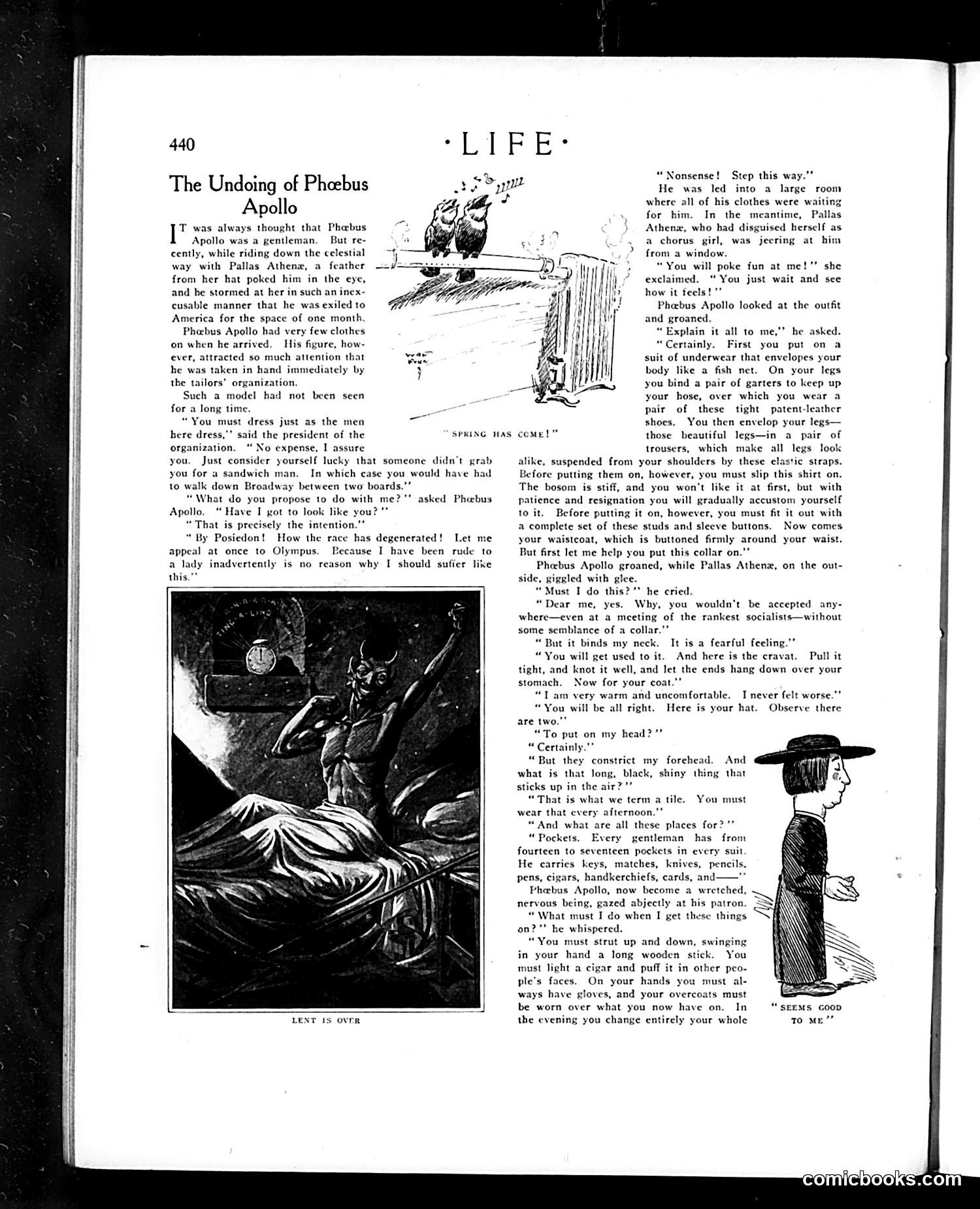
This satirical story mocks rigid masculine fashion conventions and social conformity in early 20th-century America. The mythological god Apollo, exiled to America for bad manners, is forcibly transformed by the "tailors' organization" into a properly dressed gentleman—complete with constrictive collar, formal suit, hat, gloves, and affectations like carrying a walking stick and cigar. The satire targets how American social expectations strip away individuality and natural ease, replacing them with uncomfortable, elaborate costume and performative behavior. Pallas Athena's hidden mockery reinforces the theme: society's formal dress code is inherently ridiculous, yet socially mandatory—even socialists demand it. The humor lies in the absurdist contrast between a carefree immortal being and oppressive modern menswear, critiquing how civilization constrains rather than elevates humanity.
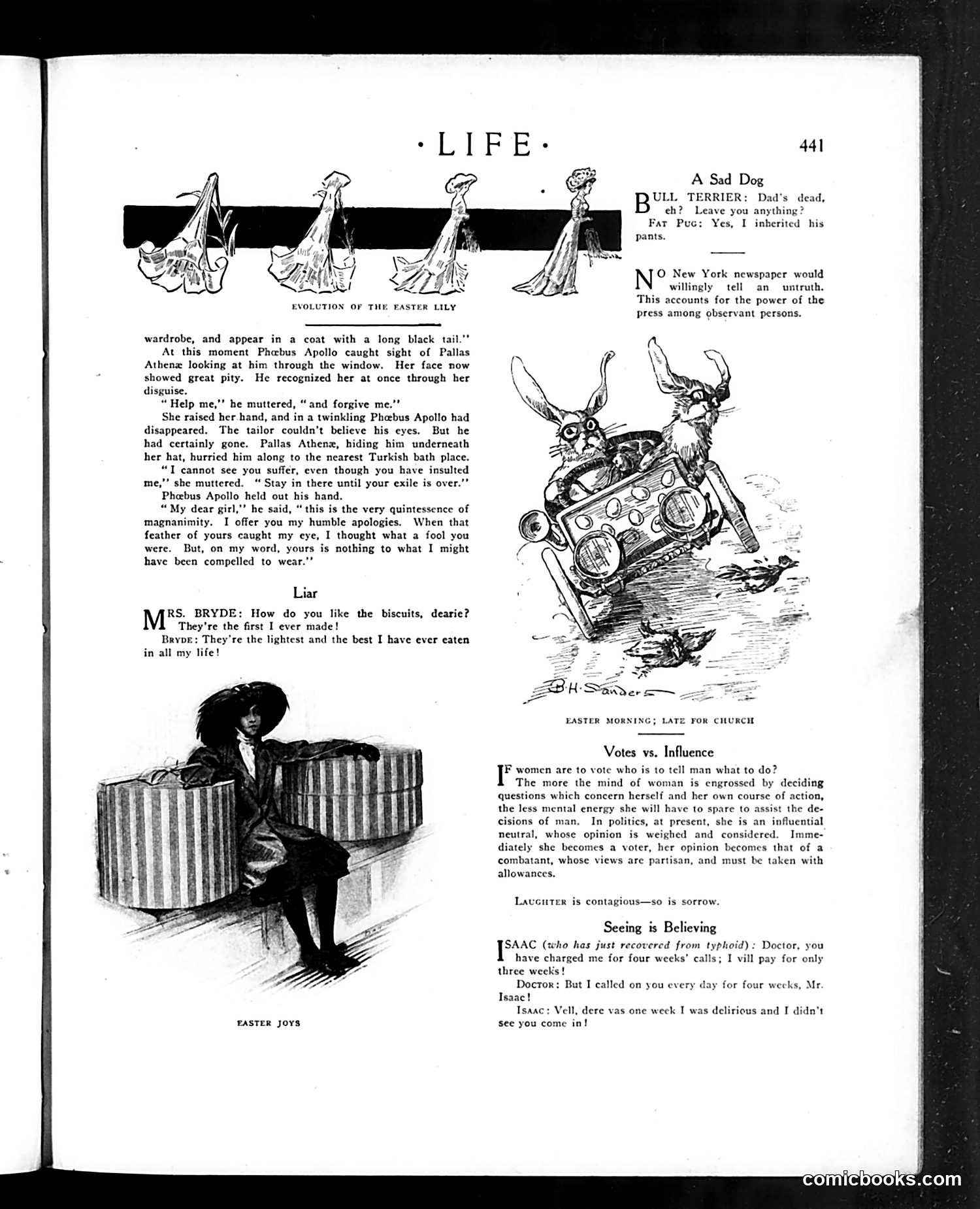
This page contains several satirical pieces reflecting early 20th-century American attitudes: **"Evolution of the Easter Lily"** depicts a mythological narrative (Phoebus Apollo and Pallas Athena) where a god is humbled and aided by a goddess—likely satirizing male vanity and female magnanimity. **"Easter Joys"** shows a woman with a large box, captioning a couple's polite lie about homemade biscuits—satirizing social pretense and insincere compliments. **"A Sad Dog"** makes a cynical joke: a bull terrier inherits only his deceased father's pants, mocking both inheritance and masculine legacy. **"Votes vs. Influence"** argues against women's suffrage, claiming voting would distract women from their "influential neutral" advisory role to men—reflecting anti-suffrage sentiment of the era. **"Seeing is Believing"** features a Jewish character (indicated by dialect) disputing a doctor's bill, claiming he didn't "see" a visit while delirious—a joke about literal versus practical truth. The page reflects period anxieties about gender roles, class, and immigrant communities.
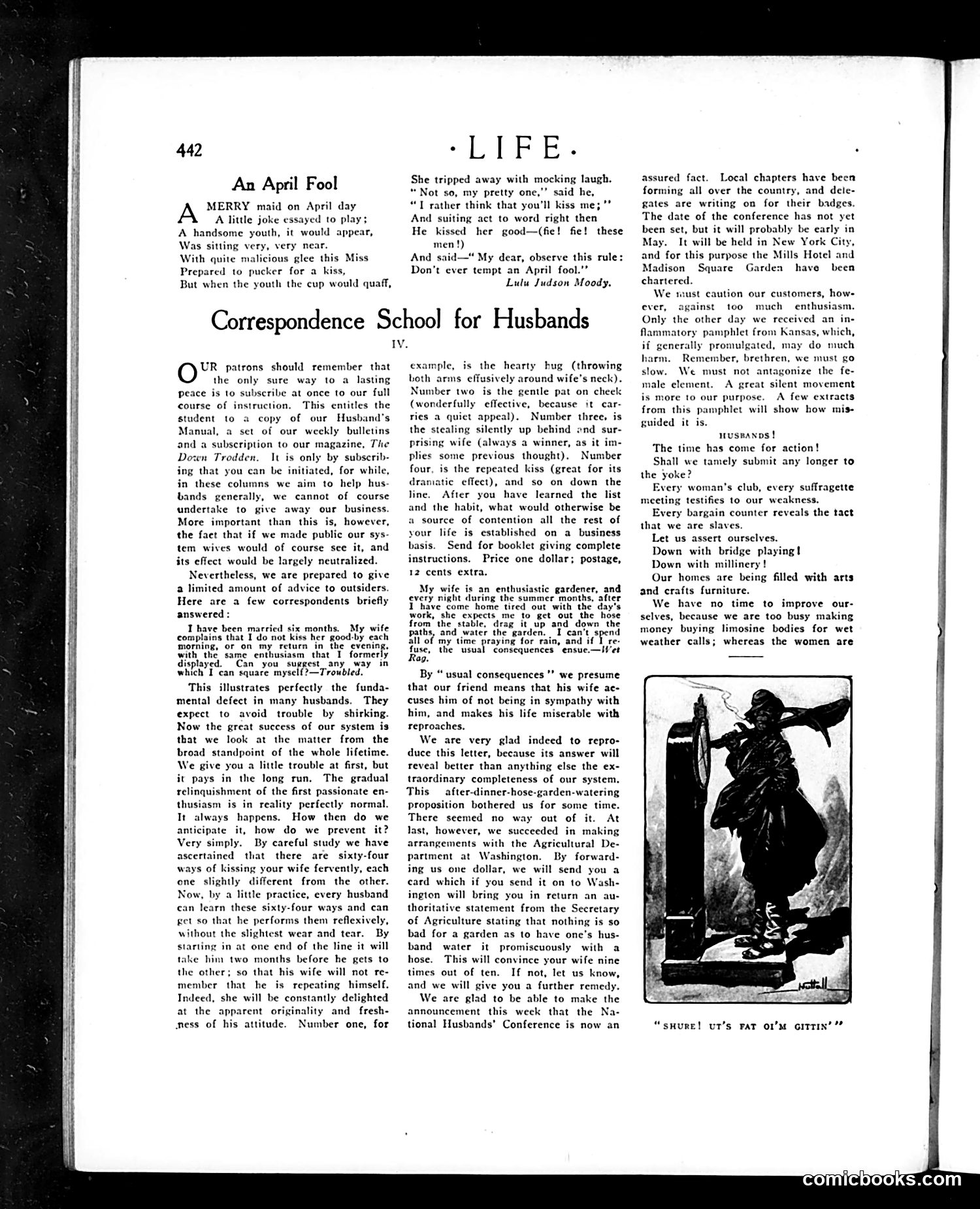
This page contains two satirical pieces mocking early-20th-century gender relations and marital advice. **"An April Fool"** is a brief poem about a young woman attempting to trick a man with a fake kiss on April Fool's Day. When he retaliates with a real kiss, he lectures her about "tempting an April fool"—a lighthearted joke about reversing expectations and male assertiveness. **"Correspondence School for Husbands"** is the main satire. It parodies the period's proliferation of mail-order "self-improvement" courses by presenting a fake instruction manual teaching husbands how to maintain romantic enthusiasm through mechanical means. The absurd premise—that husbands can perform 64 different kissing techniques in rotation to avoid appearing repetitive—mocks both the commercialization of advice and the era's often-condescending, pseudo-scientific approach to marriage. The satire targets husbands' laziness while also critiquing the reduction of intimacy to a systematized, joyless routine.
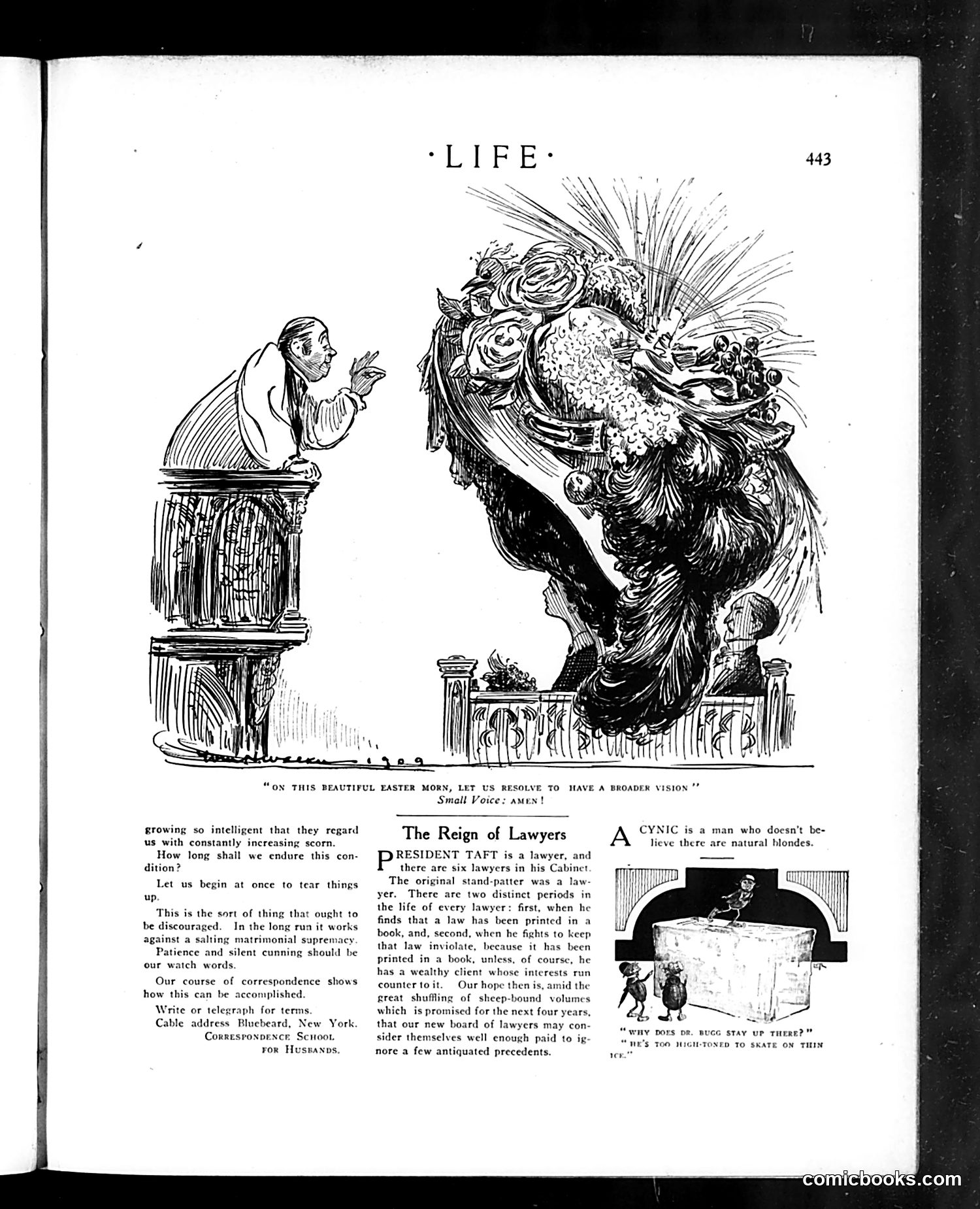
The top cartoon depicts an Easter sermon about "broader vision," while a grotesque figure—appearing to represent either corrupt capitalism or political excess—looms menacingly over a tiny preacher. The satire suggests hypocrisy: calls for moral improvement ring hollow against real-world greed and power. "The Reign of Lawyers" attacks President Taft's Cabinet, noting it contains six lawyers. The piece sarcastically suggests lawyers operate in two phases: first discovering laws exist, then fighting to preserve them unchanged—unless wealthy clients demand otherwise. The satire implies lawyers prioritize precedent and wealthy interests over justice or reform. The accompanying small cartoon mocks a character named "Bugg," likely satirizing political figures of the era. The overall page reflects Progressive Era skepticism toward establishment institutions—both religious hypocrisy and legal conservatism—suggesting they serve power rather than principle.
This page reviews three theatrical failures that opened in spring. The main critique concerns *"The Return of Eve,"* a fantasy about a woman raised in "The Garden of Eden" who enters New York society. The reviewer finds it absurd and patronizing—the author repeatedly interrupts the plot to condemn civilized society as corrupt, suggesting virtue exists only among the "uncivilized." This heavy-handed moralizing undermines the drama. Actress Bertha Galland performs adequately despite nebulous material. The page also briefly discusses *"Votes for Women,"* which closed after one week. Though well-acted and staged, the reviewer suggests the suffrage theme itself lacks theatrical appeal—women demanding voting rights don't convey sentiment or drama, making the material inherently undramatic despite its contemporary relevance in early 1900s America.
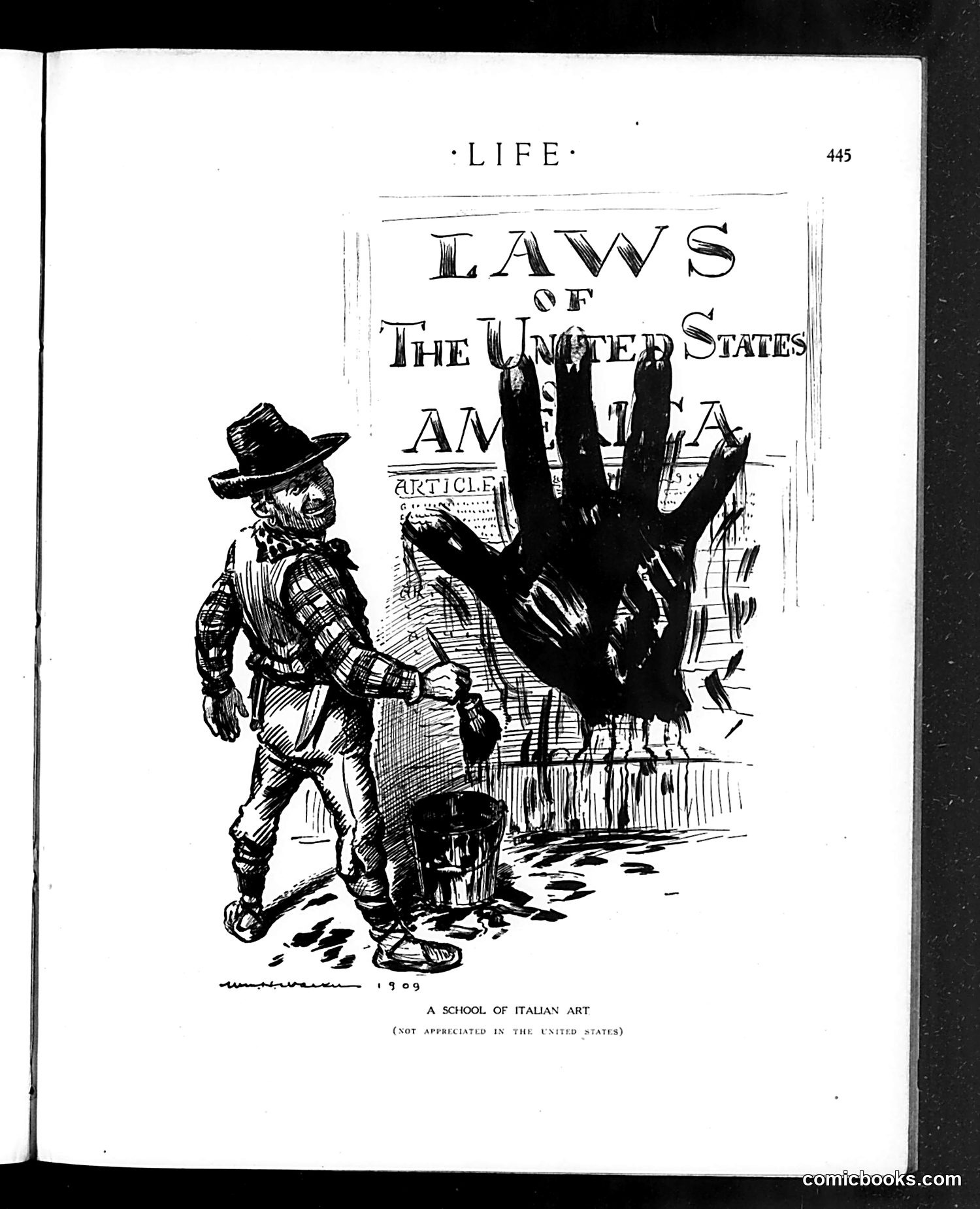
This 1909 political cartoon satirizes Italian immigration and the perceived threat of Italian legal systems to American law. The figure on the left—a caricatured Italian immigrant wearing a hat and plaid clothing—stands before a massive, menacing hand emerging from a document labeled "Laws of the United States of America." The cartoon's caption, "A School of Italian Art (Not Appreciated in the United States)," sarcastically suggests that Italian methods of law or governance are being "taught" or imported into America. The imagery implies xenophobic anxieties about foreign influence corrupting American legal institutions during a period of heavy Italian immigration. The aggressive hand symbolizes American law "swatting down" or rejecting these foreign influences, reflecting nativist sentiment common in early 20th-century America.
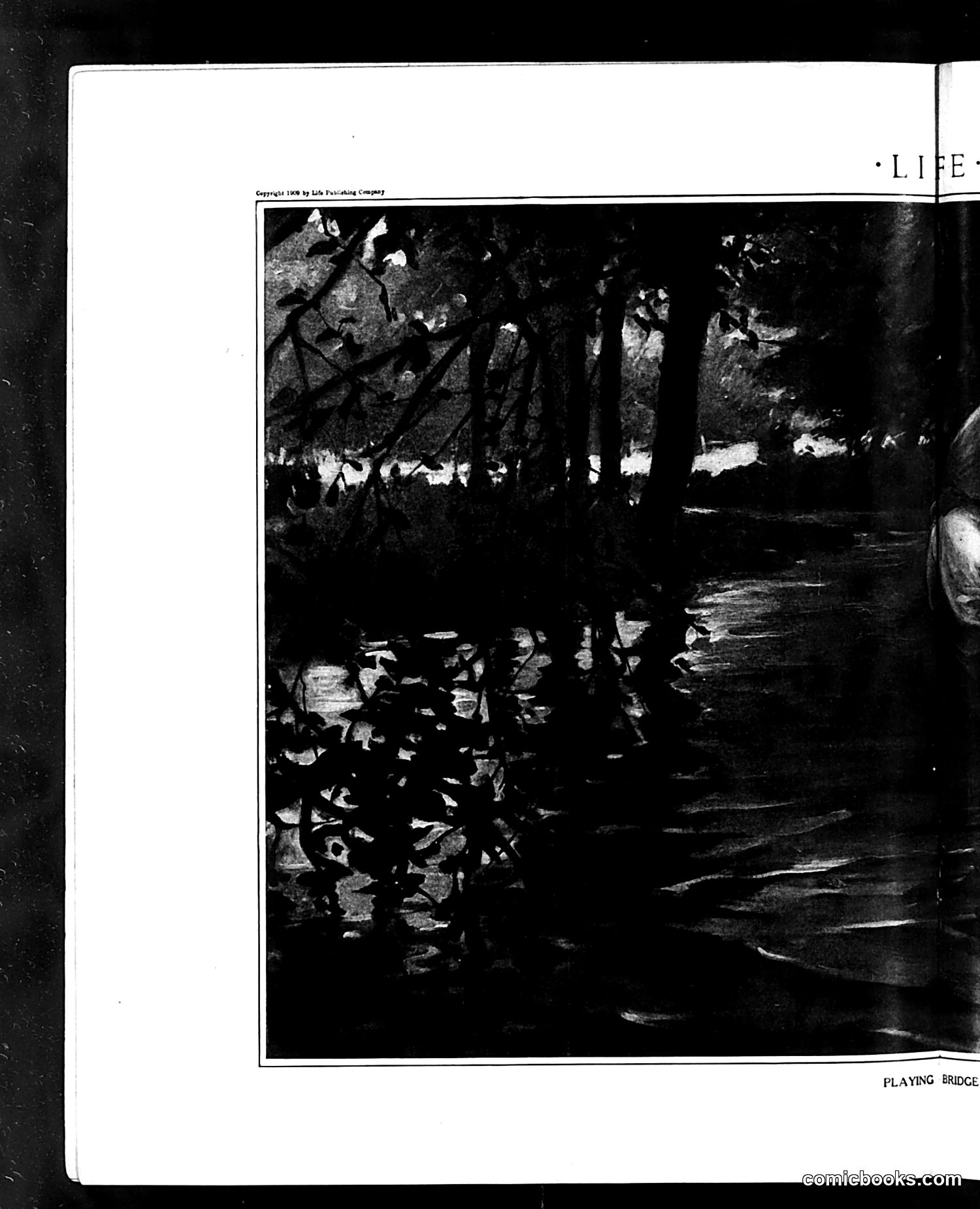
This page appears to be from an early 20th-century issue of *Life* magazine. The image shows a black and white photograph labeled "PLAYING BRIDGE" at the bottom. The photograph depicts what appears to be people gathered around a card table in an indoor setting with trees or foliage visible in the background. The composition and lighting suggest this is documenting a social scene, likely meant to be humorous or satirical about leisure activities among a particular social class. Without additional visible text or context on this page, I cannot definitively identify the specific figures, the precise date of publication, or the intended satirical message. The title "PLAYING BRIDGE" suggests the humor relates to the card game itself or the social behaviors of bridge players, but the exact point of satire remains unclear from the image alone.
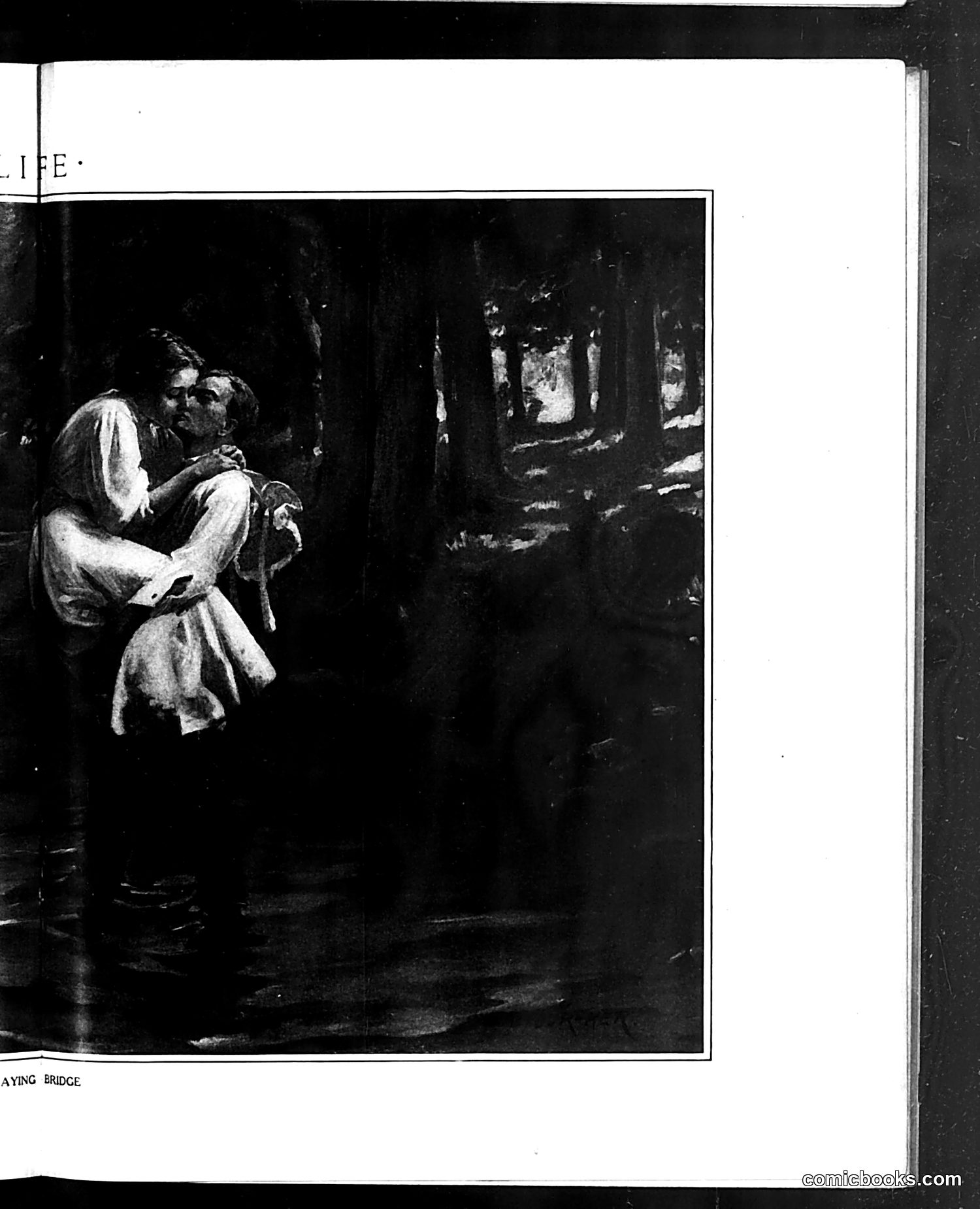
This appears to be a page from Life magazine featuring a dramatic black and white illustration titled "AYING BRIDGE" (likely "PLAYING BRIDGE," with the beginning cut off). The image shows two figures in what appears to be a dark, forested setting with tall trees. The composition is theatrical and atmospheric, with strong contrast between light and shadow. One figure appears to be holding or carrying something. However, without clearer text context visible on this page, I cannot definitively identify what social or political commentary this illustration intended to convey, or who the figures represent. The OCR'd text is too corrupted to provide meaningful context. The image alone suggests a narrative scene rather than a direct political cartoon, but the specific satire or joke remains unclear from what's legible here.
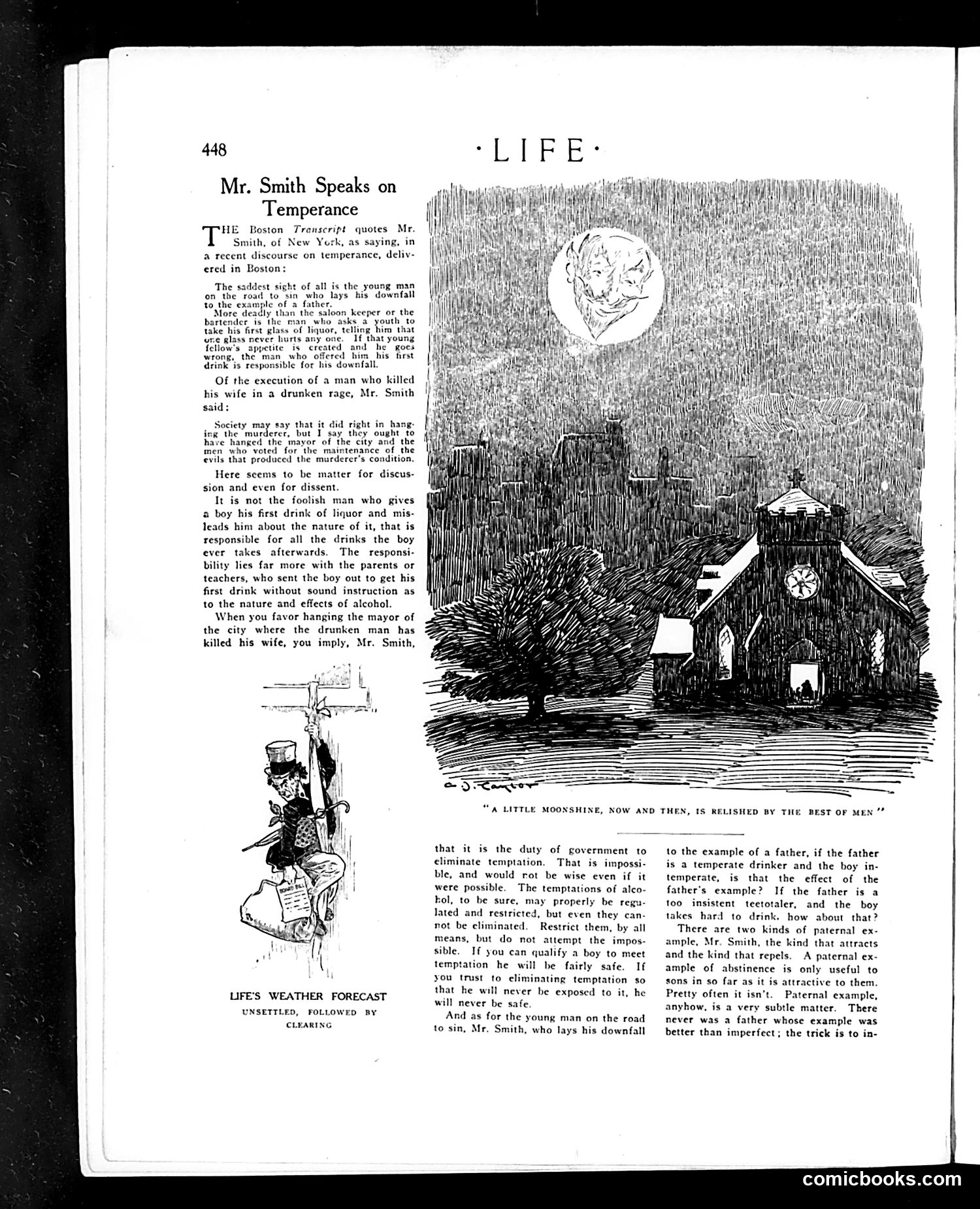
This page presents a temperance debate from the Boston *Transcript*. Mr. Smith of New York argues that society bears responsibility for alcohol-related tragedies—claiming the saloon keeper who gives a youth his first drink, or a city mayor whose jurisdiction permits drunkenness leading to murder, share culpability. The opposing editorial voice (likely *Life*'s) counters with pragmatism: eliminating temptation is impossible; instead, parents and teachers must educate youth about alcohol's effects. It also challenges Smith's logic about paternal influence, noting that both excessive drinking *and* strict teetotaling can backfire as negative examples. The accompanying illustration depicts a moonlit rural tavern, captioned "A little moonshine, now and then, is relished by the best of men"—mocking temperance reformers' idealism through ironic acceptance of drinking culture. *Life* uses Smith as a straw man for reform zeal, arguing moral responsibility lies with education, not prohibition or blame-shifting to authorities.
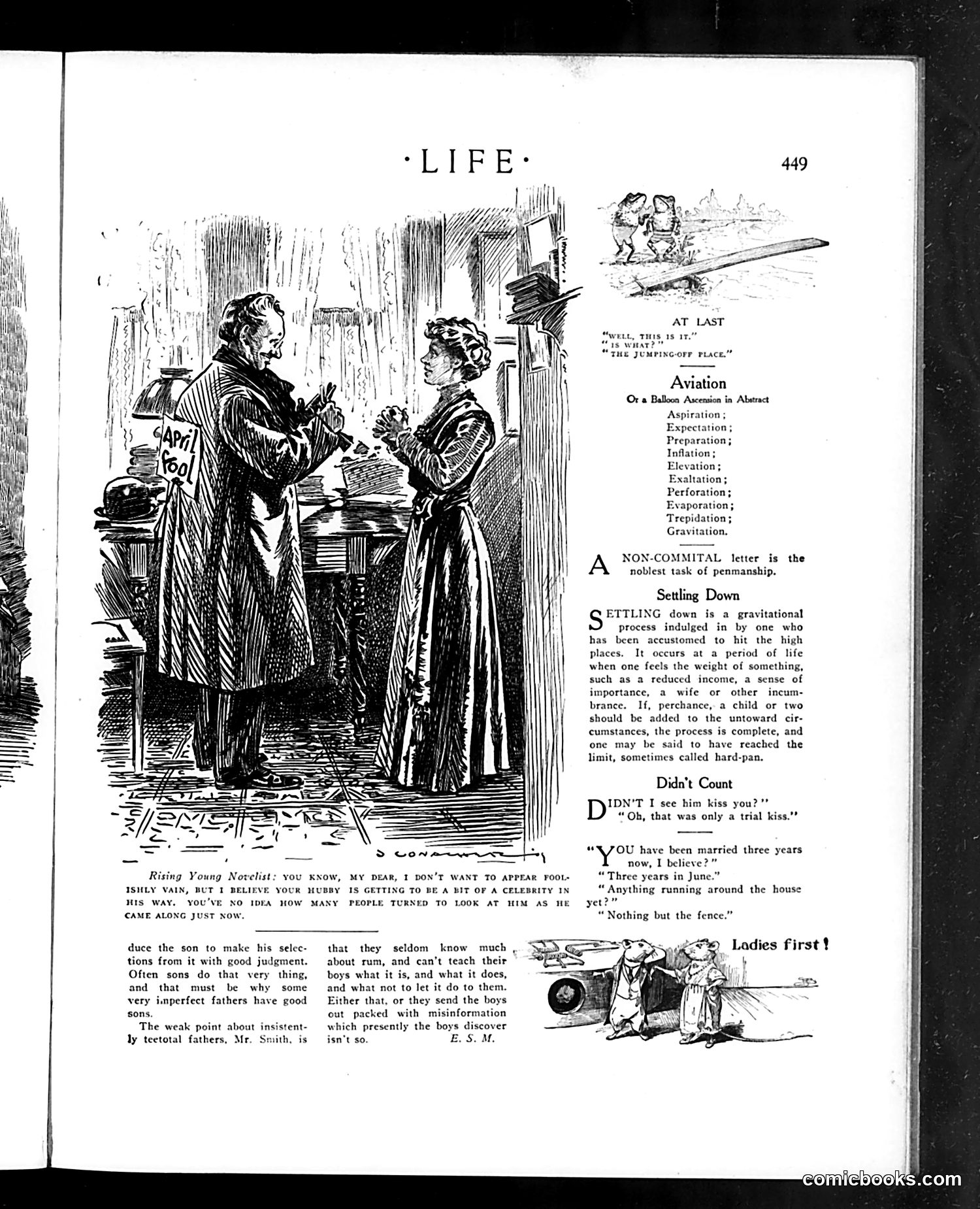
This page contains three satirical pieces mocking contemporary social pretensions and domestic realities: **"Rising Young Novelist"** (main cartoon): A self-important writer boasts to a woman about his celebrity status, claiming crowds stare at him. The satire targets vanity and the gap between perceived and actual importance. **"Settling Down"** (text section): Defines the process as one's gravitational descent from ambitious heights into domestic responsibility—reduced income, marriage, children—until reaching "hard-pan" (bottom). It's sardonic commentary on how life's realities constrain youthful aspirations. **"Didn't Count"** (dialogue): A wife dismisses a kiss as merely a "trial kiss," implying it doesn't count as infidelity. The couple's marriage seems loveless; she mentions only "anything running around the house" after three years. **"Aviation"** (right column): Lists stages of a balloon ascension abstractly, likely satirizing pretentious modern enthusiasm for emerging aviation technology. The page collectively ridicules male ego, marital disappointment, and social climbing—typical Life magazine targets.
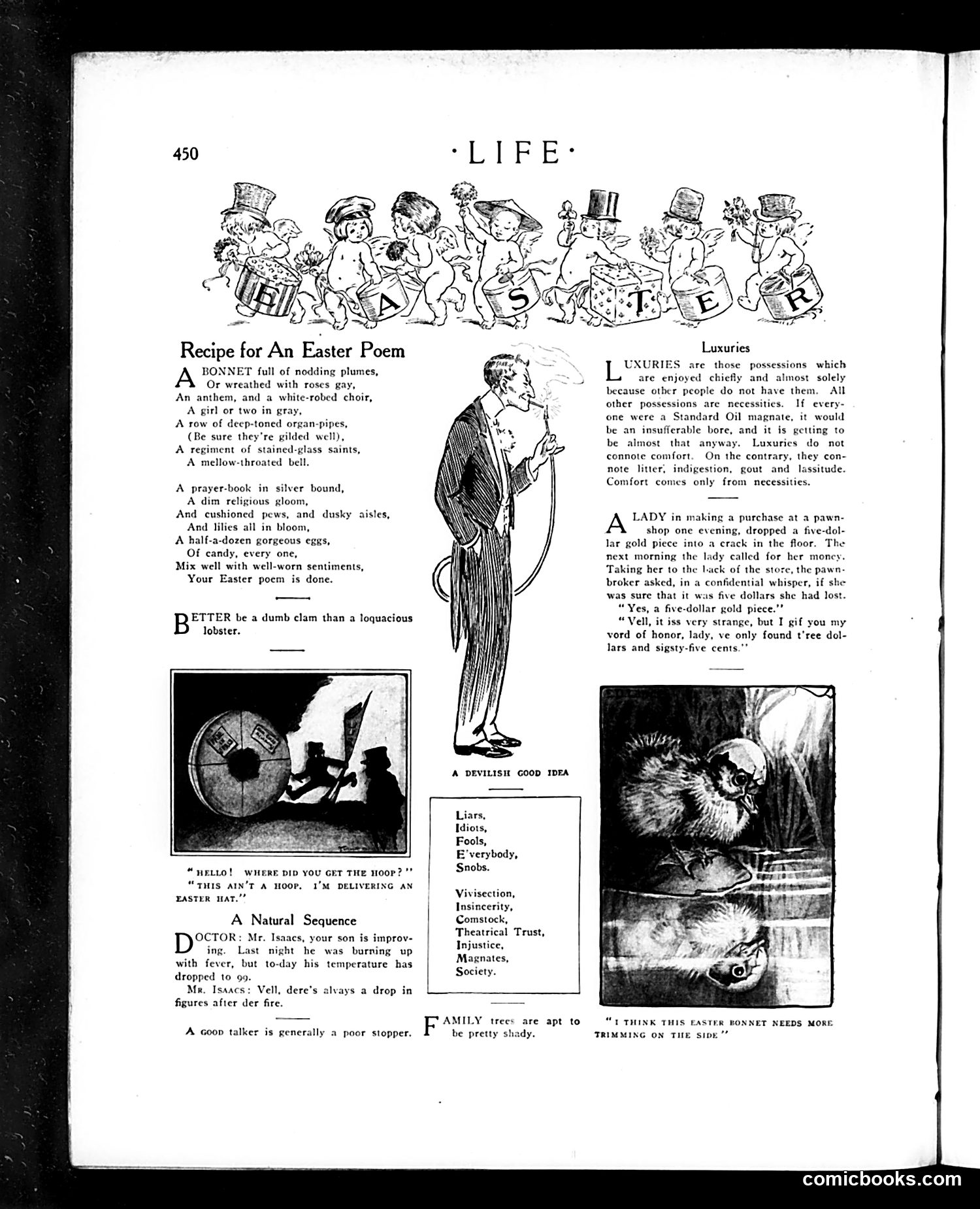
This page is a collection of satirical humor pieces typical of early 20th-century Life magazine. The central "Recipe for An Easter Poem" mocks sentimental Easter observance by reducing its clichéd elements (bonnets, choirs, lilies, candy eggs) to cookbook ingredients—suggesting Easter poetry is formulaic and superficial rather than genuinely spiritual. "A Devilish Good Idea" lists societal problems (vivisection, Comstock [likely Anthony Comstock, the moral censor], the Theatrical Trust, magnates) as things to eliminate—biting social criticism. The other pieces are brief comedic sketches: a child's misunderstanding about Easter bonnets and hoops; a Jewish immigrant's malapropism about fever dropping "after der fire" (playing on Yiddish-inflected English); a pawnbroker's dishonest excuse for missing money; observations on luxury and necessity. The cartoons employ ethnic humor and wordplay typical of the era. The overall tone is urbane mockery of pretense, hypocrisy, and social absurdity.
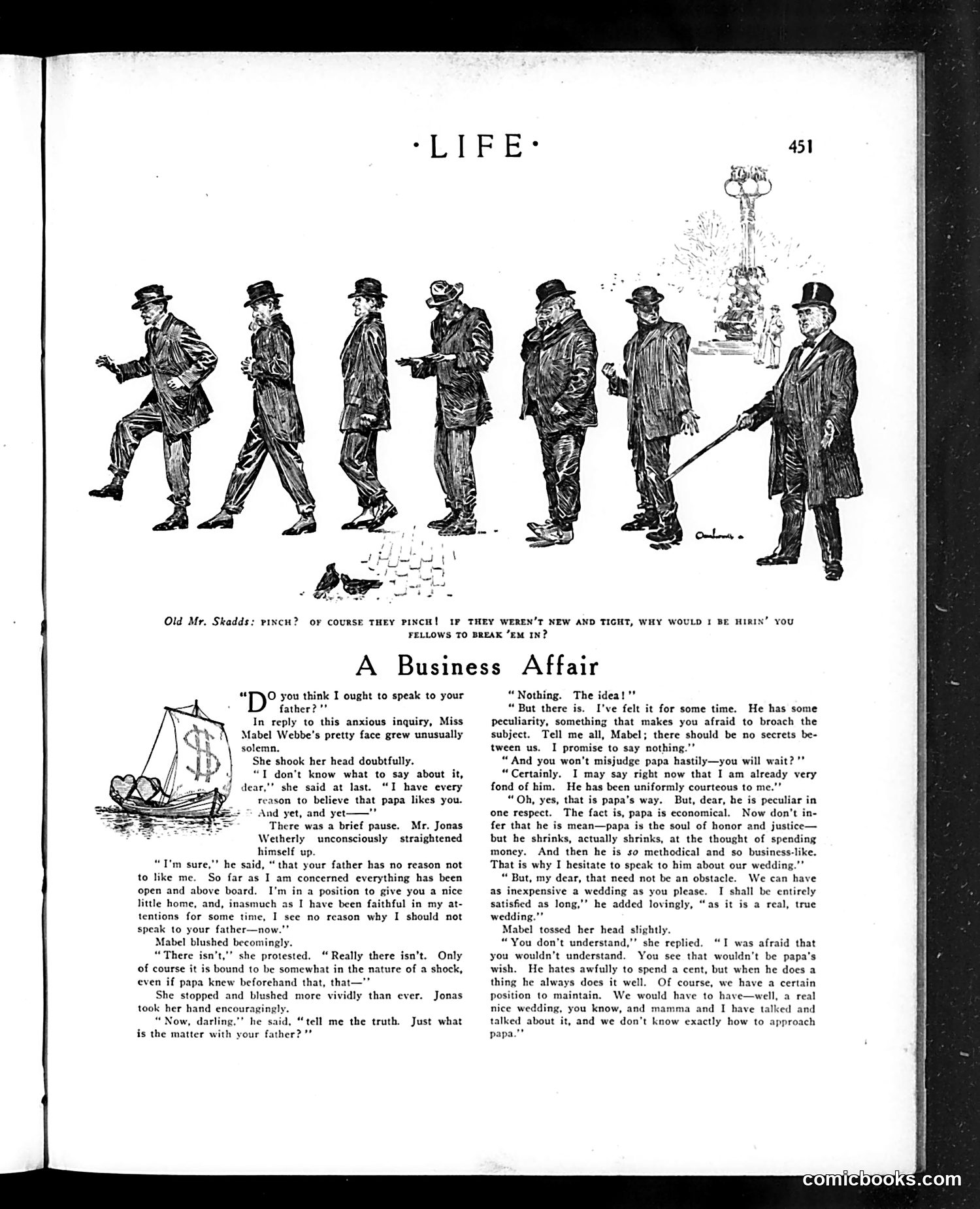
This page contains two sections: a cartoon captioning joke at the top, and a short story below. The **top cartoon** shows seven men in formal dress discussing new shoes. "Old Mr. Skadds" explains he's hired these fellows specifically to break in (stretch) his new tight shoes—a crude joke about using hired labor for personal convenience. **The story** satirizes the tension between courtship propriety and parental parsimony. Jonas Wetherly seeks to propose to Mabel Webbe but she fears her father's reaction—not from disapproval of Jonas, but because papa is extremely economical. The satire's point: the father is so stingy he avoids spending money, yet his social position demands he host an expensive wedding. Mabel and her mother have been strategizing how to approach him about the inevitable cost. The humor lies in the awkward contradiction between maintaining respectable appearances and the father's miserly nature—a common anxiety of the middle-class household.
This is a satirical short story (not a cartoon) from *Life* magazine depicting a marriage negotiation between Jonas Wetherly, a suitor, and Mr. Webbe, his fiancée's father. The humor centers on **class anxiety and financial practicality overriding romantic sentiment**. Mr. Webbe is preoccupied with wedding expenses ($2,125.17—substantial for the era), while Jonas positions himself as considerate by *not* wanting to burden the family. The satire's climax: Jonas proposes an **elopement** to save money, framing it as romantic and socially acceptable. He even suggests Mr. Webbe needn't pay for the rope ladder—Jonas will provide it himself. The joke mocks how turn-of-the-century middle-class Americans rationalized major life decisions through cost-benefit analysis, and how young suitors performed elaborate financial consideration to gain approval. It's satire on mercenary attitudes dressed in genteel language.
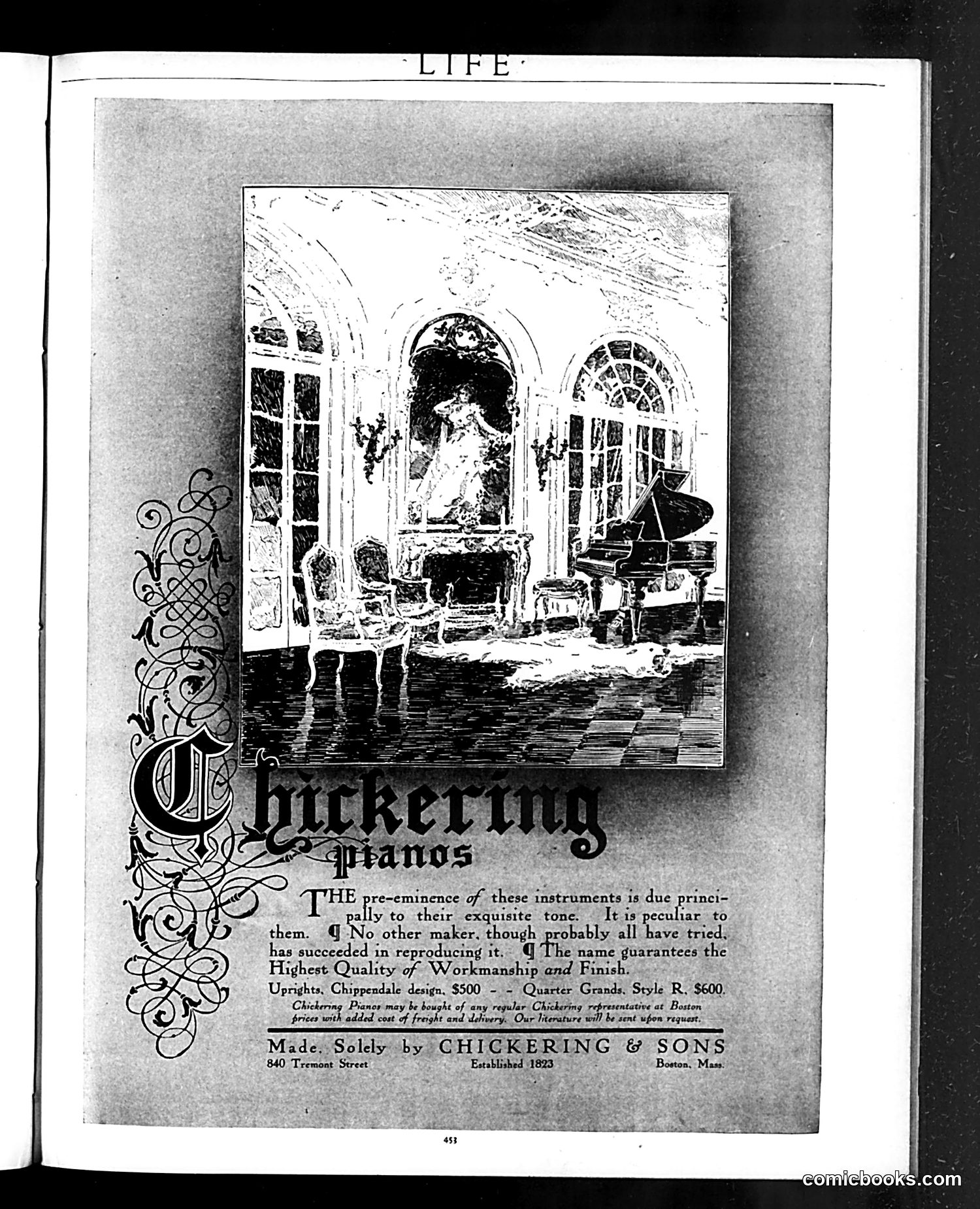
This page is a **piano advertisement**, not a political cartoon. It's a full-page ad for Chickering & Sons, a Boston piano manufacturer established in 1823. The image shows an elegant interior—a music room with arched windows, a grand piano, and classical furnishings—depicting the refined, wealthy lifestyle associated with piano ownership in the early 20th century. The text emphasizes the pianos' "exquisite tone" as their distinguishing feature, claiming no competitor has successfully reproduced it. This is typical advertising puffery: asserting superiority through vague quality claims rather than specific technical details. The ad lists two models: Uprights (Chippendale design, $500) and Quarter Grands (Style R, $600)—premium prices suggesting this product targeted the affluent. There is no satire or political commentary here—it's straightforward luxury goods marketing placed in *Life* magazine.
This page is primarily **text content**, not political cartoons. It's a literary/humor column featuring reader contributions. The main pieces are: 1. **"Frozen Language"** — An excerpt from Rabelais' *Pantagruel*, a Renaissance satirical novel. The passage imagines frozen battle sounds that thaw and become audible—a fantastical conceit used for absurdist humor about the nature of language and communication. 2. **"All Fool's Day"** — A sentimental essay defending foolishness and simplicity, referencing Biblical parables about fools and the wise, arguing for the virtue of naïveté over calculation. 3. Small sections on other topics like "Bill Nye on Hornets" and "What Do You Like?" **The satirical point**: Life's "Sparks from Old Anvils" department publishes humorous, philosophical, or literary musings—here favoring whimsy and intellectual playfulness over serious discourse. The frozen words concept exemplifies the magazine's appreciation for absurdist wit.
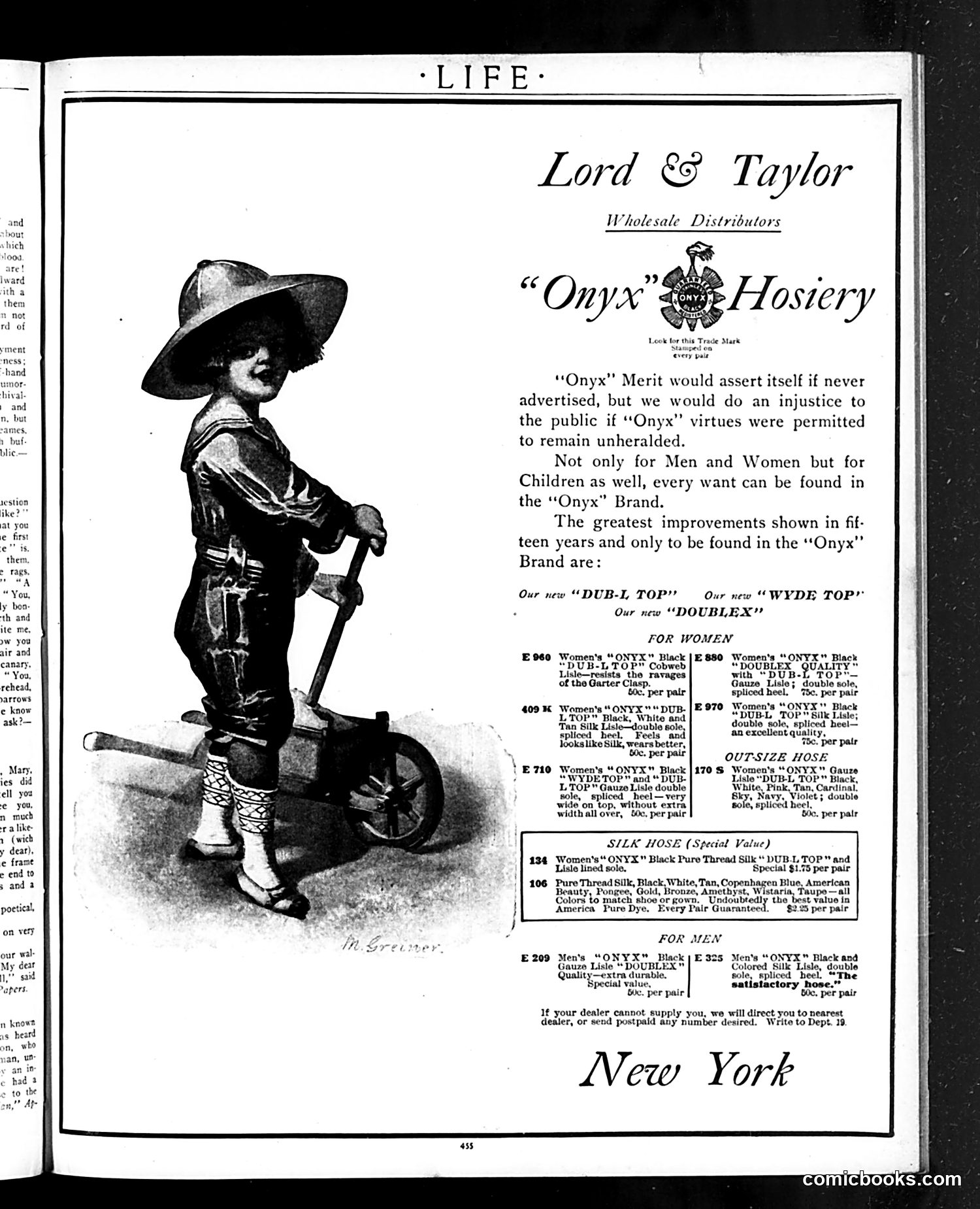
This page from *Life* magazine is a wholesale hosiery advertisement for "Onyx" brand socks and stockings, distributed by Lord & Taylor. The illustration shows a figure in period clothing (hat, knickers) standing on a unicycle—likely meant to suggest that Onyx hosiery is reliable enough for demanding activities. The ad emphasizes product innovations like "Dub-L Top," "Wyde Top," and "Doublex" designs. It lists prices and specifications for women's, men's, and children's hosiery in various materials (silk lisle, gauze, pure thread silk) and colors. The text claims these improvements represent the "greatest improvements shown in fifteen years." There is no political commentary or satirical intent visible—this is straightforward commercial advertising typical of early 20th-century *Life* magazine, which published both humor and advertisements.
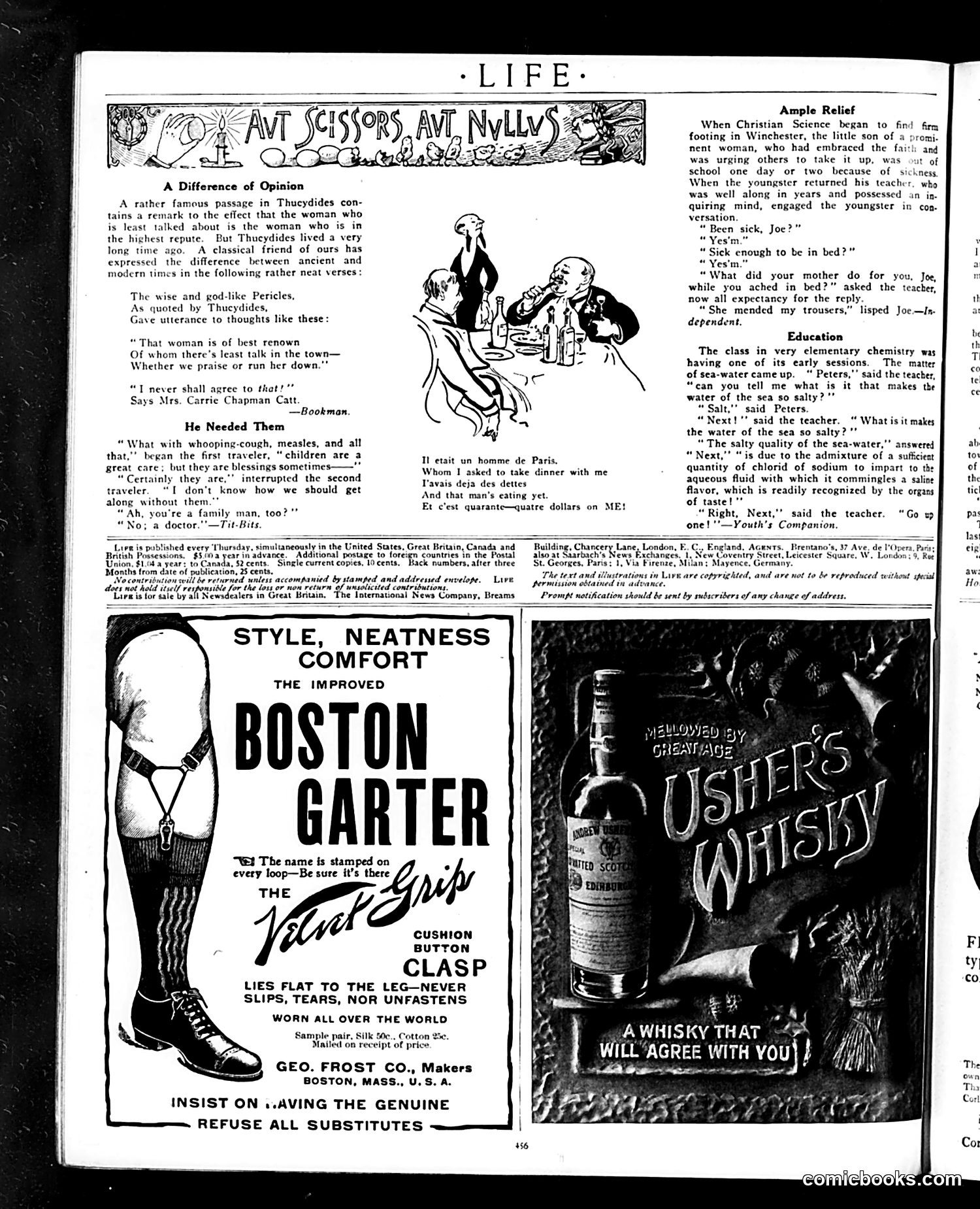
This page contains several short humorous pieces typical of early 20th-century satirical journalism: **"A Difference of Opinion"** contrasts ancient Greek philosopher Pericles's view that women of best reputation are least talked about with modern activist **Carrie Chapman Catt**, who apparently disagreed—likely referencing her prominent public advocacy for women's suffrage and social reform. **"He Needed Them"** is a brief joke about a doctor who values children not as blessings but as patients—dark humor about medical practice. **"Ample Relief"** describes a Christian Science family's approach to illness: the mother mends trousers rather than treating her son's pain, poking fun at Christian Science's rejection of conventional medical treatment. **"Education"** satirizes overly verbose scientific explanation: a student gives a needlessly complex answer about salt in seawater when "salt" would suffice. The page is predominantly **advertisements** (Boston Garter, Usher's Whisky), with humor pieces filling remaining space—typical Life magazine format from this era.
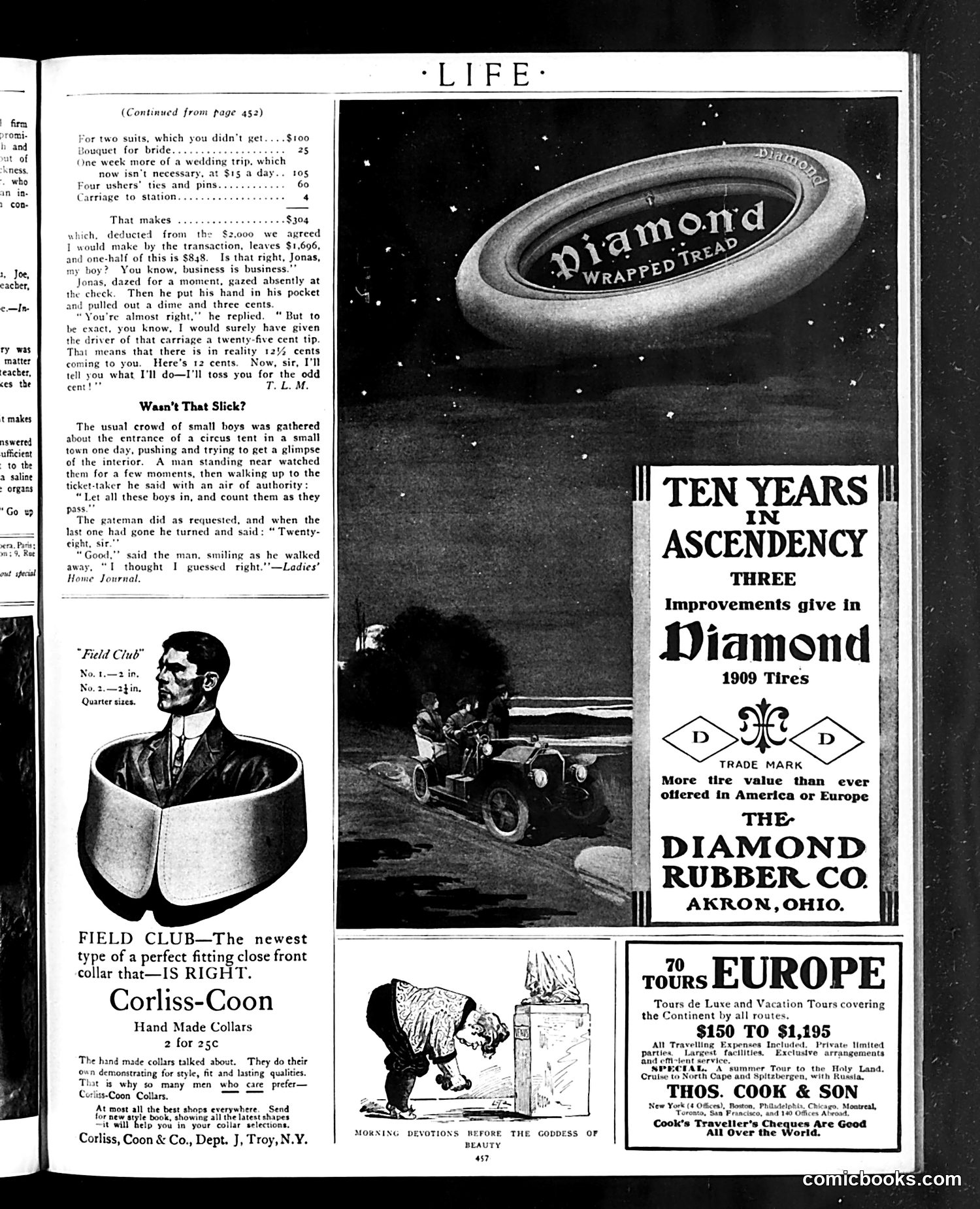
This page contains two distinct humorous stories: **"Wasn't That Slick?"** presents a con-artist anecdote about a man negotiating wedding expenses with Jonas. After carefully itemizing costs that reduce his expected $2,000 profit to $848, Jonas performs a clever reversal: he accounts for a tip the man would have given a carriage driver, reducing what's owed to merely 12 cents—then proposes they "toss" (gamble) for the remainder. The joke satirizes sharp business dealings and the absurdity of penny-pinching negotiations. The second story (heading partially visible) depicts a circus scene where a man instructs the ticket-taker to admit all boys gathered at the tent entrance, then leaves. The implied punchline suggests the man exploited the boys' free admission as a distraction or scam, though the OCR cuts off the conclusion. Both stories mock petty fraud and clever deception in everyday transactions—a satirical commentary on 1909 American business culture and human nature. The page is otherwise filled with period advertisements (Diamond tires, collars, European tours).
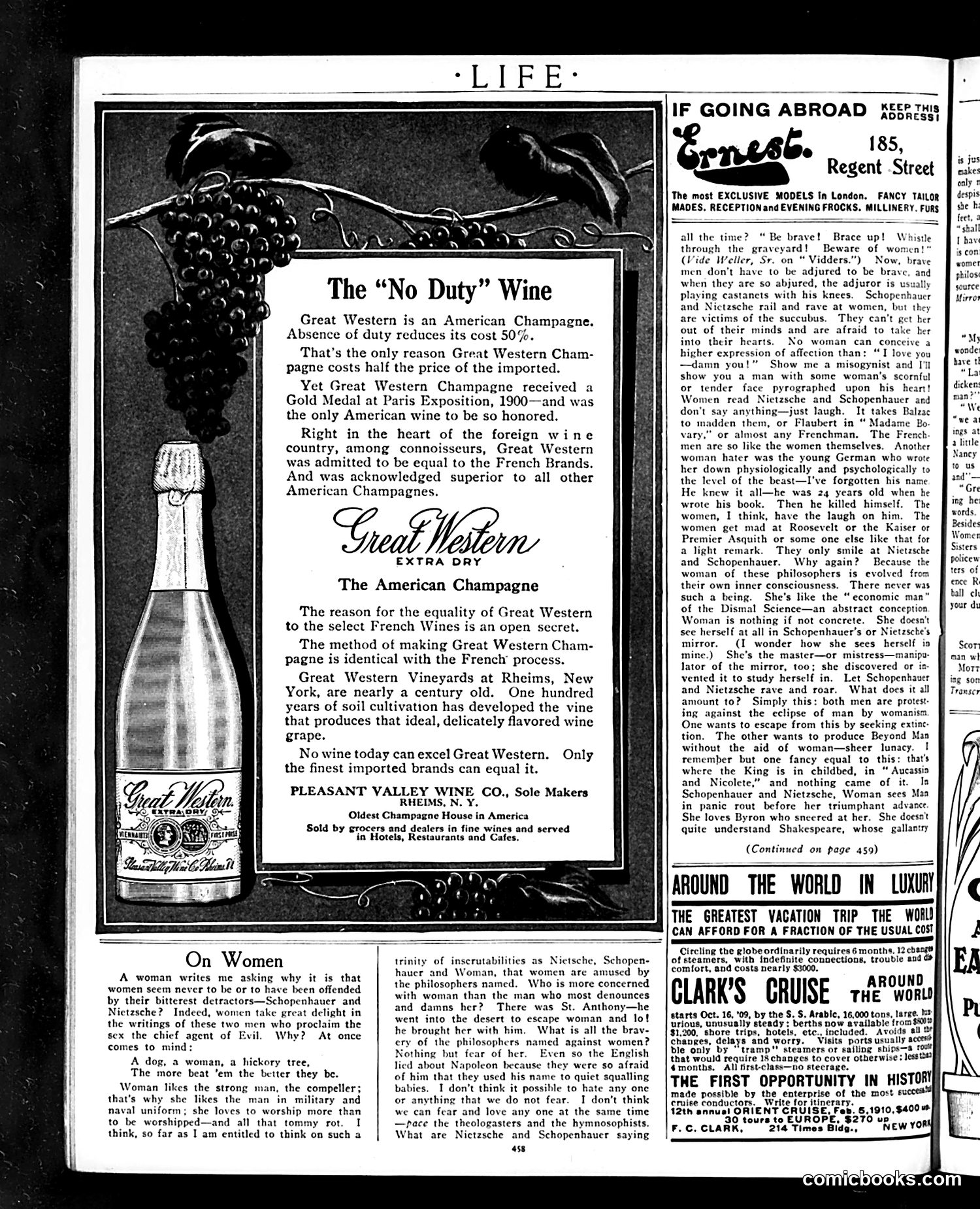
This page contains two distinct elements: a wine advertisement and a philosophical essay. **The Advertisement:** Great Western Champagne promotes itself as an American wine equal to French imports, emphasizing that its lower cost (50% less) stems solely from the absence of import duty, not inferior quality. It claims a Gold Medal from the 1900 Paris Exposition and argues the production method is identical to French champagne. **The Essay "On Women":** The author responds to a reader asking why women aren't offended by misogynistic philosophers Schopenhauer and Nietzsche. The writer argues that women find these philosophers amusing rather than threatening. The central claim: their fierce denunciations of women actually reveal fear and obsession with women, not genuine hatred. The author dismisses their anti-woman rhetoric as performative bluster, suggesting that men who publicly rage against women are actually psychologically dominated by them. The essay uses colorful examples (St. Anthony, Napoleon) to support this paradox. Both pieces reflect early 20th-century attitudes about gender and commerce.
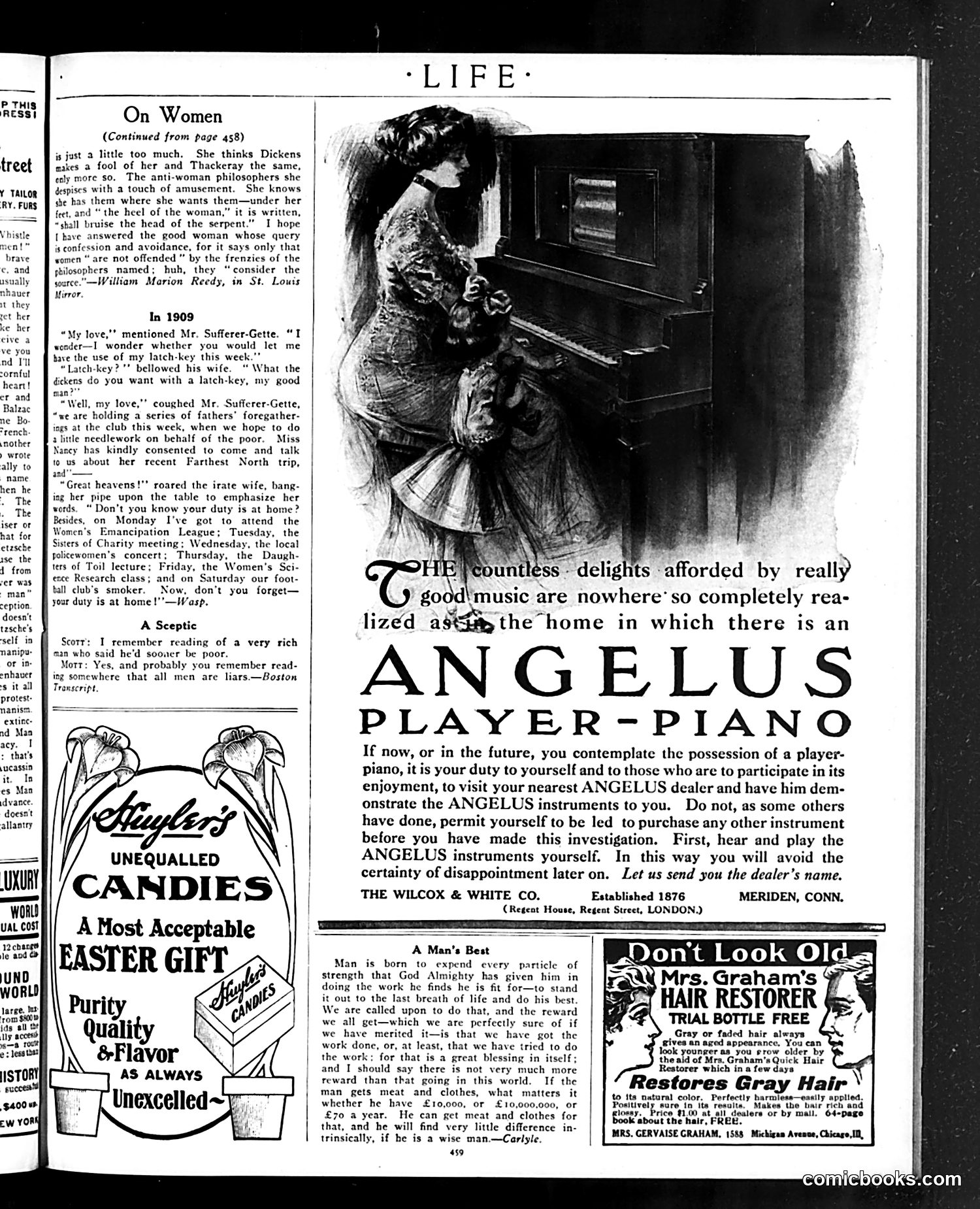
This page contains **satirical commentary on women's rights and gender roles** circa 1909, alongside period advertisements. The main cartoon depicts a marital dispute where Mr. "Sufferer-Gette" (a pun on "suffragette") asks his wife for a latch-key to attend a fathers' club meeting doing charitable needlework. His wife, smoking a pipe, angrily refuses—she's too busy with her own activities: Women's Emancipation League, Charity meetings, policewomen's concerts, and women's science lectures. **The satire's point**: It mocks the emerging women's suffrage and emancipation movements by inverting traditional gender roles. The wife's hypocrisy (demanding freedom while denying her husband's autonomy) is presented as absurd. The cartoon ridicules both militant feminists and the "hen-pecked husband" trope popular in early 20th-century humor. The page also includes an essay section on women, discussing philosophical debates about female nature, alongside conventional advertisements (Angelus player-pianos, hair restorer) targeting period consumers.
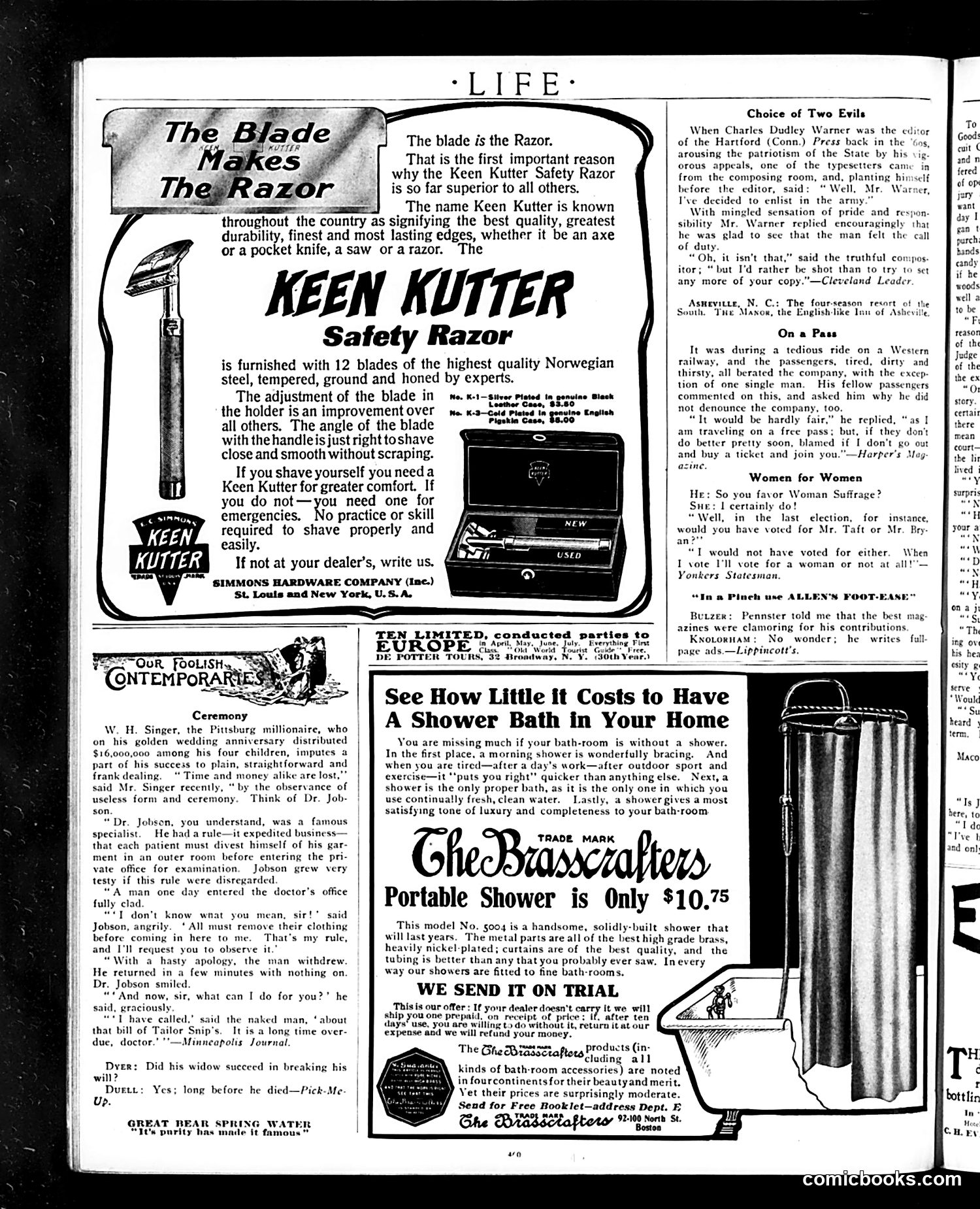
This page combines advertisements with several humorous anecdotes ("Our Foolish Contemporaries" section), a common Life magazine format. **Main Content:** The large Keen Kutter Safety Razor advertisement emphasizes blade quality as the critical feature—a straightforward sales pitch typical of early 20th-century marketing. **Satirical Sections:** - **"Ceremony"**: Mocks rigid, impractical formality through Dr. Jobson's absurd rule requiring patients to undress in an outer room before examination—a critique of meaningless convention over practical sense. - **"On a Pass"**: A gentle joke about a railway passenger's reluctance to criticize the company when traveling free, threatening to "buy a ticket" to legitimately complain—satirizing hypocrisy and entitlement. - **"Choice of Two Evils"**: A typesetter prefers military service to setting Charles Dudley Warner's editorials, finding the work intolerable—humor at Warner's editorial expense. The page reflects Life's satirical mission: using anecdotes to mock human foolishness, pretension, and social absurdity.
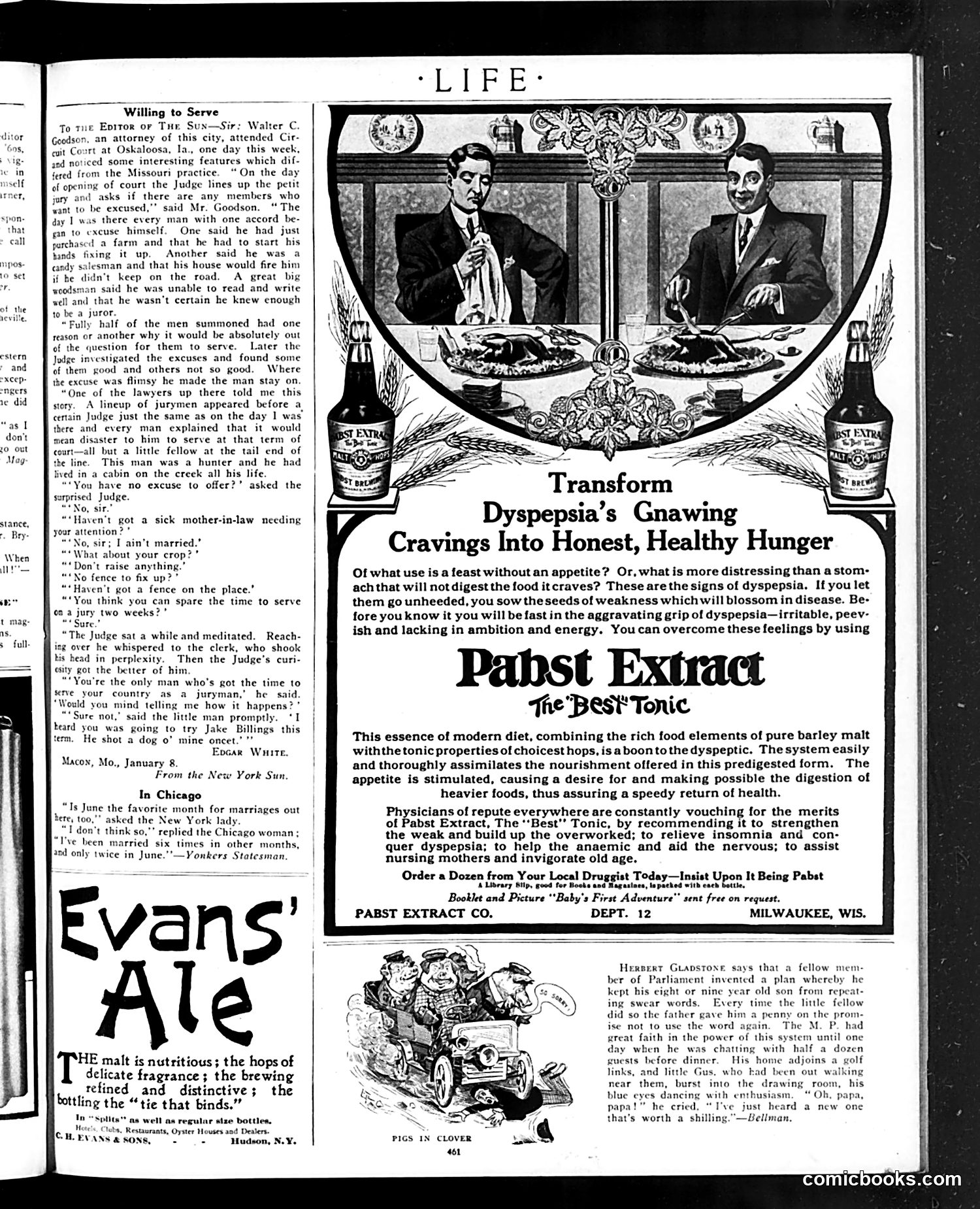
This page contains primarily **advertisements** rather than satirical content. The main advertisement promotes **Pabst Extract**, a medicinal tonic claiming to cure dyspepsia (indigestion). The illustrated scene shows two well-dressed men dining, with the text promising to "transform dyspepsia's gnawing cravings into honest, healthy hunger." This reflects early 20th-century patent medicine marketing, when tonics were heavily advertised as cure-alls for digestive complaints. Below appears a secondary ad for **Evans' Ale**, similarly marketed as a nutritious beverage. The left column contains reader letters to the editor, including a humorous anecdote about jury duty in Iowa and a quip about Chicago marriages—standard filler content for the magazine. **Modern context**: These ads exemplify pre-FDA regulation when dubious health claims were unregulated advertising. Pabst Extract was essentially flavored malt extract with minimal medicinal value, yet marketed with pseudoscientific language about "predigested form" and digestive stimulation.
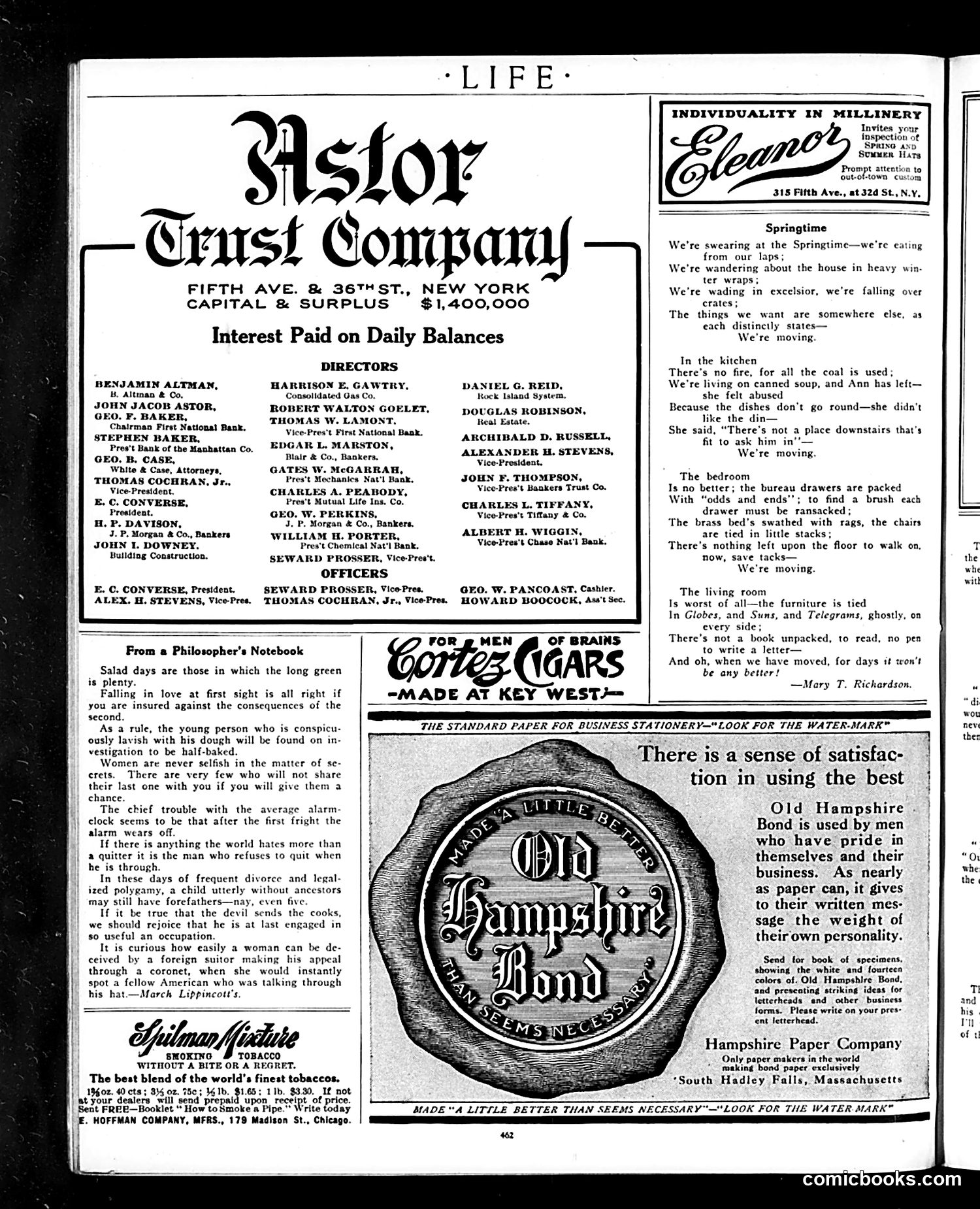
This is primarily a **business/advertising page** rather than a satirical cartoon. The dominant content is an advertisement for the **Astor Trust Company** (Fifth Avenue & 36th Street, New York), listing its directors—a roster of prominent Gilded Age financiers and industrialists including John Jacob Astor, Benjamin Altman, and J.P. Morgan associates. The page includes minor editorial content: a philosophical column offering wry observations about human nature, and a humorous poem titled "Springtime" by Mary T. Richardson describing the chaos of moving house. The remaining advertisements promote luxury goods (millinery, cigars, bond paper), typical of *Life*'s affluent readership. **Context for modern readers**: This reflects early 20th-century American finance and consumer culture—when bank advertisements prominently displayed elite leadership to establish credibility and trust.
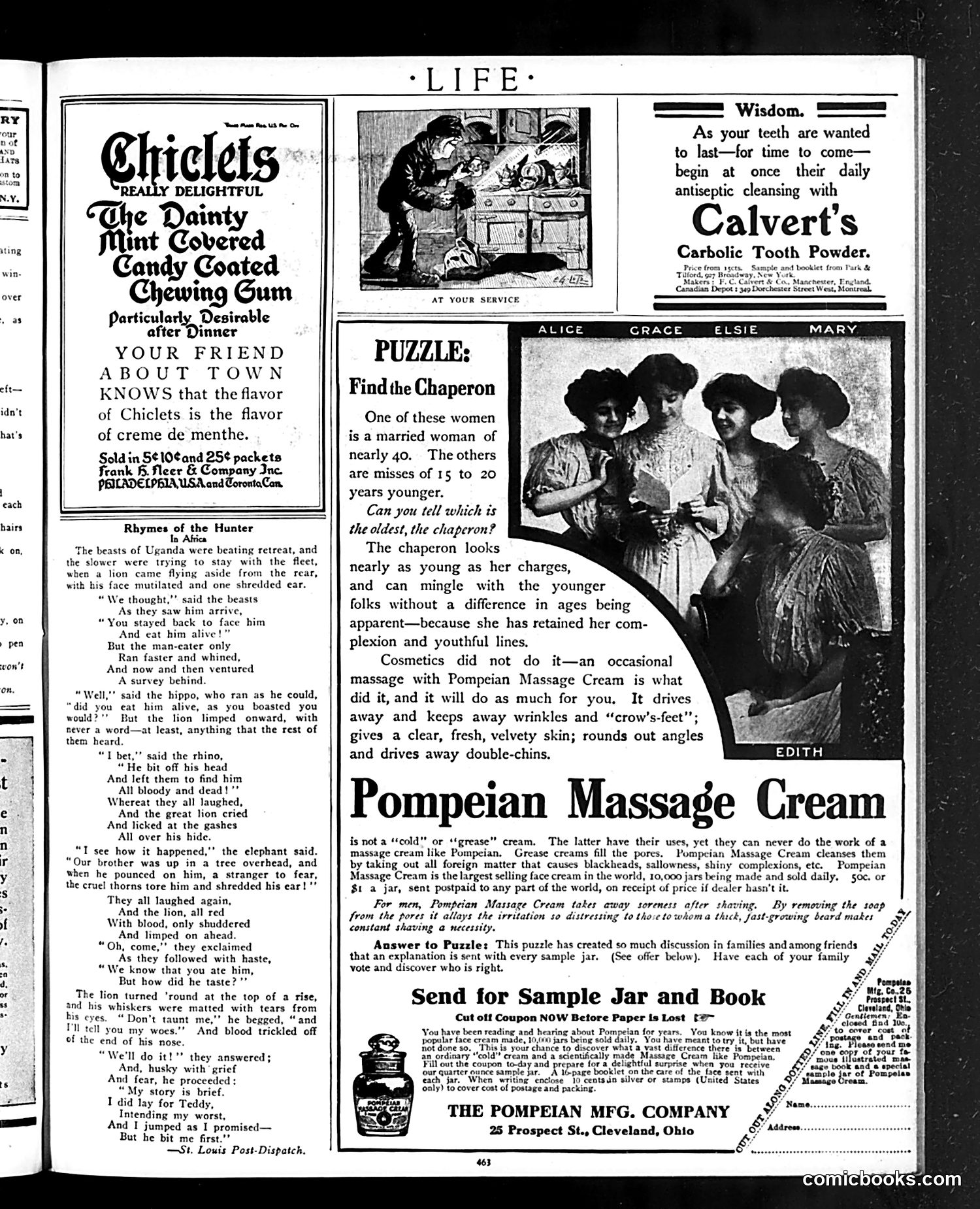
This page is primarily **advertising-driven**, featuring multiple product promotions typical of early 20th-century magazines. The main content includes: 1. **"Rhymes of the Hunter"** — A humorous poem about African animals mocking a wounded lion who claims to have attacked a man. The punchline reveals the lion was actually attacked first by "Teddy" (likely Theodore Roosevelt, known for African big-game hunting), satirizing Roosevelt's hunting exploits and public bravado. 2. **Advertisement features** dominate: Chiclets gum, Calvert's tooth powder, and prominently, **Pompeian Massage Cream**. 3. The **"Find the Chaperon" puzzle** is a visual advertisement: readers must identify which of four women is the 40-year-old married woman among younger women, with the answer being that skincare makes her indistinguishable from girls 15-20 years younger—selling the cream's anti-aging claims. The page reflects early 1900s concerns: personal grooming standards, beauty anxiety, and celebrity culture around Roosevelt's adventurism.
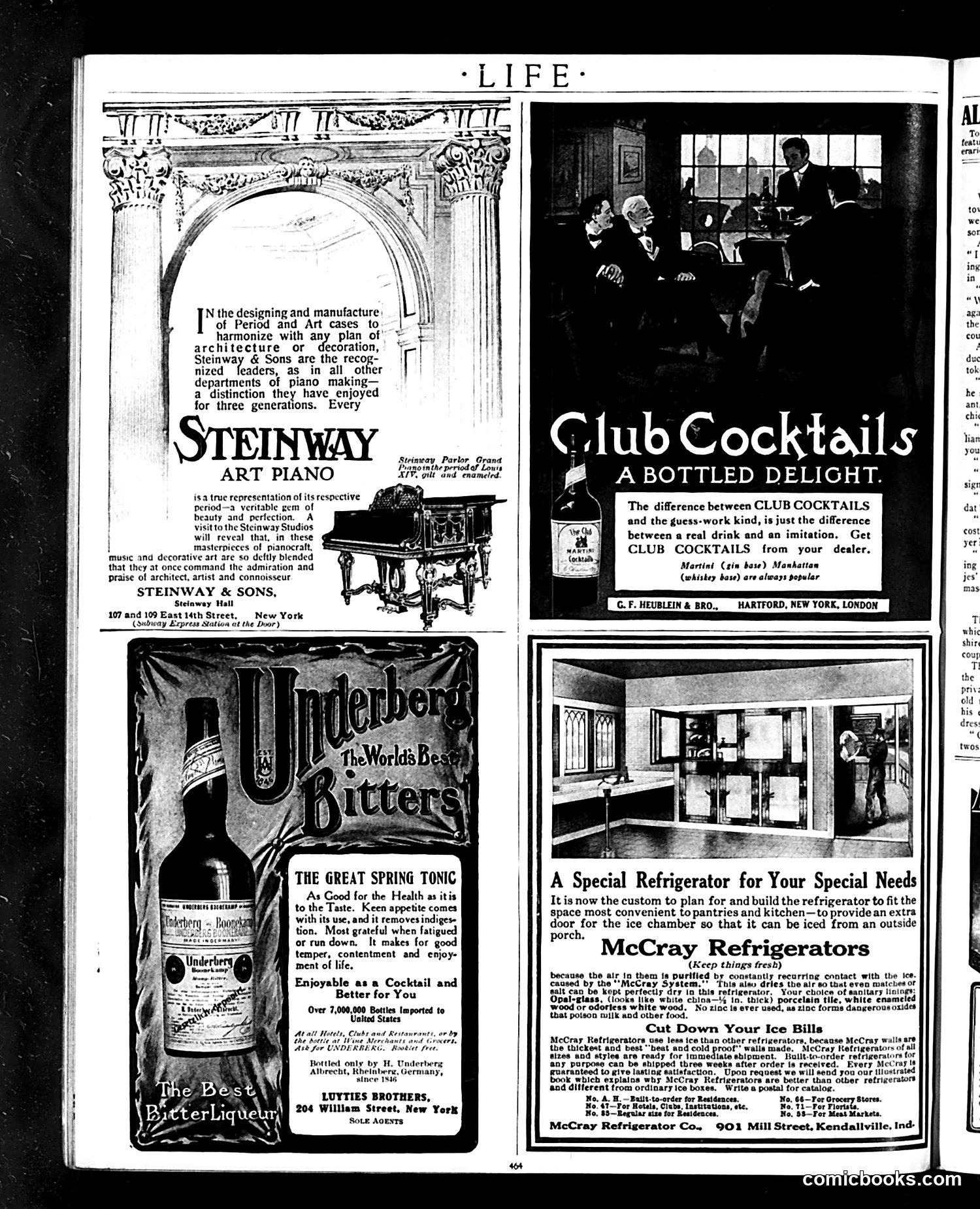
This is primarily an **advertising page**, not political satire. It contains four product advertisements from the early 20th century: 1. **Steinway & Sons pianos** — emphasizing their decorative "Period and Art cases" that harmonize with home architecture, marketed as a three-generation luxury brand 2. **Club Cocktails** — a bottled spirits product claiming superiority over homemade cocktails ("the difference between a real drink and an imitation") 3. **Underberg Bitters** — a German digestive tonic marketed as both a health supplement ("great spring tonic") and cocktail ingredient, imported widely to America 4. **McCray Refrigerators** — commercial and residential ice boxes advertising superior insulation and lower ice consumption The page reflects **Prohibition-era advertising** (note the emphasis on cocktails as purchasable products rather than bartender-made drinks) and early 20th-century consumer culture targeting middle/upper-class households. There is no political cartoon or satire visible.
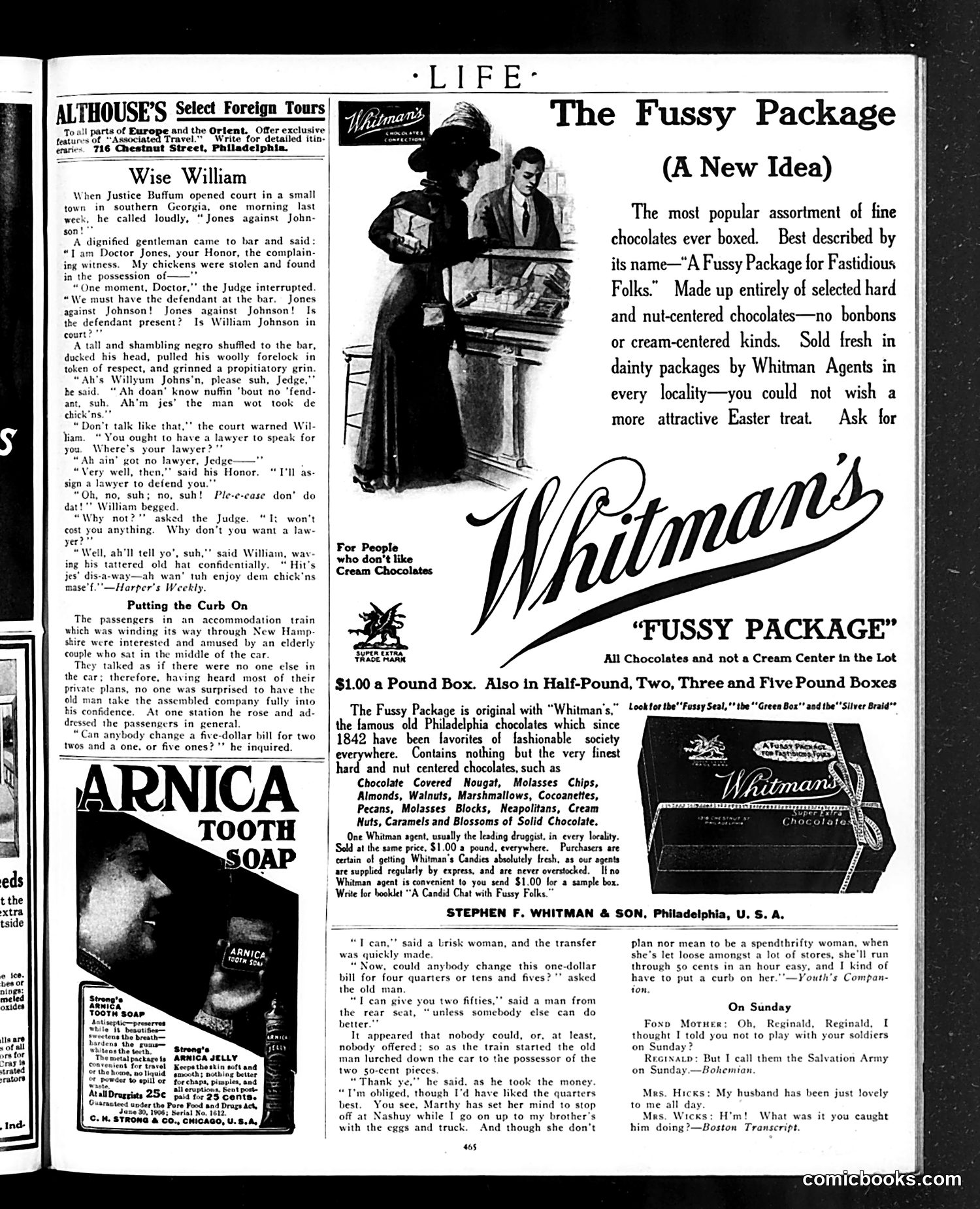
This page contains three distinct pieces: two short humorous anecdotes and a Whitman's chocolate advertisement. **"Wise William"** depicts a courtroom scene in rural Georgia featuring a Black defendant who confesses to stealing chickens. The humor relies on racist dialect stereotyping—the character speaks in exaggerated dialect ("Ah's Willyum Johns'n," "doan' know nuffin"). The joke's premise is that William refuses a lawyer because he wants to "enjoy" the stolen chickens undisturbed, suggesting he expects conviction. This reflects early 20th-century attitudes portraying Black people as simple-minded and criminal. **"Putting the Curb On"** is an unrelated anecdote about a train passenger asking to exchange a five-dollar bill—apparently a setup for a punchline (cut off in this excerpt). The majority of the page features a **Whitman's chocolate advertisement** promoting "The Fussy Package," marketed as bonbon-free chocolates for discerning customers. The ad emphasizes freshness and quality, pricing at $1.00 per pound—substantial in this era.
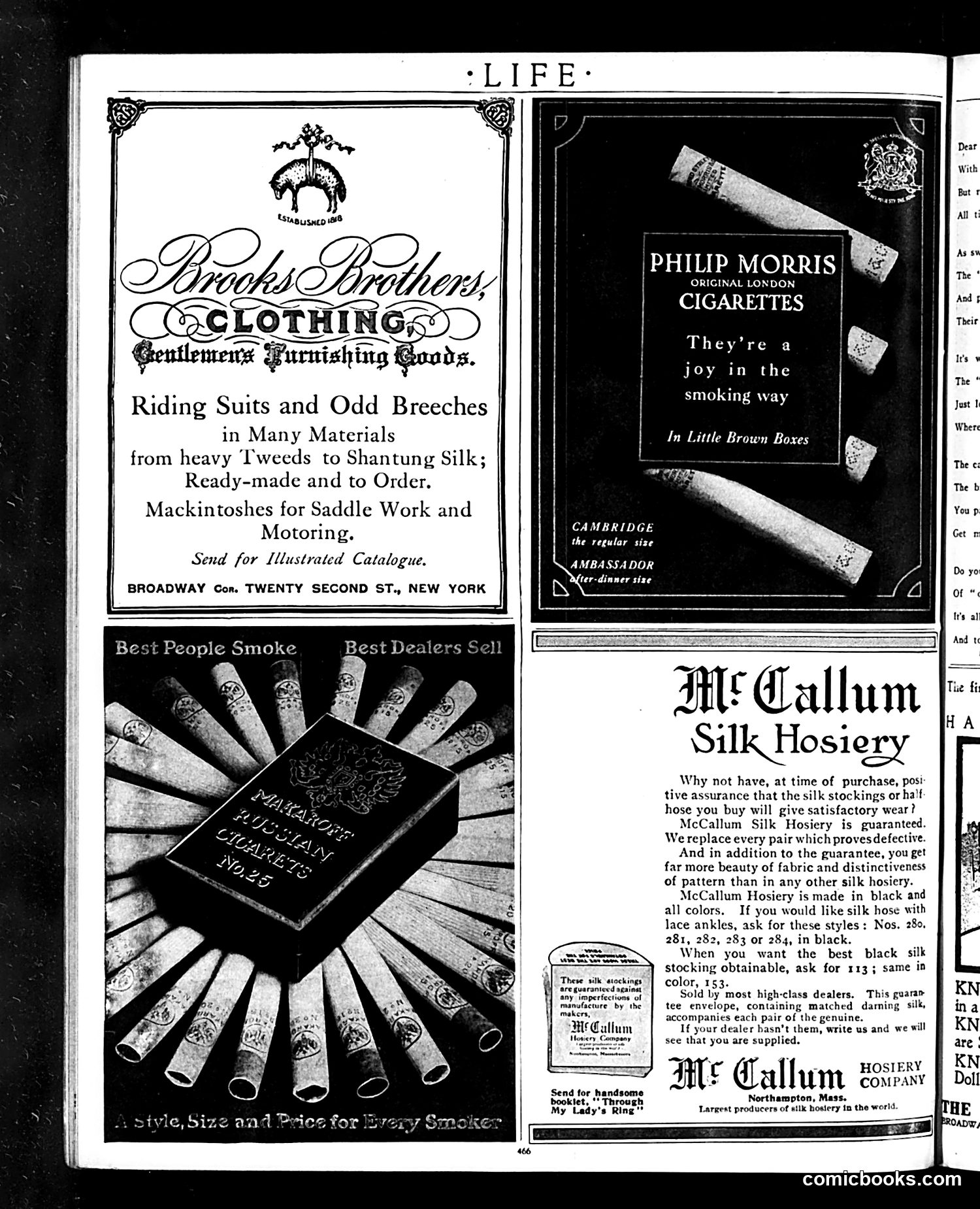
This is primarily an **advertising page**, not satirical content. It contains four product advertisements typical of early 20th-century magazines: 1. **Brooks Brothers** (top left): Gentlemen's clothing—riding suits, breeches, and mackintoshes, emphasizing quality materials and custom ordering. 2. **Philip Morris Cigarettes** (top right): Promotes "Original London Cigarettes" in decorative boxes, marketed as "a joy in the smoking way," available in regular and after-dinner sizes. 3. **Tobacco advertisement** (bottom left): Shows cigars arranged in a circle with text "Best People Smoke / Best Dealers Sell," highlighting style and price variety. 4. **McCallum Silk Hosiery** (bottom right): Guarantees quality silk stockings and socks, emphasizing durability and aesthetic appeal to upscale consumers. The page reflects **Gilded Age consumer culture**, targeting wealthy, refined audiences. There is no political satire present—this appears to be a standard revenue-generating advertising section from Life magazine.
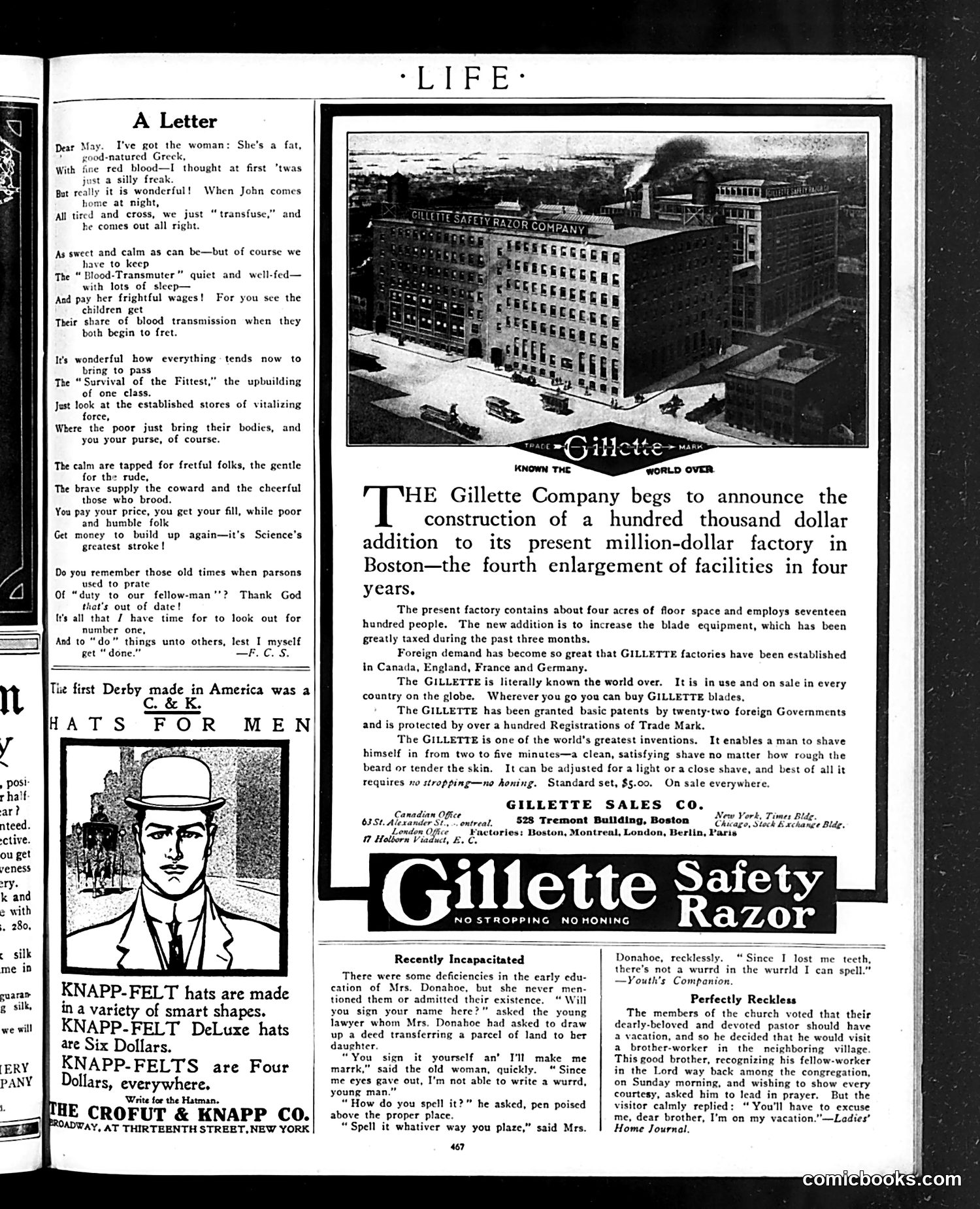
This page contains satirical content critiquing emerging scientific and economic inequalities in early 20th-century America. **"A Letter" (left column):** A poem satirizing "blood transfusion" as a metaphor for class exploitation. The speaker describes literally extracting blood from poor people (the "fat, good-natured Greek" woman) to rejuvenate wealthy clients. The satire targets how capitalism commodifies the poor's bodies while enriching the wealthy, inverting Victorian notions of Christian duty ("duty to our fellow-man") with "Science's greatest stroke"—the ultimate exploitation dressed as progress. **Right side:** Gillette Safety Razor advertisement celebrating factory expansion, representing triumphant industrial capitalism the satire attacks. **Bottom:** A humorous anecdote about an illiterate woman ("Mrs. Donahoe") unable to sign her own land deed, illustrating class-based educational deficiencies. The page juxtaposes socialist critique against capitalist boosterism, creating ironic commentary on American inequality and "progress."
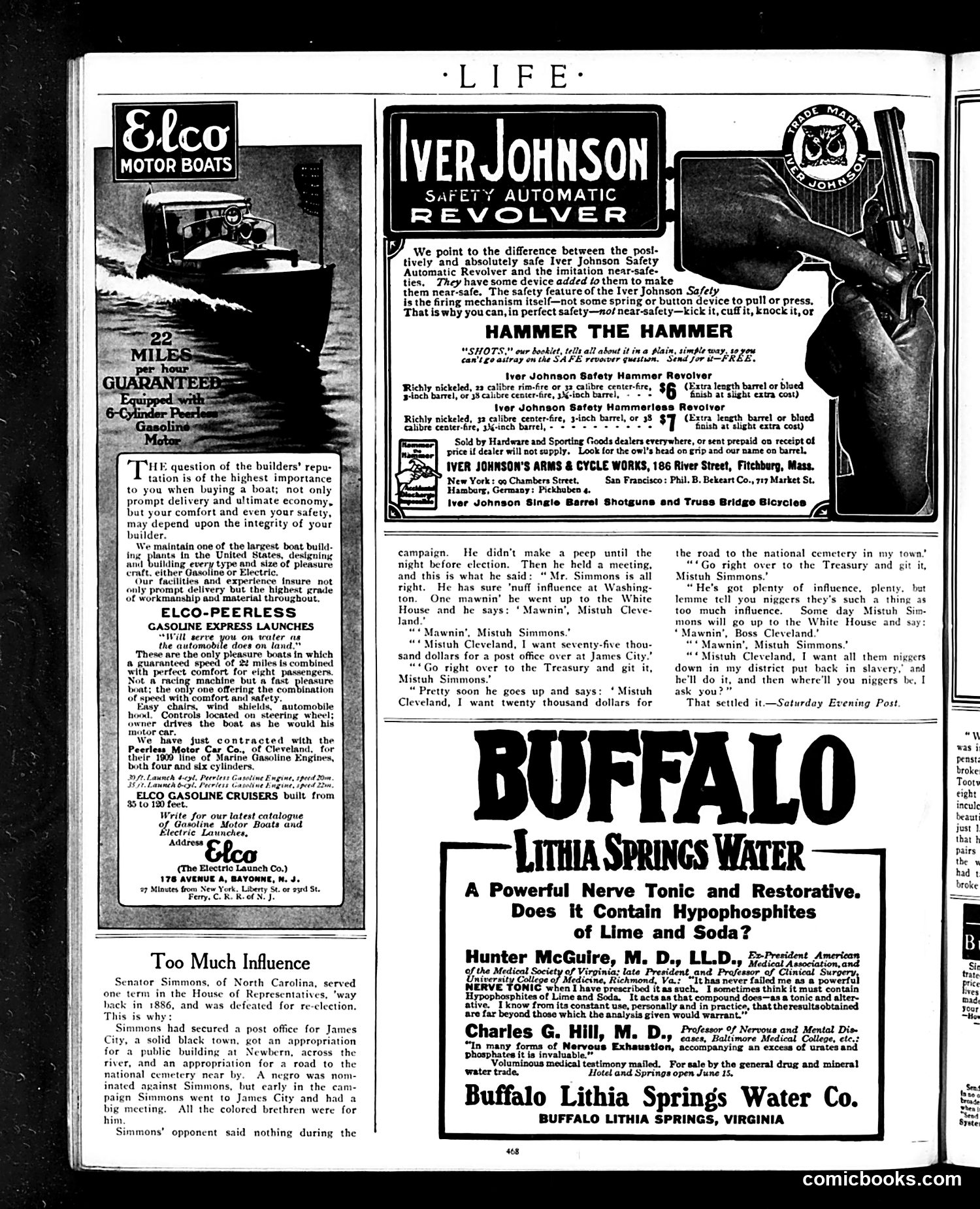
This page is primarily **advertisements** for motor boats, revolvers, and mineral water, with one satirical article titled "Too Much Influence." The article criticizes **Senator Simmons of North Carolina** for abusing his political power. The satire uses a racist dialect monologue (reflecting the era's offensive conventions) to depict Simmons claiming he can extract federal funds for local projects—a post office and cemetery road—simply by requesting them from President Cleveland's Treasury. The point: Simmons is portrayed as wielding excessive, corrupt influence, obtaining government resources for his constituents through personal connections rather than legitimate process. His opponent alleged this represented inappropriate favoritism and abuse of senatorial power during what appears to be an election campaign. The article reflects early 1900s concerns about political patronage and machine politics, though its execution relies on deeply racist stereotypes typical of that period's *Life* magazine.
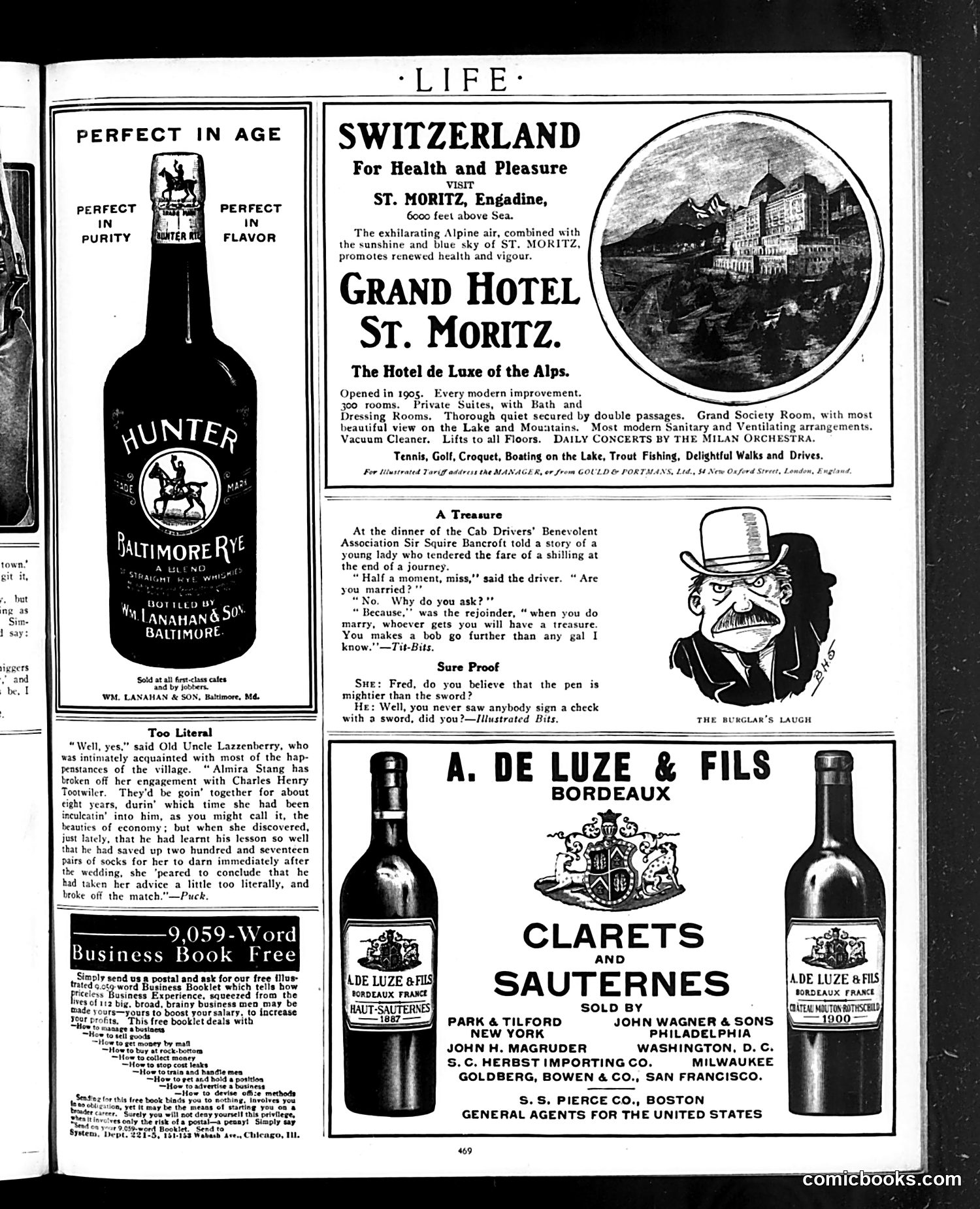
This is primarily an **advertising page** from an early 1900s Life magazine, with three brief humorous anecdotes. The cartoons are gentle Victorian-era jokes: 1. **"Too Literal"** (Puck): A woman breaks her engagement after her fiancé takes her economy lessons *too seriously*—he's saved 217 pairs of socks for her to darn after marriage. The satire mocks both excessive thriftiness and the assumption that wives will perform domestic drudgery. 2. **"A Treasure"** (Cab Drivers' story): A cabbie compliments a young woman for making small money "go further," implying she'll be a frugal wife—satirizing period assumptions about women's primary value being domestic economy. 3. **"Sure Proof"**: A quip about pens vs. swords, ending with a joke about check-signing (contracts/business)—mocking romantic notions of martial prowess. The page features advertisements for Hunter Baltimore Rye whiskey, Grand Hotel St. Moritz (Swiss resort), and A. De Luze & Fils Bordeaux wines. These reflect the magazine's affluent readership.
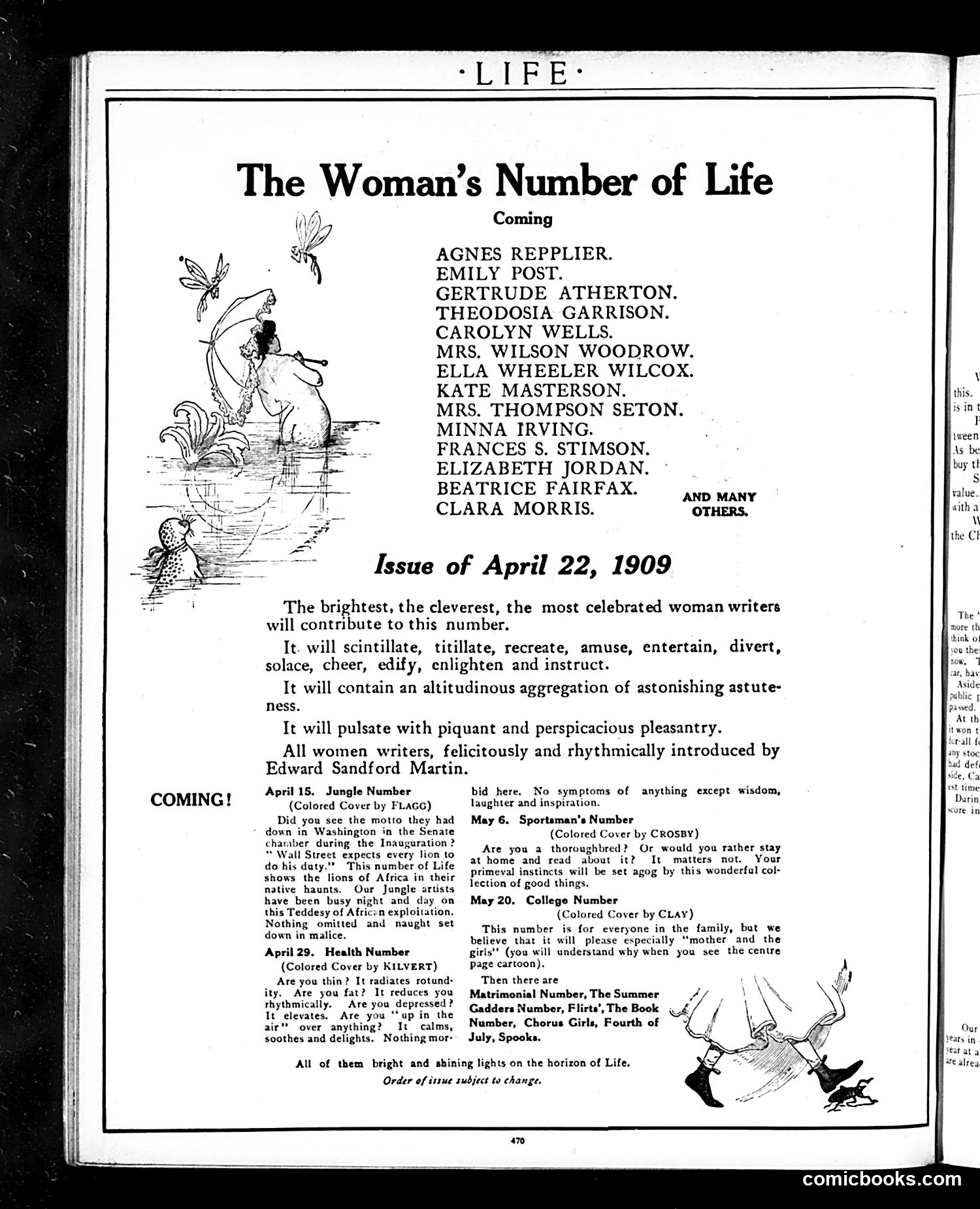
This is a **promotional announcement** for an upcoming special issue celebrating women writers. The page lists prominent female authors of the era (Agnes Repplier, Emily Post, Gertrude Atherton, and others) who will contribute to a "Woman's Number." The satire lies in the **exaggerated language** praising the issue—it will "scintillate, titillate," contain "altitudinous aggregation of astonishing astuteness," and "pulsate with piquant and perspicacious pleasantry." This purple prose mocks both the pretentiousness of literary magazines and period attitudes toward women's intellectual contributions, presenting their writing as frivolous entertainment rather than serious work. The decorative illustrations (a woman by a pond, hands gesturing) are whimsical rather than substantive, reinforcing the lighthearted tone. The page also announces upcoming themed issues (Jungle, Health, Sportsman's numbers), positioning this women's issue as one among Life's various novelty editions—suggesting women writers were treated as a seasonal gimmick rather than permanent cultural fixtures.
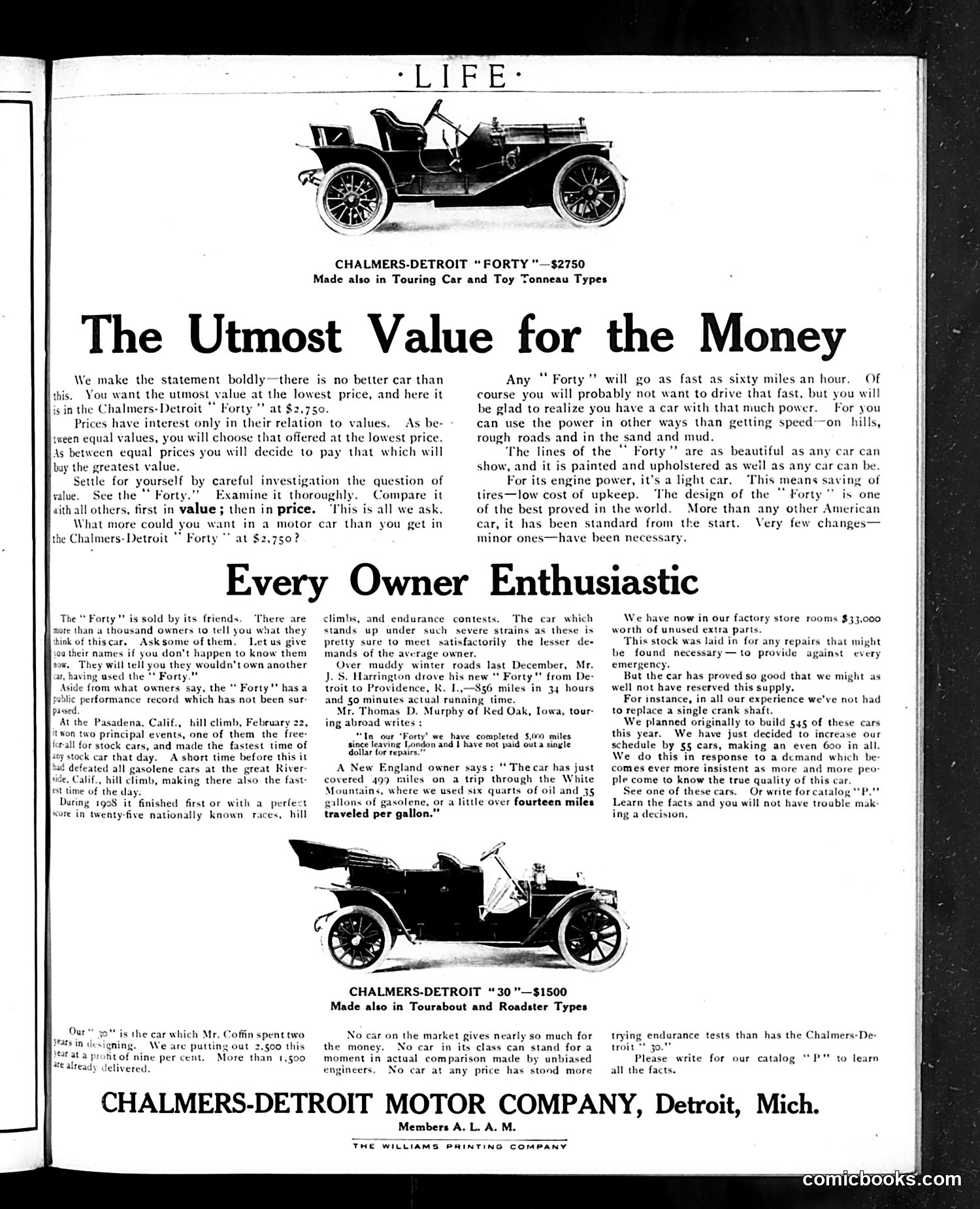
This page from *Life* magazine is a straightforward automobile advertisement for the Chalmers-Detroit Motor Company, not political satire or commentary. The ad promotes two car models—the "Forty" ($2,750) and the "30" ($1,500)—emphasizing value for money and performance. It includes testimonials from satisfied owners claiming durability and fuel efficiency (one owner reports traveling "fourteen miles per gallon"). The ad highlights competitive racing victories and a long-distance driving record (856 miles in 34 hours). The visual elements are technical drawings of the vehicles themselves, not caricatures or cartoon commentary. The selling point is straightforward: these Chalmers-Detroit cars offer superior engineering and reliability at accessible prices compared to competitors. This reflects the early automotive industry's use of *Life*'s editorial space for paid advertising.
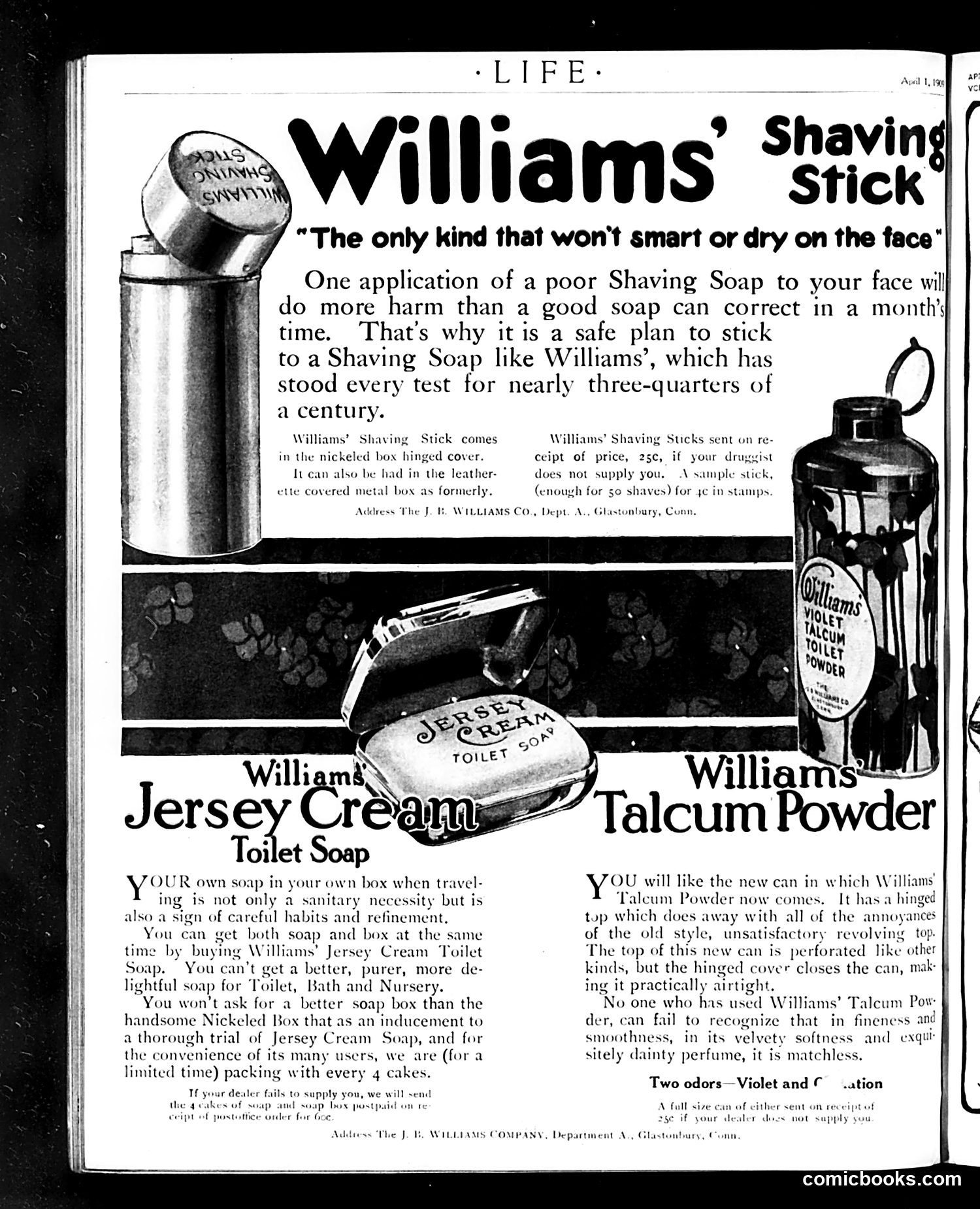
This is **not satirical content** but rather a full-page advertisement from Life magazine (April 1, 1930) promoting Williams toiletries products. The page showcases three items: Williams' Shaving Stick (top), Jersey Cream Toilet Soap (bottom left), and Talcum Powder (bottom right). The marketing emphasizes product quality and convenience—the shaving stick won't "smart or dry," the soap comes in its own elegant nickeled box for travelers, and the talcum powder features a new hinged-top can design. This represents standard early-20th-century advertising rhetoric: appeals to refinement, hygiene, modernity, and product innovation. The company was J.B. Williams Company of Glastonbury, Connecticut. There is no political satire or caricature present—this is straightforward commercial promotion aimed at middle-class consumers concerned with personal grooming and genteel presentation.