
Life, 1909-04-01 · page 34 of 52
Life — April 1, 1909 — page 34: what you’re looking at
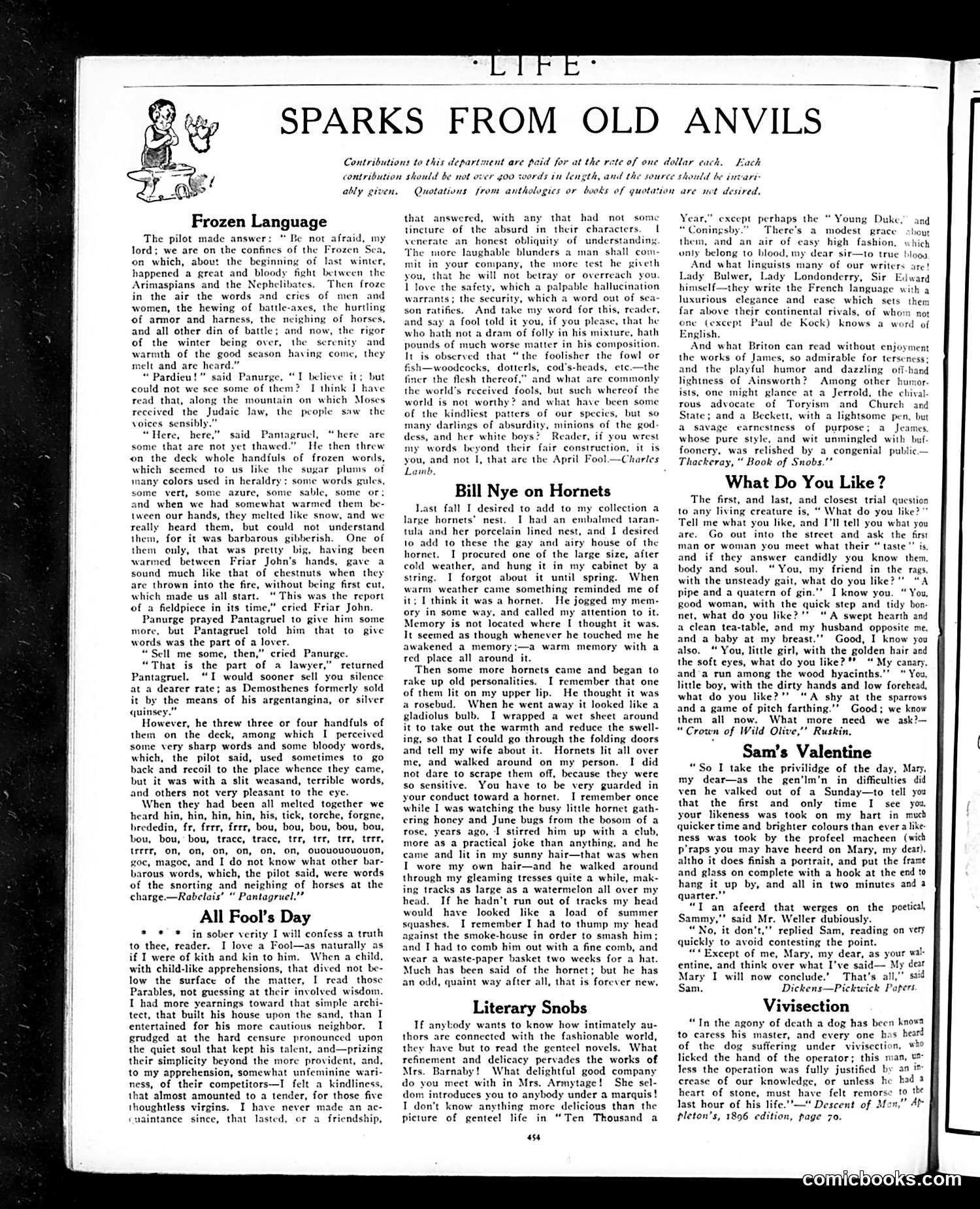
What you’re looking at
This page is primarily **text content**, not political cartoons. It's a literary/humor column featuring reader contributions. The main pieces are: 1. **"Frozen Language"** — An excerpt from Rabelais' *Pantagruel*, a Renaissance satirical novel. The passage imagines frozen battle sounds that thaw and become audible—a fantastical conceit used for absurdist humor about the nature of language and communication. 2. **"All Fool's Day"** — A sentimental essay defending foolishness and simplicity, referencing Biblical parables about fools and the wise, arguing for the virtue of naïveté over calculation. 3. Small sections on other topics like "Bill Nye on Hornets" and "What Do You Like?" **The satirical point**: Life's "Sparks from Old Anvils" department publishes humorous, philosophical, or literary musings—here favoring whimsy and intellectual playfulness over serious discourse. The frozen words concept exemplifies the magazine's appreciation for absurdist wit.
📄 Transcribed text from this page (OCR, searchable)
Machine-transcribed from the original scan — historical spelling and the odd misread are preserved.
SPARKS FROM OLD ANVILS Contributions to this department are paid for at the rate of one dollar each. Each contribution should be not over goo words in length, and the source should be invari- Quotations from anthologies or books of quotation are net desired. ably given. Frozen Language The pilot made answer: “Be not afraid, my lord; we are on the confines of the Frozen Sea, on which, about the beginning of last winter, happened a great and bloody fight between the Arimaspians and the Nephelibates. Then froze in the air the words and cries of men and women, the hewing of battle-axes, the hurtling of armor and harness, the neighing of horses, and all other din of battle; and now, the rigor of the winter being over, the serenity and warmth of the good season having come, they melt and are heard.” “Pardieu!” said Panurge, “I believe it; but could not we see some of them? I think I have read that, along the mountain on which Moses received the Judaic law, the people saw the voices sensibly.” “Here, here,” said Pantagrucl, “here are some that are not yet thawed.” He then threw on the deck whole handfuls of frozen words, which scemed to us like the sugar plums of many colors used in heraldry : some words gules, some vert, some azure, some sable, some or; and when we had somewhat warmed them be- tween our hands, they melted like snow, and we really heard them, but could not understand them, for it was barbarous gibberish. One of them only, that was pretty big, having been warmed between Friar John’s hands. gave a sound much like that of chestnuts when they are thrown into the fire, without being first cut, which made us all start. “This was the report of a fieldpiece in its time,” cried Friar John. Panurge prayed Pantagruel to give him some more, but Pantagruel told him that to give words was the part of a lover. “Sell me some, then,” cried Panurge. “That is the part of a lawyer,” returned Pantagruel. “I would sooner sell you silence at a dearer rate; as Demosthenes formerly sold it by the means of his argentangina, or silver quinse} However, he threw three or four handfuls of them on the deck, among which I perceived some very sharp words and some bloody words, which, the pilot said, used sometimes to go back and recoil to the place whence they came, but it was with a slit weasand, terrible words, and others not very pleasant to the eye. When they had been all melted together we heard hin, hin, hin, hin, his, tick, torche, forgne, brededin, fr, frrr, frrr, bou, bou, bow, bou, bou, bou, bou, bou, trace, trace, trr, trr, trr, trrr, Urrrr, on, on, on, on, on, on, ouououououon, goc, magoc, and I do not know what other b barous words, which, the pilot said, were words of the snorting and neighing of horses at the charge—Rabelais’ “ Pantagruel.’? All Fool’s Day in sober verity I will confess a truth to thee, reader. I love a Fool—as naturally as if I were of kith and kin to him. When a child, with child-like apprehensions, that dived not be- low the surface of the matter, I read those Parables, not guessing at their involved wisdom. I had more yearnings toward that simple archi- tect, that built his house upon the sand, than I entertained for his more cautious neighbor, I grudged at the hard censure pronounced upon the quiet soul that kept his talent, and—prizing their simplicity beyond the more provident, and, to my apprehension, somewhat unfeminine wari ness, of their competitors—I felt a kindliness, that almost amounted to a tender, for those five thoughtless virgins. I have never made an ac- «uaintance since, that lasted, or a friendship, that answered, with any that had not sonic tincture of the absurd in their characters. | venerate an honest obliquity of understanding The more laughable blunders a man shall com- mit in your company, the more test he giveth you, that he will not betray or overreach you 1 love the safety, which a palpable hallucination warrants; the security, which a word out of sea- son ratifies, And take my word for this, reader, and say a fool told it you, if you please, that he who hath not a dram of folly in his mixture, hath pounds of much worse matter in his composition It is observed that “the foolisher the fowl or h—woodcocks, dotterls, cod’s-heads, ete.—the finer the flesh thereof,” and what are commonly the world’s received fools, but such whereof the world is not worthy? and what have been some of the kindliest patters of our species, but so many darlings of absurdity, minions of the god dess, and her white boys? Reader, if you wrest my words beyond their fair construction, it is and not I, that are the April Fool—Charles Bill Nye on Hornets Last fall I desired to add to my collection a large hornets’ nest. I had an embalmed taran- tula and her porcelain lined nest, and I desired to add to these the gay and airy house of the hornet. I procured one of the large size, after cold weather, and hung it in my cabinet by a string. I forgot about it until spring. When warm weather came something reminded me of it; I think it was a hornet. He jogged my mem- ory in some way, and called my attention to it. Memory is not located where I thought it was. It seemed as though whenever he touched me he awakened a memory ;—a warm memory with a red_place all around it. Then some more hornets came and began to rake up old personalities. I remember that one of them lit on my upper lip. He thought it was a rosebud. When he went away it looked like a gladiolus bulb. I wrapped a wet sheet around it to take out the warmth and reduce the swell- ing, so that I could go through the folding doors and tell my wife about it. Hornets lit all over me, and walked around on my person. I did not dare to scrape them off, because they were so sensitive. You have to be very guarded in your conduct toward a hornet. I remember once while I was watching the busy little hornet gath- cring honey and June bugs from the bosom of a rose, years ago, ‘I stirred him up with a club, more as a practical joke than anything, and he came and lit in my sunny hair—that was when I wore my own hair—and he walked around through my gleaming tresses quite a while, mak- ing tracks as large as a watermelon all over my head. If he hadn't run out of tracks my head would have looked like a load of summer squashes. I remember I had to thump my head against the smoke-house in order to smash him; and Thad to comb him out with a fine comb, and wear a waste-paper basket two weeks for a hat. Much has been said of the hornet; but he has an odd, quaint way after all, that is forever new. Literary Snobs If anybody wants to know how intimately au- thors are connected with the fashionable world, they have but to read the genteel novels. What refinement and delicacy pervades the works of Mrs. Barnaby! What delightful good company do you meet with in Mrs. Armytage! She sel- dom introduces you to anybody under a marquis! I don’t know anything more delicious than the picture of genteel life in “Ten Thousand a 4s Year,” except perhaps the “ Young Duke,” and “Coningsby.” There's a modest grace shout m, and an air of easy high fashion, which only belong to blood, my dear sir—to true bloos And what linguists many of our writers are! Lady Bulwer, Lady Londonderry, Sir Edward himself—they write the French language with a luxurious elegance and ease which sets them r above thejr continental rivals, of whom not © except Paul de Kock) knows a English. And what Briton can read without enjoyment the works of James, so admirable for terseness: and the playful humor and dazzling off-hand ness of Ainsworth? Among other humor. sts, one might glance at a Jerrold, the chival- rous advocate of Toryism and Church and State; and a Beckett, with a lightsome pen, but a savage earnestness of purpose; a Jeames whose pure style, and wit unmingled with buf foonery, was relished by a congenial public— Thackeray, “ Book of Snobs.”’ What Do You Like? The first, and last, and closest trial question to any living creature is, “ What do you like?” Tell me what you like, and I'll tell you what you are. Go out into the street and ask the first man of woman you meet what their “ taste" is, and if they answer candidly you know them. body and soul. “You, my friend in the rags. with the unsteady gait, what do you like?" “A pipe and a quatern of gin.” I know you. “ You, good woman, with the quick step and tidy bon. net, what do you like?’? “A swept hearth and a clean tea-table, and my husband opposite me, and a baby at my breast."? Good, I know you also. “You, little girl, with the golden hair and the soft eyes, what do you like? “ My canary, anda run among the wood hyacinths.” “You, little boy, with the dirty hands and low forehead, what do'you like?’ “A shy at the sparrows and a game of pitch farthing.” Good; we know them all now. What more need we ask?— “Crown of Wild Olive,” Ruskin, Sam’s Valentine “So I take the privilidge of the day, Mary, my dear—as the gen'lm’n in difficulties did ven he valked out of a Sunday—to tell you that the first and only time I see you. your likeness was took on my hart in mucb quicker time and brighter colours than ever a like- ness was took by the profeel_macheen (wict p'raps you may have heerd on Mary, my deat). altho it does finish a portrait, and put the frane and glass on complete with a hook at the end hang it up by, and all in two minutes and a quarter.”” “Tan afeerd that werges on the poetical Sammy,” said Mr. Weller dubiously. “No, it don’t,” replied Sam, reading on quickly to avoid contesting the point. . “*Except of me, Mary, my dear, as your wal entine, and think over what I've said— My dat Mary I will now conclude.’ That's all,” said Sam. Dickens—Pickwick Papers Vivisection “In the agony of death a dog has been knows to caress his master, and every one has heard of the dog suffering under vivisection, licked the hand of the operator; this man, less the operation was fully justified by an im crease of our knowledge, or unless he bad + heart of stone, must have felt remorse to tbe last hour of his life.""—" Descent of Mon,” 4h pleton’s, 1896 edition, page 70. word of