
Life, 1909-04-01 · page 16 of 52
Life — April 1, 1909 — page 16: what you’re looking at
What you’re looking at
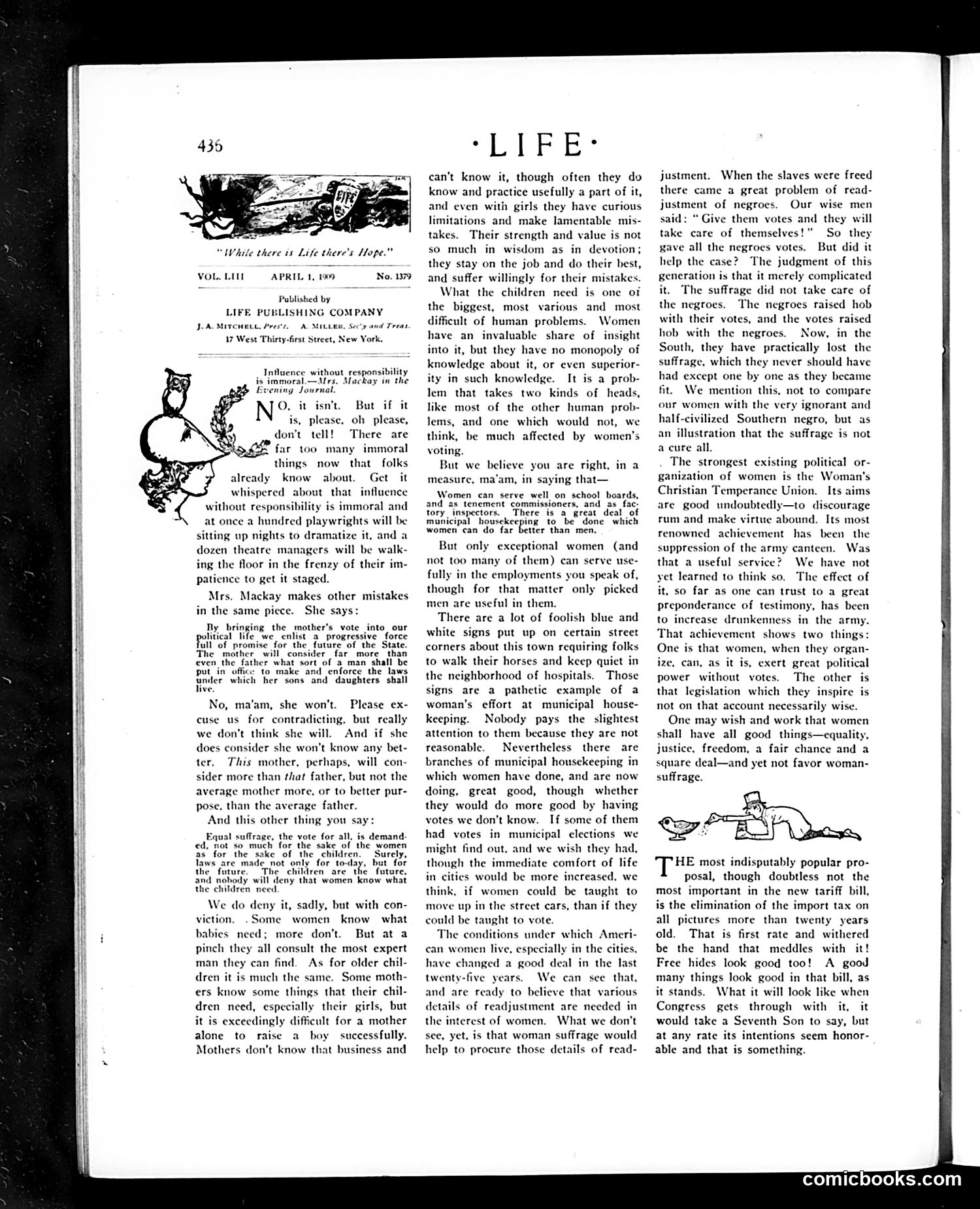
This page from Life magazine (April 1, 1912) critiques arguments for women's suffrage, particularly responding to statements by Mrs. Mackay published in the Evening Journal. **The Satire's Target:** Life's editors mock pro-suffrage claims that women voters would be morally superior lawmakers, especially regarding children's welfare. They argue women lack the practical expertise and business knowledge necessary for governance. **Key Arguments Attacked:** - That mothers naturally understand what children need better than fathers - That women's votes would improve legislation for future generations - That women excel at all forms of municipal governance **Life's Counterargument:** While acknowledging women can effectively serve on school boards and factory inspections (domestic/social matters), the editors insist most women lack the judgment for broader political decisions. They illustrate this with hospital signs women supposedly mandated—which people ignore because they're "not reasonable." **Context:** This represents anti-suffrage sentiment common before women gained voting rights (1920). The magazine frames opposition as practical rather than ideological, though this masks resistance to women's political equality.
📄 Transcribed text from this page (OCR, searchable)
Machine-transcribed from the original scan — historical spelling and the odd misread are preserved.
“While there is Life there's Hope.” No. 1379 APRIL 1, 199 Published by LIFE PUBLISHING COMPANY JA MITCHELL, Prost. A MILLER, Sec'y and Treas. 17 West Thirty-first Street, New York. Influence without responsibility is immoral.—Mrs. Mackay in the Evening Journal. N ©. it isn't. But it it is, please, oh please, don’t tell! There are far too many immoral things now that folks already know about. Get it whispered about that influence without responsibility is immoral and at once a hundred playwrights will be sitting up nights to dramatize it, and a dozen theatre managers will be walk- ing the floor in the frenzy of their im- Patience to get it staged. Mrs, Mackay makes other mistakes in the same piece. She says: By bringing the mother's vote into, our litical life we enlist a progressive force full of promise for the future of the State. The ‘mother will consider far more than even the father what sort of a man shall be put in office to make and enforce the laws Hodee which her sons and daughters shall i No, ma’am, she won't. Please ex- cuse us for contradicting. but really we don’t think she will. And if she does consider she won't know any bet- ter, This mother, perhaps, will con- sider more than that father, but not the average mother more, or to better pur- pose, than the average father. And this other thing you say: Equal suffrage, the vote for all, is demand- ed, not so much for the sake of the women as’ for the sake of the children. Surely, laws are made not only for today, but for future. The children are the future, and nobody will deny that women know what the children need. We do deny it, sadly, but with con- viction. .Some women know what babies need; more don't. But at a pinch they all consult the most expert man they can find. As for older chil- dren it is much the same. Some moth- ers know some things that their chil- dren need, especially their girls, but it is exceedingly difficult for a mother alone to raise a boy successfully. Mothers don't know that business and “LLE EE’ can’t know it, though often they do know and practice usefully a part of it, and even with girls they have curious limitations and make lamentable mis- takes. Their strength and value is not so much in wisdom as in devotion; they stay on the job and do their best, and suffer willingly for their mistakes. What the children need the biggest, most various and most difficult of human problems. Women have an invaluable share of insight into it, but they have no monopoly of knowledge about it, or even superior- ity in such knowledge. It is a prob- lem that takes two kinds of heads, like most of the other human prob- Jems, and one which would not, we think, be much affected by women’s voting. But we believe you are right, in a measure, ma’am, in saying that— Women can serve well on school boards, and as tenement commissioners, and as fac: tory inspectors. There is a great deal of municipal housekeeping to be done which women can do far better than men. is one of But only exceptional women (and not too many of them) can serve use- fully in the employments you speak of, though for that matter only picked men are useful in them, There are a lot of foolish blue and white signs put up on certain street corners about this town requiring folks to walk their horses and keep quiet in the neighborhood of hospitals. Those signs are a pathetic example of a woman's effort at municipal house- keeping. Nobody pays the slightest attention to them because they are not reasonable. Nevertheless there are branches of municipal housekeeping in which women have done, and are now doing, great good, though whether they would do more good by having votes we don’t know. If some of them had votes in municipal elections we might find out, and we wish they had, though the immediate comfort of life in cities would be more increased. we think, if women could be taught to move up in the street cars, than if they could be taught to vote. The conditions under which Ameri- can women live, especially in the cities, have changed a good deal in the last twenty-five years. We can see that, and are ready to believe that various details of readjustment are needed in the interest of women. What we don't see, yet, is that woman suffrage would help to procure those details of read- justment. When the slaves were freed there came a great problem of read- justment of negroes. Our wise men said: “Give them votes and they will take care of themselves!” So they gave all the negroes votes. But did it help the case? The judgment of this generation is that it merely complicated it. The suffrage did not take care of the negroes. The negroes raised hob with their votes, and the votes raised hob with the negroes. Now, in the South, they have practically lost the suffrage. which they never should have had except one by one as they became fit. We mention this, not to compare our women with the very ignorant and half-civilized Southern negro, but as an illustration that the suffrage is not a cure all. The strongest existing political or- ganization of women is the Woman's Christian Temperance Union. Its aims are good undoubtedly—to discourage rum and make virtue abound. Its most renowned achievement has been the suppression of the army canteen. Was that a useful service? We have not yet learned to think so. The effect of it, so far as one can trust to a great preponderance of testimony, has been to increase drunkenness in the army. That achievement shows two things: One is that women, when they organ- ize, can, as it is, exert great political power without vot The other is that legislation which they inspire is not on that account necessarily wise. One may wish and work that women shall have all good things—equality, justice, freedom, a fair chance and a square deal—and yet not favor woman- suffrage. HE most indisputably popular pro- posal, though doubtless not the most important in the new tariff bill, is the elimination of the import tax on all pictures more than twenty years old. That is first rate and withered be the hand that meddles with it! Free hides look good too! A good many things look good in that bill, as it stands. What it will look like when Congress gets through with it, it would take a Seventh Son to say, but at any rate its intentions seem honor- able and that is something. comicbooks.com