
Life, 1909-04-01 · page 28 of 52
Life — April 1, 1909 — page 28: what you’re looking at
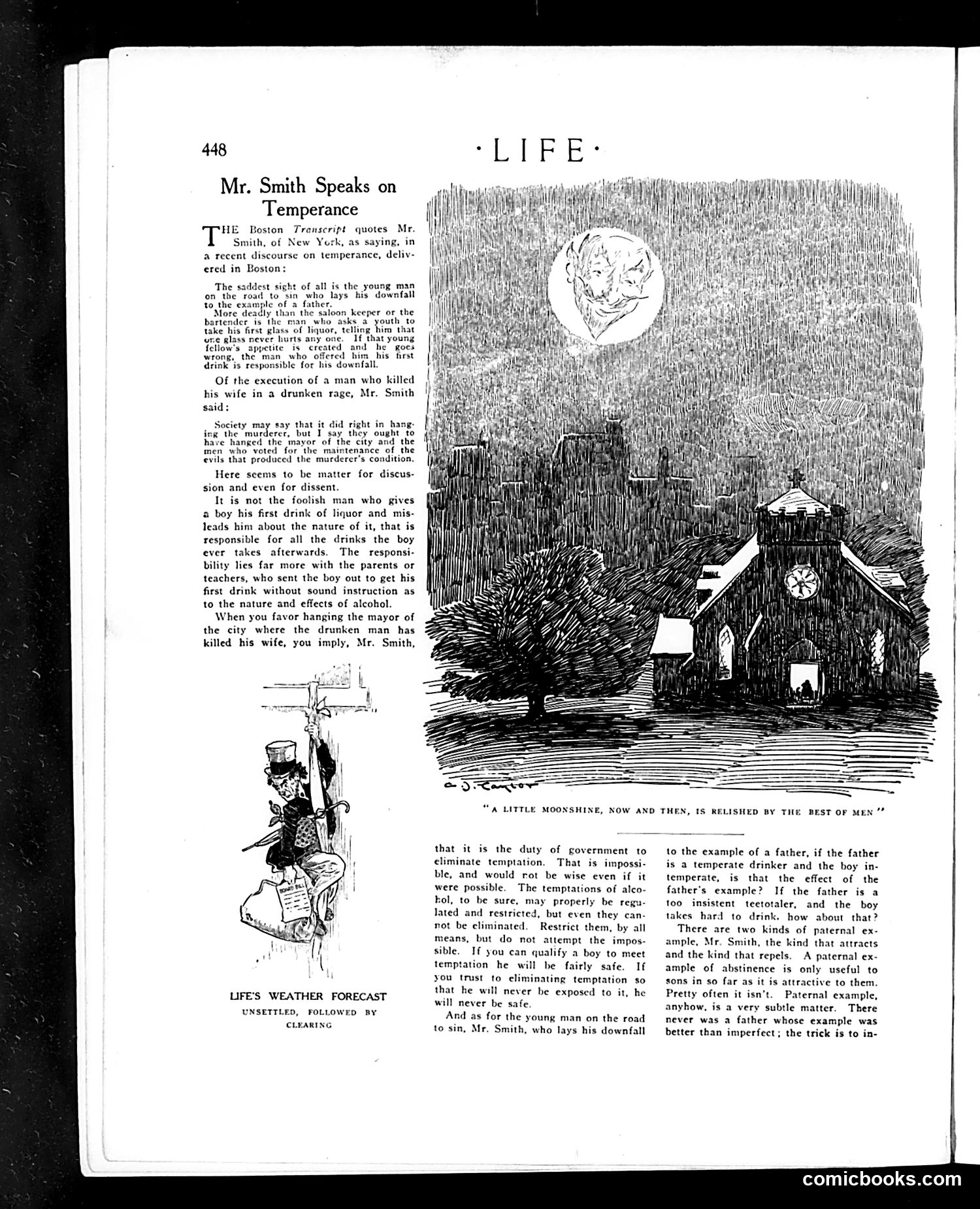
What you’re looking at
This page presents a temperance debate from the Boston *Transcript*. Mr. Smith of New York argues that society bears responsibility for alcohol-related tragedies—claiming the saloon keeper who gives a youth his first drink, or a city mayor whose jurisdiction permits drunkenness leading to murder, share culpability. The opposing editorial voice (likely *Life*'s) counters with pragmatism: eliminating temptation is impossible; instead, parents and teachers must educate youth about alcohol's effects. It also challenges Smith's logic about paternal influence, noting that both excessive drinking *and* strict teetotaling can backfire as negative examples. The accompanying illustration depicts a moonlit rural tavern, captioned "A little moonshine, now and then, is relished by the best of men"—mocking temperance reformers' idealism through ironic acceptance of drinking culture. *Life* uses Smith as a straw man for reform zeal, arguing moral responsibility lies with education, not prohibition or blame-shifting to authorities.
📄 Transcribed text from this page (OCR, searchable)
Machine-transcribed from the original scan — historical spelling and the odd misread are preserved.
448 Mr. Smith Speaks on Temperance HE Boston Transcript quotes Mr. Smith, of New York, as saying, in a recent discourse on temperance, deliv- ered in Boston: The saddest si d to fon the ro: to the exal t of all is the young man in who lays his downfall saloon keeper or the n who asks a youth to take his first glass of liquor, telling him that une glass never hurts any one, If that young fellow's appeti is created and he goes wrong, the man who offered him his first drink is responsible for his downfall. Of the execution of a man who killed his wife in a drunken rage, Mr. Smith said: say that it did right in hang: Society ma} say they ought to fg the murderer, but Ben he seied for tke Suanteanuce of ane evils that produced the murderer's condition Here seems to be matter for discus- sion and even for dissent. It is not the foolish man who gives a boy his first drink of liquor and mis- leads him about the nature of it, that is responsible for all the drinks the boy ever takes afterwards. The responsi- bility lies far more with the parents or teachers, who sent the boy out to get his first drink without sound instruction as to the nature and effects of alcohol. When you favor hanging the mayor of the city where the drunken man has killed his wife, you imply, Mr. Smith, LIFE'S WEATHER FORECAST UNSETTLED, FOLLOWED BY CLEARING ‘or of the city and the | that it is the duty of government to climinate temptation. That is impossi- ble, and would rot be wise even if it were possible. The temptations of alco- hol, to be sure, may properly be regu- lated and restricted, but even they can- not be eliminated. Restrict them, by all means, but do not attempt the impos- sible. If you can qualify a boy to meet temptation he will be fairly safe. If you trust to eliminating temptation so that he will never be exposed to it, he will never be safe And as for the young man on the road to sin, Mr. Smith, who lays his downfall to the example of a father, if the father is a temperate drinker and the boy in- temperate, is that the effect of the father’s example? If the father is a too insistent teetotaler, and the boy takes hard to drink. how about that? There are two kinds of paternal ex- ample, Mr. Smith, the kind that attracts and the kind that repels. A paternal ex- ample of abstinence is only useful to sons in so far as it is attractive to them. Pretty often it isn’t. Paternal example, anyhow, is a very subtle matter. There never was a father whose example was better than imperfect; the trick is to in- comicbooks.com