
Life, 1909-04-01 · page 24 of 52
Life — April 1, 1909 — page 24: what you’re looking at
What you’re looking at
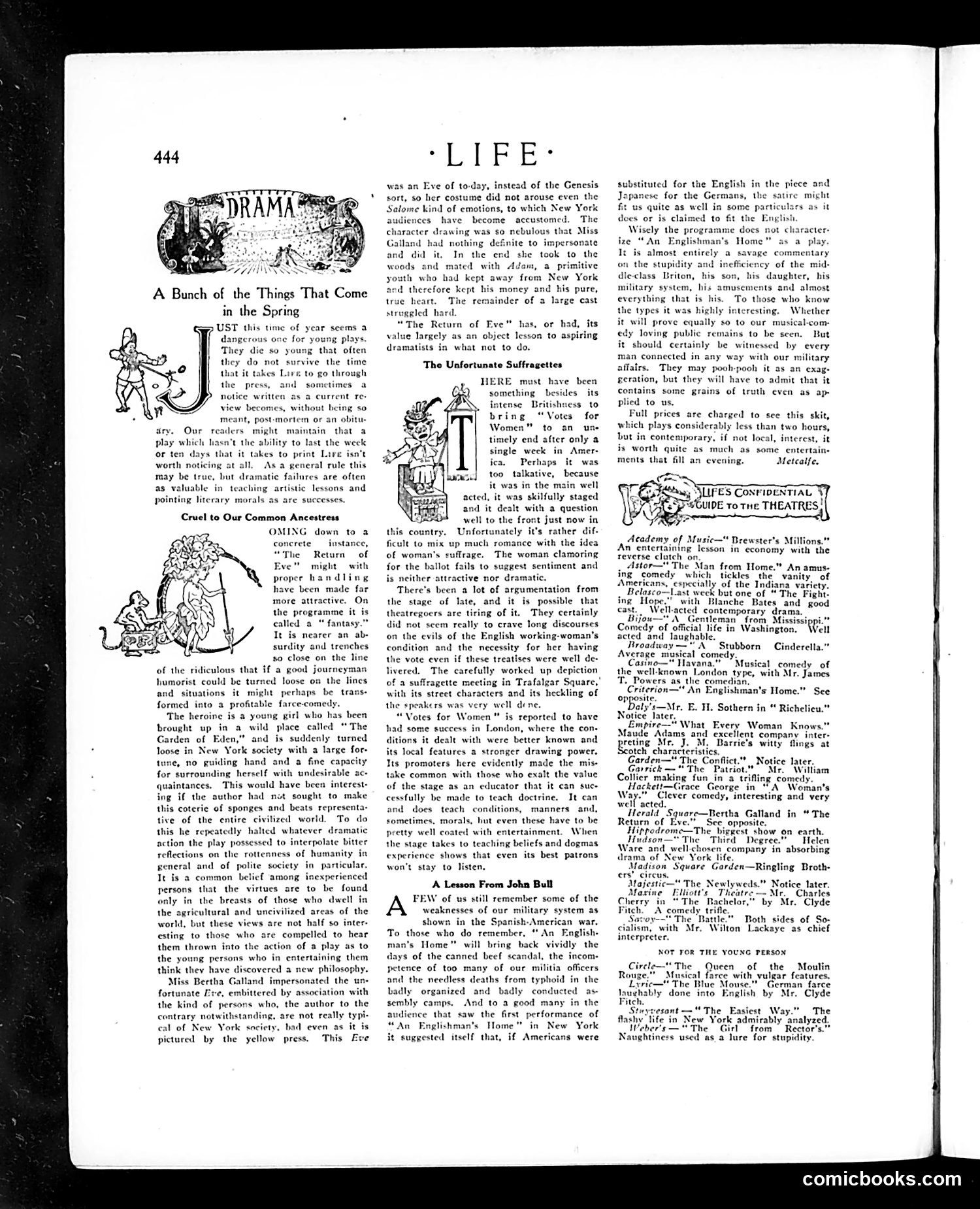
This page reviews three theatrical failures that opened in spring. The main critique concerns *"The Return of Eve,"* a fantasy about a woman raised in "The Garden of Eden" who enters New York society. The reviewer finds it absurd and patronizing—the author repeatedly interrupts the plot to condemn civilized society as corrupt, suggesting virtue exists only among the "uncivilized." This heavy-handed moralizing undermines the drama. Actress Bertha Galland performs adequately despite nebulous material. The page also briefly discusses *"Votes for Women,"* which closed after one week. Though well-acted and staged, the reviewer suggests the suffrage theme itself lacks theatrical appeal—women demanding voting rights don't convey sentiment or drama, making the material inherently undramatic despite its contemporary relevance in early 1900s America.
📄 Transcribed text from this page (OCR, searchable)
Machine-transcribed from the original scan — historical spelling and the odd misread are preserved.
A Bunch of the Things That Come in the Spring UST this time of year scems a They die so young that often they do not survive the time that it takes Lire to go through the press, and sometimes a notice written as a current re- ng so jortem of an obitu. ary. Our maintain that a play which hasn't the ability to last the week or ten days that it takes to print Lire isn’t worth noticing at all, Asa general rule this may be true, but dramatic failures are often as valuable in teaching artistic lessons and pointing literary morals as are successes, view becomes, without meant, post readers might Cruel to Our Common Ancestress OMING down to a concrete instance, The Return of ht with proper handling have been made far more attractive. On the programme it is called a fantasy. Ie is nearer an abe surdity and trenches ‘so close on the line of the ridiculous that if a good journeyman humorist could be turned loose on the lines and situations it might perhaps be trans- formed into a profitable farce-comedy, ‘The heroine is a young girl who has been brought up in a wild place called “The Garden of Eden," and is suddenly turned loose in New York society with a large fore tune, no guiding hand and a fine capacity for surrounding herself with undesirable ac- waintances. This would have been interest- ng if the author had not sought to make this coterie of sponges and beats representa- ive of the entire civilized world. To do this he repeatedly halted whatever dramatic action the play possessed to interpolate bitter reflections on the rottenness of humanity in general and of polite society in particular. It is a common belief among inexperienced persons that the virtues are to be found only in the breasts of those who dwell in the agricultural and uncivilized areas of the world, but these views are not half so inter- esting to those who are compelled to hear them thrown into the action of a play as to the young persons who in entertaining them think they have discovered a new philosoph; Miss Bertha Galland impersonated the uns fortunate Eve, embittered by association with the kind of persons who, the author to the contrary notwithstanding, are not really typi- cal of New York society, bad even as it is pictured by the yellow press. This Eve *LIFE* was an Eve of today, instead of the Genesis sort, so her costume did not arouse even the Salome kind of emotions, to which New York have become accustomed. The + drawing was so nebulous that Miss Salland had nothing definite to impersonate and did it, In the end took to the woods and mated with Adam, a primitive youth who had kept away from New York and therefore kept his money and his pure, true t. The r inder of a large cast str led hard. The Return of Eve” has, or had, its value largely as an object lesson to aspiring dramatists in what not to do. The Unfortunate Suffragettes HERE must have been na] something besides its intense Britishness to bring “Votes for Women" to an une timely end after only a single week in Amer ica, Perhaps it was too talkative, because it was in the main well acted, it was skilfully staged and it dealt with a question well to the front just now in this country, Unfortunately it’s rather dif- ficult to mix up much romance with the idea of woman's suffrage. The woman clamoring for the ballot fails to suggest sentiment and is neither attractive nor dramatic, There's been a lot of argumentation from the stage of late, and it is possible that theatregoers are tiring of it. They certainly did not seem really to crave long discourses on the evils of the English working-woman’s condition and the necessity for her having the vote even if these treatises were well de- livered. The carefully worked up depiction jences. of a suffragette meeting in Trafalgar Square,’ with its street characters and its heckling of the speakers was very well dene. “Votes for Women" is reported to have had some success in London, where the con- ditions it dealt with were better known and its local features a stronger drawing power. Its promoters here evidently made the mis take common with those who exalt the value of the stage as an educator that it can suce cessfully be made to teach doctrine. It can conditions, manners and, metimes, morals, hut even these have to be pretty well coated with entertainment. When the stage takes to teaching beliefs and dogmas experience shows that even its best patrons won't stay to listen, A Lesson From John Bull A, FEW of us still remember some of the weaknesses of our military system as shown in the Spanish-American war. To those who do remember, “An English. man's Home" will bring back vividly the days of the canned beef scandal, the incom- petence of too many of our militia officers and the needless deaths from typhoi the Ladly organized and badly sembly And to a good many in the audience that saw the first performance of “An Englishma New York it suggested itself that, if Americans were and does teach conducted as: camps. Home" in substituted for the English in the piece and Jepanese for the Germans, the satire might fit us quite as well in some particulars as it does or is claimed to fit the English Wisely the progra: ize “An Englishman's Home” as a_ pl. Iz is almost entirely a savage com! ficiency of the mid- dleclass Briton, his son, his daughter, his military system, his amusements and almost everything that is his. To those who know the types it was highly interesting. Whether it will prove equally so to our musicalcom loving public remains to be scen. But it should certainly be witnessed by every man connected in any way with our military affairs, They may pooh-pooh it as an exag- geration, but they will have to admit that it contains some grains of truth even as ap- plied to us. Full prices are charged to see this skit, which plays considerably less than two hours, but in contemporary, if not local, interest, it is worth quite as much as some entertaine ments that fill an evening. Metcalfe. docs not characters on the stupidity an ; LIFES ConripeNTIAL ¥ *SGUIDE ro THe THEATRES! Academy of Music—" Brewster's Mi An entertaining lesson in economy with the reverse clutch on. . Astor—"The Man from Home.” An amus- ing comedy which tickles the vanity. of Americans, especially of the Indiana vai jety. _ Belasco—Last week but one of “ The Fight. ing Hope. with Blanche Bates and good cast. Well-acted contemporary drama. Bijou—" A Gentleman from Mississippi.” Comedy of official life in Washington. Well acted and laughable. Hroadway—" A” Stubborn Average musical comedy. Casino" Hava Musical comedy of the well-known London type, with Mr. James T. Powers as the comedian, ° Criterion—* An Englishman's Home.” See pposite. _Daly's—Mr. E. Il, Sothern in “ Richelieu." Notice later, Empire—* What Every Woman Knows Maude Adams and excellent company inter- pieting (Mr. J. M. Barrie's witty ings at atch, characteristics, jarden—"* The Conflict." Notice lat Garrick —" The” Patriot.” Mr. Wil Cinderella. George in Clever comedy, interesting and very well ‘acted, Herald ‘Squore—Rertha Galland in “The Return of Eve." See opposite. Hippodromce—The biggest show on earth. wilttion "The “Thied Degree “iteten ‘are and well-chosen company in absorbi drama of New York life. Pay, ne Madison Square Garden—Ringling Broth- ers’ circus, Majestic—* The Newlyweds.” Notice later. Maxine Elliott's Theatre —- Mr. Charles Cherry in The Bachelor,” by Mr. Clyde Fitch. A comedy trifle Savoy--" The Battle.” Both sides of So- with Mr. Wilton Lackaye as chief interpreter. NOT TOR THE YOUNG PERSON Circle—" The Queen of the — Moulin Rouge. usical farce with vulgar features, Lyric—" The Blue Mouse.” German farce laughably done into English by Mr. Clyde Fitch. vesant "The Easiest Way.” The y life in New York admirably analyzed. Weber's —"The Girl from — Rector’s.” Naughtiness used as a lure for stupidity. comicbooks.com