
Life, 1909-04-01 · page 21 of 52
Life — April 1, 1909 — page 21: what you’re looking at
What you’re looking at
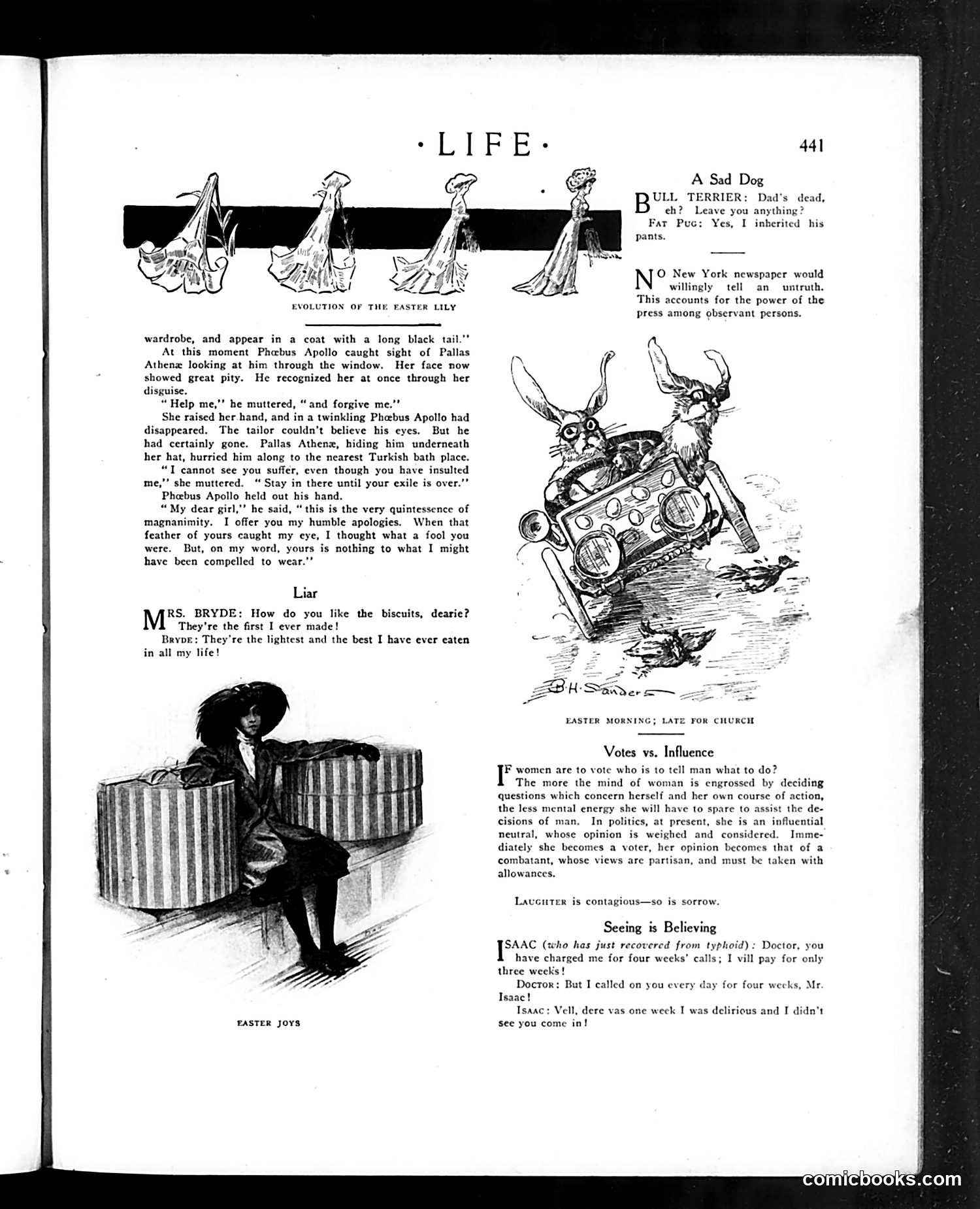
This page contains several satirical pieces reflecting early 20th-century American attitudes: **"Evolution of the Easter Lily"** depicts a mythological narrative (Phoebus Apollo and Pallas Athena) where a god is humbled and aided by a goddess—likely satirizing male vanity and female magnanimity. **"Easter Joys"** shows a woman with a large box, captioning a couple's polite lie about homemade biscuits—satirizing social pretense and insincere compliments. **"A Sad Dog"** makes a cynical joke: a bull terrier inherits only his deceased father's pants, mocking both inheritance and masculine legacy. **"Votes vs. Influence"** argues against women's suffrage, claiming voting would distract women from their "influential neutral" advisory role to men—reflecting anti-suffrage sentiment of the era. **"Seeing is Believing"** features a Jewish character (indicated by dialect) disputing a doctor's bill, claiming he didn't "see" a visit while delirious—a joke about literal versus practical truth. The page reflects period anxieties about gender roles, class, and immigrant communities.
📄 Transcribed text from this page (OCR, searchable)
Machine-transcribed from the original scan — historical spelling and the odd misread are preserved.
EVOLUTION OF THE EASTER LILY wardrobe, and appear in a coat with a long black tail.’’ At this moment Phabus Apollo caught sight of Pallas Athena looking at him through the window. Her face now showed great pity. He recognized her at once through her disguise. “Help me,’’ he muttered, “and forgive me.’ She raised her hand, and in a twinkling Phoebus Apollo had disappeared. The tailor couldn't believe his eyes. But he had certainly gone. Pallas Athenx, hiding him underneath her hat, hurried him along to the nearest Turkish bath place. “TI cannot see you suffer, even though you have insulted me," she muttered. “Stay in there until your exile is over.”” Phebus Apollo held out his hand. “ My dear girl,”’ he said, “this is the very quintessence of magnanimity. I offer you my humble apologies. When that feather of yours caught my eye, I thought what a fool you were. But, on my word, yours is nothing to what I might have been compelled to wear.”’ Liar RS. BRYDE: How do you like the biscuits, dearie? They're the first I ever made! Bryve: They're the lightest and the best I have ever eaten in all my life! FASTER JOYS 441 A Sad Dog ULL TERRIER: Dad’s dead, ch? Leave you anythin Far Puc: Yes, I inherited his pants, © New York newspaper would willingly tell an untruth. This accounts for the power of the Press among observant persons. LATE FOR CHURCH Votes vs. Influence F women are to vote who is to tell man what to do? The more the mind of woman is engrossed by deciding questions which concern herself and her own course of action, the less mental energy she will have to spare to assist the de- cisions of man, In politics, at present, she is an influential neutral, whose opinion is weighed and considered. Imme- diately she becomes a voter, her opinion becomes that of a combatant, whose views are partisan, and must be taken with allowances. Lavcuter is contagious—so is sorrow. Seeing is Believing SAAC (who has just recovered from typhoid): Doctor, you have charged me for four weeks’ calls; I vill pay for only three wee! Doctor: But I called on you every day for f Isaac! Isaac: Vell, dere vas one week I was delirious and I didn't see you come in! weeks, Mr.