
A complete issue · 40 pages · 1908
Life — July 2, 1908

I can see this is from Life magazine, Vol. LII, No. 1340, dated July 2, 1908. However, the image quality is quite poor—it's a dark nighttime photograph showing illuminated buildings with what appears to be fireworks or searchlights in the sky above them. Without clearer visibility of details or accompanying caption text, I cannot reliably identify which specific buildings, figures, or political events this references. The date (July 1908) and nighttime celebration setting suggest it may relate to a Fourth of July commemoration or significant public event from that period, but I cannot assert specific details with confidence based on what's legible here. A clearer image or the original caption would be needed for accurate interpretation.
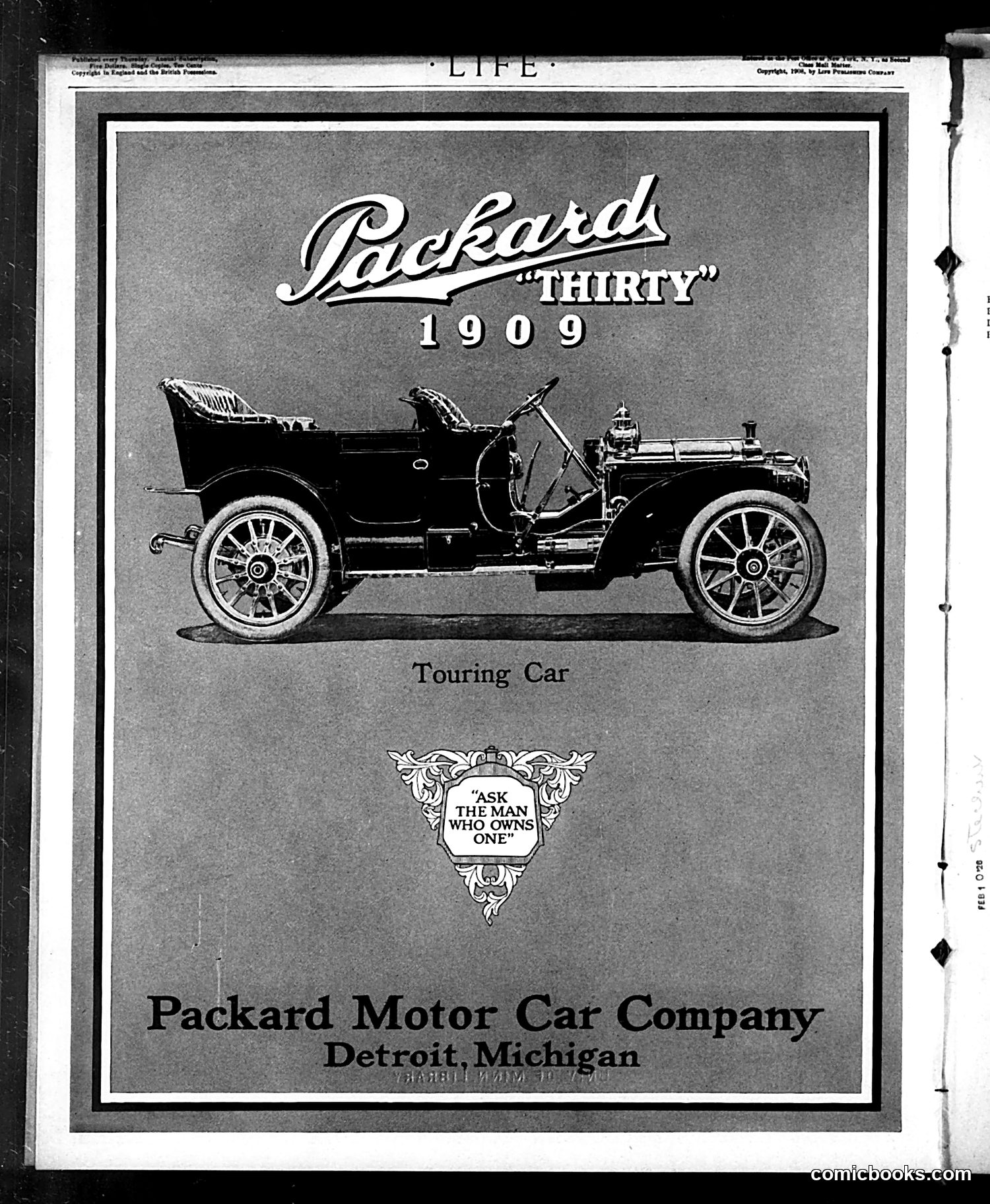
This page is primarily **advertising, not satire or political commentary**. It features a 1909 Packard "Thirty" touring car—a luxury automobile from the Packard Motor Car Company of Detroit, Michigan. The ad includes a side-view technical illustration of the vehicle and a tagline: "ASK THE MAN WHO OWNS ONE." This was Packard's famous advertising slogan, implying that satisfied owners would enthusiastically endorse the product. There is no political cartoon or satirical content visible. The page appears in *Life* magazine (which contained both humor and advertisements), but this particular content is straightforward product marketing aimed at affluent readers interested in early automobiles during the automobile industry's rapid expansion in the early 1900s.
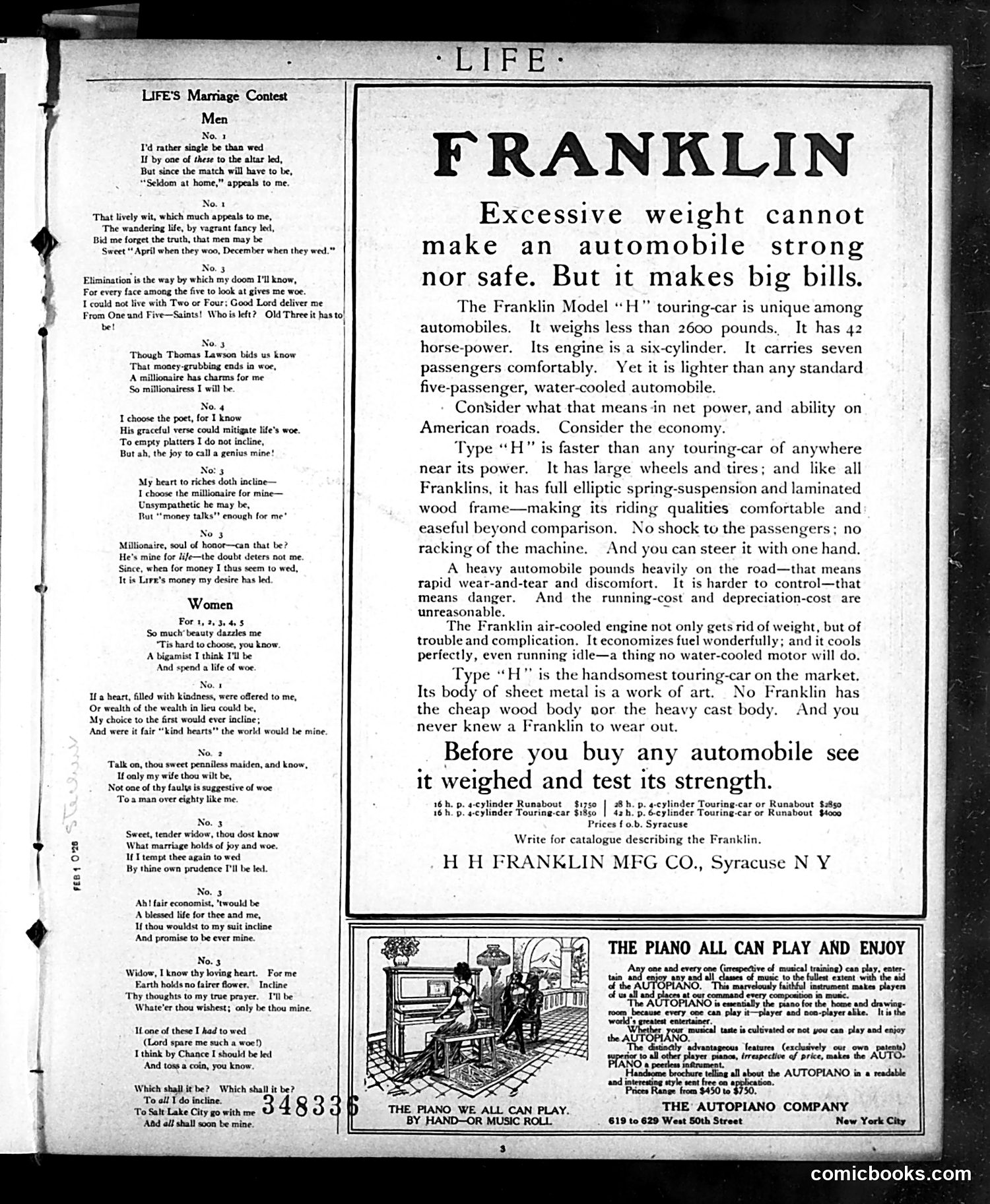
This page contains **satirical poetry** rather than political cartoons. The left side features "Life's Marriage Contest," with numbered poems about marriage from both male and female perspectives. These are light satirical verses mocking romantic ideals—men claim they'd "rather single be than wed," while women counter with their own complaints about marriage and money. The right side is a **Franklin automobile advertisement**, not satire. It promotes the Model "H" touring car, emphasizing its lightweight design, fuel economy, and durability compared to heavier vehicles. Below is an advertisement for the **Autopiano**, a player piano that allows non-musicians to enjoy music. The page blends entertainment (satirical poetry about marriage) with period advertisements, typical of Life magazine's format.
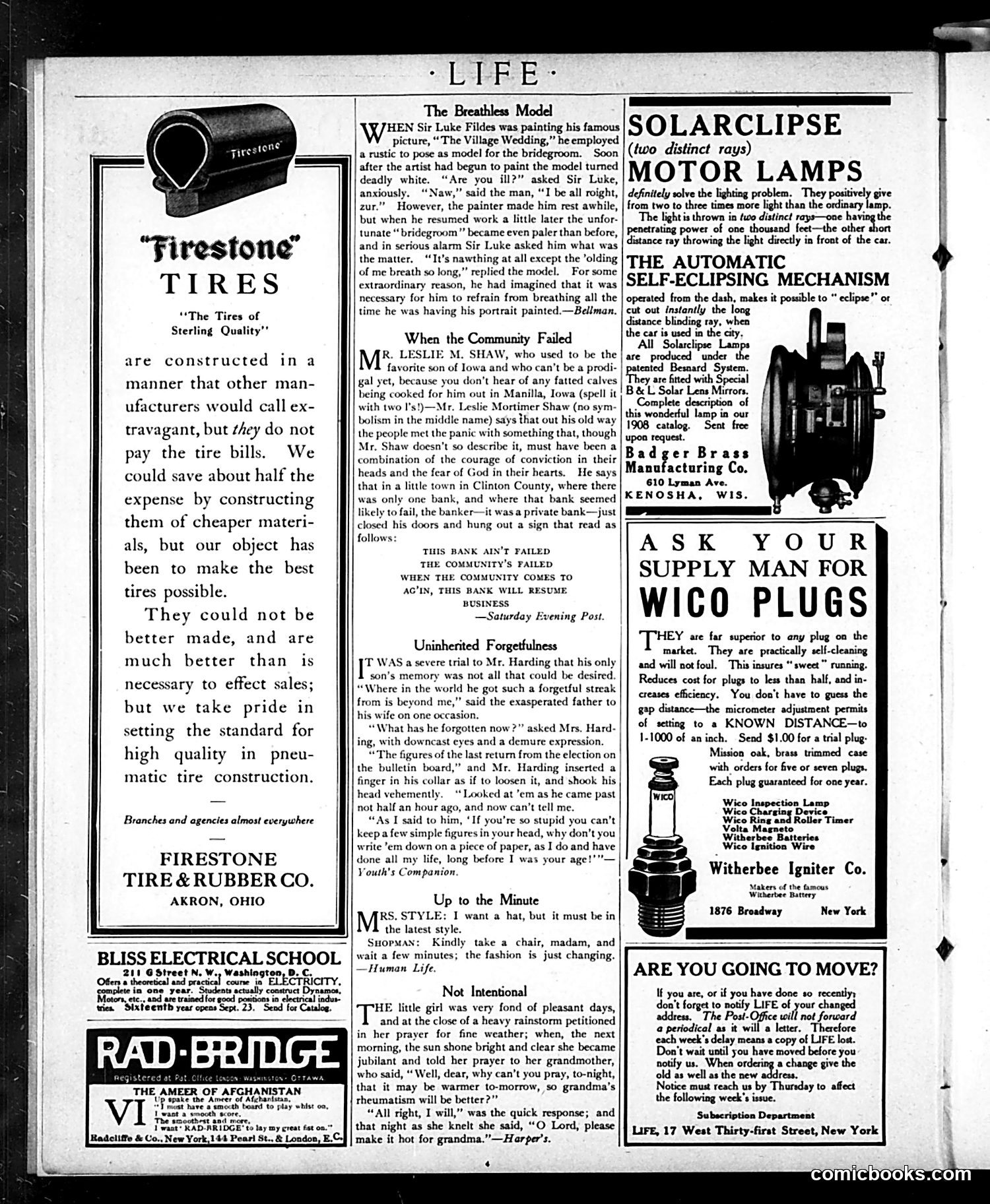
This page is primarily **advertising** with minimal satirical content. The ads include: - **Firestone Tires**: A company statement defending quality over cheap materials - **Solarclipse Motor Lamps** and **Wico Plugs**: Automotive accessories - **Bliss Electrical School**: Vocational training - **Rad-Bridge**: A patent medicine or supplement The only clear satirical content appears in small **anecdotal stories** embedded in the page: 1. A tale about Sir Luke Fildes and a portrait model becoming progressively paler 2. A story about a failed bank in Iowa with a humorous sign 3. A brief piece mocking an elderly man's forgetfulness These are light humor pieces rather than political cartoons—they target human foibles rather than specific figures or events. The page represents **Life magazine's mixed format** of advertising, consumer goods promotion, and genteel humor typical of early 20th-century publishing.
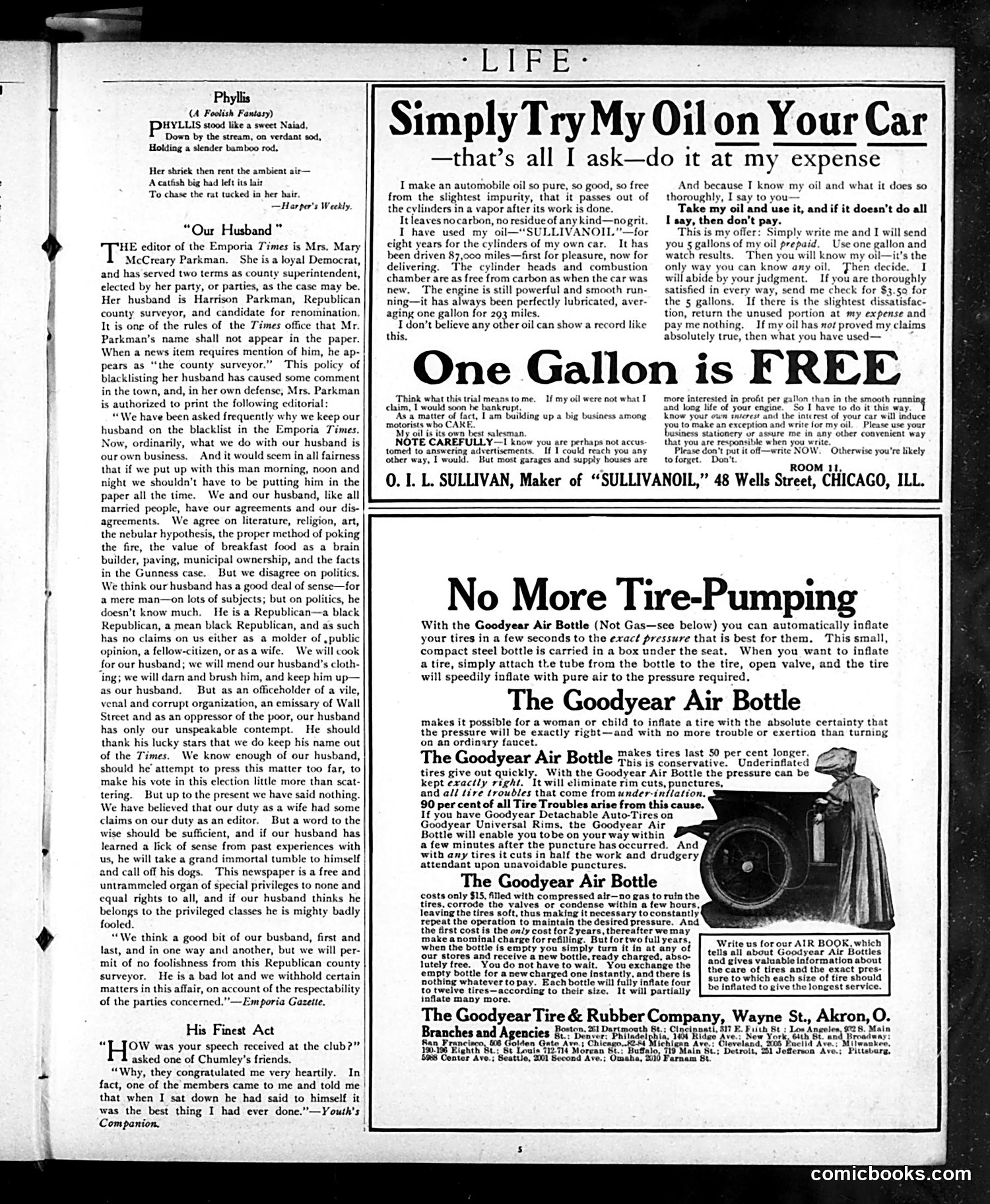
This page is **primarily advertising** rather than satirical content. The dominant features are two product advertisements: 1. **Sullivansoil advertisement** (top right): Promotes an automobile oil brand, offering a free gallon trial to encourage consumer testing. 2. **Goodyear Air Bottle advertisement** (bottom): Markets an automatic tire-inflation device for cars, eliminating manual tire-pumping. The left column contains editorial content, including a brief poem "Phyllis" and an article titled "Our Husband" about Democratic county politics—likely referencing contemporary political figures, though specific identities aren't clear from context. The advertisements reflect early 20th-century automotive consumer culture and emerging convenience technologies. The satirical magazine context is minimal on this particular page; it's essentially a commercial publication.
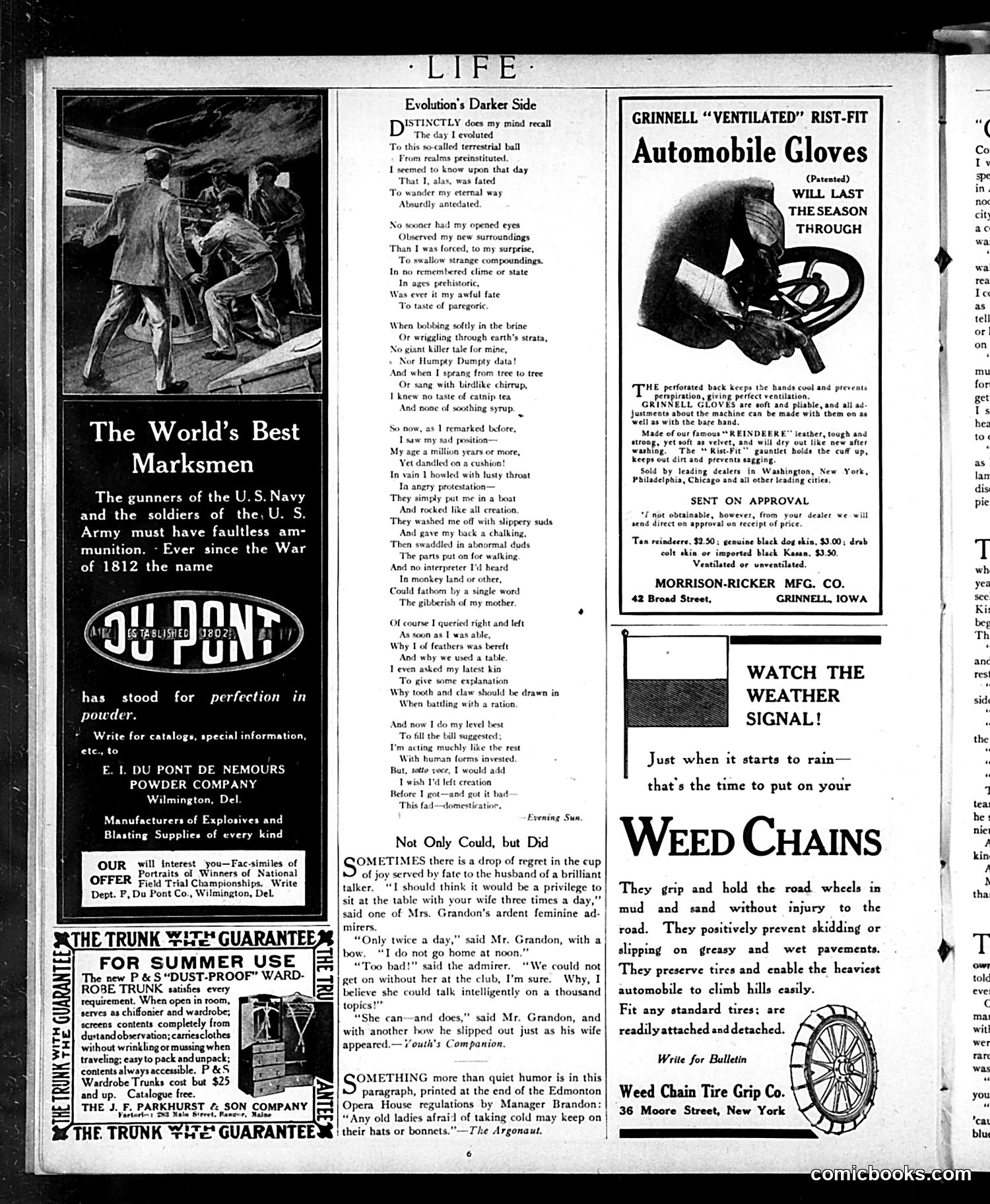
This Life magazine page is primarily **advertising**, not satirical content. The left side features a DuPont gunpowder advertisement emphasizing military ammunition quality since 1812, targeting Navy and Army procurement. Below it, a "Trunk with Guarantee" ad promotes luggage for summer use. The center contains a poem titled "Evolution's Darker Side" by Evening Sun, apparently reflecting on humanity's primitive nature despite civilization. The right side advertises automotive products: Grinnell "Ventilated" automobile gloves and Weed Chains tire grips for winter driving safety. A small humor piece, "Not Only Could, but Did," presents a domestic anecdote about a husband and wife at a club—light social comedy typical of the era's family magazine content. This appears to be a standard commercial issue mixing advertising with light editorial material.
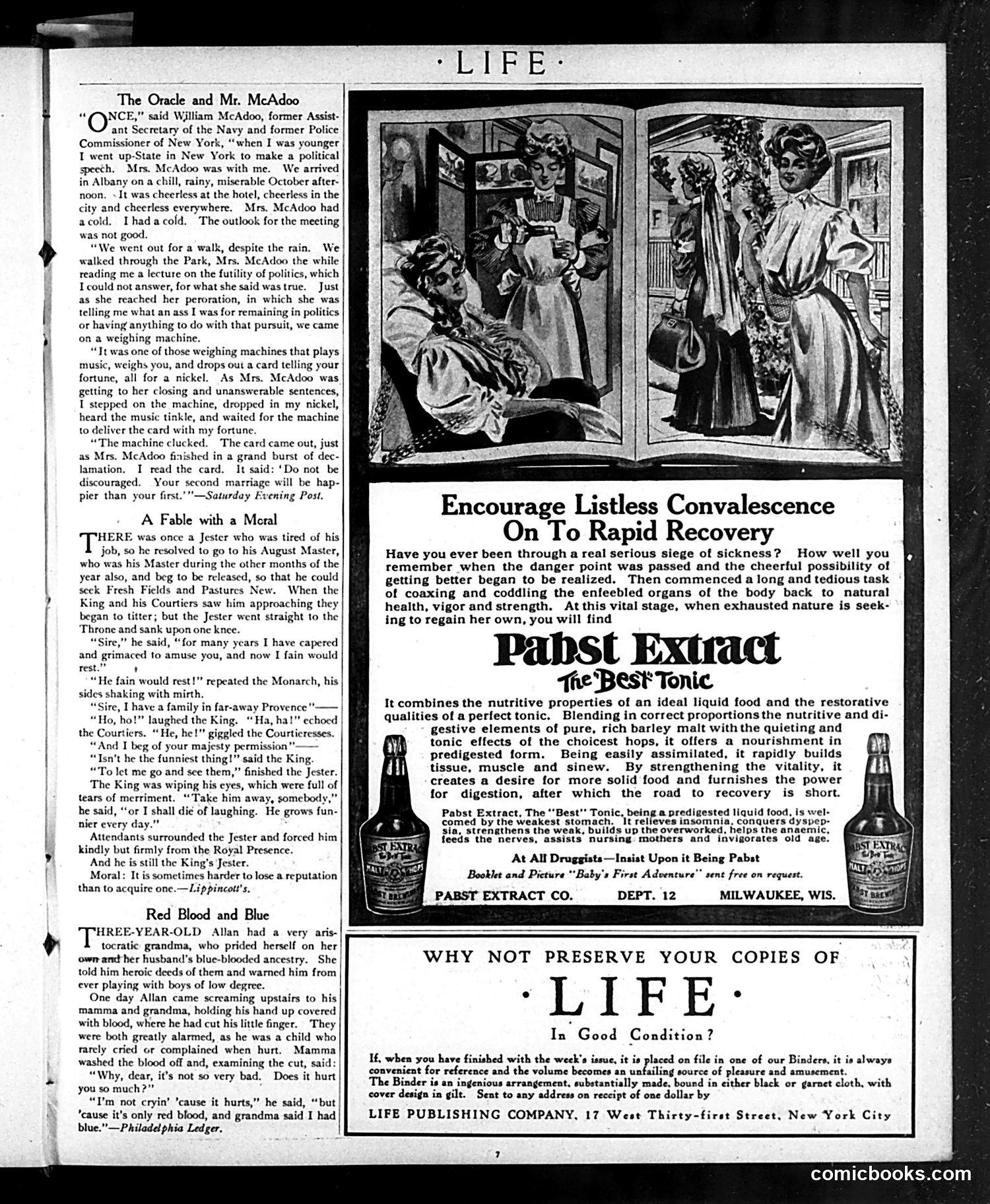
This page contains three distinct pieces: **"The Oracle and Mr. McAdoo"** is a humorous anecdote about William McAdoo (former Assistant Secretary of the Navy and Police Commissioner of New York). While walking in rainy Albany with his wife, they encounter a fortune-telling machine. The joke hinges on the machine's fortune card predicting his second marriage would be "happier than your first"—implying critical commentary about his current marriage. **"A Fable with a Moral"** is a separate satirical story about a Jester and King, emphasizing that reputation is harder to lose than acquire. **"Red Blood and Blue"** mocks aristocratic pretension through a three-year-old's innocent observation about bloodlines. The remainder of the page is **advertising** for Pabst Extract tonic and Life magazine bindings—not satirical content.
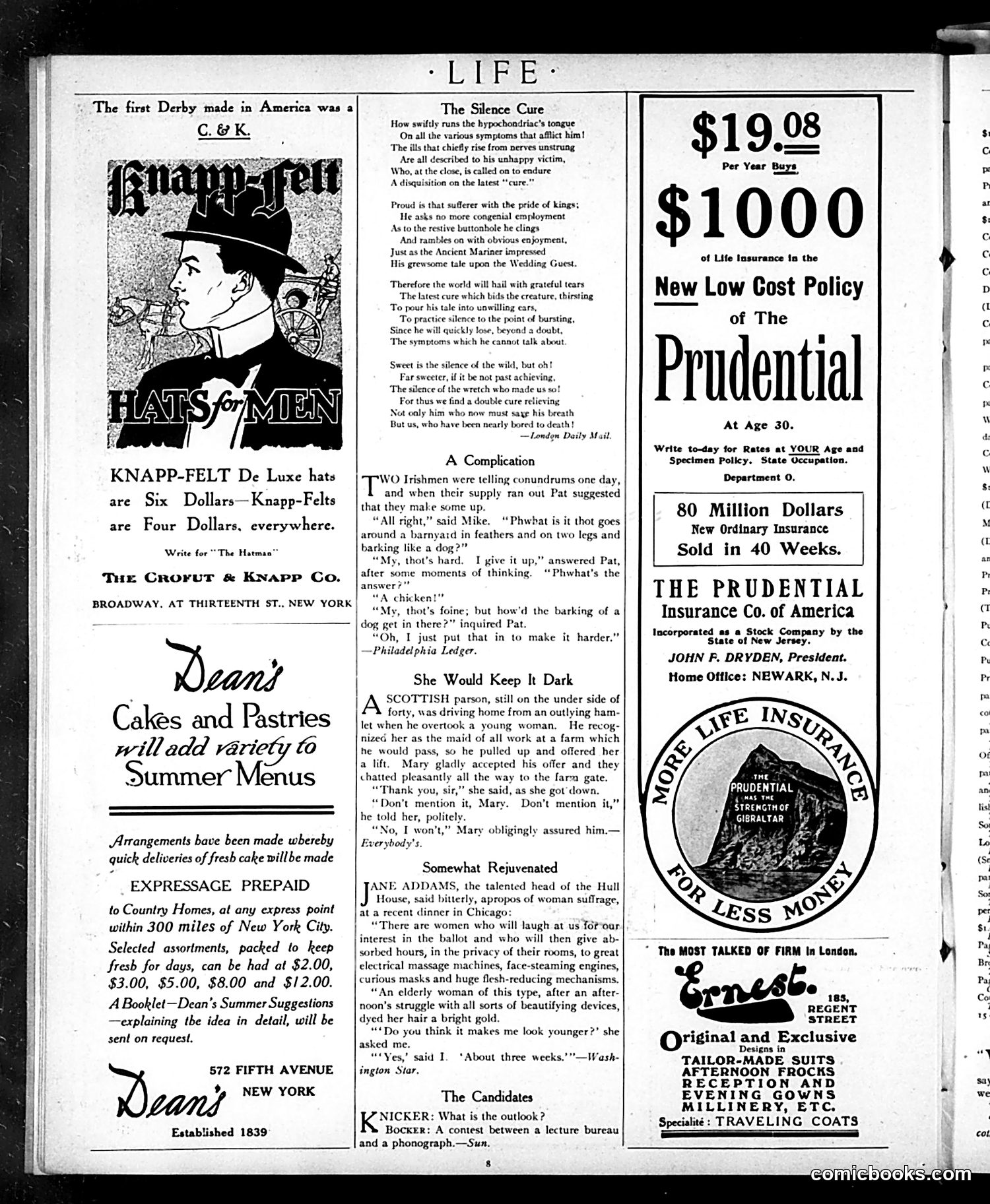
This page combines satirical poetry with period advertisements. The main cartoon advertises Knapp-Felt De Luxe hats ($6) and Knapp-Felts ($4), using a man's profile in formal attire as the visual centerpiece. The accompanying poem "The Silence Cure" appears to satirize hypochondriacs—people obsessed with imaginary ailments. It mocks those who suffer from "pride of kings" and various nervous complaints, suggesting silence and rest as cure-alls. The poem implies these patients are self-absorbed worriers whose ailments lack genuine medical basis. The page is predominantly advertising-driven, featuring Dean's Cakes and Pastries, Prudential Life Insurance, and Ernest tailor shop. The satire targets wealthy, anxious consumers of the era.
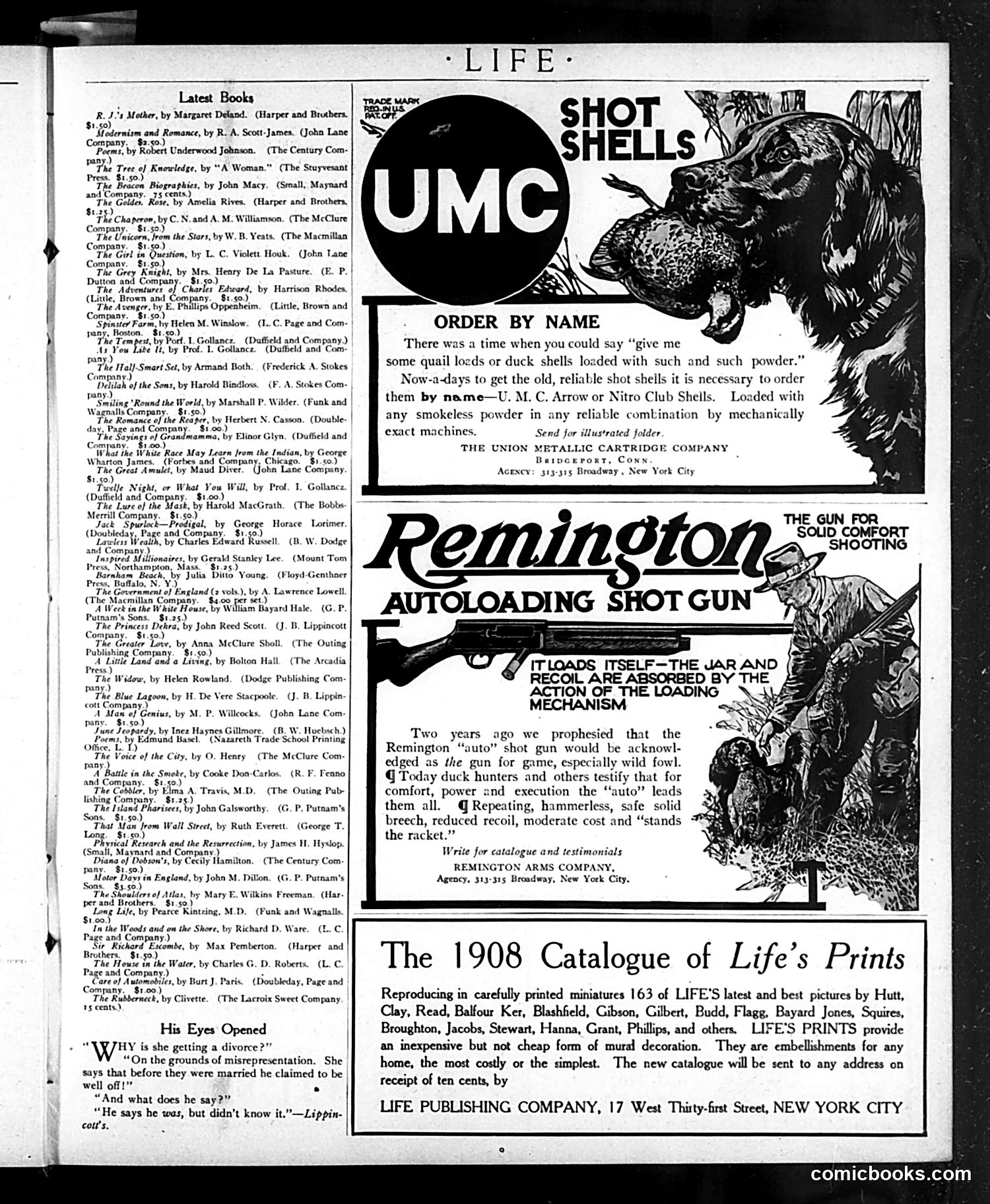
This page is primarily **advertising**, not satire or editorial content. The page features two gun advertisements: 1. **UMC (Union Metallic Cartridge Company)** promotes "Shot Shells" for hunting, showing a dog retrieving game. The ad emphasizes ordering ammunition by brand name for reliability. 2. **Remington** advertises an "Autoloading Shot Gun" with illustrations of hunting scenes. The text claims this gun represents technological progress for hunters, offering "comfort, power and execution." A smaller item titled **"His Eyes Opened"** appears to be a brief joke about divorce, unrelated to the advertisements. The page also advertises **Life's 1908 Print Catalogue** at bottom. These hunting advertisements reflect early 20th-century American leisure culture and the commercialization of sporting equipment.
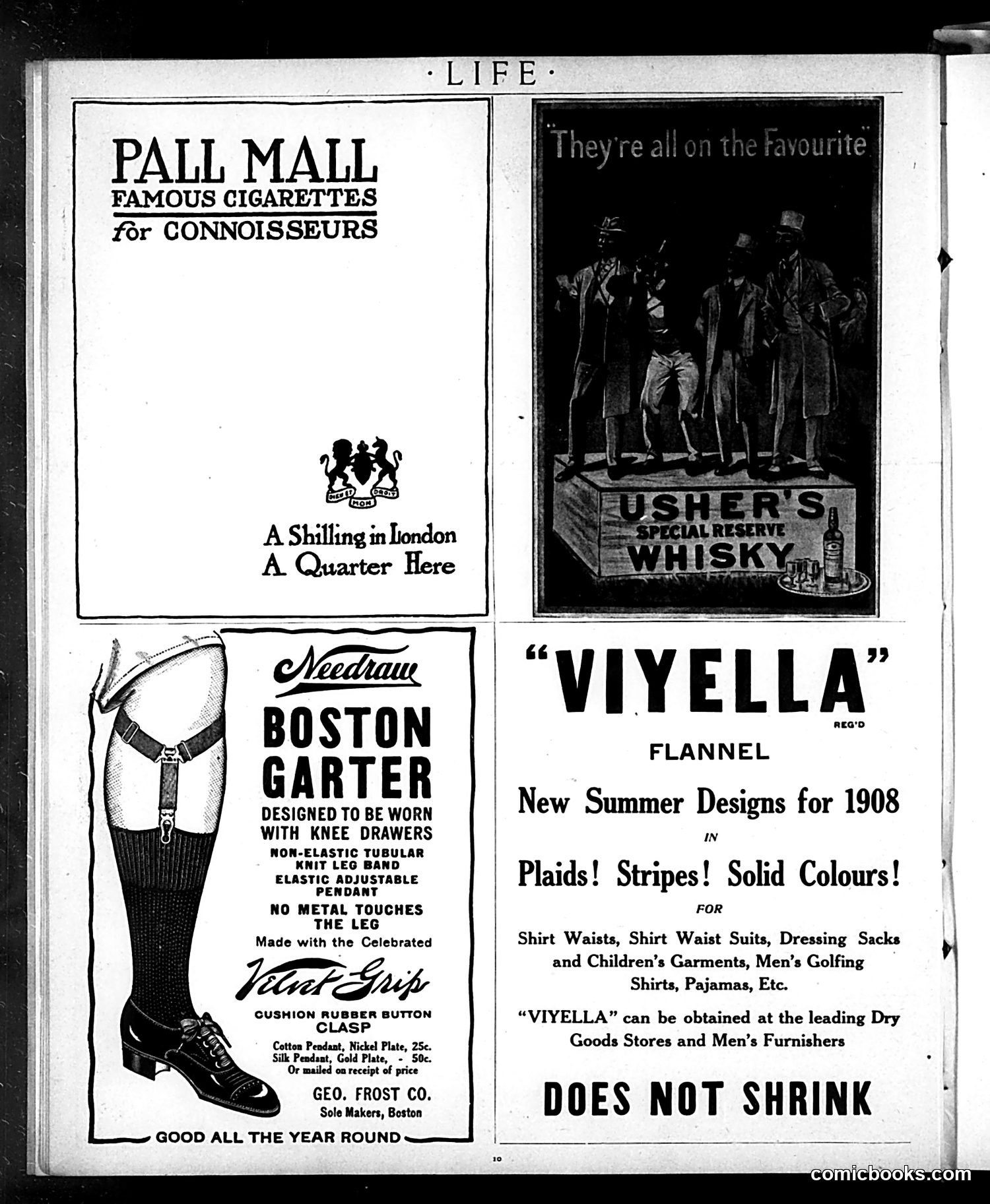
This page is primarily **advertising**, not political satire. It contains three commercial advertisements from what appears to be an early 1900s Life magazine issue: 1. **Pall Mall Cigarettes** — positioned as luxury goods for discerning smokers, priced at "a shilling in London, a quarter here" 2. **Needham Boston Garter** — men's hosiery designed for comfort, emphasizing practical features like non-elastic tubular knit and adjustable pendant 3. **Viyella Flannel** — fabric for summer 1908 clothing, advertised as "does not shrink," available in plaids, stripes, and solid colors The only image content is product illustrations: cigarette branding, a leg wearing a garter, and what appears to be a whisky advertisement. No political commentary or satire is evident on this page.
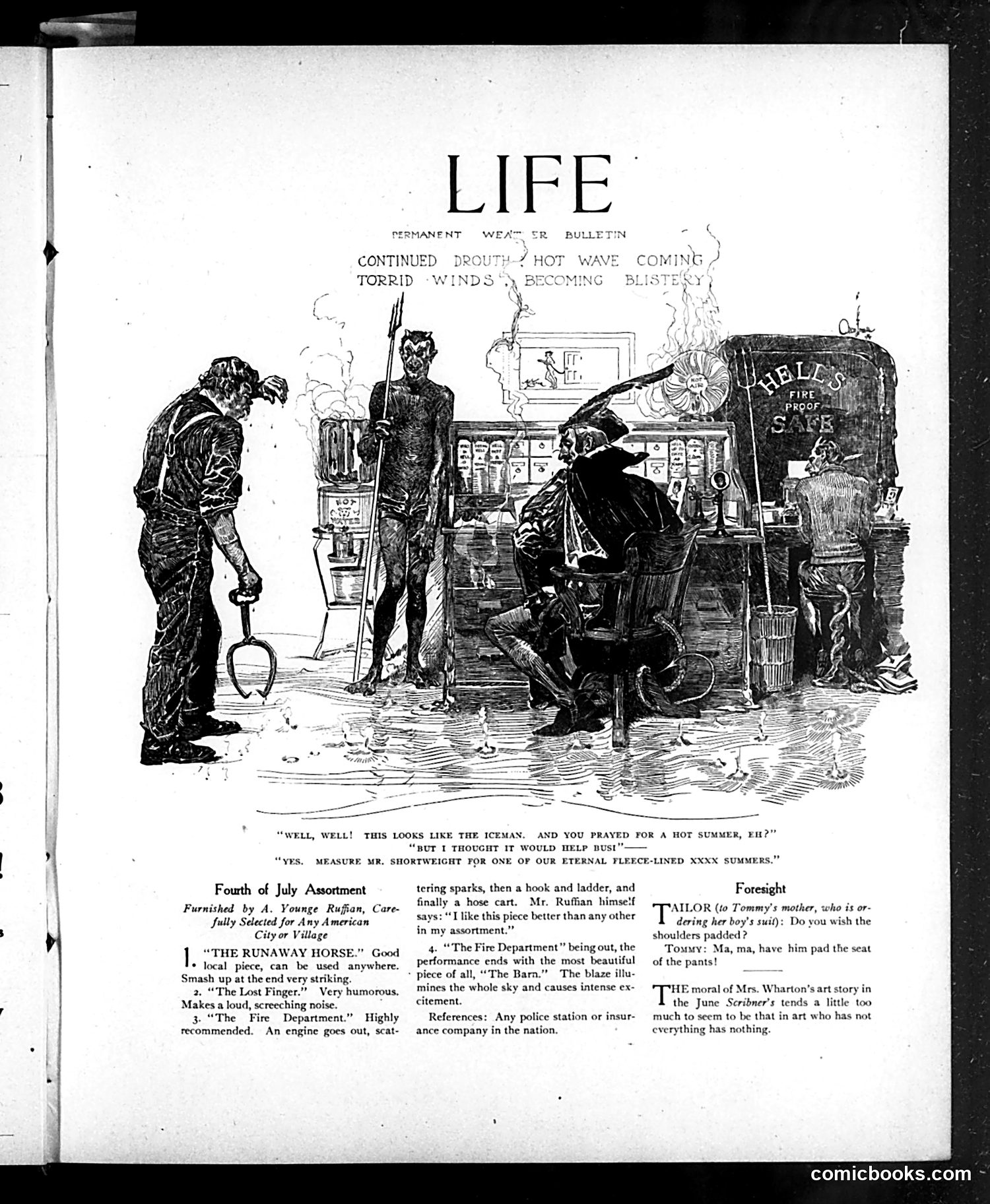
This is a **permanent weather bulletin** satirizing an extreme heat wave. The cartoon depicts workers at what appears to be a fire department or industrial facility suffering from "continued drought" and "hot wave" conditions, with "torrid winds" and "blistering" heat. The joke plays on the contrast between expectations and reality: one figure asks another if he "prayed for a hot summer," and the response is that while they hoped heat would help business, they didn't anticipate such extreme conditions. The caption mentions measuring someone "for one of our eternal fleece-lined xxxxx summers"—likely referring to winter underwear, sarcastically suggesting people will need heavy clothing even in summer. The satire critiques unbearable urban heat conditions during what was apparently a notable heat wave.
This page discusses the 1908 U.S. presidential election, praising Theodore Roosevelt's decision not to seek another term and endorsing Republican candidate William Howard Taft over Democrat William Jennings Bryan. The small cartoons illustrate rural/agricultural scenes, likely representing American voters the candidates must appeal to. The text argues Taft is better equipped than Bryan to continue Roosevelt's policies. It criticizes Bryan's lack of temperament and experience, claiming he's been a "shadow" of a man due to electoral defeats. The article praises Taft as "whole of a man" with sound judgment—higher praise in early 20th-century political rhetoric. A tragic anecdote about Harvard students drowning appears unrelated to the election coverage, likely filling remaining column space in this issue.
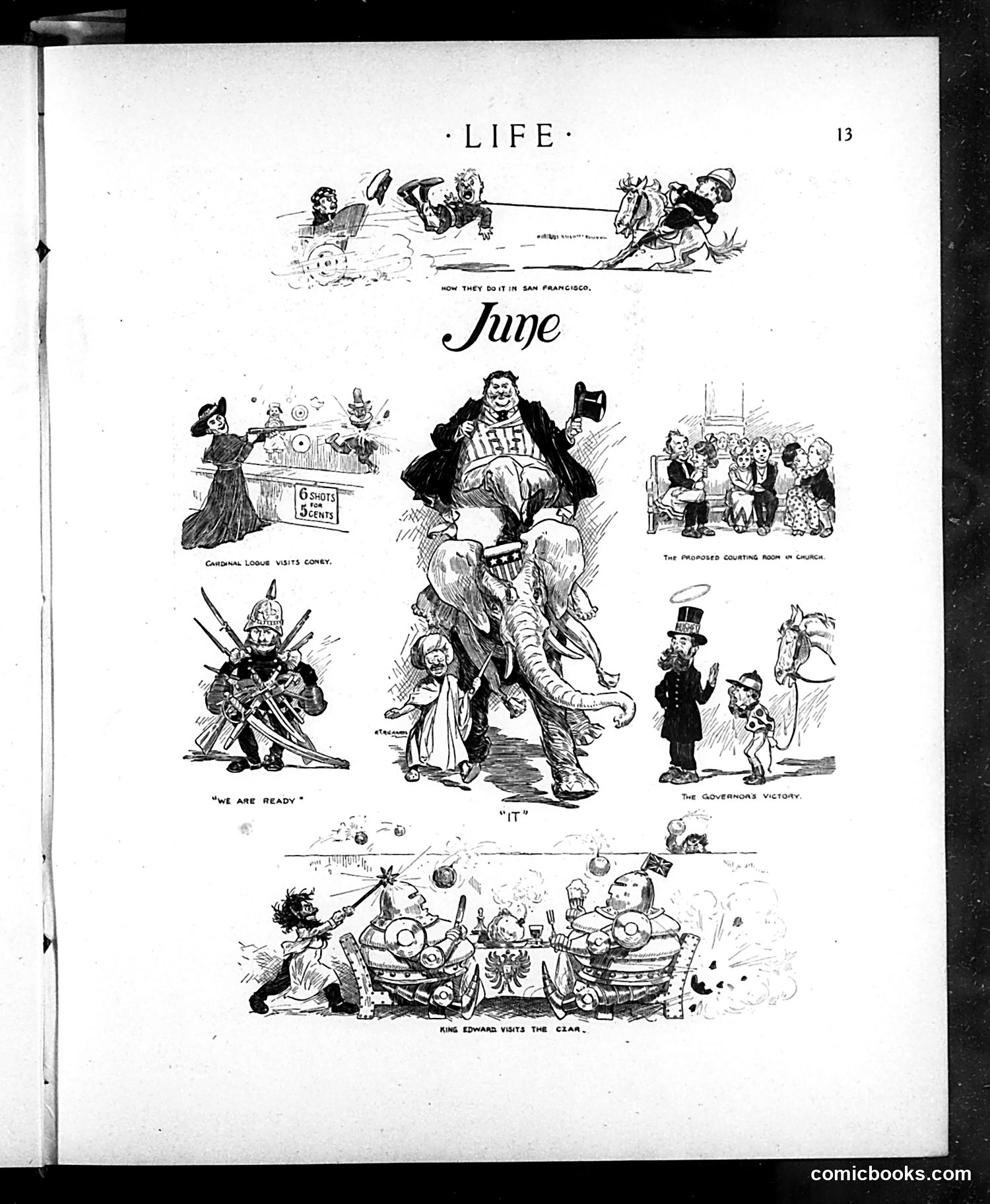
This is a satirical page from Life magazine's June calendar section featuring political and social commentary cartoons in the early 20th century. **Key elements visible:** - "How they do it in San Francisco" - appears to reference local politics or scandals - "Cardinal Logue visits Coney" - likely satirizing a religious figure's public appearance - "We are Ready" - depicts a military or political figure with weapons - Central figure labeled "It" - a large elephant (possibly representing Republican Party or political establishment) with small figures climbing it - "The Proposed Counting Room in Church" - church politics satire - "The Governors Victory" - political victory celebration - "King Edward Visits the Czar" - bottom cartoon referencing international diplomacy The cartoons use exaggeration and symbolic imagery typical of early 20th-century American political satire, though specific references require historical context we cannot fully verify from the image alone.
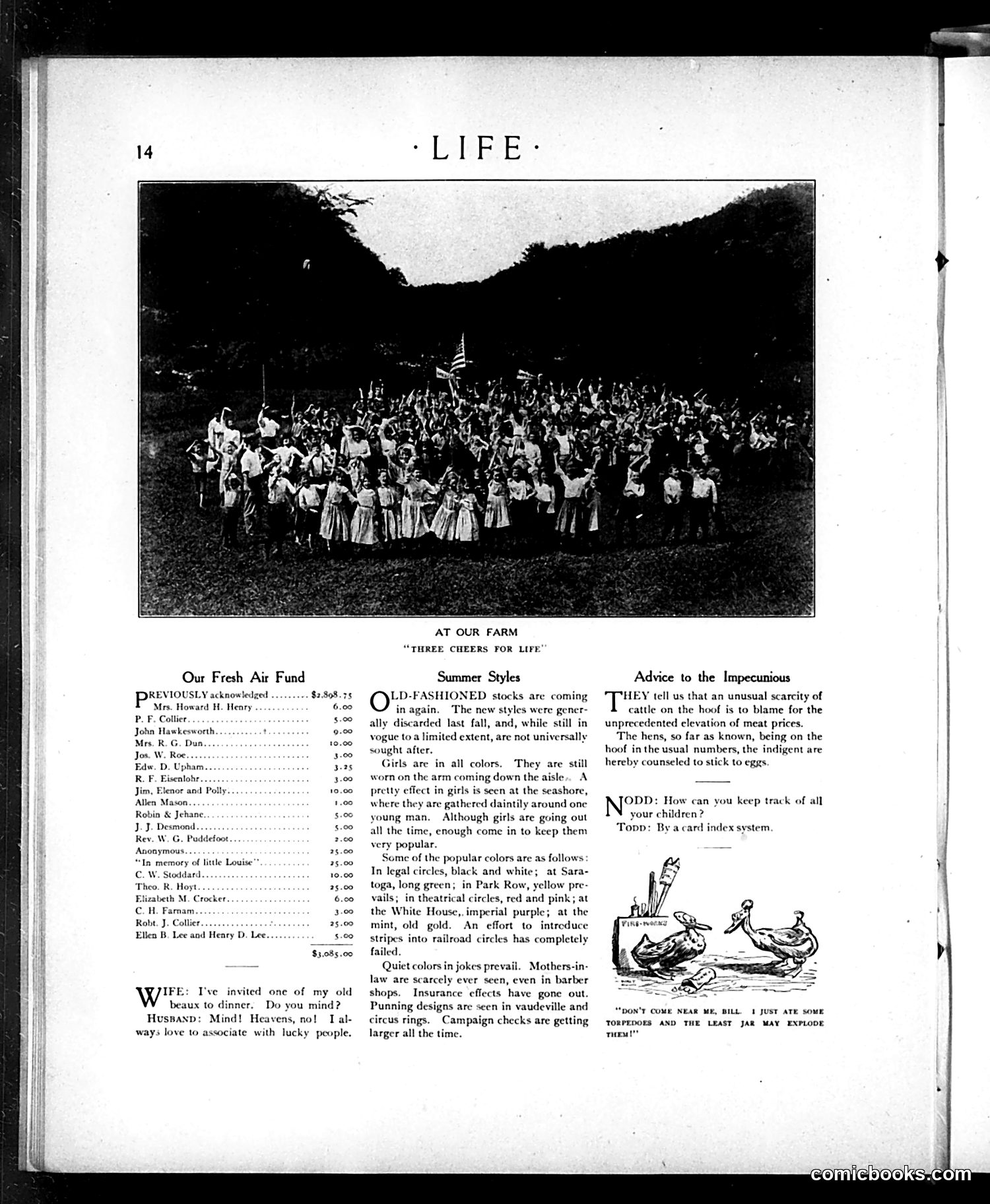
This page from *Life* magazine (a satirical publication) contains several humor pieces typical of early 20th-century American satire: **"Our Fresh Air Fund"** lists donors to a charitable cause—standard magazine content acknowledging contributors. **The main cartoon** shows a large crowd at a farm gathering with "Three Cheers for Life," likely promoting the magazine itself as a force for social good. **"Summer Styles"** is satirical commentary on women's fashion and social behavior. The humor lies in describing girls as seasonal fashion items—they "come in all colors," are "gathered daintily around one young man," and their popularity fluctuates like clothing trends. The section mocks how different professions have color preferences (lawyers wear black/white, theatrical people wear red/pink), extending the fashion metaphor absurdly to institutions like the White House and railroad companies. **"Advice to the Impecunious"** sarcastically addresses poverty: with meat prices high, poor people should eat eggs instead—practical but darkly humorous. The bottom cartoon appears to be a domestic humor piece about marriage and avoiding disruption to one's wife's plans.
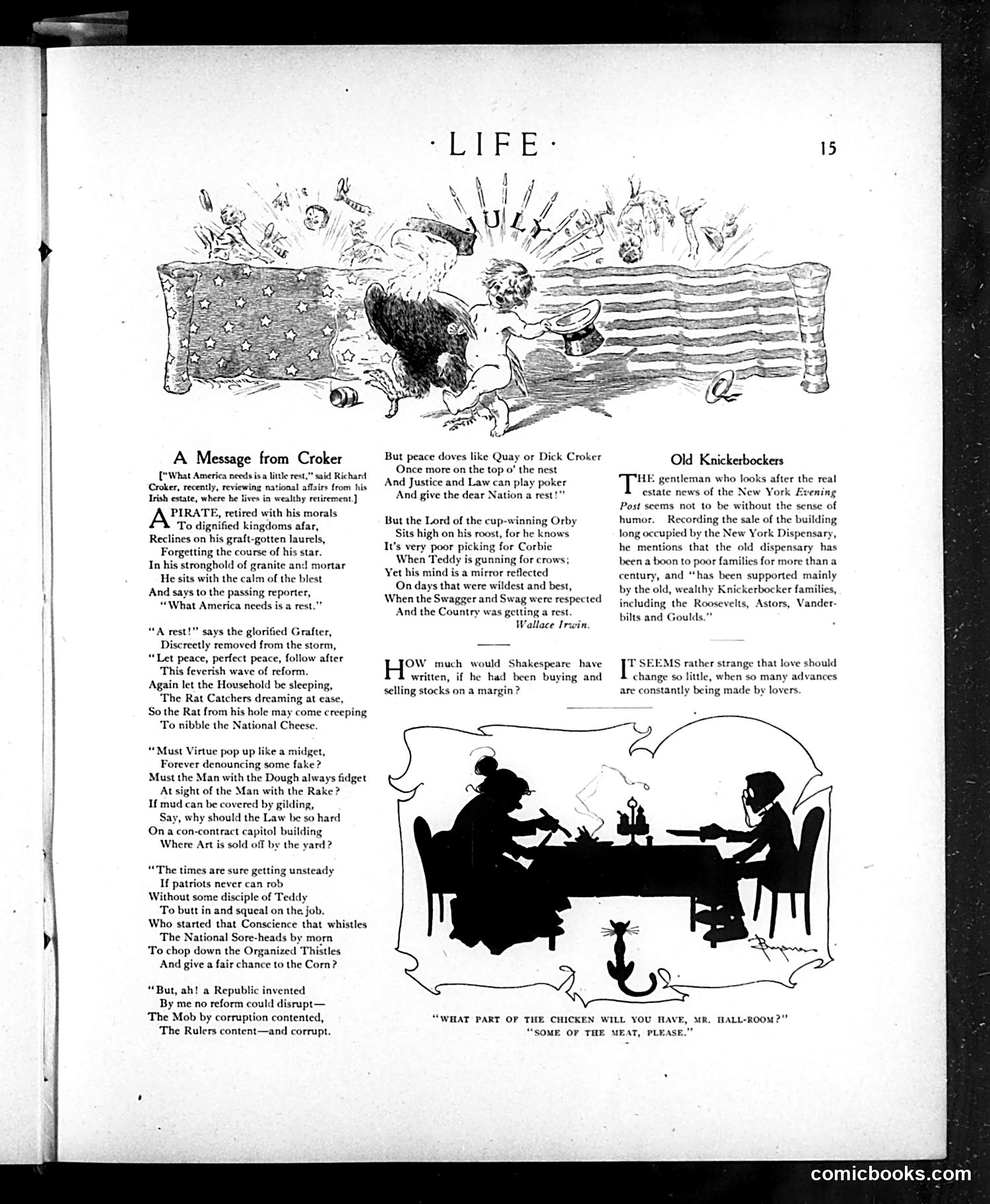
This page satirizes **Richard Croker**, the corrupt Irish-American political boss of Tammany Hall, who recently retired to Ireland claiming "America needs a rest." The lengthy poem mocks his statement as a thinly veiled plea for reformers to stop exposing corruption. The satire targets Croker's hypocrisy: he accumulated wealth through graft ("graft-gotten laurels") and now wants the nation to stop investigating political crime so corrupt politicians can continue unchecked. References to "the Man with the Rake," "con-contract capitol building," and "rats" nibbling "the National Cheese" represent various corruption schemes. **"Teddy" (Theodore Roosevelt)** appears as the reformer disrupting the corrupt status quo—the "crows" that politicians now must hide from. The bottom cartoon about "Old Knickerbockers" humorously notes wealthy families' charitable support, while the restaurant dialogue is an unrelated joke about portion sizes.
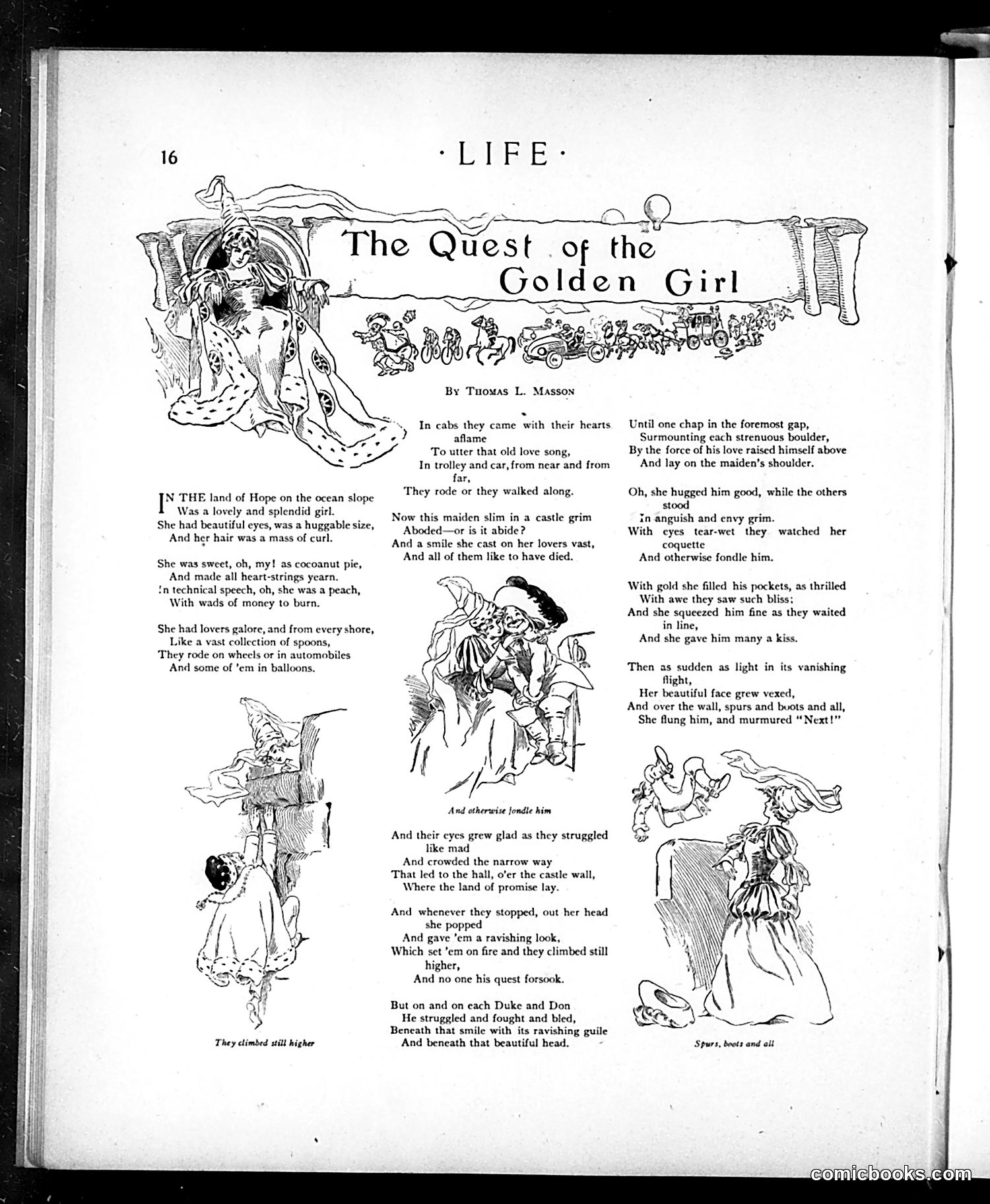
This is a satirical poem by Thomas L. Masson mocking both wealthy heiresses and the men who pursue them for money. The "Golden Girl" is a rich, beautiful woman in a castle besieged by suitors arriving by car, trolley, and balloon—modern transport that emphasizes their desperation and the absurdity of their pursuit. The satire targets the commercialization of romance and marriage: the men compete physically to reach her, she distributes money to the winner, then callously discards him for the next suitor ("Next!"), literally throwing him off the castle wall. The illustrations show the chaotic scramble of fortune-seekers and the girl's capricious cruelty. The poem mocks both the shallow materialism of wealthy women and the mercenary desperation of men willing to literally kill themselves for wealth and access—a commentary on early 20th-century courtship, class, and the dangers of unchecked female economic power.
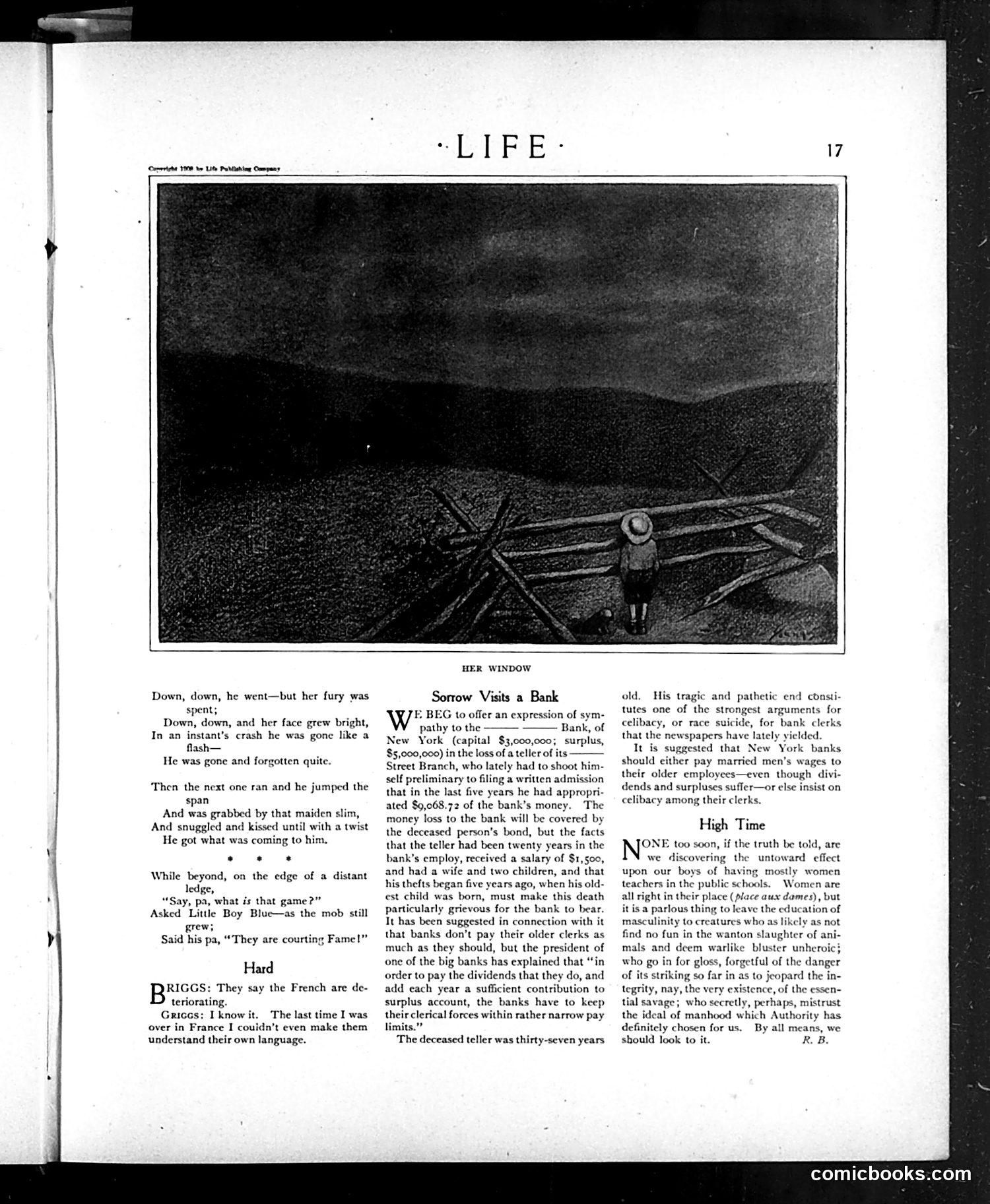
This page contains three distinct pieces of satirical social commentary: **"Her Window"** (illustrated): A cartoon mocking women's frivolous pursuit of fame and attention. The image shows a woman at a window repeatedly dropping men (literally) who court her, with a child asking his father what "game" they're playing. The father replies "courting Fame"—satirizing women as vain attention-seekers who discard suitors casually. **"Sorrow Visits a Bank"**: Bitter satire on bank economics. A 37-year-old teller, earning only $1,500 annually with a wife and two children, embezzled $9,068.72 over five years before committing suicide. The piece mocks banks' meager clerk wages while paying generous dividends, sarcastically suggesting that banks should either pay living wages to married men or force celibacy on employees—implying the system itself drove him to theft and death. **"High Time"**: Commentary warning that women teachers in public schools are feminizing boys and eroding "essential savage" masculine ideals necessary for manhood and national integrity. All three pieces reflect early 1900s anxieties about gender roles and economic inequality.
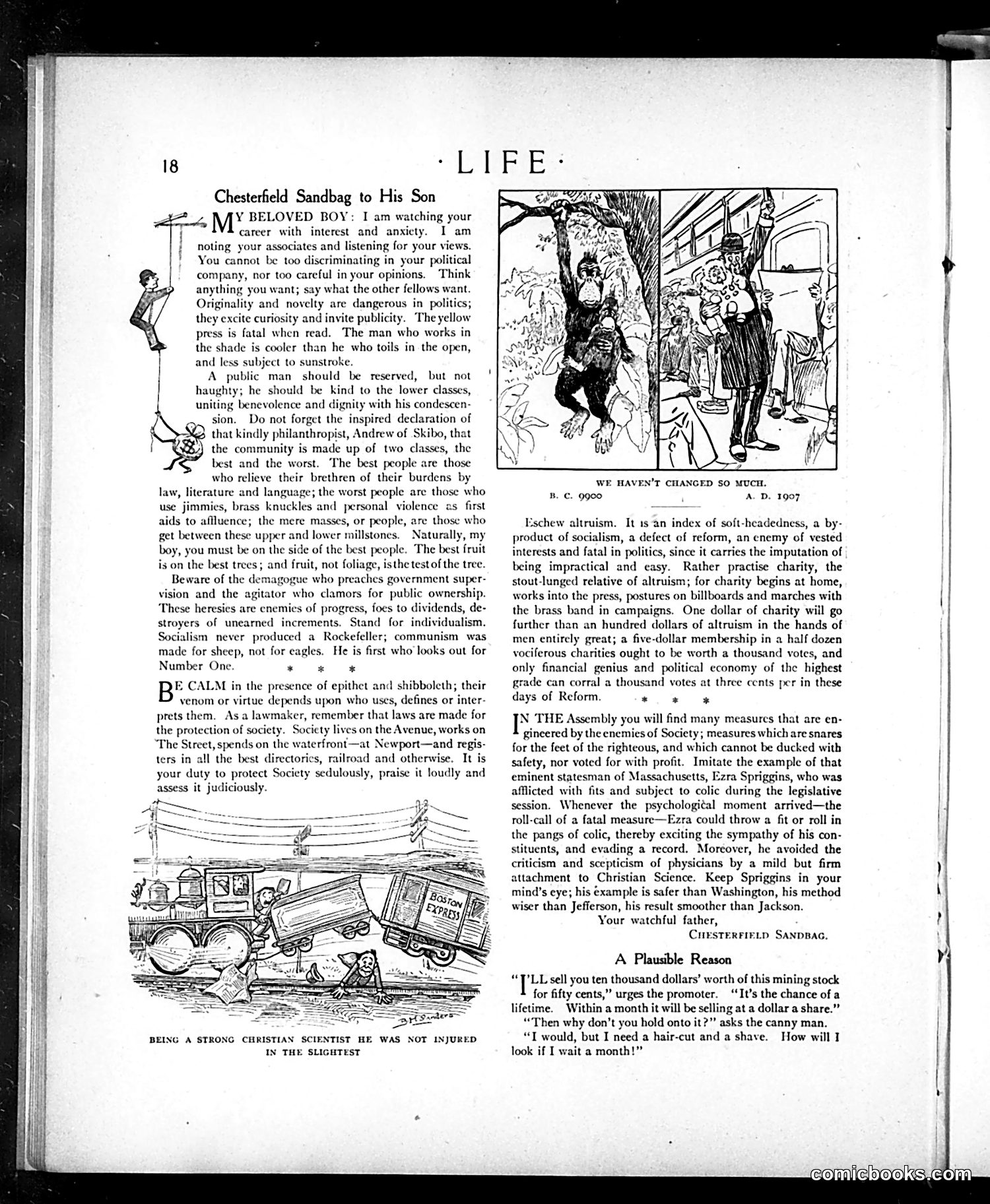
This is a **Gilded Age critique of political hypocrisy and corporate corruption**. The letter purports to be advice from a wealthy father ("Chesterfield Sandbag") to his son on political conduct. The satire works by having the father openly advocate what politicians *actually do* but won't admit: avoid genuine conviction, suppress reform ideas, protect wealthy interests over the masses, use "charity" (public relations) rather than real altruism, and dodge reform votes through convenient illness. The references to "Andrew of Skibo" (Andrew Carnegie), "Rockefeller," and attacks on socialism and public ownership identify this as **anti-plutocrat satire**—mocking the wealthy elite's influence over politics during the Progressive Era. The cartoon below reinforces this: it shows nothing has fundamentally changed between "B.C. 9900" and "A.D. 1907," suggesting corruption is timeless. The joke: the advice is so cynically frank that it exposes the corruption usually hidden behind respectable language.
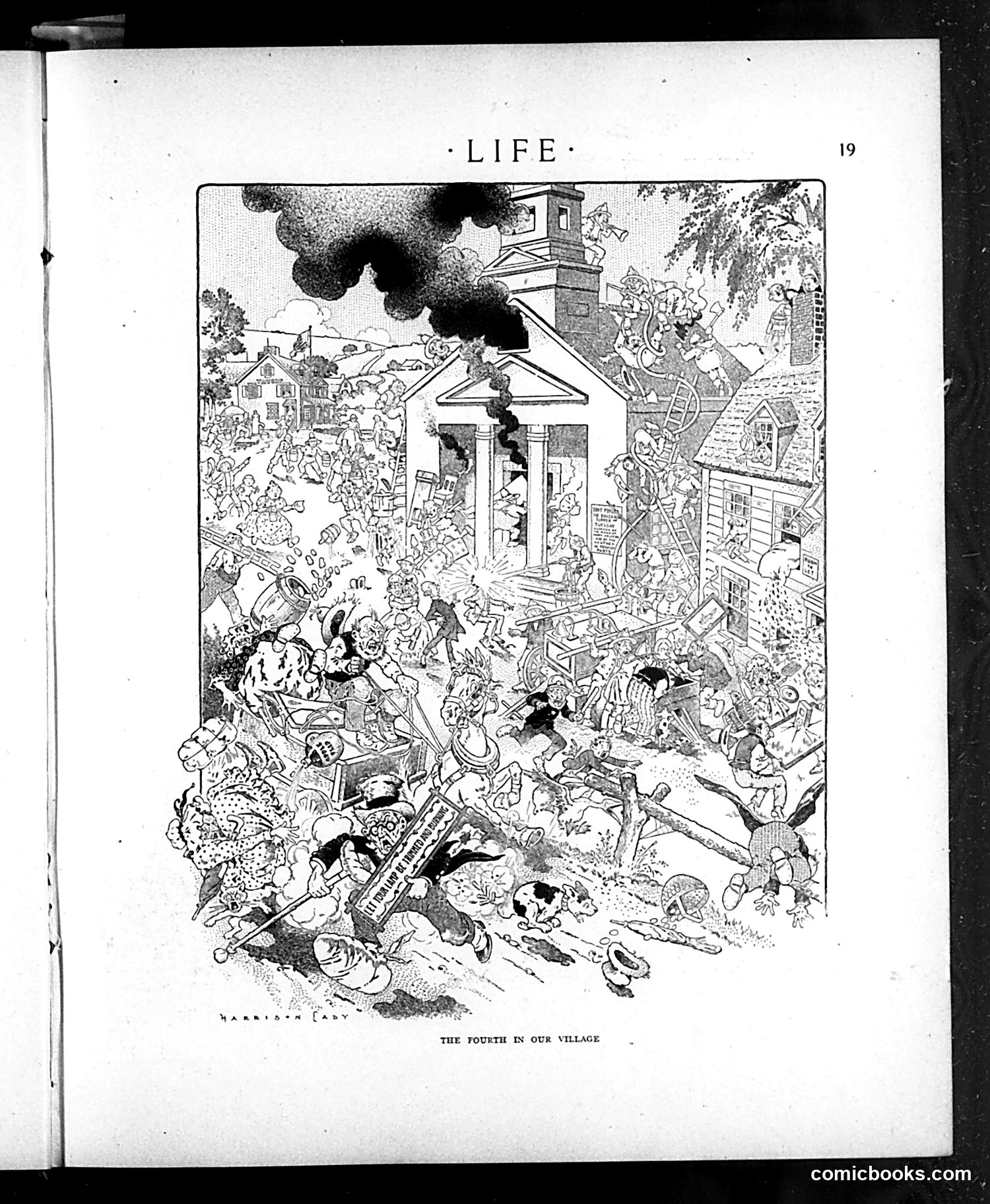
This satirical illustration depicts a chaotic Fourth of July celebration in a small American town. The crowded scene shows villagers engaged in various Independence Day activities and mischief surrounding a church building—the central focal point that anchors the composition. The cartoon satirizes small-town American life by portraying the Fourth of July festivities as anarchic and somewhat absurd. The dense mass of figures engaged in revelry, pranks, and general disorder suggests the satirist's critique of how rural communities celebrate the holiday—mixing patriotic sentiment with unruly behavior. The church's prominent placement amid this chaos may suggest tensions between religious propriety and secular celebration, a common satirical theme in early 20th-century American humor about provincial life.
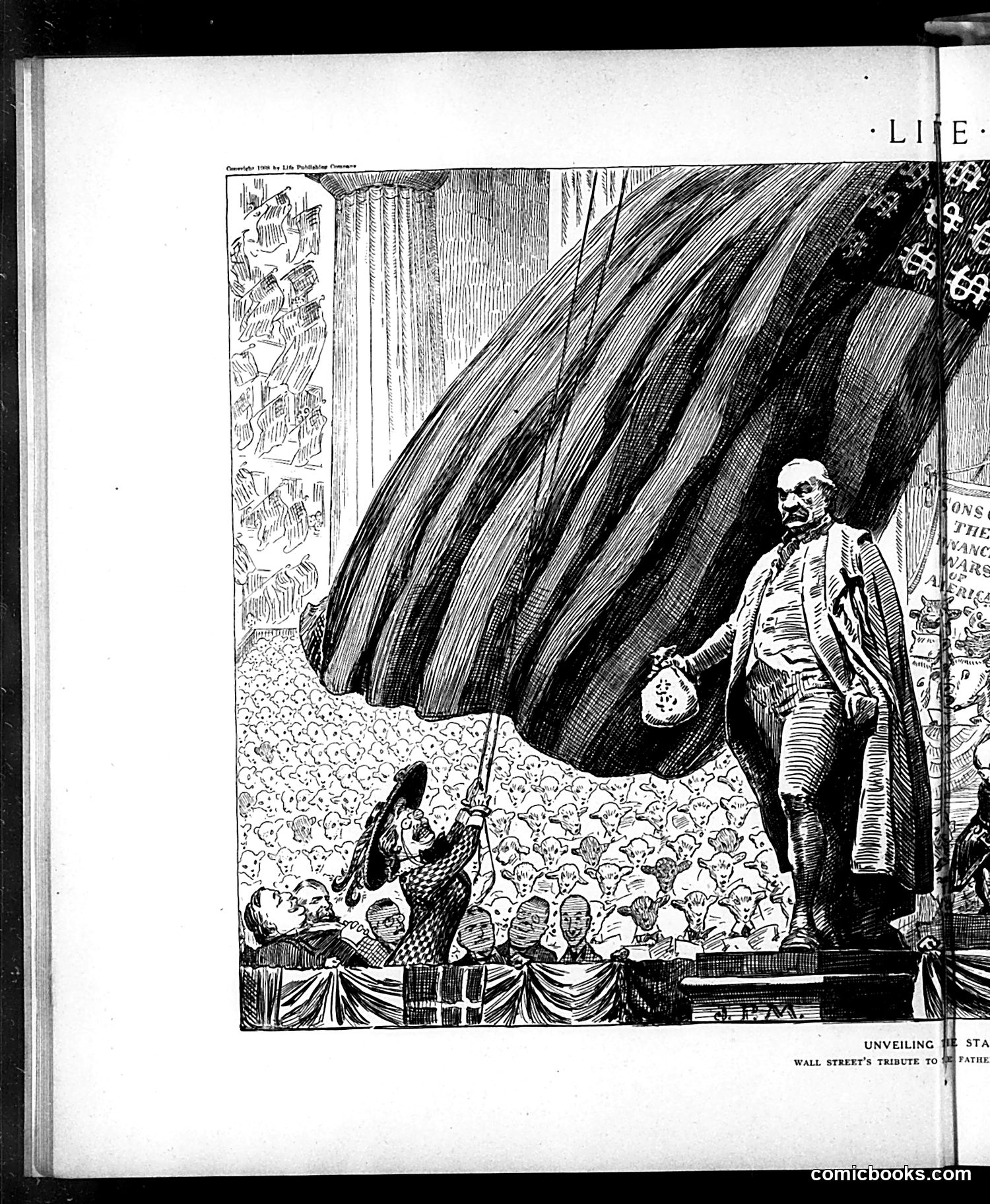
This appears to be a satirical engraving showing a statue unveiling ceremony. A distinguished gentleman in period dress stands beside a massive draped statue, while a crowd of identical-looking figures (represented economically through repetition) gazes upward. The title references "Wall Street's Tribute," suggesting this mocks the financial district's commemoration of something—likely a financial figure or concept. The cartoon's satire operates on multiple levels: the crowd's uniformity ridicules conformity among investors or the masses; the grand theatrical unveiling parodies pretentious monument-building; and the overall scene suggests ironic criticism of how Wall Street lionizes financial interests. Without the complete caption or date, the specific target remains unclear, but the tone unmistakably criticizes capitalist excess and the reverent treatment wealth receives in American society.
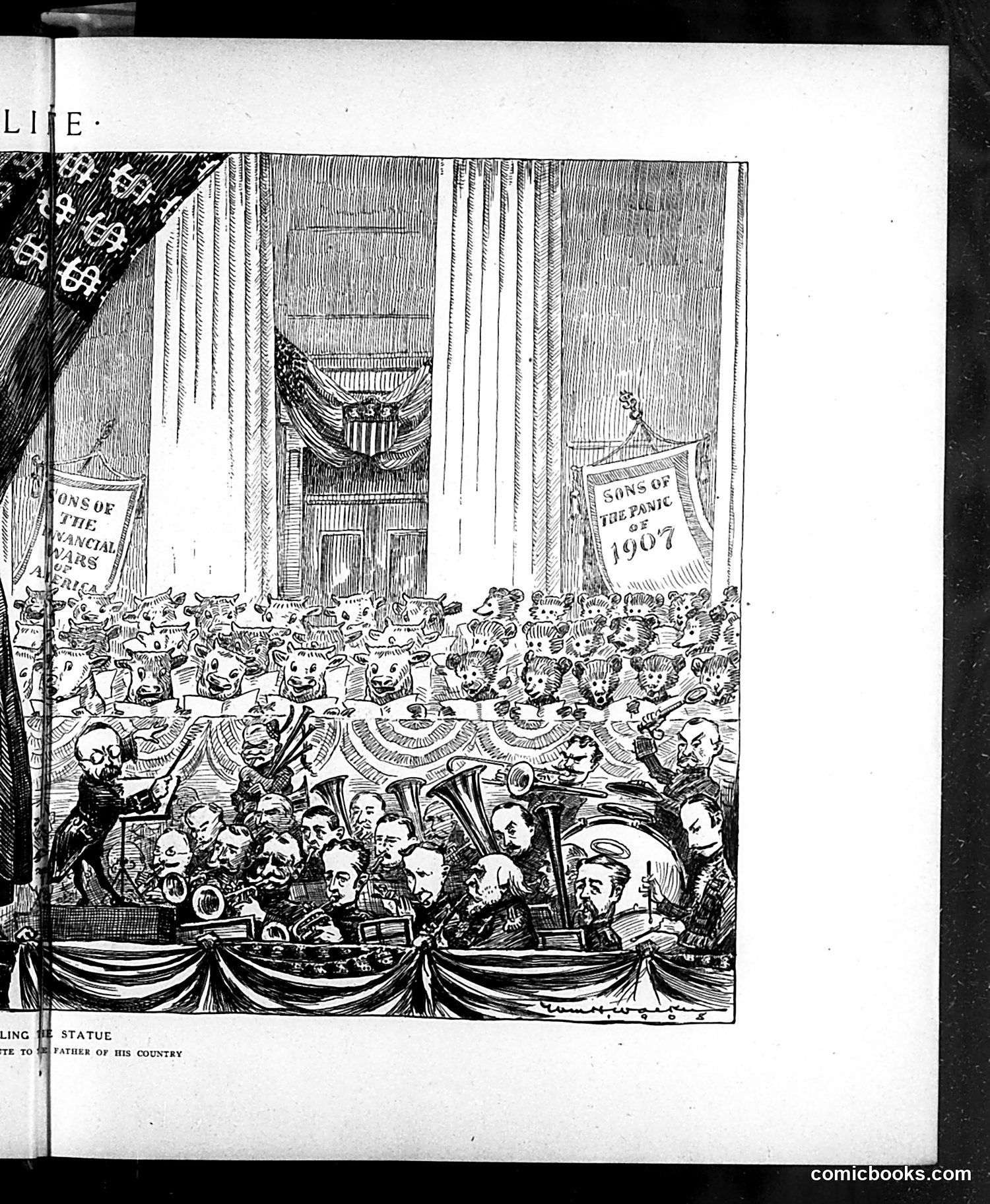
This satirical cartoon depicts a formal governmental or ceremonial scene, likely from around 1907 based on the visible banner reading "Sons of the Panic of 1907." The image shows a large crowd of pig-faced figures in the upper gallery, while dignified officials in formal dress occupy a lower platform with draped bunting. The pigs appear to represent speculators or financial manipulators, while the officials likely represent government leadership. The satire critiques the financial panic of 1907, suggesting that greedy financial actors (depicted as pigs) were responsible for the economic crisis, while government officials presided over the chaos. The contrast between the two groups emphasizes the separation between those blamed for the disaster and those ostensibly in control.
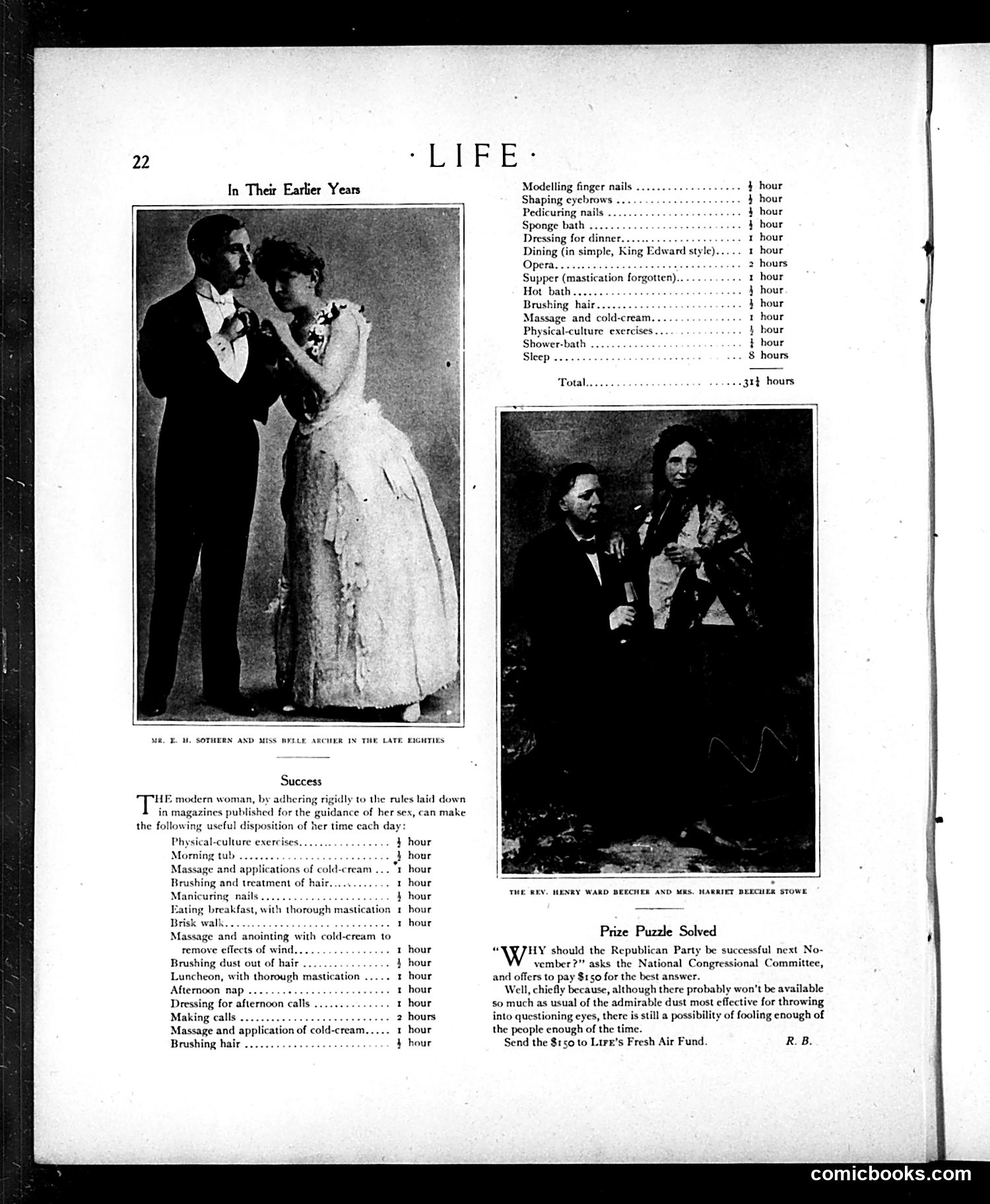
This page mocks the emerging "modern woman" of the late 19th/early 20th century through two satirical lists. The first, titled "In Their Earlier Years," contrasts a couple (labeled as E.H. Sothern and Miss Nelle Archer) with a schedule suggesting women spent 31½ hours daily on beauty rituals—an obvious impossibility meant to ridicule excessive vanity. The second list, "Success," sarcastically prescribes how a woman should spend her time "adhering to the rules laid down in magazines," again totaling impossible hours devoted to beauty treatments, dining, and social calls. The joke targets both the superficiality of women's magazines promoting endless grooming, and the leisure-class culture they represented. A separate item mocks the Republican Party's prize puzzle about electoral success, suggesting their "dust" (campaign rhetoric) was their only effective tool. The page satirizes gender expectations and consumer culture of the era.
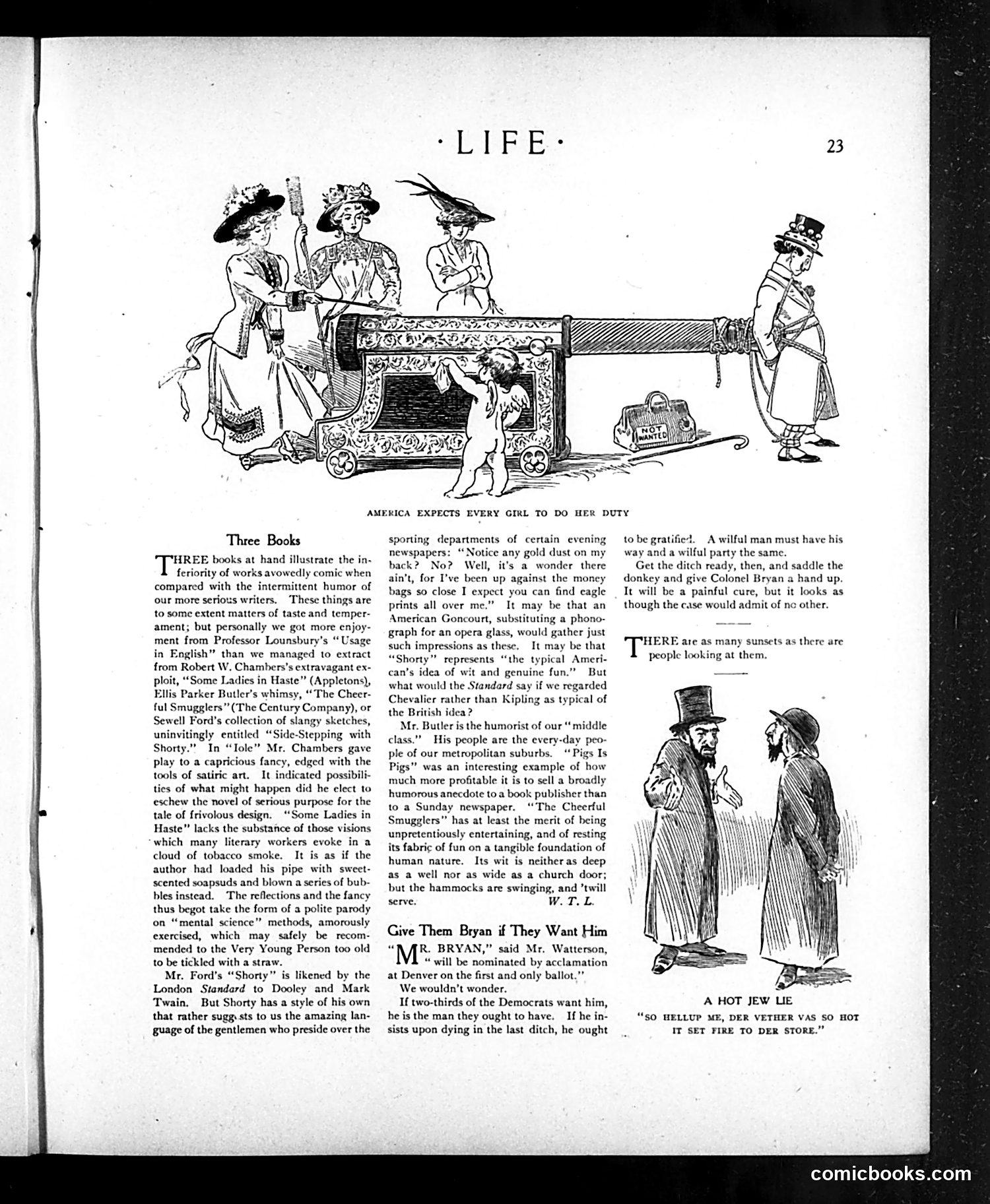
This Life magazine page contains two distinct items: **Top Cartoon:** "America Expects Every Girl to Do Her Duty" depicts women operating an enormous telescope or cannon-like device, with a man peering through it. The caption plays on the famous WWI British recruitment slogan ("England Expects Every Man to Do His Duty"). The satire appears to mock gender roles and women's expanding public participation—likely commenting on the suffrage movement or changing social expectations for women around this era. **Book Reviews:** The text critiques three contemporary humorous books, arguing they're inferior to serious literature. It discusses their styles and merit, comparing American humorists unfavorably to British ones. **"A Hot Jew Lie":** A brief ethnic joke featuring a character speaking in exaggerated Yiddish-accented English, claiming heat from weather set fire to his store. This reflects the casual antisemitic humor that was normalized in early 20th-century American publications. The page reflects period attitudes toward women's roles, literary taste, and ethnic stereotyping common to the era.
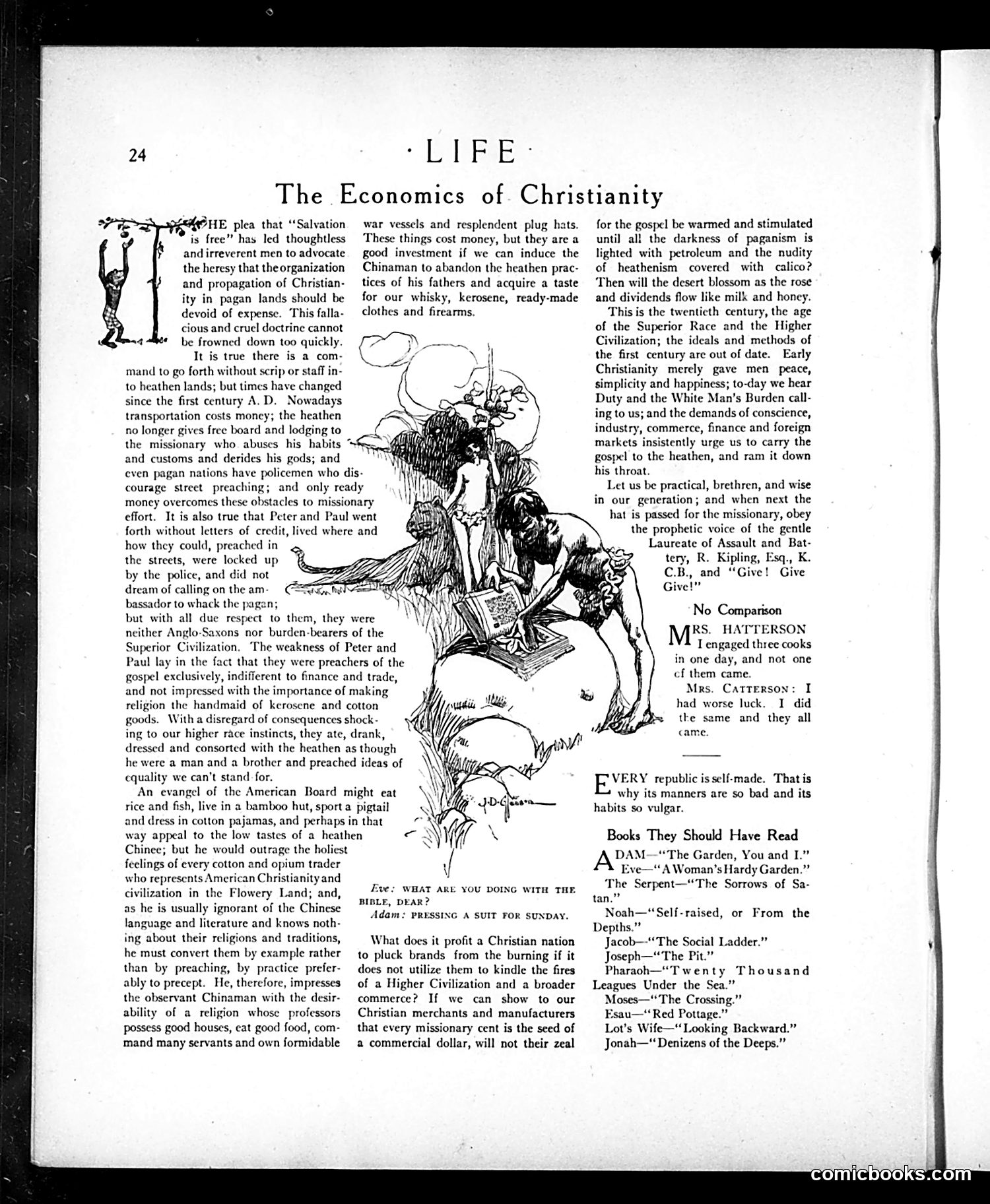
This satirical article and cartoon mock American missionaries and traders who justify commercial exploitation of China under the guise of Christian conversion. The **cartoon** shows Adam pressing his Bible suit for Sunday—a visual pun suggesting Christians compartmentalize morality, dressing religiously only on weekends while conducting business unethically the rest of the time. The **text** sarcastically argues that modern missionaries should abandon early Christian simplicity and instead use commerce as conversion's tool. The author mocks the hypocrisy: selling whisky, kerosene, and firearms to Chinese people while claiming moral superiority as the "Superior Race." He ridicules the notion that profit motive ("every missionary cent is the seed of a commercial dollar") should drive spiritual work. The piece critiques American imperialism disguised as Christian charity—particularly targeting the "White Man's Burden" ideology justifying Western colonial expansion. It exposes how traders weaponized missionary activity to open Asian markets, contradicting actual Christian principles of simplicity and equality that early apostles practiced.
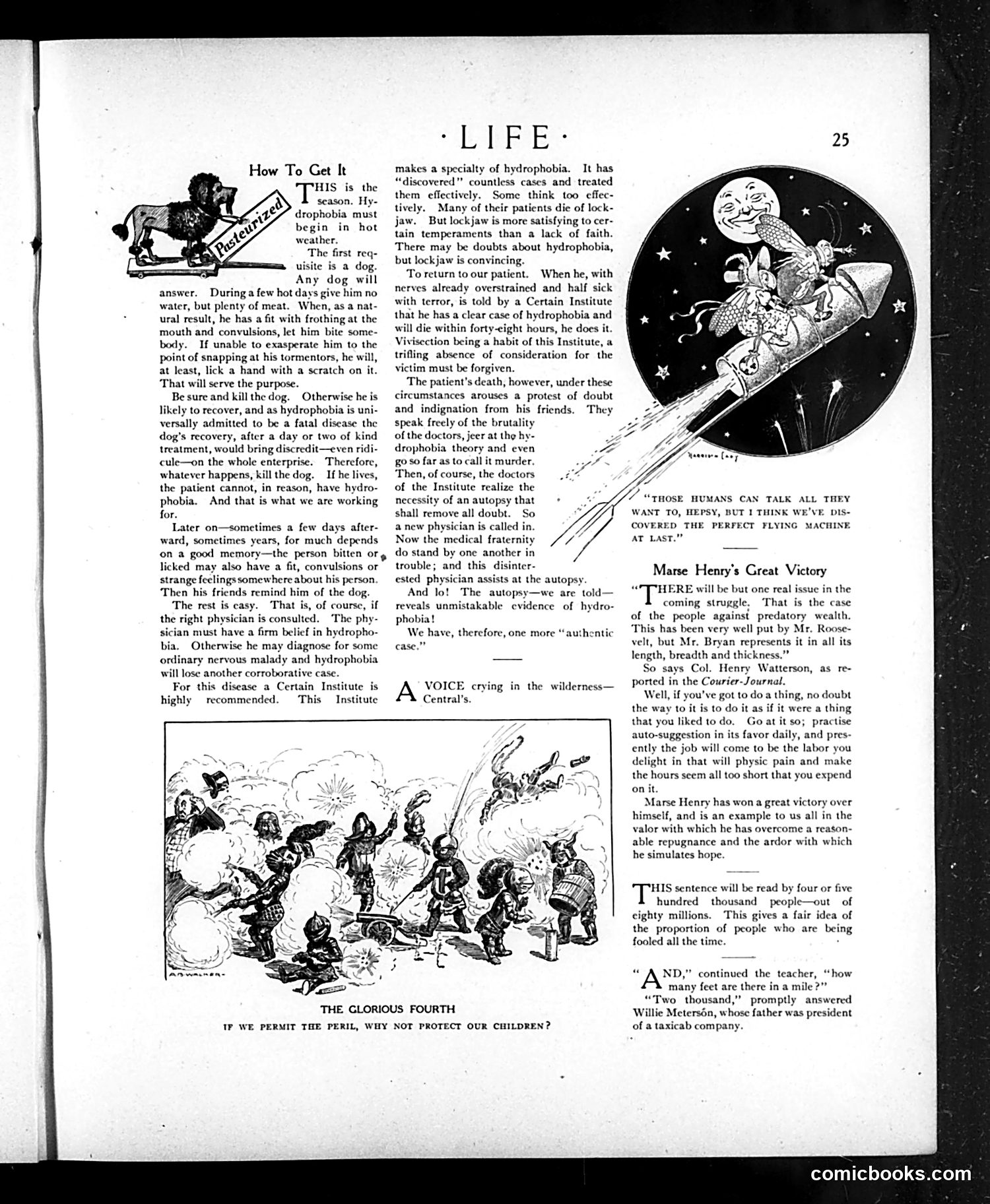
This page contains two distinct satirical pieces mocking medical and political figures of the era. **"How To Get It"** is a scathing expose of fraudulent hydrophobia (rabies) diagnosis. The satirist describes a cynical scheme: a dog is starved and provoked into biting someone, then killed. When the victim later shows any nervous symptoms, a complicit "Certain Institute" diagnoses fatal hydrophobia. The victim dies from psychological terror or lockjaw. An autopsy conveniently "confirms" the diagnosis, protecting the Institute's reputation. The satire attacks both medical quackery and institutional self-preservation at patients' expense. **"Marse Henry's Great Victory"** mocks newspaper editor Henry Watterson, who claimed Bryan better represents anti-monopoly sentiment than Roosevelt. The satirist suggests Watterson is merely practicing self-delusion through "auto-suggestion"—convincing himself of something untrue through repetition—rather than facing reality. Both pieces exemplify Life's role as muckraking social critic, exposing medical fraud and journalistic dishonesty in the Progressive Era.
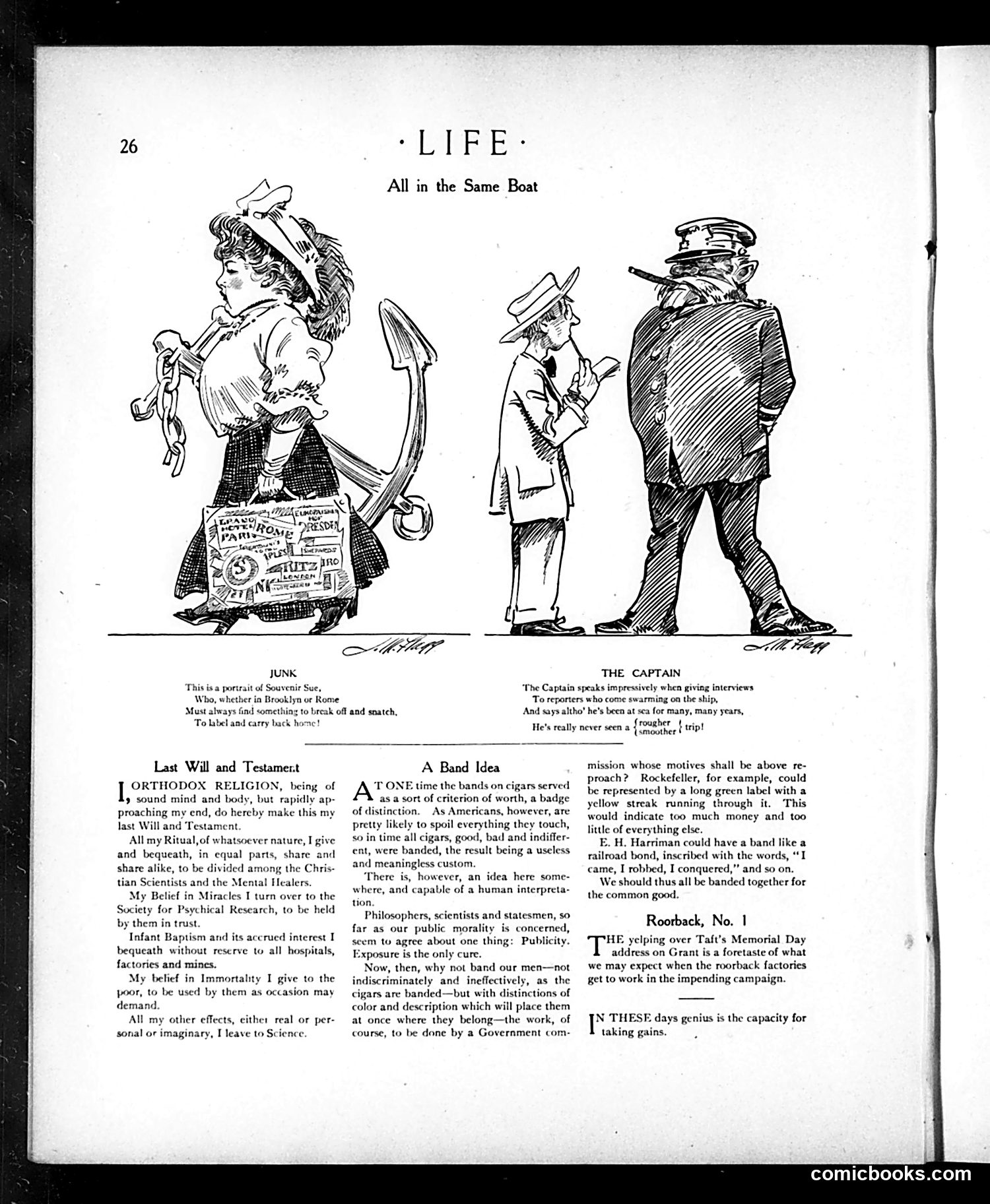
This page contains three satirical pieces mocking American society and public figures circa early 1900s. **"Souvenir Sue"** ridicules tourists (particularly women) who compulsively collect and transport souvenirs while traveling. **"The Captain"** caricatures ship captains who give self-aggrandizing interviews to reporters, boasting about their experience while exaggerating their accomplishments. **"A Band Idea"** proposes humorously that prominent businessmen and politicians should wear colored bands (like cigar bands) labeling their crimes and vices—specifically mentioning Rockefeller and E.H. Harriman as examples of robber barons whose excessive wealth and unethical practices deserve public identification. The satirist suggests a government commission regulate this "branding." **"Last Will and Testament"** mocks Orthodox Religion, bequeathing its various doctrines to institutions like Christian Science, Mental Healers, and scientific societies—implying religious beliefs are outdated curiosities. **"Roorback, No. 1"** references political smear campaigns ("roorback factories"), predicting dirty tactics in upcoming elections.
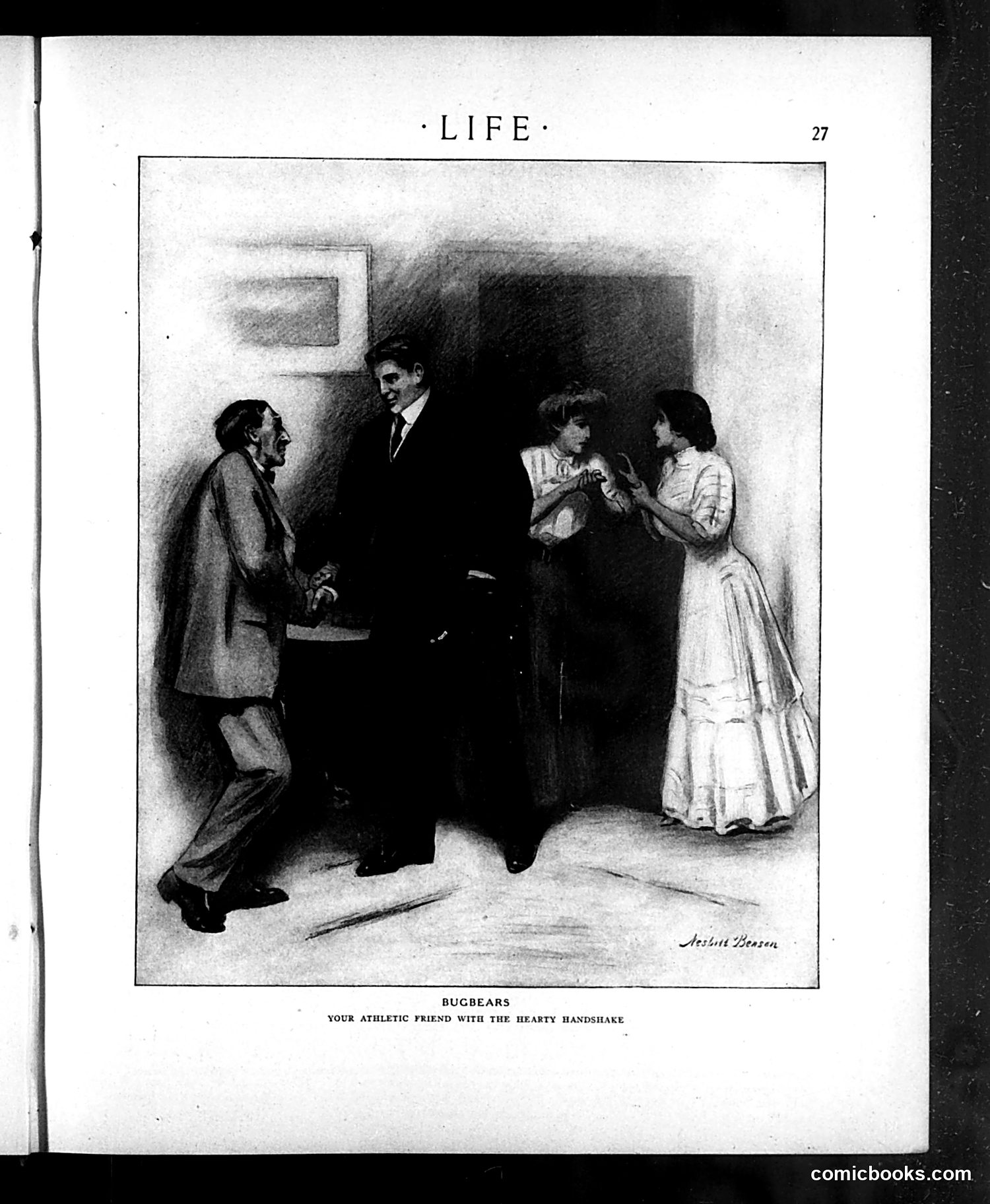
This satirical cartoon depicts a well-dressed man enthusiastically shaking hands with a smaller, older gentleman, while two women on the right appear concerned or distressed. The title suggests mockery of the overly vigorous, patronizing "athletic friend" type—someone who affects hearty friendliness and physical exuberance (the aggressive handshake) as social performance. The cartoon satirizes a recognizable social type: the athletic, boisterous man whose enthusiastic bonhomie masks either obliviousness or insincerity. The women's worried expressions suggest his "hearty" manner is unwelcome or uncomfortable rather than genuinely friendly. The satire targets masculine affectation and performative friendliness as a social "bugbear"—an imaginary threat or foolish concern masquerading as genuine warmth.
This is a serialized short story (not a political cartoon), appearing in Life magazine's "Life" section—a regular feature of humorous fiction and social commentary. The narrative satirizes **early 20th-century class and professional prejudices**. Jack Stenson, a struggling author using a pen name, has fallen for Mabel Hurde, daughter of a conservative banker. His publisher friend Dilling warns him that Colonel Hurde—a practical, old-fashioned businessman—holds "literary men" in contempt as impractical and unsuitable. The satire targets the era's **social hierarchy placing businessmen above artists**, and the assumption that creative professions were frivolous or disreputable. The irony is that Stenson must hide his literary identity to court respectable people, despite having just earned real money from his writing. The story continues on page 30, suggesting this was serialized entertainment for middle-class readers amused by these professional and romantic entanglements.
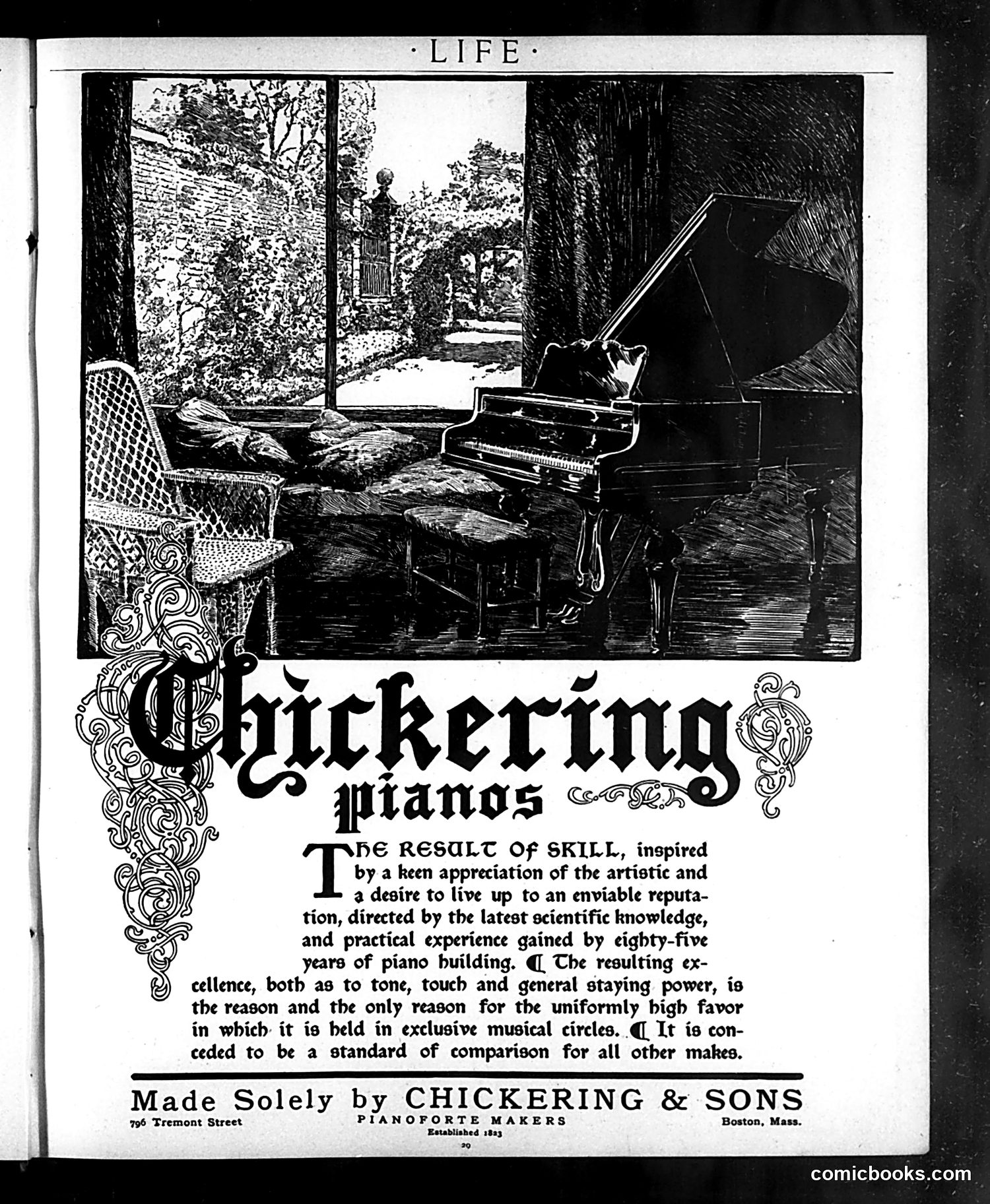
This page is primarily a **piano advertisement**, not satire or political commentary. It shows Chickering & Sons, a Boston piano manufacturer established in 1823, promoting their grand pianos. The image depicts an elegant interior scene: a woman seated at a grand piano beneath an open-roof conservatory or garden room, with ivy-covered walls and manicured grounds visible beyond. An umbrella leans nearby, suggesting leisurely outdoor-adjacent music-making. The advertisement emphasizes the piano's quality through claims of "eighty-five years of piano building," superior "tone, touch and staying power," and prestigious acceptance in "exclusive musical circles." The ornate typography and refined aesthetic appeal to wealthy, cultured consumers for whom owning a fine piano signified sophistication and social status. This represents typical early-20th-century luxury goods marketing—associating the product with elegance, tradition, and exclusivity rather than practical utility.
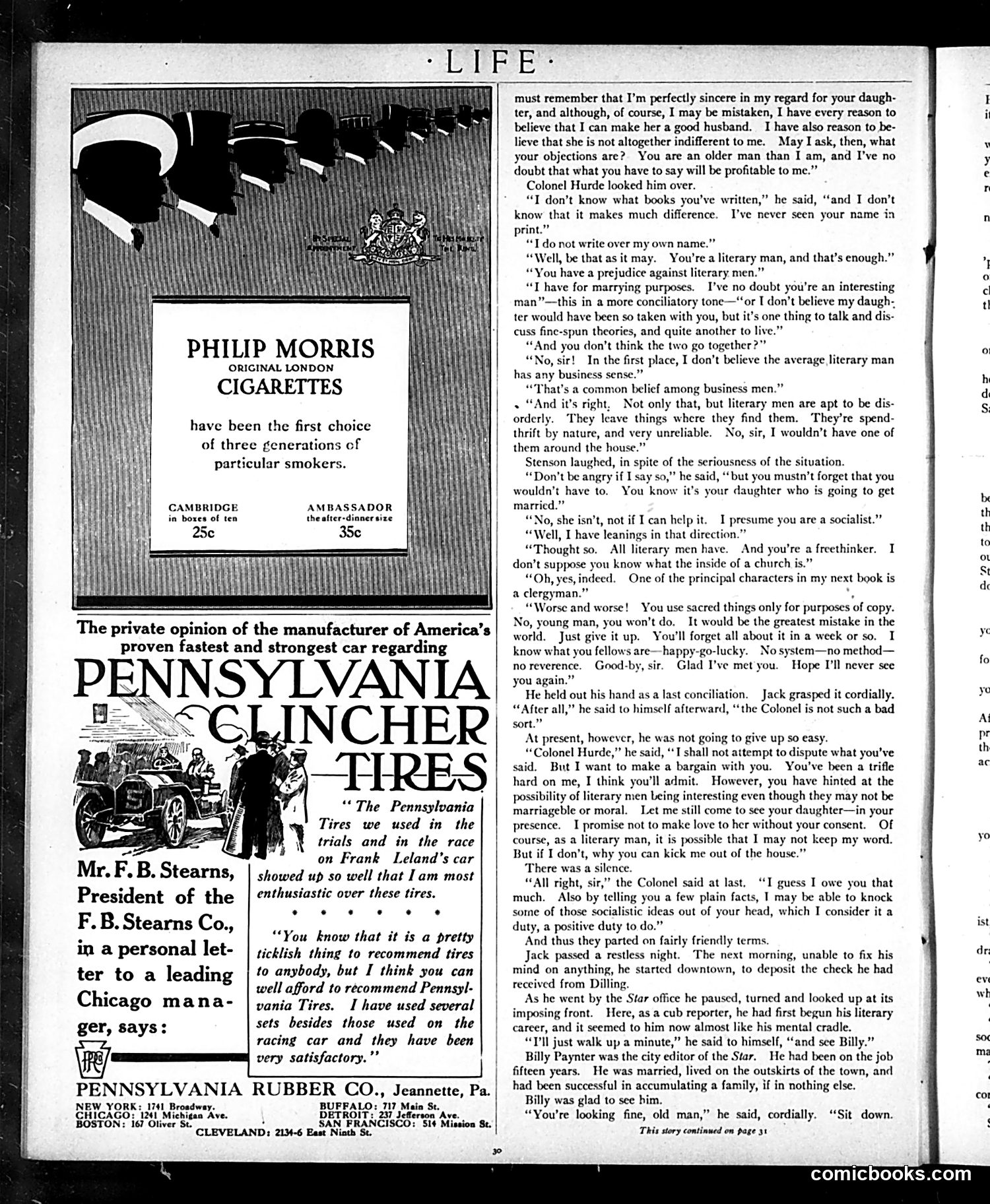
This page contains **advertising and serialized fiction**, not political satire. The advertisements promote Philip Morris cigarettes and Pennsylvania rubber tires, using endorsements from business figures (F.B. Stearns, car manufacturer). These are straightforward commercial pitches typical of early 20th-century *Life* magazine. The bulk of the page is a **serialized short story** depicting a conversation between a young literary man named Jack and Colonel Hurde, whose daughter Jack wishes to marry. The Colonel expresses class-based prejudices against writers: they lack business sense, are disorderly and unreliable, hold socialist and freethinker views, and misuse sacred subjects for literary copy. This appears to be social satire about **intellectual versus practical classes**—mocking the Colonel's provincial distrust of educated "literary men" while portraying Jack's earnest idealism. The story continues on page 31.
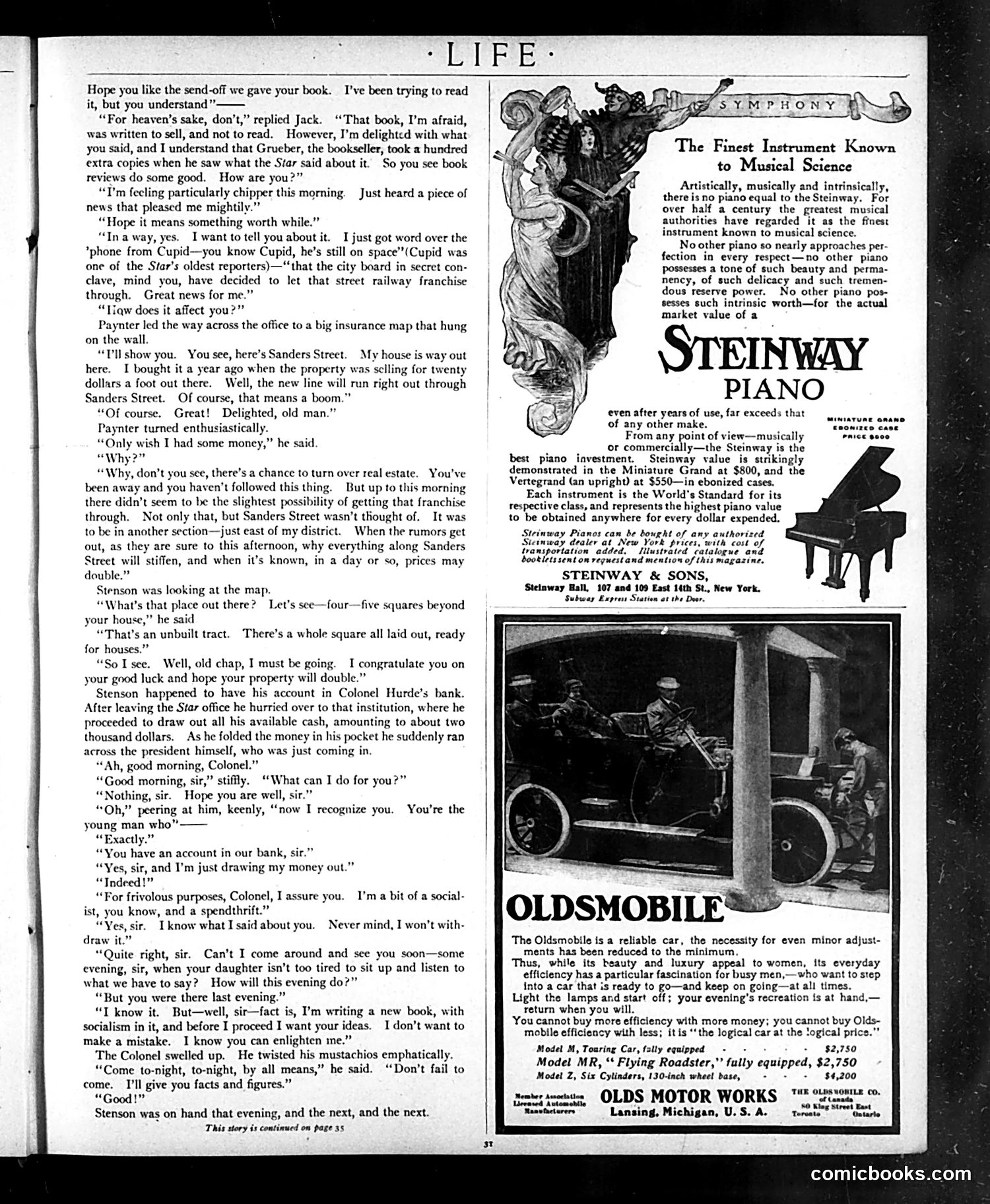
This page contains a short story satirizing insider trading and financial speculation. The narrative follows two newspaper men: Paynter, who learns confidential information that a streetcar franchise will be approved on Sanders Street, and Stenson, who overhears this news. Paynter gloats about property he owns there—bought cheaply a year ago, now about to boom in value. Stenson immediately withdraws his $2,000 life savings from Colonel Hurde's bank and approaches the Colonel, positioning himself as a humble "socialist spendthrift" seeking wisdom for a book. The Colonel, flattered and eager to impress, invites Stenson to his home that evening. The satire targets wealthy men's susceptibility to flattery and their willingness to share confidential information with those who stroke their egos—making them vulnerable to financial manipulation. It's a critique of corruption and how insider knowledge drives unfair wealth accumulation. The advertisements below are period-appropriate (Steinway pianos, Oldsmobile automobiles).
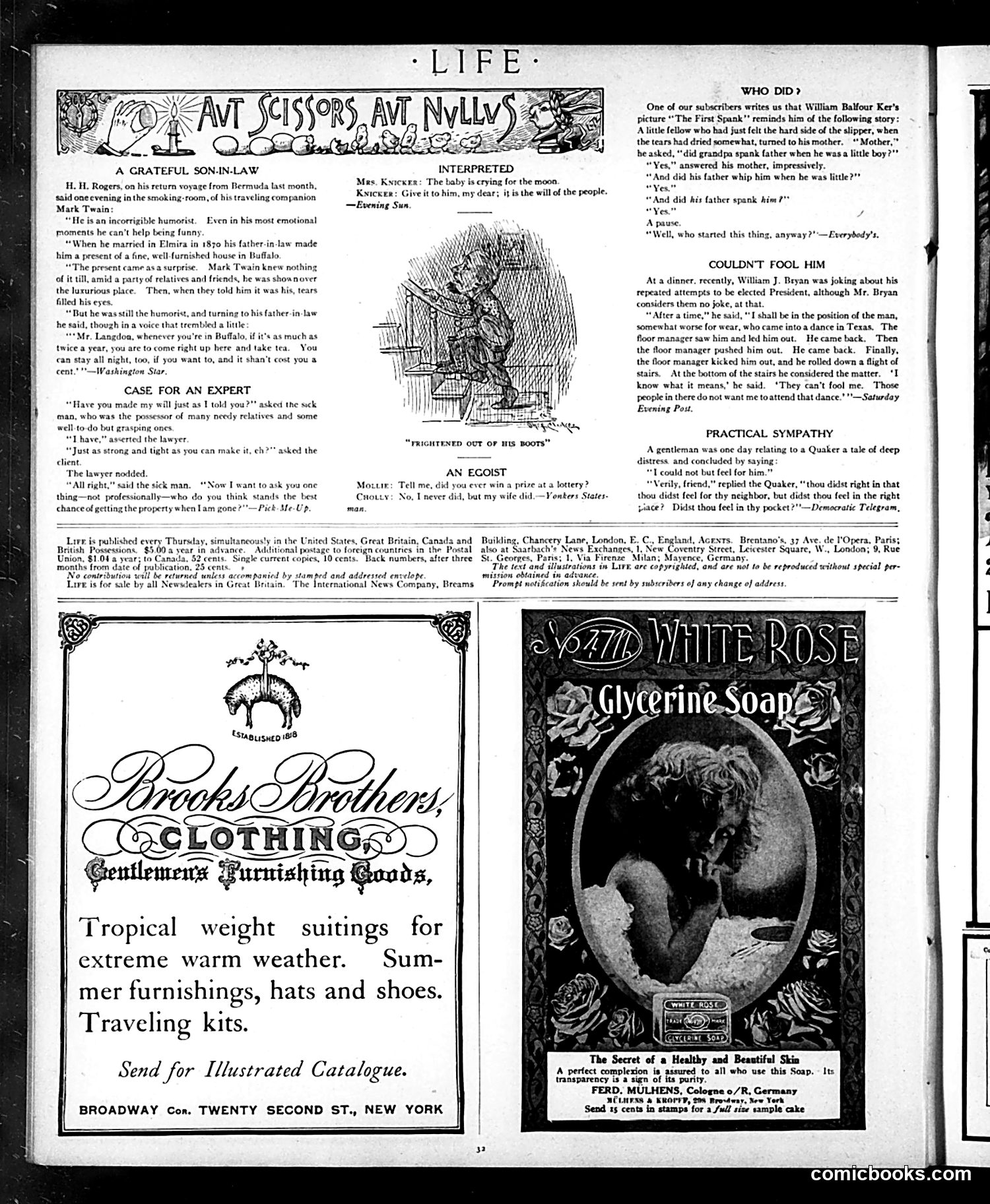
This page contains several humorous anecdotes typical of *Life* magazine's satirical content, plus period advertisements. **Main Cartoons/Stories:** 1. **"A Grateful Son-in-Law"** features Mark Twain's supposedly witty response to receiving a house from his father-in-law—offering free tea and lodging "if it shan't cost you a cent," a humorous contradiction. 2. **"Case for an Expert"** jokes about a dying man ensuring his will is ironclad against greedy relatives. 3. **"An Egoist"** satirizes a man's wife winning the lottery, with him insisting it demonstrates "the will of the people"—mocking self-centeredness. 4. **"Who Started This Thing?"** recounts generational spanking, humorously tracing parental discipline backward through time. 5. **"Couldn't Fool Him"** references William J. Bryan's repeated unsuccessful presidential campaigns, comparing him to a man repeatedly ejected from a dance who finally understands he's unwanted. 6. **"Practical Sympathy"** contrasts empty sentiment with actual charitable action—a Quaker suggests feeling pity is worthless without opening one's wallet. The advertisements for Brooks Brothers clothing and White Rose soap represent typical period commerce.
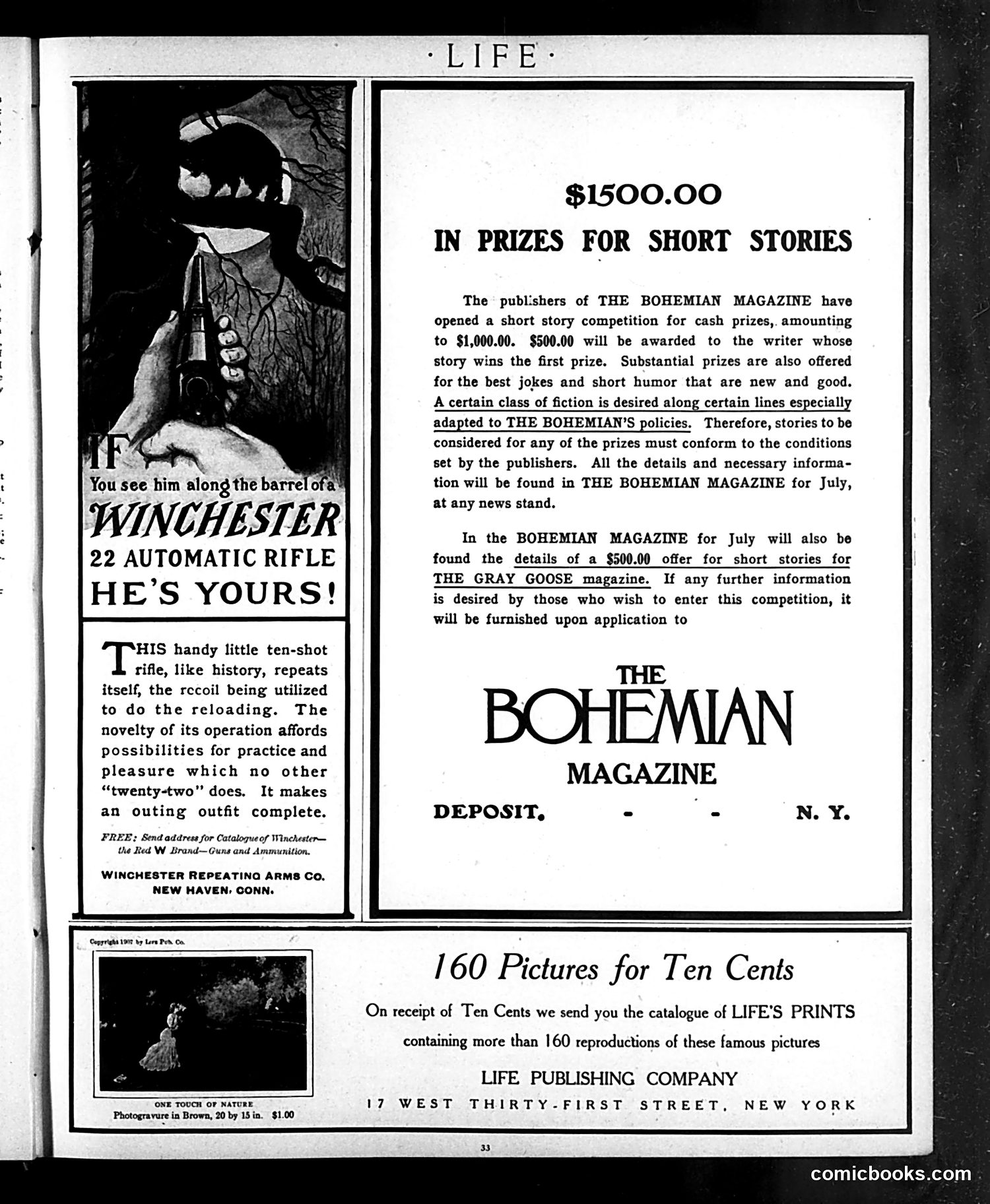
This page is primarily **advertising**, not satire or political commentary. It contains three distinct advertisements: 1. **Winchester Rifle Ad** (left): Promotes the Winchester .22 automatic rifle as a recreational "outing outfit," emphasizing its repeating mechanism and ease of use. The illustration shows a silhouetted hunter. This is straightforward product marketing. 2. **The Bohemian Magazine Contest** (center/right): Announces a $1,500 short-story competition with $500 for first prize. The text notes stories must "conform to conditions set by the publishers" and align with the magazine's "policies"—suggesting editorial gatekeeping of acceptable content. 3. **Life's Prints Catalog** (bottom): Offers 160 picture reproductions for ten cents from Life Publishing Company. **For modern readers**: This reflects early 20th-century magazine culture—competitions, mail-order catalogs, and recreational hunting were common advertised pursuits. The Bohemian's editorial requirements hint at censorship standards typical of that era.
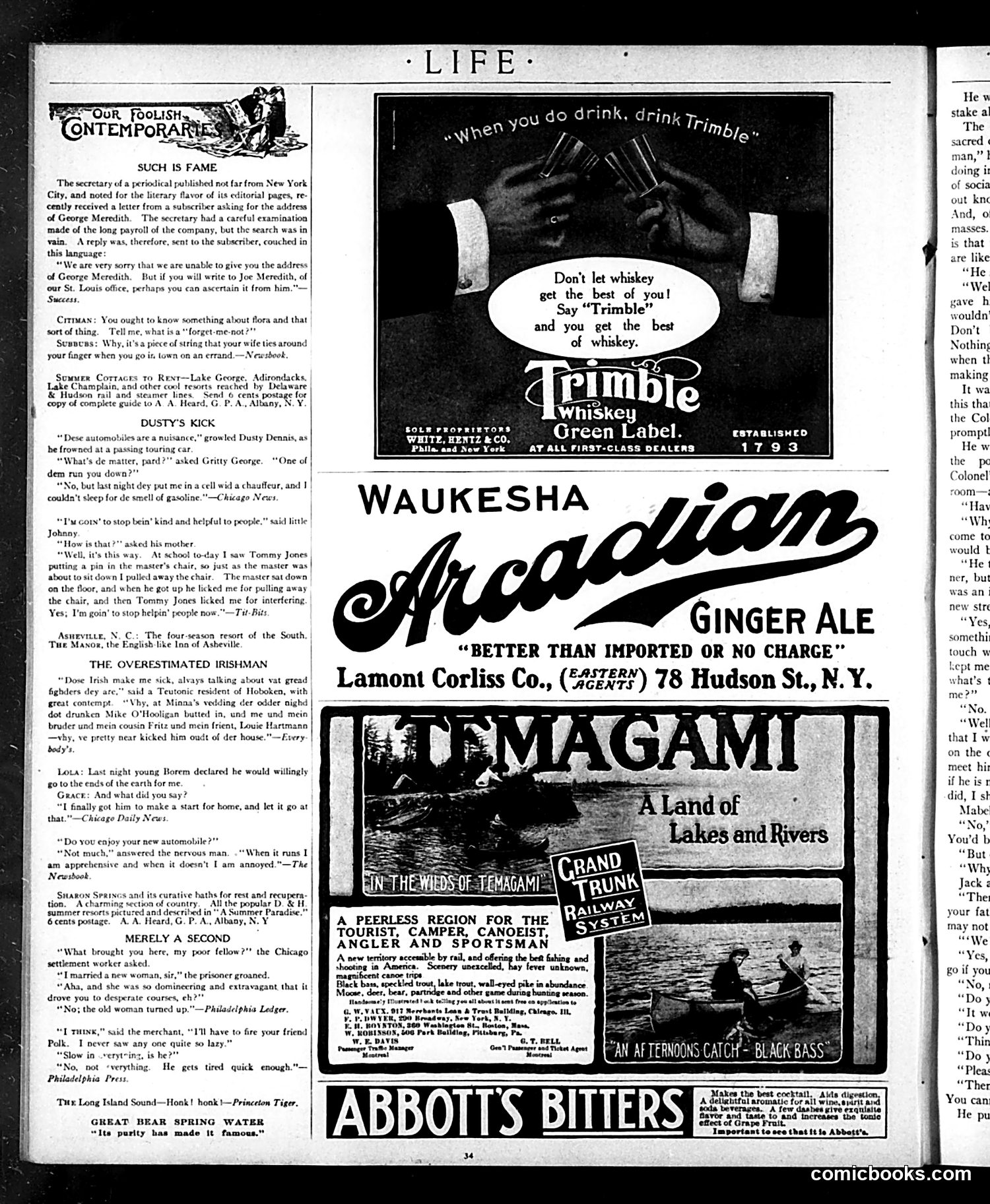
This page is primarily **advertising with humorous filler content**, typical of early 1900s Life magazine format. The main satirical pieces are brief anecdotes mocking contemporary follies: - **"Such Is Fame"**: Jokes about mistaken identity—a magazine secretary confuses the famous author George Meredith with an office employee named Joe Meredith, satirizing how obscure even celebrated literary figures were to ordinary people. - **"Dusty's Kick"**: Mocks the emerging automobile era, with a character complaining that a night in jail with a chauffeur was worse than being hit by a car—poking fun at early auto culture's prevalence. - **Minor anecdotes** ridicule Irish stereotypes, feminine logic, and schoolboy mischief. The **advertisements dominate**: Trimble Whiskey, Arcadian Ginger Ale, Temagami tourism, and Abbott's Bitters represent period products and travel destinations. The messaging emphasizes quality and novelty—Arcadian is "better than imported," Temagami promises "black bass" fishing. Overall, this reflects turn-of-the-century American middle-class anxieties about modernity, celebrity, and consumer culture.
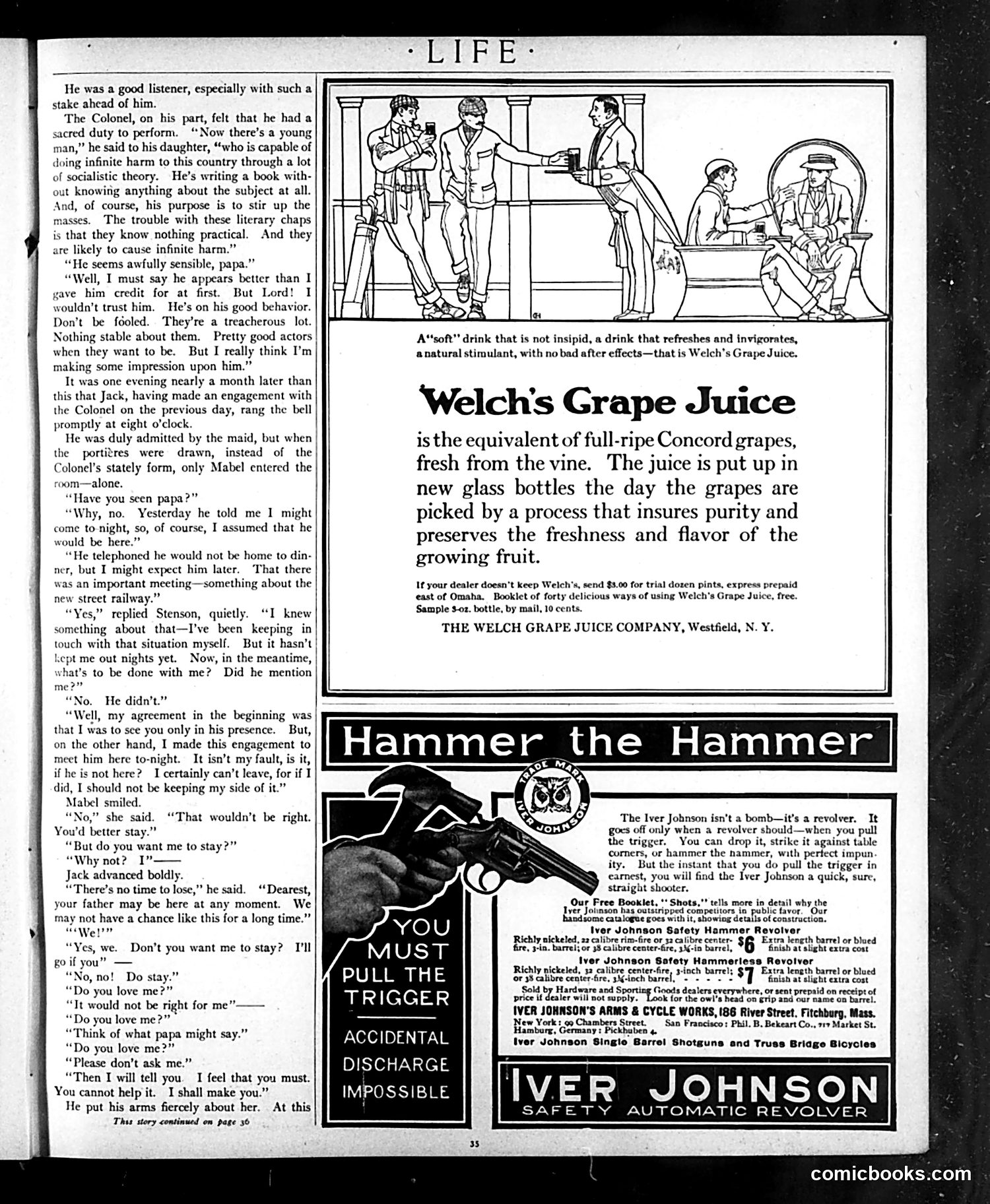
This page contains two distinct elements: **Main Story (Left Column):** A serialized romantic narrative about a young socialist writer named Jack courting Mabel, daughter of a disapproving Colonel. The Colonel distrusts Jack's "socialistic theory" and literary ambitions as dangerous to the country, yet Jack is gradually winning him over. The excerpt ends with Jack and Mabel alone together when the Colonel unexpectedly delays—setting up dramatic tension. This appears to be satirizing early 20th-century class anxieties about radical intellectuals and courtship propriety. **Advertisements (Right Side):** Two product ads—Welch's Grape Juice (emphasizing purity and naturalness) and the Iver Johnson revolver (stressing safety features). The revolver ad's tagline "You Must Pull the Trigger" and "Accidental Discharge Impossible" markets the gun as foolproof and safe. The juxtaposition is jarring to modern readers: a domestic romance story adjacent to firearm marketing, reflecting an era when such advertising was routine in mainstream publications and handguns were marketed directly to general audiences without current safety restrictions or social controversy.
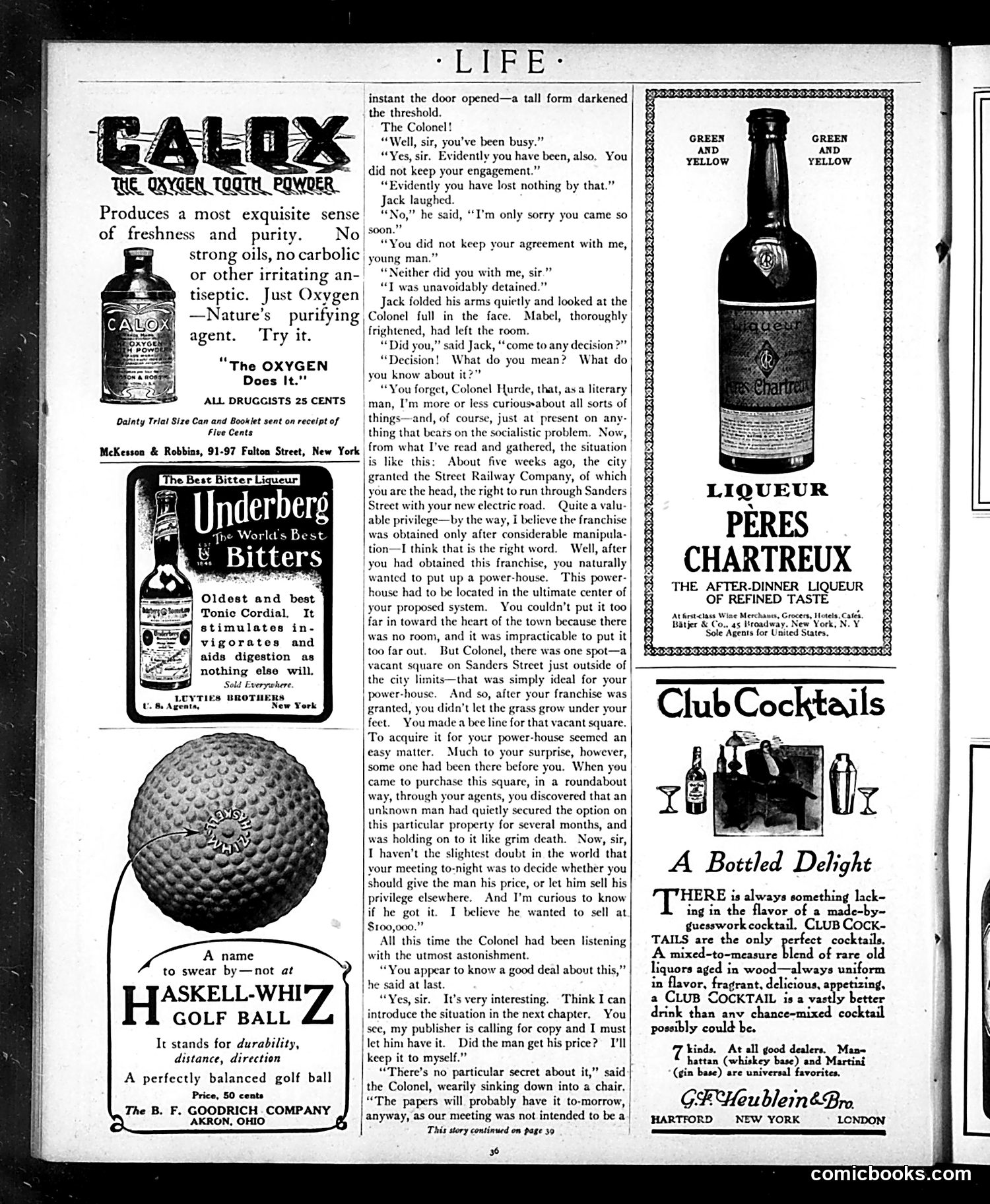
This page is primarily **advertising**, not satire or political commentary. It displays product advertisements for the era circa 1900s-1910s: - **Calox Tooth Powder** ("The Oxygen Tooth Powder") - **Underberg Bitters** (a tonic cordial) - **Haskell-Whiz Golf Ball** - **Liqueur Pères Chartreux** (after-dinner liqueur) - **Club Cocktails** (bottled cocktail mix) The center column contains what appears to be **serialized fiction**—a narrative story about a Colonel, Jack, and Mabel involving a streetcar franchise dispute and real estate negotiation in an unnamed city. This reflects Progressive Era concerns about corporate monopolies and land acquisition. The fiction serves as editorial content to fill the magazine; the advertisements surrounding it are the primary commercial purpose of the page. No political cartoon is present.
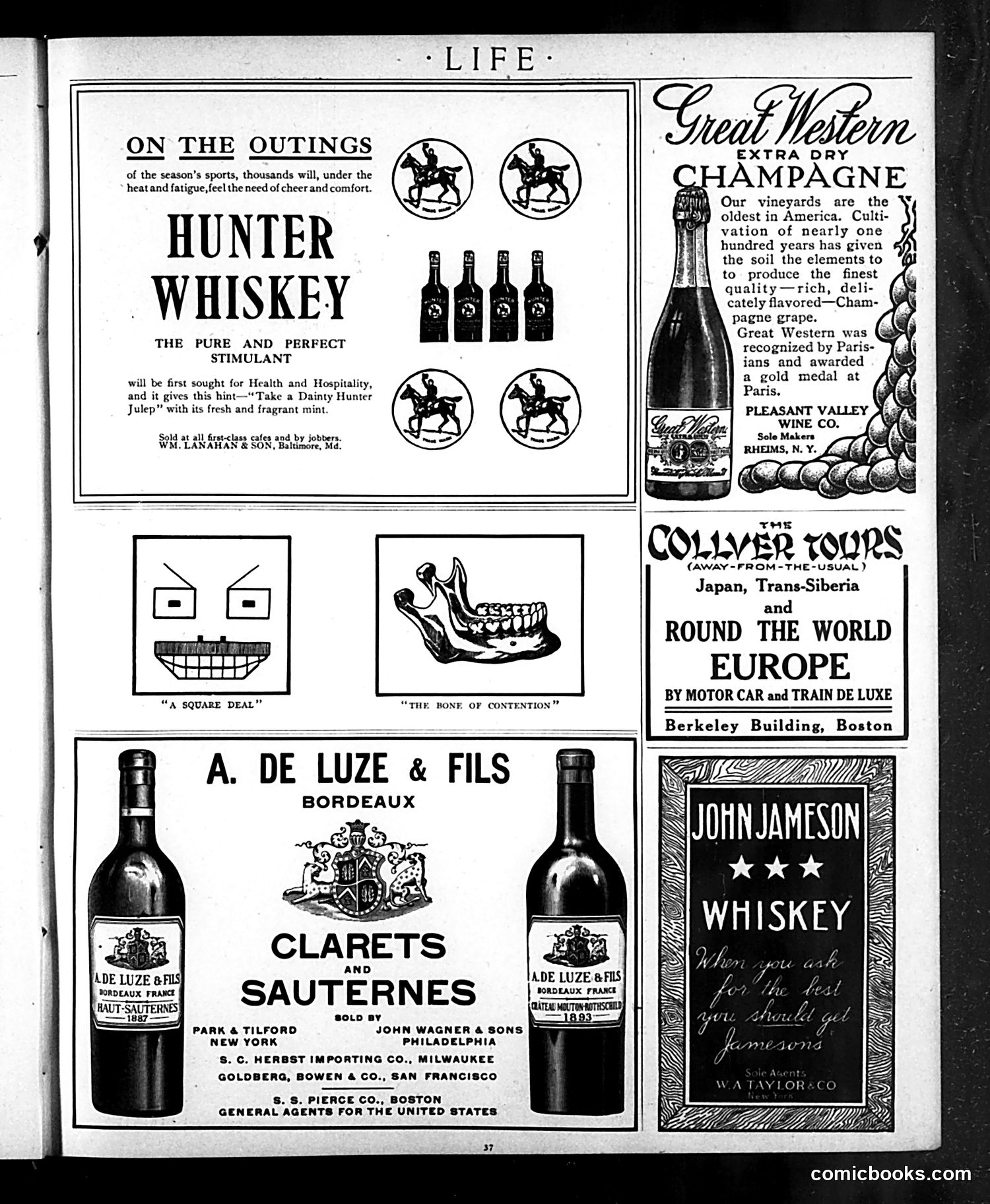
This is primarily an **advertising page** from Life magazine, not a political cartoon. The page features liquor and luxury travel advertisements typical of early 20th-century publications. Two small cartoons appear mid-page: "A Square Deal" (a smiling face with geometric features) and "The Bone of Contention" (a skeletal jaw). These appear to be *standalone comic vignettes* rather than satirical commentary—their meaning is unclear from context alone. The advertisements promote: - **Hunter Whiskey** and **John Jameson Whiskey** (spirits marketed for "health and hospitality") - **Great Western Champagne** (American-made, awarded a Paris gold medal) - **French wines** (Bordeaux clarets and sauternes) - **Collier Tours** (luxury travel to Japan, Trans-Siberia, and Europe) The page reflects the pre-Prohibition era's open alcohol marketing and the era's aspirational focus on European luxury goods and international travel for the wealthy.
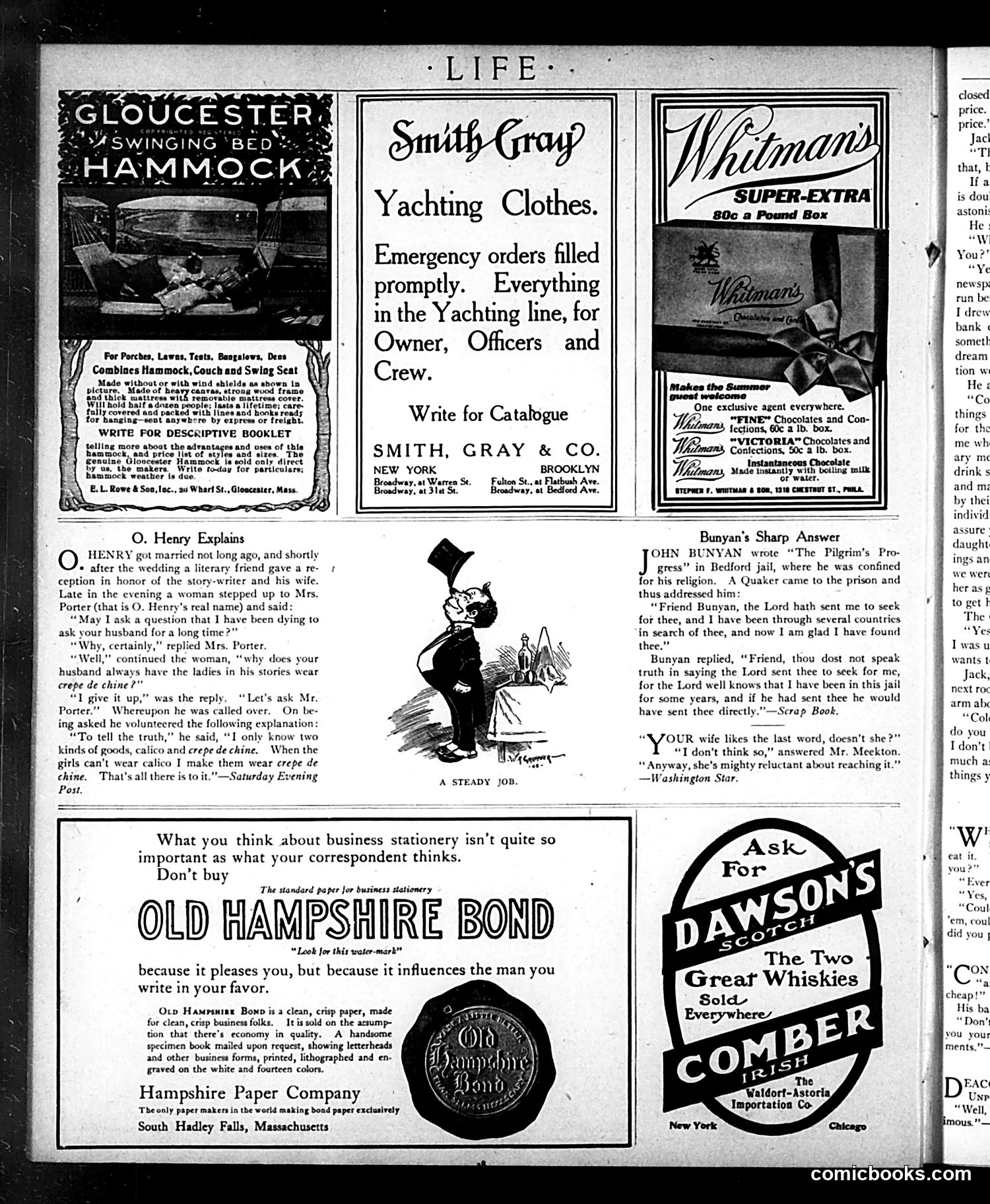
This page contains primarily **advertising and humorous anecdotes** rather than political cartoons. The main content includes: 1. **"O. Henry Explains"**: A biographical anecdote about author O. Henry at a reception. When asked why his female characters always wear "crepe de chine" (an expensive fabric), he admits he only knows two types of fabric—calico and crepe de chine—so uses them by default. The joke mocks his limited fashion knowledge despite being a celebrated writer. 2. **"Bunyan's Sharp Answer"**: A historical anecdote about John Bunyan in jail. A Quaker claims God sent him to find Bunyan; Bunyan logically counters that if God sent him, God would know Bunyan is imprisoned and wouldn't need searching. The humor comes from Bunyan's logical takedown of the Quaker's false piety. 3. **A small cartoon** showing a man reading, captioned "A Steady Job"—though details are unclear. The rest is commercial advertising for hammocks, yachting clothes, chocolates, and stationery. No significant political content is present.
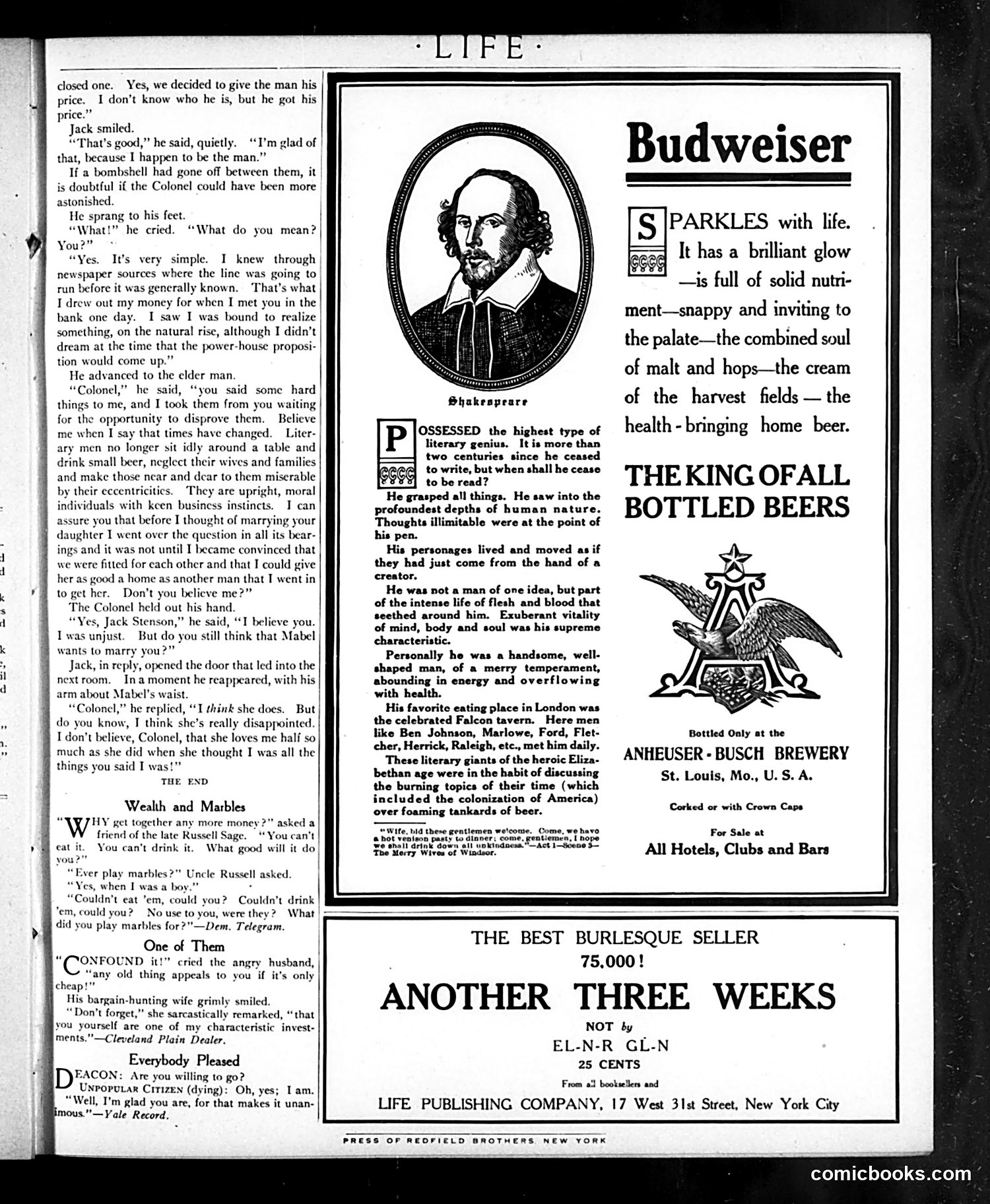
This page contains a serialized fiction story ("Wealth and Marbles") alongside several short humorous anecdotes and a Shakespeare tribute advertisement. The main narrative depicts a young man (Jack Stenson) proving his worth to a disapproving Colonel by successfully profiting from insider knowledge about a power-house proposition and railway line. The satire critiques outdated stereotypes: the Colonel initially disparages "literary men" as idle drunkards, but Jack rebuts this, asserting that modern young men of letters are respectable, moral, and possess keen business instincts—they marry only after careful consideration. The accompanying jokes mock human nature: Russell Sage's marble analogy suggests wealth accumulation is merely a game; the bargain-hunting wife exchange satirizes marital penny-pinching; and the dying man's willingness to go to heaven is called "unanimous" because no one objects. The Shakespeare section is promotional advertising for Budweiser beer, using the Bard's legacy to elevate beer consumption as civilized and literary.
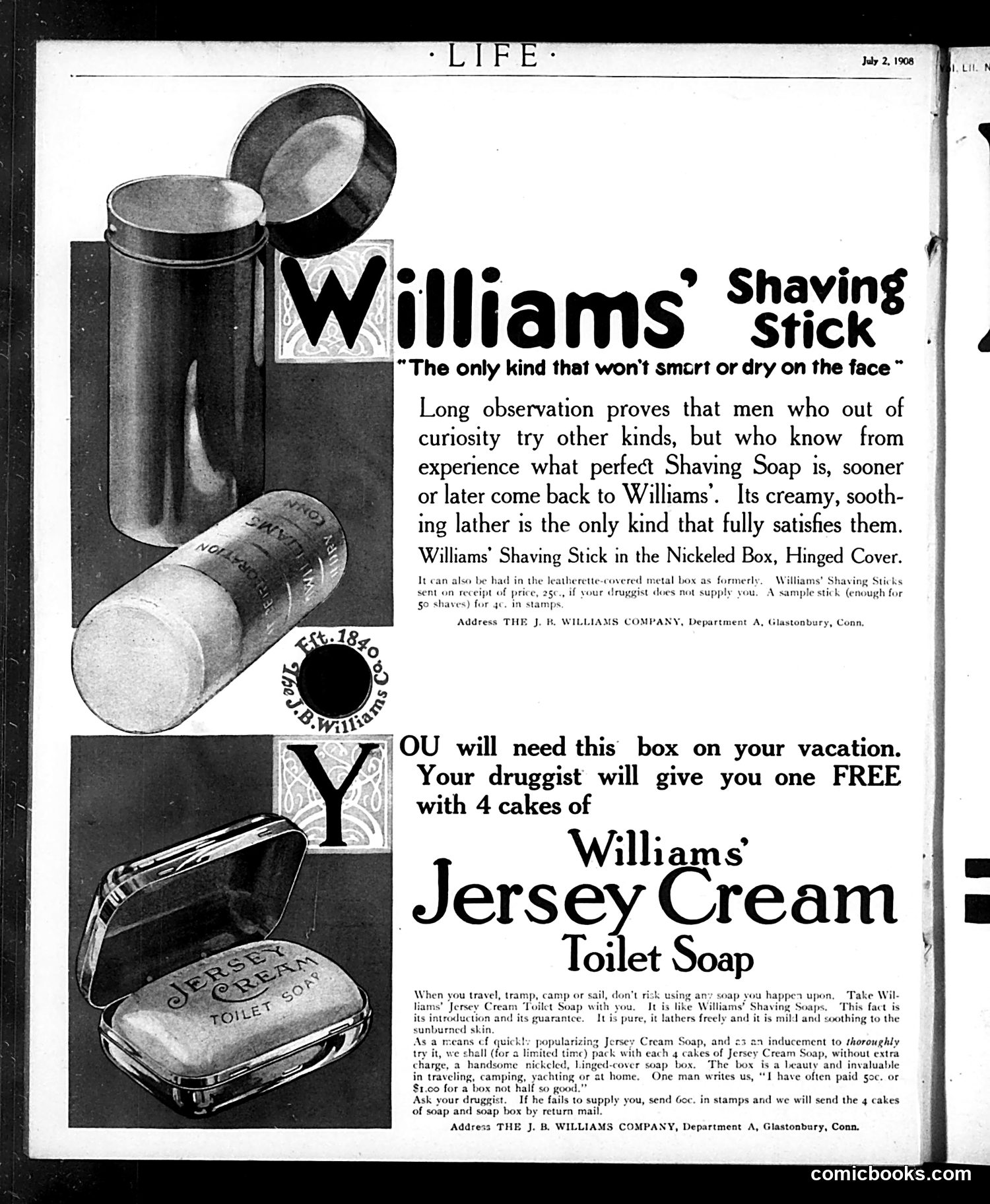
This page contains **no political cartoon or satire**—it is straightforward advertising for J.B. Williams Company toiletries. The ads promote two products: 1. **Williams' Shaving Stick**: A solid soap in a nickeled hinged box, marketed as superior because it won't "smart or dry on the face." The copy claims men inevitably return to it after trying competitors. 2. **Williams' Jersey Cream Toilet Soap**: Positioned as travel-friendly. The promotion offers a free box with four cakes when purchased with shaving stick—marketed as essential for "vacation," camping, or sailing. The appeals are practical (mild, pure lather) and lifestyle-focused (adventure, travel). The $0.50 price point and mail-order option suggest middle-class consumers. This represents early 20th-century consumer marketing targeting men's grooming habits.