
Life, 1908-07-02 · page 18 of 40
Life — July 2, 1908 — page 18: what you’re looking at
What you’re looking at
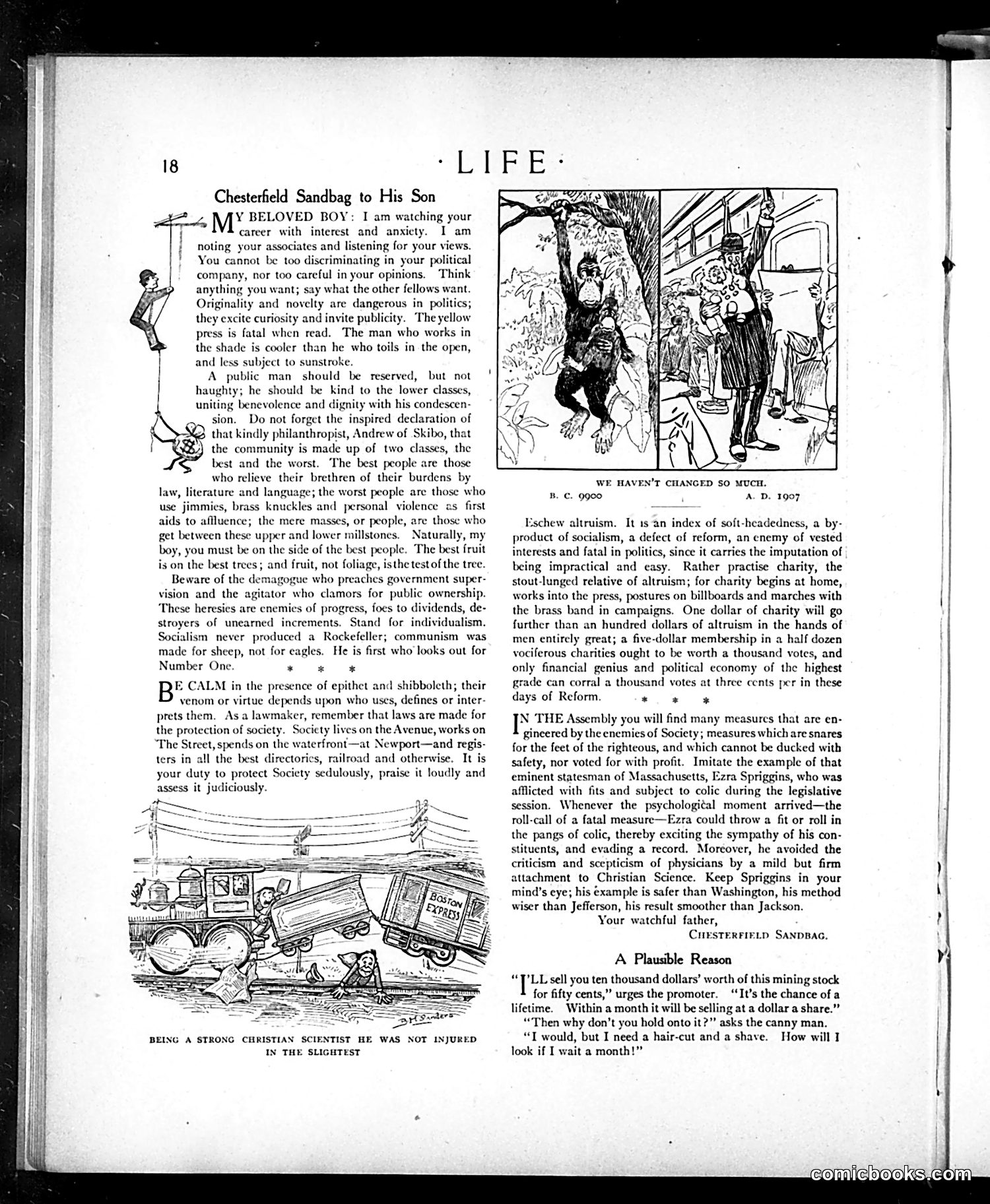
This is a **Gilded Age critique of political hypocrisy and corporate corruption**. The letter purports to be advice from a wealthy father ("Chesterfield Sandbag") to his son on political conduct. The satire works by having the father openly advocate what politicians *actually do* but won't admit: avoid genuine conviction, suppress reform ideas, protect wealthy interests over the masses, use "charity" (public relations) rather than real altruism, and dodge reform votes through convenient illness. The references to "Andrew of Skibo" (Andrew Carnegie), "Rockefeller," and attacks on socialism and public ownership identify this as **anti-plutocrat satire**—mocking the wealthy elite's influence over politics during the Progressive Era. The cartoon below reinforces this: it shows nothing has fundamentally changed between "B.C. 9900" and "A.D. 1907," suggesting corruption is timeless. The joke: the advice is so cynically frank that it exposes the corruption usually hidden behind respectable language.
📄 Transcribed text from this page (OCR, searchable)
Machine-transcribed from the original scan — historical spelling and the odd misread are preserved.
Chesterfield Sandbag to His Son Z Y BELOVED BOY: I am watching your { career with interest and anxicty. I am | noting your associates and listening for your views. ! You cannot be too discriminating in your political ia company, nor too careful in your opinions. Think | o anything you want; say what the other fellows want. | Origi and novelty are dangerous in politics; | BS ey excite curiosity and invite publicity. The yellow | 4 fatal when read. The man who works in the shade is cooler than he who toils in the open, and less subject to sunstroke, A public man should be reserved, but not haughty; he should be kind to the lower classes, uniting benevolence and dignity with his condescen- «sion. Do not forget the inspired declaration of SB that kindly philanthropist, Andrew of Skibo, that ! 2) the community is made up of two classes, the best and the worst. ‘The best people are those who relieve their brethren of their burdens by law, literature and language; the worst people are those who use jimmies, brass knuckles and personal violence as first aids to affluence; the mere masses, or people, are those who get between these upper and lower millstones. Naturally, my boy, you must be on the side of the best people. The best fruit is on the best trees; and fruit, not foliage, isthe test of the tree. Beware of the demagogue who preaches government supe vision and the agitator who clamors for public ownership. ‘These heresies are enemies of progress, foes to dividends, de- stroyers of unearned increments. Stand for individualism. Socialism never produced a Rockefeller; communism was made for sheep, not for eagles. He is first who looks out for Number One. “ € «& | E CALM in the presence of epithet and shibboleth; their venom or virtue depends upon who uses, defines or inter- prets them. Asa lawmaker, remember that laws are made for the protection of society. Society lives on the Avenue, works on “The Street, spends on the waterfront—at Newport—and regis- ters in all the best directories, railroad and otherwise. It is your duty to protect Society sedulously, praise it loudly and assess it judiciously. BEING A STRONG CHRISTIAN SCIENTIST HE WAS NOT INJURED IN THE SLIGHTEST WE HAVEN'T CHANGED SO MUCH. B.C. 9900 A. D. 1907 Eschew altruism. It 1s an index of soft-headedness, a by- product of socialism, a defect of reform, an enemy of vested interests and fatal in politics, since it carries the imputation of being impractical and easy. Rather practise charity, the stout-lunged relative of altruism; for charity begins at home, works into the press, postures on billboards and marches with the brass band in campaigns. One dollar of charity will go further than an hundred dollars of altruism in the hands of men entirely great; a five-dollar membership in a half dozen vociferous charities ought to be worth a thousand votes, and only financial genius and political economy of the highest grade can corral a thousand votes at three cents per in these days of Reform. * + * [8.THE Assembly you will nd many measures that are en- gincered by the enemies of Society; measures which are snares for the feet of the righteous, and which cannot be ducked with safety, nor voted for with profit. Imitate the example of that eminent statesman of Massachusetts, Ezra Spriggins, who was afflicted with fits and subject to colic during the legislative session. Whenever the psychologiéal moment arrived—the roll-call of a fatal measure—Ezra could throw a fit or roll in the pangs of colic, thereby exciting the sympathy of his con- stituents, and evading a record, Moreover, he avoided the criticism and scepticism of physicians by a mild but firm attachment to Christian Science. Keep Spriggins in your mind’s eye; his example is safer than Washington, his method wiser than Jefferson, his result smoother than Jackson. Your watchful father, CiesTerFi-tp SANDBAG. A Plausible Reason * [tt sell you ten thousand dollars’ worth of this mining stock for fifty cents,” urges the promoter. ‘‘It’s the chance of a lifetime. Within a month it will be selling at a dollar a share.” “Then why don’t you hold onto it?” asks the canny man. “T would, but I need a hair-cut and a shave. How will I look if I wait a month!”