
Life, 1908-07-02 · page 28 of 40
Life — July 2, 1908 — page 28: what you’re looking at
What you’re looking at
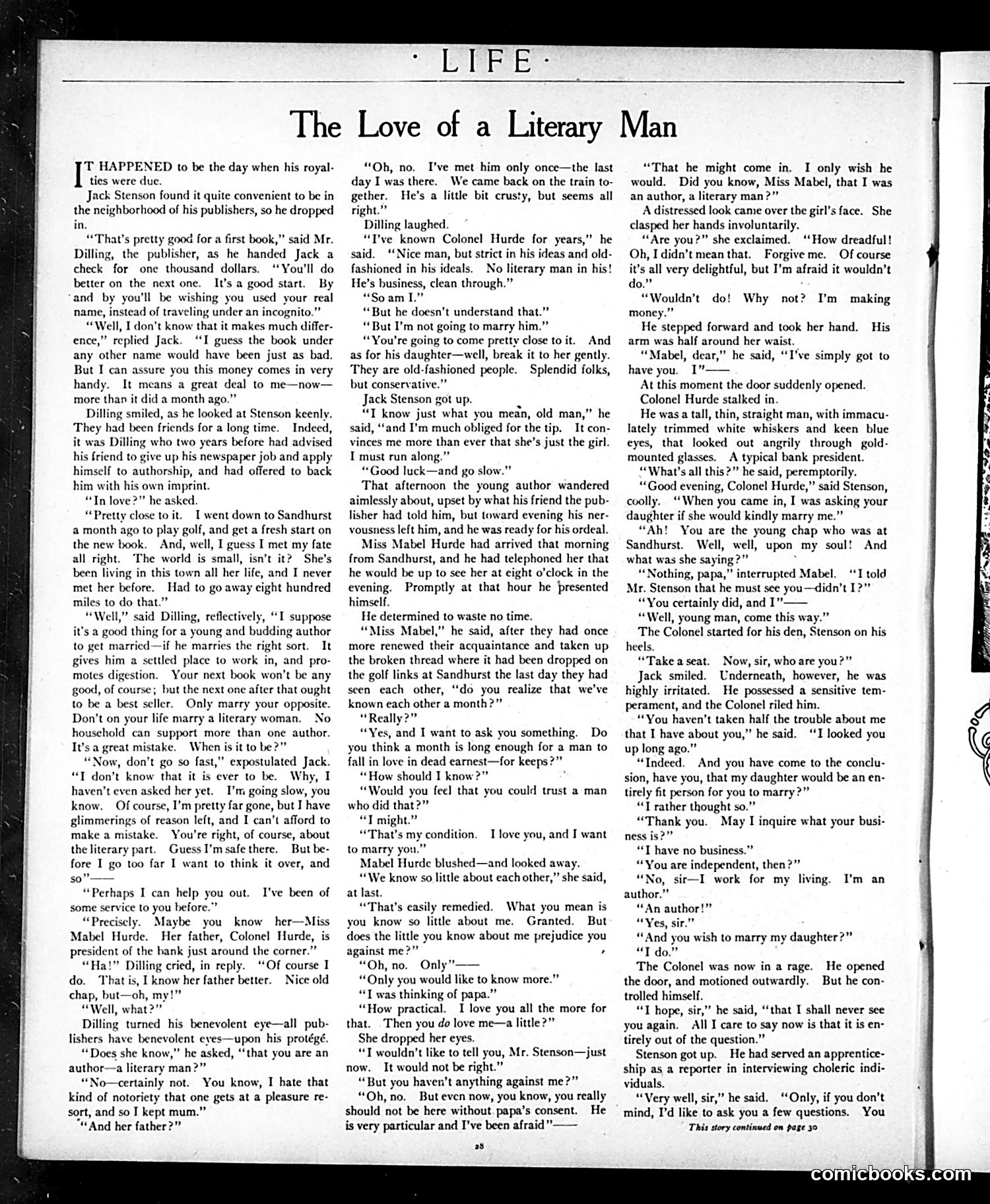
This is a serialized short story (not a political cartoon), appearing in Life magazine's "Life" section—a regular feature of humorous fiction and social commentary. The narrative satirizes **early 20th-century class and professional prejudices**. Jack Stenson, a struggling author using a pen name, has fallen for Mabel Hurde, daughter of a conservative banker. His publisher friend Dilling warns him that Colonel Hurde—a practical, old-fashioned businessman—holds "literary men" in contempt as impractical and unsuitable. The satire targets the era's **social hierarchy placing businessmen above artists**, and the assumption that creative professions were frivolous or disreputable. The irony is that Stenson must hide his literary identity to court respectable people, despite having just earned real money from his writing. The story continues on page 30, suggesting this was serialized entertainment for middle-class readers amused by these professional and romantic entanglements.
📄 Transcribed text from this page (OCR, searchable)
Machine-transcribed from the original scan — historical spelling and the odd misread are preserved.
altars The Love of a Literary Man T HAPPENED to be the day when his royal- ties were duc. Jack Stenson found it quite convenient to be in the neighborhood of his publishers, so he dropped in. “That's pretty good for a first book,” said Mr. Dilling, the publisher, as he handed Jack a check for one thousand dollars. ‘You'll do better on the next one. It’s a good start. By and by you'll be wishing you used your real name, instead of traveling under an incognito.” “Well, I don’t know that it makes much differ- ence,” replied Jack. “I guess the book under any other name would have been just as bad. But I can assure you this money comes in very handy. It means a great deal to me—now— more than it did a month ago.” Dilling smiled, as he looked at Stenson keenly. They had been friends for a long time. Indeed, it was Dilling who two years before had advised his friend to give up his newspaper job and apply himself to authorship, and had offered to back him with his own imprint. “Tn love?” he asked. “Pretty close to it. I went down to Sandhurst a month ago to play golf, and get a fresh start on the new book. And, well, I guess I met my fate all right. The world is small, isn’t it? She's been living in this town all her life, and I never met her before. Had to go away eight hundred miles to do that.” “Well,” said Dilling, reflectively, “I suppose it’s a good thing for a young and budding author to get married—if he marries the right sort. It gives him a settled place to work in, and pro- motes digestion. Your next book won’t be any good, of course; but the next one after that ought to be a best seller. Only marry your opposite. Don't on your life marry a literary woman. No household can support more than one author. It’s a great mistake. When is it to be?” “Now, don’t go so fast,” expostulated Jack. “T don’t know that it is ever to be. Why, I haven't even asked her yet. I’m going slow, you know. Of course, I’m pretty far gone, but I have glimmerings of reason left, and I can’t afford to make a mistake. You're right, of course, about the literary part. Guess I’m safe there. But be- fore I go too far I want to think it over, and “Perhaps I can help you out. I’ve been of some service to you before.” “Precisely. Maybe you know her—Miss Mabel Hurde. Her father, Colonel Hurde, is president of the bank just around the corner.”” “Ha!” Dilling cried, in reply. “Of course I do. That is, I know her father better. Nice old chap, but—oh, my!” “Well, what?” Dilling turned his benevolent eye—all pub- lishers have benevolent eyes—upon his protégé. “Does she know,” he asked, “that you are an author—a literary man?” “No—certainly not. You know, I hate that kind of notoriety that one gets at a pleasure re- sort, and so I kept mum.” “And her father?” “Oh, no. I’ve met him only once—the last day I was there. We came back on the train to- gether. He’s a little bit crusty, but seems all right.” Dilling laughed. “T've known Colonel Hurde for years,” he said. ‘Nice man, but strict in his ideas and old- fashioned in his ideals. No literary man in his! He’s business, clean through.” “So am I.” “But he doesn’t understand that.” “But I’m not going to marry him.” “You're going to come pretty close to it. And as for his daughter—well, break it to her gently. ‘They are old-fashioned people. Splendid folks, but conservative.” Jack Stenson got up. “I know just what you mean, old man,” he said, “‘and I’m much obliged for the tip. It con- vinces me more than ever that she’s just the girl. I must run along.” “Good luck—and go slow.” That afternoon the young author wandered aimlessly about, upset by what his friend the pub- lisher had told him, but toward evening his ner- vousness left him, and he was ready for his ordeal. Miss Mabel Hurde had arrived that morning from Sandhurst, and he had telephoned her that he would be up to see her at eight o'clock in the evening. Promptly at that hour he presented himself. He determined to waste no time. “Miss Mabel,” he said, after they had once more renewed their acquaintance and taken up the broken thread where it had been dropped on the golf links at Sandhurst the last day they had seen each other, ‘do you realize that we've known each other a month?” “Really?” “Yes, and I want to ask you something. Do you think a month is long enough for a man to fall in love in dead earnest—for keeps?” “How should I know?” “Would you feel that you could trust a man who did that?”” “T might.” “That's my condition. to marry you.”” Mabel Hurde blushed—and looked away. “We know so little about each other,” she said, at last. “That’s easily remedied. What you mean is you know so little about me. Granted. But does the little you know about me prejudice you against me?” , “Oh, no. Only”— “Only you would like to know more.” “T was thinking of papa.” “How practical. I love you all the more for that. Then you do love me—a little?” She dropped her eyes. “T wouldn’t like to tell you, Mr. Stenson—just now. It would not be right.” “But you haven’t anything against me?” “Oh, no. But even now, you know, you really should not be here without. papa’s consent. He is very particular and I’ve been afraid” —— Tove you, and I want “That he might come in. I only wish he would. Did you know, Miss Mabel, that I was an author, a literary man?” A distressed look came over the girl’s face. She clasped her hands involuntarily. “Are you?” she exclaimed. ‘How dreadful! Oh, I didn’t mean that. Forgive me. Of course it’s all very delightful, but I’m afraid it wouldn’t do.” “Wouldn’t money.” He stepped forward and took her hand. arm was half around her wi “Mabel, dear,” he said, have you. 1”—— At this moment the door suddenly opened. Colonel Hurde stalked in He was a tall, thin, straight man, with immacu- lately trimmed white whiskers and keen blue eyes, that looked out angrily through gold- mounted glasses. A typical bank president. “What's all this?” he said, peremptorily. “Good evening, Colonel Hurde,” said Stenson, coolly. “When you came in, I was asking your daughter if she would kindly marry me.” “Ah! You are the young chap who was at Sandhurst. Well, well, upon my soul! And what was she saying?” “Nothing, papa,” interrupted Mabel. “I told Mr. Stenson that he must see you—didn’t 1?” “You certainly did, and I” — “Well, young man, come this way.” The Colonel started for his den, Stenson on his heels. “Take a seat. Now, sir, who are you?” Jack smiled. Underneath, however, he was highly irritated. He possessed a sensitive tem- perament, and the Colonel riled him. “You haven’t taken half the trouble about me that I have about you,” he said. “I looked you up long ago.” “Indeed. do! Why not? I'm making His ve simply got to And you have come to the conclu- sion, have you, that my daughter would be an en- tirely fit person for you to marry?” “T rather thought so.” “Thank you. May I inquire what your busi- ness is?” “T have no business.” “You are independent, then?” “No, sir—I work for my living. author.” “An author!” “Yes, sir.” “And you wish to marry my daughter?” “T do.” The Colonel was now in a rage. the door, and motioned outwardly. trolled himself. “T hope, sir,” he said, “that I shall never see you again. All J care to say now is that it is en- tirely out of the question.” Stenson got up. He had served an apprentice- ship as a reporter in interviewing choleric indi- viduals, “Very well, sir,” he said. mind, I’d like to ask you a few questions. This story continued on poge 30 I’m an He opened But he con- “Only, if you don’t You