
Life, 1908-07-02 · page 39 of 40
Life — July 2, 1908 — page 39: what you’re looking at
What you’re looking at
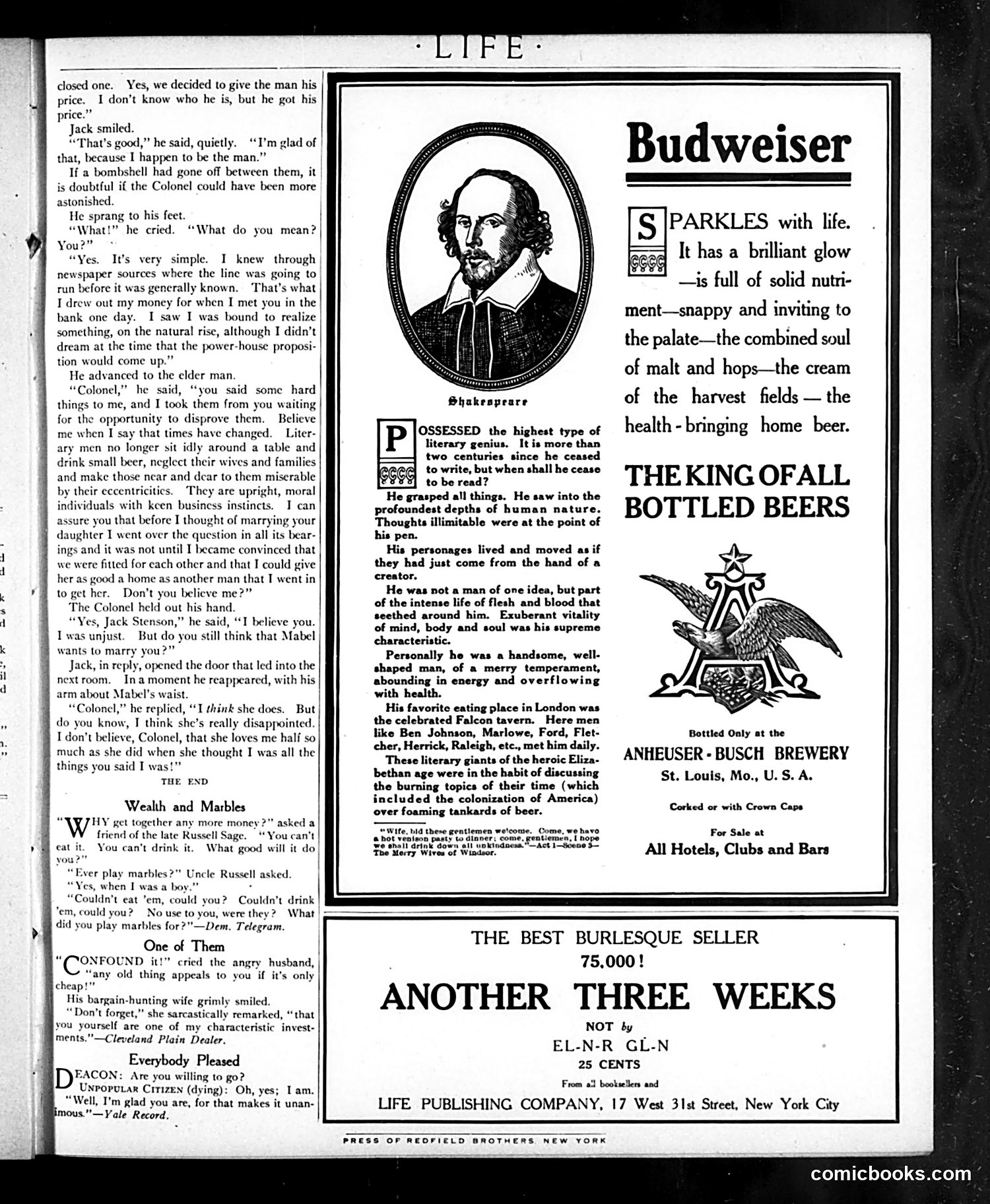
This page contains a serialized fiction story ("Wealth and Marbles") alongside several short humorous anecdotes and a Shakespeare tribute advertisement. The main narrative depicts a young man (Jack Stenson) proving his worth to a disapproving Colonel by successfully profiting from insider knowledge about a power-house proposition and railway line. The satire critiques outdated stereotypes: the Colonel initially disparages "literary men" as idle drunkards, but Jack rebuts this, asserting that modern young men of letters are respectable, moral, and possess keen business instincts—they marry only after careful consideration. The accompanying jokes mock human nature: Russell Sage's marble analogy suggests wealth accumulation is merely a game; the bargain-hunting wife exchange satirizes marital penny-pinching; and the dying man's willingness to go to heaven is called "unanimous" because no one objects. The Shakespeare section is promotional advertising for Budweiser beer, using the Bard's legacy to elevate beer consumption as civilized and literary.
📄 Transcribed text from this page (OCR, searchable)
Machine-transcribed from the original scan — historical spelling and the odd misread are preserved.
Gage ones Ventre decided to give the tua his'| price. I don’t know who he is, but he got his price.” Jack smiled. ‘That's good,” he said, quietly. “I’m glad of | that, because I happen to be the man.” If a bombshell had gone off between them, it is doubtful if the Colonel could have been more astonished. He sprang to his feet. | “What!” he cried. “What do you mean? | You?” “Yes, It’s very simple. I knew through newspaper sources where the line was going to run before it was generally known, ‘That’s what I drew out my money for when I met you in the | bank one day. I saw I was bound to realize | something, on the natural rise, although I didn’t dream at the time that the power-house proposi- tion would come up.” He advanced to the elder man. “Colonel,” he said, “you said some hard things to me, and I took them from you waiting for the opportunity to disprove them. Believe me when I say that times have changed. _Liter- ary men no longer sit idly around a table and drink small beer, neglect their wives and families and make those near and dear to them miserable by their eccentricities. ‘They are upright, moral individuals with keen business instincts. I can assure you that before I thought of marrying your daughter I went over the question in all its bear- ings and it was not until I became convinced that we were fitted for each other and that I could give her as good a home as another man that T went in to get her. Don’t you believe me?” The Colonel held out his hand. “Yes, Jack Stenson,” he said, “I believe you. Iwas unjust. But do you still think that Mabel wants to marry you?” Jack, in reply, opened the door that led into the next room. Ina moment he reappeared, with his arm about Mabel’s waist. “Colonel,” he replied, “T think she does. But 4 do you know, I think she’s really disappointed. I don’t bel Colonel, that she loves me half so much as she did when she thought I was all the things you said I was!” THE END Wealth and Marbles HY get together any more money ?"” asked a friend of the late Russell Sage.“ You can't eat it, You can’t drink it. What good will it do you?” “Ever play marbles?” Uncle Russell asked. “Yes, when I was a boy.” : “Couldn't eat em, could you? Couldn't drink “em, could you? No use to you, were they? What did you play marbles for?” —Dem. Telegram. One of Them ONFOUND it!” cried the angry husband, “any old thing appeals to you if it’s only cheap! His bargain-hunting wife grimly smiled. “Don't forget,” she sarcastically remarked, “that urself are one of my characteristic invest- -"'"—Cleveland Plain Dealer. Everybody Pleased EACON: Are you willing to go? OPULAR CiTizEN (dying): Oh, yes; Lam. “Well, I'm glad you are, for that makes it unan- imous.""—Yale Record. Shakespeare OSSESSED the highest type of literary genius. It is more than two centuries since he ceased to write, but when shall he cease to be read? He grasped all things. He saw into the profoundest depths of human nature. Thoughts illimitable were at the point of his pen. His personages lived and moved as if they had just come from the hand of a creator. He was not a man of one idea, but part of the intense life of flesh and blood that seethed around him. Exuberant vitality of mind, body and soul was his supreme characteristic. Personally he was a handsome, well- shaped man, of a merry temperament, abounding in energy and overflowing with health. His favorite eating place in London was the celebrated Falcon tavern. Here men like Ben Johnson, Marlowe, Ford, Flet- cher, Herrick, Raleigh, etc., met him daily. These literary giants of the heroic Eliza- bethan age were in the habit of discussing the burning topics of their time (which included the colonization of America) foaming tankards of beer. eseq S| PARKLES with life. It has a brilliant glow —is full of solid nutn- ment—snappy and inviting to Kec the palate—the combined soul of malt and hops—the cream of the harvest fields — the health - bringing home beer. THE KING OFALL BOTTLED BEERS Bottled Only at the ANHEUSER - BUSCH BREWERY St. Louis, Mo., U. S. A. Corked or with Crown Caps For Sale at All Hotels, Clubs and Bars THE BEST BURLESQUE SELLER 75,000! ANOTHER THREE WEEKS NOT by EL-N-R GL-N 25 CENTS From al booksellers and LIFE PUBLISHING COMPANY, 17 West 31st Street, New York City PRESS OF REOFIELD BROTHERS NEW YORK comicbooks.com