
Life, 1908-07-02 · page 30 of 40
Life — July 2, 1908 — page 30: what you’re looking at
What you’re looking at
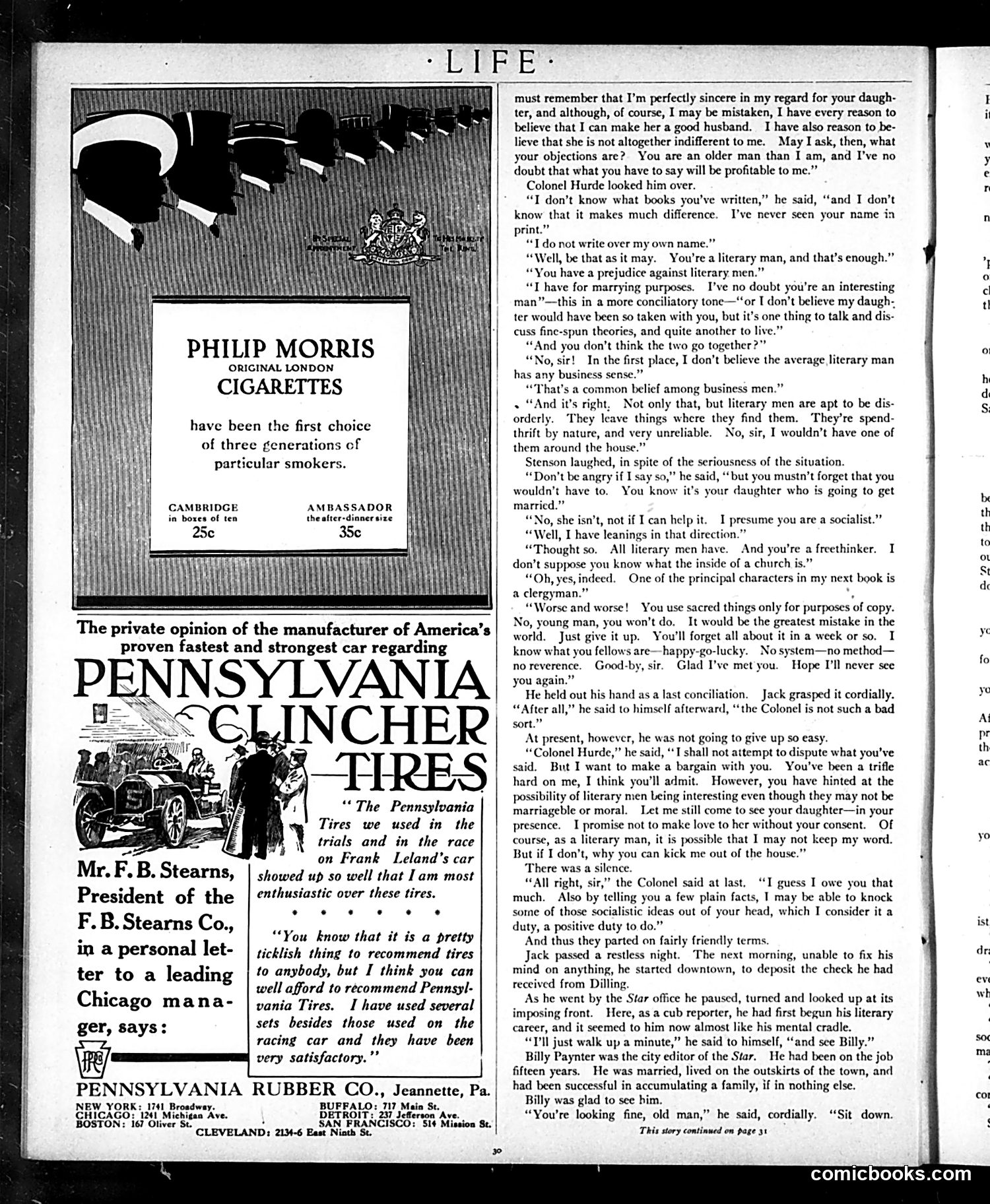
This page contains **advertising and serialized fiction**, not political satire. The advertisements promote Philip Morris cigarettes and Pennsylvania rubber tires, using endorsements from business figures (F.B. Stearns, car manufacturer). These are straightforward commercial pitches typical of early 20th-century *Life* magazine. The bulk of the page is a **serialized short story** depicting a conversation between a young literary man named Jack and Colonel Hurde, whose daughter Jack wishes to marry. The Colonel expresses class-based prejudices against writers: they lack business sense, are disorderly and unreliable, hold socialist and freethinker views, and misuse sacred subjects for literary copy. This appears to be social satire about **intellectual versus practical classes**—mocking the Colonel's provincial distrust of educated "literary men" while portraying Jack's earnest idealism. The story continues on page 31.
📄 Transcribed text from this page (OCR, searchable)
Machine-transcribed from the original scan — historical spelling and the odd misread are preserved.
CAMBRIDGE in boxes of ten PHILIP MORRIS ORIGINAL LONDON CIGARETTES have been the first choice of three generations of particular smokers. AMBASSADOR the after-dinner size The private opinion of the manufacturer of America’s proven fastest and strongest car regarding PENNSYLVANIA Mr. F. B. Stearns, President of the F.B. Stearns Co., in a personal let- ter to a leading Chicago mana- ger, says: NEW YORK: 1741 Broadway. CHICAGO: 1241 Michigan Ave. BOSTON: 167 Oliver St. “The Pennsylvania Tires we used in the trials and in the race on Frank Leland’s car showed up so well that lam most enthusiastic over these tires. o 8 © © ee “You know that it is a pretty ticklish thing to recommend tires to anybody, but I think you can well afford to recommend Pennsyl- vania Tires. I have used several sets besides those used on the racing car and they have been very satisfactory.’’ PENNSYLVANIA RUBBER CO., Jeannette, Pa. | BUFFALO: 17 Maia St. ROIT: 237 Jefferson SANE FRANCISCO: si Mission Se. CLEVELAND: 214-6 East Ni x» must remember that I’m perfectly sincere in my regard for your daugh- ter, and although, of course, I may be mistaken, I have every reason to believe that I can make her a good husband. I have also reason to be- lieve that she is not altogether indifferent tome. May I ask, then, what your objections are? You are an older man than I am, and I’ve no doubt that what you have to say will be profitable to me.” Colonel Hurde looked him over. “I don’t know what books you've written,” he said, ‘‘and I don’t know that it makes much difference. I’ve never seen your name in print.” “T do not write over my own name.” “Well, be that as it may. You're a literary man, and that’s enough.” “You have a prejudice against literary men.” “T have for marrying purposes. I’ve no doubt you're an interesting man”—this in a more conciliatory tone—‘‘or I don’t believe my daugh- ter would have been so taken with you, but it’s one thing to talk and dis- cuss fine-spun theories, and quite another to live.” “And you don’t think the two go together?” “No, sit! In the first place, I don’t believe the average, literary man has any business sense.” hat’s a common belief among business men.”” + “And it’s right, Not only that, but literary men are apt to be dis- orderly. They leave things where they find them. ‘They’re spend- thrift by nature, and very unreliable. No, sir, I wouldn’t have one of them around the house.” Stenson laughed, in spite of the seriousness of the situation. “Don't be angry if I ”’ he said, “but you mustn’t forget that you wouldn’t have to. You know it’s your daughter who is going to get married.” “No, she isn’t, not if I can help it. I presume you are a socialist.” “Well, I have leanings in that direction.” “Thought so. All literary men have. And you're a freethinker. I don’t suppose you know what the inside of a church is.” One of the principal characters in my next book is “Oh, yes, indeed. a clergyman.” , “Worse and worse! You use sacred things only for purposes of copy. No, young man, you won’t do, It would be the greatest mistake in the world. Just give it up. You'll forget all about it in a week or so. I know what you fellows are—happy-go-lucky. No system—no method— no reverence. Good-by, sir. Glad I’ve met you. Hope I'll never see you again.” He held out his hand as a last conciliation. Jack grasped it cordially. “After all,” he said to himself afterward, ‘the Colonel is not such a bad sort.” At present, however, he was not going to give up so easy. “Colonel Hurde,” he said, “I shall not attempt to dispute what you've said. But I want to make a bargain with you. You've been a trifle hard on me, I think you'll admit. However, you have hinted at the possibility of literary men Leing interesting even though they may not be marriageble or moral. Let me still come to see your daughter—in your presence. I promise not to make love to her without your consent. Of course, as a literary man, it is possible that I may not keep my word. But if I don’t, why you can kick me out of the house.”” There was a silence. “All right, sir,” the Colonel said at last, “‘I guess I owe you that much. Also by telling you a few plain facts, | may be able to knock some of those socialistic ideas out of your head, which I consider it a duty, a positive duty to do.” And thus they parted on fairly friendly terms. Jack passed a restless night. The next morning, unable to fix his mind on anything, he started downtown, to deposit the check he had received from Dilling. As he went by the Star office he paused, turned and looked up at its imposing front. Here, as a cub reporter, he had first begun his literary career, and it seemed to him now almost like his mental cradle. “T'll just walk up a minute,” he said to himself, ‘‘and sce Billy.” Billy Paynter was the city editor of the Star. He had been on the job fifteen years. He was married, lived on the outskirts of the town, and had been successful in accumulating a family, if in nothing else. Billy was glad to see him. “You're looking fine, old man,” he said, cordially. This story continued on page 31 “Sit down. comicbooks.com yo