
Life, 1908-07-02 · page 24 of 40
Life — July 2, 1908 — page 24: what you’re looking at
What you’re looking at
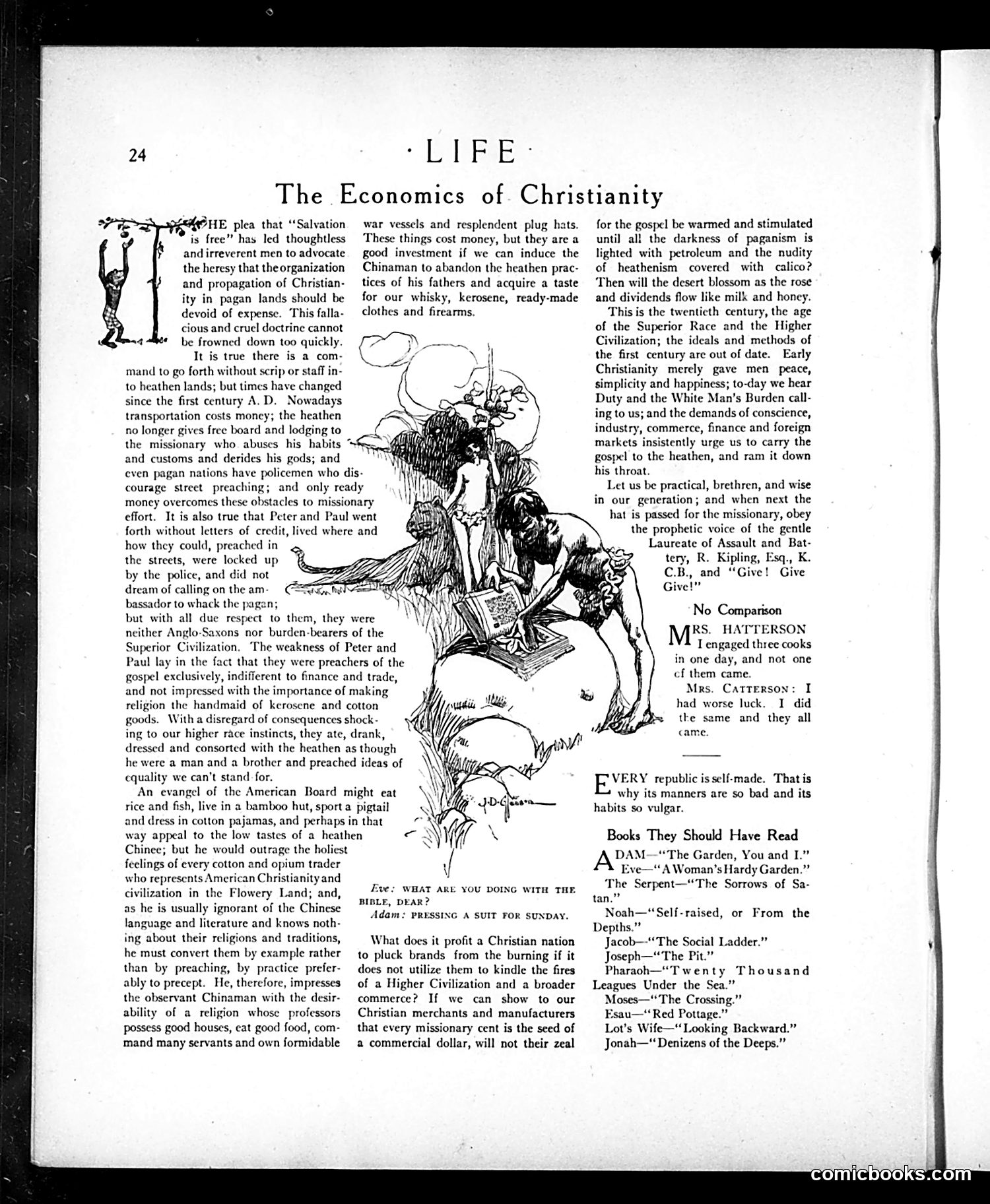
This satirical article and cartoon mock American missionaries and traders who justify commercial exploitation of China under the guise of Christian conversion. The **cartoon** shows Adam pressing his Bible suit for Sunday—a visual pun suggesting Christians compartmentalize morality, dressing religiously only on weekends while conducting business unethically the rest of the time. The **text** sarcastically argues that modern missionaries should abandon early Christian simplicity and instead use commerce as conversion's tool. The author mocks the hypocrisy: selling whisky, kerosene, and firearms to Chinese people while claiming moral superiority as the "Superior Race." He ridicules the notion that profit motive ("every missionary cent is the seed of a commercial dollar") should drive spiritual work. The piece critiques American imperialism disguised as Christian charity—particularly targeting the "White Man's Burden" ideology justifying Western colonial expansion. It exposes how traders weaponized missionary activity to open Asian markets, contradicting actual Christian principles of simplicity and equality that early apostles practiced.
📄 Transcribed text from this page (OCR, searchable)
Machine-transcribed from the original scan — historical spelling and the odd misread are preserved.
ERE: The Economics of. Christianity HE plea that ‘‘Salvation is free’ has led thoughtless and irreverent men to advocate the heresy that the organization and propagation of Christian- ity in pagan lands should be devoid of expense. This falla- cious and cruel doctrine cannot be frowned down too quickly. It is true there is a com- mand to go forth without scrip or staff in- to heathen lands; but times have changed since the first century A.D. Nowadays transportation costs money; the heathen no longer gives free board and lodging to op war vessels and resplendent plug hats. These things cost money, but they are a good investment if we can induce the Chinaman to abandon the heathen prac- tices of his fathers and acquire a taste for our whisky, kerosene, ready-made clothes and firearms. the missionary who abuses his habits SS and customs and derides his gods; and even pagan nations have policemen who dis- courage street preaching; and only ready money overcomes these obstacles to missionary effort. It is also true that Peter and Paul went forth without letters of credit, lived where and how they could, preached in the streets, were locked up by the police, and did not dream of calling on the am bassador to whack the pagan; but with all due respect to them, they were neither Anglo-Saxons nor burden-bearers of the Superior Civilization. ‘The weakness of Peter and Paul lay in the fact that they were preachers of the gospel exclusively, indifferent to finance and trade, and not impressed with the importance of making religion the handmaid of kerosene and cotton goods. With a disregard of consequences shock ing to our higher race instincts, they ate, drank, dressed and consorted with the heathen as though he were a man and a brother and preached ideas of equality we can’t stand for. ‘An evangel of the American Board might eat rice and fish, live in a bamboo hut, sport a pigtail and dress in cotton pajamas, and perhaps in that way appeal to the low tastes of a heathen Chinee; but he would outrage the holiest feelings of every cotton and opium trader who represents American Christianity and civilization in the Flowery Land; and, as he is usually ignorant of the Chinese language and literature and knows noth- ing about their religions and traditions, he must convert them by example rather than by preaching, by practice prefer- ably to precept. He, therefore, impresses the observant Chinaman with the desir- ability of a religion whose professors possess good houses, cat good food, com- mand many servants and own formidable Eve; WHAT ARE YOU DOING WITH THE BIBLE, DEAR? Adam: PRESSING A SUIT FOR SUNDAY. What does it profit a Christian nation to pluck brands from the burning if it does not utilize them to kindle the fires of a Higher Civilization and a broader commerce? If we can show to our Christian merchants and manufacturers that every missionary cent is the seed of a commercial dollar, will not their zeal for the gospel be warmed and stimulated until all the darkness of paganism is lighted with petroleum and the nudity of heathenism covered with calico? ‘Then will the desert blossom as the rose and dividends flow like milk and honey. This is the twenticth century, the age of the Superior Race and the Higher Civilization; the ideals and methods of the first century are out of date. Early Christianity merely gave men peace, simplicity and happiness; to-day we hear Duty and the White Man’s Burden call- ing to us; and the demands of conscience, industry, commerce, finance and foreign markets insistently urge us to carry the gospel to the heathen, and ram it down his throat. Let us be practical, brethren, and wise in our generation; and when next the hat is passed for the missionary, obey the prophetic voice of the gentle Laureate of Assault and Bat- tery, R. Kipling, Esq., K. C.B., and “Give! Give RS. HATTERSON T engaged three cooks in one day, and not one cf them came. Mrs. Catterson: I had worse luck. I did tke same and they all came. E ERY republic is self-made. That is why its manners are so bad and its habits so vulgar. Books They Should Have Read (DM “The Garden, You and I.” “*A Woman’s Hardy Garden.” The Serpent—‘The Sorrows of Sa- tan.” Noah—“‘Self-raised, or From the Depths.” Jacob—‘‘The Social Ladder.” Joseph—“The Pit.” Pharaoh—“Twenty Thousand Leagues Under the Sea.” Moses—“'The Crossing.” Esau—‘‘Red Pottage.” Lot’s Wife—“ Looking Backward.” Jonah—‘Denizens of the Deeps.”