
Life, 1908-07-02 · page 31 of 40
Life — July 2, 1908 — page 31: what you’re looking at
What you’re looking at
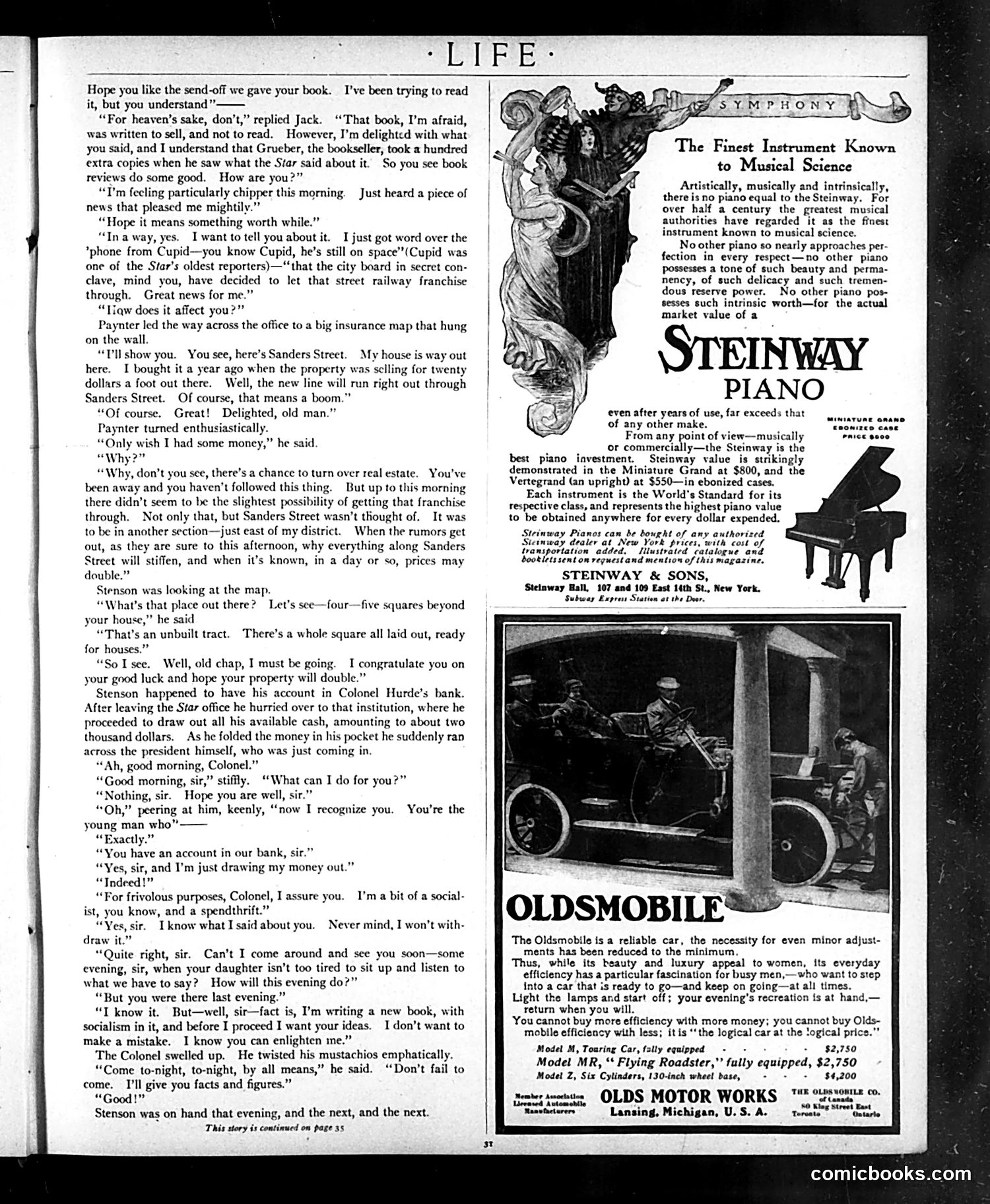
This page contains a short story satirizing insider trading and financial speculation. The narrative follows two newspaper men: Paynter, who learns confidential information that a streetcar franchise will be approved on Sanders Street, and Stenson, who overhears this news. Paynter gloats about property he owns there—bought cheaply a year ago, now about to boom in value. Stenson immediately withdraws his $2,000 life savings from Colonel Hurde's bank and approaches the Colonel, positioning himself as a humble "socialist spendthrift" seeking wisdom for a book. The Colonel, flattered and eager to impress, invites Stenson to his home that evening. The satire targets wealthy men's susceptibility to flattery and their willingness to share confidential information with those who stroke their egos—making them vulnerable to financial manipulation. It's a critique of corruption and how insider knowledge drives unfair wealth accumulation. The advertisements below are period-appropriate (Steinway pianos, Oldsmobile automobiles).
📄 Transcribed text from this page (OCR, searchable)
Machine-transcribed from the original scan — historical spelling and the odd misread are preserved.
TEE Hope you like the send-off we gave your book. I’ve been trying to read it, but you understand”. “For heaven’s sake, don’t,” replied Jack. ‘‘That book, I’m afraid, was written to sell, and not to read. However, I’m delighted with what you said, and I understand that Grueber, the bookseller, took a hundred extra copies when he saw what the Star said about it. So you see book reviews do some good. How are you?” “I'm fecling particularly chipper this morning. Just heard a piece of news that pleased me mightily.” “‘Hope it means something worth while.” “Ina way, yes. I want to tell you about it. I just got word over the *phone from Cupid—you know Cupid, he’s still on space’(Cupid was one of the Star’s oldest reporters)—“‘that the city board in secret con- clave, mind you, have decided to let that street railway franchise through. Great news for me.” “Tiqw does it affect you?” Paynter led the way across the office to a big insurance map that hung on the wall. “Pll show you. You see, here’s Sanders Street. My house is way out here. I bought it a year ago when the property was selling for twenty dollars a foot out there. Well, the new line will run right out through Sanders Street. Of course, that means a boom.” “Of course. Great! Delighted, old man.” Paynter turned enthusiastically. “Only wish I had some money,” he said don’t you see, there’s a chance to turn over real estate. You've been away and you haven't followed this thing. But up to this morning there didn’t seem to be the slightest possibility of getting that franchise through. Not only that, but Sanders Street wasn’t thought of. It was to be in another section—just east of my district. When the rumors get out, as they are sure to this afternoon, why everything along Sanders Street will stiffen, and when it’s known, in a day or so, prices may double.” Stenson was looking at the map. “What's that place out there? Let’s see—four—five squares beyond your house,” he said “That’s an unbuilt tract. There’s a whole square all laid out, ready for houses.” “So I see. Well, old chap, I must be going. I congratulate you on your good luck and hope your property will double.” Stenson happened to have his account in Colonel Hurde’s bank. After leaving the Star office he hurried over to that institution, where he proceeded to draw out all his available cash, amounting to about two thousand dollars. As he folded the money in his pocket he suddenly rap across the president himself, who was just coming in. “Ah, good morning, Colonel.” “Good morning, sir,” stiffly, ‘What can I do for you?” “Nothing, sir. Hope you are well, sir.” “Oh,” peering at him, keenly, ‘now I recognize you. You're the young man who" actly.” You have an account in our bank, sir. “Yes, sir, and I'm just drawing my money out.” “Indeed!” “For frivolous purposes, Colonel, I assure you. I’m a bit of a social- ist, you know, and a spendthrift.” I know what I said about you. Never mind, I won't with- “Quite right, sir. Can't I come around and sce you soon—some evening, sir, when your daughter isn’t too tired to sit up and listen to what we have to say? How will this evening do?” “But you were there last evening. “T know it. But—well, sir—fact is, I’m writing a new book, with socialism in it, and before I proceed I want your ideas. I don’t want to make a mistake. I know you can enlighten me.” The Colonel swelled up. He twisted his mustachios emphatically, “Come to-night, to-night, by all means,” he said. ‘Don’t fail to come. I'll give you facts and figures.” “Good!” Stenson was on hand that evening, and the next, and the next. This story is continued on page 35 The Finest Instrument Known to Musical Science Artistically, musically and intrinsically, there is no piano equal to the Steinway. For over half a century the greatest musical authorities have regarded it as the finest instrument known to musical science. No other piano so nearly approaches per- fection in every respect—no other piano possesses a tone of such beauty and perma- nency, of such delicacy and such tremen- dous feserve power. No other piano pos- sesses such intrinsic worth—for the actual market value of a STEINWAY PIANO even after years of use, far exceeds that of any other make. From any point of view—musically or commercially—the Steinway is the best piano investment. Steinway value is strikingly demonstrated in the Miniature Grand at $800, and the Vertegrand (an upright) at $550—in ebonized cases. Each instrument is the World's Standard for its respective class, and represents the highest piano value to be obtained anywhere for every dollar expended. teinway Pianos can be bought of any authorized nway dealer at New York prices, with cost of transportation added, Illustrated catalogue and bookicts sent on reguestand mention of this magazine, STEINWAY & SONS, Steinway Hall, 107 and 109 East 14th St., New York. Subway Express Station at the Door, The Oldsmobile is a reliable car, the necessity for even minor adjust- ments has been reduced to the minimum, Thus, while its beauty and luxury appeal to women, its everyday efficiency has a particular fascination for busy men,—who want to step into a car that is ready to go—and keep on going—at all times. Light the lamps and start off; your evening's recreation is at hand,— return when you will. You cannot buy more efficiency with more money; you cannot buy Olds- mobile efficiency with less; it is ‘‘the logical car at the ‘ogical price.”” Model M, Touring Car, fally equipped - + $2,750 Model MR, “ Flying Roadster,” fally eauipped, $2,750 Model Z, Six Cylinders, 130-inch wheel base, . ° $4,200 artim; OLDS MOTOR WORKS ™: “uta © Actas Lansing, Michigan, U.S.A. terete """Qntarte comicbooks.com