
A complete issue · 44 pages · 1906
Life — May 3, 1906
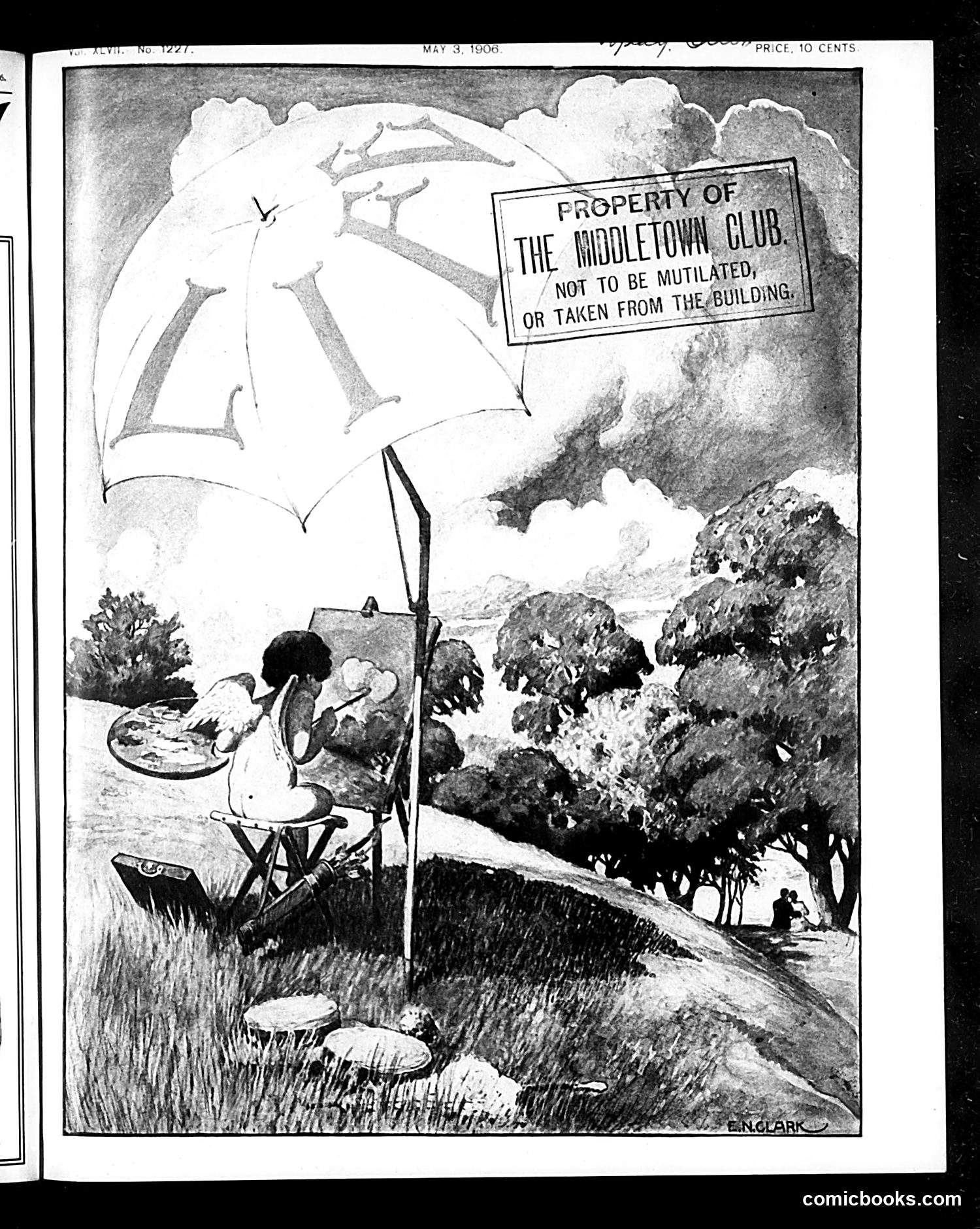
This is a satirical cartoon from *Life* magazine (May 3, 1906, priced at 10 cents). The image depicts a figure painting a large "Z" on a cloud while sitting outdoors, with a landscape and other figures visible below. The stamp reading "PROPERTY OF THE MIDDLETOWN CLUB. NOT TO BE MUTILATED OR TAKEN FROM THE BUILDING" suggests this cartoon satirizes either the Middletown Club itself or comments on how institutional property restrictions apply even to artistic works or creative endeavors. The meaning appears to reference theft, vandalism, or unauthorized use of club property. Without additional context about the Middletown Club's specific 1906 situation, the precise satirical target remains unclear, though it likely lampoons either the club's rules or someone's artistic pretensions being curtailed by institutional ownership claims.
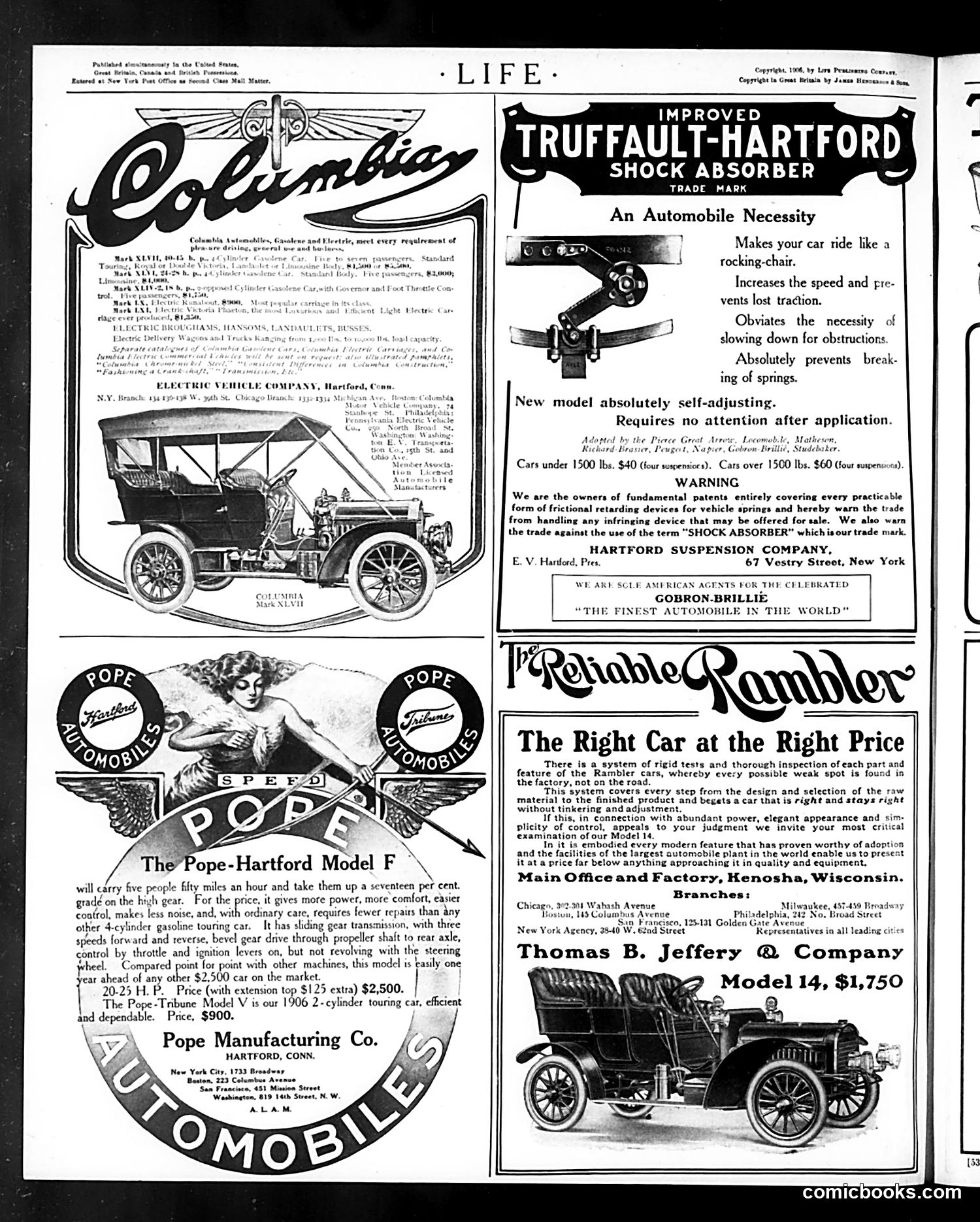
This page consists primarily of **automobile advertisements** rather than political cartoons or satire. The ads showcase early 1900s vehicles from manufacturers including Columbia, Pope-Hartford, Truffault-Hartford (shock absorbers), and Rambler automobiles. The only illustrated element approaching cartoon style is the Pope-Hartford advertisement featuring a classical winged female figure (likely representing Speed or Victory) alongside promotional text about their Model F automobile. The page reflects the era's automobile industry marketing—emphasizing technological innovations like shock absorbers and rigid testing systems. Prices range from $900 to $2,500, positioning these as luxury goods for affluent buyers. There is no political satire or social commentary evident; this is commercial content typical of early 20th-century magazine advertising.
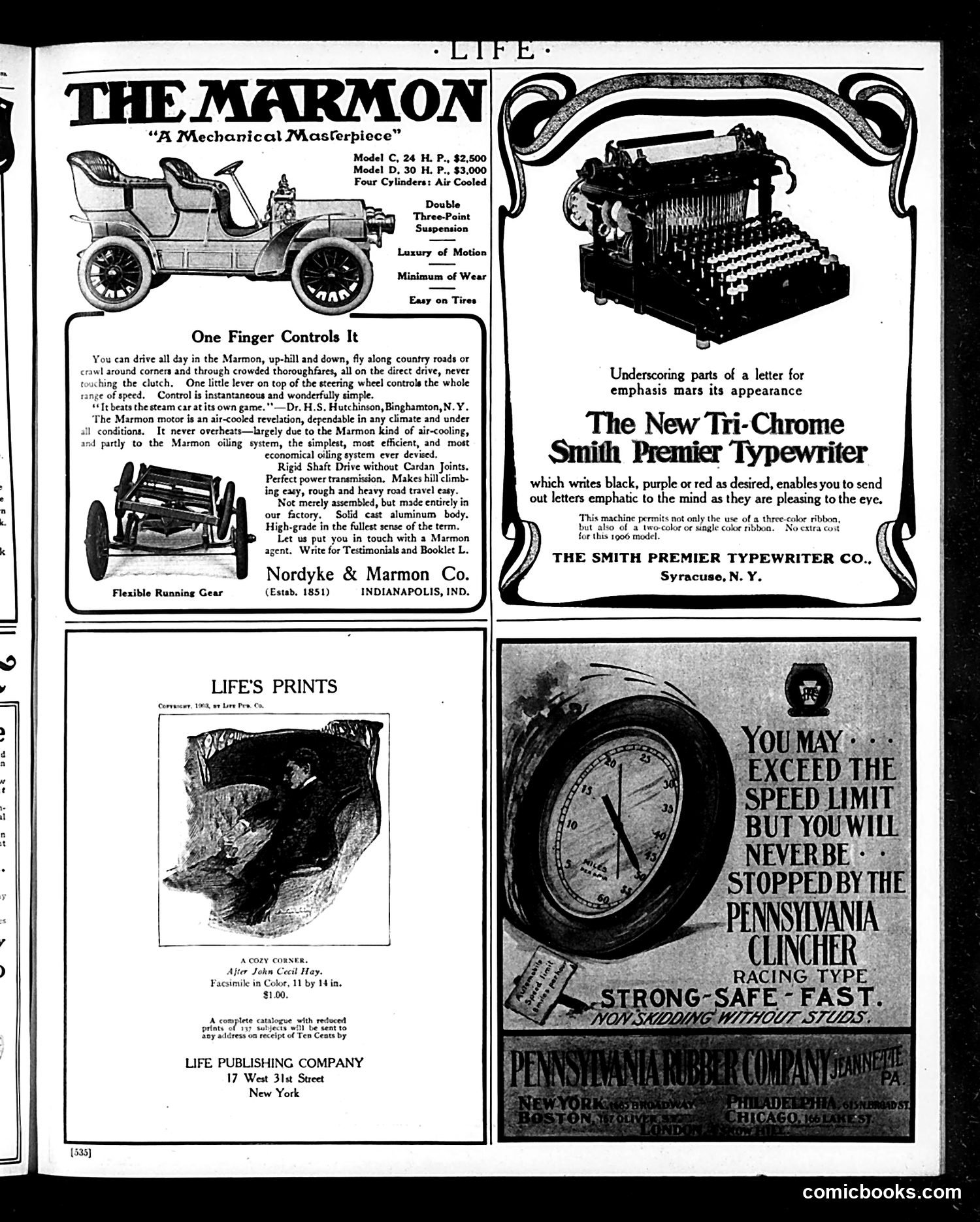
This page is **primarily advertising**, not satirical content. It contains four product advertisements from what appears to be an early 1900s issue of Life magazine: 1. **The Marmon automobile** - promotes "one finger controls it," emphasizing ease of operation for this early motorcar 2. **Smith Premier Typewriter** - advertises a tri-chrome model allowing black, purple, or red text 3. **Life's Prints** - offers art reproductions, including a "Cozy Corner" piece by John Cecil Hay 4. **Pennsylvania Clincher Tire** - promotes a non-skidding tire, claiming superior stopping power versus speed limits The only potentially humorous element is the tire ad's tongue-in-cheek tagline about exceeding speed limits without consequences, reflecting early automotive culture. Otherwise, this is a straightforward commercial page with no political or satirical cartoons present.
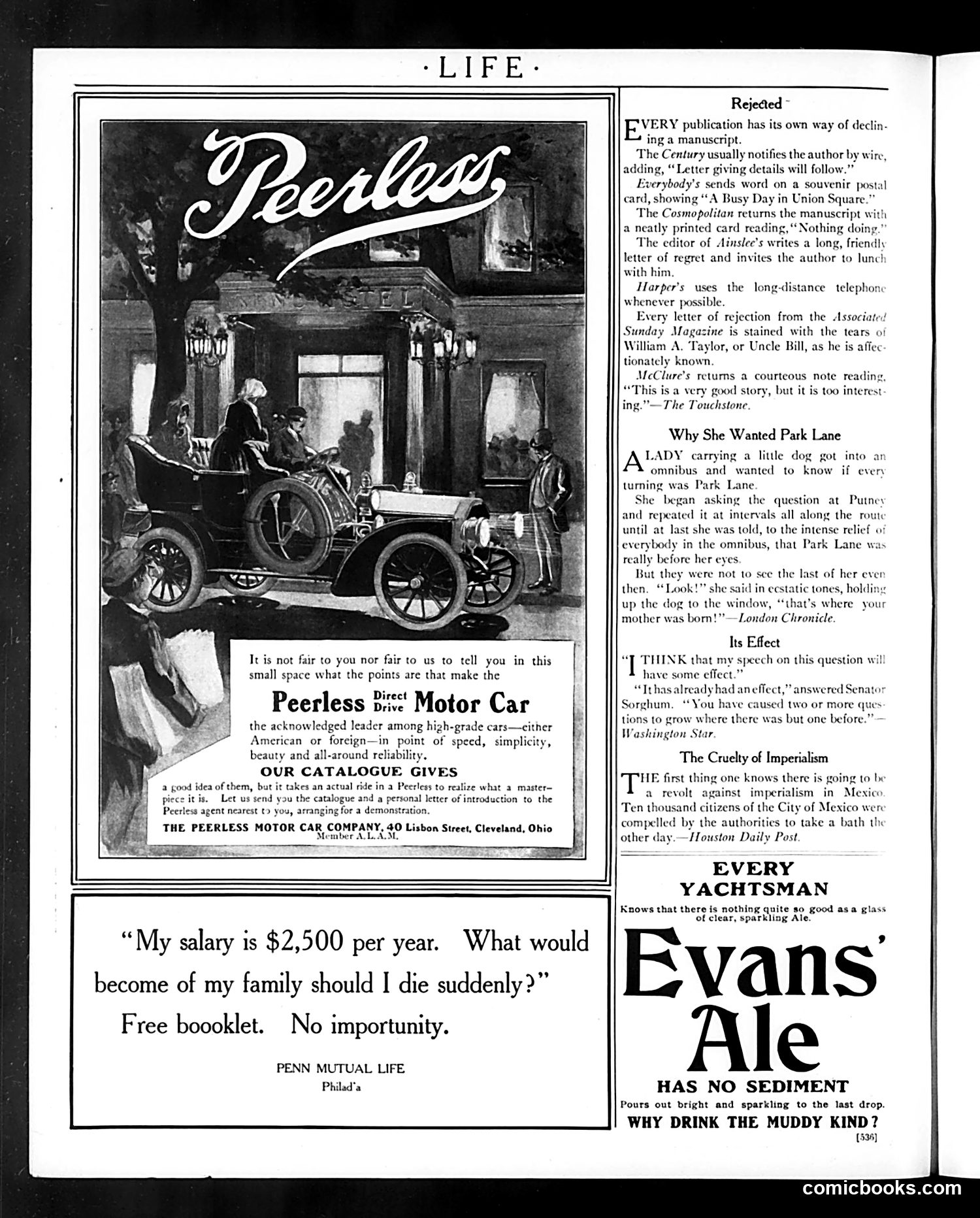
This page is primarily **advertising**, not editorial satire. The dominant content is a large **Peerless Motor Car advertisement** featuring an illustration of the vehicle outside an elegant storefront with well-dressed pedestrians. The ad emphasizes the car's reliability and quality, positioning it as a "leader among high-grade cars." Below are smaller advertisements for **Penn Mutual Life Insurance** (addressing financial security for families) and **Evans' Ale** (promoting a "clear, sparkling" beverage without sediment). A brief humorous anecdote titled "Why She Wanted Park Lane" appears on the right side—a light social joke about a lady discovering Park Lane was her birthplace. The page reflects early 20th-century consumer culture and advertising conventions rather than political commentary.
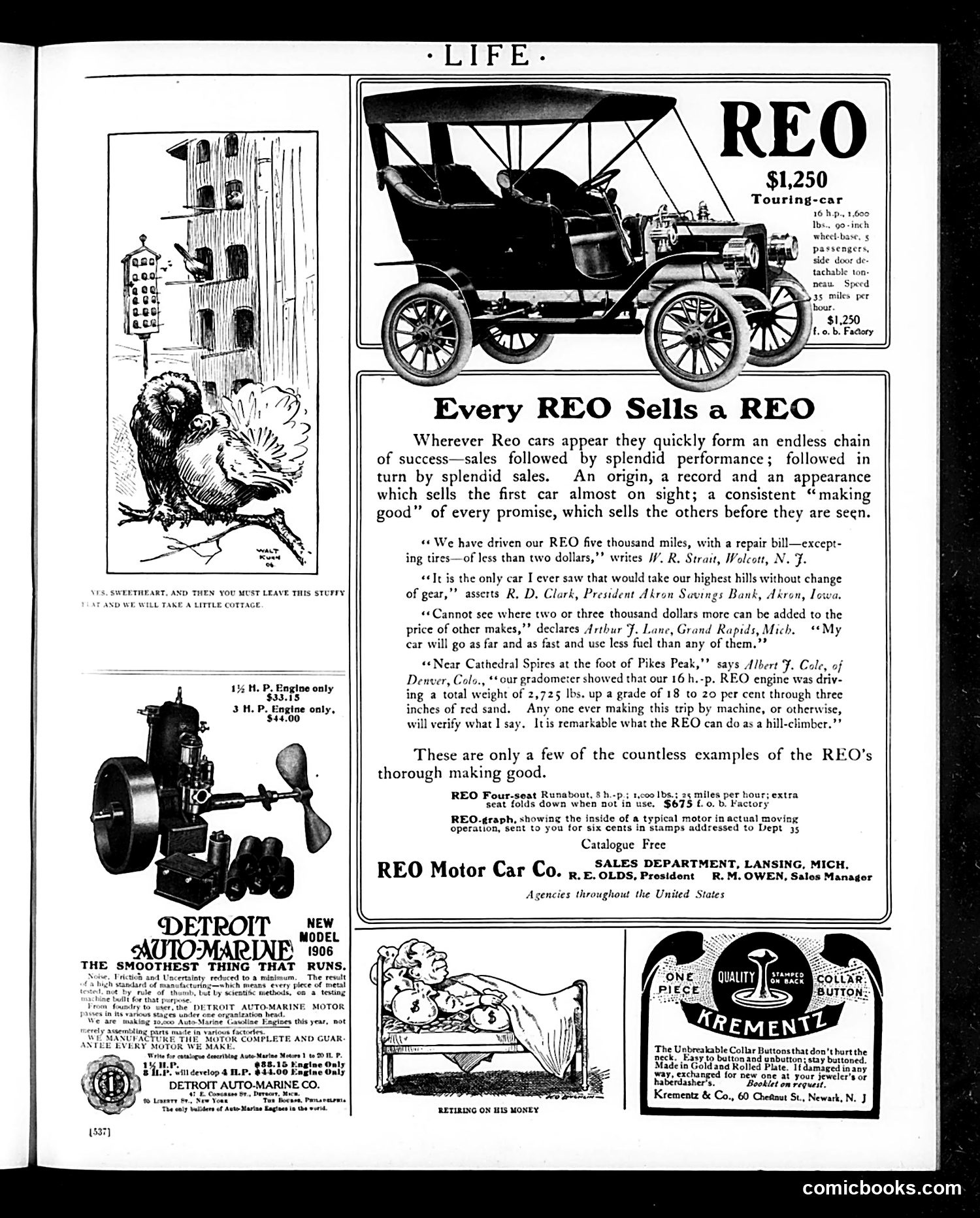
This page is primarily **advertising, not satire or political commentary**. The main content features ads for three early automobiles: the REO touring car ($1,250), the Detroit Auto-Marine engine, and Krementz collar buttons. The only cartoon element is a small illustration on the left showing a bird leaving a cottage, captioned "Yes, sweetheart, and then you must leave this stuffy old maid we will take a little cottage." This appears to be a generic romance illustration unrelated to the automotive advertisements. The REO ad emphasizes customer testimonials praising the car's reliability and fuel efficiency. This represents typical early-1900s automotive marketing, before such vehicles were luxuries rather than novelties.
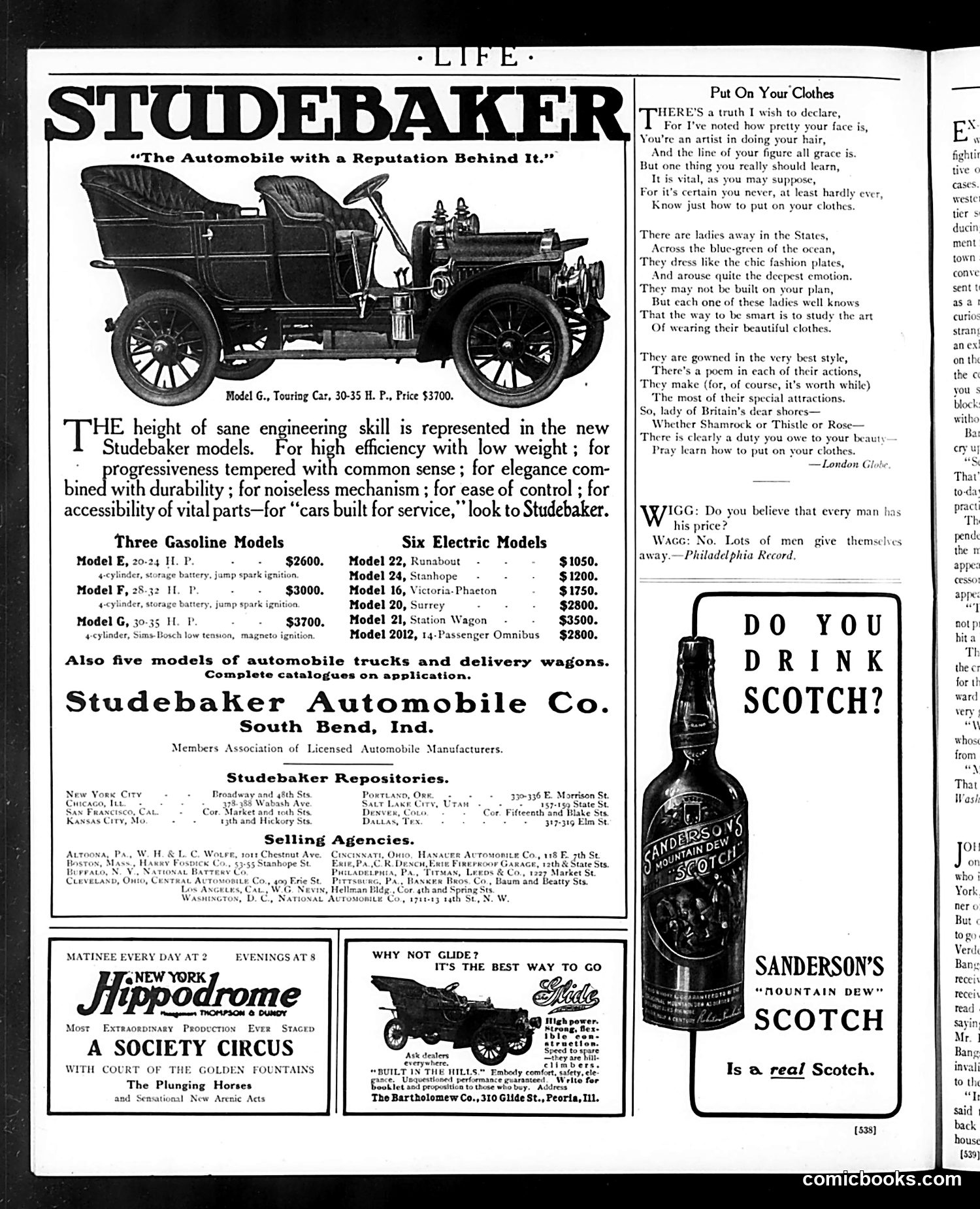
This page is **primarily advertising**, not satirical content. It features: 1. **Studebaker automobiles** - A major advertisement highlighting their 1910 gasoline and electric car models, emphasizing engineering quality and reliability. 2. **Sidebar content** - A poem titled "Put On Your Clothes" about fashion and grooming for women, referencing British fashion trends. 3. **Minor humor section** - A brief Q&A exchange ("WIGG") about whether men have principles. 4. **Entertainment ads** - Including the New York Hippodrome theater and a Studebaker automobile truck advertisement. 5. **Sanderson's Scotch whisky advertisement** - A full-page liquor ad claiming it's a "real Scotch." There is **no political cartoon** on this page. The content reflects early 1900s consumer culture and product marketing typical of *Life* magazine's commercial pages.
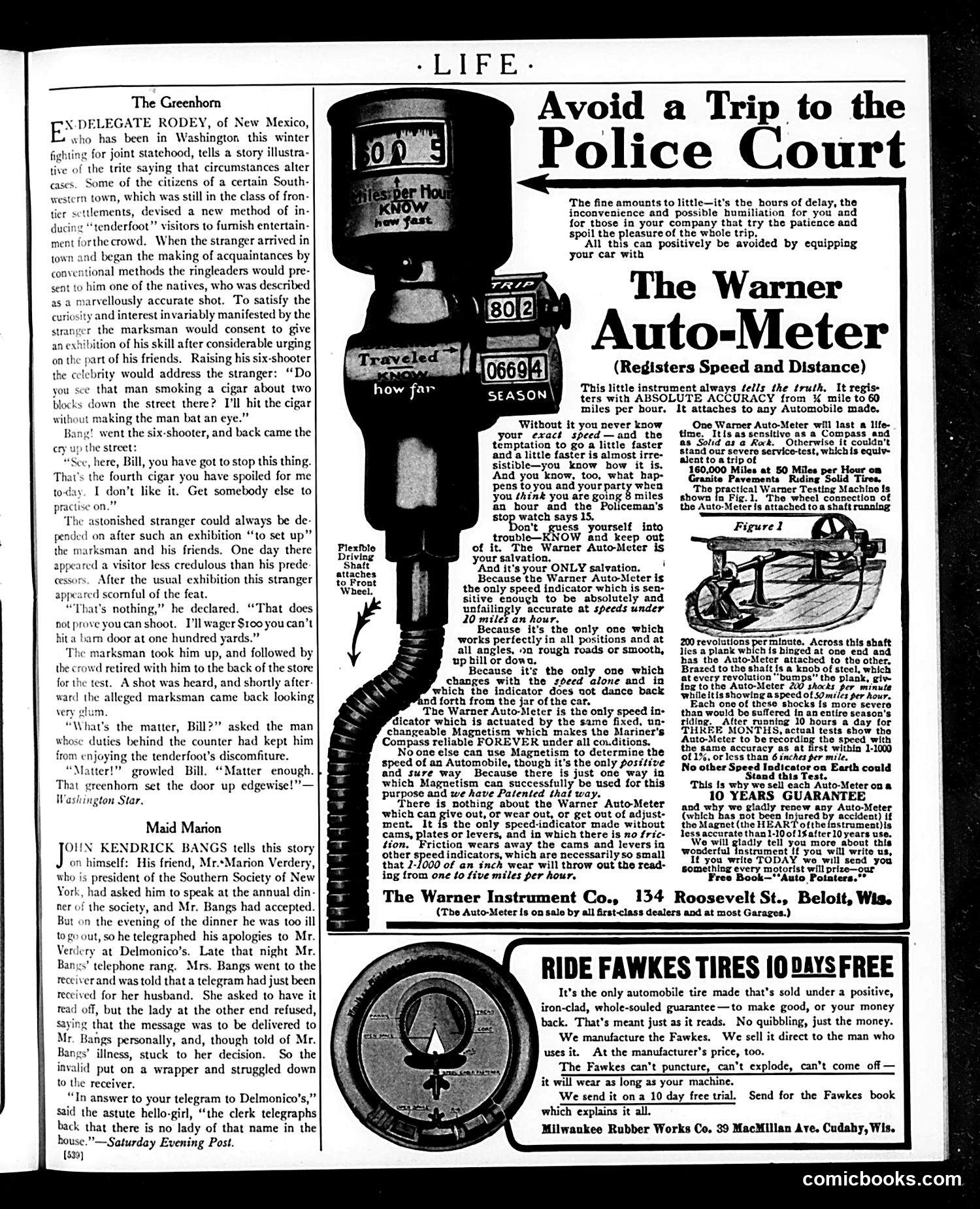
This page mixes editorial content with advertising. The left column contains two humorous anecdotes: "The Greenhorn" describes a frontier town's entertainment scheme to trick a city visitor into an embarrassing shooting exhibition, while "Maid Marion" recounts a dinner party mix-up involving telegrams. The right side features advertisements for the **Warner Auto-Meter** (a speedometer) and **Fawkes Tires**, framed by a satirical header "Avoid a Trip to the Police Court." The Warner ad suggests equipping your car to avoid speeding tickets—the joke being that knowing your speed prevents police encounters. This reflects early 1900s concerns about automobile regulation and traffic enforcement, a novel phenomenon for readers of that era.
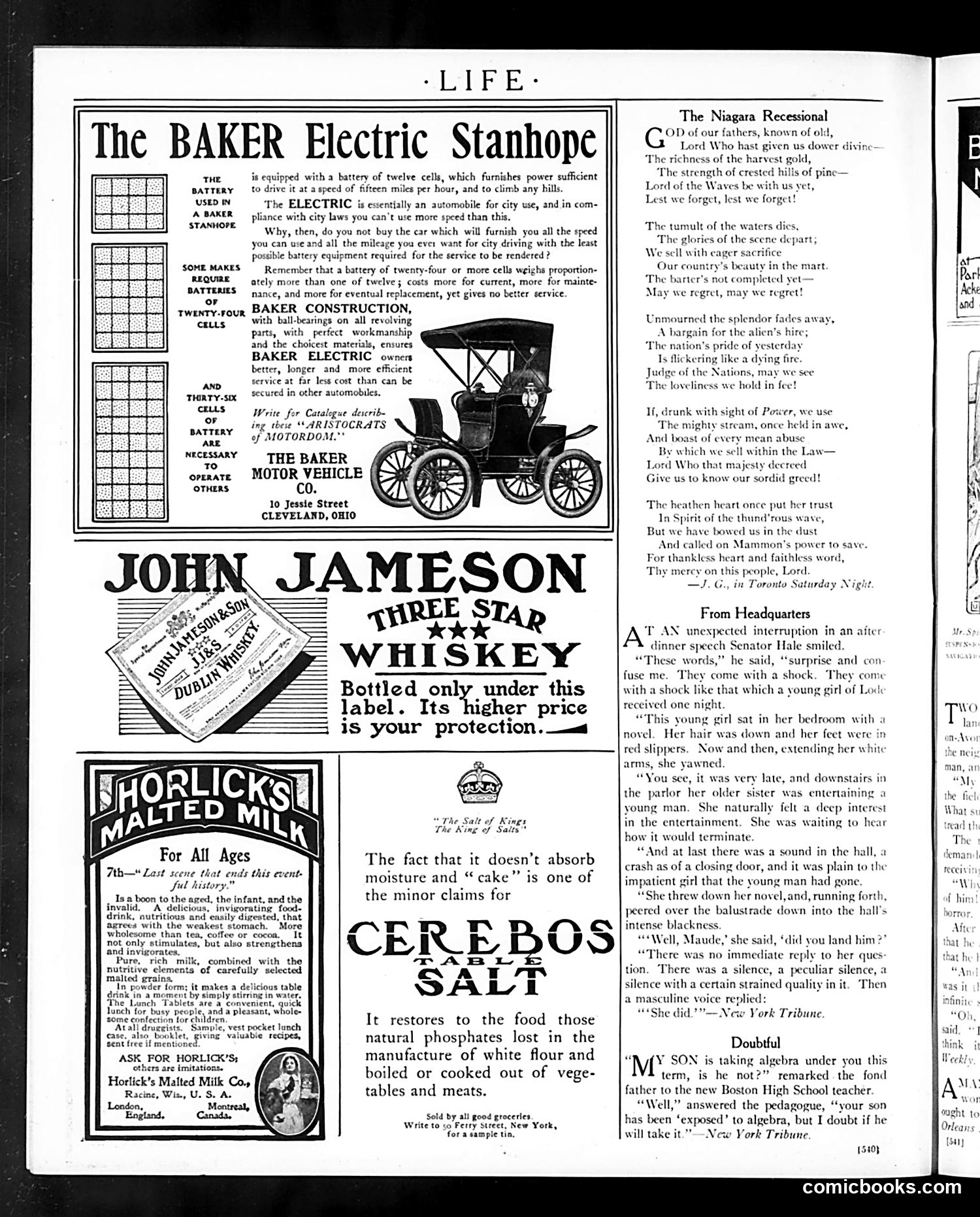
This page is primarily **advertising**, not political satire. It contains four commercial advertisements: 1. **Baker Electric Stanhope** - promoting an early electric automobile, emphasizing its reliability and low maintenance compared to gasoline cars 2. **John Jameson Three Star Whiskey** - Irish whiskey advertisement highlighting authenticity and quality 3. **Horlick's Malted Milk** - a nutritional drink marketed for "All Ages" 4. **Cerebos Table Salt** - promoting the product's moisture-resistant properties and nutritional benefits The page also includes **"The Niagara Recessional,"** a poem reflecting on national decline, and two brief humorous anecdotes ("From Headquarters" and "Doubtful") typical of *Life* magazine's satirical content. The advertising reflects early 20th-century consumer products and commercial messaging strategies.
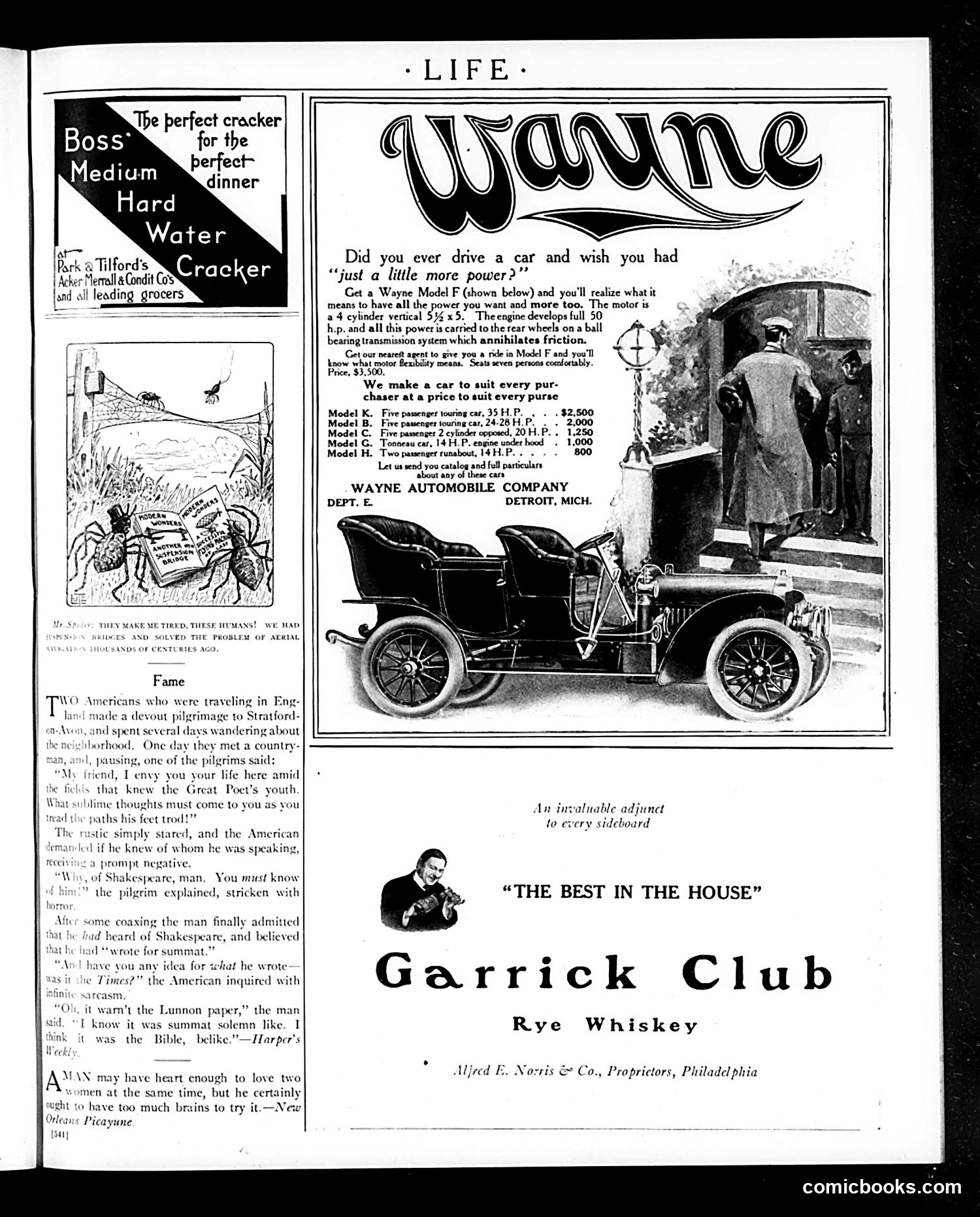
This page is primarily **advertising and literary content**, not political satire. The left column contains a humorous anecdote ("Fame") about two Americans in England who encounter a pilgrim. When asked if they know Shakespeare, they misidentify him, confusing his works with the Bible and a newspaper (the *Times*). The joke mocks American ignorance of classical literature. The page features **three advertisements**: Boss crackers, Wayne automobiles (multiple models ranging $800-$2,500), and Garrick Club rye whiskey ("The Best in the House"). The Wayne automobile ad emphasizes power and engineering features for consumers seeking performance, reflecting early-1900s automotive marketing aimed at buyers wanting practical family transportation at various price points.
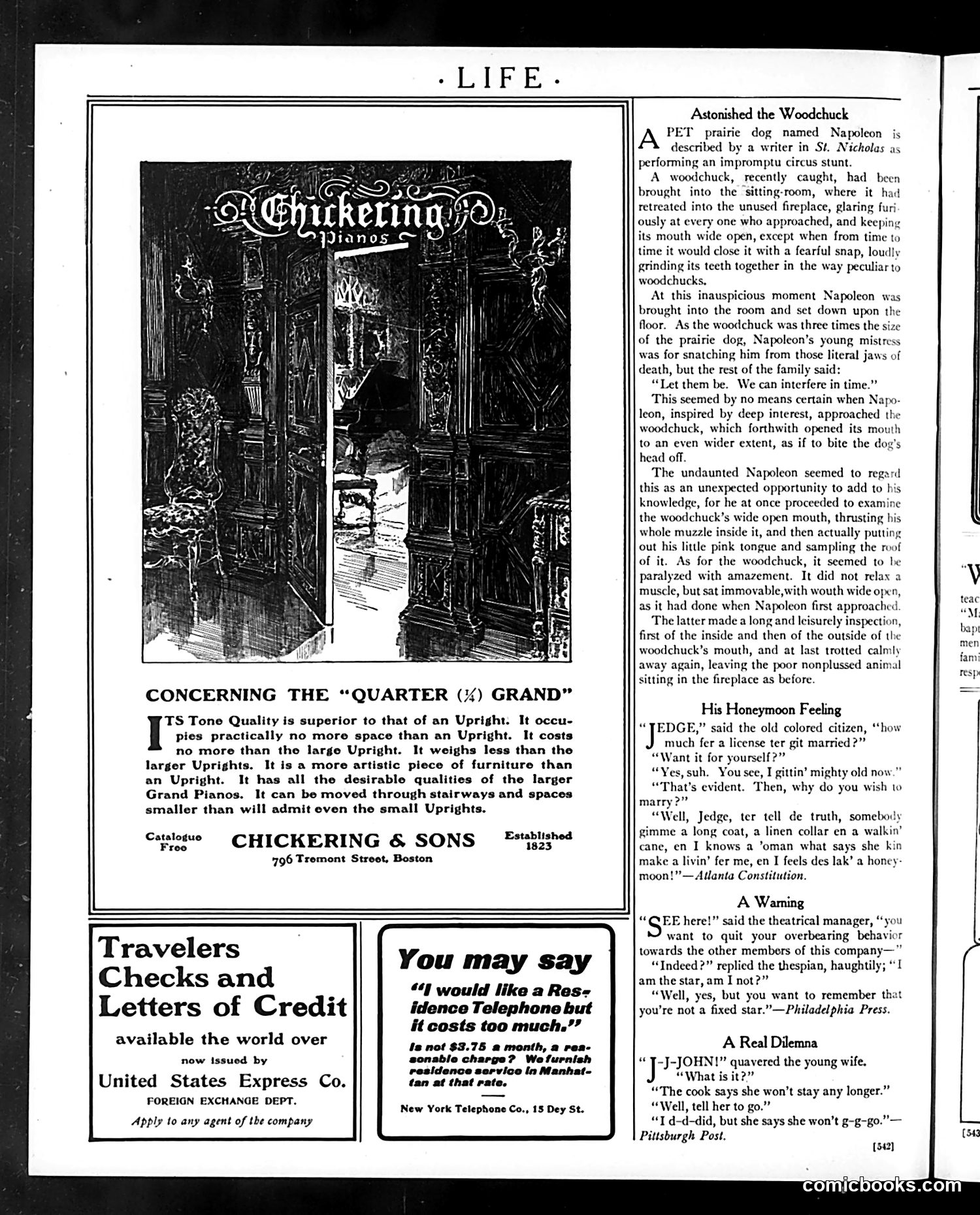
This page is primarily **advertising and humorous anecdotes**, not political satire. The main content includes: 1. **"Chickering & Sons" piano advertisement** — promotes their "Quarter Grand" piano as superior to upright models while occupying less space, positioned as artistic furniture. 2. **Three humor pieces** titled "Astonished the Woodchuck," "His Honeymoon Feeling," "A Warning," and "A Real Dilemma" — brief comedic vignettes about everyday situations (a pet dog encountering a woodchuck, marital disputes, workplace behavior). 3. **Service advertisements** for Travelers Checks and New York Telephone Company. The humor relies on **domestic and social situations** rather than political commentary. These are gentle satirical observations about American middle-class life, typical of Life magazine's lighter content from this era.
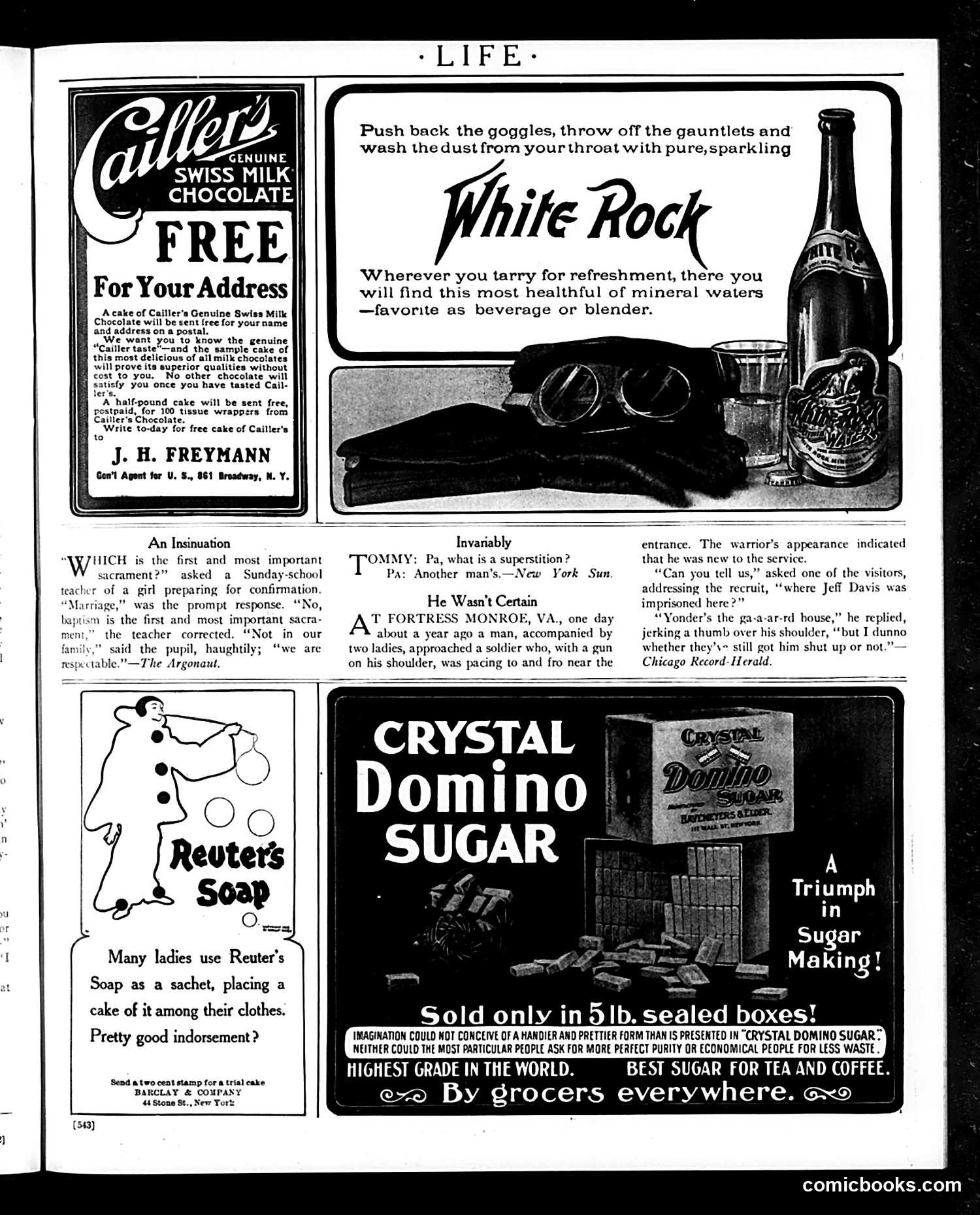
This page is primarily **advertising**, not satire or political commentary. The ads include: - **Callier's Swiss Milk Chocolate** (free sample offer) - **White Rock mineral water** (positioned as healthful, shown with goggles and athletic imagery) - **Reuter's Soap** (with a cartoon woman using soap as a sachet) - **Crystal Domino Sugar** (emphasizing purity and quality) The only editorial content includes brief anecdotes: one about "marriage" as a sacrament in Sunday school, and another about soldiers at Fortress Monroe. These appear to be filler humor rather than satirical commentary. The page reflects early 20th-century advertising appeals emphasizing health, purity, and product quality—common marketing strategies of the era. No political figures or social satire are evident.
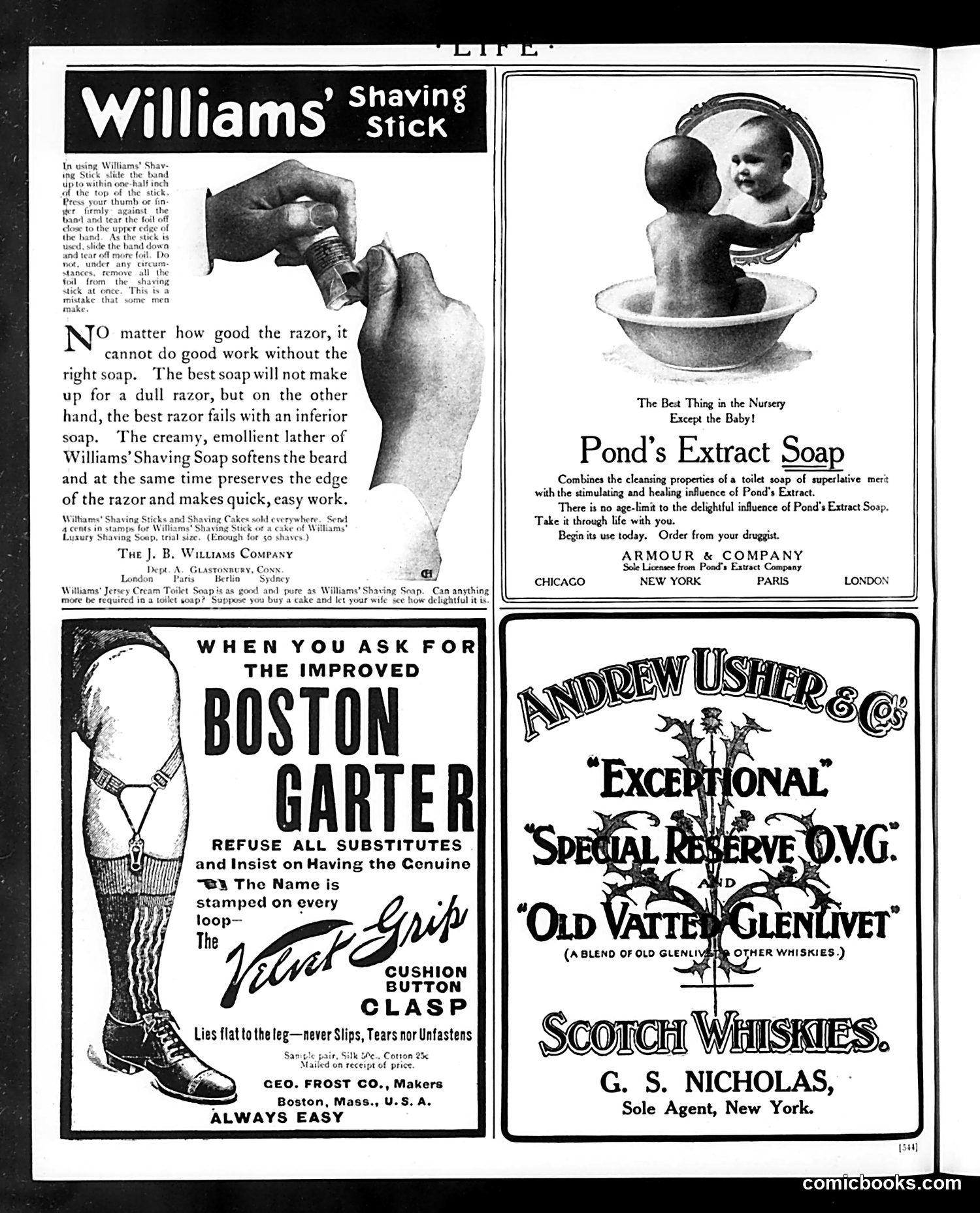
This page contains four separate advertisements rather than political cartoons: 1. **Williams' Shaving Stick** - promotes the product's quality, emphasizing that even the best razor needs good soap to work properly. 2. **Pond's Extract Soap** - advertises a toilet soap, featuring an image of a baby in a basin with text calling it "The Best Thing in the Nursery Except the Baby!" 3. **Boston Garter** - sells a garter clasp with "Velvet Grip" cushioning, marketed to men concerned about slipping or damage to clothing. 4. **Andrew Usher & Co.** - promotes Scotch whiskies including "Exceptional," "Special Reserve O.V.G.," and "Old Vatted Glenlivet." This is a typical early 20th-century Life magazine advertisement section, mixing personal grooming products with luxury goods.
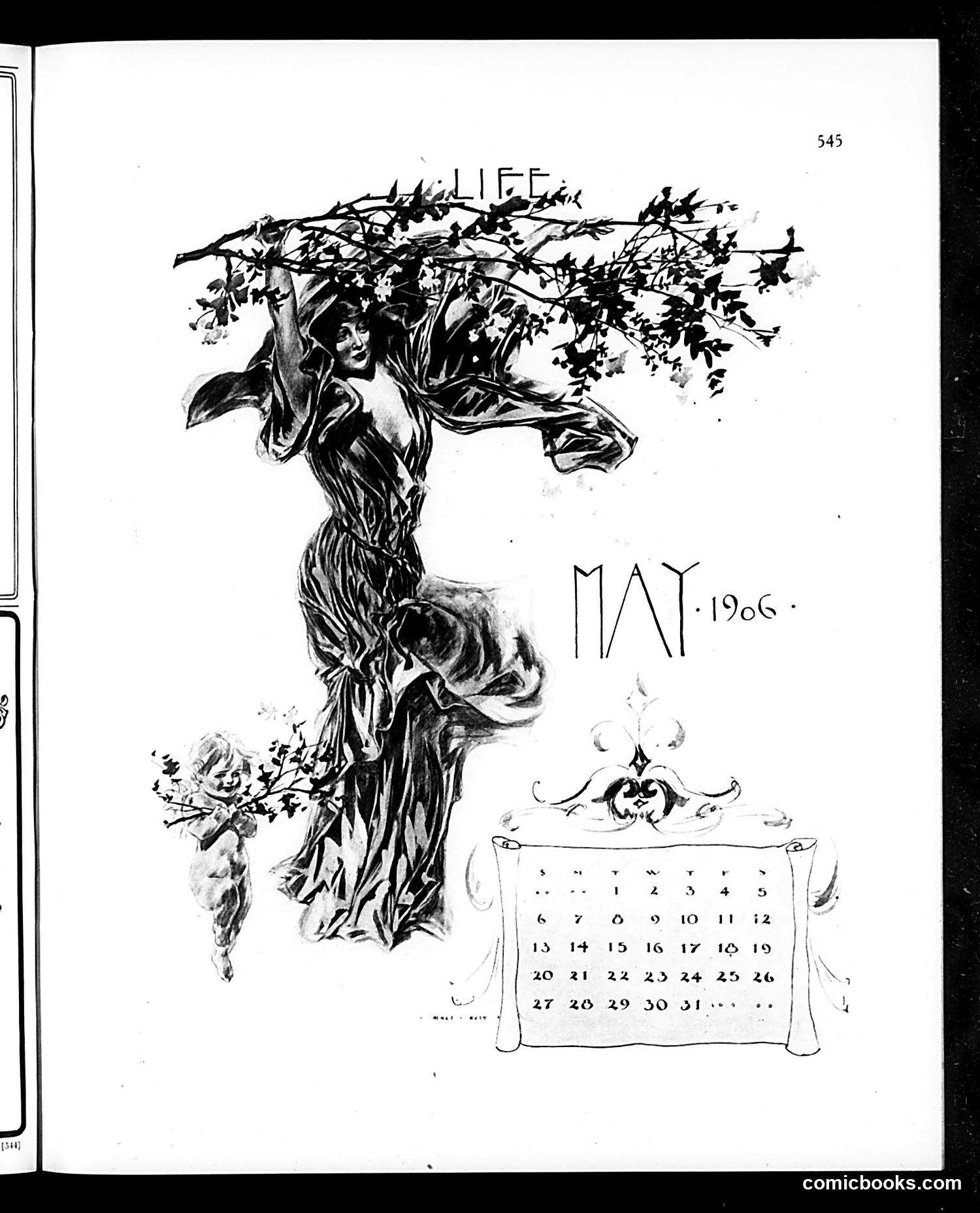
This is a calendar page from *Life* magazine for May 1906. The illustration depicts an allegorical female figure—likely representing Spring or Nature—emerging from or intertwined with a gnarled tree trunk. She holds flowering branches above her head while smaller cherub-like figures appear below, suggesting themes of renewal and fertility associated with the month of May. The artistic style is Art Nouveau, popular during this period, emphasizing organic, flowing lines and the female form merged with natural elements. Rather than political satire, this appears to be decorative cover art for the calendar, reflecting early-20th-century aesthetic sensibilities about spring's arrival and nature's rebirth. The page number (545) indicates this is from a bound collection.
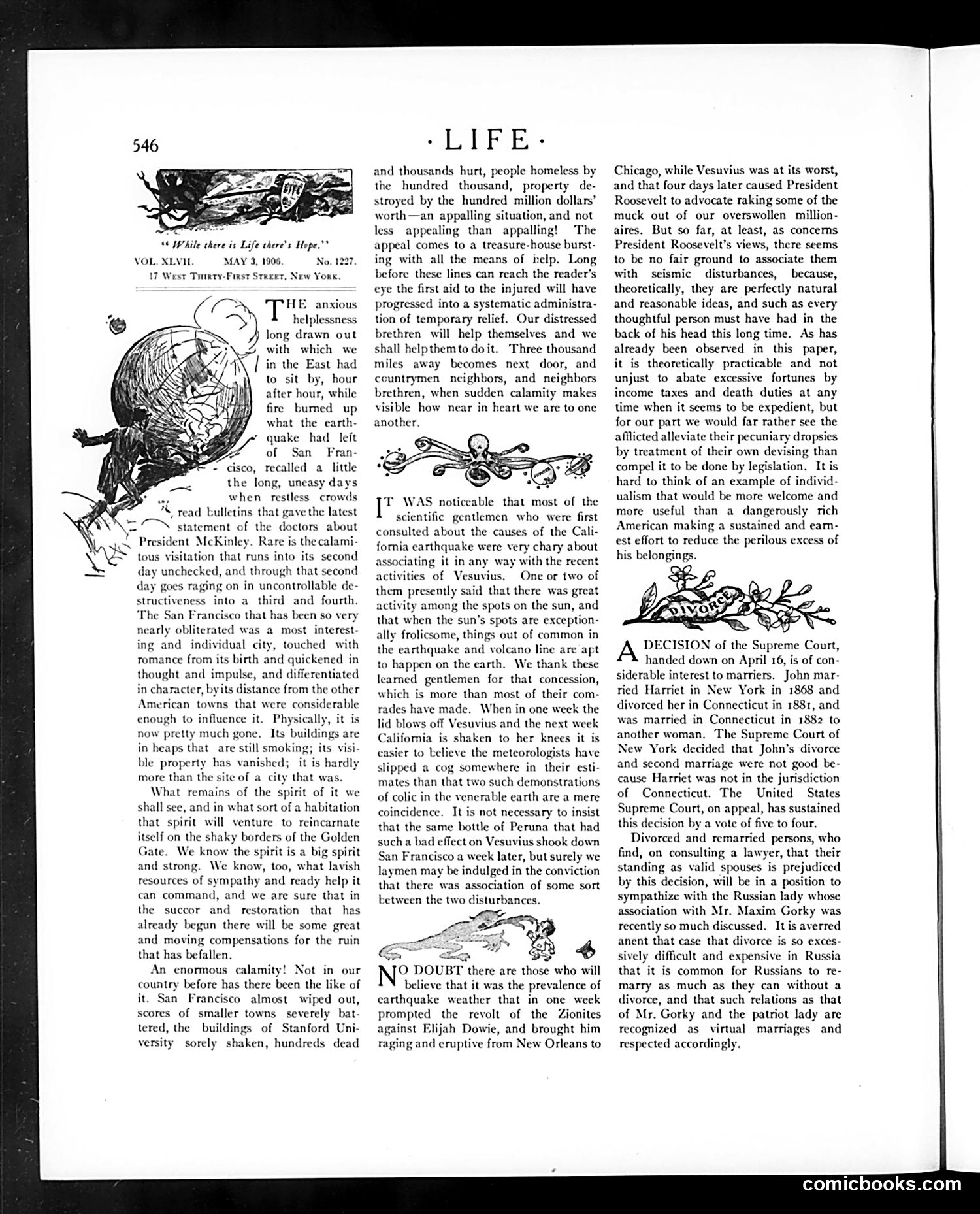
This page addresses the 1906 San Francisco earthquake and fire. The left illustration appears to depict President McKinley (based on the text reference to "President McKinley") observing destruction, though the specifics are unclear from the image alone. The main text is a serious editorial praising American sympathy and relief efforts for the disaster, emphasizing national unity—"three thousand miles away becomes next door." However, there's satirical commentary mocking scientists who attributed both the San Francisco earthquake and concurrent volcanic activity at Mount Vesuvius to sunspots rather than acknowledging coincidence. The text sarcastically references "Peruna" (a patent medicine), humorously suggesting it caused both disasters—a jab at pseudoscientific explanations popular at the time. The page balances genuine compassion for victims with typical Life magazine satire targeting scientific pretension and absurd remedies of the era.
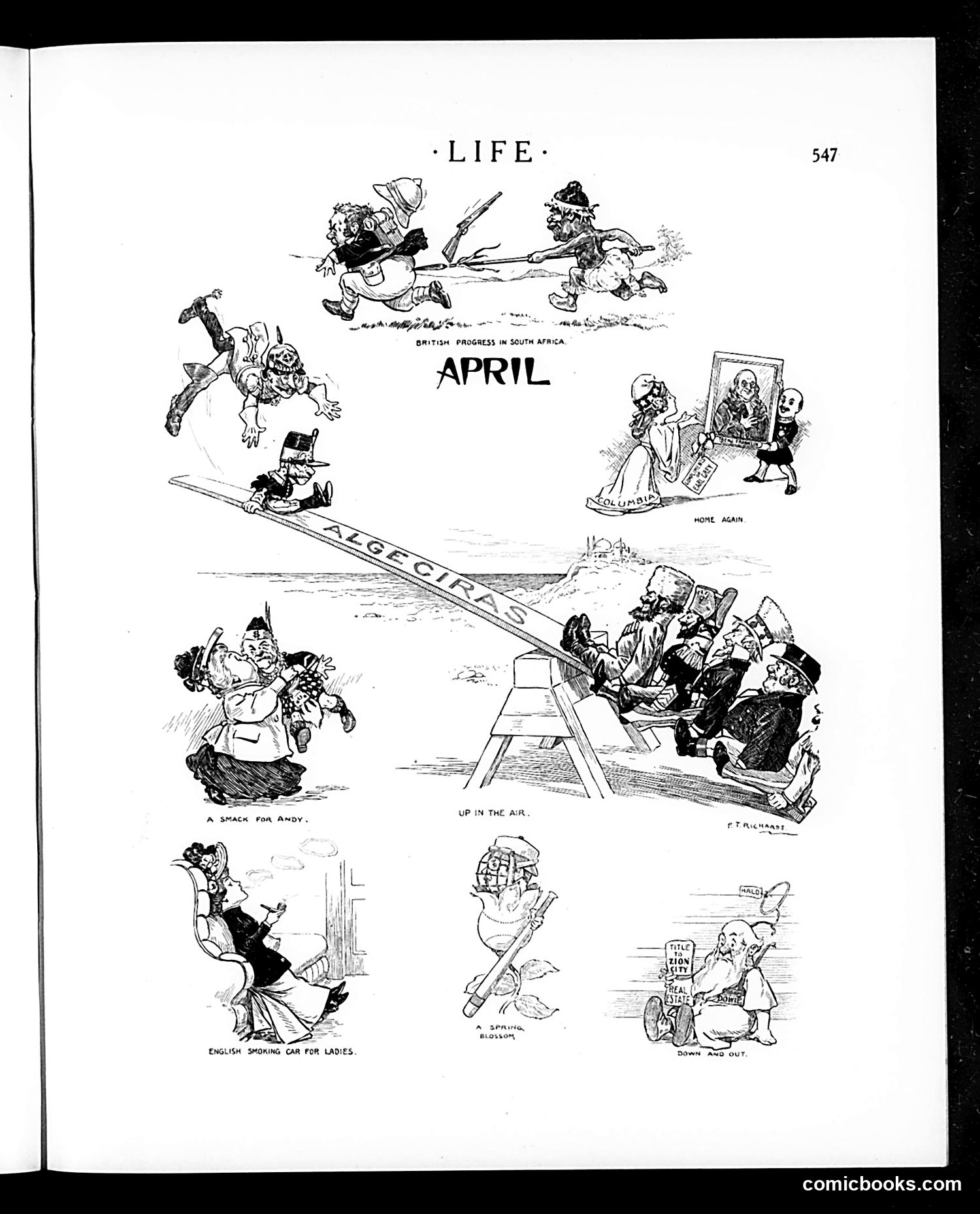
This page presents satirical cartoons about events during April, likely from World War I era based on the "British Progress in South Africa" reference and military themes. The central image shows a seesaw labeled "Algeciras" (a 1906 international conference), depicting diplomatic tensions. "Home Again" shows what appears to be a returning soldier. "A Smack for Andy" features a caricatured figure receiving punishment. "Up in the Air" depicts anxiety or uncertainty about outcomes. "English Smoking Car for Ladies" satirizes social conventions, while "A Spring Blossom" and "Down and Out" appear to comment on social conditions. The cartoons employ exaggerated facial features and physical comedy typical of early 20th-century satirical illustration to mock political figures, military situations, and social pretensions of the period.
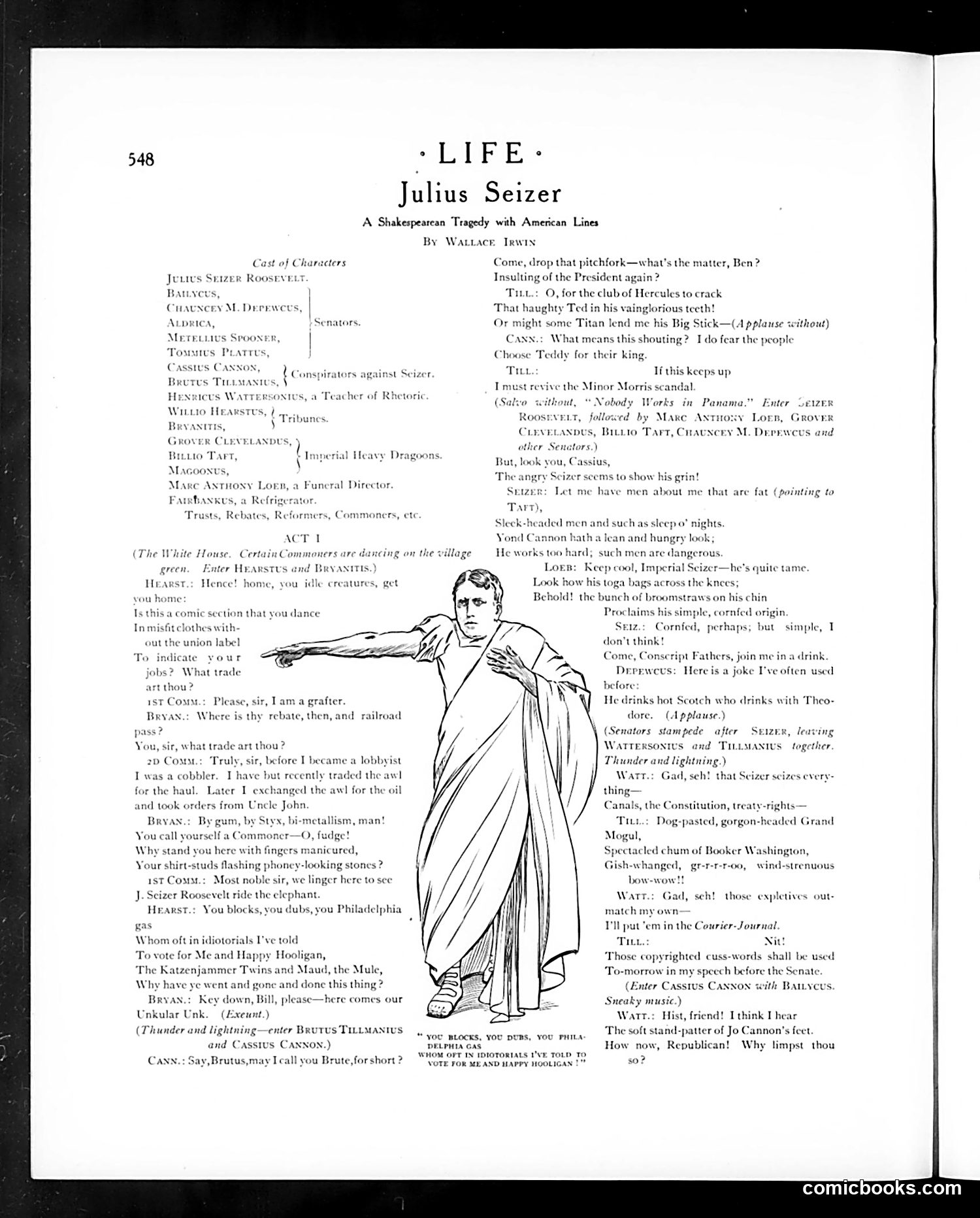
This is a Shakespearean parody satirizing President Theodore Roosevelt and his political opponents. The play reimagines *Julius Caesar* with American figures: **Key identifications:** - "Julius Seizer Roosevelt" = Theodore Roosevelt - "Brutus Tillmanius" = likely Senator Joseph Cannon - "Cassius Cannon" = appears to reference political conspirators - Characters named after real figures: Bryan, Hearst, Defreyus, Cleveland **The satire:** The piece mocks Roosevelt's aggressive presidential style (his "Big Stick" policy) and portrays him as a tyrannical figure whom politicians plot against. References to "Minor Morris scandal," Panama Canal, and "copyrighted cuss-words" suggest contemporary political controversies. **The humor:** By casting American political figures as Shakespearean conspirators, *Life* ridicules both Roosevelt's imperious manner and the theatrical posturing of his critics—particularly newspaper editor Hearst and populist Bryan. The dialogue mimics Shakespeare while inserting American slang and contemporary references (streetcar conductors, oil trades, comic strips), creating absurdist political commentary typical of *Life's* muckraking satire.
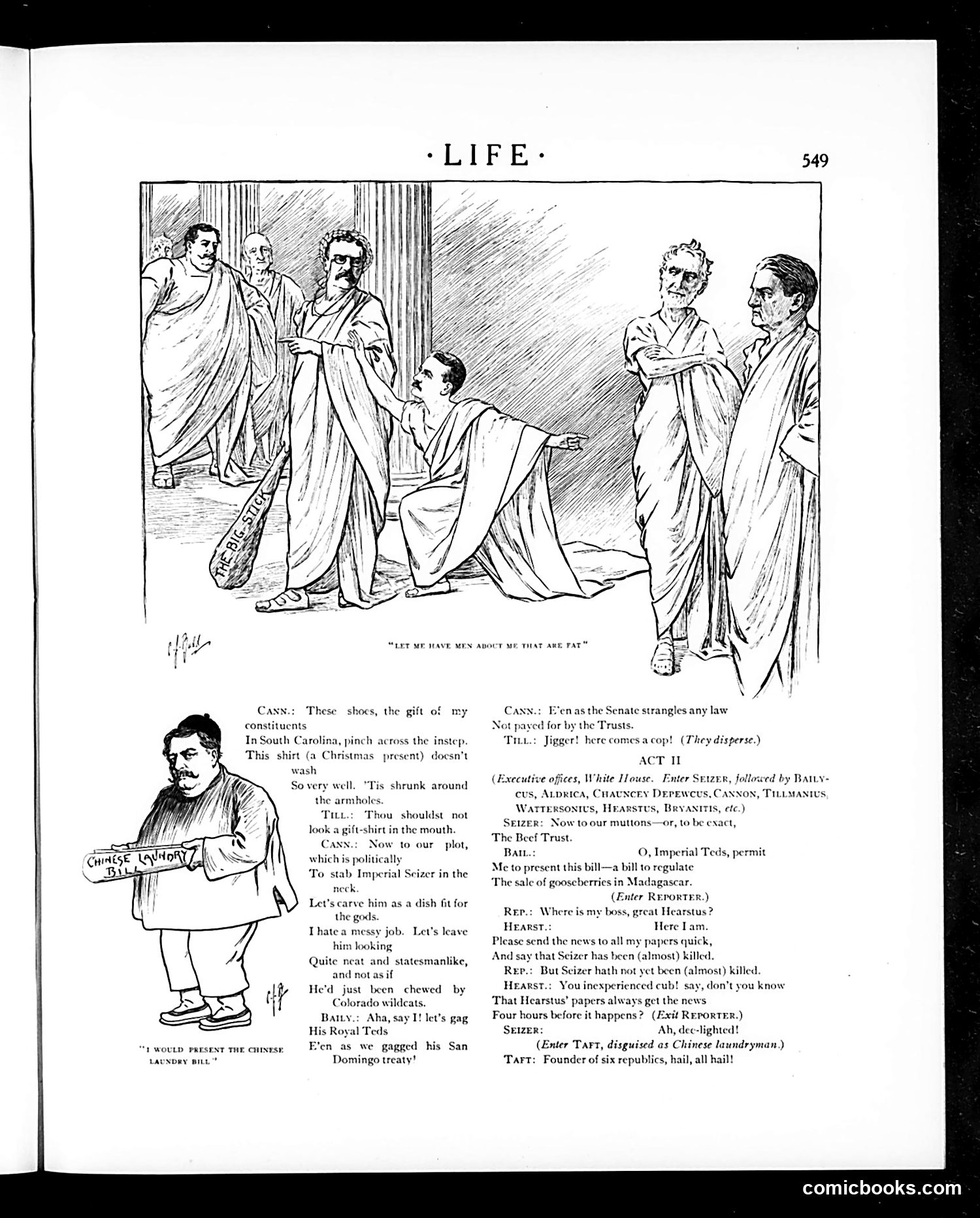
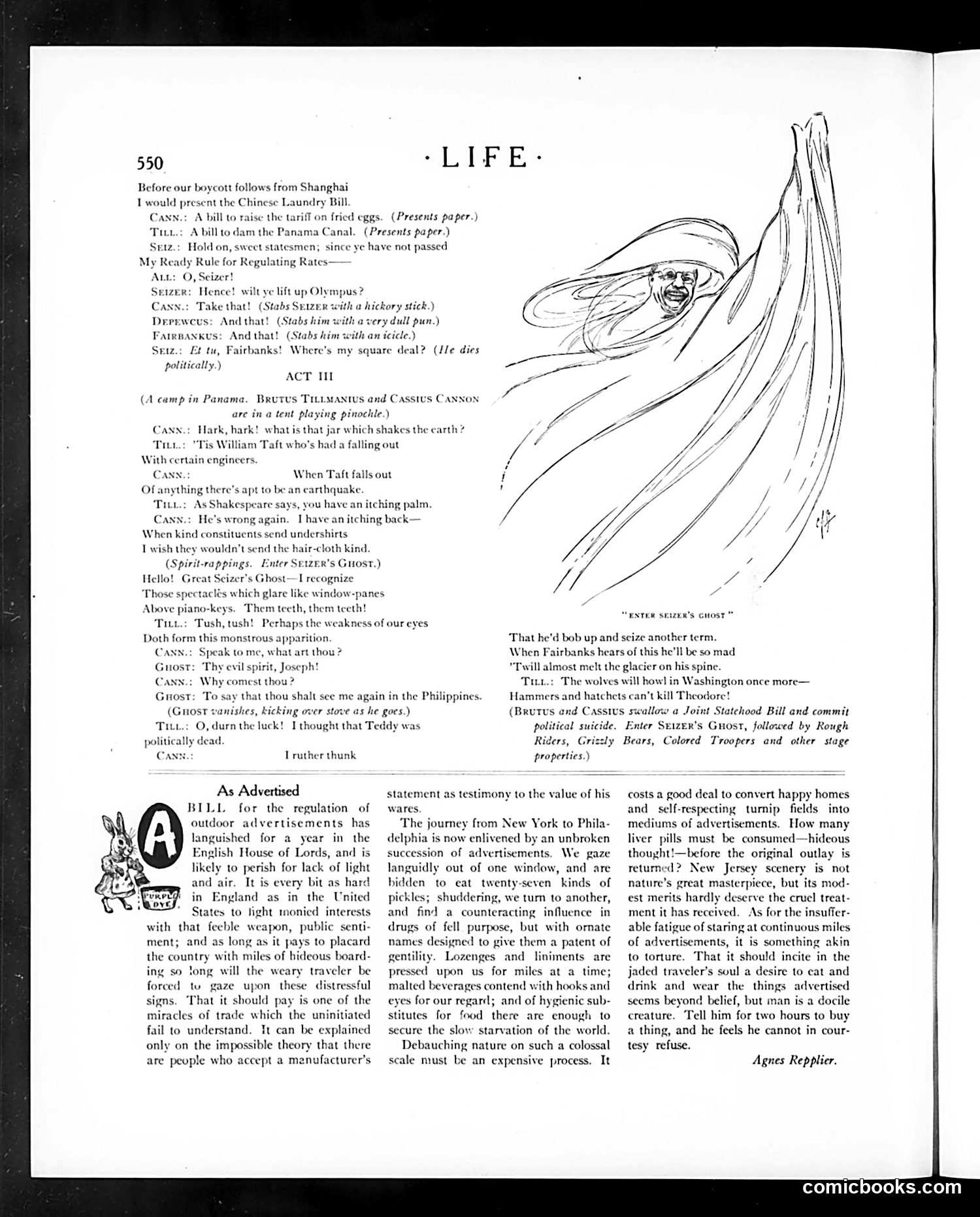
This page contains a theatrical satire **mocking President Theodore Roosevelt and his administration** through a fake "Act III" of a classical play set in Panama. **The Political Context:** The sketch ridicules Roosevelt's major policies—the Panama Canal project and tariff debates ("Chinese Laundry Bill," "tariff on fried eggs"). Characters named "Brutus Thalmannus" and "Cassius Cannon" represent political figures; "Seizer's Ghost" appears to reference Roosevelt's aggressive "Square Deal" policies. **The Caricature:** William Howard Taft (Roosevelt's successor) is mocked as causing an "earthquake" when he "falls out." Vice President James Sherman ("Fairbanks") is portrayed as emotionally volatile. The ghost invokes Theodore Roosevelt's return—suggesting anxiety he'll challenge Taft politically. **The Satire's Point:** Life ridicules the administration's imperial ambitions (Panama Canal) and internal political instability, using Shakespearean tragedy tropes to suggest the government is theatrical melodrama rather than serious governance. **Below:** A separate article ("As Advertised") criticizes billboard advertising's proliferation, unrelated to the political cartoon.
This is a **letters-to-the-editor page** from Life magazine, featuring reader correspondence on social and moral issues of the era. **Main debates:** 1. **Missionary work**: A Christian Scientist argues that missionary efforts (referencing Christ's "Great Commission") should prioritize healing alongside preaching, suggesting aggressive proselytization creates hypocrites. 2. **English sparrows**: Readers debate whether introduced English sparrows deserve protection. One correspondent argues they're destructive pests harming native songbirds and should be exterminated like rats—a stance Life's editor seems to find somewhat absurd (note the sarcastic editorial comment). 3. **Children's literature**: A reader condemns a book called "Larky Furnace" for exposing children to mature themes (drunkenness, theft, murder). Life's editor responds with gentle mockery, implying the correspondent is overreacting to the book's actual content. The page reflects Progressive-era anxieties: missionary zeal, environmental concerns about invasive species, and debates over children's moral protection.
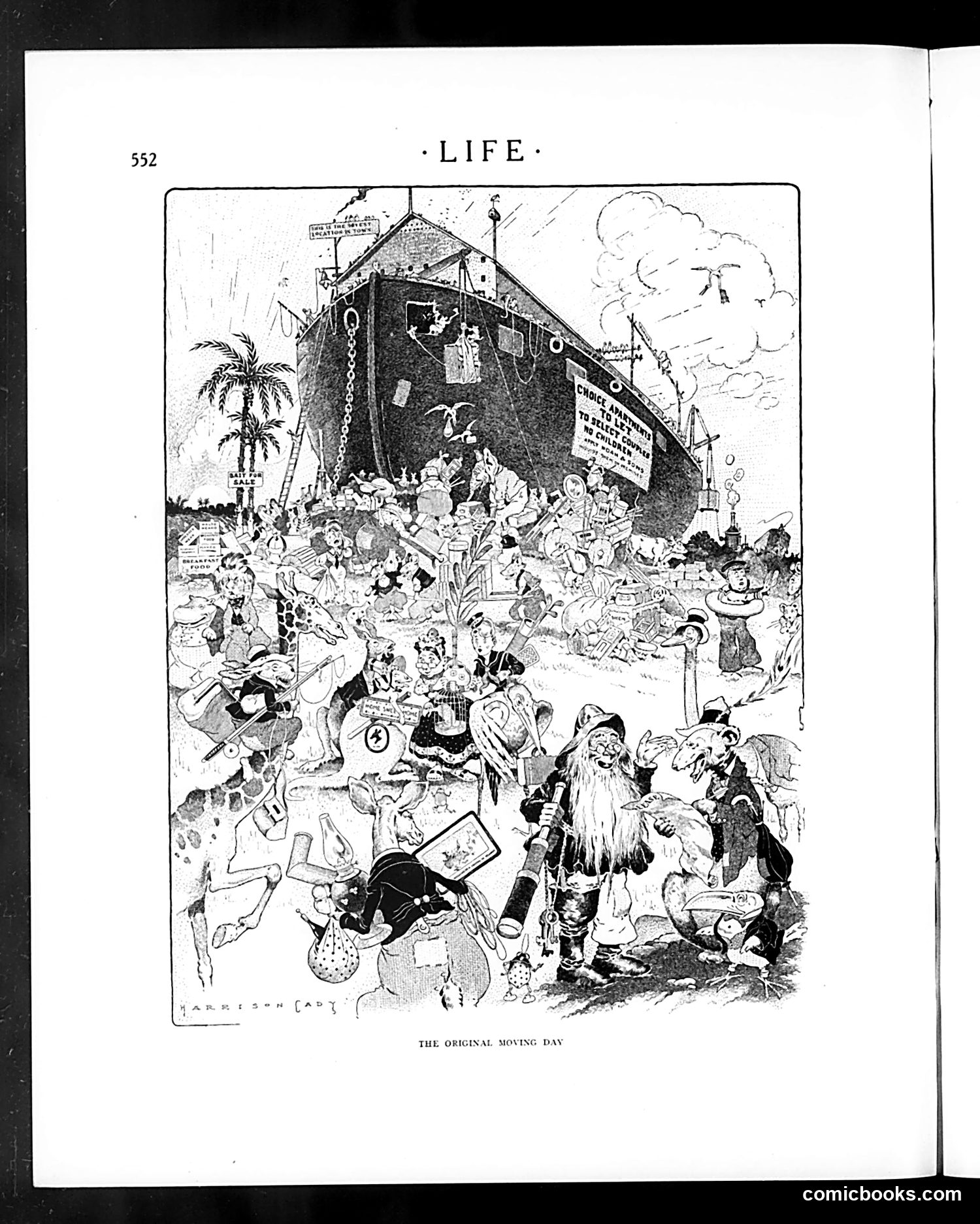
This satirical cartoon depicts chaos surrounding a massive, ship-like structure being moved. The illustration shows numerous figures—some appearing to be working-class people, others in various states of disarray—amid scattered belongings, furniture, and debris. A palm tree on the left and the ship's scale suggest tropical or maritime setting. "Moving day" refers to a traditional day when renters relocated. The cartoon satirizes this as chaotic and disruptive. The "original" framing suggests this comments on moving day as an established social problem. The ship-structure may reference immigration or mass relocation. The crowded, frantic composition emphasizes the disorder and strain of such mass displacement on ordinary people. The specific historical context—without a visible date—remains unclear, though this appears from early-to-mid 20th century Life magazine.
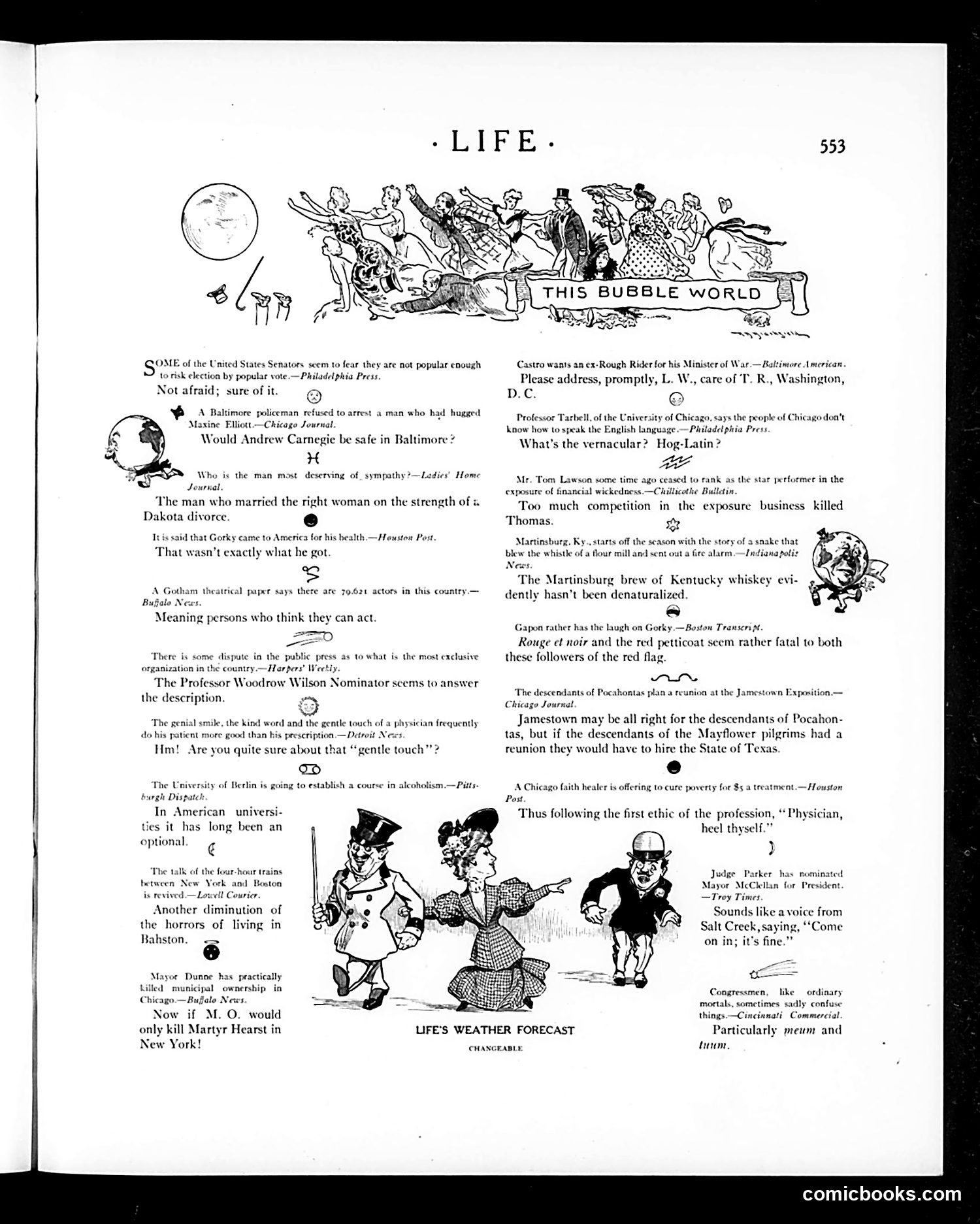
This page collects brief satirical comments on American politics and society, likely from the early 1900s. Key targets include: **Political figures**: References to Senator election fears, Andrew Carnegie's safety, and Mayor McClellan's presidential nomination suggest establishment critique. **Cultural commentary**: Jokes about American theater (79,621 actors who "think they can act"), Woodrow Wilson as an intellectual lacking practical sense ("gentle touch"), and Chicago's failed municipal ownership under Mayor Dunne mock both artistic pretension and progressive politics. **Social scandals**: Allusions to Tom Lawson's financial exposure crusades suggest satire of muckraking journalism becoming competitive and sensationalized. **International**: Castro seeking a "Rough Rider" (Theodore Roosevelt reference) for his military cabinet, and mentions of Gorky and Russian politics, reflect America's imperial interests. The cartoon "Life's Weather Forecast" (bottom) appears to satirize unpredictability in public affairs. Overall, the page's tone is cynical toward politicians, reformers, and public figures claiming competence they lack.
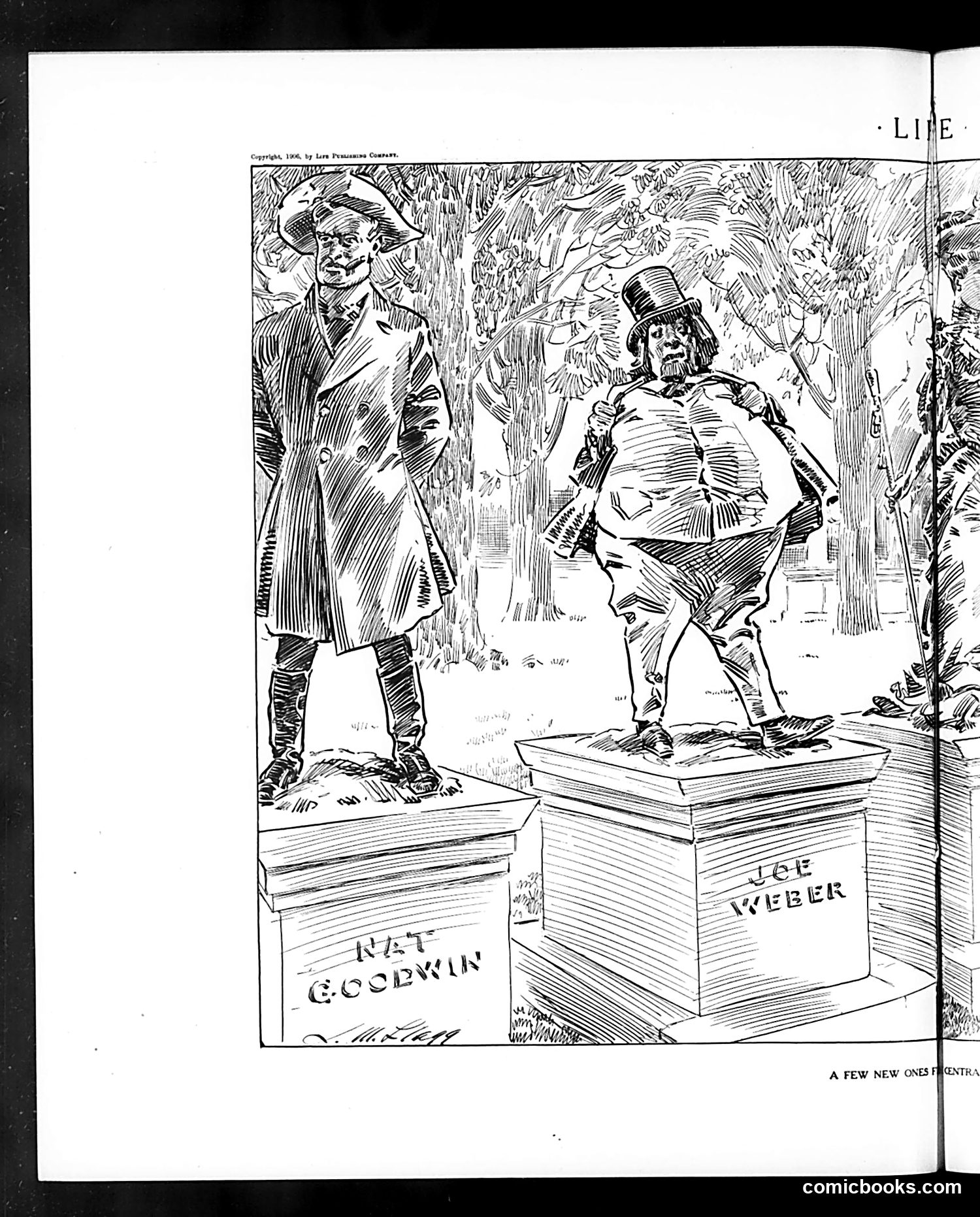
This cartoon depicts two figures standing on pedestals labeled "NAT GOODWIN" and "JOE WEBER" in what appears to be a wooded setting. Both men are rendered as caricatures wearing period clothing and top hats, adopting theatrical poses. The satire likely references these two entertainment figures—Nat Goodwin and Joe Weber were prominent performers of the late 19th/early 20th century. The pedestals suggest they're being elevated or commemorated, possibly mocking their celebrity status or theatrical pretensions. The caption "A FEW NEW ONES" remains unclear without additional context, but the overall tone appears to be humorous commentary on entertainment personalities or public figures of that era. The crude woodcut style was typical of Life magazine's satirical illustrations.
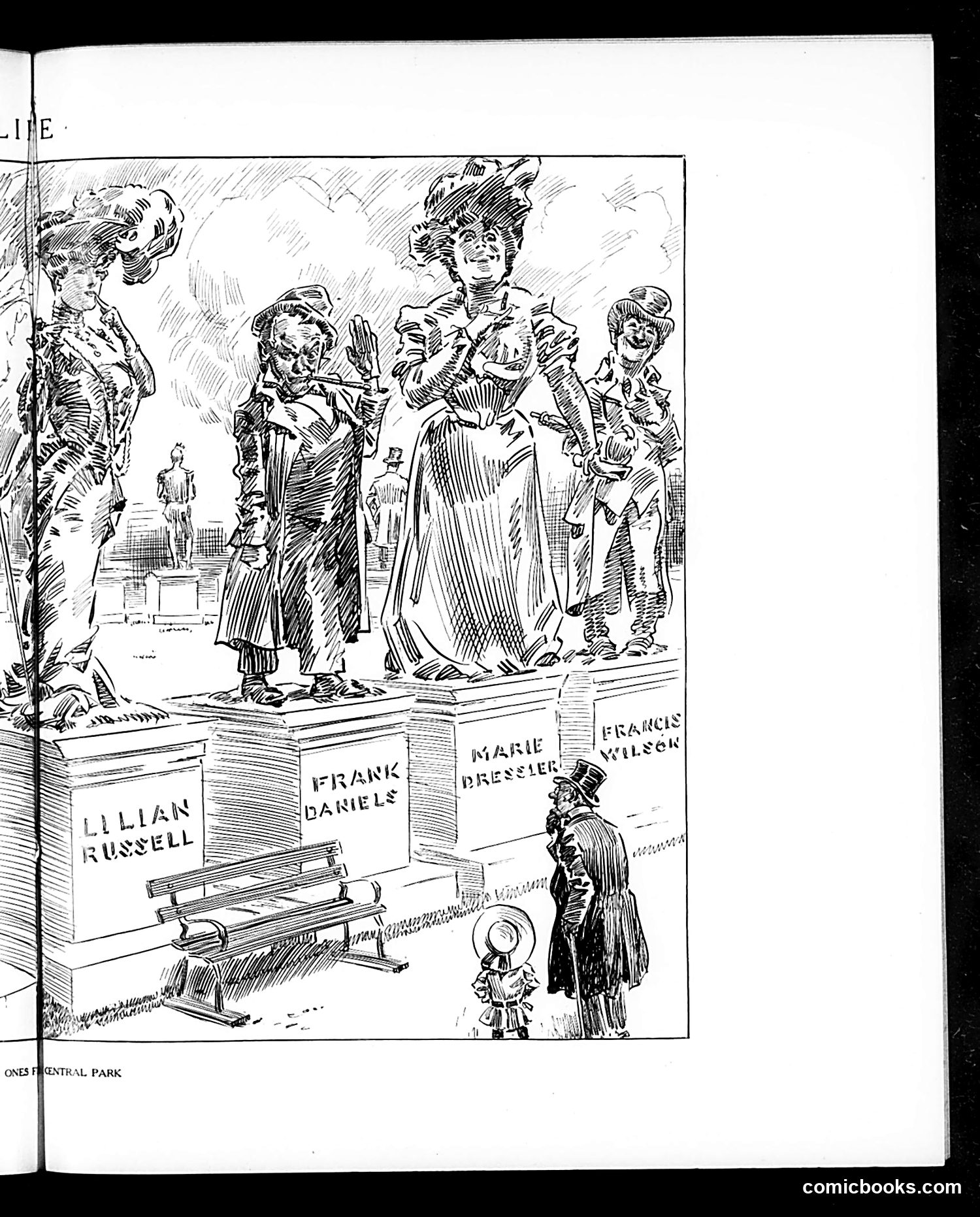
This appears to be a satirical cartoon from *Life* magazine depicting four women statues on pedestals in Central Park. The pedestals are labeled with names: **Lillian Russell**, **Frank Daniels**, **Marie Dressler**, and **Francis Wilson**. A man and child stand viewing these monuments. The satire likely mocks the tendency to memorialize theatrical or entertainment figures as public statues—treating performers with the same reverence as historical figures. By placing them in Central Park alongside presumably more "serious" monuments, the cartoon satirizes either the vanity of show business celebrities or the questionable judgment of those commissioning such tributes. The specific individuals named were prominent stage performers of the early 20th century, suggesting this cartoon critiques a contemporary trend of celebrity monument-building that the artist found ridiculous or unwarranted.
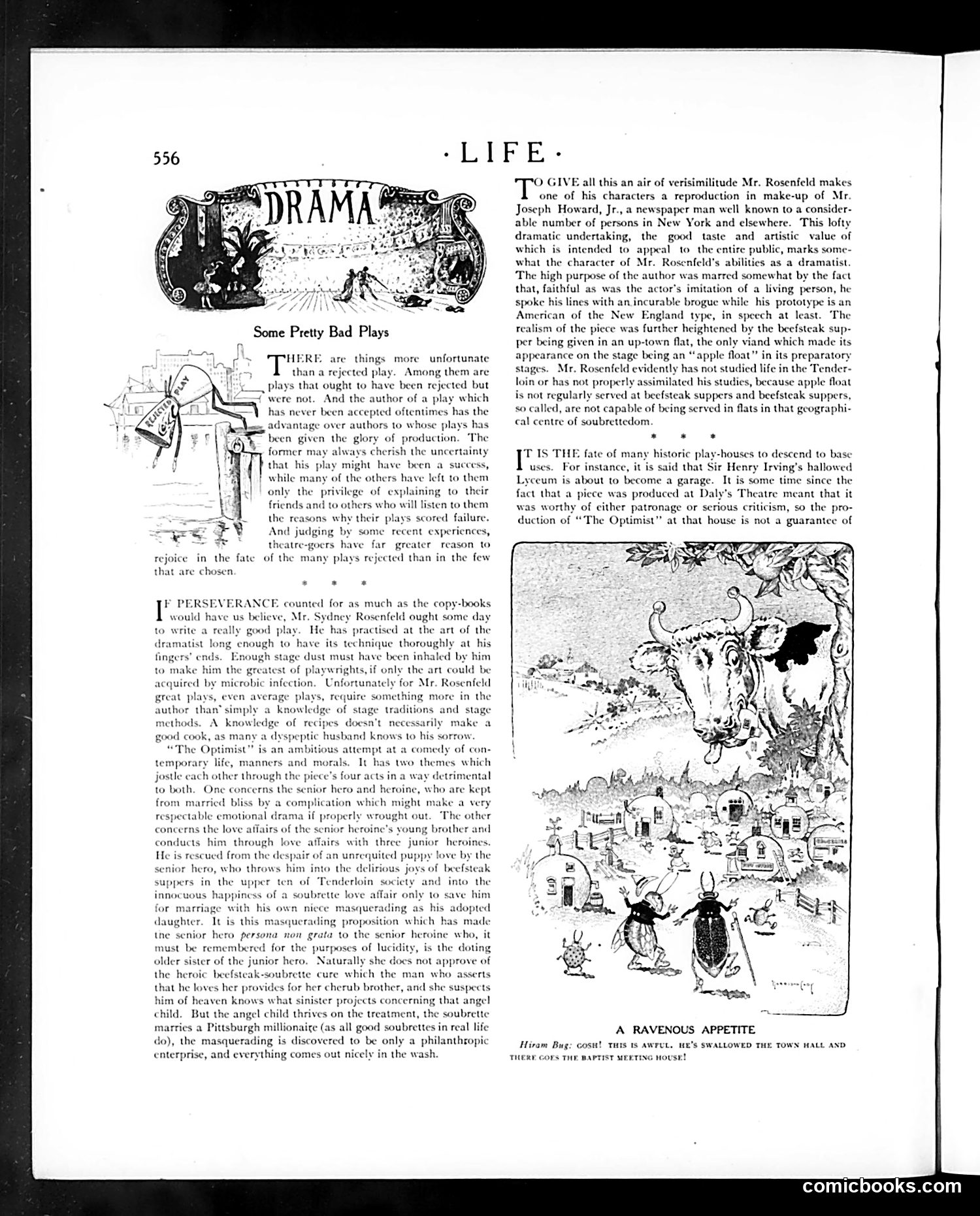
This page critiques several contemporary theatrical productions, particularly Sydney Rosenfeld's plays. The main article, "Some Pretty Bad Plays," argues that rejected plays are sometimes fortunate—at least they avoid public failure. Rosenfeld receives particular criticism for his dramatic technique and lack of authentic observation. The text specifically mocks Rosenfeld's use of Joseph Howard Jr., a known New York newspaper figure, as a character, noting the actor performed with an Irish brogue despite Howard being a New England-type American. The piece also ridicules an "apple float" served at a Tenderloin flat, suggesting Rosenfeld hadn't properly researched such settings. The accompanying illustration, titled "A Ravenous Appetite," depicts a goat consuming the contents of a room, likely satirizing poor theatrical taste or excessive dramaturgy. The overall tone suggests Life's theater critics found Rosenfeld's work technically competent but artistically hollow and lacking authentic social observation.
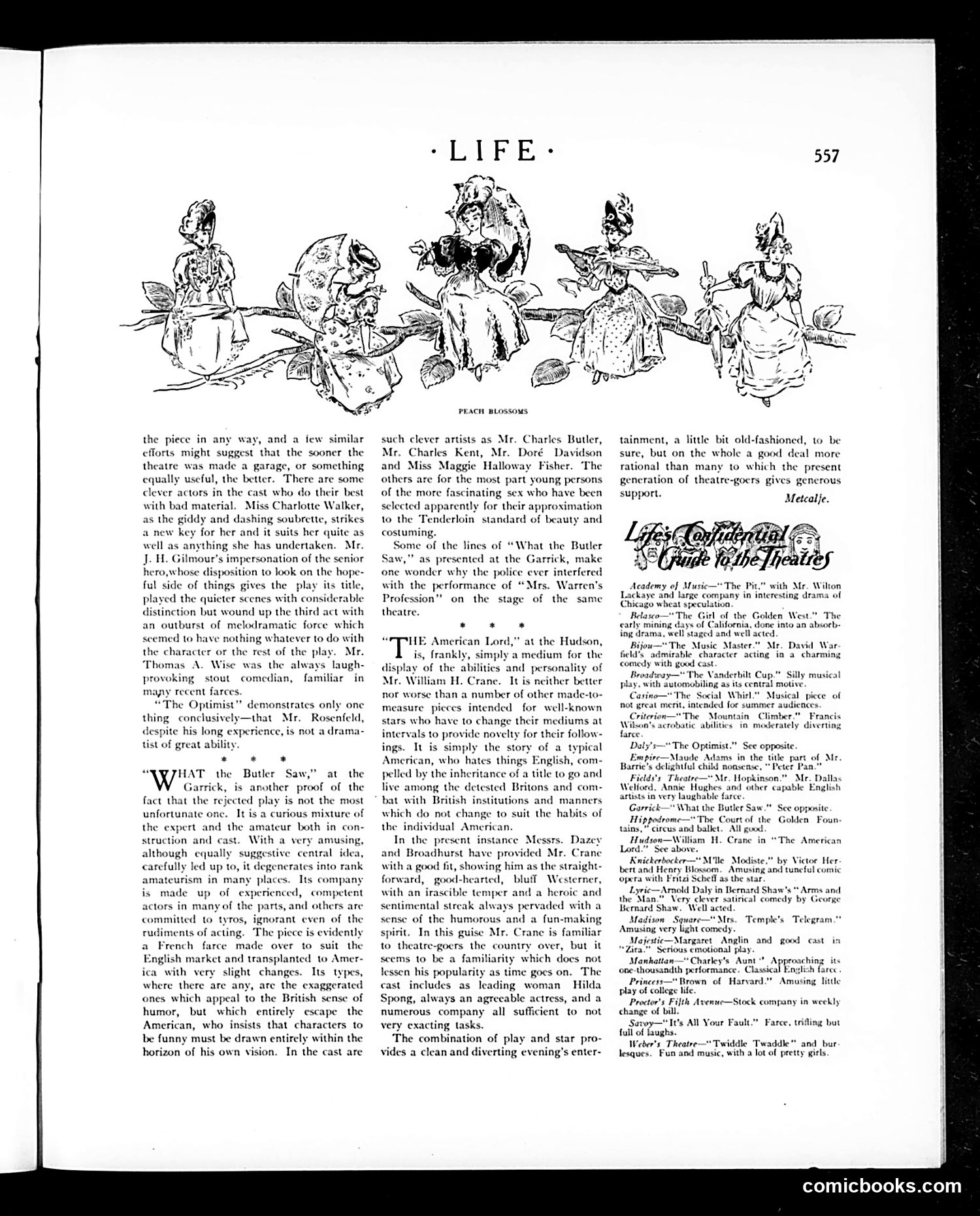
This page contains three theater reviews from Life magazine's drama section, illustrated with a decorative header showing "Peach Blossoms" — stylized theatrical figures in costumes. The reviews critique three Broadway plays: 1. **"The Optimist"** — The critic dismisses playwright Rosenfeld's work as poorly written, despite competent cast members like Charlotte Walker and J.H. Gilmour. The satire: even good actors cannot save bad material. 2. **"What the Butler Saw"** (at the Garrick) — A French farce adapted for American audiences. The reviewer notes it mixes expert and amateur construction. The satire references "Mrs. Warren's Profession" — suggesting this play contains similarly scandalous content that should have faced police interference. The "Tenderloin standard of beauty" alludes to New York's notorious red-light district, implying actresses were selected for appearance rather than talent. 3. **"The American Lord"** (at the Hudson) — A vehicle for star William H. Crane, who plays a typical American resisting British customs. The reviewer finds it formulaic but acknowledges Crane's enduring popularity. The overall tone is sophisticated theatrical criticism mixed with social satire about American theater's commercial priorities.
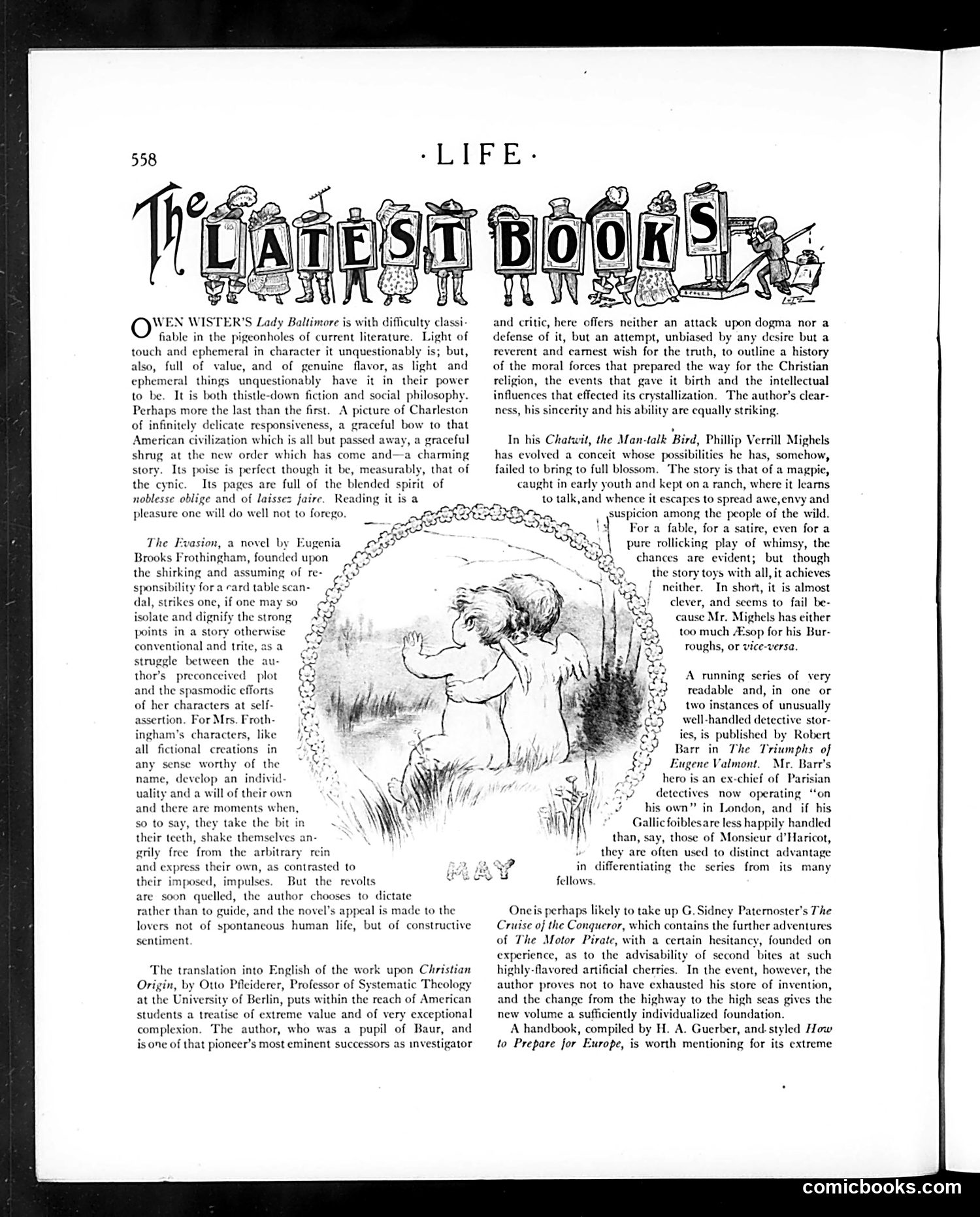
This is a **book review section**, not a political cartoon page. The page titled "The Latest Books" contains literary criticism of several contemporary novels and works, circa early 1900s. The reviews discuss: 1. **Lady Baltimore** by Owen Wister—praised as delicate Charleston society fiction blending social philosophy with charm 2. **The Evasion** by Eugenia Brooks Frothingham—criticized for characters rebelling against authorial control, creating tension between plot and spontaneous human drama 3. **Christian Origin** by Otto Pfleiderer—a serious theological treatise offering unbiased historical analysis of Christianity's moral foundations 4. **Chatwit, the Man-talk Bird** by Phillip Verrill Mighels—about a magpie taught to speak, criticized for failing to develop its satirical potential 5. **The Triumphs of Eugene Valmont** by Robert Barr—detective fiction featuring a Parisian detective now working in London The only illustration is a small sketch accompanying the Mighels review, depicting the talking magpie character.
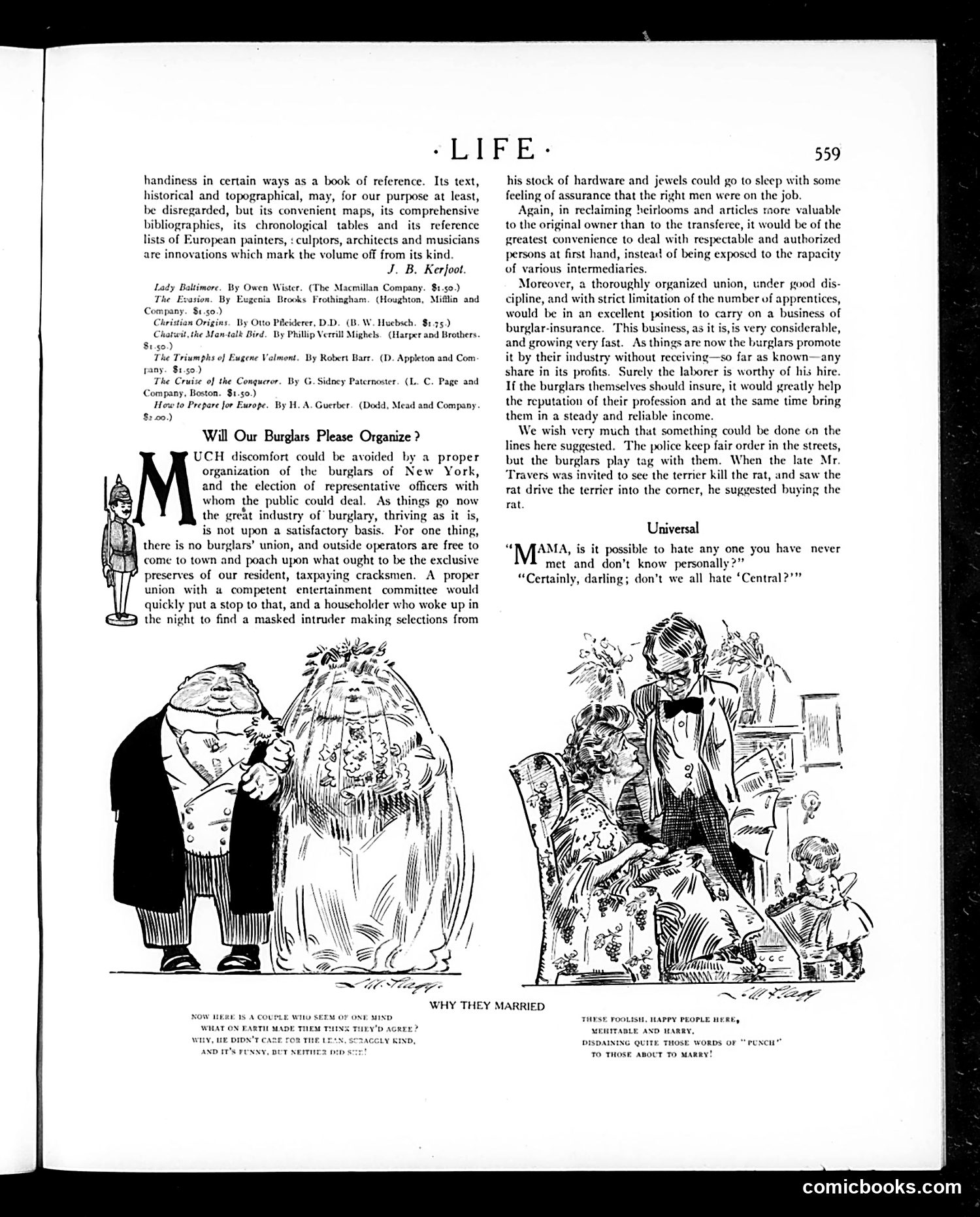
This satirical piece proposes that New York City burglars should unionize—elect officers, establish territorial rights for resident criminals, and create "burglar-insurance." The joke mocks both the organized labor movement (unions were a heated contemporary issue) and the perceived incompetence of police, by suggesting criminals deserve the same professional protections and business legitimacy as legitimate workers. The accompanying illustrations show two contrasting marriages: one couple who "seem of one mind" despite obvious incompatibility, and another happy family. The "Universal" caption jokes that one can hate people without meeting them—citing "Central" (likely the telephone exchange operator), a common frustration point for early-20th-century Americans. This reflects Life magazine's satirical approach to urban problems, labor disputes, and domestic life.
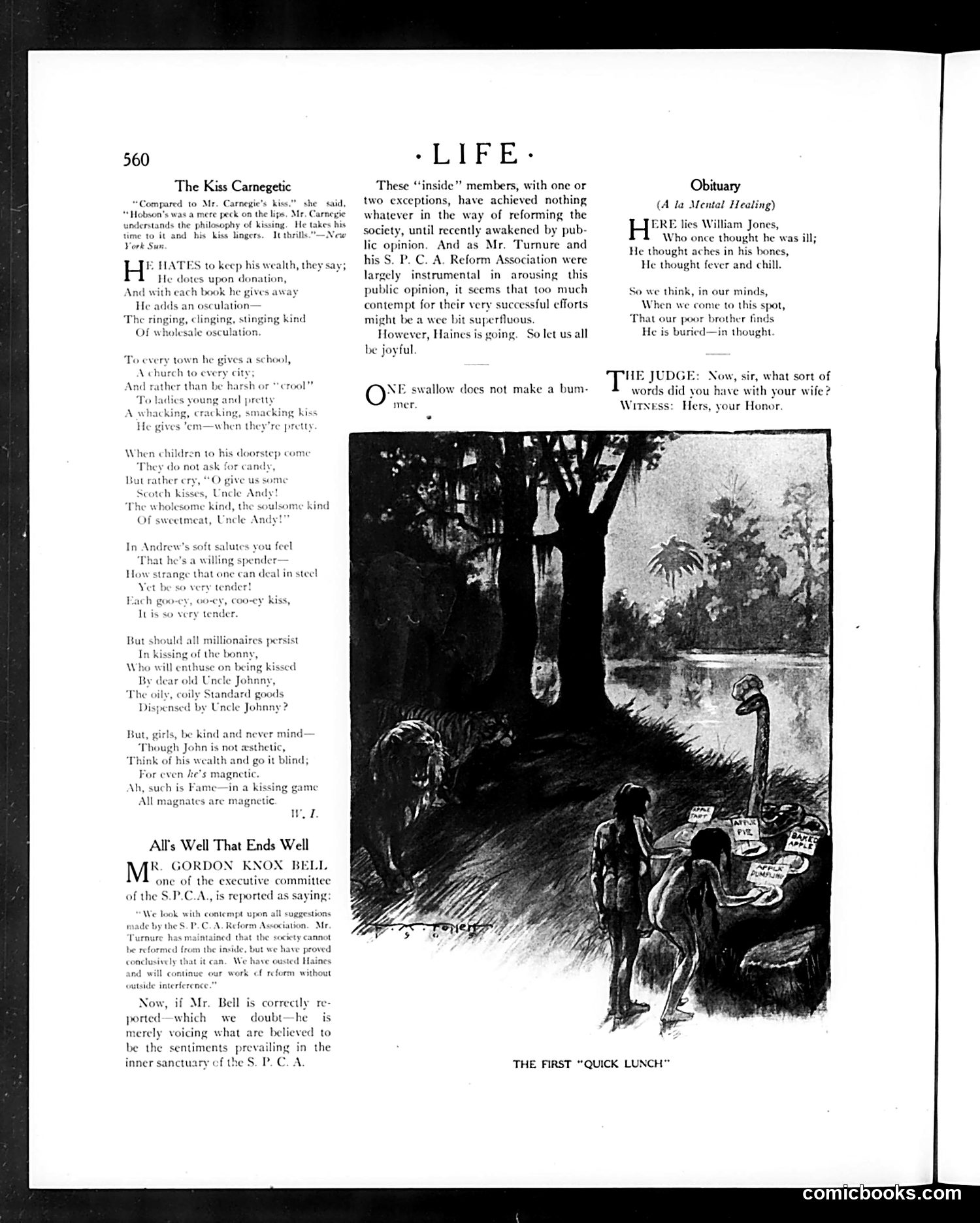
This page from *Life* magazine contains satirical commentary on wealthy industrialist **Andrew Carnegie** and the SPCA (Society for the Prevention of Cruelty to Animals). **"The Kiss Carnegetic"** mocks Carnegie's philanthropic strategy of giving away his wealth through donations of schools and churches. The satire suggests that Carnegie accompanies each donation with a public "kiss"—meaning he seeks credit and public affection for his generosity. The poem contrasts this with the "steel" (his industrial ruthlessness) beneath his tender public persona, implying his philanthropy is performative rather than purely altruistic. The reference to Hobson's kiss suggests Carnegie's version is more prolonged and self-aggrandizing. **"All's Well That Ends Well"** criticizes the SPCA's internal politics, suggesting that despite the organization's reform efforts, some members (particularly someone named Haines) have resisted change until recently forced out by public pressure and activist Turnure's Reform Association. The page also includes unrelated content: an obituary joke and a judge/witness joke about marital discord.
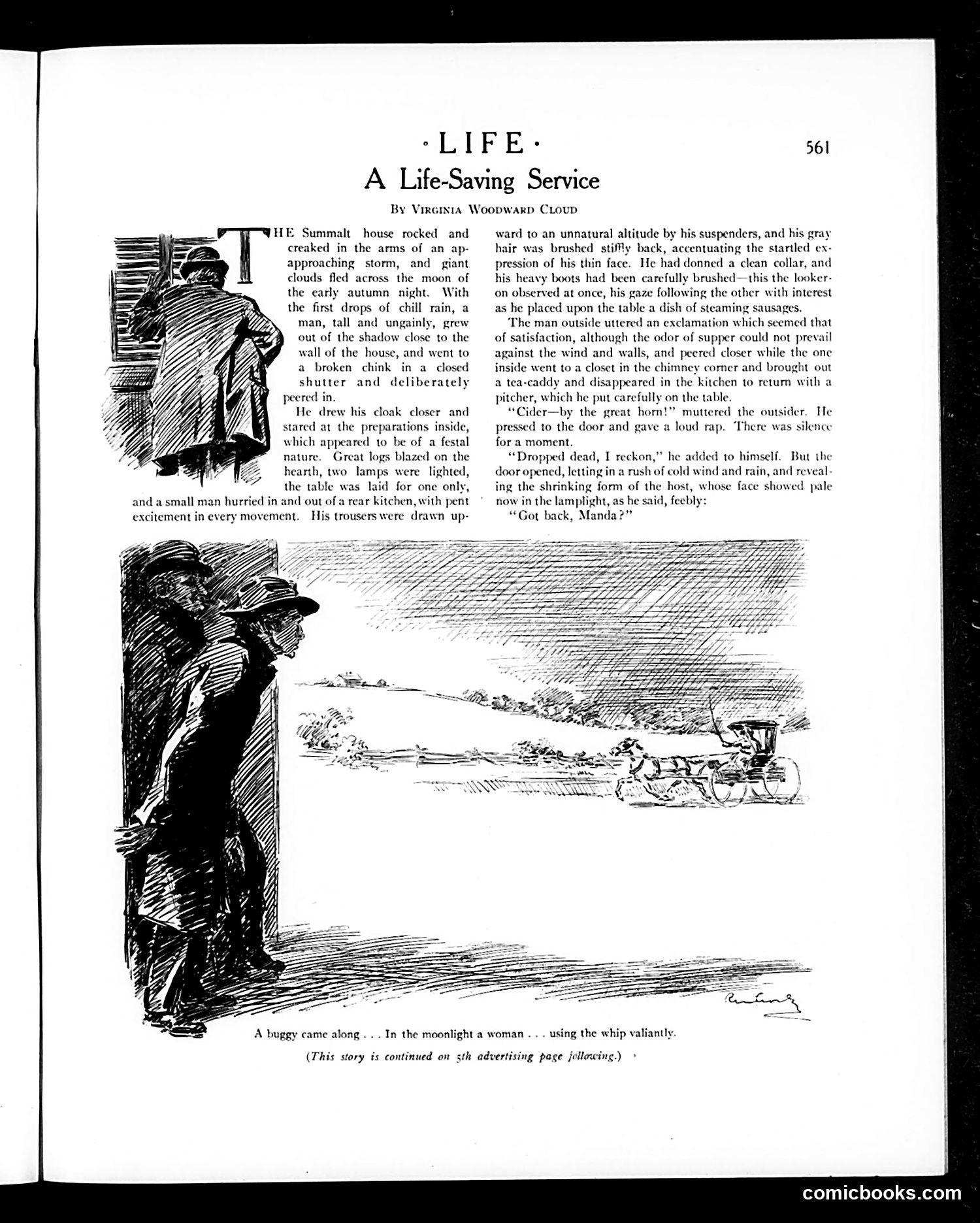
This is a short story illustration, not political satire. The narrative depicts a gothic melodrama: a tall, gaunt stranger peers through a shutter at a small man preparing an elaborate dinner inside a house during a storm. The outsider observes the host's careful grooming and food preparations with apparent satisfaction, then knocks loudly on the door. When the door opens, the shrunken host appears pale and frightened, asking "Got back, Manda?" The final illustration shows a woman in a buggy using her whip urgently in the moonlight. The setup suggests a suspenseful tale involving possibly sinister intentions (the stranger's predatory observation) or rescue/danger (the woman's urgent departure). The title "Life-Saving Service" implies someone—likely the woman—will intervene to save the vulnerable host from the mysterious visitor. The story continues on a later advertising page.
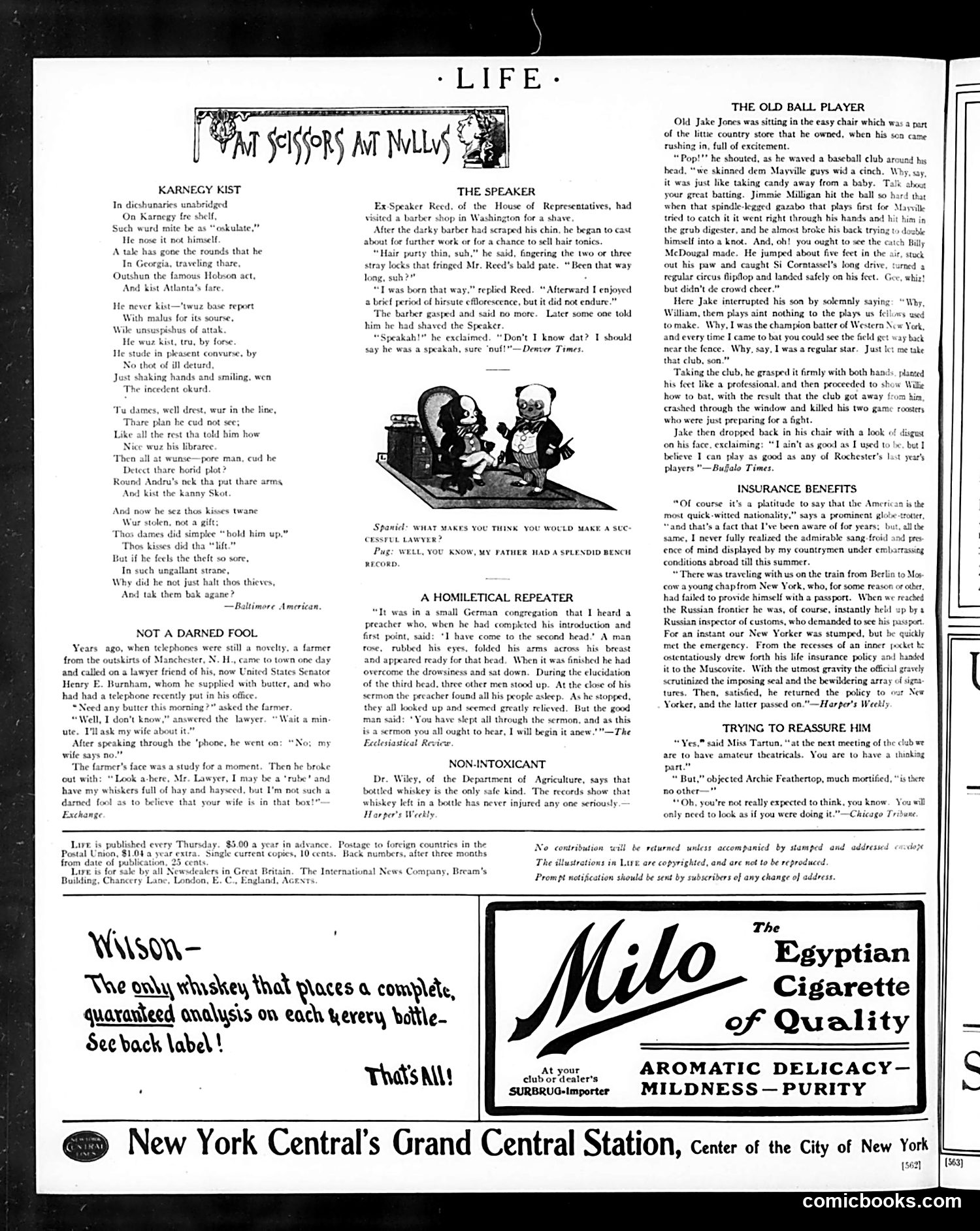
This page contains several humorous anecdotes and satirical pieces typical of early Life magazine: **"Karnegy Kist"** mocks Andrew Carnegie (misspelled phonetically) for allegedly being kissed without consent by two women who "stole" kisses from him at his library. The satire plays on Carnegie's fastidiousness and the audacity of the women. **"The Speaker"** ridicules Speaker of the House Thomas Brackett Reed for his baldness. A barber comments on his thin hair, and Reed responds with overly fancy language ("hirsute efflorescence"), which the barber finds pretentiously amusing. **"Not a Darned Fool"** is an anecdote about a farmer who, after using a telephone to ask his wife about butter, refuses to believe his friend that the telephone actually works—insisting his wife couldn't be "in that box." **Other brief jokes** include a pun about a spaniel discussing legal credentials and a piece about a repetitive preacher. The page emphasizes wordplay, absurd situations, and gentle mockery of prominent figures and rural naiveté.
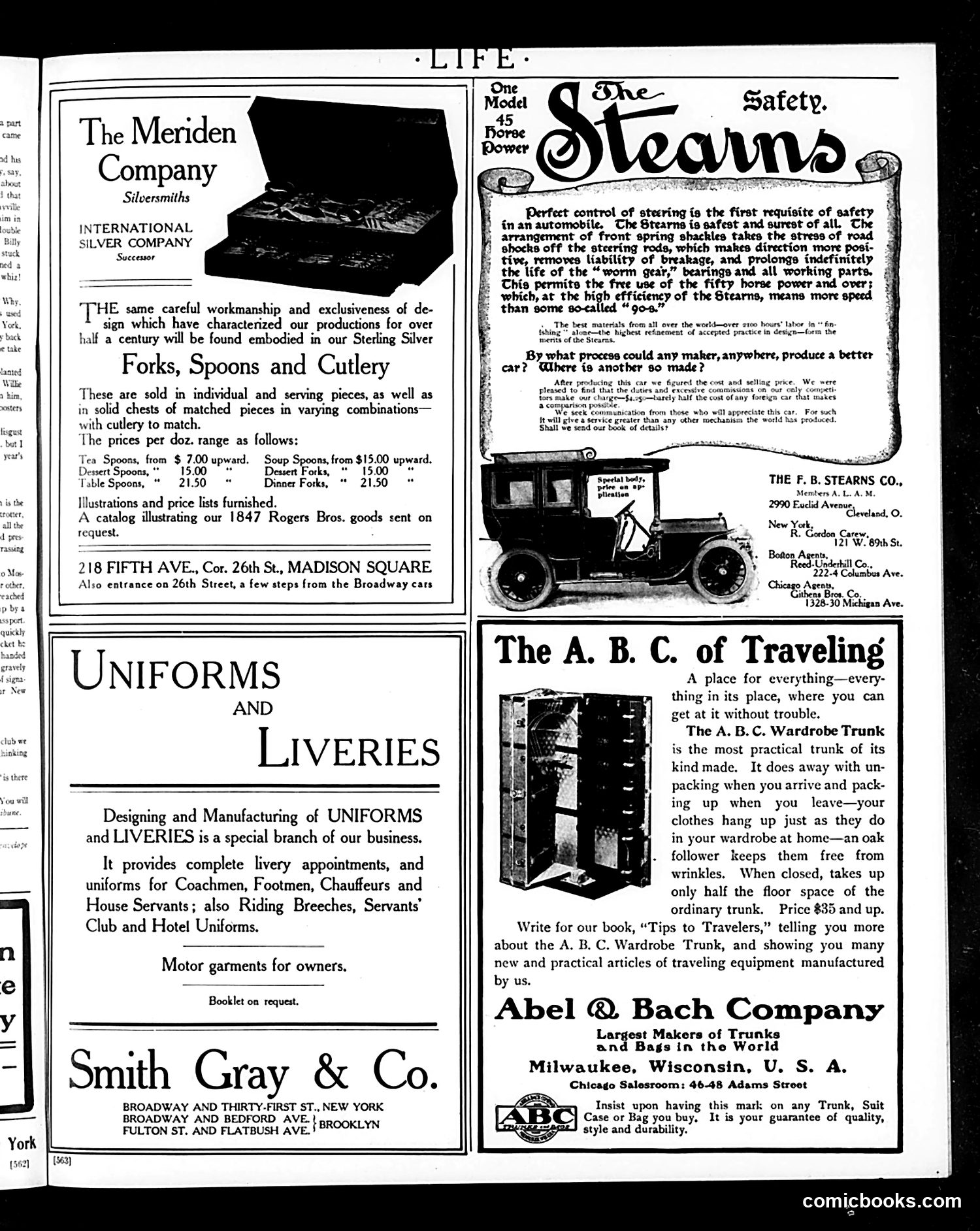
This page is primarily **advertising**, not satire or political commentary. It contains five product advertisements from the early 1900s: 1. **The Meriden Company** — sterling silver flatware (forks, spoons, cutlery) 2. **The Stearns** — an automobile, emphasizing steering safety and 50 horsepower 3. **Smith Gray & Co.** — uniforms and liveries for servants, coachmen, and chauffeurs 4. **A.B.C. Wardrobe Trunk** — a practical traveling trunk with hanging space 5. **Abel & Bach Company** — trunks and luggage The Stearns automobile ad includes an illustration of an early motorcar and discusses competitive manufacturing claims ("by what process could any maker produce a better car?"). There are **no political cartoons or satire** on this page. It represents typical Life magazine content from this era, mixing humor publications with commercial advertisements targeting affluent readers interested in luxury goods, household servants, and automobiles.
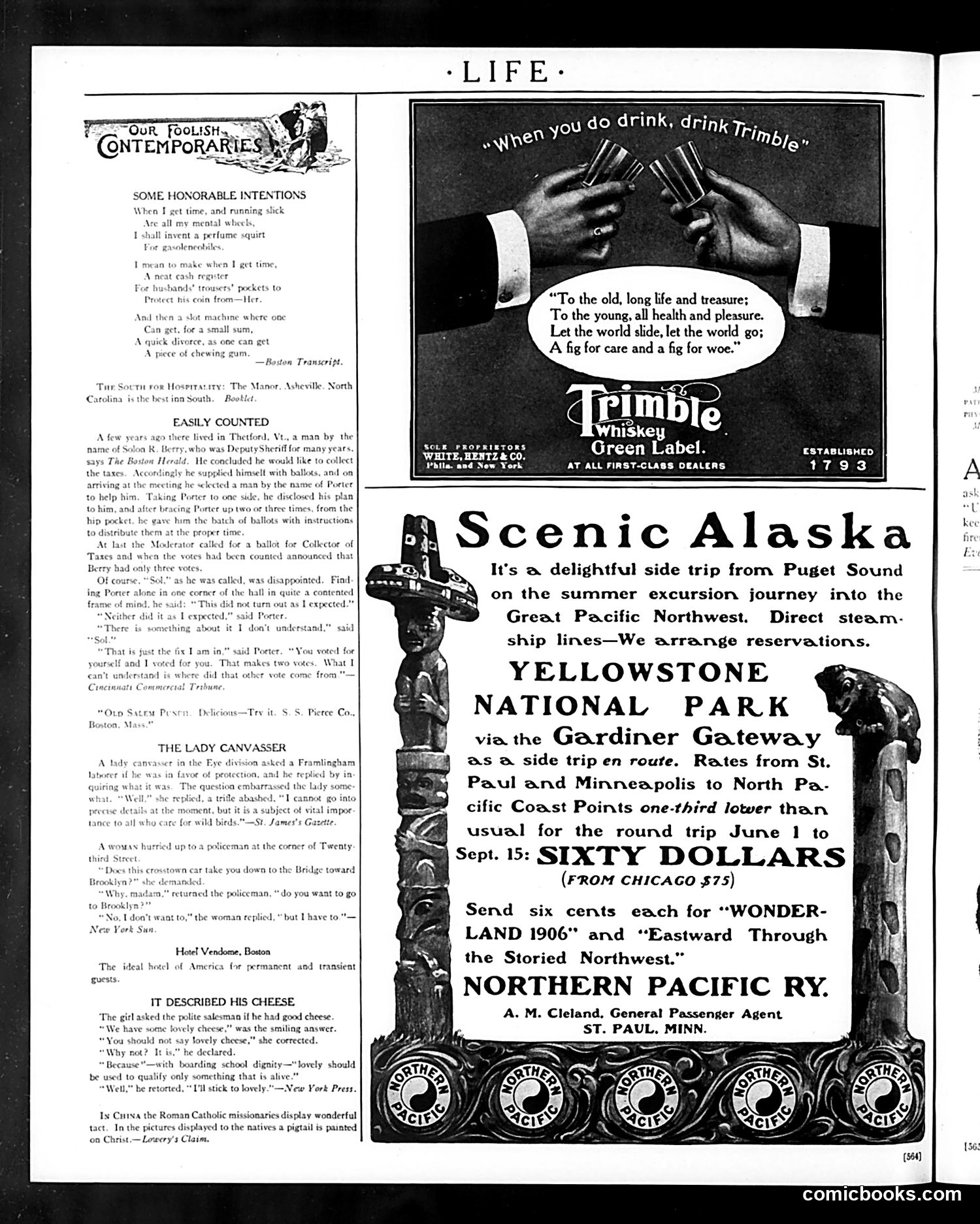
This page is primarily **advertising and humor columns** rather than political cartoons. The upper left contains "Our Foolish Contemporaries"—a regular satirical column mocking current figures and events through anecdotes. The visible items are lighthearted social humor: stories about a Vermont man, a lady canvasser, and observations about cheese and missionary work. These lack the sharp political edge of true political satire. The dominant content is **commercial advertising**: a Trimble Whiskey ad (featuring a drinking toast), and a large Northern Pacific Railway advertisement promoting Yellowstone National Park and Alaskan cruises—typical early-1900s travel marketing. The page reflects *Life* magazine's dual nature as both satirical publication and advertising vehicle. Without clearer identification of who "contemporaries" are being mocked, the specific targets remain unclear to modern readers, though the humor appears to be gentle social observation rather than pointed political commentary.
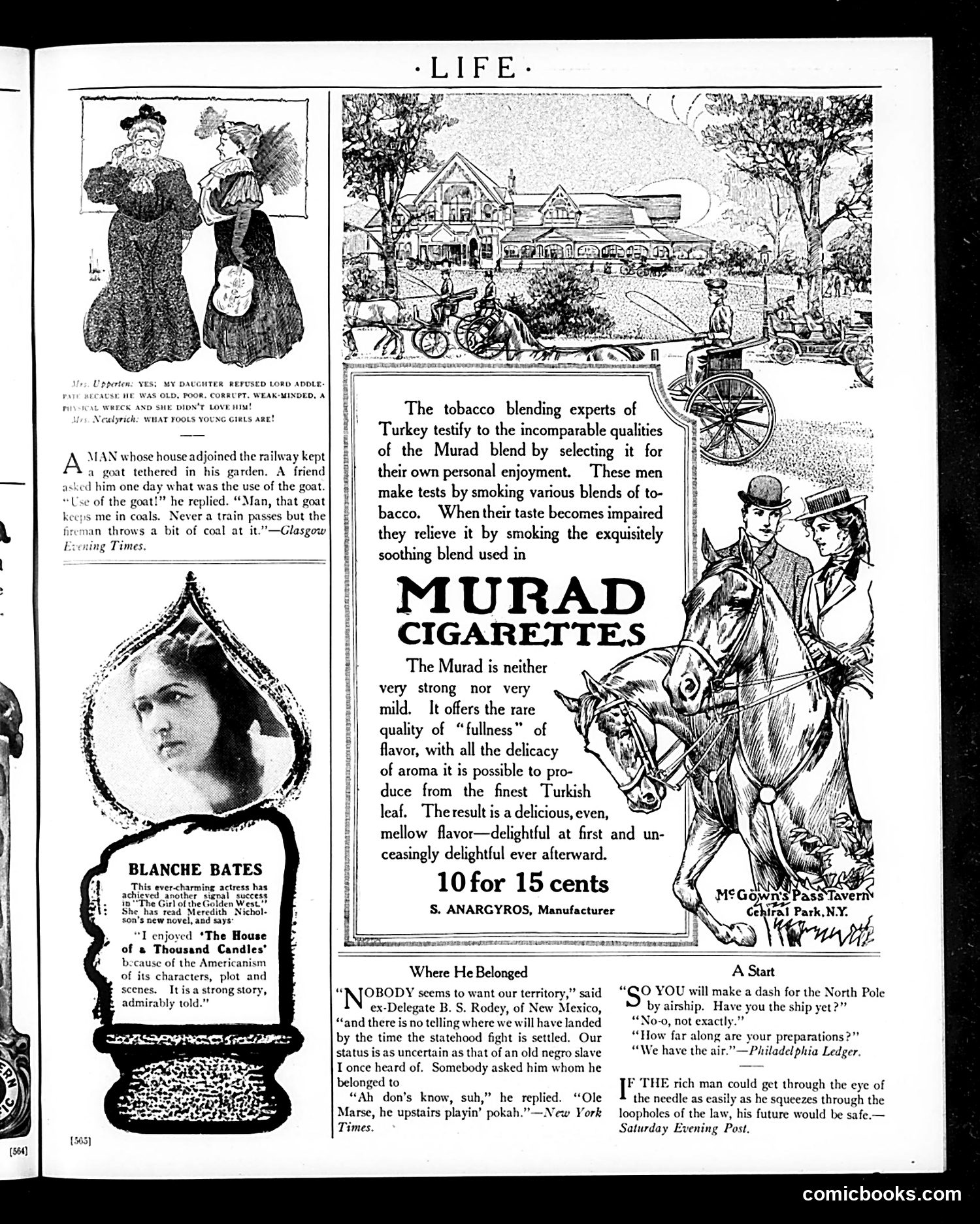
This page combines satirical humor with advertising. The left side contains three brief jokes: one mocking young women who reject unsuitable suitors (the upper cartoon shows two women discussing a rejected proposal); another about a resourceful man who trains his goat to collect coal thrown from passing trains; and a celebrity endorsement by actress Blanche Bates. The right side is dominated by a **Murad Cigarettes advertisement** featuring Turkish tobacco experts and an illustration of well-dressed men on horseback. The ad emphasizes the cigarettes' quality and balanced flavor. Below are three additional jokes: one about New Mexico's uncertain territorial status (comparing it to a confused enslaved person), one about polar exploration preparations, and one satirizing wealthy people's ability to exploit legal loopholes. The page reflects early 1900s American life—concerns about western expansion, emerging aviation technology, wealth inequality, and the casual racism typical of period publications.
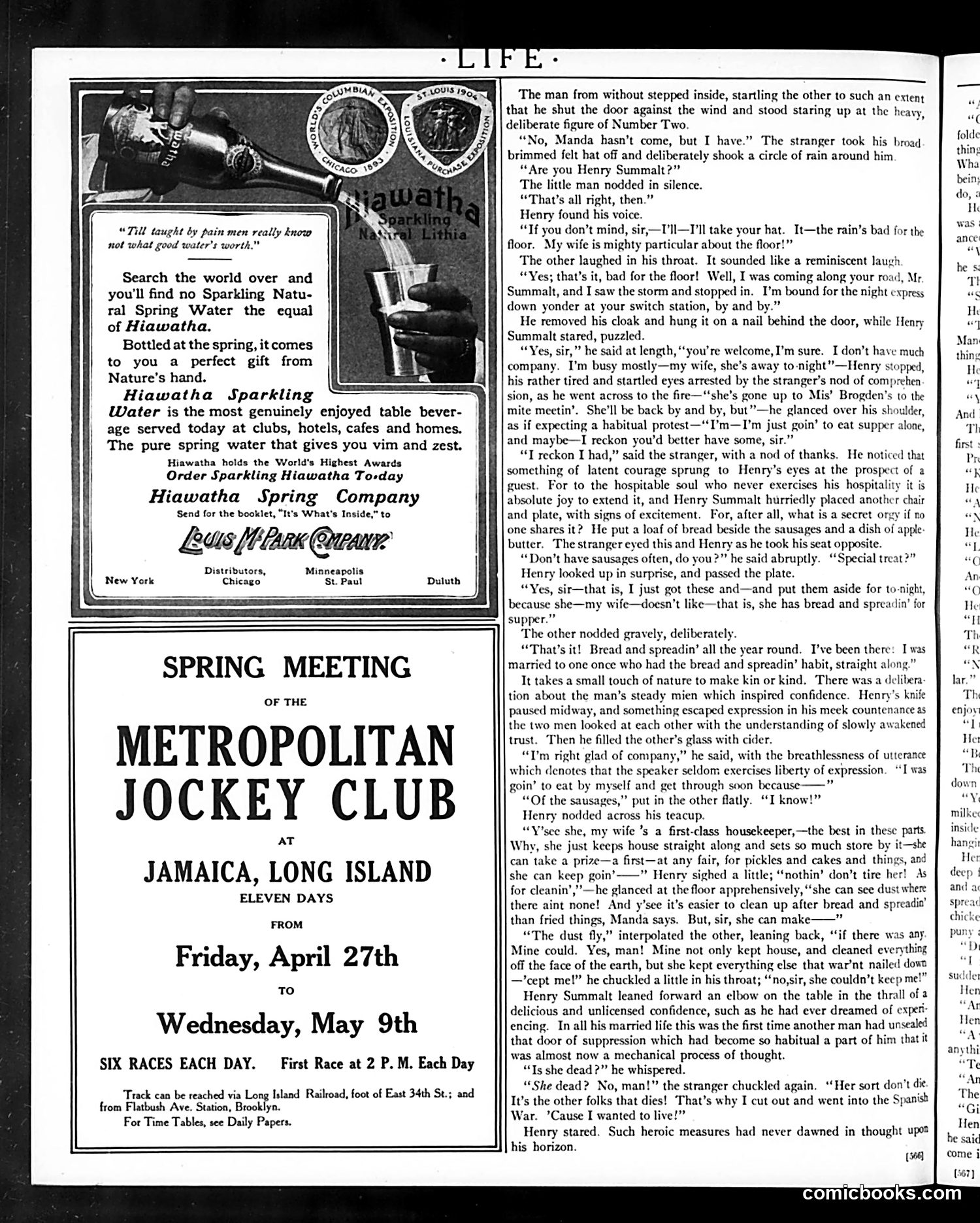
This page is primarily **advertising and announcements**, not political satire. The top features a **Hiawatha Sparkling Water advertisement**, a commercial product marketed as superior spring water with purported health benefits—typical early 20th-century marketing claims. The lower half announces a **Metropolitan Jockey Club Spring Meeting** at Jamaica, Long Island (a horse-racing event), with practical details for attendance. The right column contains the **beginning of a serialized short story** about a man named Henry Summalt visited by a mysterious stranger during a rainstorm. The narrative appears to explore themes of hospitality, loneliness, and human connection—the stranger's mention of a previous wife with similar habits suggesting deeper character development ahead. **No political cartoon or satire is present.** This is a typical Life magazine page mixing commercial advertisements with fiction and event announcements, representing early 20th-century magazine publishing practices.
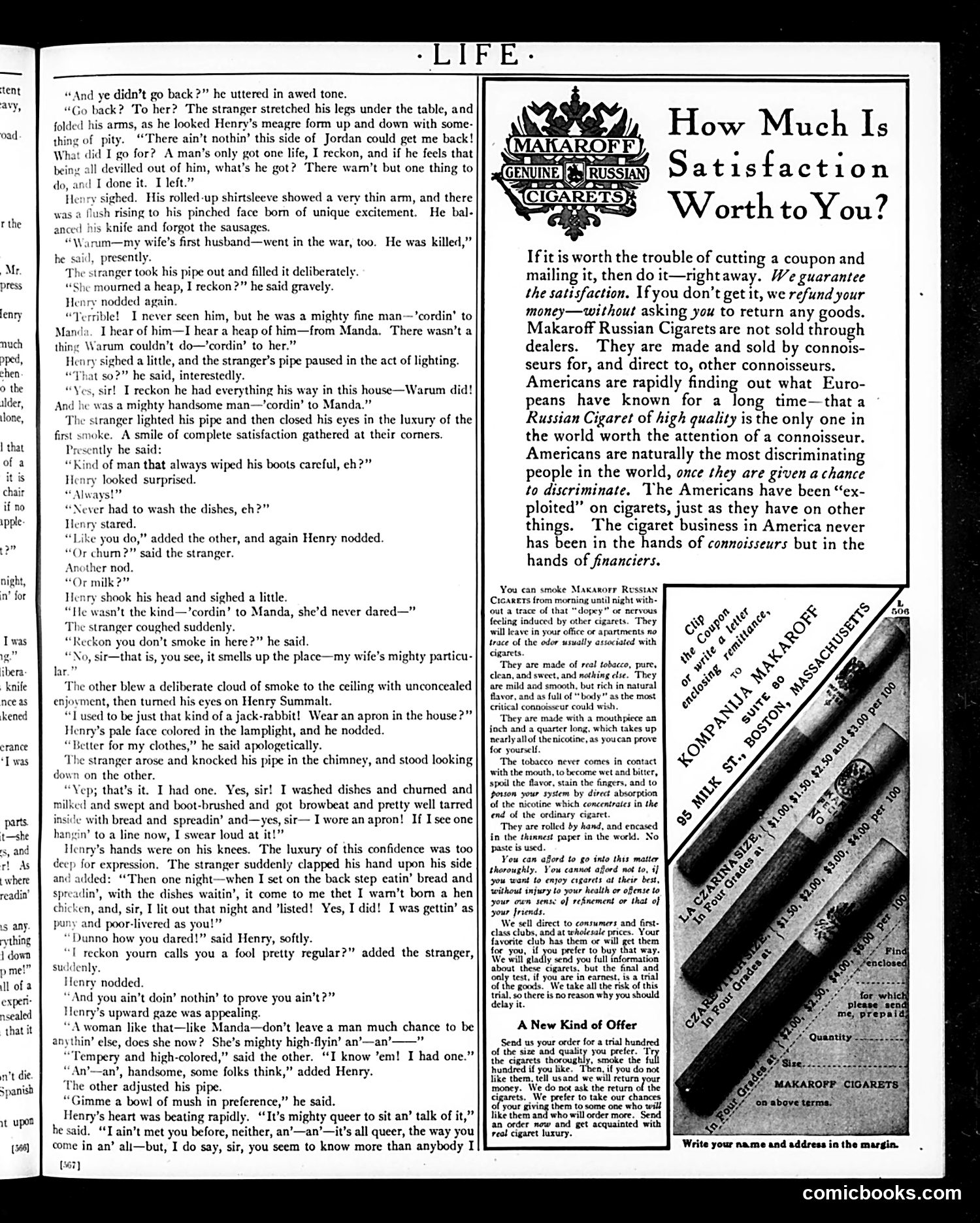
This page contains a short story excerpt (left) and a **Makaroff Russian Cigarettes advertisement** (right). The story depicts two men—Henry, a meek, hen-pecked husband, and a stranger—discussing their marriages. Henry's wife is domineering: she controls him, makes him do housework, wear an apron, and forbids smoking indoors. The stranger reveals he was once similarly subjugated by his own demanding wife but eventually fled to join the military, reclaiming his independence and masculinity. **The satirical point**: The story ridicules both the tyranny of domineering wives and the passivity of emasculated husbands. The stranger's escape to war—presented as liberation—reflects early-20th-century gender anxieties about women's domestic power and men's loss of authority. The **Makaroff ad** emphasizes quality and exclusivity, positioned alongside this masculine-themed narrative, suggesting cigarettes as a marker of refined male independence—ironic given Henry's wife forbids him from smoking.
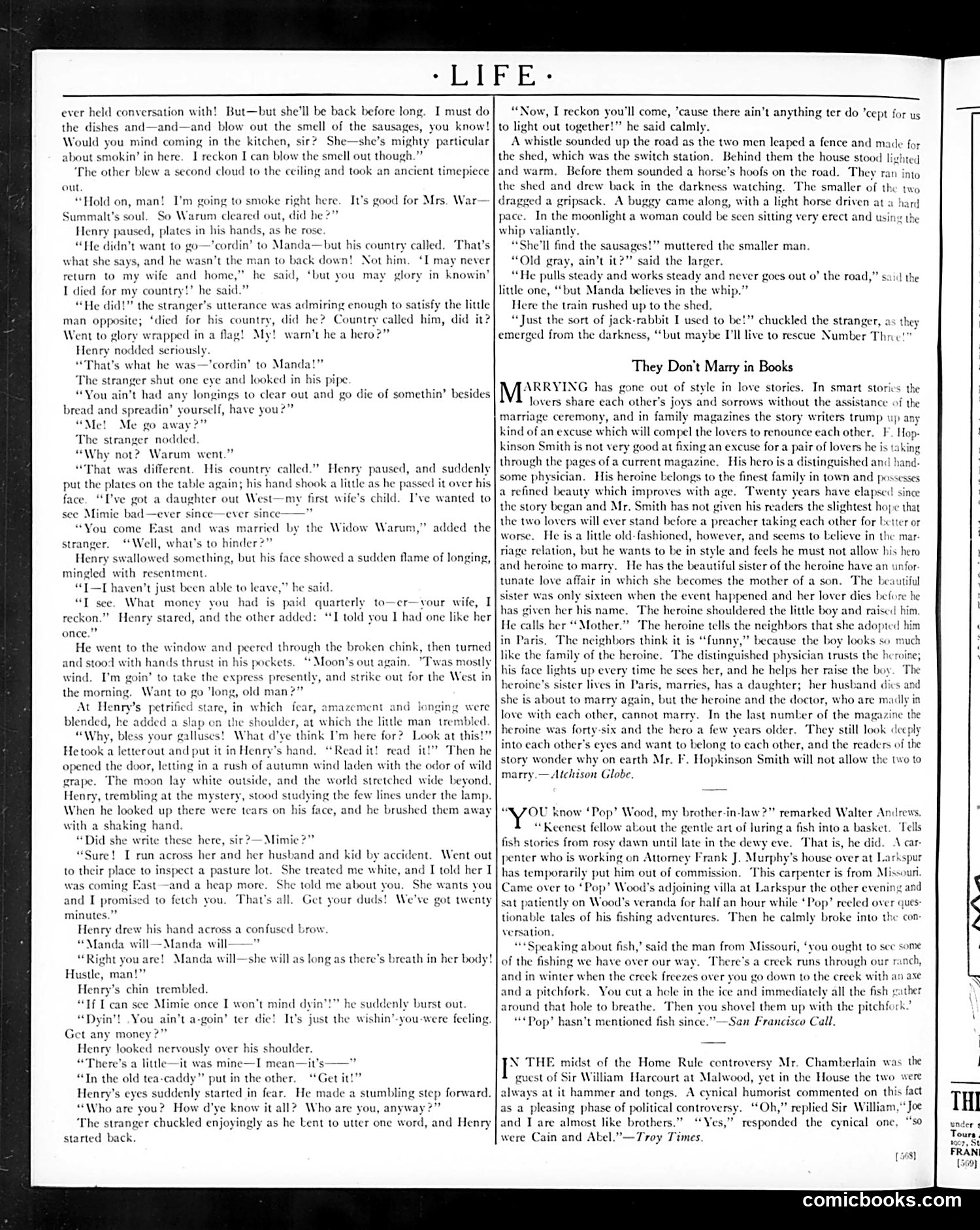
This page contains a serialized short story rather than a political cartoon. The narrative depicts a domestic drama set in rural America, likely early 20th century. The plot concerns Henry, a working-class man trapped in an unhappy second marriage to "Manda" (the Widow Warum). A mysterious stranger arrives, revealing he knows Henry's daughter Mimie from his first marriage, whom Henry hasn't seen in years. The stranger offers Henry the chance to escape his dreary life—proposing they leave that very night to travel West. The satire targets the constraints of working-class domesticity: Henry is literally trapped washing dishes and managing his wife's household preferences. The comparison to "Warum," who died heroically for his country, contrasts Henry's mundane imprisonment with romantic notions of masculine freedom and purpose. The story explores class-based family obligations, remarriage complications, and the tension between duty and personal desire—themes typical of Life's satirical commentary on American middle and working-class life.
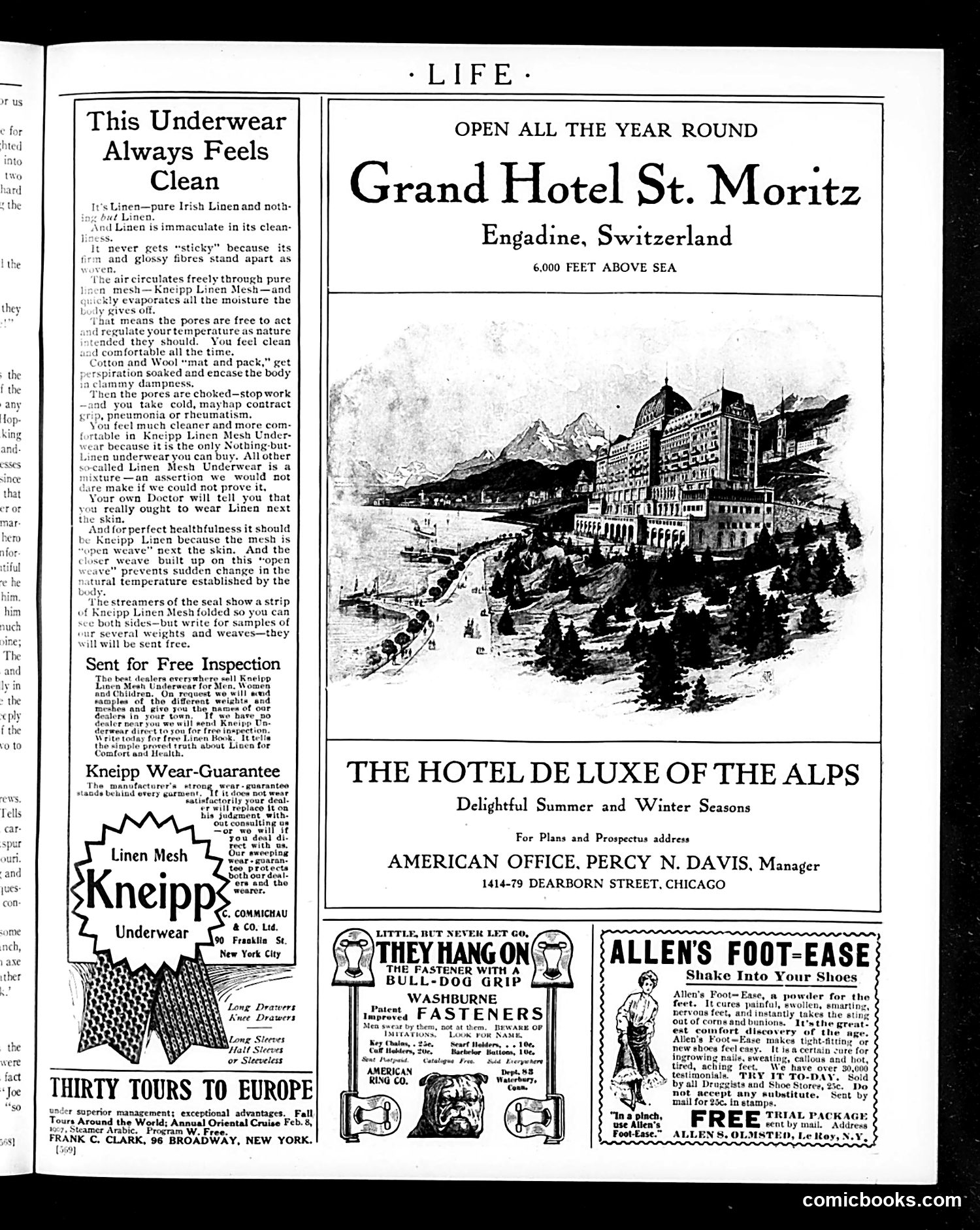
This is primarily an **advertising page** rather than satirical content. It features multiple product advertisements typical of early 20th-century American magazines: **Main advertisements:** - **Kneipp Linen Underwear**: Markets pure Irish linen undergarments with health claims—emphasizing breathability, moisture-wicking, and temperature regulation. The text contrasts linen favorably against cotton/wool as superior for hygiene and preventing illness. - **Grand Hotel St. Moritz**: Luxury Alpine resort in Switzerland, 6,000 feet elevation, advertising year-round operation. - **Allen's Foot-Ease**: Powder product for foot problems (blisters, odor, perspiration). - **They Hang On Fasteners**: Hardware fasteners advertisement. - **Thirty Tours to Europe**: Travel agency offering guided European tours. The page reflects early 1900s consumer culture emphasizing health-focused products and luxury travel for affluent readers. The advertisements use pseudo-scientific language to market everyday goods—typical for the era before strict advertising regulations.
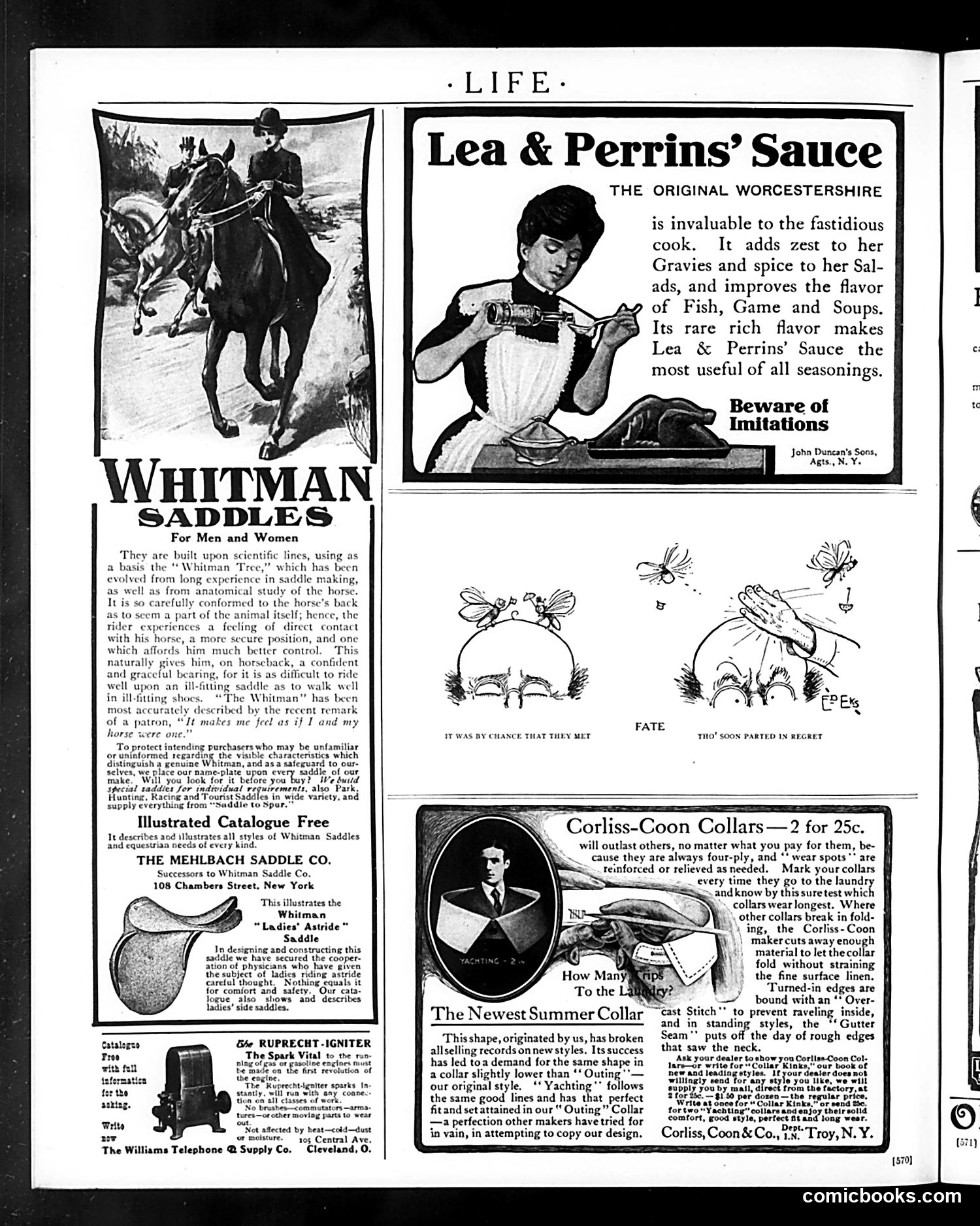
This page is primarily **advertisements** with one small cartoon element. The cartoon ("It Was by Chance That They Met / This Soon Parted in Regret") depicts two insects meeting, likely representing a humorous or romantic encounter—a common light satirical trope of the era. The bulk of the page features product ads typical of early 20th-century Life: Whitman Saddles (emphasizing scientific design and comfort for riders), Lea & Perrins' Worcestershire Sauce (the "original"), the Ruprecht-Igniter for engines, and Corliss-Coon Collars. These ads reflect period consumer culture: riding was genteel recreation, branded sauces signified culinary sophistication, automobile ignition technology was cutting-edge, and durable collars were a significant purchase. The ads target middle-class readers concerned with quality, durability, and respectability. The small insect cartoon is minor decoration; the page's real purpose is revenue through advertising, not satire.
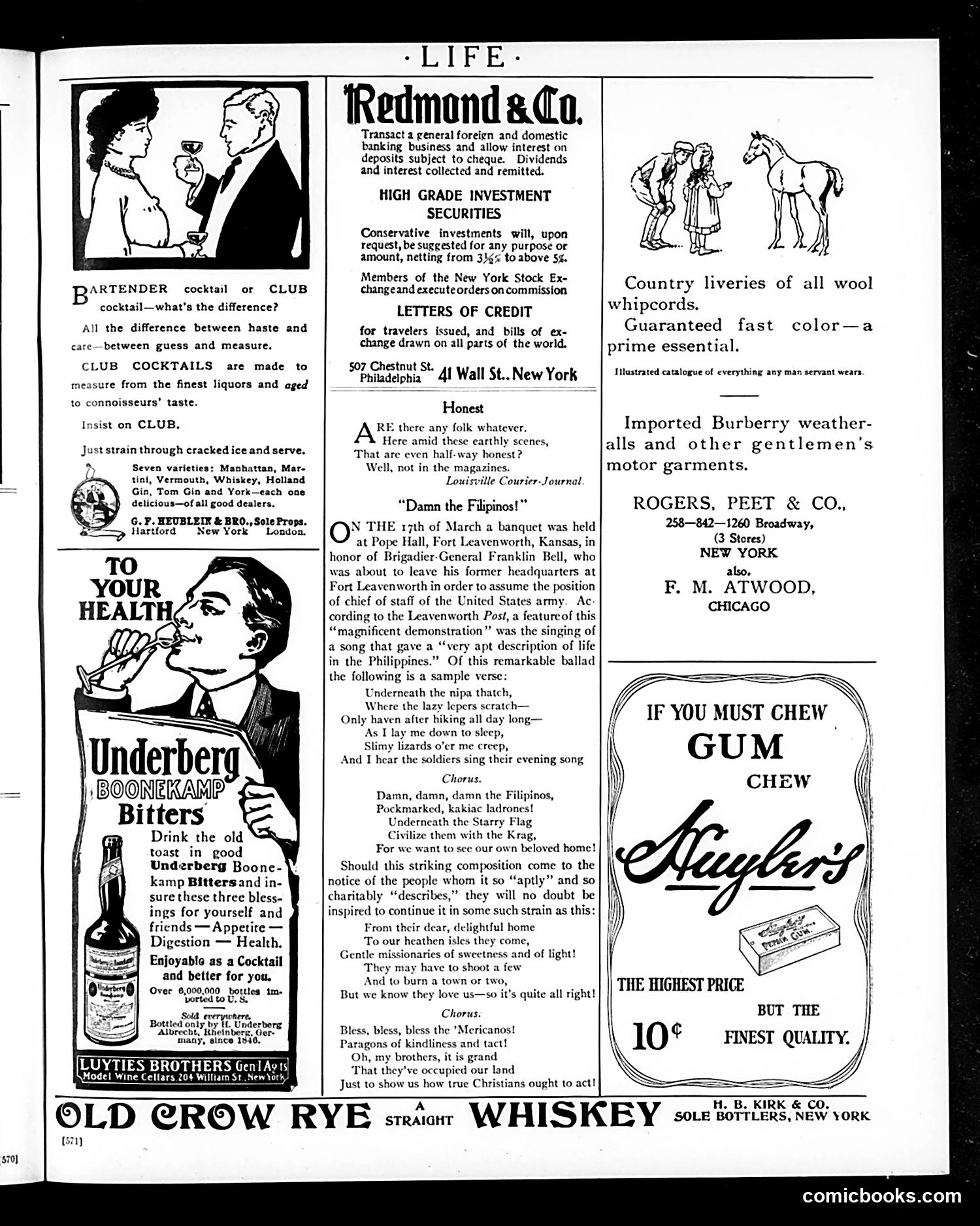
This page contains a sharp satirical critique of U.S. military conduct during the Philippine-American War (early 1900s). The central piece mocks a banquet honoring General Franklin Bell at Fort Leavenworth, Kansas, where soldiers sang a crude song with the chorus "Damn, damn, damn the Filipinos." **The satire works by:** Life republishes the offensive military song, then provides an imagined Filipino response—a mirror-image verse mocking American claims of bringing Christian civilization while employing brutal military tactics ("civilize them with the Krag" rifle). The Filipinos' version sarcastically praises American "kindliness" and occupation. **The point:** The juxtaposition exposes the hypocrisy of American imperial rhetoric—soldiers openly expressing contempt for the people they claimed to civilize, contradicting missionary and democratic justifications for the war. The remainder of the page consists of period advertisements (banking, clothing, beverages), typical of Life magazine's format.
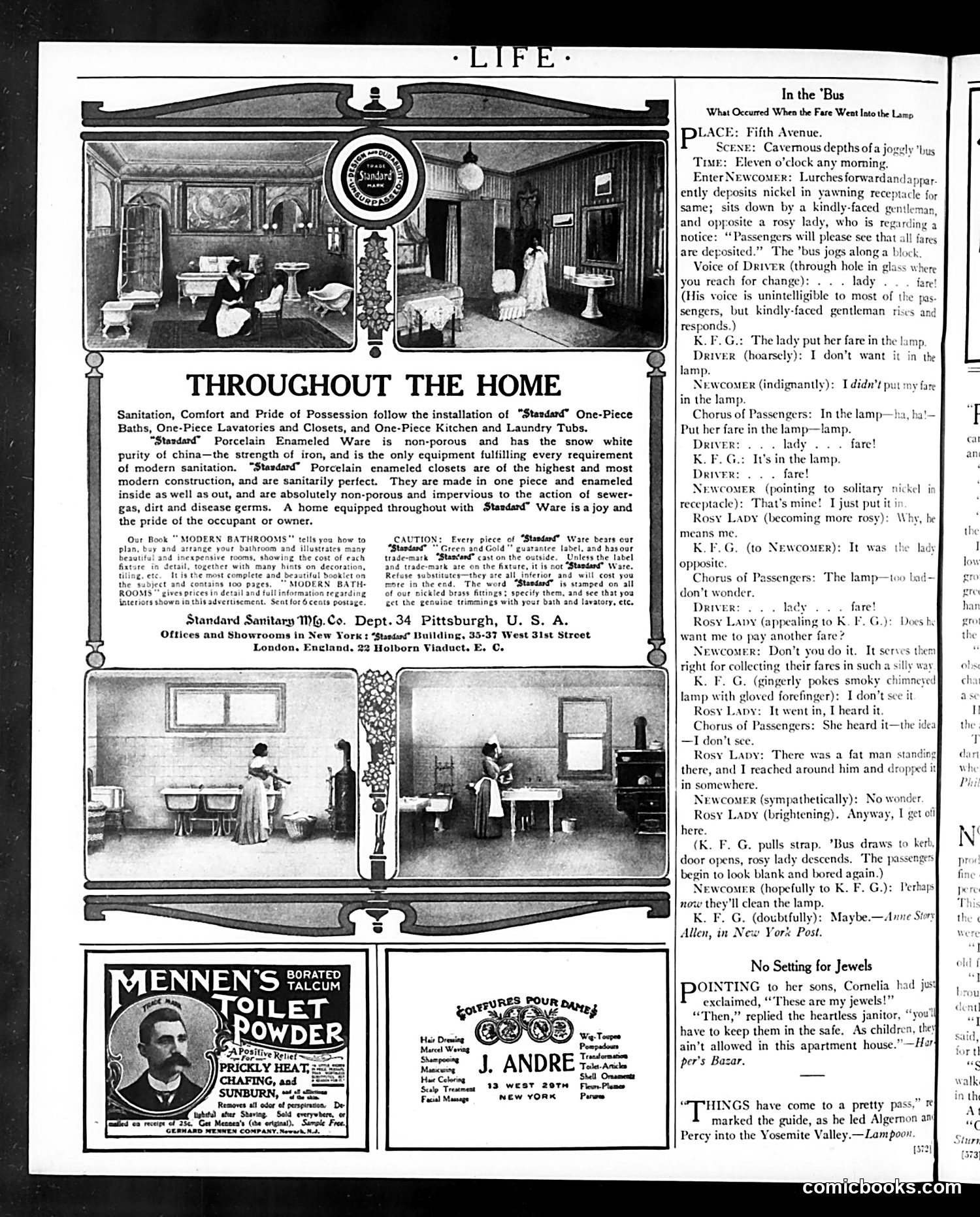
This page is primarily **advertising**, not political satire. The main content showcases "Standard" brand bathroom fixtures and kitchen equipment, emphasizing modern sanitation and porcelain-enameled durability. The ad targets homeowners seeking pride in possession through up-to-date plumbing. The right-side column contains **"In the Bus,"** a humorous sketch (not political) about urban transit confusion. A passenger accidentally deposits her fare into a bus lamp instead of the fare receptacle. The comedy derives from miscommunication—the gruff driver's unintelligible voice, the lady's indignation, and other passengers' bewilderment as she insists her nickel went into the wrong place. It satirizes ordinary city life frustrations rather than politics. The page also includes minor ads for Mennen's talcum powder and J. André beauty products.
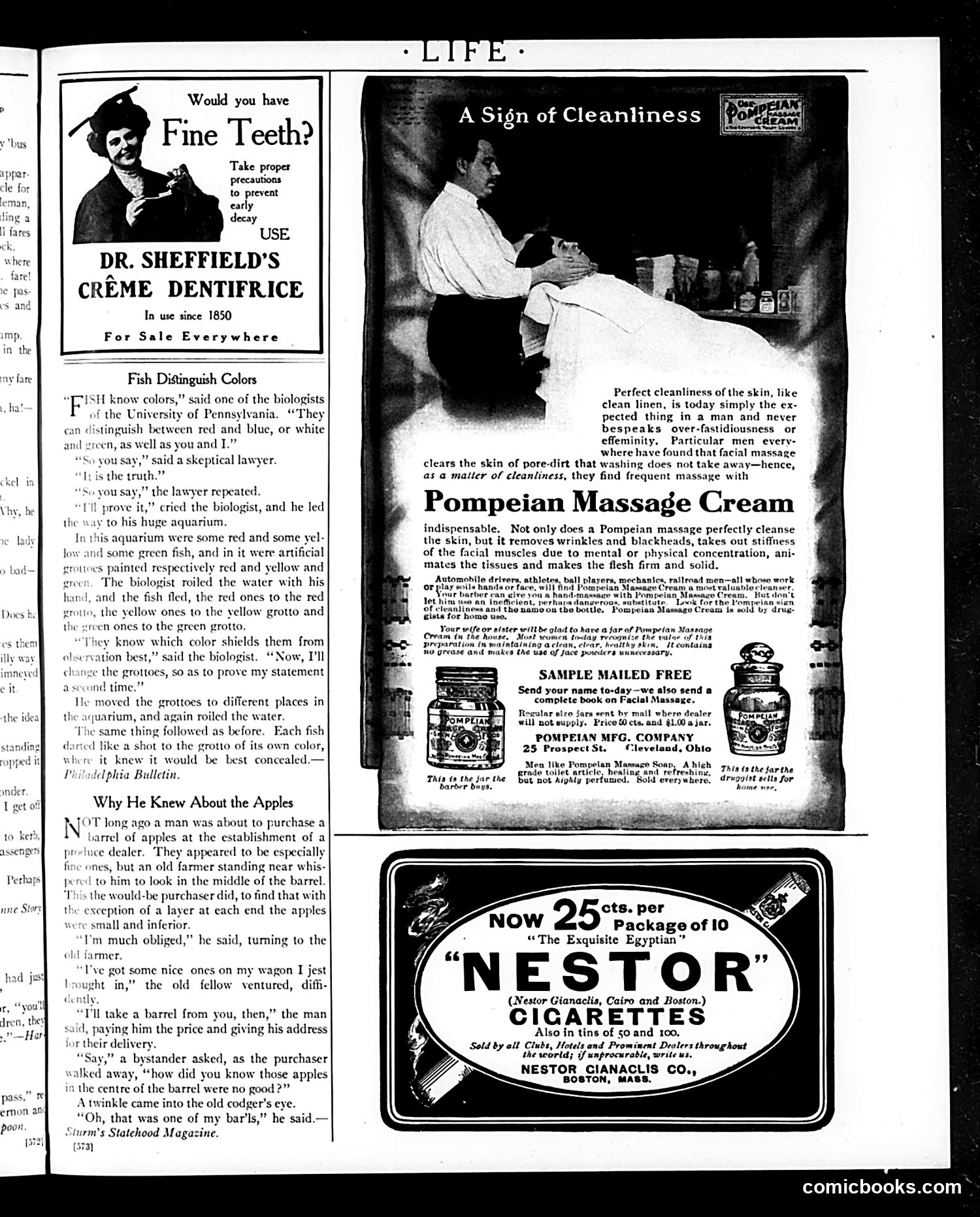
This page contains three distinct pieces of editorial/advertising content: **"Fish Distinguish Colors"** — A humorous anecdote illustrating animal intelligence. A biologist demonstrates to a skeptical lawyer that fish can distinguish colors by observing them instinctively retreat to grottoes matching their own color, even when the grottoes are relocated. The joke mocks the lawyer's disbelief in observable facts. **"Why He Knew About the Apples"** — A rural confidence-scheme anecdote. An old farmer warns a city buyer that a barrel of apples has inferior fruit hidden in the middle (a common deceptive sales practice). The farmer then sells the buyer a barrel from his own wagon—revealing he owns the original barrel and was running a setup to gain trust and make a sale. **Advertisements** — The page also features period product ads: Dr. Sheffield's Creme Dentifrice (toothpaste, "in use since 1850"), Pompeian Massage Cream (facial skincare), and Nestor Cigarettes. The satirical content targets gullibility and deceptive marketing practices of the era.
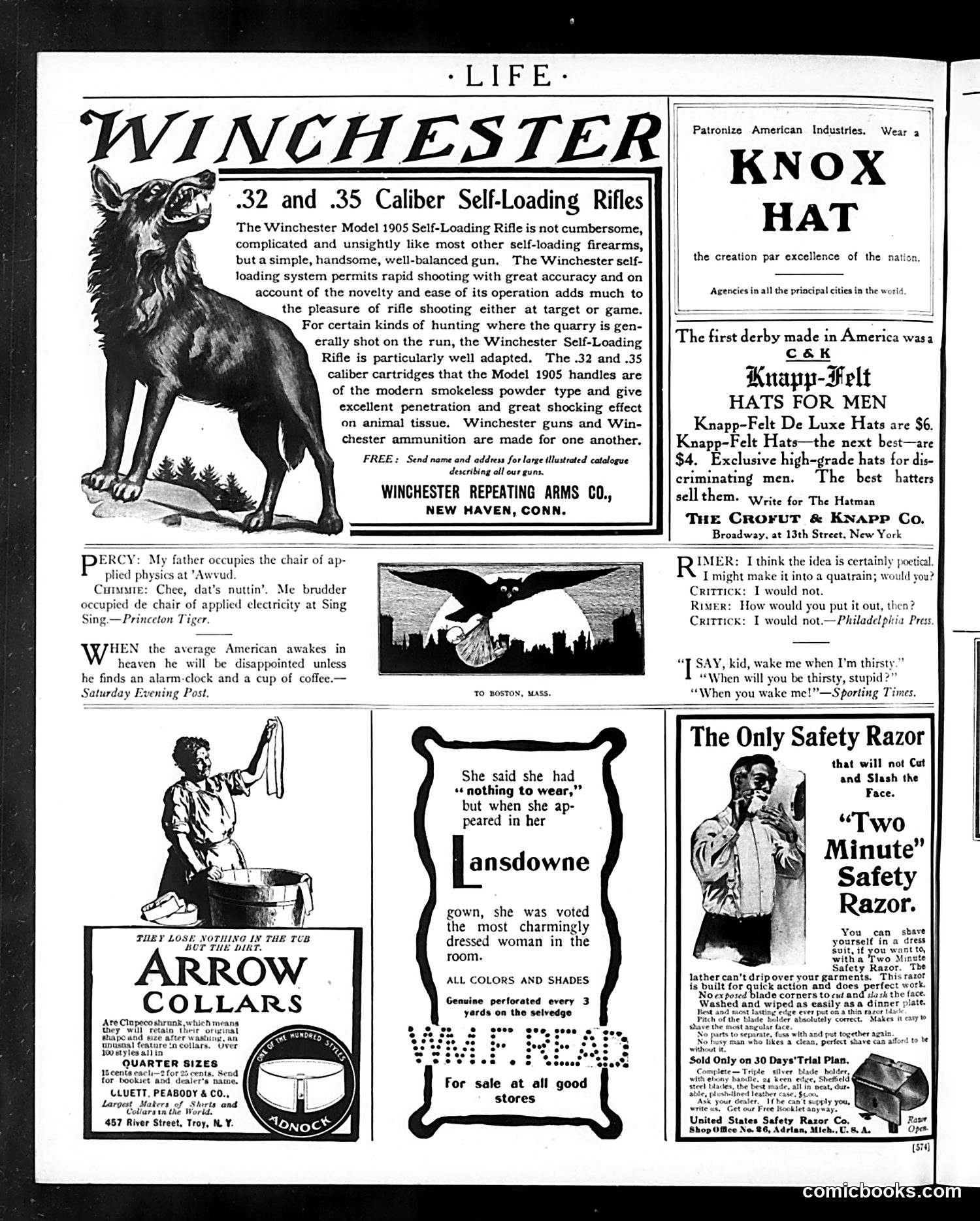
This page is primarily **advertisements** from an early 1900s *Life* magazine, with minimal satirical content. The main features are: **Advertisements:** Winchester rifles, Knox hats, Knapp-Felt hats, Arrow collars, Lansdowne gowns, and a "Two Minute" safety razor dominate the page. **Humorous content:** Brief jokes appear, including: - A comparison between academic credentials and crime (Princeton Tiger reference) - A quip about heaven requiring an alarm clock and coffee (Saturday Evening Post) - A dialogue about poetry being unprintable (Philadelphia Press) - A joke about a thirsty child (Sporting Times) **Social context:** The advertisements reflect early 20th-century consumer culture emphasizing "American Industries"—appealing to nationalist sentiment. The Lansdowne gown ad uses the then-common trope of women's worth being tied to appearance ("most charmingly dressed"). The page reflects *Life's* evolution from pure satire toward advertising-dependent publishing, typical of American magazines by this era.
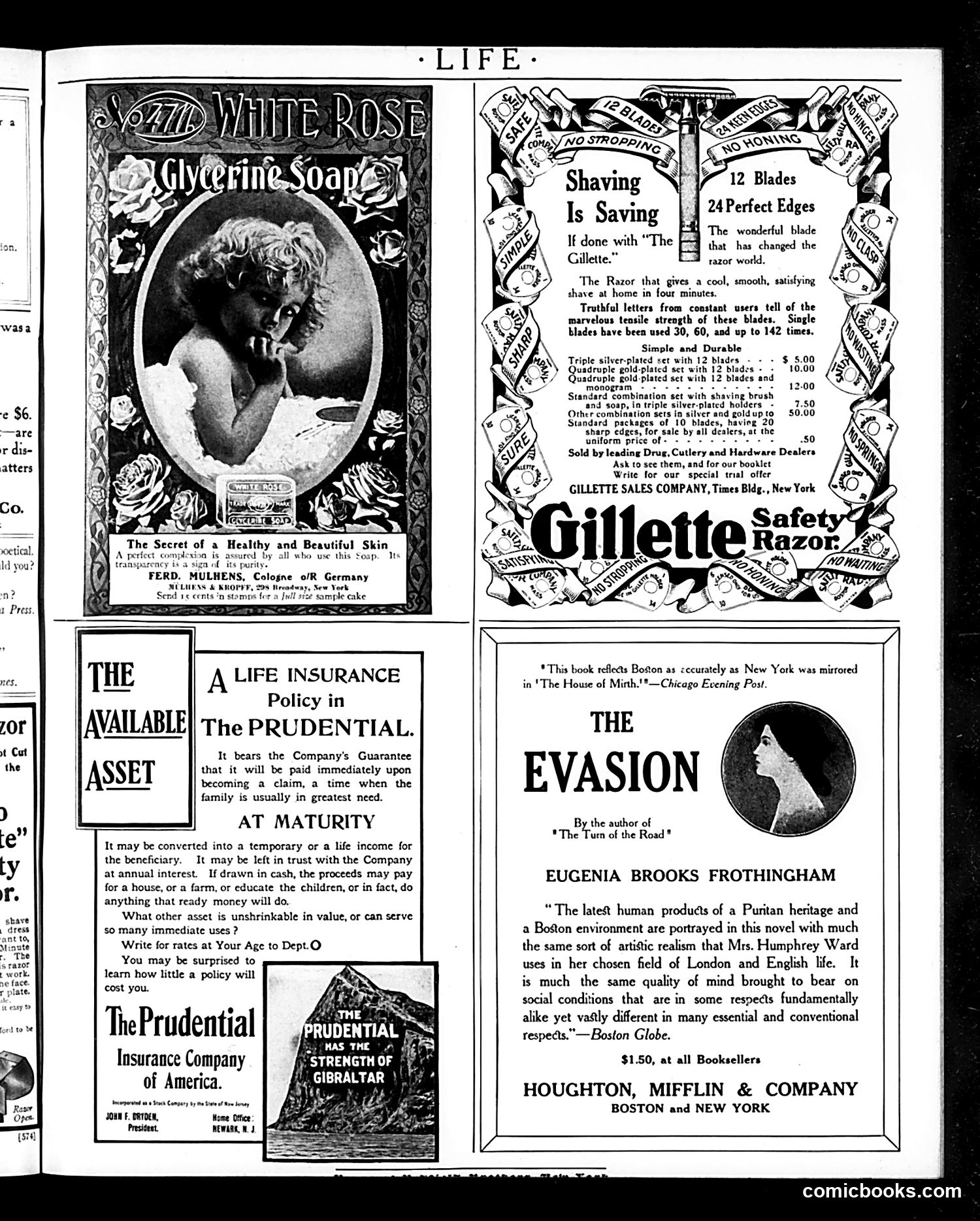
This page contains **advertisements and book promotion**, not political cartoons or satire. The ads showcase early 20th-century consumer products: White Rose Glycerine Soap emphasizes skin health using classical imagery; Gillette Safety Razor highlights its innovative "12 blades" technology and durability (blades reusable 30-142 times), marketing it as convenient home shaving; and Prudential Insurance promotes life policies' flexibility and immediate payouts for families in need. The book promotion features "The Evasion" by Eugenia Brooks Frothingham, a novel about Boston society compared favorably to Henry James's "The House of Mirth" for its literary realism depicting Puritan New England life. The page reflects **Progressive Era consumer culture**: products marketed around convenience, health, and family security—themes resonating with modern middle-class anxieties about mortality, appearance, and financial stability.
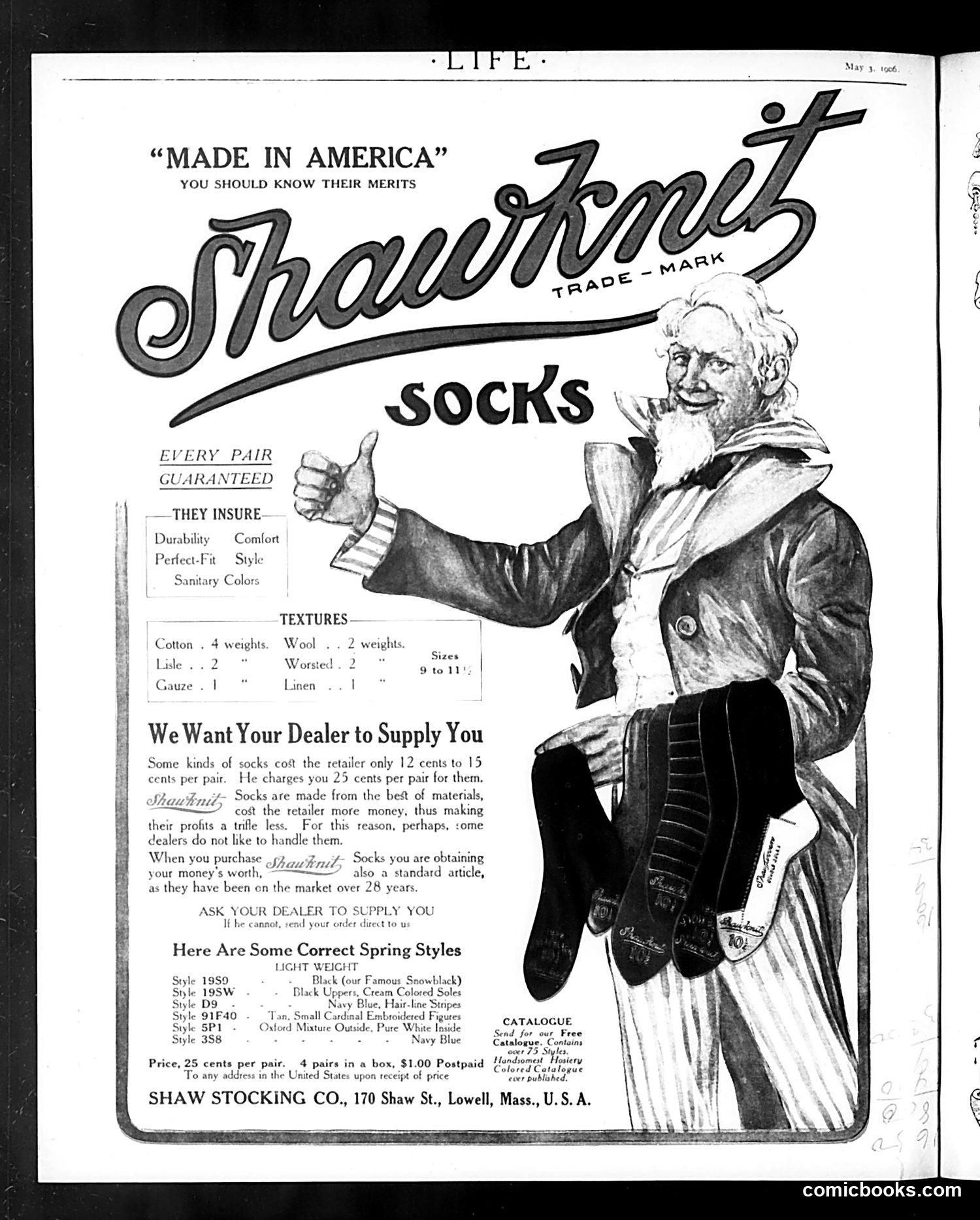
This is primarily a **product advertisement**, not political satire. The page advertises Shauinit brand socks in *Life* magazine (May 5, 1908). The illustration features an elderly bearded man (Santa Claus-like figure) giving a thumbs-up endorsement. The ad's pitch emphasizes American manufacturing and quality: Shauinit socks cost retailers more than cheaper competitors, so some dealers avoid stocking them, yet they're a reliable "standard article" available for 28 years. The appeal is patriotic ("Made in America—You Should Know Their Merits") combined with value assurance. The gaffer mascot suggests trustworthiness and tradition. The ad lists multiple fabric weights and spring styles, with pricing at 25 cents per pair—positioning Shauinit as a quality product worth asking dealers to stock despite lower profit margins.