
Life, 1906-05-03 · page 19 of 44
Life — May 3, 1906 — page 19: what you’re looking at
What you’re looking at
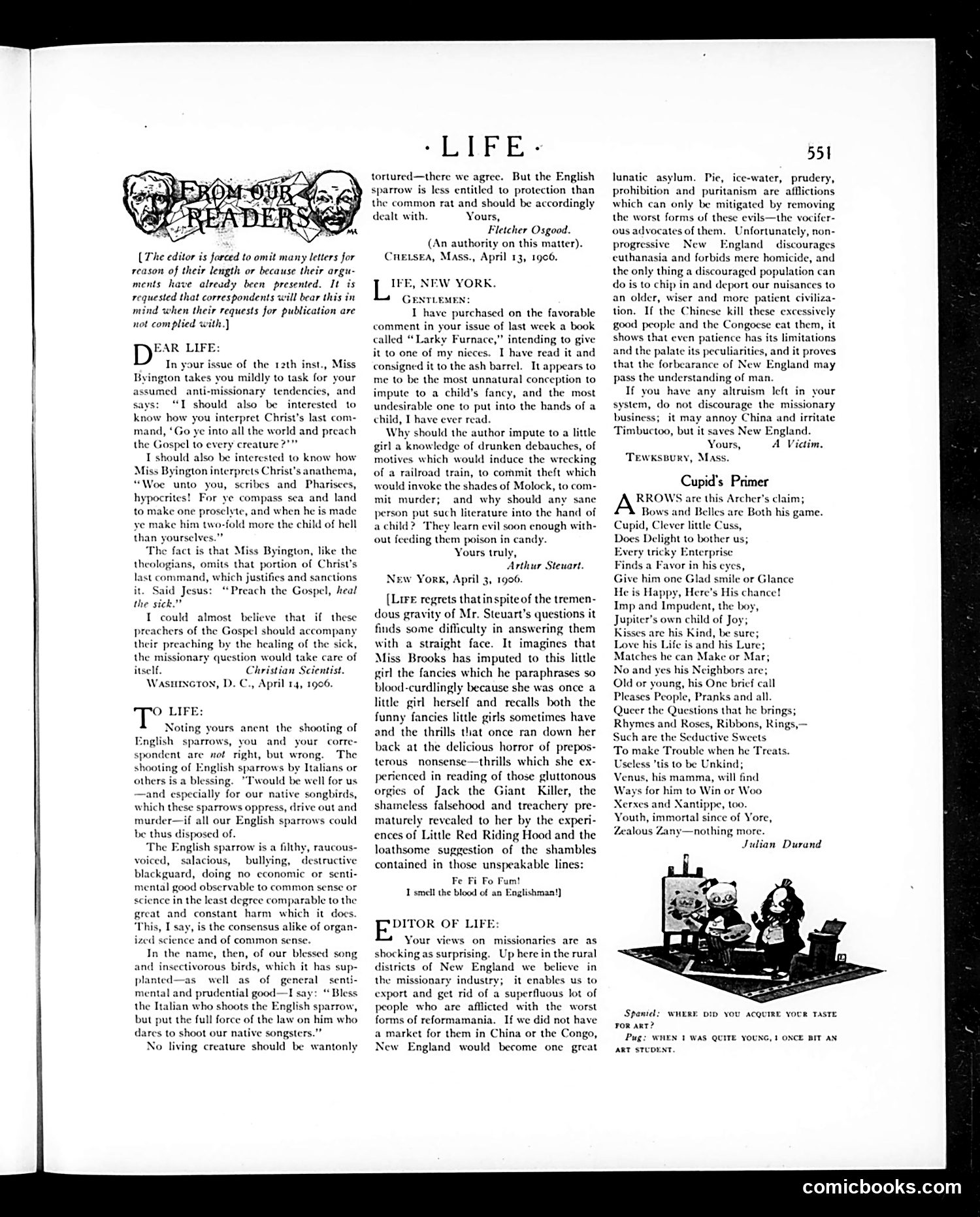
This is a **letters-to-the-editor page** from Life magazine, featuring reader correspondence on social and moral issues of the era. **Main debates:** 1. **Missionary work**: A Christian Scientist argues that missionary efforts (referencing Christ's "Great Commission") should prioritize healing alongside preaching, suggesting aggressive proselytization creates hypocrites. 2. **English sparrows**: Readers debate whether introduced English sparrows deserve protection. One correspondent argues they're destructive pests harming native songbirds and should be exterminated like rats—a stance Life's editor seems to find somewhat absurd (note the sarcastic editorial comment). 3. **Children's literature**: A reader condemns a book called "Larky Furnace" for exposing children to mature themes (drunkenness, theft, murder). Life's editor responds with gentle mockery, implying the correspondent is overreacting to the book's actual content. The page reflects Progressive-era anxieties: missionary zeal, environmental concerns about invasive species, and debates over children's moral protection.
📄 Transcribed text from this page (OCR, searchable)
Machine-transcribed from the original scan — historical spelling and the odd misread are preserved.
( The editor is farced to omit many letters for reason of their length or because their argu- ments have already been presented. It is requested that correspondents will bear this in mind when their requests for publication are not com plied with.) ZAR LIFE In your issue of the 12th inst., Miss Byington takes you mildly to task for your assumed sionary tendencies, and ys: “Is also be interested to know how you interpret Christ’s last com- mand, ‘Go ye into all the world and preach the Gospel to every creature ?”” T should also be interested to know how Miss Byington interprets Christ’s anathema, “Woe unto you, scribes and Pharisees, hypocrites! For ye compass sea and land to make one prosclyte, and when he is made ye make him two-fold more the child of hell than yourselves.”” The fact is that Miss Byington, like the theologians, omits that portion of Christ's last command, which justifies and sanctions it. Said Jesus: “Preach the Gospel, heal the sick.” I could almost believe that if th preachers of the Gospel should accompany their preaching by the healing of the si the missionary question would take care of itself. Christian Scientist. Wasurxcroy, D. C., April 14, 1906. ‘0 LIF Noting yours anent the shooting of cnglish sparrows, you and your corre- spondent are not right, but wrong. The shooting of English sparrows by Italians or hers is a blessing. "Twould be well for us —and especially for our native songbirds, which these sparrows oppress, drive out and murder—if all our English sparrows could be thus disposed of. The English sparrow is a filthy, raucous- voiced, salacious, bullying, destructive blackguard, doing no economic or senti- mental good observable to common sense or science in the least degree comparable to the great and constant harm which it does ‘This, I say, is the consensus alike of organ- ized science and of common sense. In the name, then, of our blessed song and insectivorous birds, which it has sup= well general senti- mental and prudential good—I say: “ Bless the Italian who shoots the English sparrow, but put the full force of the law on him who dares to shoot our native songster: No living creature should be wantonly planted—as as of -LIFE- tortured—there we agree. But the English sparrow is less entitled to protection than the common rat and should be accordingly dealt with. Yours, Fletcher Osgood. (An authority on this matter). Cnetsea, Mass., April 13, 1906. NEW YORK. I have purchased on the favorable comment in your issue of last week a book called “Larky Furnace,” intending to give it to one of my nieces. I have read it and consigned it to the ash barrel. It appears to me to be the most unnatural conception to impute to a child's fancy, and the most undesirable one to put into the hands of a child, I have ever read. Why should the author impute to a little girl a knowledge of drunken debauches, of motives which would induce the wrecking of a railroad train, to commit theft which would invoke the shades of Molock, to com- mit murder; and why should any sane person put such literature into the hand of achild? ‘They learn evil soon enough with- out feeding them poison in candy. Yours truly, Arthur Steuart. New York, April 3, 1996. [Lire regrets that inspite of the tremen- dous gravity of Mr. Steuart’s questions it finds some difficulty in answering them with a straight face. It imagines that Miss Brooks has imputed to this little girl the fancies which he paraphrases so blood-curdlingly because she was once a little girl herself and recalls both the funny fancies little girls sometimes ha and the thrills that once ran down her back at the delicious horror of prepos- terous nonsense—thrills which she ex- perienced in reading of those gluttonous orgies of Jack the Giant Killer, the shameless falsehood and treachery pre- maturely revealed to her by the experi- ences of Little Red Riding Hood and the loathsome suggestion of the shambles contained in those unspeakable lines: Fe Fi Fo Fum! I smell the blood of an Englishman!) DITOR OF LIF Your views on missionaries are as hocking as surprising. Up here in the rural districts of New England we believe in the missionary industry; it enables us to export and get rid of a superfluous lot of people who are afilicted with the worst forms of reformamania. If we did not have a market for them in China or the Congo, ‘ew England would become one great 551 lunatic asylum. Pie, ice-water, prudery, prohibition and puritanism are afflictions which can only be mitigated by removing the worst forms of these evils—the vocifer- ous advocates of them. Unfortunately, non- progressive. New England discourag euthanasia and forbids mere homicide, and the only thing a discouraged population can do is to chip in and deport our nuisances to an older, wiser and more patient civiliza- tion. If the Chinese kill these excessive good people and the Congocse eat them, it shows that even patience has its limitations and the palate its peculiarities, and it proves that the forbearance of New England may pass the understanding of man. If you have any altruism left in your system, do not discourage the missionary business; it may annoy China and irritate Timbuctoo, but it saves New England. Yours, A Victim. Tewksbury, Mass. Cupid's Primer RROWS are this Archer's claim; Bows and Belles are Both his game. Cupid, Clever little Cuss, Does Delight to bother us; ery tricky Enterprise Finds a Favor in his eyes, Give him one Glad smile or Glance He is Happy, Here's His chance! Imp and Impudent, the boy, Jupiter's own child of Joy; Kisses are his Kind, be sure; Love his Life is and his Lure; Matches he can Make or Mar; No and yes his Neighbors are; Old or young, his One brief call Pleases People, Pranks and all. Queer the Questions that he brings Rhymes and Roses, Ribbons, Rings,— Such are the Seductive Sweets To make Trouble when he Treats. Useless ’tis to be Unkind; Venus, his mamma, will find Ways for him to Win or Woo Xerxes and Xantippe, too. Youth, immortal since of Yore, Zealous Zany—nothing more. Julian Durand Spaniel: TOR ART? Pug: WHEN 1 WAS QUITE YOUNG, 1 ONCE BIT AN ART STUDENT. WHERE DID YOU ACQUIRE YouR TASTE comicbooks.com