
Life, 1906-05-03 · page 36 of 44
Life — May 3, 1906 — page 36: what you’re looking at
What you’re looking at
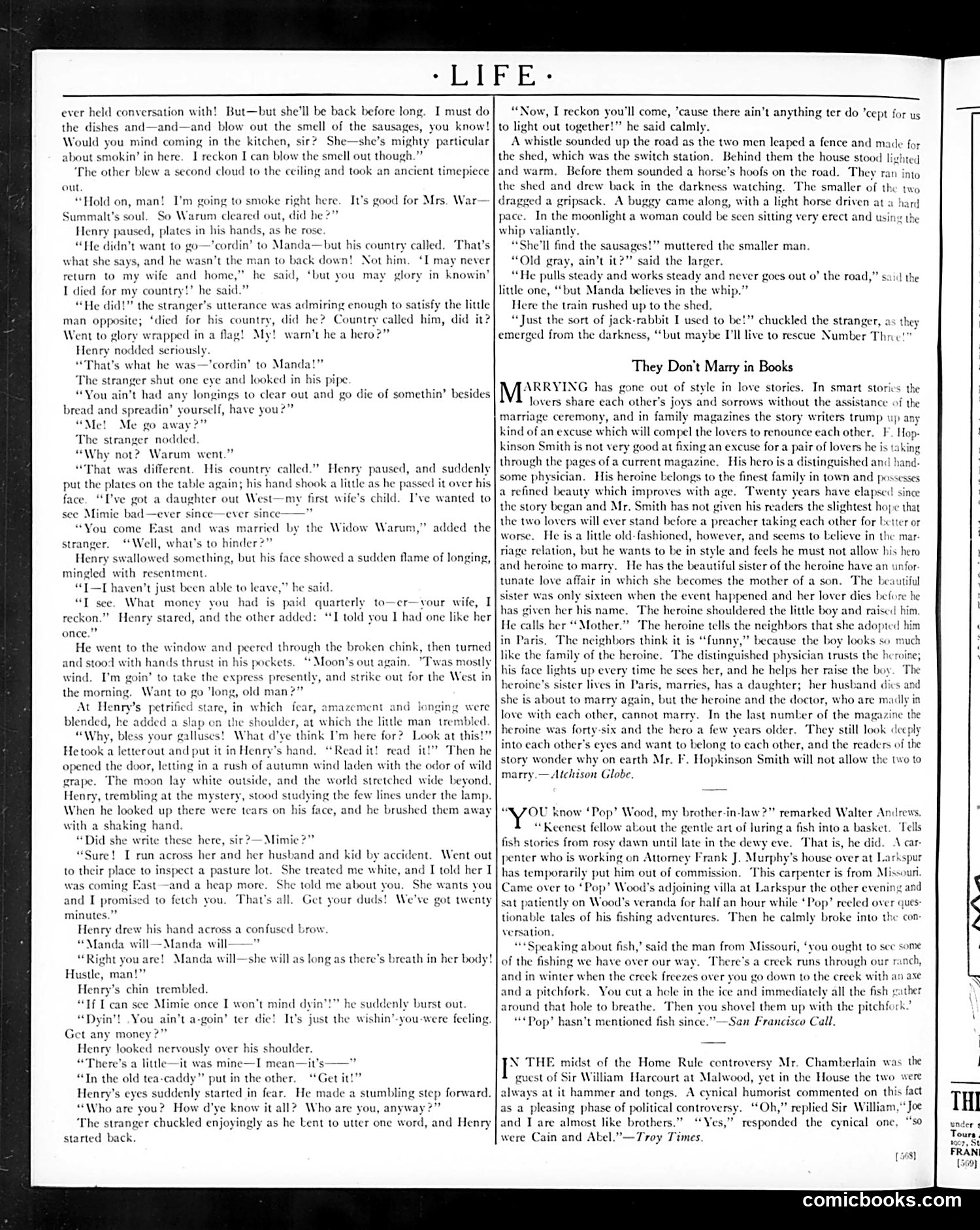
This page contains a serialized short story rather than a political cartoon. The narrative depicts a domestic drama set in rural America, likely early 20th century. The plot concerns Henry, a working-class man trapped in an unhappy second marriage to "Manda" (the Widow Warum). A mysterious stranger arrives, revealing he knows Henry's daughter Mimie from his first marriage, whom Henry hasn't seen in years. The stranger offers Henry the chance to escape his dreary life—proposing they leave that very night to travel West. The satire targets the constraints of working-class domesticity: Henry is literally trapped washing dishes and managing his wife's household preferences. The comparison to "Warum," who died heroically for his country, contrasts Henry's mundane imprisonment with romantic notions of masculine freedom and purpose. The story explores class-based family obligations, remarriage complications, and the tension between duty and personal desire—themes typical of Life's satirical commentary on American middle and working-class life.
📄 Transcribed text from this page (OCR, searchable)
Machine-transcribed from the original scan — historical spelling and the odd misread are preserved.
“IE Es ever held conversation with! But—but she'll be back before long. I must do the dishes and—and—and blow out the smell of the sausages, you know! Would you mind coming in the kitchen, sir? She—she’s mighty particular about smokin’ in here. I reckon I can blow the smell out though.” ‘The other blew a second cloud to the ceiling and took an ancient timepiece out “Hold on, man! I'm going to smoke right here Summalt’'s soul. So Warum cleared out, did he?” Henry paused, plates in his hands “He didn’t want to go—'cordin’ to Manda—but his country called. ‘That's what she says, and he wasn’t the man to back down! Not him. ‘I may never return to my wife and home d, ‘but you may glory in knowin’ I died for my country!’ he said.” “He did!” the stranger's utterance was admiring enough to satisfy the little man opposite; ‘died for his country, did he? Country called him, did it? Went to glory wrapped in a flag! My! warn’t he a hero?” Henry nodded seriously “That's what he was—cordin’ to Manda!” ‘The stranger shut one eye and looked in his pipe “You ain't had any longings to clear out and go die of somethi bread and spreadin’ yourself, have you?” “Me! Me go away?” ‘The strar It’s good for Mrs. War 1s he rose cer nodded “Why not? Warum went.” “That s different. His country called.” Henry paused, and suddenly put the plates on the table again; his hand shook a little as he passed it over his face. “L’ve got a daughter out West—my first wife's child. I've wanted to sce Mimie bad—ever since—ever since—" “You come East and was married by the Widow Warum,” stranger. ‘Well, what's to hinder?” Henry swallowed something, but his face showed a sudden flame of longing, mingled with resentment “TT haven't just been able to leave,” he said I see. What moncy you had is paid quarterly to—er—vour wife, I reckon.” Henry stared, and the other added: “TI told you I had one like her once.” He went to the window and peered through the broken chink, then turned “Moon's out a ’Twas mostly lor the West in added the and stood with hands thrust in his pockets. wind. I'm goin’ to take the express presently, and strike out the morning. Want to go ‘long, old man?” At Henry’s petrified stare, in which fear, amazement and longing were blended, he added a slap en the shoulder, at which the little man trembled “Why, bless your galluses!: What d'ye think I'm here for? Look at this!” He took a letterout and put it in Henry’s hand, “Read it! read it!” Then he opened the door, letting in a rush of autumn wind laden with the odor of wild grape. The moon lay white outside, and the world stretched wide beyond. Henry, trembling at the mystery, stood studying the few lines under the lamp When he looked up there were tcars on his face, and he brushed them away with a shaking hand, “Did she write these here, sir?— Mimic?” “Sure! I run across her and her husband and kid by accident to their place to inspect a pasture lot. She treated me white, and I told her I was coming East —and a heap more. She told me about you. She wants you and I promised to fetch you. That's all. Get your duds! We've got twenty minutes.” Henry drew his hand across a confused brow. “Manda will—Manda will se, “Right you are! Manda will Hustle, man!”” Henry’s chin trembled “If Tcan sce Mimie once I won't mind dyin’! he suddenly burst out “Dyin’! You ain't a-goin’ ter die! It’s just the wishin’-you-were feeling Get any money?” Went out t she will as long as there’s breath in her body! Henry looked nervously over his shoulder. “There's a little—it was mine—I mean—i’ “In the old tea-caddy” put in the other. “Get it Henry's eyes suddenly started in fear. He made a stumbling step forward. “Who are you? How d’ye know it all? Who are you, anyway?” ‘The stranger chuckled enjoyingly as he Lent to utter one word, and Henry started back. “Now, I reckon you'll come, ‘cause there ain’t anything ter do ’cept for us to light out together!” he said calmly, A whistle sounded up the road as the two men leaped a fence and made for the shed, which was the switch station, Behind them the house stood lighted and warm, Before them sounded a horse’s hoofs on the road. ‘They ran into the shed and drew back in the darkness watching. The smaller of the two dragged a gripsack. A buggy came along, with a light horse driven at a hard pace. In the moonlight a woman could be seen sitting very erect and usin whip valiantly. “She'll find the sausages!” muttered the smaller man. “Old gray, ain’t it?” said the larger. “He pulls steady and works steady and never goes out 0’ the road,” s little one, “but Manda believes in the whip.” Here the train rushed up to the shed, “Just the sort of jack-rabbit I used to be!” chuckled the stranger, a emerged from the darkness, “but maybe I'll live to rescue Number Thre They Don't Marry in Books ARRYING has gone out of style in love stories. In smart stories the lovers share each other's joys and sorrows without the assistance of the marriage ceremony, and in family magazines the story writers trump up any kind of an excuse which will compel the lovers to renounce each other. F. Hop- kinson Smith is not very good at fixing an excuse for a pair of lovers he is taking through the pages of a current magazine. His hero isa distinguished and hand- some physician. His heroine belongs to the finest family in town and possesses a refined beauty which improves with age. Twenty years have elapsed since the story began and Mr. Smith has not given his readers the slightest hope that the two lovers will ever stand before a preacher taking each other for better or worse. He is a little old-fashioned, however, and seems to believe in the mar- riage relation, but he wants to be in style and feels he must not allow his hero and heroine to marry. He has the beautiful sister of the heroine have an unfor tunate love affair in which she becomes the mother of a son. The beautiful sister was only sixteen when the event happened and her lover dies before he has given her his name. The heroine shouldered the little boy and raised him. He calls her “Mother.” The heroine tells the neighbors that she adopted him in Paris. The neighbors think it is ‘funny,’ because the boy looks so much like the family of the heroine. The distinguished physician trusts the heroine; his face lights up every time he sees her, and he helps her raise the boy. The heroine's sister lives in Paris, marries, has a daughter; her husband dics and she is about to marry again, but the heroine and the doctor, who are mailly in love with cach other, cannot marry. In the last number of the magazine heroine was forty-six and the hero a few y into each other's eyes and want to belong to cach other, and the readers of t story wonder why on earth Mr. F, Hopkinson Smith will not allow the two to marry. — Atchison Globe, “WVOU know ‘Pop’ Wood, my brother-in-law?” remarked Walter Andrews. “Keenest fellow about the gentle art of luring a fish into a basket. ‘Tells fish stories from rosy dawn until late in the dewy eve. That is, he did. .\ car- penter who is working on Attorney Frank J. Murphy’s house over at Larkspur has temporarily put him out of commission. ‘This carpenter is from Missouri Came over to ‘Pop’ Wood’s adjoining villa at Larkspur the other evening sat patiently on Wood's veranda for half an hour while ‘Pop’ reeled over ques: tionable tales of his fishing adventures. Then he calmly broke into the con- versation, Speaking about fish,’ said the man from Missouri, ‘you ought to sec some of the fishing we have over our way. There's a creck runs through our ranch, over you go down to the creek with and a pitchfork. You cuta hele in the ice and immediately all the fish gather around that hole to breathe. Then you shovel them up with the pitchfork.’ “*Pop’ hasn’t mentioned fish since.”-—San Francisco Call. and in winter when the creck freez N THE midst of the Home Rule controversy Mr. Chamberlain was the guest of Sir William Harcourt at Malwood, yet in the House the two were always at it hammer and tongs. A cynical humorist commented on this fact as a pleasing phase of political controversy. “Oh,” replied Sir William, “Joe and I are almost like brothers.” “Yes,” responded the cynical one, “so were Cain and Abel.”"—Troy Times. comicbooks.com