
Life, 1906-05-03 · page 26 of 44
Life — May 3, 1906 — page 26: what you’re looking at
What you’re looking at
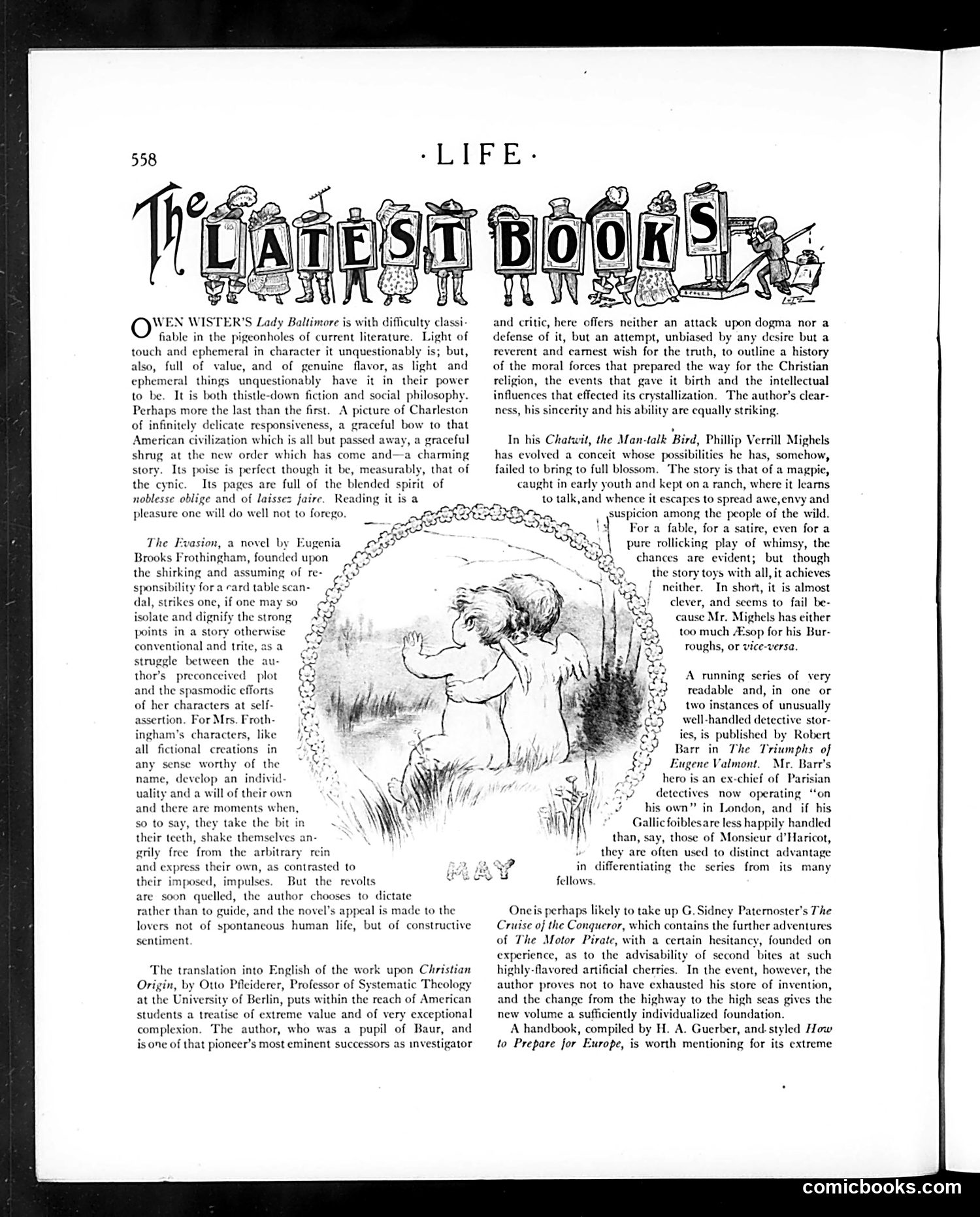
This is a **book review section**, not a political cartoon page. The page titled "The Latest Books" contains literary criticism of several contemporary novels and works, circa early 1900s. The reviews discuss: 1. **Lady Baltimore** by Owen Wister—praised as delicate Charleston society fiction blending social philosophy with charm 2. **The Evasion** by Eugenia Brooks Frothingham—criticized for characters rebelling against authorial control, creating tension between plot and spontaneous human drama 3. **Christian Origin** by Otto Pfleiderer—a serious theological treatise offering unbiased historical analysis of Christianity's moral foundations 4. **Chatwit, the Man-talk Bird** by Phillip Verrill Mighels—about a magpie taught to speak, criticized for failing to develop its satirical potential 5. **The Triumphs of Eugene Valmont** by Robert Barr—detective fiction featuring a Parisian detective now working in London The only illustration is a small sketch accompanying the Mighels review, depicting the talking magpie character.
📄 Transcribed text from this page (OCR, searchable)
Machine-transcribed from the original scan — historical spelling and the odd misread are preserved.
ady Baltimore is with difficulty cla fiable in the pigeonholes of current literature. Light of touch and ephemeral in character it unquestionabl but, also, full of value, and of genuine flavor, as light and ephemeral things unquestionably have it in their power to be. It is both thistle-down fiction and social philosophy. Perhaps more the last than the first. A picture of Charleston of infinitely delicate responsiveness, a graceful bow to that American civilization which is all but passed away, a graceful shrug at the new order which has come and—a charming story. Its poise is perfect though it be, measurably, that of the cynic. Its pages are full of the blended spirit. of noblesse oblige and of laissez faire. Reading it is a pleasure one will do well not to forego. Brooks Frothingham, founded upon the shirking and assuming of re- sponsibility fora ard table scan- dal, strikes one, if one may so isolate and dignify the strong points in a story otherwise conventional and trite, as a struggle between the au- thor’s preconceived _ plot and the spasmodic efforts of her characters at self- assertion. For Mrs. Froth- ingham’s characters, like all fictional creations in any sense worthy of the name, develop an individ uality and a will of their own and there are moments when, so to say, they take the bit in r teeth, shake themselves an- ily free from the arbitrary rein and express their own, as contrasted to their imposed, impulses. But the revolts are soon quelled, the author chooses to dictate rather than to guide, and the novel’s appeal is made to the lovers not of spontaneous human life, but of constructive sentiment The translation into English of the work upon Christian Origin, by Otto Pfleiderer, Professor of Systematic Theology at the University of Berlin, puts within the reach of American students a treatise of extreme value and of very exceptional complexion. The author, who was a pupil of Baur, and is one of that pioncer’s most eminent successors as investigator EO and critic, here offers neither an attack upon dogma nor a defense of it, but an attempt, unbiased by any desire but a reverent and camest wish for the truth, to outline a history of the moral forces that prepared the way for the Christian religion, the events that gave it birth and the intellectual influences that effected its crystallization. The author’s clear- ness, his sincerity and his ability are equally striking. In his Chatwit, the Man-talk Bird, Phillip Verrill Mighels has evolved a conceit whose possibilities he has, somchow, failed to bring to full blossom. is that of a magpie, caught in carly youth and kept ona ranch, where it learns pets to talk,and whence it escapes to spread awe,envy and = AGEPC ote Eevee ree The Evasion, a novel by Eugenia as? ca? es suspicion among the people of the wild. For a fable, for a satire, even for a \ pure rollicking play of whimsy, the chances are evident; but though tory toys with all, it achieves neither. In short, it is almost clever, and seems to fail be- cause Mr. Mighels has either too much AEsop for his Bur- roughs, or vice-versa. Soe td A running series of very readable and, in one or two instances of unusually well-handled detective stor- ies, is published by Robert Barr in The Triumphs of iugene Valmont. Mr. Bart's hero is an ex-chief of Parisian detectives now operating “on his own” in London, and _ if his llic foiblesare less happily handled than, say, those of Monsicur d’Haricot, they are often used to distinct advantage in differentiating the series from its many fellows. Oneis perhaps likely to take up G. Sidney Paternoster’s The Cruise of the Conqueror, which contains the further adventures of The Motor Pirate, with a certain hesitancy, founded on experience, as to the advisability of second bites at such highly-flavored artificial cherries. In the event, however, the author proves not to have exhausted his store of invention, and the change from the highway to the high s new volume a sufficiently individualized foundation. A handbook, compiled by H. A. Guerber, and-styled How to Prepare for Europe, is worth mentioning for its extreme gives the comicbooks.com