
Life, 1906-05-03 · page 25 of 44
Life — May 3, 1906 — page 25: what you’re looking at
What you’re looking at
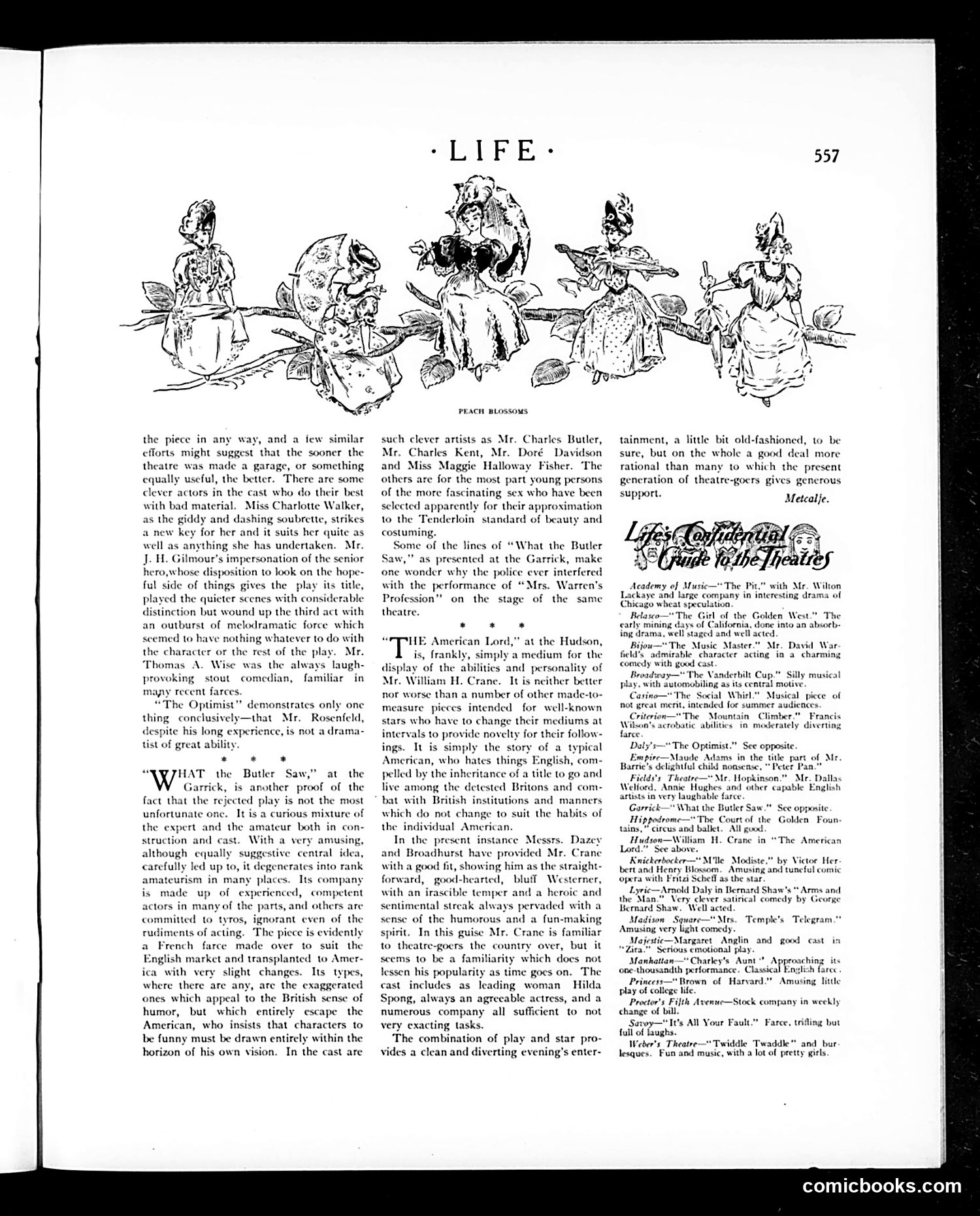
This page contains three theater reviews from Life magazine's drama section, illustrated with a decorative header showing "Peach Blossoms" — stylized theatrical figures in costumes. The reviews critique three Broadway plays: 1. **"The Optimist"** — The critic dismisses playwright Rosenfeld's work as poorly written, despite competent cast members like Charlotte Walker and J.H. Gilmour. The satire: even good actors cannot save bad material. 2. **"What the Butler Saw"** (at the Garrick) — A French farce adapted for American audiences. The reviewer notes it mixes expert and amateur construction. The satire references "Mrs. Warren's Profession" — suggesting this play contains similarly scandalous content that should have faced police interference. The "Tenderloin standard of beauty" alludes to New York's notorious red-light district, implying actresses were selected for appearance rather than talent. 3. **"The American Lord"** (at the Hudson) — A vehicle for star William H. Crane, who plays a typical American resisting British customs. The reviewer finds it formulaic but acknowledges Crane's enduring popularity. The overall tone is sophisticated theatrical criticism mixed with social satire about American theater's commercial priorities.
📄 Transcribed text from this page (OCR, searchable)
Machine-transcribed from the original scan — historical spelling and the odd misread are preserved.
the piece in any way, and a few similar efforts might suggest that the sooner the theatre was made a garage, or something equally useful, the better. There are some clever actors in the cast who do their best with bad material. Miss Charlotte Walker, as the giddy and dashing soubrette, strikes a new key for her and it suits her quite as well as anything she has undertaken. Mr. J. H. Gilmour's impersonation of the senior hero,whose disposition to look on the hope- ful side of things gives the play its title, played the quieter scenes with considerable distinction but wound up the third act with an outburst of melodramatic force which scemed to have nothing whatever to do with the character or the rest of the play. Mr. A. Wise was the always laugh- stout familiar in Thomas provoking comedian, maay recent fare The Optimist” demonstrates only one thing conclusively—that Mr. Rosenfeld, despite his long experience, is not a drama- tist of great ability * 6 * “YYTHAT the Butler Saw,” at the Garrick, is another proof of the fact that the rejected play is not the most unfortunate one. It is a curious mixture of the expert and the amateur both in con- struction and cast. With a very amusing, ough cqually sug carefully led up to, it degenerates into rank amateurism in many places. Its company is made up of experienced, competent actors in many of the parts, and others are committed to tyros, ignorant even of the rudiments of acting. The piece is evidently a French farce made over to suit the English market and transplanted to Amer- ica with very slight changes. Its types, where there are any, are the exaggerated ones which appeal to the British sense of humor, but which entirely escape the American, who insists that characters to be funny must be drawn entirely within the horizon of his own vision, In the cast are e central id PEACH BLOSSOMS such clever artists as Mr. Charles Butler, Mr. Charles Kent, Mr. Doré Davidson and Miss Maggie Halloway Fisher. The others are for the most part young persons of the more fascinating sex who have been selected apparently for their approximation to the Tenderloin. standard of beauty and costuming. Some of the lines of “What the Butler Saw," as presented at the Garrick, make one wonder why the police ever interfered with the performance of “Mrs. Warren's Profession” on the stage of the same theatre. + # 8 HE American Lord,” at the Hudson, is, frankly, simply a medium for the display of the abilities and personality of Mr. William H. Crane. It is neither better nor worse than a number of other made-to- measure pieces intended for well-known stars who have to change their mediums at intervals to provide novelty for their follow- ings. It is simply the story of a typica American, who hates things English, com- pelled by the inheritance of a title to go and live among the detested Britons and com- bat with British institutions and manners which do not change to suit the habits of the individual American. In the present instance Mes rey and Broadhurst have provided Mr. Crane with a good fit, showing him as the straight- forward, good-hearted, blufl Westerner, with an irascible temper and a heroic and sentimental streak always pervaded with a sense of the humorous and a fun-making spirit. In this guise Mr. Crane is familiar to theatre-goers the country over, but it seems to be a familiarity which docs not lessen his popularity as time goes on. The cast includes as leading woman Hilda Spong, always an agrecable actress, and a humerous company all sufficient to. not very exacting tasks. The combination of play and star pro- vides a clean and diverting evening’s enter- tainment, a little bit old-fashioned, to be sure, but on the whole a good deal more rational than many to which the present generation of theatre-gocrs gives generous support. Metcalje. Academy of Music—*The Pit,” with Mr. Wilton Lackaye and large company in interesting drama Chicago wheat speculation, Belasco—" The Girl of the Golden West.” carly mining days of California, done into an absorb- ing drama, well staged and well acted. Bijou—"The Music Master."" Mr. David War field’s admirable character acting in a charming comedy with good cast Broadway—"The Vanderbilt Cup." Silly musical biling as its central motive: ncial Whirl.” Musical _picce of faded for summer audiences ion—""The Mountain Climber." Francis Wilson's acrobatic abilities in moderately diverting farce Daty’'s— ‘The Optimist.” See opposite Empire—Maude Adams in the title part Barrie's delightful child nonsense, " Peter Pan Fictds's Theatre—* Mr. Hopkinson.” Me. Dallas Welford, Annie Hughes and other capable English artists in very laug! le farce Garrick—" What the Butler Saw." Sce opposite Hippodrome—* The Con of the Golden tains,” circus and ballet. All gov Hudson—William H. Crane in Lord.” See above. Knickerbocker—" Mlle Modiste.” by Victor Her bert and Henry Blossom. Amusing and tuneful comic opera with Fritzi Scheff as the star. Lyric— Arnold Daly in Bernard Shaw's" Arms and the Man.” Very clever satirical comedy by George Bernard Shaw. Well acted. Madison Sqware—" Mrs. Amusing very light comedy Majestie—Margaret Anglin and good cast in “Zita.” Serious emotional play. Manhattan—" Charkey’s Aunt Approaching it one-thousandth performance. Classical English farce Princess—" Brown of Harvard.” Amusing little play of college life. Proctor’s Fifth Avenue—Stock company in weekly change of bill. Savoy—"It full of faughs. Weber's Theatre—"Twiddle Twaddle” and bur lesques. Fun and music, with a lot of pretty girls. “The Amer Temple's. Telegram.” All Your Fault." Farce, trifling but comicbooks.com