
Life, 1906-05-03 · page 14 of 44
Life — May 3, 1906 — page 14: what you’re looking at
What you’re looking at
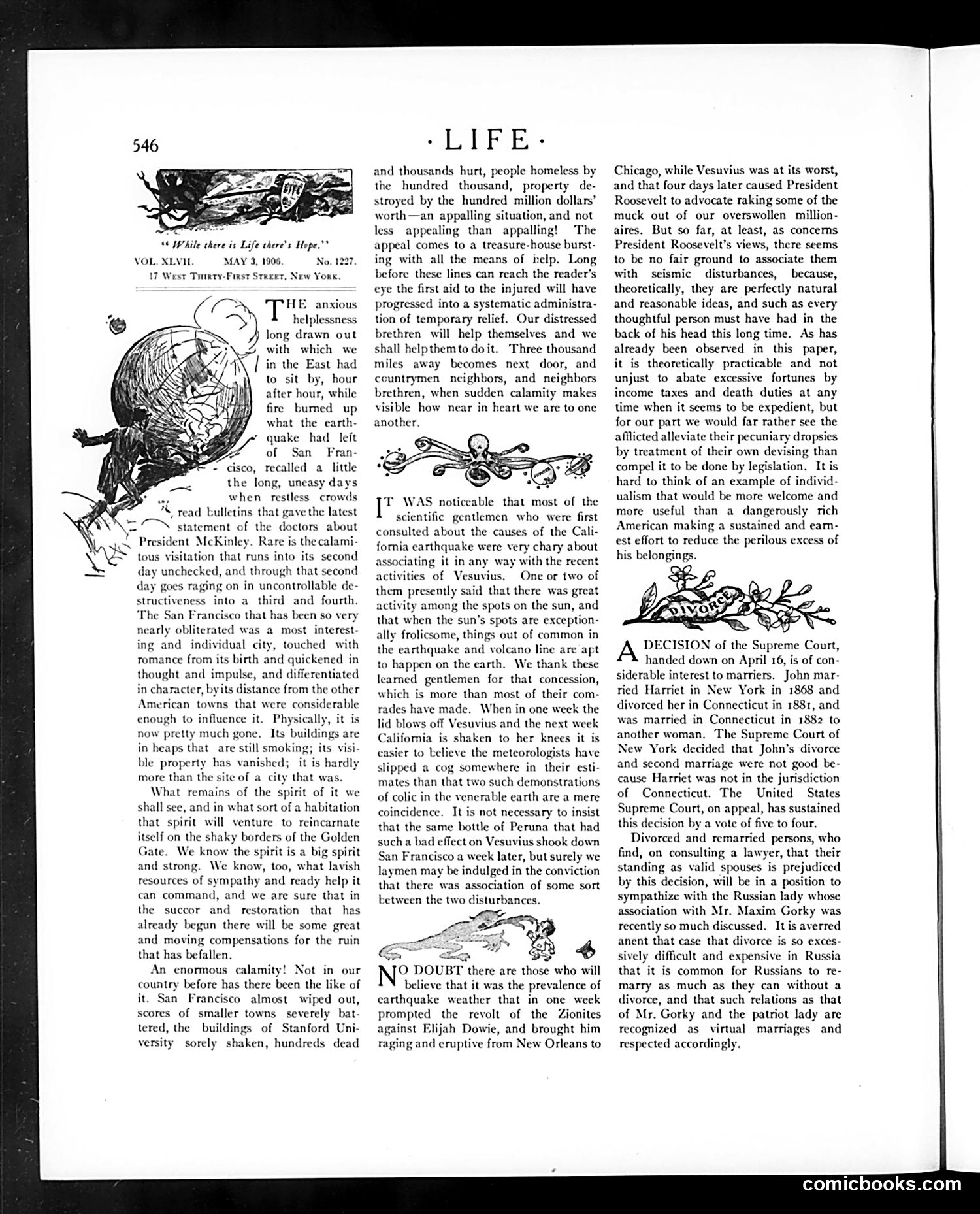
This page addresses the 1906 San Francisco earthquake and fire. The left illustration appears to depict President McKinley (based on the text reference to "President McKinley") observing destruction, though the specifics are unclear from the image alone. The main text is a serious editorial praising American sympathy and relief efforts for the disaster, emphasizing national unity—"three thousand miles away becomes next door." However, there's satirical commentary mocking scientists who attributed both the San Francisco earthquake and concurrent volcanic activity at Mount Vesuvius to sunspots rather than acknowledging coincidence. The text sarcastically references "Peruna" (a patent medicine), humorously suggesting it caused both disasters—a jab at pseudoscientific explanations popular at the time. The page balances genuine compassion for victims with typical Life magazine satire targeting scientific pretension and absurd remedies of the era.
📄 Transcribed text from this page (OCR, searchable)
Machine-transcribed from the original scan — historical spelling and the odd misread are preserved.
“While there is Life there's Hope.” VOL. XLVIL. MAY 3, 1906. No. 122 West Trtery-First Street, New York. anxious helplessness long drawn out with which we in the East had to sit by, hour after hour, while fire bumed up what the carth- quake had left of San Fran- recalled a little the long, uneasy days when restless crowd read bulletins that gave the latest = statement of the doctors about tation that runs into its second day unchecked, and through that second day goes raging on in uncontrollable de- ructiveness into a third and fourth. he San Francisco that has been so very nearly obliterated was a most interest- ing and individual city, touched with romance from its birth and quickened in thought and impulse, and differentiated in character, by its distance from the other American towns that were considerable enough to influence it. Physically, it is now pretty much gone. Its buildings are in heaps that are still smoking; its visi- ble property has vanished; it is hardly more than the site of a city that was. What remains of the spirit of it we shall see, and in what sort of a habitation that spirit will venture to reincarnate itself on the shaky borders of the Golden Gate. We know the spirit is a big spirit and strong. We know, too, what lavish resources of sympathy and ready help it can command, and we are sure that in the succor and restoration that has already begun there will be some great and moving compensations for the ruin that has befallen. An enormous calamity! Not in our country before has there been the like of it. San Francisco almost wiped out, scores of smaller towns severely bat- tered, the buildings of Stanford Uni- versity sorely shaken, hundreds dead -LIFE- and thousands hurt, people homeless by the hundred thousand, property de- stroyed by the hundred million dollars’ worth—an appalling situation, and not less appealing than appalling! ‘The appeal comes to a treasure-house burst- ing with all the means of ielp. Long before these lines can reach the reader’s eye the first aid to the injured will have progressed into a systematic administra- tion of temporary relief. Our distressed brethren will help themselves and we shall helpthemto doit. Three thousand miles away becomes next door, and countrymen neighbors, and neighbors brethren, when sudden calamity makes visible how near in heart we are to one another. I" WAS noticeable that most of the scientific gentlemen who were first consulted about the causes of the Cali- fomia earthquake were very chary about y with the recent activities of Vesuvius. One or two of them presently said that there was great activity among the spots on the sun, and that when the sun’s spots are exception- ally frolicsome, things out of common in the earthquake and volcano line are apt to happen on the earth. We thank these learned gentlemen for that concession, which is more than most of their com- rades have made. When in one week the lid blows off Vesuvius and the next week California is shaken to her knees it is r to believe the metcorologists have slipped a cog somewhere in their esti- mates than that two such demonstrations of colic in the venerable earth are a mere coincidence. It is not necessary to insist that the same bottle of Peruna that had such a bad effect on Vesuvius shook down San Francisco a week later, but surely we laymen may be indulged in the conviction that there was association of some sort between the two disturbance: > = O DOUBT there are those who will believe that it was the prevalence of earthquake weather that in one week prompted the revolt of the Zionites against Elijah Dowie, and brought him raging and cruptive from New Orleans to Chicago, while Vesuvius was at its worst, and that four days later caused President Roosevelt to advocate raking some of the muck out of our overswollen million- aires. But so far, at least, as concerns President Roosevelt's views, there seems to be no fair ground to associate them with seismic disturbances, because, theoretically, they are perfectly natural and reasonable ideas, and such as every thoughtful person must have had in the back of his head this long time. As has already been observed in this paper, it is theoretically practicable and not unjust to abate excessive fortunes by income taxes and death duties at any time when it seems to be expedient, but for our part we would far rather see the afilicted alleviate their pecuniary dropsies by treatment of their own devising than compel it to be done by legislation. It is hard to think of an example of individ- ualism that would be more welcome and more useful than a dangerously rich American making a sustained and eam- est effort to reduce the perilous excess of his belongings. DECISION of the Supreme Court, handed down on April 16, is of con- siderable interest to marriers. John mar- ried Harriet in New York in 1868 and divorced her in Connecticut in 1881, and was married in Connecticut in 1882 to another woman. The Supreme Court of New York decided that John’s divorce and second marriage were not good be- cause Harriet was not in the jurisdiction of Connecticut. The United States Supreme Court, on appeal, has sustained this decision by a vote of five to four. Divorced and remarried persons, who find, on consulting a lawyer, that their standing as valid spouses is prejudiced by this decision, will be in a position to sympathize with the Russian lady whose association with Mr. Maxim Gorky was recently so much discussed. It is averred anent that case that divorce is so exces- sively difficult and expensive in Russia that it is common for Russians to re- marry as much as they can without a divorce, and that such relations as that of Mr. Gorky and the patriot lady are recognized as virtual marriages and respected accordingly. comicbooks.com