
Life, 1906-05-03 · page 24 of 44
Life — May 3, 1906 — page 24: what you’re looking at
What you’re looking at
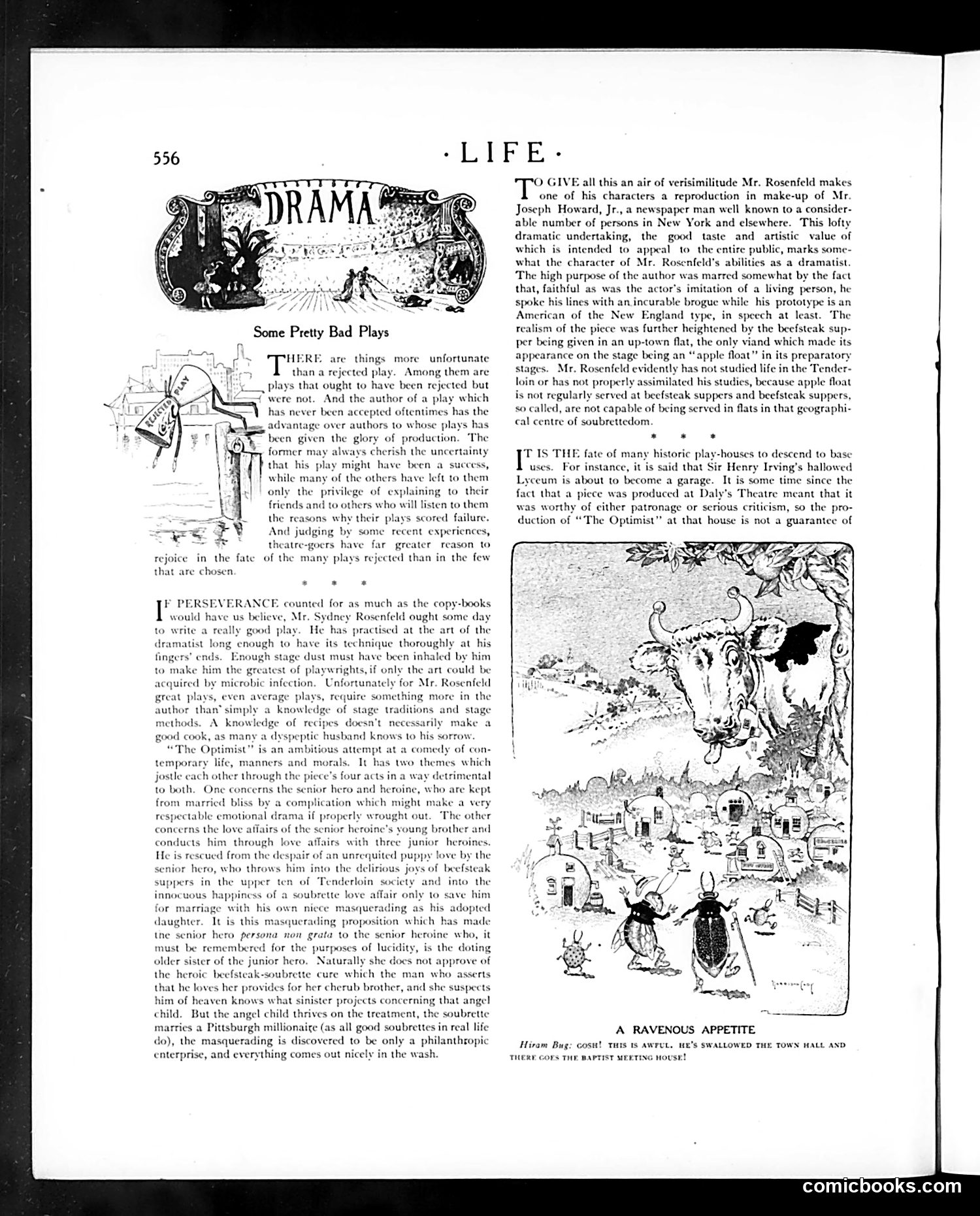
This page critiques several contemporary theatrical productions, particularly Sydney Rosenfeld's plays. The main article, "Some Pretty Bad Plays," argues that rejected plays are sometimes fortunate—at least they avoid public failure. Rosenfeld receives particular criticism for his dramatic technique and lack of authentic observation. The text specifically mocks Rosenfeld's use of Joseph Howard Jr., a known New York newspaper figure, as a character, noting the actor performed with an Irish brogue despite Howard being a New England-type American. The piece also ridicules an "apple float" served at a Tenderloin flat, suggesting Rosenfeld hadn't properly researched such settings. The accompanying illustration, titled "A Ravenous Appetite," depicts a goat consuming the contents of a room, likely satirizing poor theatrical taste or excessive dramaturgy. The overall tone suggests Life's theater critics found Rosenfeld's work technically competent but artistically hollow and lacking authentic social observation.
📄 Transcribed text from this page (OCR, searchable)
Machine-transcribed from the original scan — historical spelling and the odd misread are preserved.
LIFE ) GIVE all this an air of verisimilitude Mr. Rosenfeld makes one of his characters a reproduction in make-up of Mr. Joseph Howard, Jr., a newspaper man well known to a consider- able number of persons in New York and elsewhere. This lofty dramatic undertaking, the good taste and artistic value of which is intended to appeal to the entire public, marks some- what the character of Mr. Rosenfeld’s abilities as a dramatist. The high purpose of the author was marred somewhat by the fact that, faithful as was the actor's imitation of a living person, he spoke his lines with an incurable brogue while his prototype American of the New England type, in speech at least Some Pretty Bad Plays realism of the piece was further heightened by the beefsteak sup- HERE. are things more unfortunate appearance on the stage being an “apple float” in its preparatory than a rejected play. Among them are ages. Mr. Rosenfeld evidently has not studied life in the Tender- plays that ought to have been rejected but loin or has not properly assimilated his studies, because apple float —F were not. And the author of a play which is not regularly served at beefsteak suppers and beefsteak suppers, has never been accepted oftentimes has the _ $0 Called, are not capable of being served in flats in that geograph de ss advantage over authors to whose plays h cal centre of soubrettedom been given the glory of production. former may always cherish the uncertainty T IS THE fate of many historic play-houses to descend to base that his play might have been a success, uses. For instance, it is said that Sir Henry Irving’s hallowed while many of the others have left to them Lyceum is about to become a garage. It is some time since the only the privilege of explaining to their fact that a piece was produced at Daly's Theatre meant that it friends and to others who will listen to them was worthy of cither patronage or scrious criticism, so the pro- the reasons why their plays scored failure. duction of The Optimist” at that house is not a guarantee of And judging by some recent experiences, re-gocrs have far greater reason to rejoice in the fate of the many plays rejected than in the few F PERSEVERANCE counted for as much as the copy-books I would have us believe, Mr. Sydney Rosenfeld ought some day write a really good play. He has practised at the art of the dramatist enough to have its technique thoroughly at his fingers’ ends. Enough stage dust must have been inhaled by him to make him the greatest of playwrights, if only the art could be acquired by microbic infection. Unfortunately for Mr. Rosenfeld great plays, even average plays, require something more in the than’ simply: « ge of stage traditions methods. A knowledge of recipes doesn’t necessarily good cook, as many a dyspeptic hus knows to his so “ i tious attempt at a comedy of con- temporary li crs a rals. It has two themes which stle cach other through the piece’s four acts in a way detrimental to both. One concerns the senior hero and f vho are kept from married bliss by a complication which might make a very respectable emotional drama if properly wroug other concerns the love affairs of the senio: : conducts him through love affairs with three junior heroines. He is rescued from the despa qquited puppy love by the senior hero, who throws him in > delirious joys of beefsteak pers in the upper ten of Tenderloin society and into the innocuous happiness of a soubrette love affair only to save him F marriage with his own nicce masquerading as dopted daughter. It is this masquerading proposition which has made the senior hero persona non grata to the senior heroine who, it must be remembered for the purposes of lucidity, is the doting older sister of the junior hero. Naturally she docs not approve of the heroic beefsteak-soubrette cure which the man who asserts that he loves her provides for her cherub brother, and she suspects him of heaven knows what sinister projects concerning that angel child. But the angel child thrives on the treatment, the soubrette marries a Pittsburgh millionaire (as all good soubrettes in real life A RAVENOUS APPETITE do), the masquerading is discovered to be only a philanthropic jrisgm Bug: cost! THis ts AWFUL, E's SWALLOWED THE TOWN MALL AND enterprise, and everything comes out nicely in the wash. THEME COA THY ooTisY krone HesEL comicbooks.com