
A complete issue · 68 pages · 1927
Judge — October 15, 1927
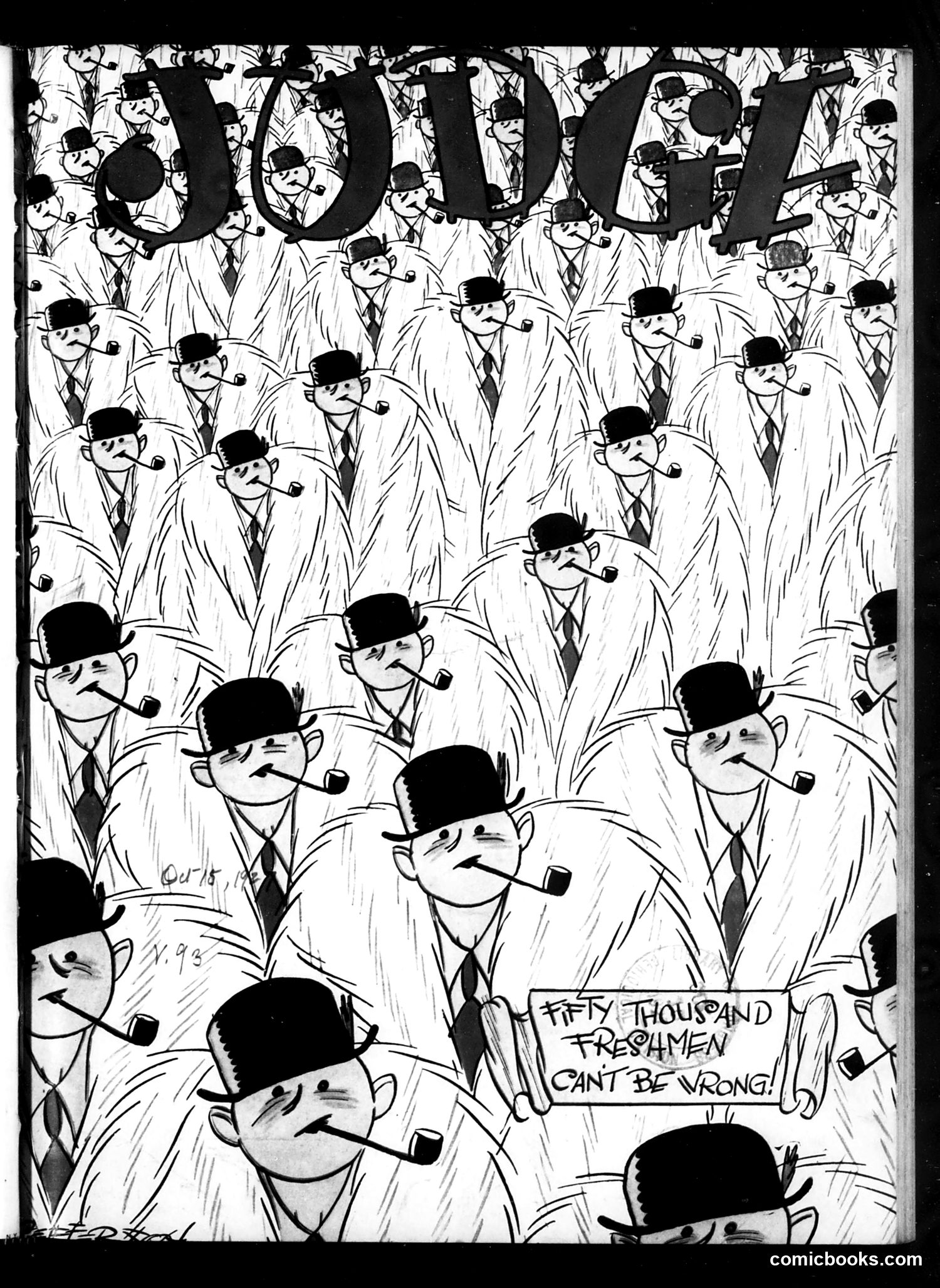
This **Judge** magazine cartoon satirizes college conformity and herd mentality. The image depicts dozens of identical businessmen in bowler hats and suits, each smoking pipes—visual shorthand for the "respectable" establishment type. The text "FIFTY THOUSAND FRESHMEN CAN'T BE WRONG!" mocks the pressure on college students to conform to prevailing attitudes and fashions. The repetitive, identical figures emphasize how individuality is erased through social conformity. The large text overlay at the top appears fragmented but likely conveys the satirical message. This cartoon criticizes how mass culture and peer pressure homogenize young people, transforming diverse individuals into indistinguishable members of a conformist crowd—a recurring concern in American satire about education and social standardization.
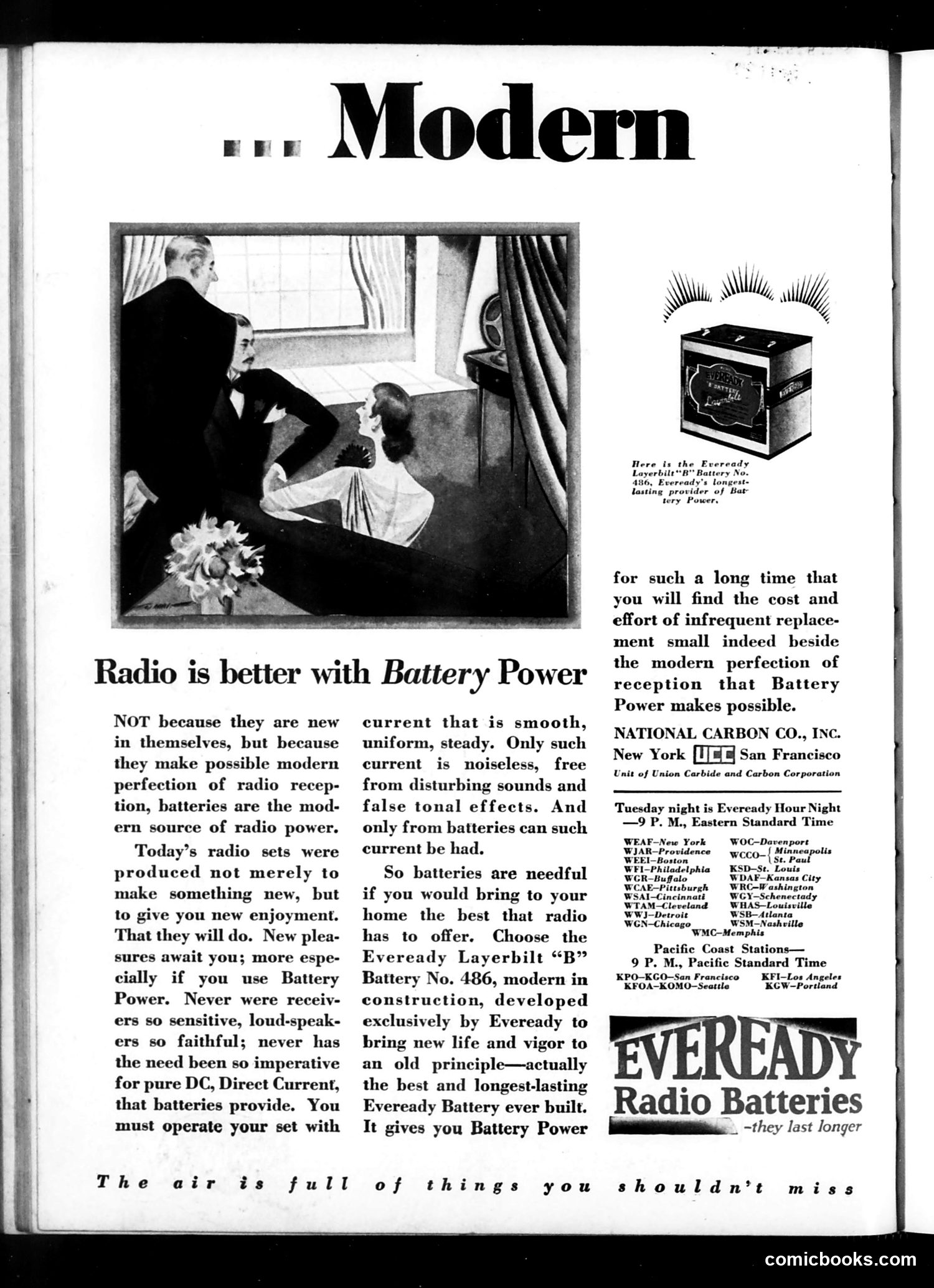
This page is **primarily an advertisement**, not satirical content. It promotes Eveready Radio Batteries (National Carbon Co., Inc.) to Judge magazine readers. The advertisement features a domestic scene showing a well-dressed couple listening to radio, with the woman reclining. The copy emphasizes that battery-powered radios provide superior reception compared to other power sources—specifically, "smooth, uniform, steady" direct current without "disturbing sounds and false tonal effects." The ad targets affluent households, positioning radio as a modern luxury requiring quality batteries for optimal performance. The Eveready Layerbilt "B" Battery No. 486 is promoted as "the best and longest-lasting Eveready Battery ever built." The accompanying radio station call letters suggest this ran in a major market publication. This represents early 20th-century consumer advertising in a prestigious satirical magazine.
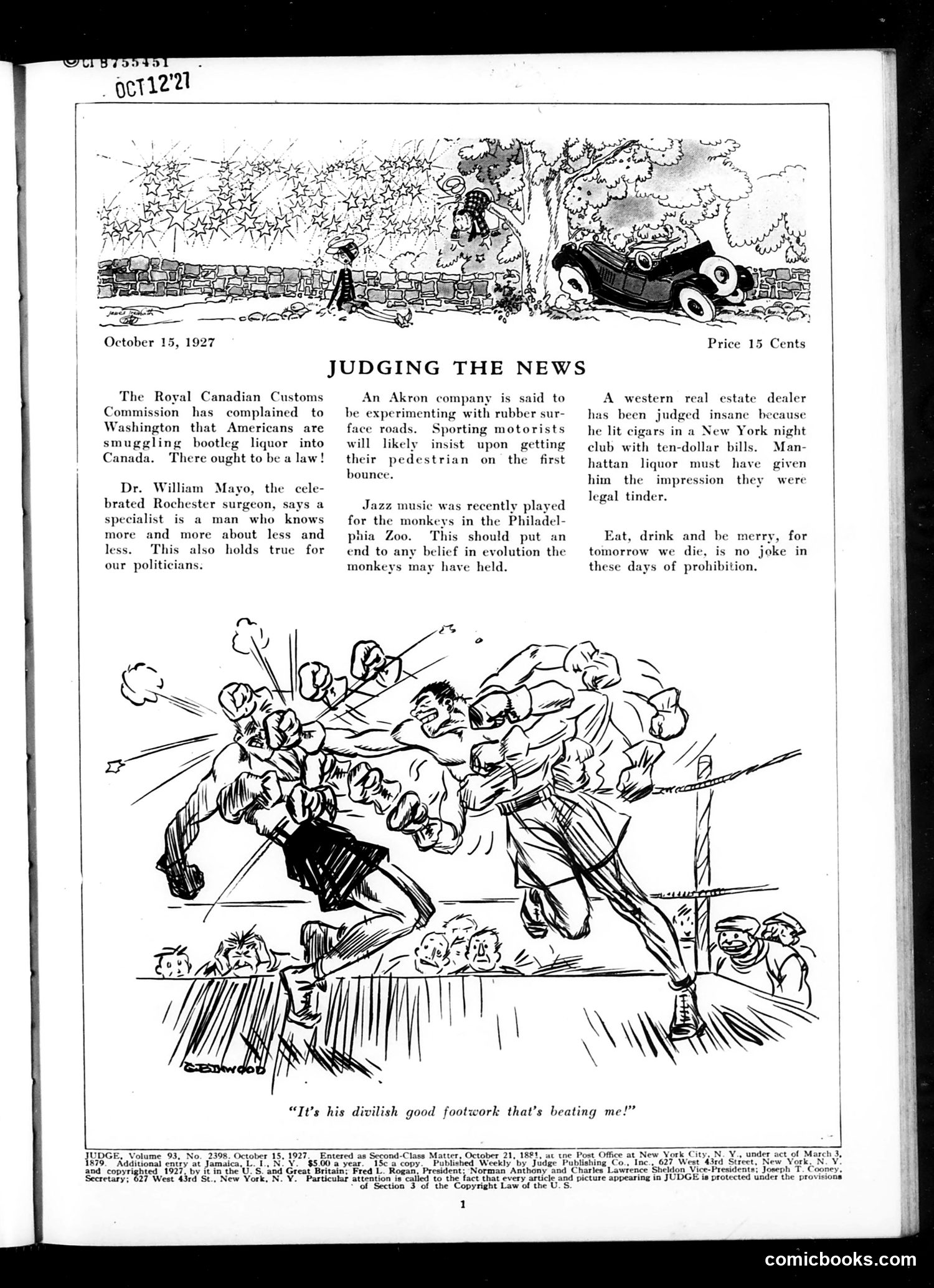
The main cartoon depicts a boxing match with the caption "It's his devilish good footwork that beating me!" The satire likely comments on contemporary boxing or politics, though without identifying specific fighters or figures, the exact target remains unclear. The "Judging the News" section above contains brief satirical commentary on current events: complaints about American alcohol smuggling into Canada, an Akron company testing rubber roads for motorists, jazz music played for monkeys at Philadelphia Zoo, and a real estate dealer using ten-dollar bills as currency in prohibition-era New York. These items exemplify 1920s American concerns: bootlegging, automotive innovation, jazz-age culture, and prohibition's economic absurdities.
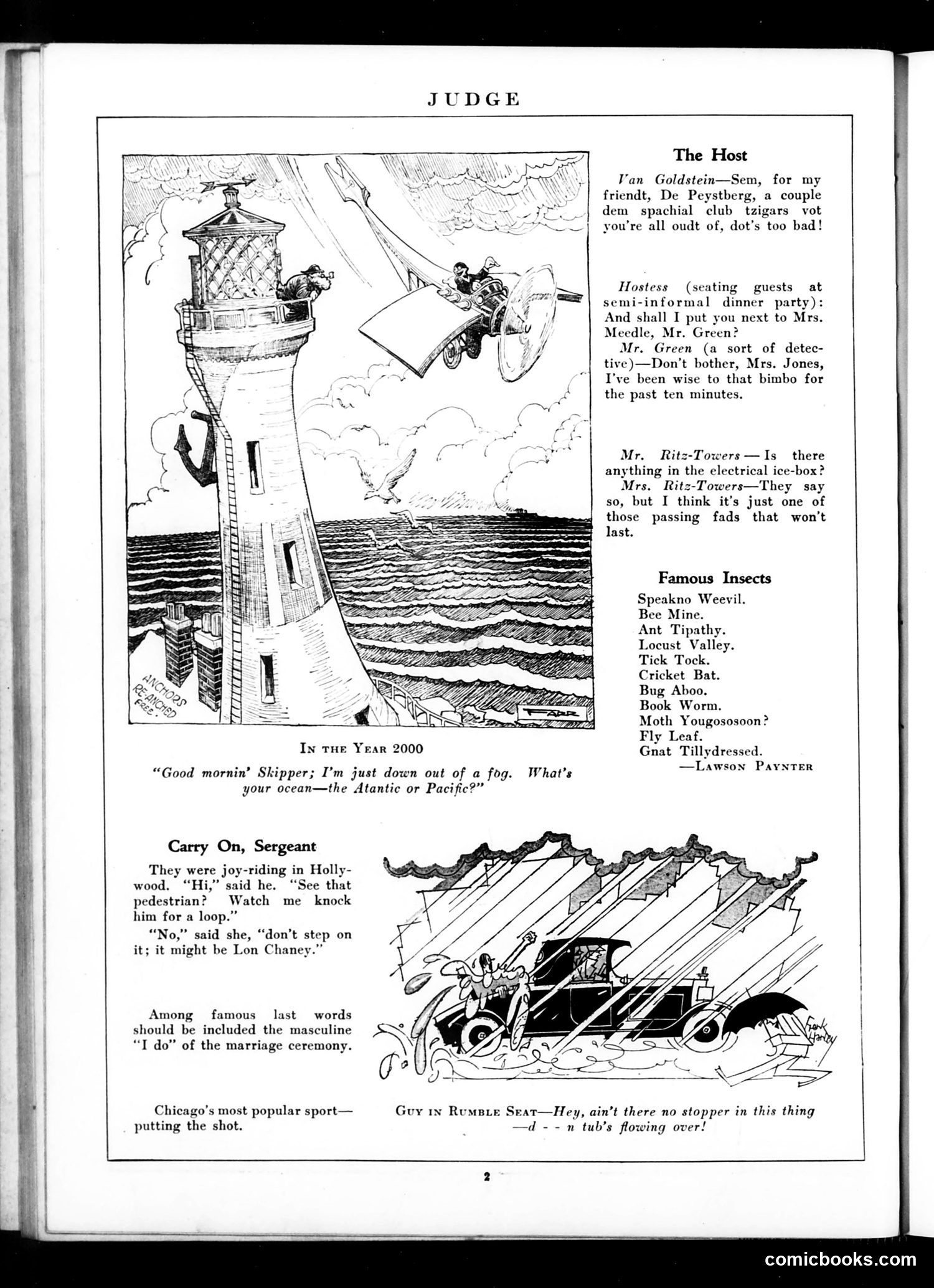
This page contains several unrelated humorous sketches typical of Judge's satirical format: **"The Host"** features dinner-party dialogue poking fun at wealthy social pretension and awkward guest interactions—a recurring Judge theme mocking upper-class manners. **"In the Year 2000"** depicts a futuristic lighthouse scene with an airship, satirizing turn-of-century anxieties about technological progress and transportation. **"Carry On, Sergeant"** is a brief joke about mistaking a pedestrian for someone named "Lon Chaney" (likely referencing the silent-film actor). **"Guy in Rumble Seat"** shows an automobile accident, poking fun at early motorcar hazards and the popular "rumble seat" feature. The page also includes a whimsical list of "Famous Insects" with pun-based names by contributor Lawson Paynter, and a note that putting the shot was Chicago's most popular sport.
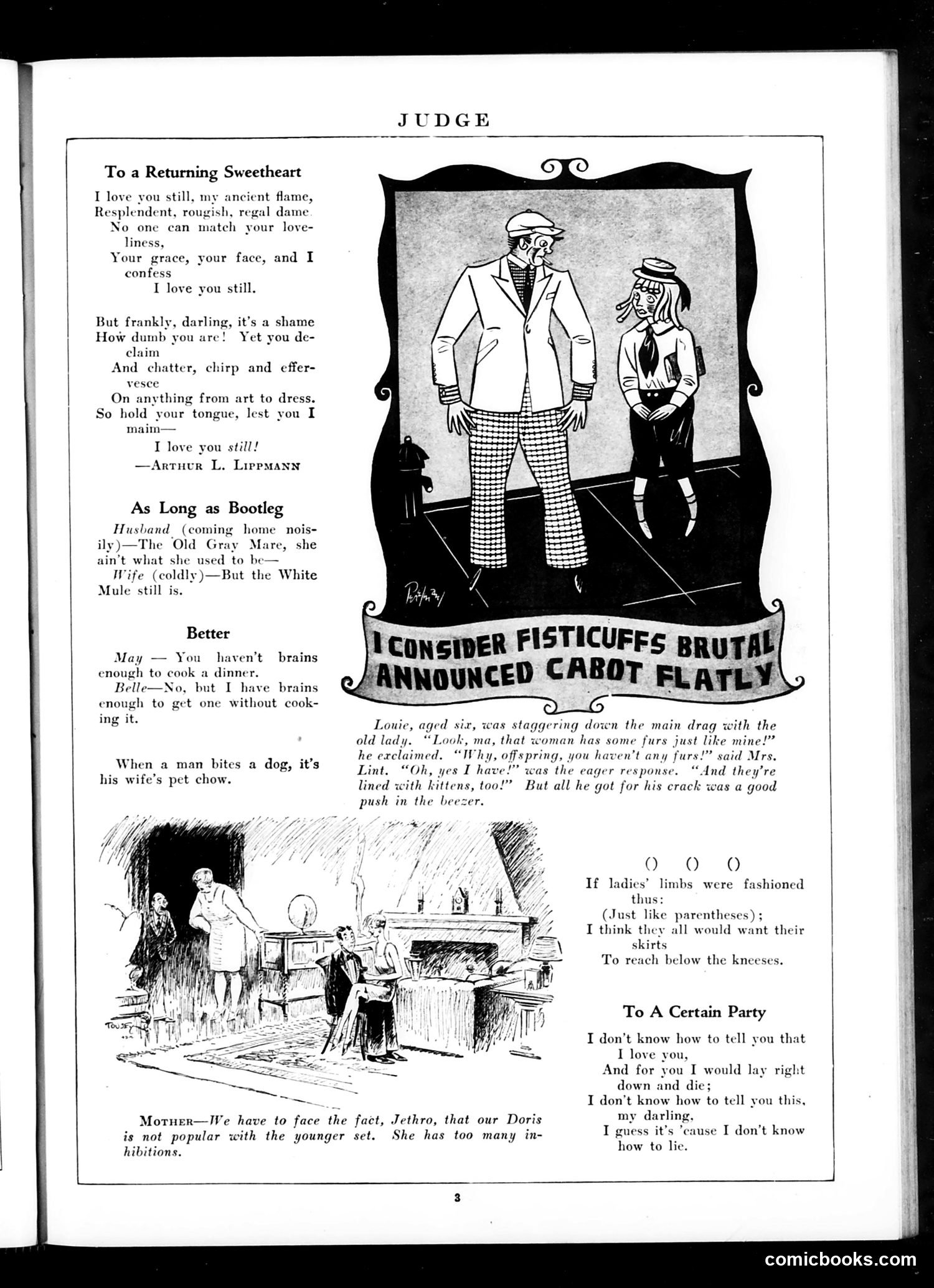
This page from *Judge* magazine contains primarily humorous poetry and light social commentary rather than political cartoons. The main cartoon, "I Consider Fisticuffs Brutal Announced Cabot Flatly," depicts a couple discussing their mule, apparently making an oblique joke about physical violence and class pretension. The accompanying narrative suggests wordplay about mules and furs. Other pieces include: - A poem mocking a returning sweetheart's lack of intelligence - A joke about a husband and wife with a dog - Domestic humor about cooking abilities - A sketch of a family scene The content reflects typical early 20th-century *Judge* humor: domestic situations, marital comedy, and light social observation. The "O O O" section jokes about women's fashion (limbs shaped like parentheses). Overall, this is social satire rather than political commentary, targeting contemporary manners and gender dynamics.
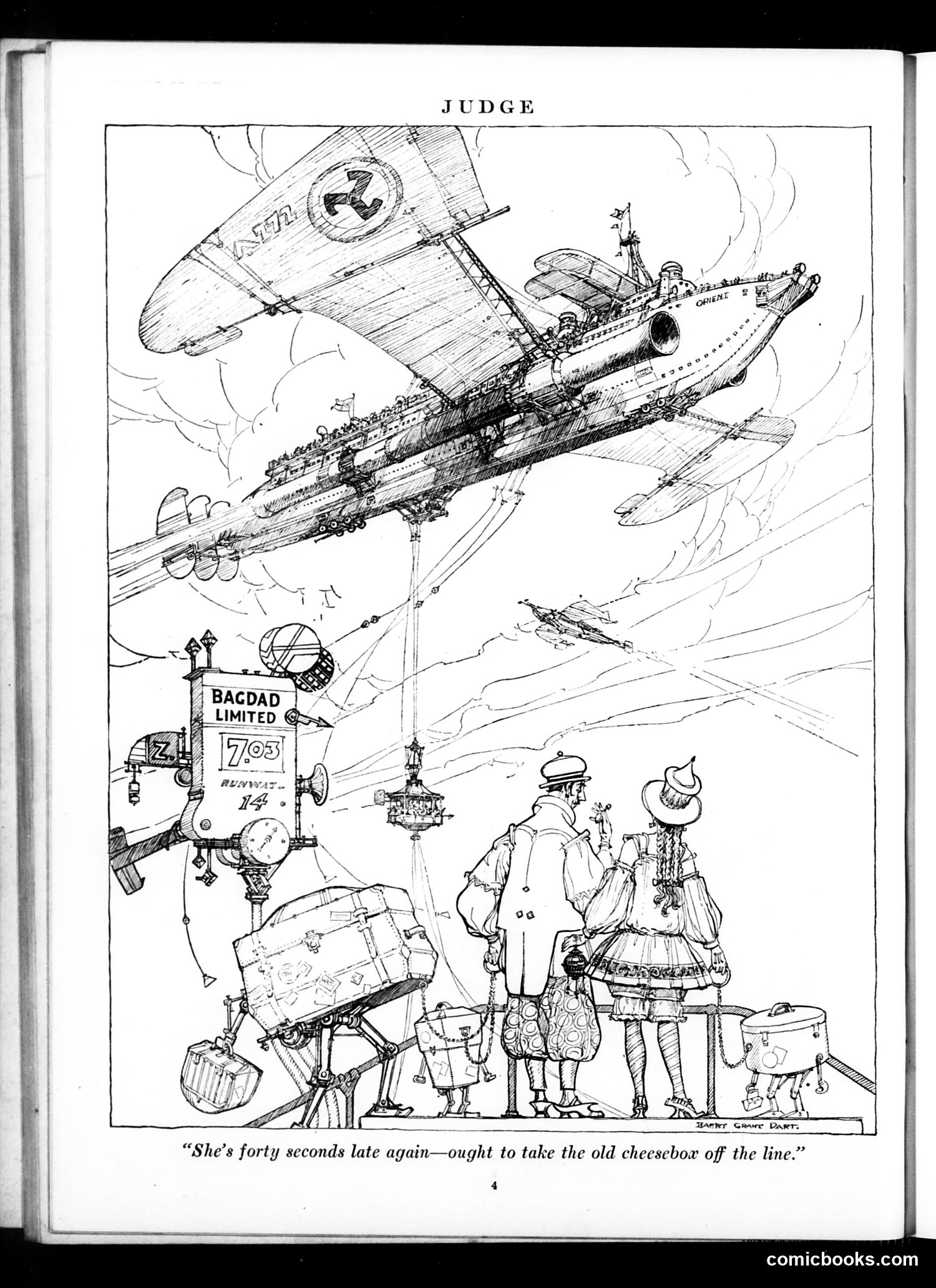
This is a single satirical cartoon depicting futuristic air travel. The title "JUDGE" appears at the top, and the caption reads: "She's forty seconds late again—ought to take the old cheesebox off the line." The cartoon shows a massive airship labeled "BAGDAD LIMITED" (suggesting a luxury passenger service route) arriving late while ground crew and passengers wait below with luggage. Multiple aircraft are visible in the sky, suggesting an established air transportation system. The satire appears to target the unreliability of early commercial aviation, mocking both the grandiose naming of air routes and the expectation that such service would be punctual. The term "cheesebox" is derisive slang for an inferior vessel. The cartoon suggests contemporary concerns about whether aviation could deliver on promises of modern, efficient transportation.
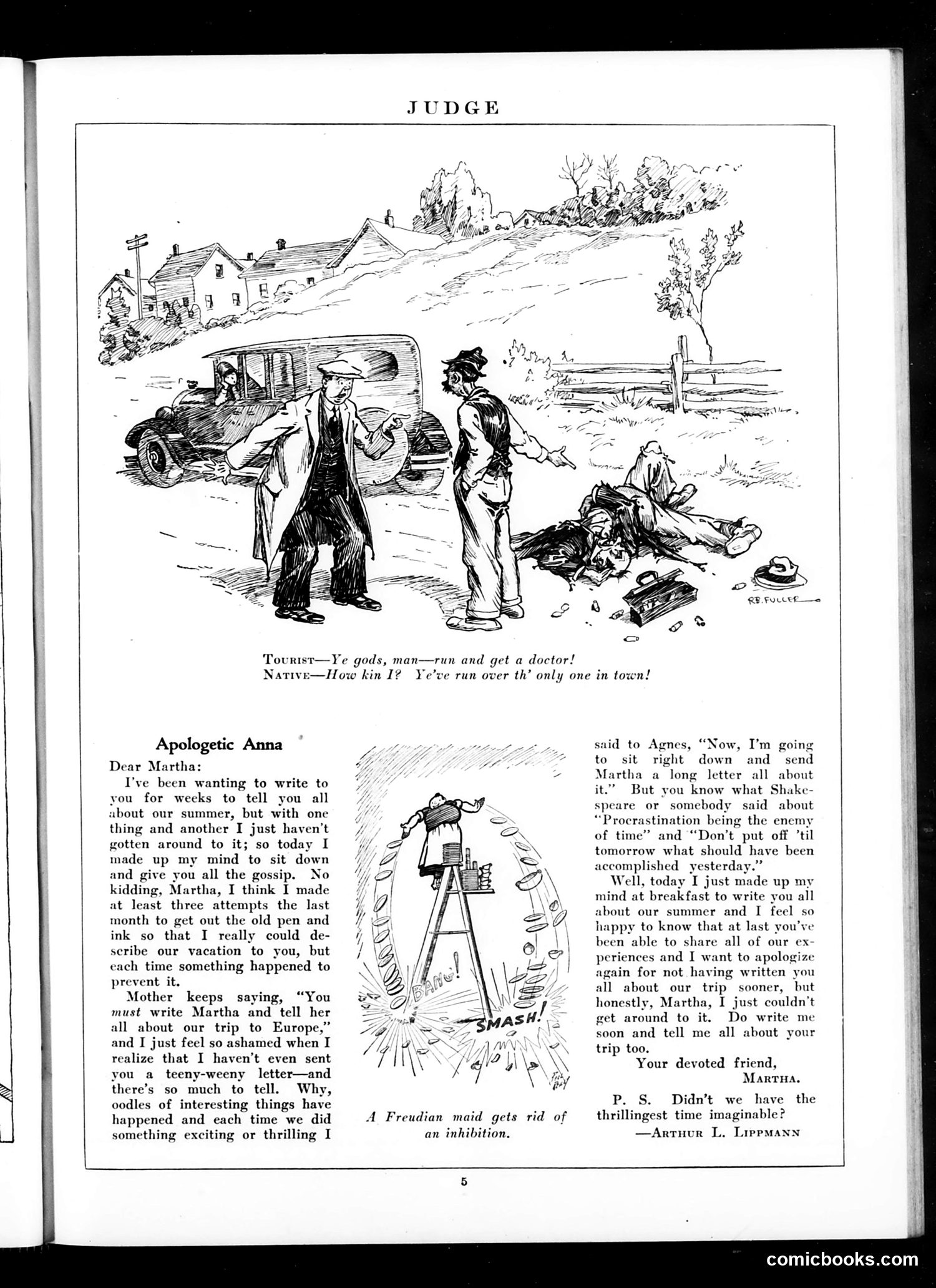
**Top Cartoon ("Judge"):** This depicts a car accident involving tourists and a local resident. The "native" sarcastically notes they've "run over th' only one in town" while the tourist demands a doctor. The satire mocks automobile dangers in rural America—specifically how cars were still novel and dangerous in small towns, and the irony that hitting the lone local person represents the rarest misfortune. It's commentary on early automotive culture's recklessness and the clash between modern city travelers and rural communities unprepared for motorized traffic. **Lower Section ("Apologetic Anna"):** This humorously depicts a woman's procrastination in writing vacation letters. The accompanying illustration shows a photographer destroying camera equipment—"A Freudian maid gets rid of an inhibition"—suggesting unconscious rebellion against photo documentation. The satire gently mocks the social obligation to share travel experiences and the anxiety surrounding belated correspondence.
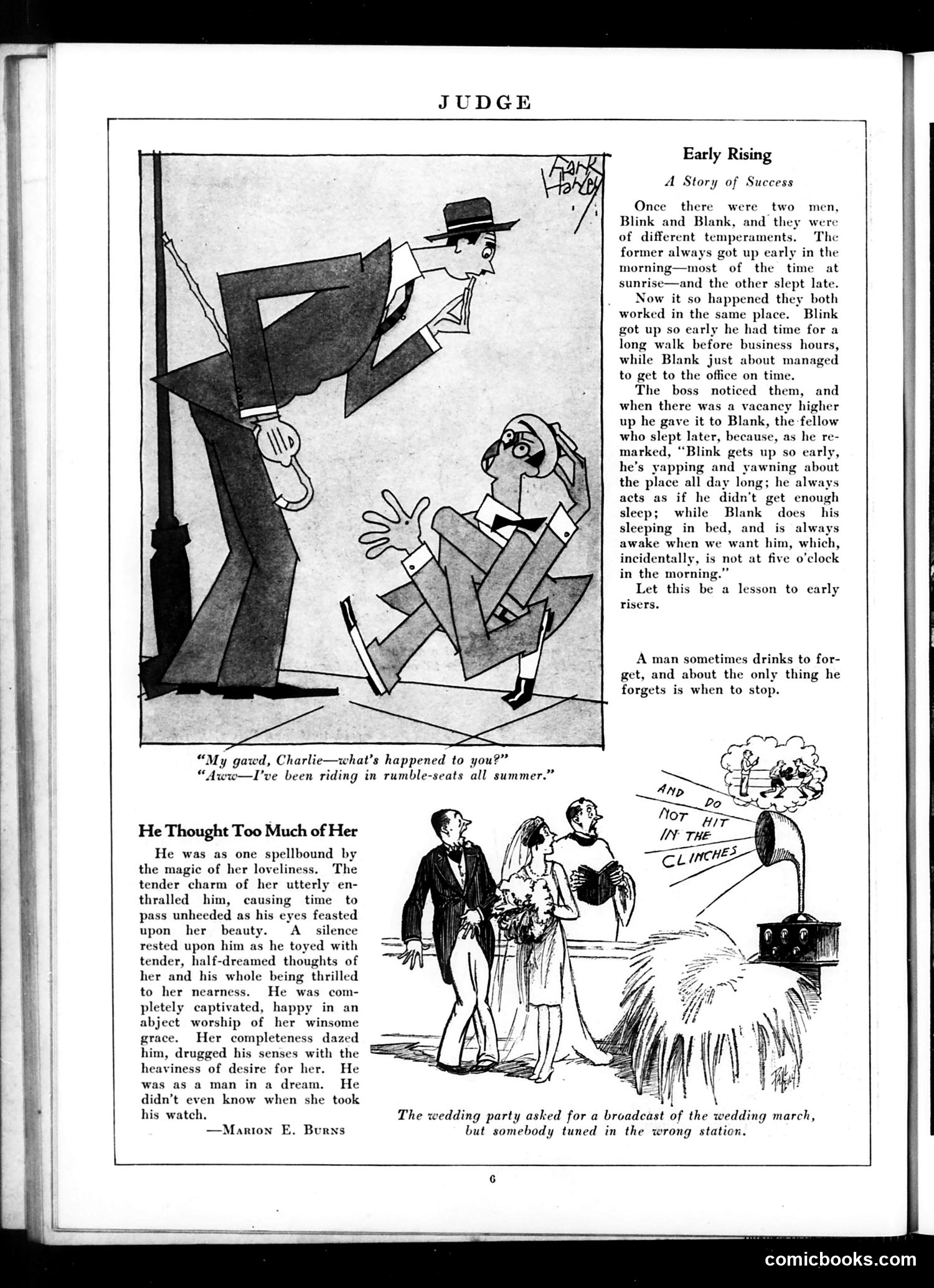
This page contains three distinct satirical pieces: **"Early Rising"** mocks the conventional wisdom that early rising ensures success. The cartoon shows an energetic early riser being passed over for promotion in favor of a late sleeper. The boss explains the early riser appears exhausted and distracted all day, while the late sleeper is fresh and alert during work hours. The satire undercuts the popular "early bird" aphorism. **"He Thought Too Much of Her"** is a romantic parody where flowery, sentimental prose about a man's devotion to a woman's beauty concludes with the punchline that he's so entranced he doesn't notice her stealing his watch—a cynical commentary on romantic delusion. **"The wedding party" cartoon** shows a bride and groom with what appears to be a radio malfunction during their ceremony, suggesting chaotic modern life intruding on traditional occasions. All three pieces use humor to deflate conventional sentiments about success, romance, and propriety—typical of Judge's satirical approach.
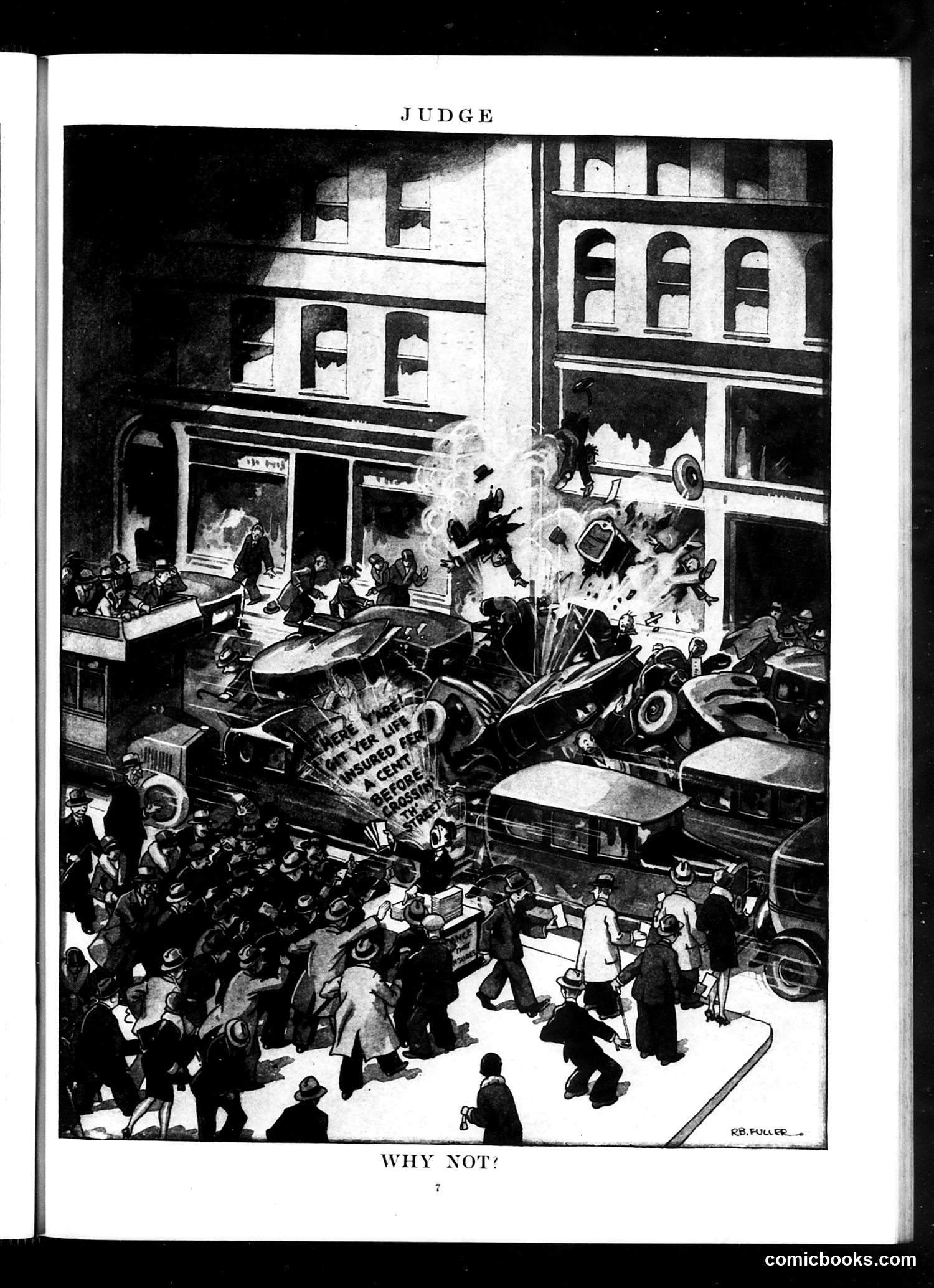
This is a satirical cartoon titled "Why Not?" depicting a chaotic street scene with an explosion or major accident involving multiple automobiles and a crowd of onlookers. A building with storefronts is visible in the background, with figures watching from windows and a balcony. The cartoon appears to criticize automobile safety or traffic regulation—the "why not?" likely sarcastically questions whether such dangerous, crowded street conditions should be allowed to continue. The composition suggests Judge magazine is commenting on the dangers of early automotive traffic in urban areas, possibly advocating for traffic laws or safety regulations that were lacking at the time. The artist's signature appears to be "KB Fuller" or similar. Without a specific date visible, the exact historical context remains unclear, though this likely dates to the early automobile era.
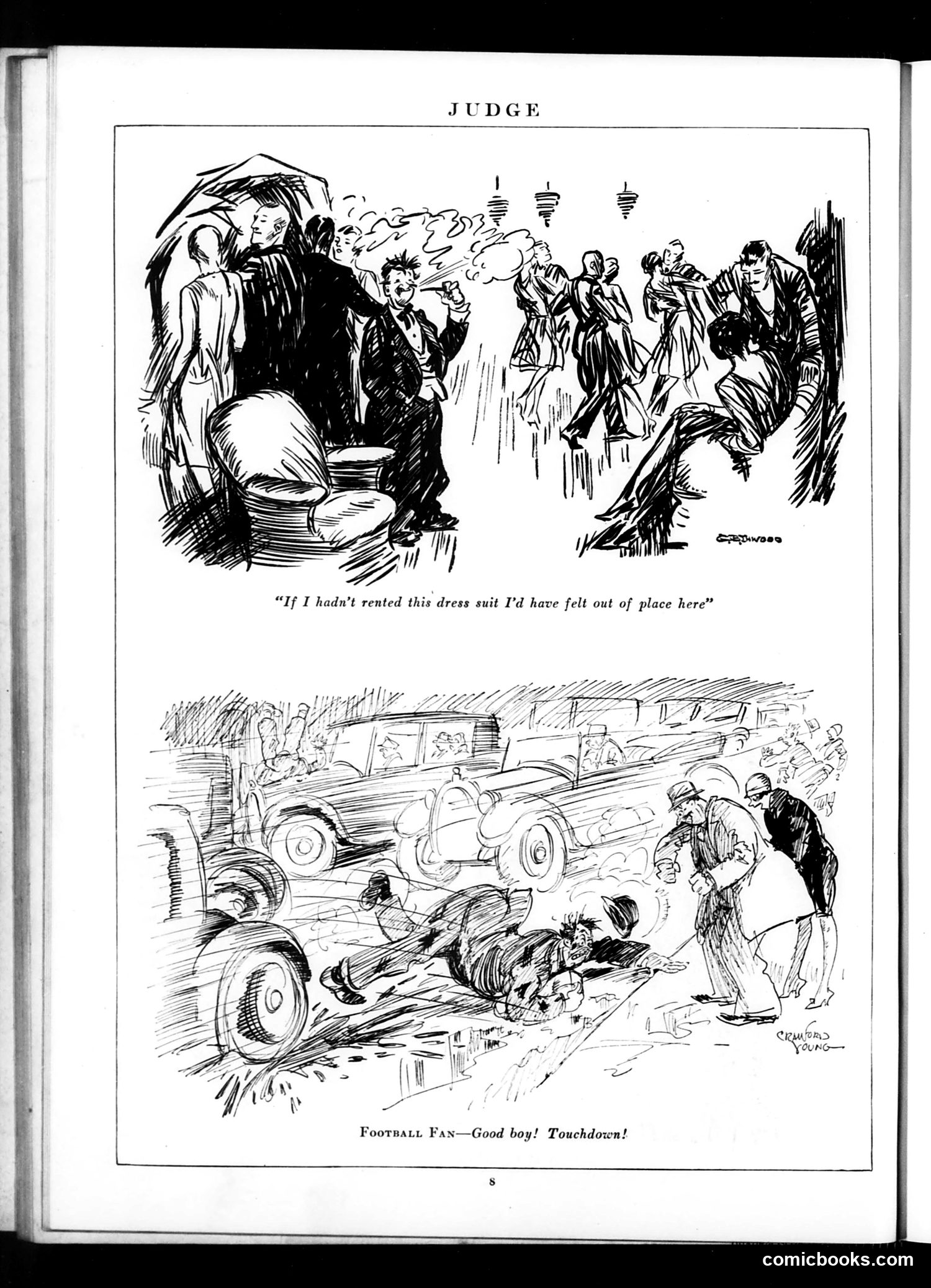
This page contains two unrelated cartoons satirizing American social pretensions. The **top cartoon** mocks class anxiety at formal events. A woman wearing a rented dress feels insecure among well-dressed attendees, suggesting that borrowed finery creates psychological discomfort—the satire targets both her self-consciousness and the superficiality of dress-based social judgment. The **bottom cartoon** ridicules overzealous sports fans. A man enthusiastically cheers a football "touchdown" while gesturing wildly at what appears to be a serious car accident, confusing the tragic collision with a football play. The joke satirizes fans who are so absorbed in sports they've lost perspective on real-world events happening around them. Both cartoons reflect Judge's typical early-20th-century humor targeting middle-class vanity and American sports culture's outsized social importance.
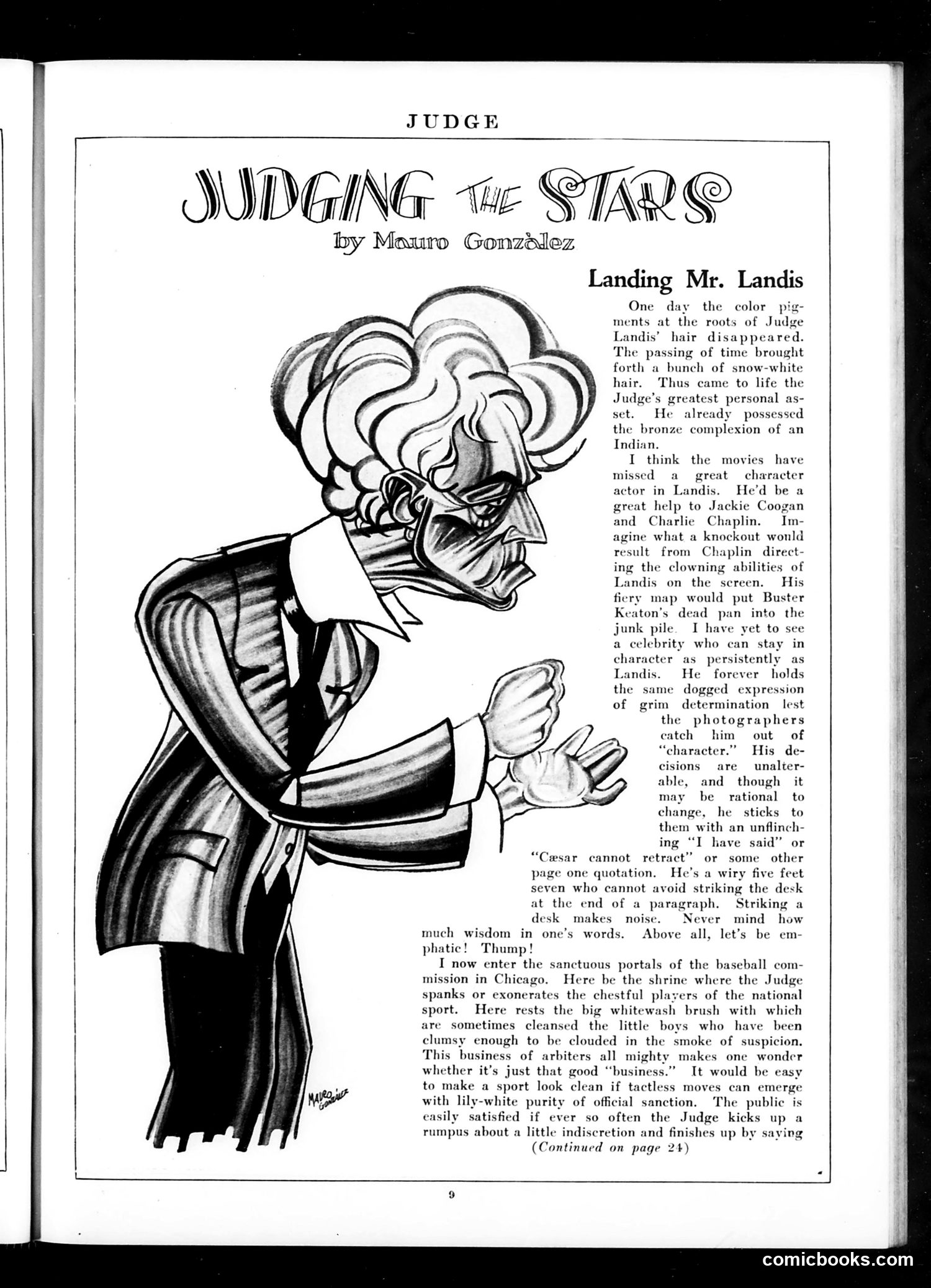
This article satirizes **Judge Landis**, Commissioner of Major League Baseball, through caricature and commentary. The cartoon depicts him as a distinctive figure with white hair and dark complexion, emphasized as his "greatest personal asset." The satire works on multiple levels: 1. **Physical mockery**: His appearance is exaggerated for comedic effect; the author imagines him as a potential silent-film actor alongside Chaplin and Keaton. 2. **Personality critique**: Landis is portrayed as stubbornly theatrical—constantly striking his desk for emphasis, never reconsidering decisions, robotically maintaining "grim determination" to appear authoritative. 3. **Institutional critique**: The author questions whether baseball's disciplinary system is genuine justice or mere "business"—suggesting Landis uses theatrical displays of morality (the "whitewash brush") to maintain public confidence while potentially overlooking actual misconduct. The piece suggests Landis prioritizes appearance and dramatic performance over substantive governance of professional baseball.
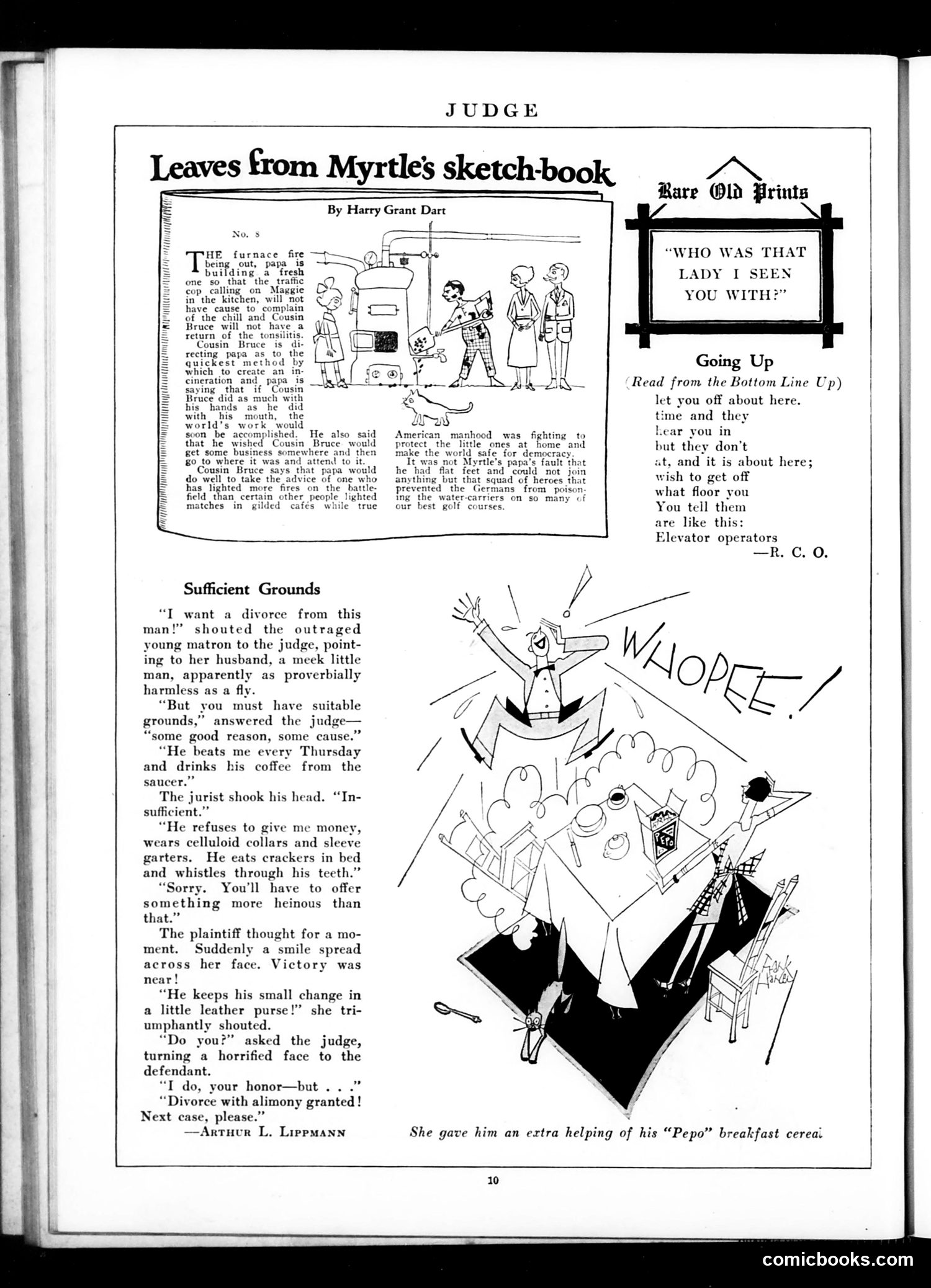
This page contains three satirical pieces typical of Judge's humor circa World War I era: **"Leaves from Myrtle's Sketch-Book"** (top): A domestic comedy strip by Harry Grant Dart showing a father and Cousin Bruce building a furnace. The joke contrasts Bruce's talkativeness with his actual usefulness—he talks extensively about business and patriotism while being no more helpful than soldiers who fought in WWI. **"Going Up"** (right): A short poem mocking elevator operators who complain about passengers asking them questions, portraying them as lazy and unhelpful. **"Sufficient Grounds"** (bottom): A judge humor piece by Arthur L. Lippmann. A woman seeks divorce on increasingly trivial grounds (beating, drinking from saucer, refusing money, wearing cheap collars, eating crackers in bed). The judge dismisses each until she mentions her husband keeps coins in a *leather purse*—which horrifies the judge enough to grant the divorce. The satire mocks both judicial absurdity and masculine vanity about appearance/propriety.
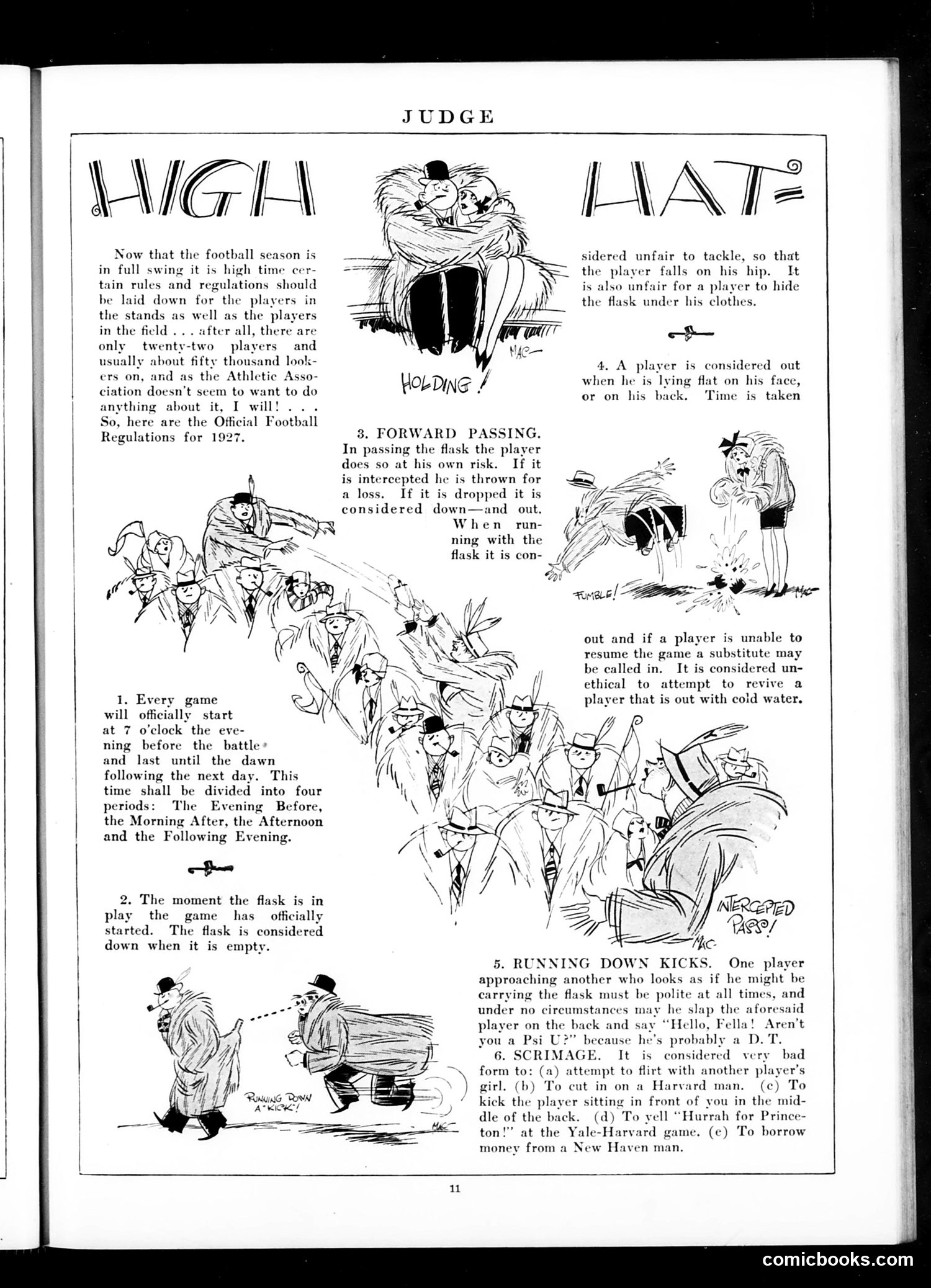
This page satirizes Prohibition-era college football culture by mock-seriously presenting "Official Football Regulations" that are actually about **smuggling and drinking alcohol at games**, not playing football itself. The joke plays on the contrast between legitimate sports rules and the elaborate social codes governing **flask-passing** among spectators—treating contraband liquor distribution like actual football plays ("forward passing," "running down kicks," "scrimmage"). References include: - **"Flask"** as the central "player" being moved around - **"D.T."** (delirium tremens—alcohol withdrawal hallucinations) - **Yale-Harvard game** (major college football rivalry) - **"Psi U"** (fraternity reference) The cartoons depict disheveled drinkers and the chaos of intoxicated fans. This mocks both Prohibition's ineffectiveness among the wealthy college set and the absurdity of trying to hide drinking at public events. The satire suggests that at 1920s football games, consuming illegal alcohol was as organized and rule-governed as the sport itself.
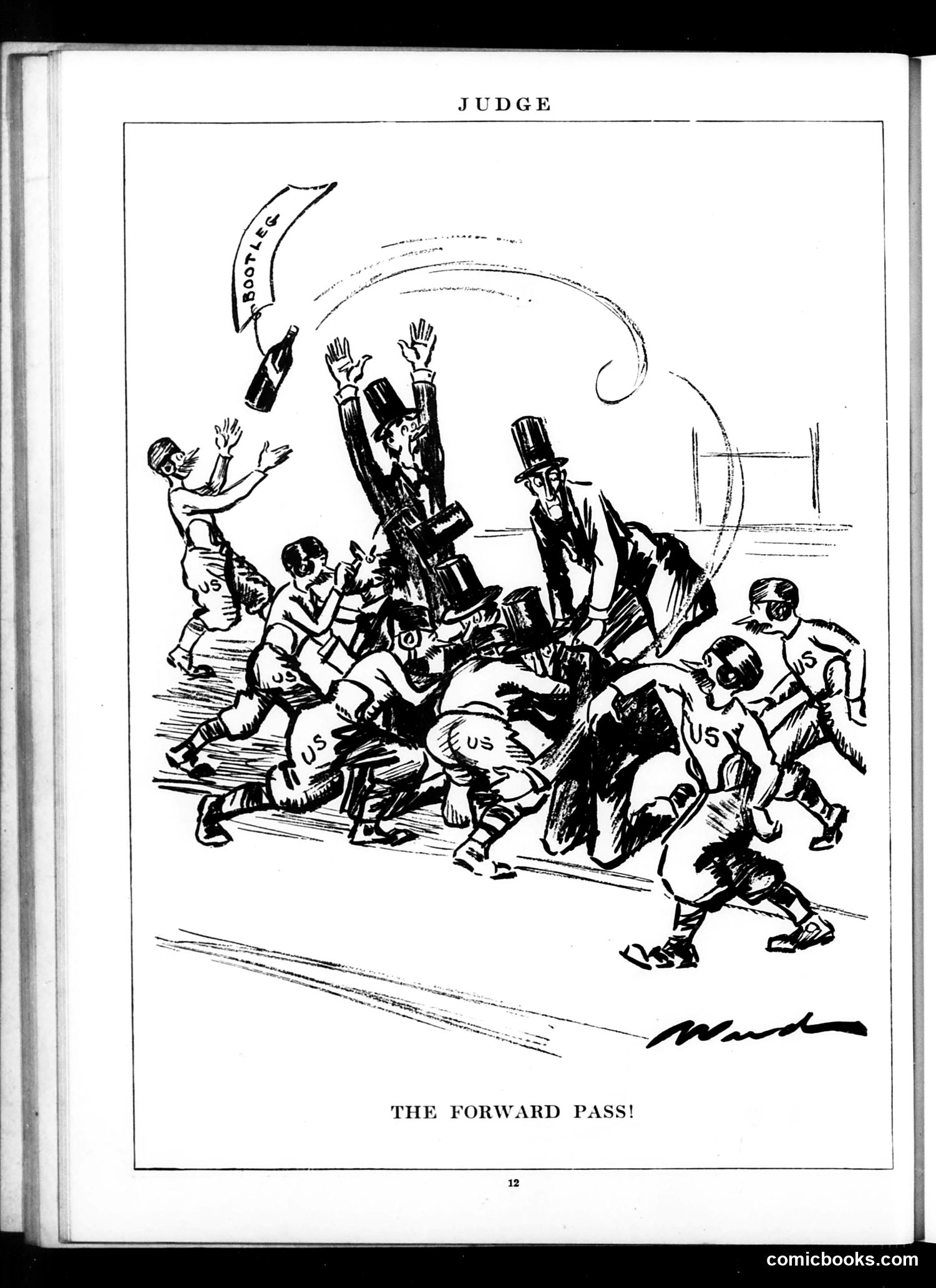
This political cartoon satirizes American football's forward pass rule (legalized in 1906) as a metaphor for chaotic or reckless governance. The central figure—a tall man in a top hat labeled "ROOSEVELT"—executes a forward pass while surrounded by smaller figures marked "US" (representing American citizens or institutions) in disarray. Some figures tumble, others reach skyward in confusion. The "BOOTLEG" flag in the upper left suggests illicit or unauthorized action. The satire critiques Theodore Roosevelt's presidency as unpredictable and destabilizing, using football terminology to suggest his policies created disorder rather than controlled progress. The chaotic scramble of citizens implies the public struggled to follow his administration's rapid reforms and assertive executive actions.
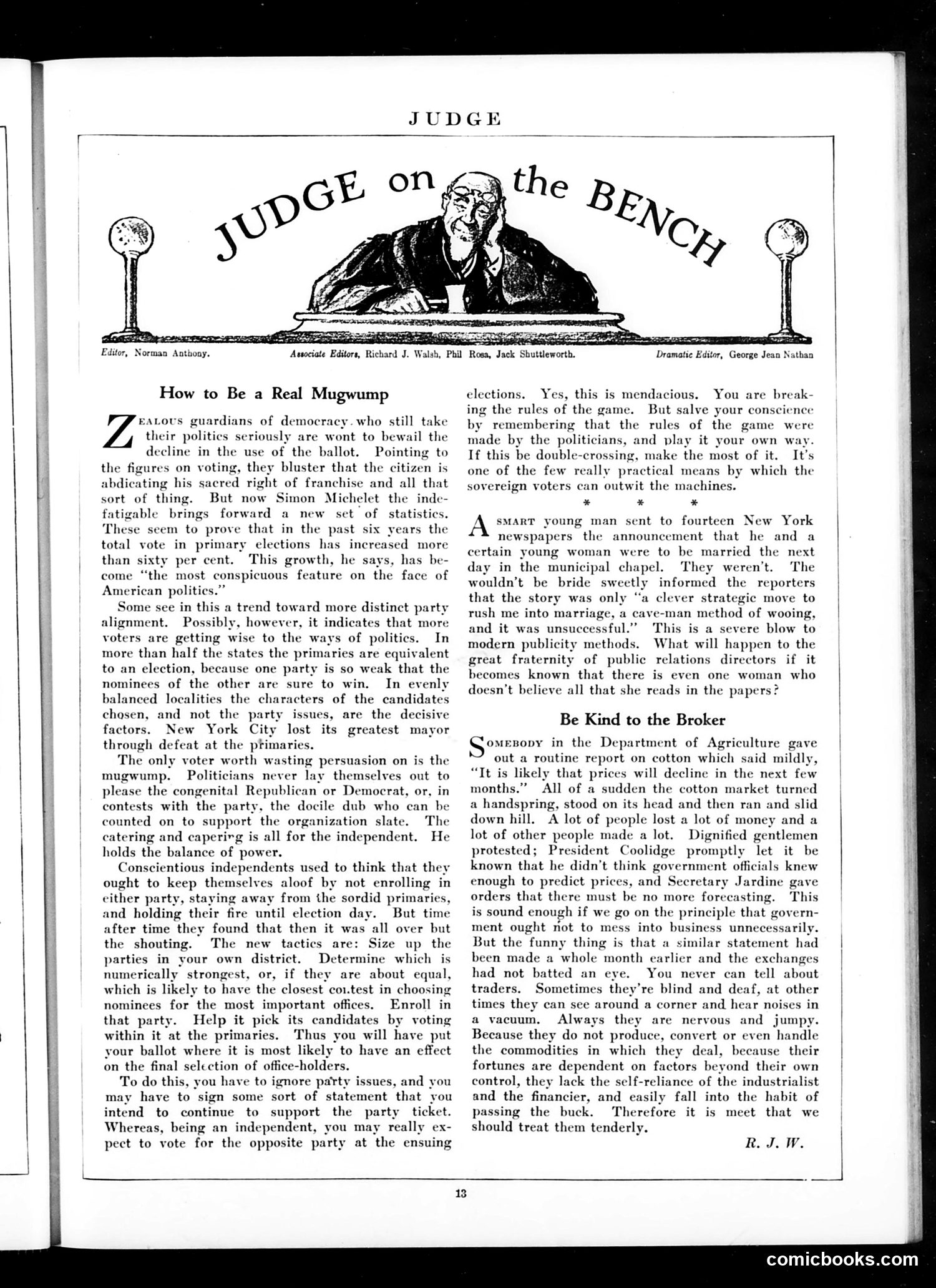
This page satirizes American political behavior, particularly around primary elections and voter independence. **"How to Be a Real Mugwump"** (main article) targets "mugwumps"—historically, Republicans who crossed party lines, but here meaning swing voters. The article ironically advises independents to: strategically join whichever party is stronger in their district, vote in its primaries to influence nominations, then freely vote for the opposing party in the general election. The satire suggests this "double-crossing" is actually *smart politics*—voters need only tell themselves they're following politicians' own rule-breaking tactics. **The cartoon header** shows a judge presiding—reinforcing the "bench" metaphor of judgment/authority. **The brief items below** mock publicists (a woman unmoved by staged marriage announcement) and commodity traders (Agriculture Department cotton forecasts causing market panic). The overall message: American voters and politicians operate as cynical game-players, not principled democrats. The "mugwump" strategy satirizes calculated political participation divorced from genuine civic engagement.
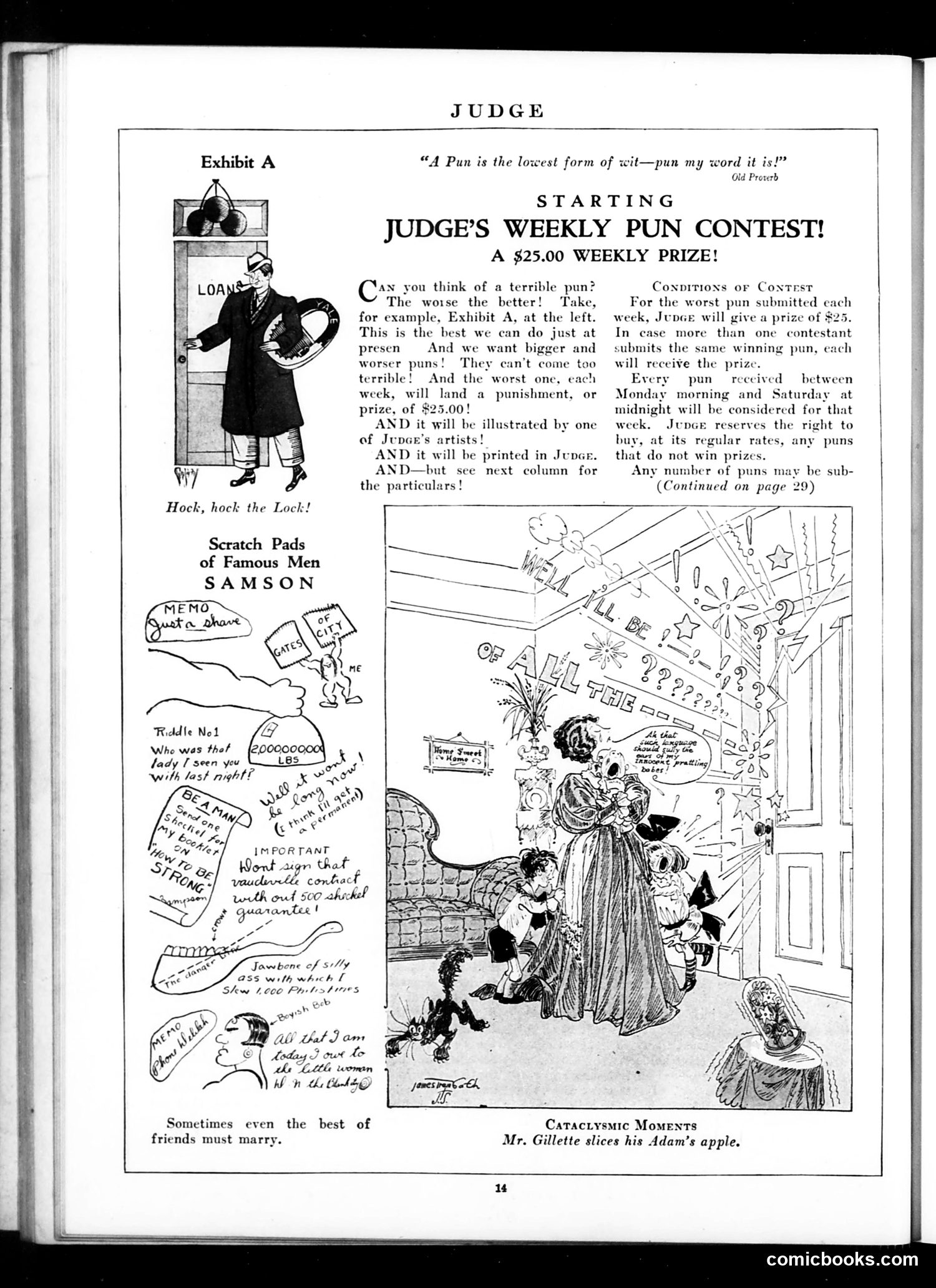
This page announces Judge's new weekly pun contest, offering $25 prizes for the worst puns submitted. The satirical angle is that Judge is explicitly seeking *terrible* puns—the worse, the better—inverting conventional contests that reward quality. "Exhibit A" shows a man at a pawn shop saying "Hock, hock the Lock!"—a painfully obvious pun on the word "hock." The left sidebar features "Scratch Pads of Famous Men," likely mocking celebrity memorabilia culture by imagining Samson's notes, which are hilariously mundane (a lost glove, mundane memories) despite his biblical fame. The bottom cartoon, "Cataclysmic Moments," shows Mr. Gillette slicing an "Adam's apple"—a visual pun on the name "Gillette" (a razor brand) combined with the anatomical term. The elaborate domestic scene appears designed for darkly humorous effect, treating dangerous mishap as comic fodder. The overall content reflects early 20th-century American satire's embrace of lowbrow wordplay and visual gags.
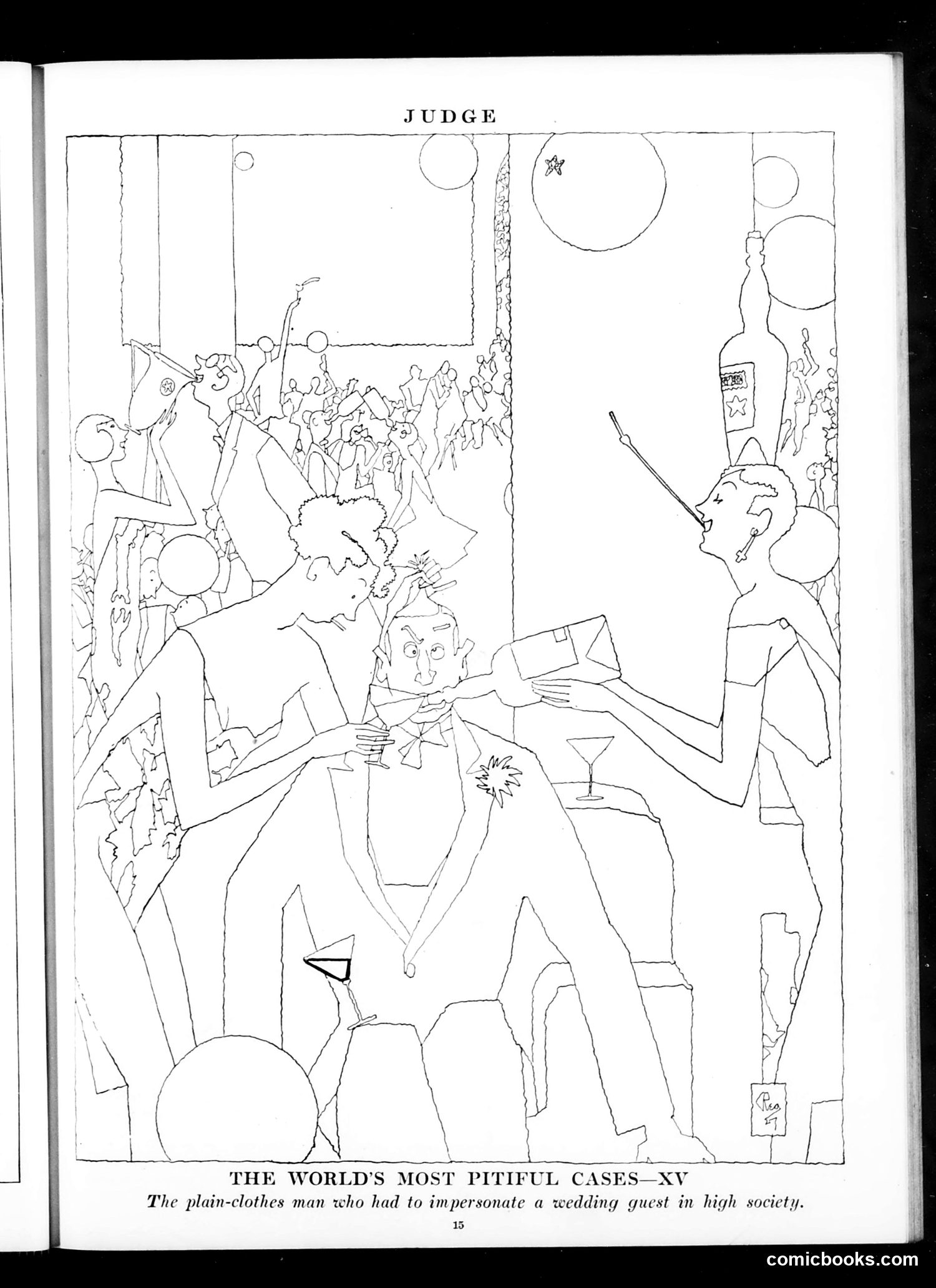
This cartoon from Judge magazine's "The World's Most Pitiful Cases" series depicts a satirical scene titled "The plain-clothes man who had to impersonate a wedding guest in high society." The humor targets class anxieties and the supposed awkwardness of ordinary people entering wealthy social circles. A working-class man (the "plain-clothes man," likely a police officer or detective in disguise) appears uncomfortable at an elegant wedding reception, surrounded by fashionable guests. The visual gag emphasizes the contrast between his simplicity and high-society pretension—he's clearly out of place despite attempting to blend in. The satire mocks both the rigidity of class boundaries and the superficiality of high society that would make an ordinary person's presence so conspicuous and uncomfortable. It's a commentary on early 20th-century American class consciousness and social exclusivity, suggesting that even in a celebratory context, rigid social hierarchies create absurd situations.
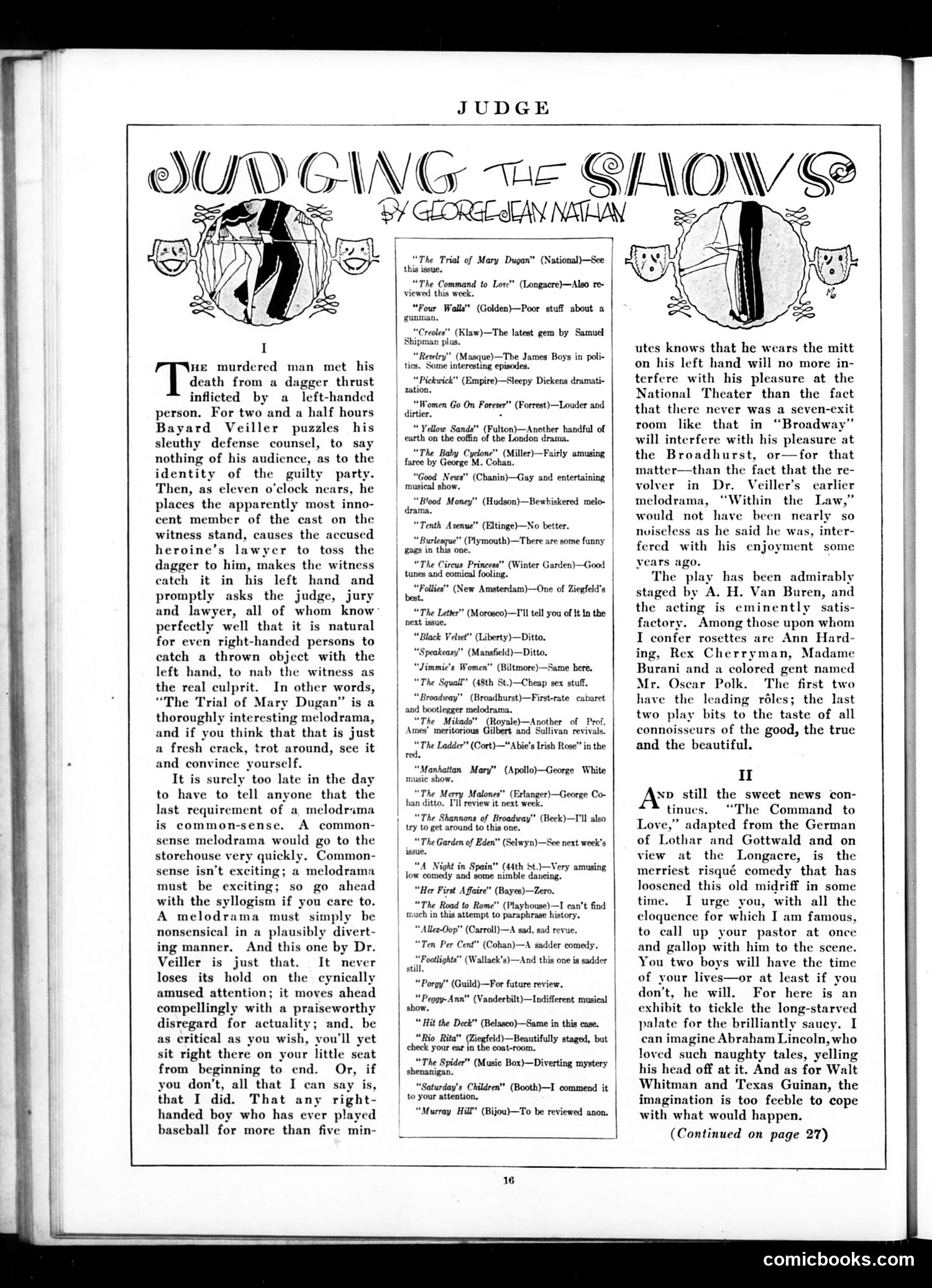
This page reviews Broadway theater productions. The main article discusses Bayard Veiller's melodrama *"The Trial of Mary Dugan,"* praising it as effectively entertaining despite—or because of—its logical absurdity. The plot hinges on a left-handed person catching a dagger, allowing the lawyer to falsely accuse an innocent witness. Nathan argues melodramas *must* be nonsensical to succeed; introducing realism would kill their appeal. He defends the genre's implausibility as necessary entertainment, declaring the play compulsively engaging regardless of critical objections. The surrounding text lists brief reviews of other Broadway shows opening that week, using Nathan's characteristic witty dismissals ("Poor stuff," "Cheap sex stuff"). The decorative header features theatrical masks, appropriate for theater criticism. This represents Judge magazine's cultural coverage—sophisticated drama criticism for educated readers.
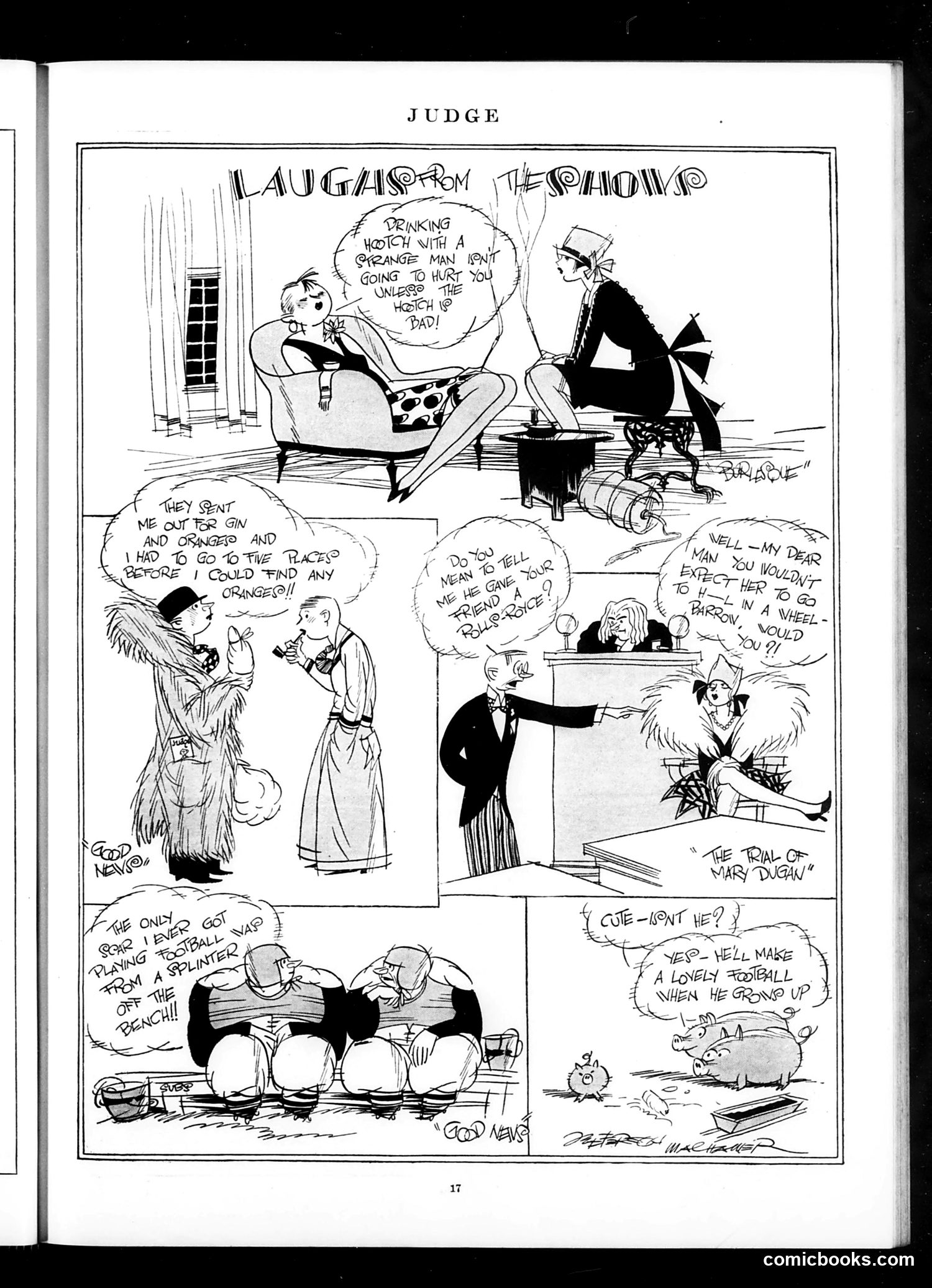
This page from *Judge* magazine satirizes "The Trial of Mary Dugan," likely a contemporary legal case or theatrical production (the OCR suggests a play title). The comic shows various characters gossiping about scandalous details: someone spent money on gin and racing, an "orange man" is involved in some indiscretion, and there are hints at moral impropriety. A judge presides over proceedings while spectators react dramatically. The satire targets sensationalist court coverage and public fascination with salacious trial details. The exaggerated reactions and melodramatic dialogue mock both the legal system's theatricality and society's appetite for scandal. The final panel's crude humor about a pig suggests the satirist views the entire proceeding as beneath dignity. The artwork style and references place this in the early 20th century, when high-profile trials were major public spectacles covered extensively in press and entertainment.
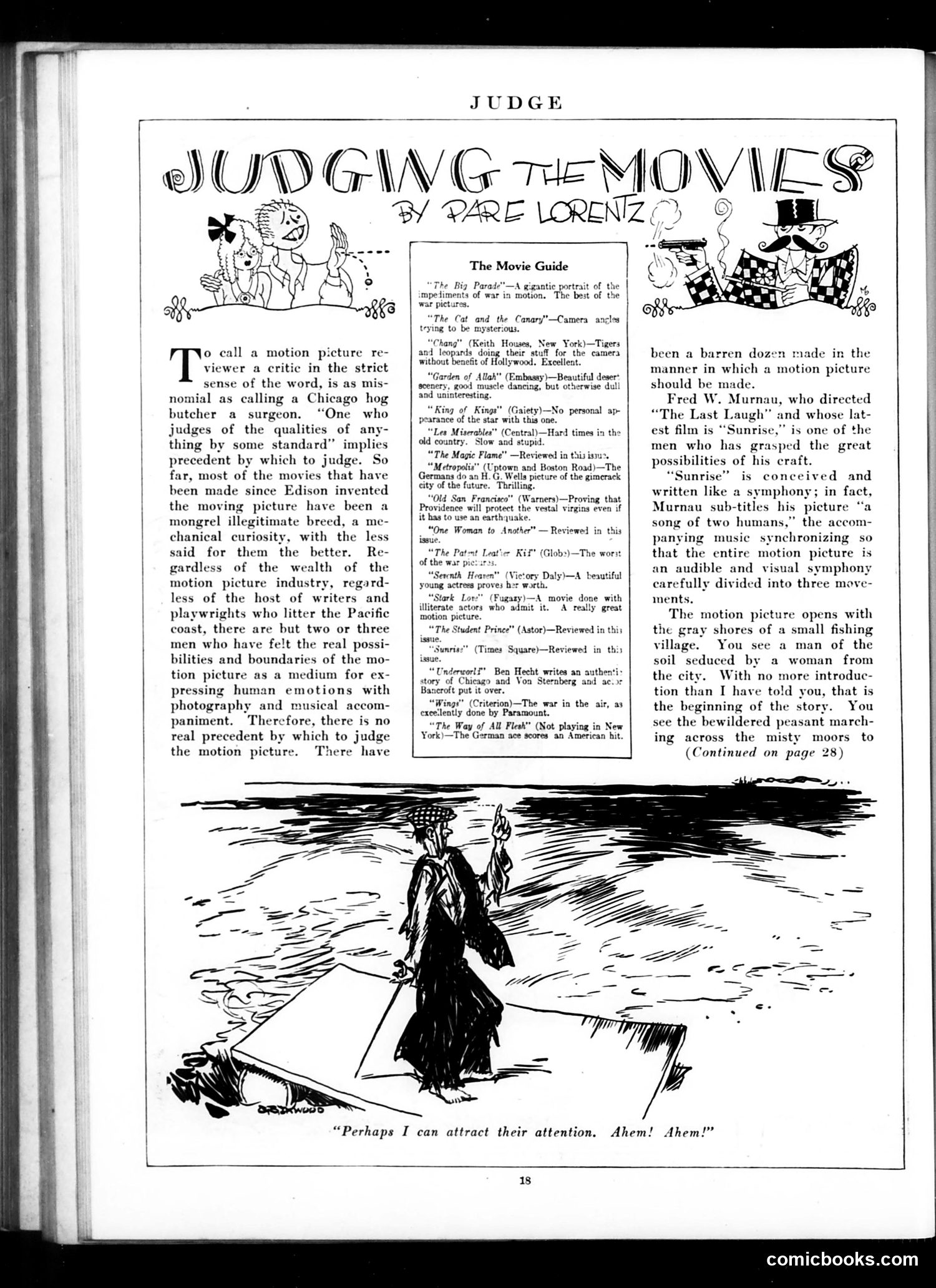
This page reviews silent films for Judge magazine's readers. The main article argues that most movies lack artistic merit because there's no established standard for evaluating them—comparing bad film criticism to calling a butcher a surgeon. The author praises director Fred W. Murnau's "Sunrise," calling it a masterpiece conceived like a symphony, with synchronized music and visual elements creating unified emotional expression. This represents cutting-edge filmmaking of the era. The "Movie Guide" sidebar reviews current releases, rating films like "The Big Parade," "Wings," and "Metropolis." Notable: the guide mocks "King of Kings" for hiding its star, and praises "Stark Love" despite using "illiterate actors who admit it." The illustration shows a figure with torches on misty moors—likely depicting the opening of "Sunrise" described in the article. The satire critiques Hollywood's general mediocrity while celebrating rare artistic achievement in this still-young medium.
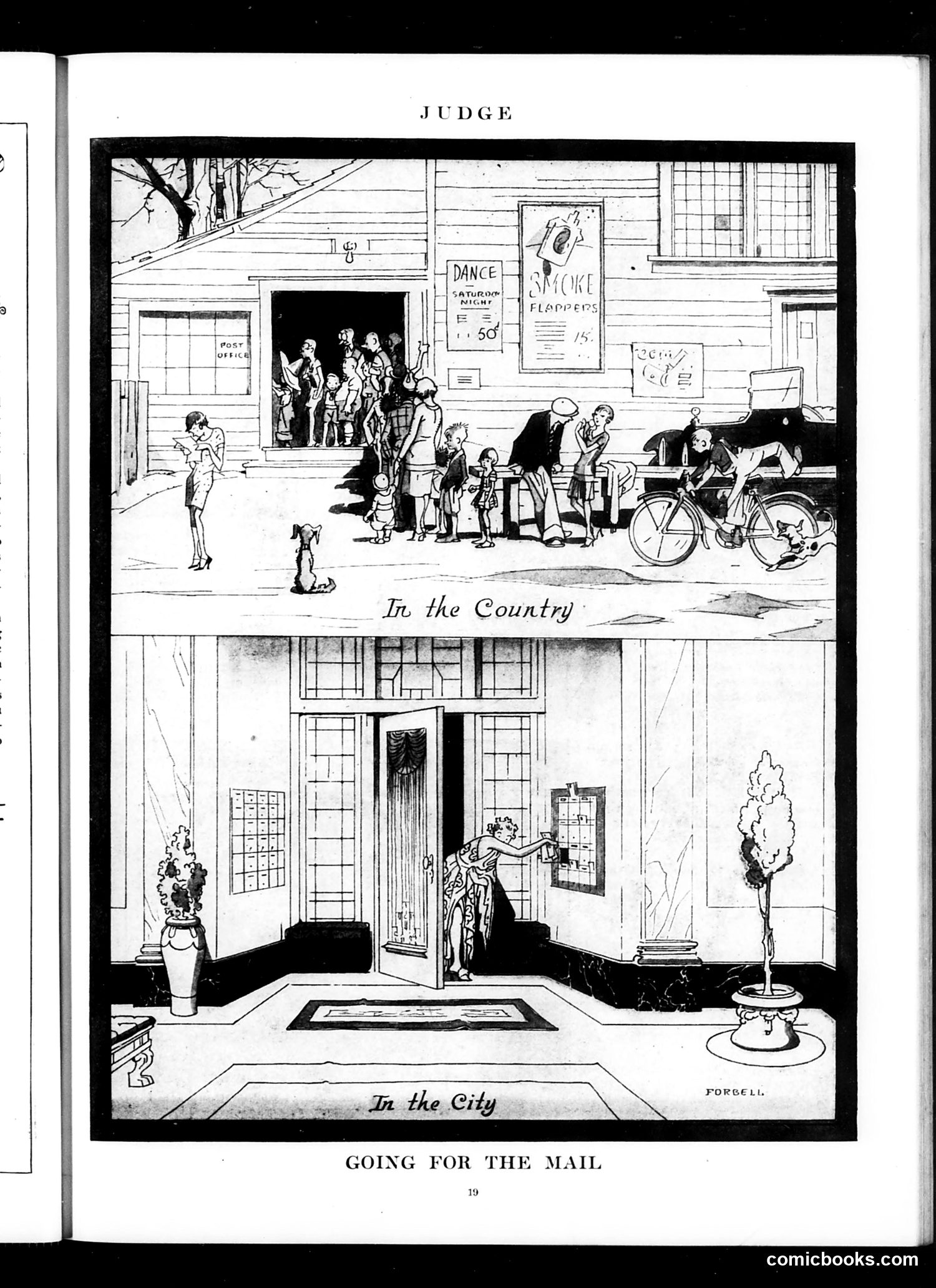
This Judge cartoon contrasts rural and urban life through the simple act of checking mail. The top panel ("In the Country") depicts a vibrant small-town street scene with a general store, community gathering, bicycles, and informal social interaction—suggesting small-town vitality and neighborly connection. The bottom panel ("In the City") shows an elegant, empty modernist interior with potted plants and formal architectural lines. A lone figure checks mail at what appears to be a mailbox or postal slot—emphasizing urban isolation and sterile formality. The satire critiques urban life as disconnected and lonely compared to the communal warmth of country living. This reflects early-to-mid twentieth-century ambivalence about industrialization and urbanization, romanticizing rural community while depicting city life as atomized and impersonal.
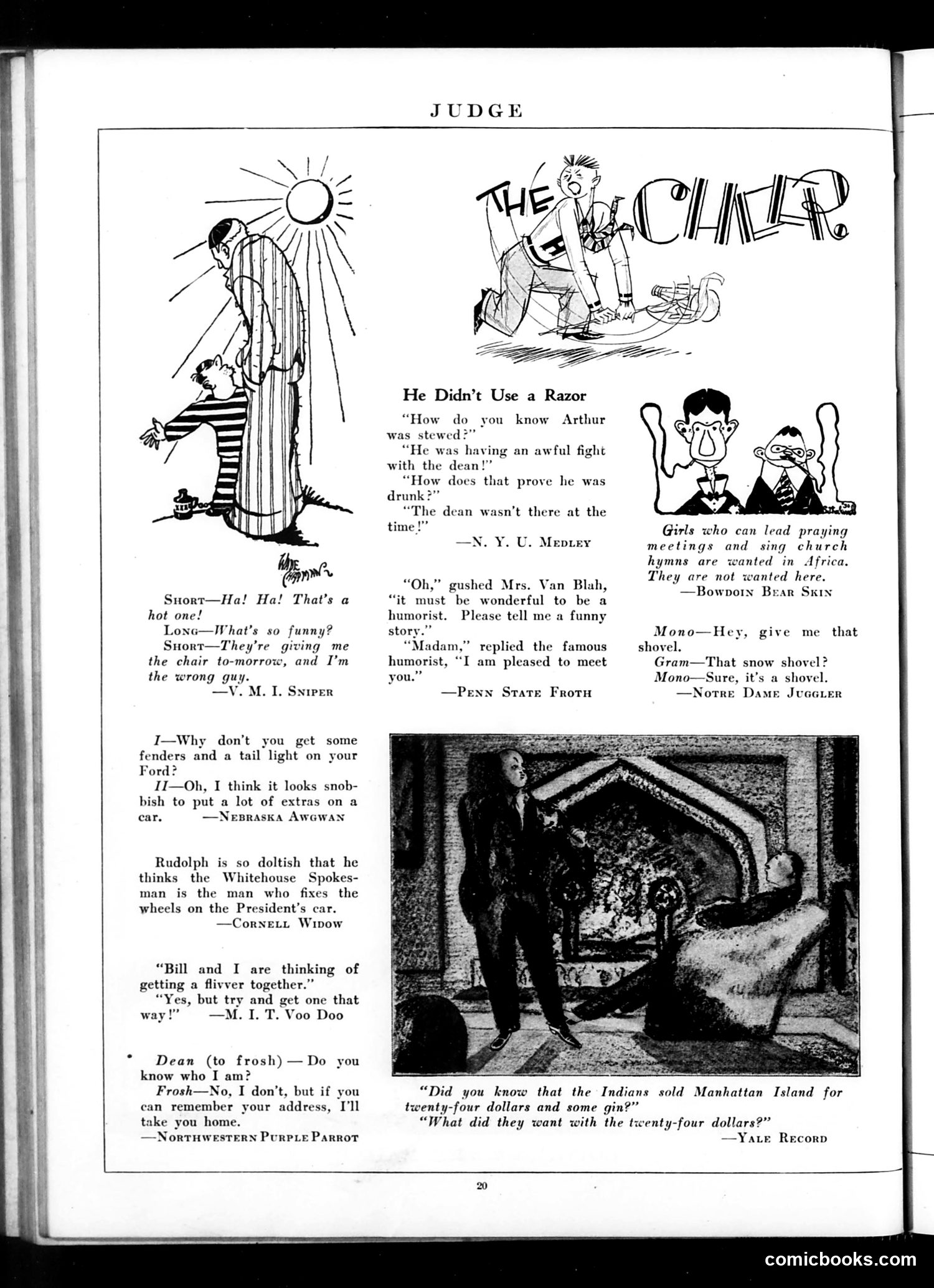
This page collects brief jokes and cartoons from various college publications, typical of Judge's format in the early 20th century. **Key Content:** The jokes reference contemporary concerns: capital punishment ("electric chair"), Ford automobiles (the affordable "flivver"), and college life (drunk students, hazing). One cartoon depicts a man in a coat viewing what appears to be a bed or furniture piece—the caption references Manhattan's sale to Indians for "twenty-four dollars and some gin," a historical reference to the 1626 purchase of Manhattan Island by Dutch colonists. **Satire Points:** The humor targets: - Dangerous driving (Ford safety features seen as "snobby") - Student drinking and discipline - Class pretension - Academic pomposity - Colonial history absurdity The recurring theme is deflating authority figures and exposing human folly through college-humor sensibilities. The racial slur in one byline reflects the publication's era, not its intent.
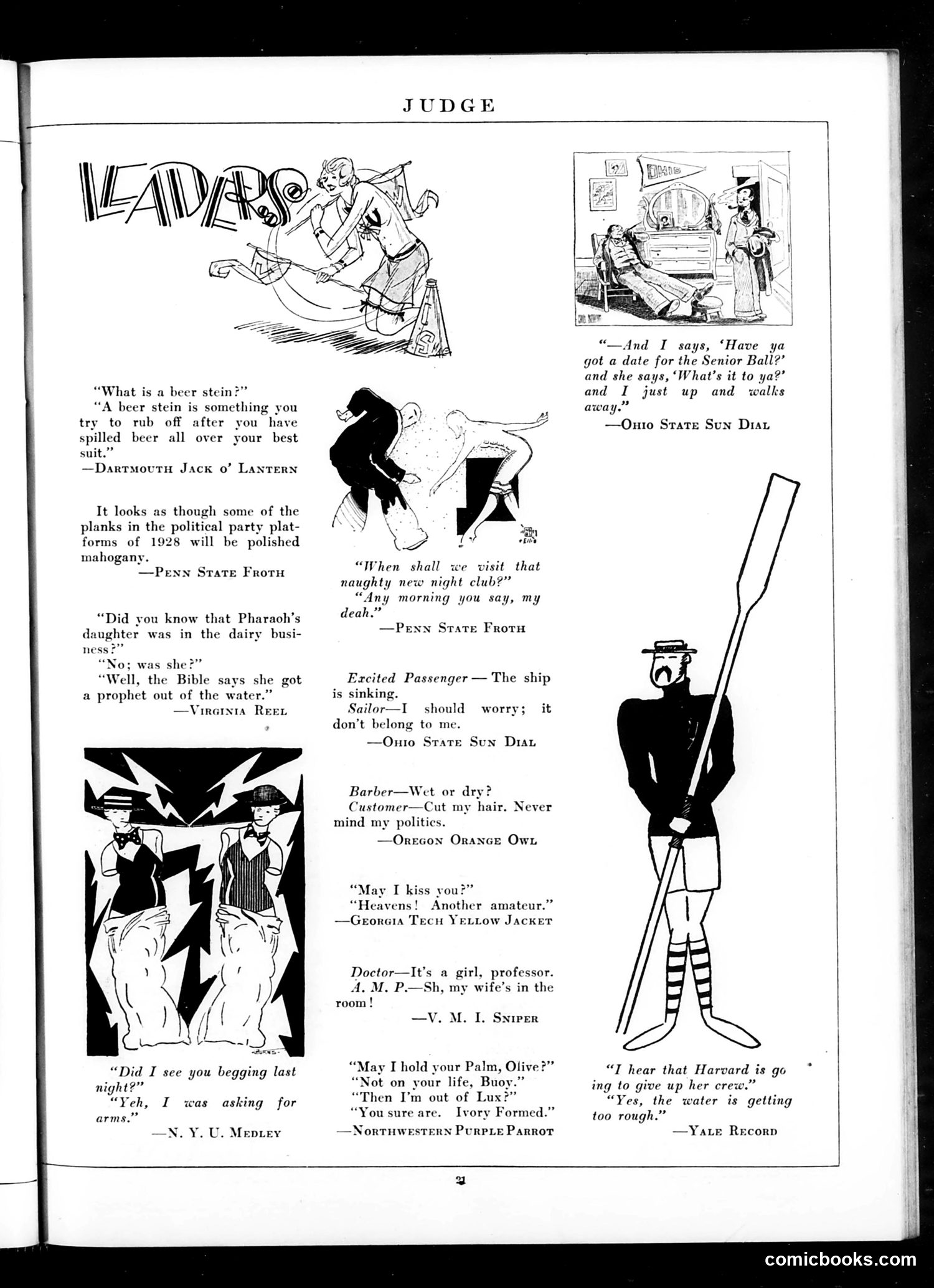
This is a collection of brief jokes and cartoon gags from Judge magazine, likely from the 1928 era (referenced in one item about political party platforms). The page contains: **Key Content:** - Multiple one-liner jokes credited to college humor publications (Dartmouth, Penn State, Yale, etc.), suggesting this was a collegiate humor compilation - References to Prohibition-era concerns (beer steins, "naughty night clubs") - A visual gag about a sailor on a sinking ship (the humor lies in indifference) - Word-play jokes mixing product names (Palm, Olive, Lux, Ivory—all contemporary brands) - A barber-shop exchange mocking political discussion - General collegiate/social humor about courtship and embarrassment **The Satire:** Rather than targeting specific political figures, the page satirizes everyday American life during the late 1920s: drinking culture, dating customs, and the banality of political discourse. The college credits emphasize youth culture and student life as primary subjects. This represents Judge's lighter, humor-magazine format rather than serious political commentary.
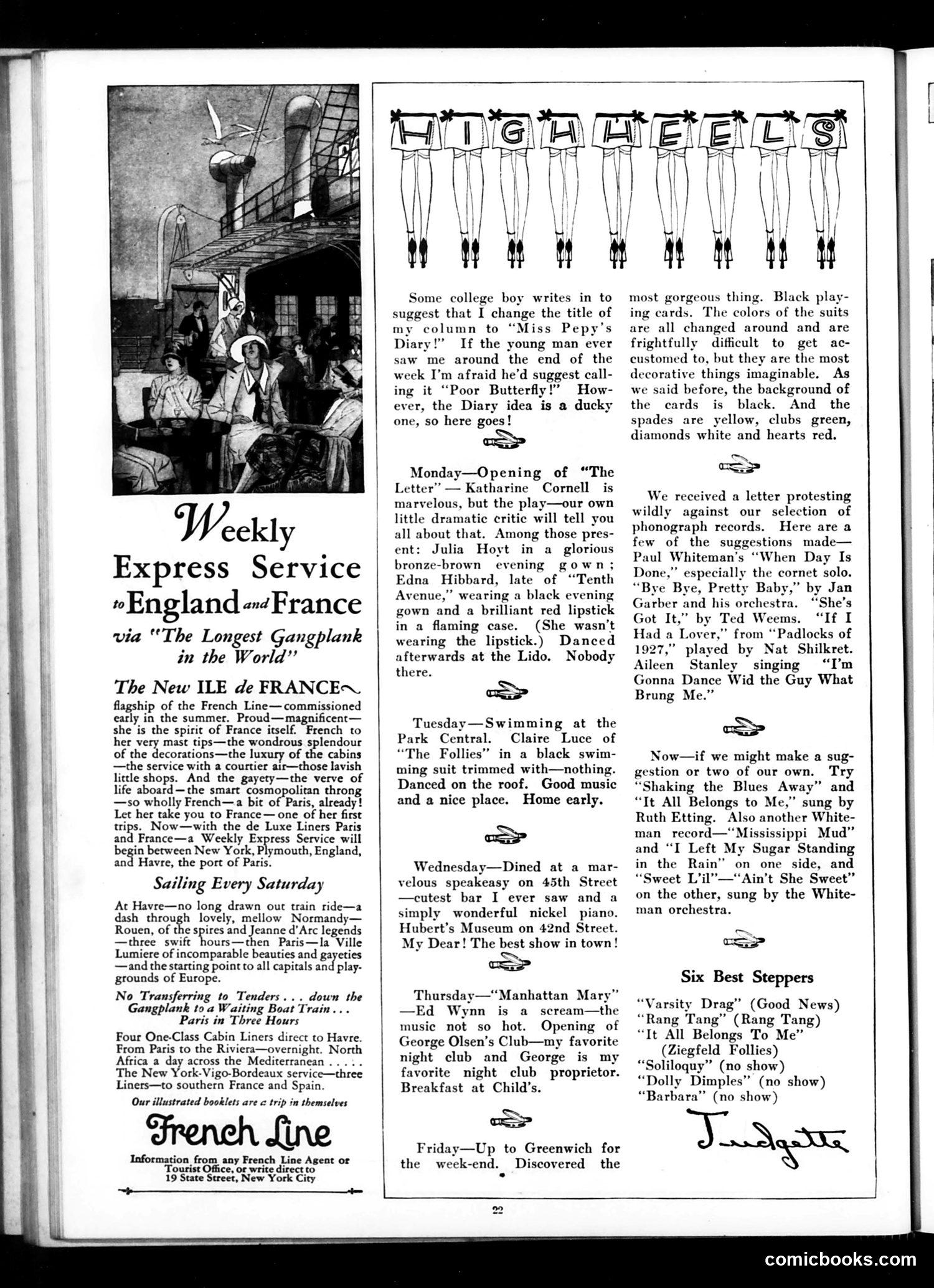
This page contains two main elements: **advertising** (left side) and **society/entertainment column** (right side). The **French Line advertisement** promotes luxurious transatlantic travel to France via the new flagship *Île de France*, emphasizing elegant Parisian leisure and cosmopolitan sophistication. The **"Highbells" column** is a society diary satirizing 1920s Manhattan nightlife. The unnamed female columnist breathlessly catalogs her week: attending Broadway openings (Katharine Cornell in "The Letter"), visiting speakeasies (illegal bars during Prohibition), nightclubs, and museums. References include Ed Wynn's theatrical performance and George Olsen's orchestra. The satire targets the frivolous, status-conscious social scene—the writer obsesses over fashion details and trendy venues while presenting herself as cultured. The column mocks both the Jazz Age's hedonism and the era's casual violations of Prohibition laws. The "six best steppers" (popular songs) and phonograph records at the column's end reinforce this world of fashionable entertainment consumption.
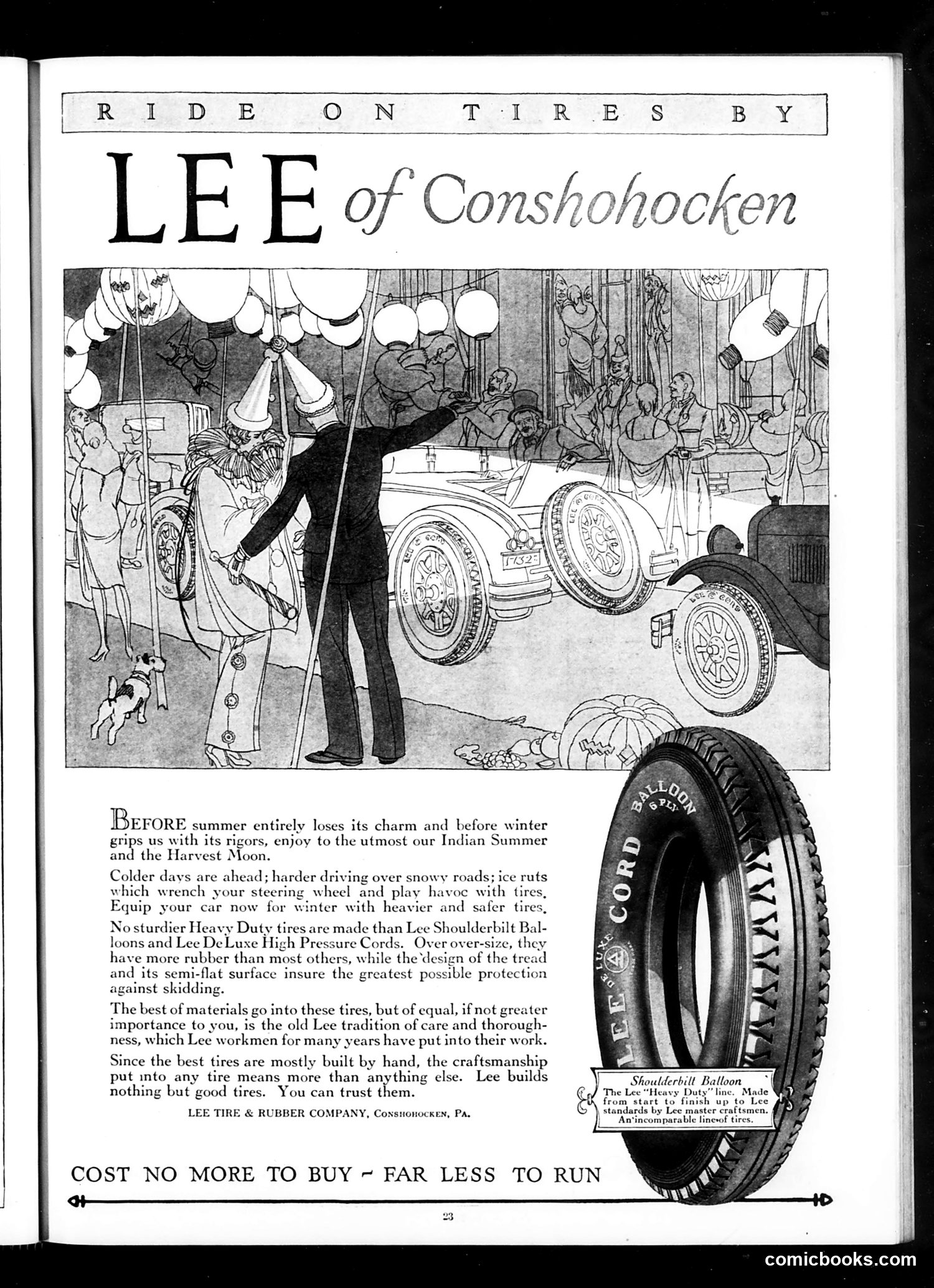
This is **primarily an advertisement**, not political satire. It's a tire company ad for Lee of Conshohocken, Pennsylvania, disguised as editorial content in Judge magazine. The illustration shows a stylish couple at what appears to be a fashionable outdoor gathering or auto show, with period automobiles visible. The woman wears an elegant dress; the man is in formal attire. The scene suggests leisure and sophistication. The "satire" is subtle advertising messaging: the text warns of approaching winter driving hazards (snow, ice, rutted roads) and urges readers to equip their cars with Lee tires before cold weather arrives. The ad emphasizes Lee's manufacturing superiority—hand-built quality, superior rubber content, and reliable craftsmanship—positioning the brand as trustworthy. The tagline "Cost No More to Buy—Far Less to Run" uses common advertising logic of the era: premium tires cost the same initially but save money through durability and safety. This represents Judge's practice of blending advertising with editorial content, presenting commercial messages through entertainment-styled layouts to reach affluent readers.
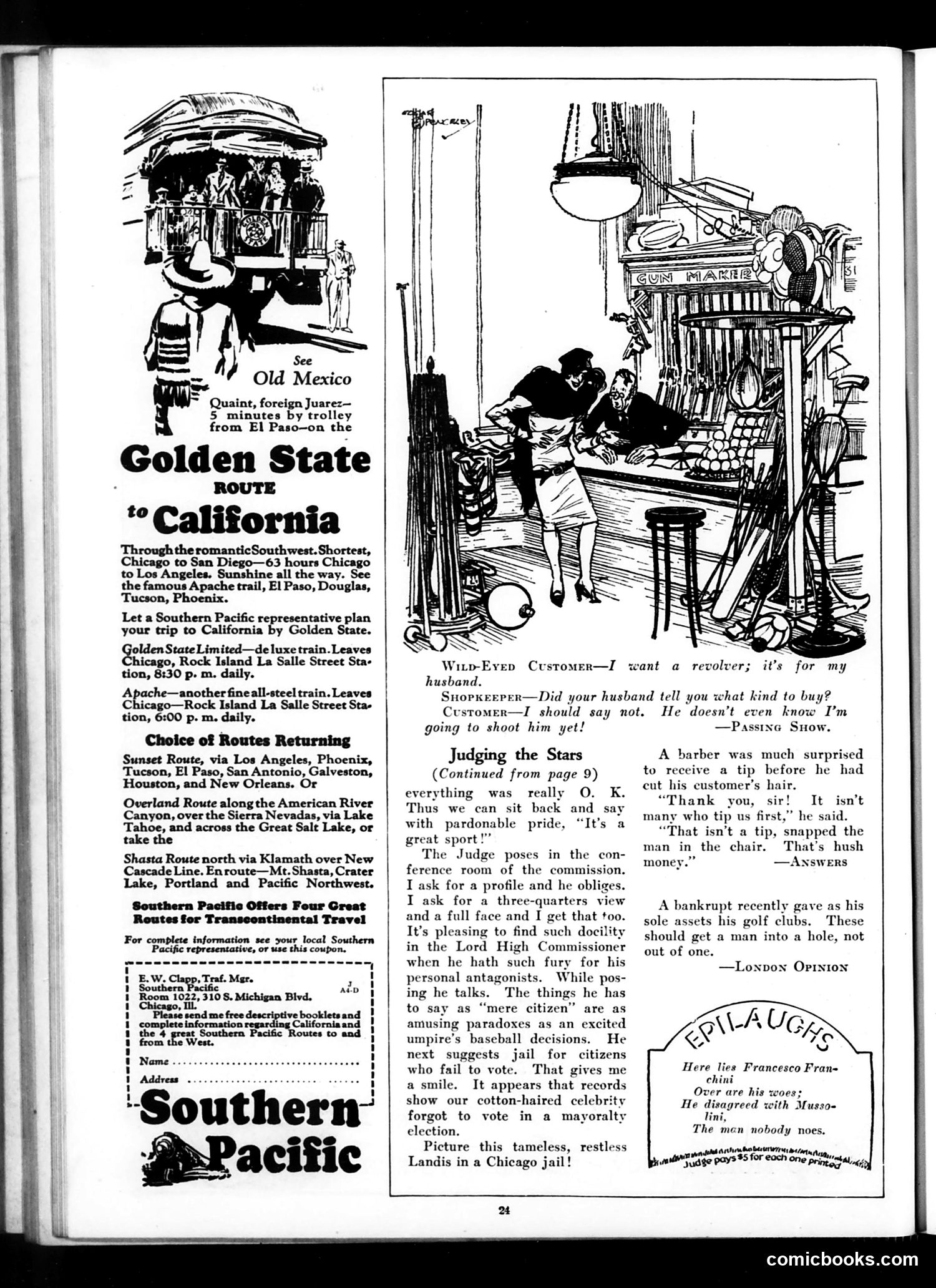
This page mixes **railroad advertising** with **satirical commentary** on Judge Kenesaw Mountain Landis, the newly appointed Commissioner of Major League Baseball (1920). The main cartoon mocks Landis's hypocrisy. While he poses grandly for portraits and talks tough about punishing citizens who don't vote, the text reveals he himself "forgot to vote in a mayoralty election." The satire culminates in imagining the "tameless, restless Landis in a Chicago jail"—suggesting his moral authority is hollow. The smaller jokes address gender politics (a wife buying a revolver for her husband) and class commentary (a bankrupt's golf clubs, a barber's "hush money" for a premature tip). The **epilogue** mocking "Francesco Franchini" appears to reference Italian political tensions, though specifics are unclear from this page alone. Essentially: Judge ridicules Landis's sanctimonious baseball reform crusade by exposing personal failings.
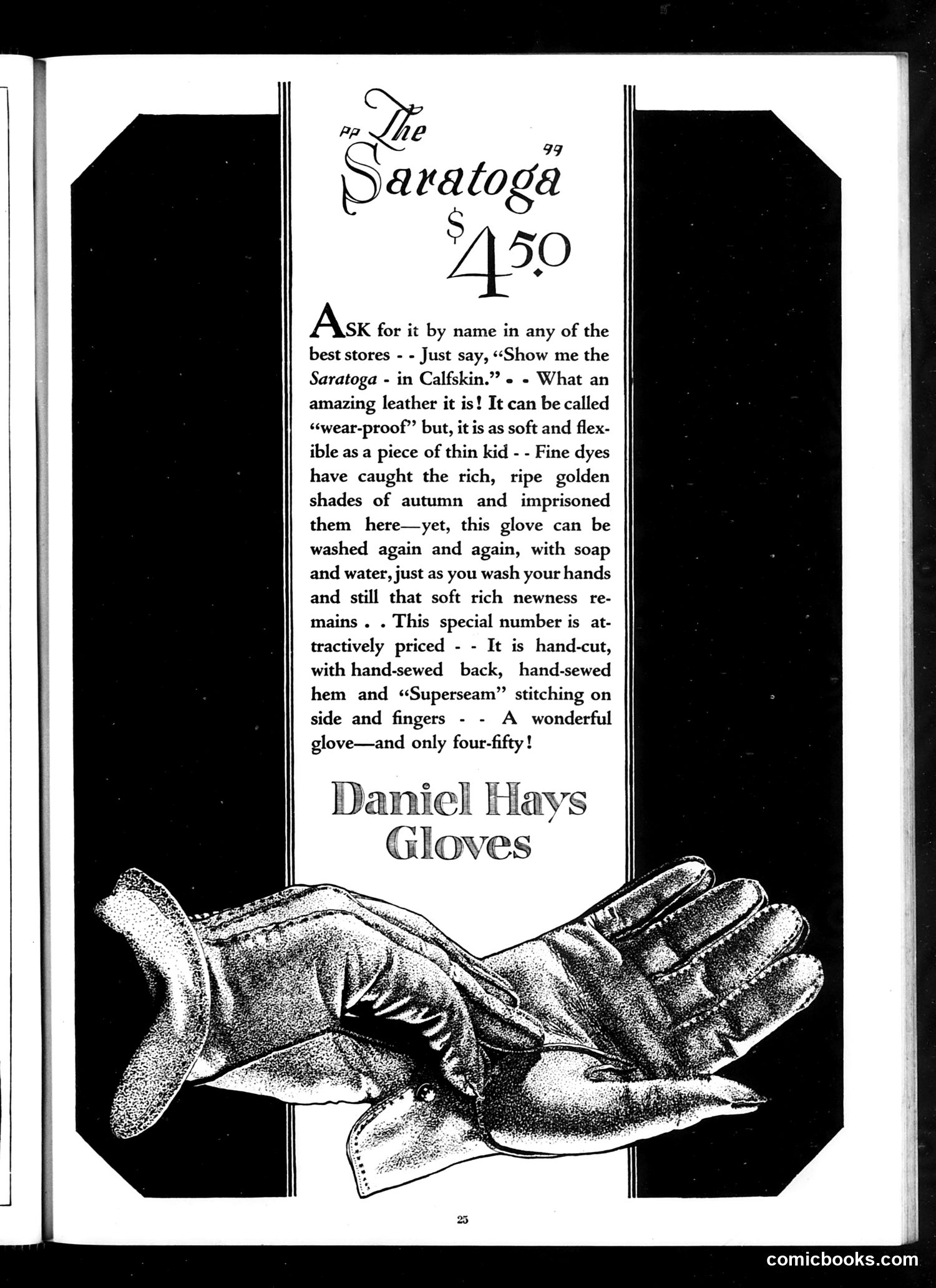
This is a **product advertisement**, not a political cartoon. It promotes "The Saratoga" gloves by Daniel Hays Gloves, priced at $4.50. The ad emphasizes the glove's luxury qualities: calfskin leather that is both durable ("wear-proof") and soft, dyed in "golden autumn" tones, and capable of withstanding repeated washing. It highlights craftsmanship details—hand-cut construction, hand-sewn back and hem, and "Superseam" stitching. The illustration shows a hand modeling the glove to demonstrate its quality and fit. For modern readers: this represents early 20th-century consumer advertising emphasizing artisanal production methods and durability as selling points—values quite different from today's fast fashion marketing. The price ($4.50 then) represents a significant accessory investment, suggesting these were premium goods for affluent consumers.
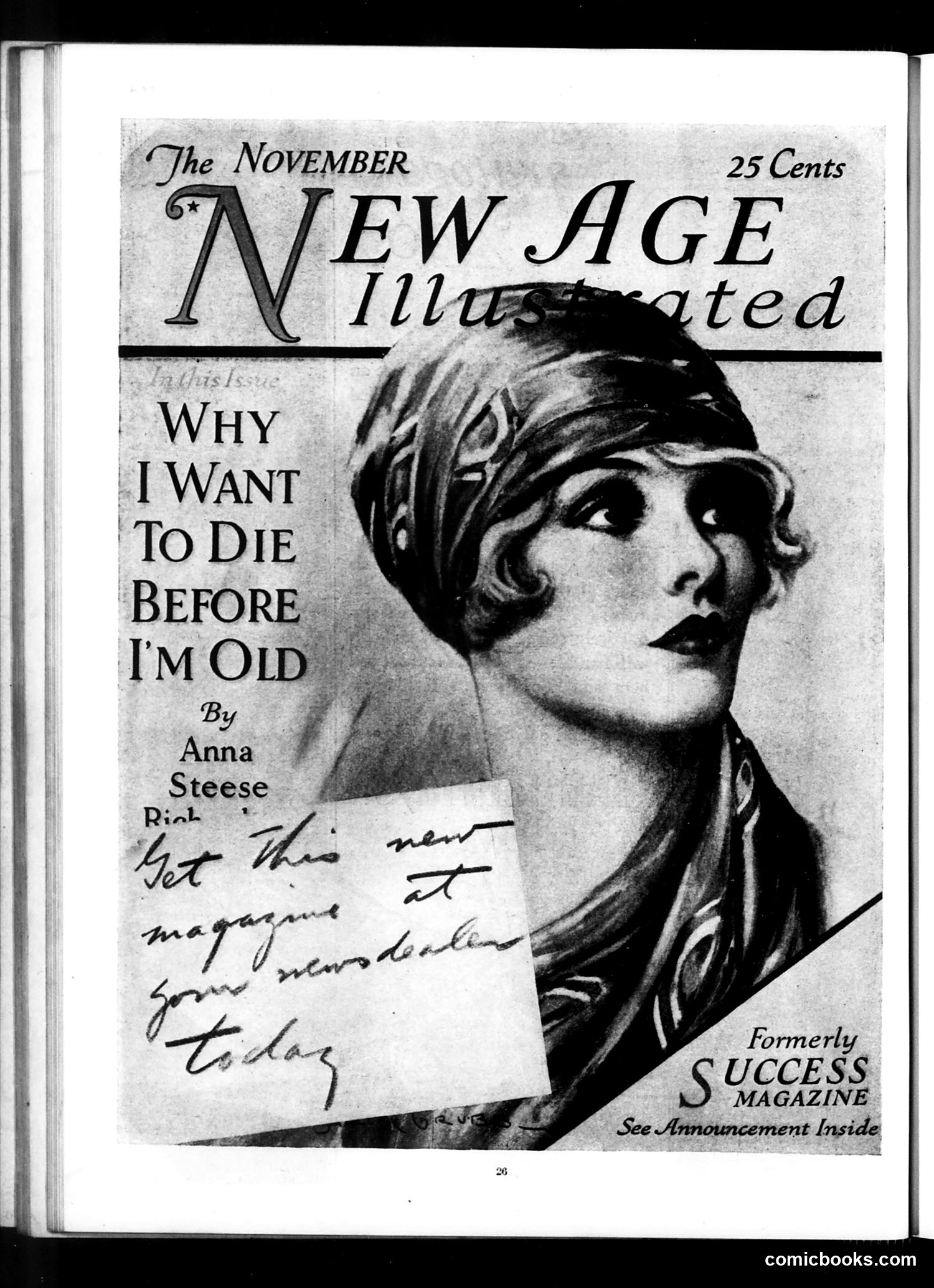
This is primarily a **magazine cover/advertisement**, not a political cartoon. It shows *The New Age Illustrated* (formerly *Success Magazine*), November issue, priced at 25 cents. The cover features a portrait of a young woman with 1920s-style bobbed hair and makeup, styled as a "flapper." The main headline reads "Why I Want to Die Before I'm Old" by Anna Steese Rick—likely sensationalist cover copy typical of this era's magazines designed to provoke reader interest. There is handwritten text overlaid on the image, appearing to be a personal inscription, though it's difficult to read clearly in this reproduction. The cover represents popular magazine marketing of the Jazz Age, emphasizing youth culture and modern attitudes toward aging and mortality.
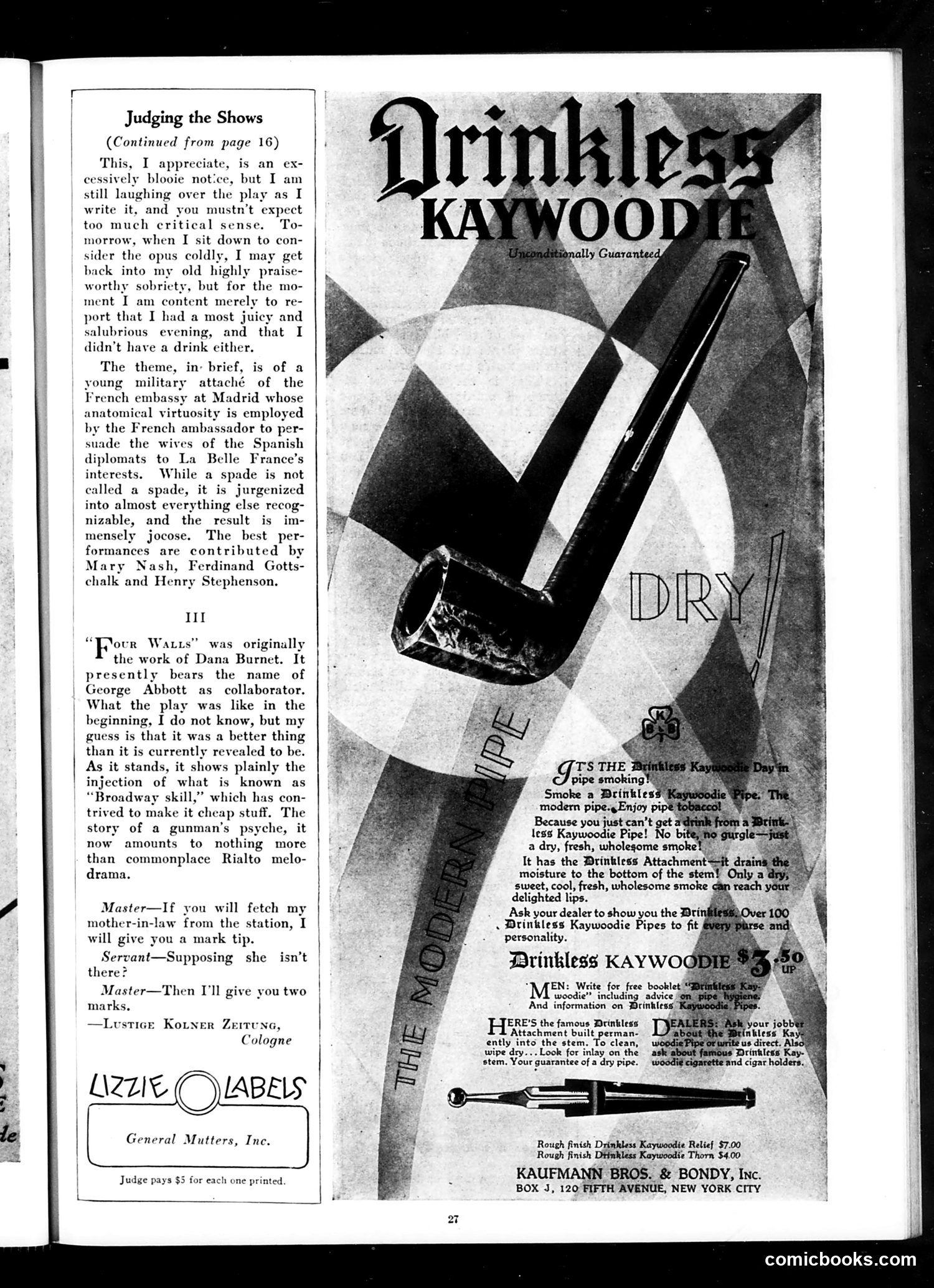
This page contains two distinct elements: **Left side:** Theater review of two Broadway plays. The critic praises "Drunken Kaywoodie" (unclear title—possibly "Drinkless"?) for its entertaining absurdity about a French military attaché seducing Spanish diplomats' wives through "anatomical virtuosity." He also critiques "Four Walls," noting it's been cheapened by "Broadway skill" into a conventional melodrama about a gunman's psychology. A German joke about servant wages appears at bottom. **Right side:** Full-page advertisement for Drinkless Kaywoodie pipes, featuring a large photograph of a pipe with the slogan "Unconditionally Guaranteed." The ad emphasizes the pipe's "Drinkless Attachment" that supposedly drains moisture from the stem, allowing "dry, fresh, wholesome smoke." Pricing and manufacturer details (Kaufmann Bros. & Bondy, NYC) are provided. The page is primarily advertising with theater commentary as secondary content.
This page contains a film review of what appears to be a silent drama (likely F.W. Murnau's "Sunrise," mentioned in the text). The critic praises the film's atmospheric storytelling and emotional depth—its depiction of a man tempted toward murder by an urban seductress, portraying rural tragedy with "hard, granite strength." However, the review pivots to criticism: the film inexplicably undermines its own serious tone by introducing jarring, comedic elements. The critic compares this tonal whiplash to John D. Rockefeller suddenly appearing in a grass skirt at a Standard Oil meeting—absurdly incongruous. Director William Fox apparently either wouldn't let Murnau produce the film as intended, or deliberately inserted slapstick comedy fearing American audiences wouldn't accept pure drama. The satire criticizes both the film's inconsistent tone and Hollywood's commercial timidity regarding serious subject matter.
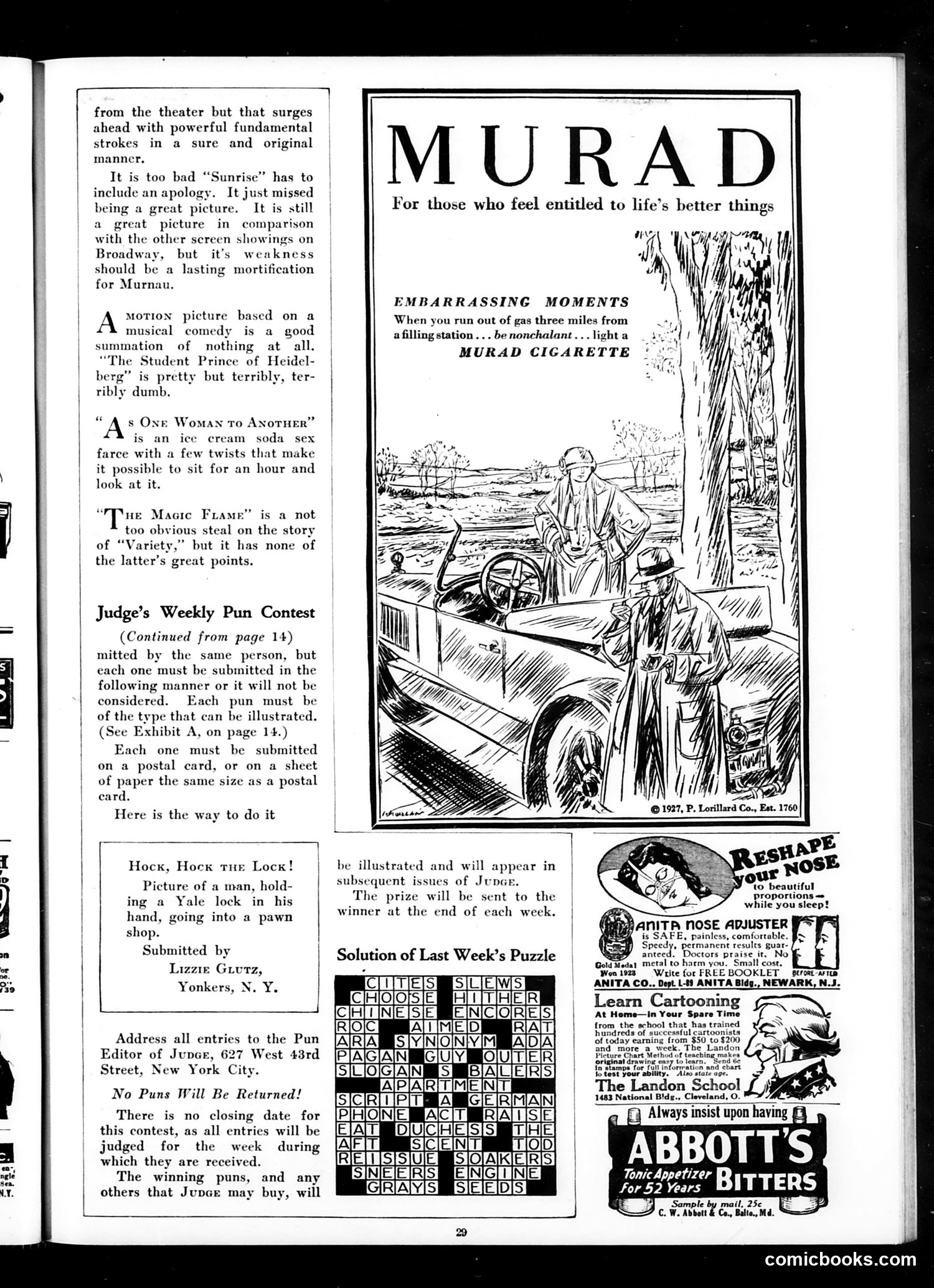
This page from *Judge* magazine contains film reviews and a pun contest rather than political cartoons. **Film Reviews:** The critic dismisses several contemporary movies as mediocre—notably "The Student Prince of Heidelberg" (criticized as "pretty but terribly, terribly dumb") and "As One Woman to Another" (an "ice cream soda sex farce"). "Sunrise" receives backhanded praise as great but flawed. These reviews reflect 1920s silent film criticism. **Main Advertisement:** The Murad Cigarette ad features an "Embarrassing Moments" scenario—a stranded motorist lighting a cigarette to appear nonchalant when out of gas. This appeals to aspirational masculinity and social composure. **Pun Contest:** Judge invites reader submissions for illustrated puns, offering publication as prizes. The example shows a man pawning a Yale lock ("Hock, Hock the Lock!"). **Sidebar Ads:** Period product advertisements for nose adjustment, cartooning courses, and Abbott's Bitters occupy the remaining space, typical of magazine monetization practices.
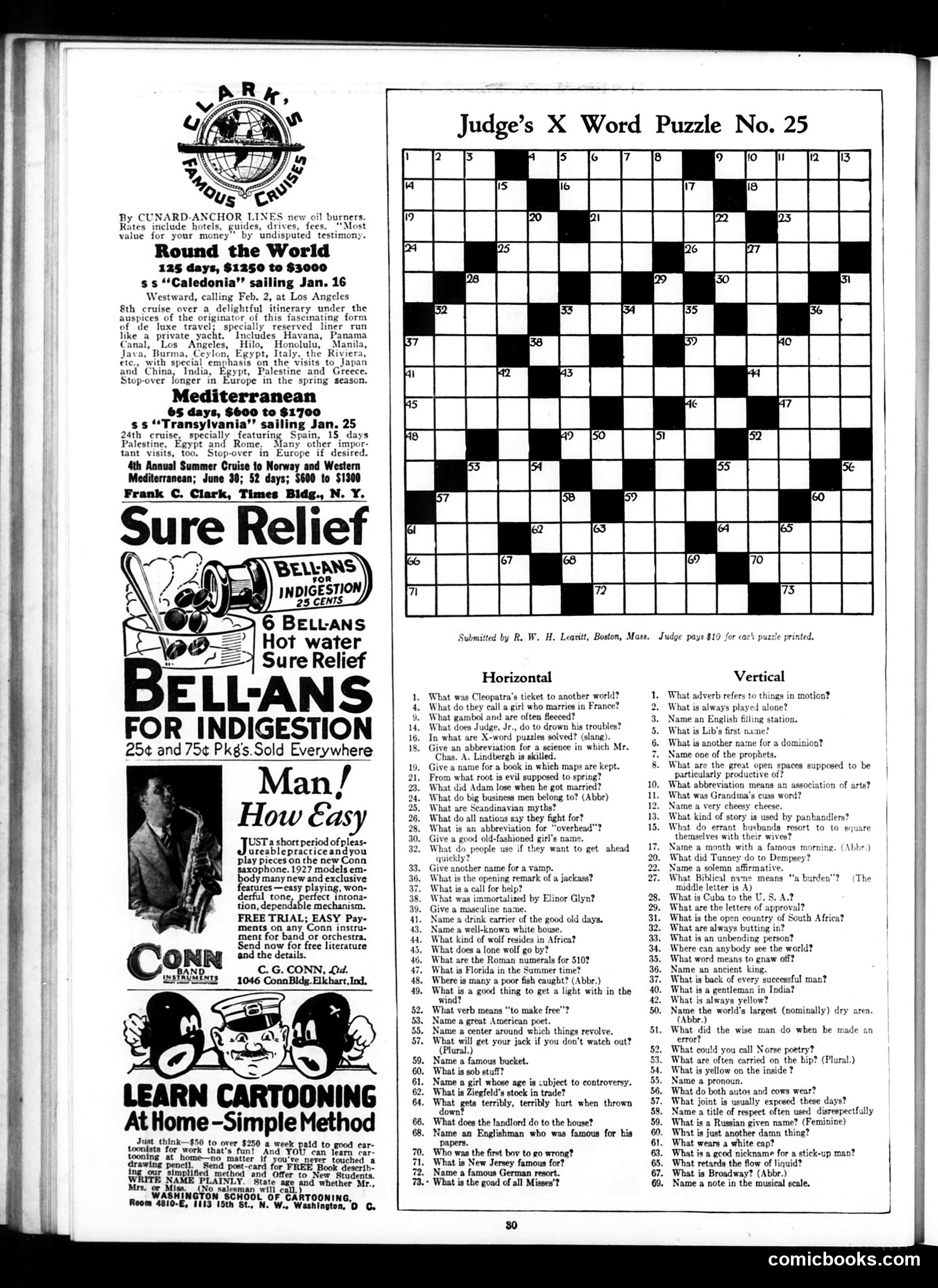
This page is primarily **advertising and a crossword puzzle**, not political satire. The main content includes: - **Travel advertisements** for luxury cruise lines (Cunard-Anchor Lines), promoting expensive round-world voyages and Mediterranean cruises—targeting affluent 1920s readers - **Patent medicine ads** for Bell-Ans indigestion remedy, reflecting the era's widespread promotion of dubious health products - **Vocational training ads** for learning saxophone and cartooning at home—common in this period - **"Judge's X Word Puzzle No. 25"** (a crossword puzzle) The puzzle clues reference 1920s culture: Cleopatra, Charles Lindbergh's aviation skills (abbreviated "Aero"), and contemporary entertainment like Ziegfeld's theatrical productions. The clues are playful wordplay typical of period puzzles. **No political cartoon is visible.** This appears to be a back page mixing advertisements with recreational content, reflecting how magazines monetized space and entertained readers simultaneously.
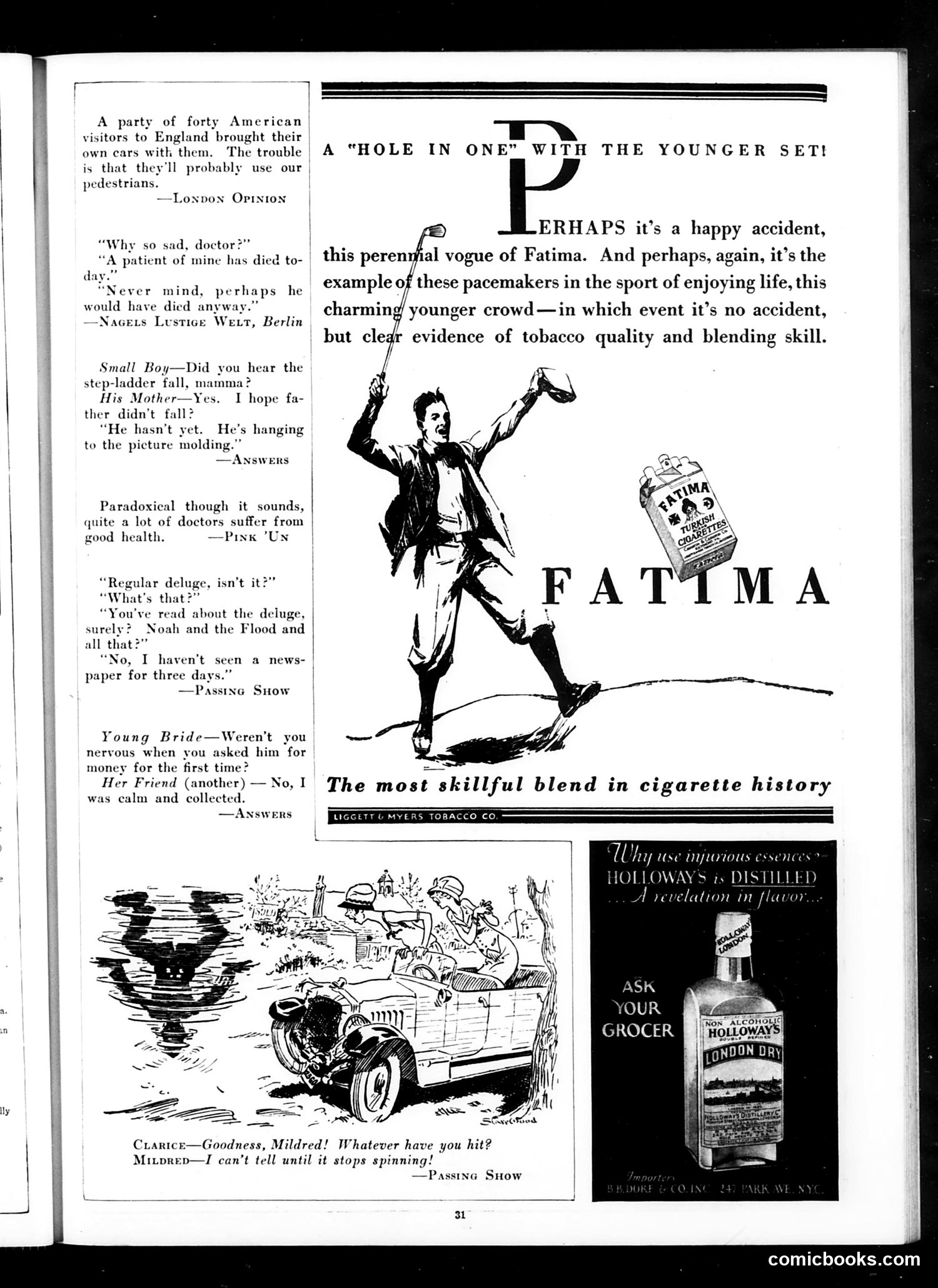
This page is primarily **advertising with comedic filler content**. The main feature is a Fatima cigarette ad depicting a jubilant young man in a "hole in one" golf pose, claiming Fatima represents "the most skillful blend in cigarette history" appealing to "the younger set." The left column contains **brief jokes reprinted from international publications** (London Opinion, Berlin's Nacels Lustige Welt, etc.)—typical Judge filler material. These include mild humor about American tourists being reckless drivers in England, a doctor's dark joke about a patient's death, and domestic comedy about a stepladder. **The satire here is minimal**—mostly gentle social observation rather than political commentary. The Fatima ad itself uses aspirational lifestyle marketing (youth, sport, vigor) rather than explicit claims, a common early 20th-century tobacco advertising strategy before health warnings existed. The page reflects Judge's mixed revenue model: entertaining short jokes subsidized by prominent advertising space, particularly for luxury goods like cigarettes and gin (Holloway's ad, bottom right).
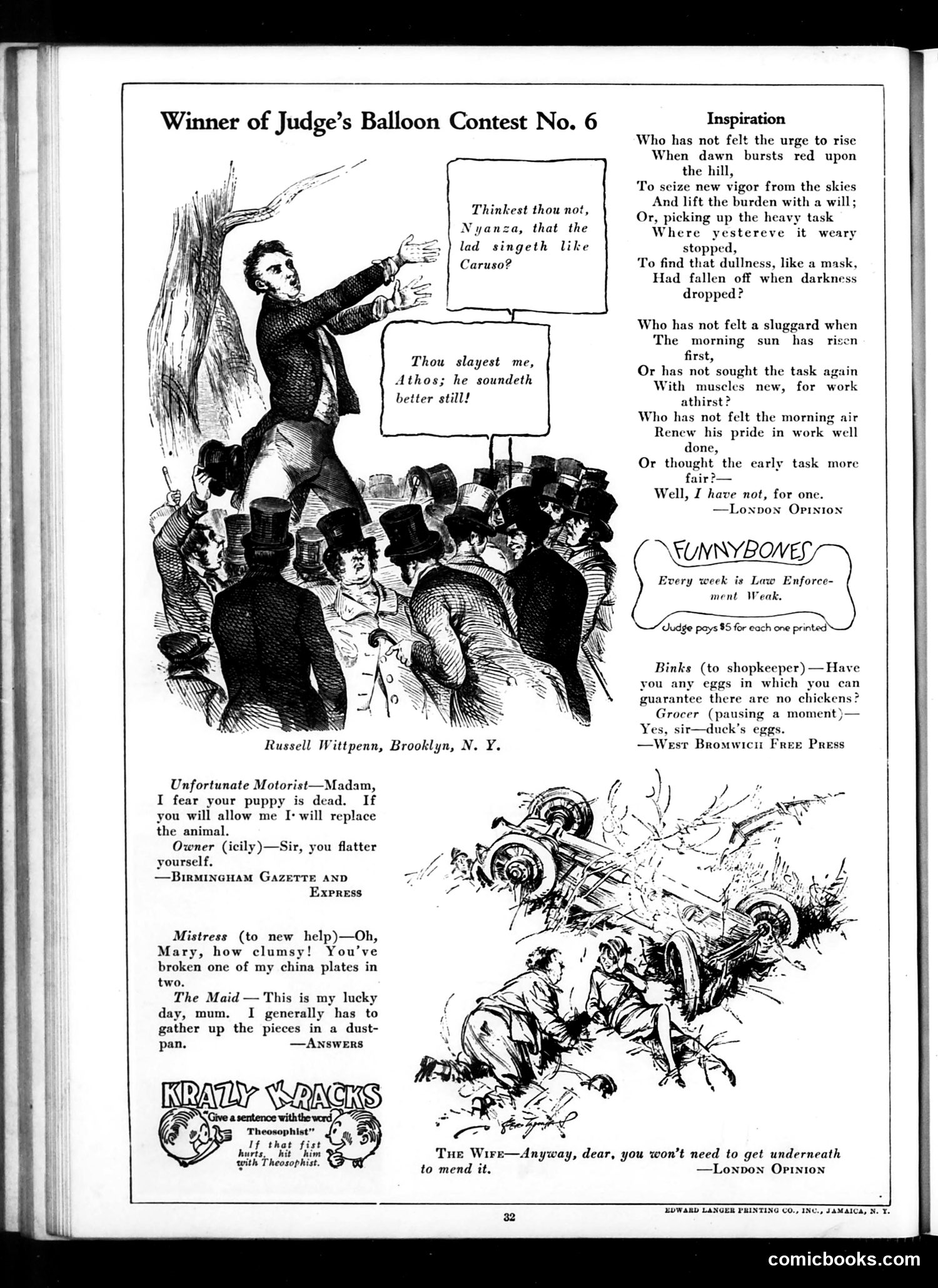
This Judge magazine page contains several humor pieces from the early 20th century: **The main cartoon** shows a man conducting an orchestra of top-hatted gentlemen, comparing one performer to the famous opera singer Enrico Caruso—a contemporary celebrity reference. The joke plays on pretentious musical appreciation. **Below are brief comedic exchanges:** - A motorist offers to replace a woman's dead puppy; she insults him in response - A clumsy maid breaks a plate but considers it lucky because she won't have to gather scattered pieces - A customer asks a grocer for eggs with "no chickens"—the grocer replies "duck's eggs," a pun on the unexpected answer **"Inspiration"** is a serious poem mocking people who claim morning energy motivates them to work harder—the London Opinion author sardonically admits he feels none of this. **"Funny Bones"** advertises Judge's humor submission section paying $5 per joke. The overall tone reflects Edwardian-era class consciousness, wordplay humor, and gentle satire of aspirational middle-class life.
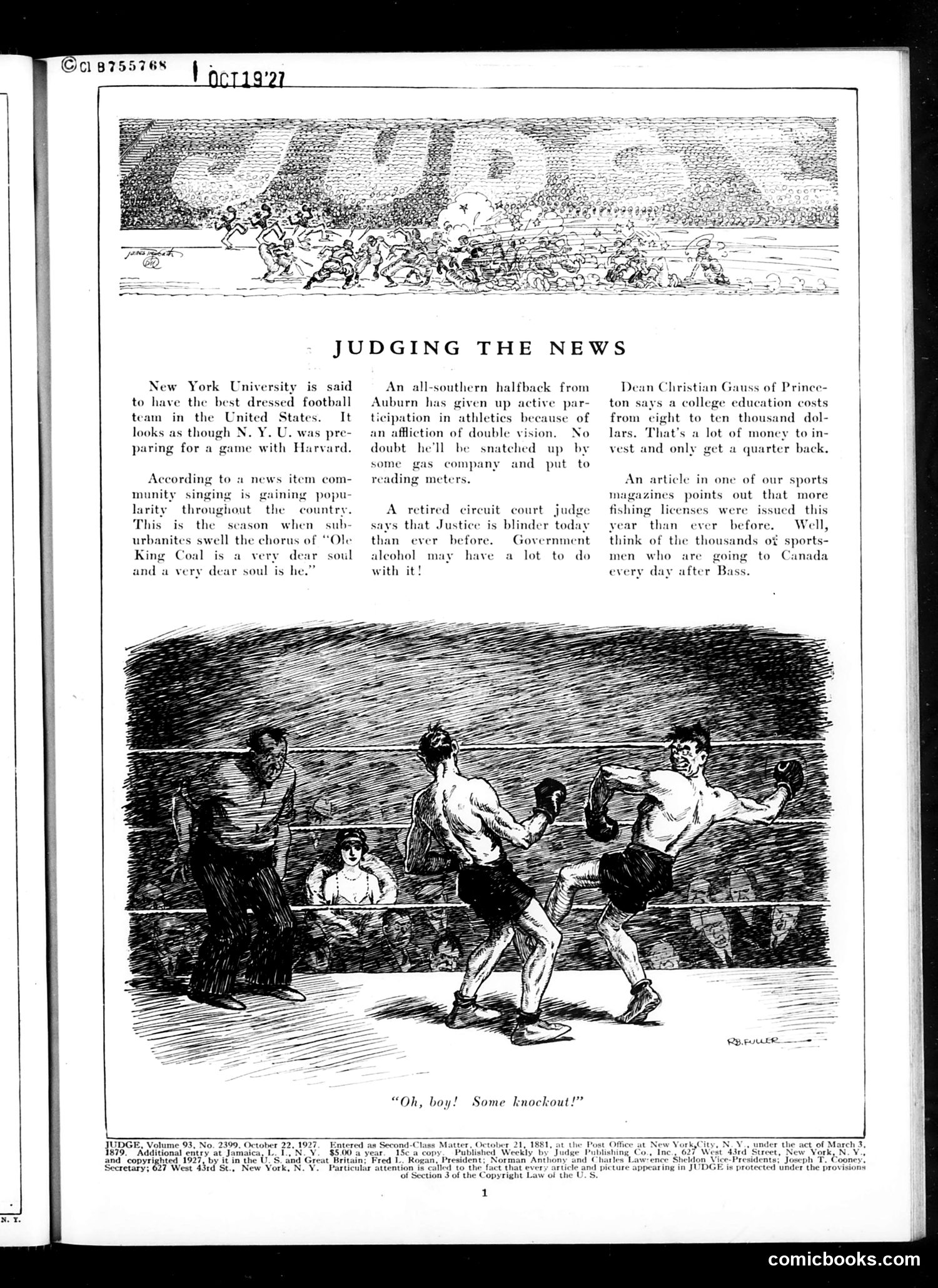
This page contains satirical commentary on contemporary news items, arranged in short quips with illustrations. The top cartoon depicts a boxing match with the caption "Oh, boy! Some knockout!" — likely illustrating one of the news items about athletics or competition mentioned in the text. The text snippets mock various 1920s topics: - **NYU football team**: Satire on excessive concern with appearance over substance in college sports - **Auburn halfback**: Dark humor about a player with double vision being fit only for reading gas meters — poking fun at both his disability and the low-status work available - **Justice and blindness**: References a judge's complaint that Justice is "blinder today than ever" — likely commentary on Prohibition enforcement or legal system failures during the dry era - **Fishing licenses**: Satirizes how many Americans are fleeing to Canada, presumably to escape Prohibition restrictions on alcohol - **College costs**: Mock the high expense of education at places like Princeton relative to actual career returns The overall tone is cynical about contemporary American life, institutions, and the ongoing effects of Prohibition.
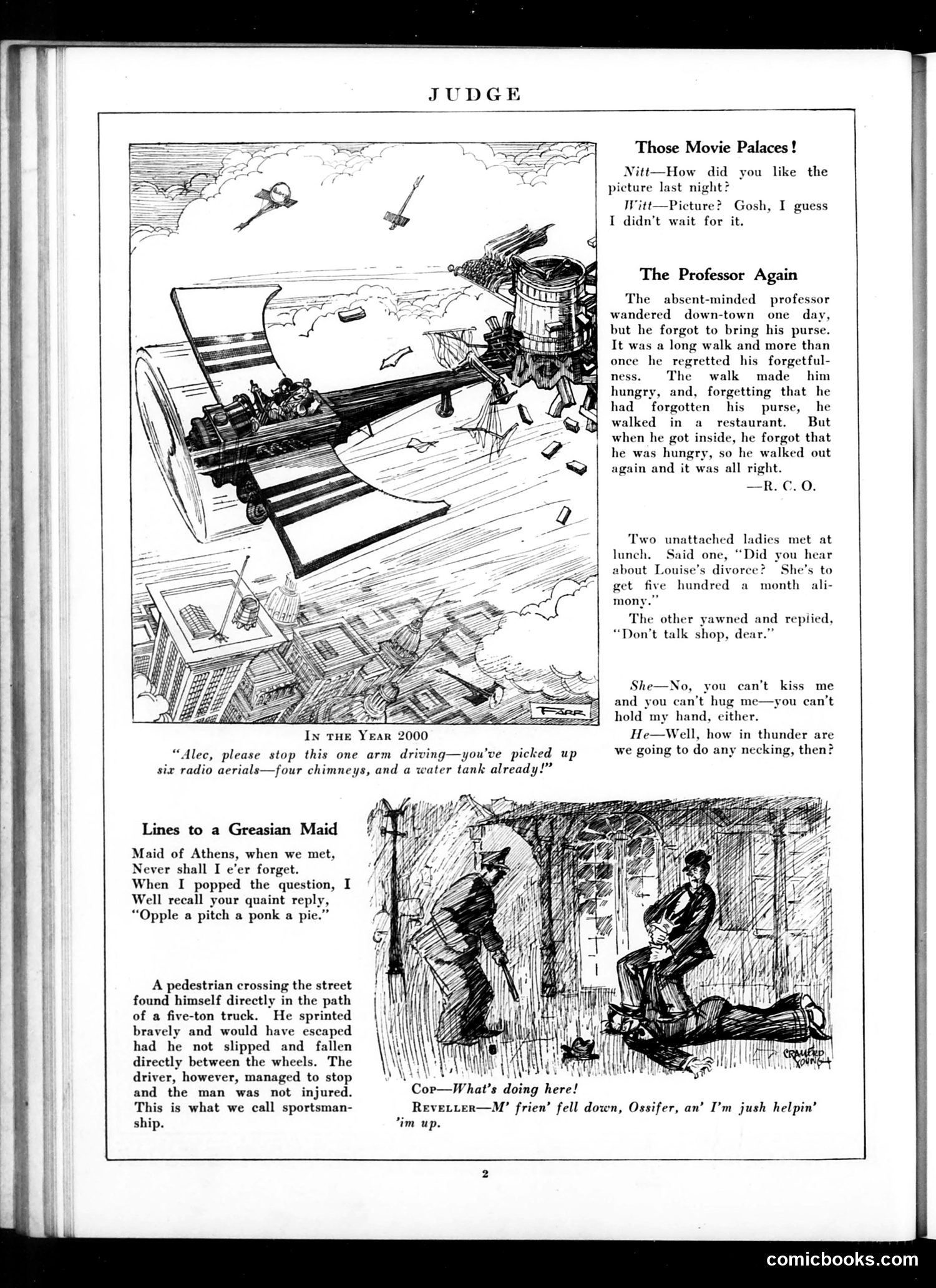
This page contains several brief humor pieces typical of early-20th-century satirical magazines: **"Those Movie Palaces"** mocks expensive new cinema theaters by suggesting patrons are too distracted by the luxurious surroundings to actually watch the film. **"The Professor Again"** is a absurdist joke about an absent-minded academic so forgetful he contradicts himself—he forgets his wallet, enters a restaurant hungry, then forgets he's hungry and leaves. **"In the Year 2000"** depicts a fantastical flying car overburdened with collected radio aerials and household items, satirizing both future-tech speculation and automotive excess. The remaining pieces are brief one-liners and anecdotes: a couple's quarrel about physical affection, a "greasian maid" poetry reference (likely ethnic humor), and a "sportsmanship" story about a truck driver's quick reflexes. The page reflects Judge's formula: short comedic vignettes mixing social commentary with whimsy, often relying on period-specific references and casual ethnic stereotyping now considered offensive.
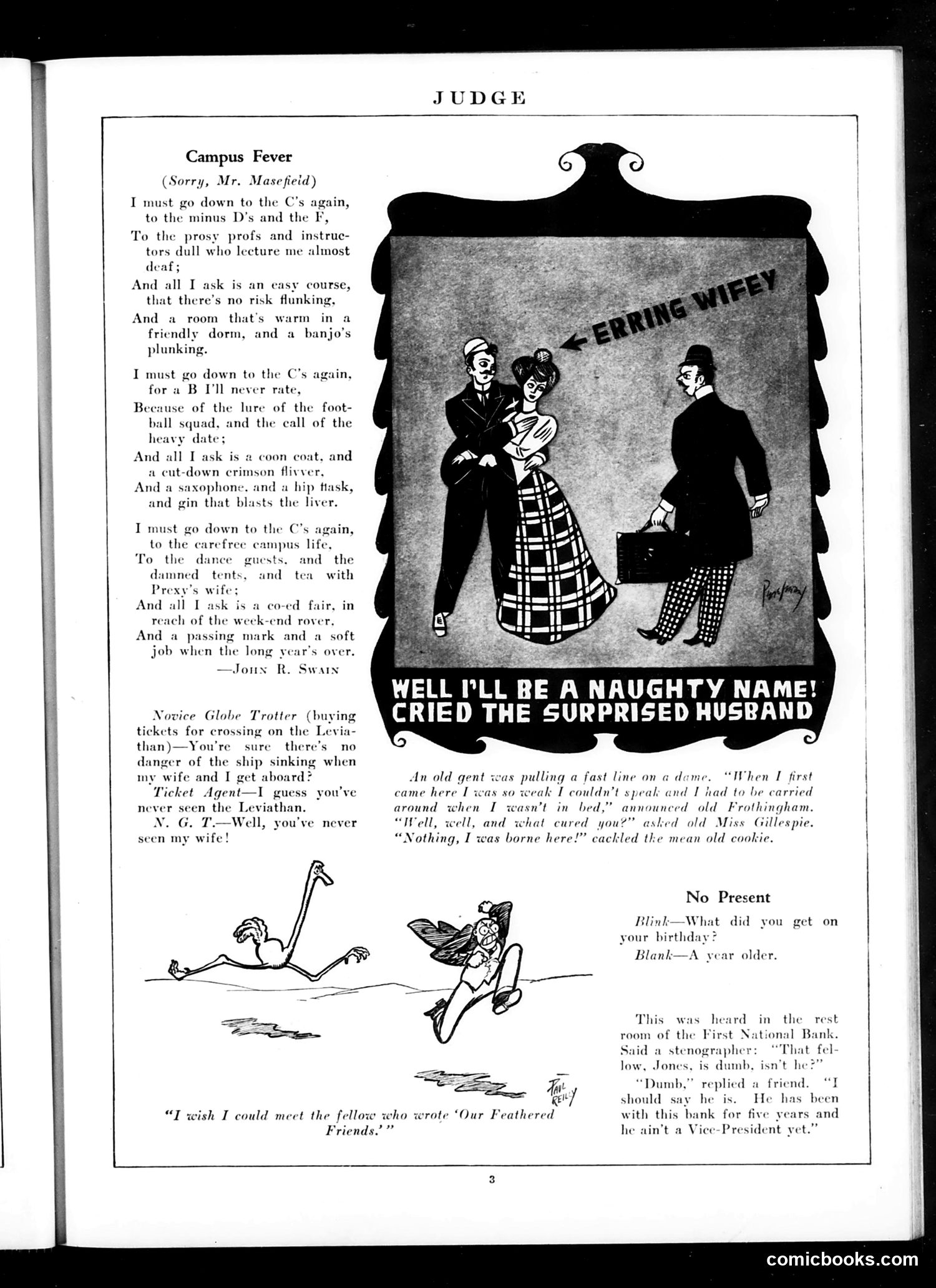
This page contains early 20th-century American humor with several distinct pieces: **"Campus Fever"** is a parody of John Masefield's poem "Sea Fever," satirizing college students' priorities. The narrator laments wanting easy courses, warm dorms, and jazz-age pleasures (coon coats, saxophones, gin) rather than genuine education—mocking how undergraduates prioritize social life and avoiding failure over actual learning. **The central cartoon** shows a man introducing another couple to his wife, with the caption "Well I'll be a naughty name! cried the surprised husband." The joke appears to involve infidelity or an awkward social encounter. **"Novice Globe Trotter"** is a brief joke about a man asking if a ship will sink; the punchline relies on insulting his wife. **"No Present"** mocks a bank employee who, despite five years' tenure, hasn't advanced to Vice-President—suggesting either incompetence or the slow advancement of corporate hierarchies. These pieces reflect 1920s-era college culture, contemporary anxieties about "modern" youth behavior, and workplace humor typical of Judge's satirical content.
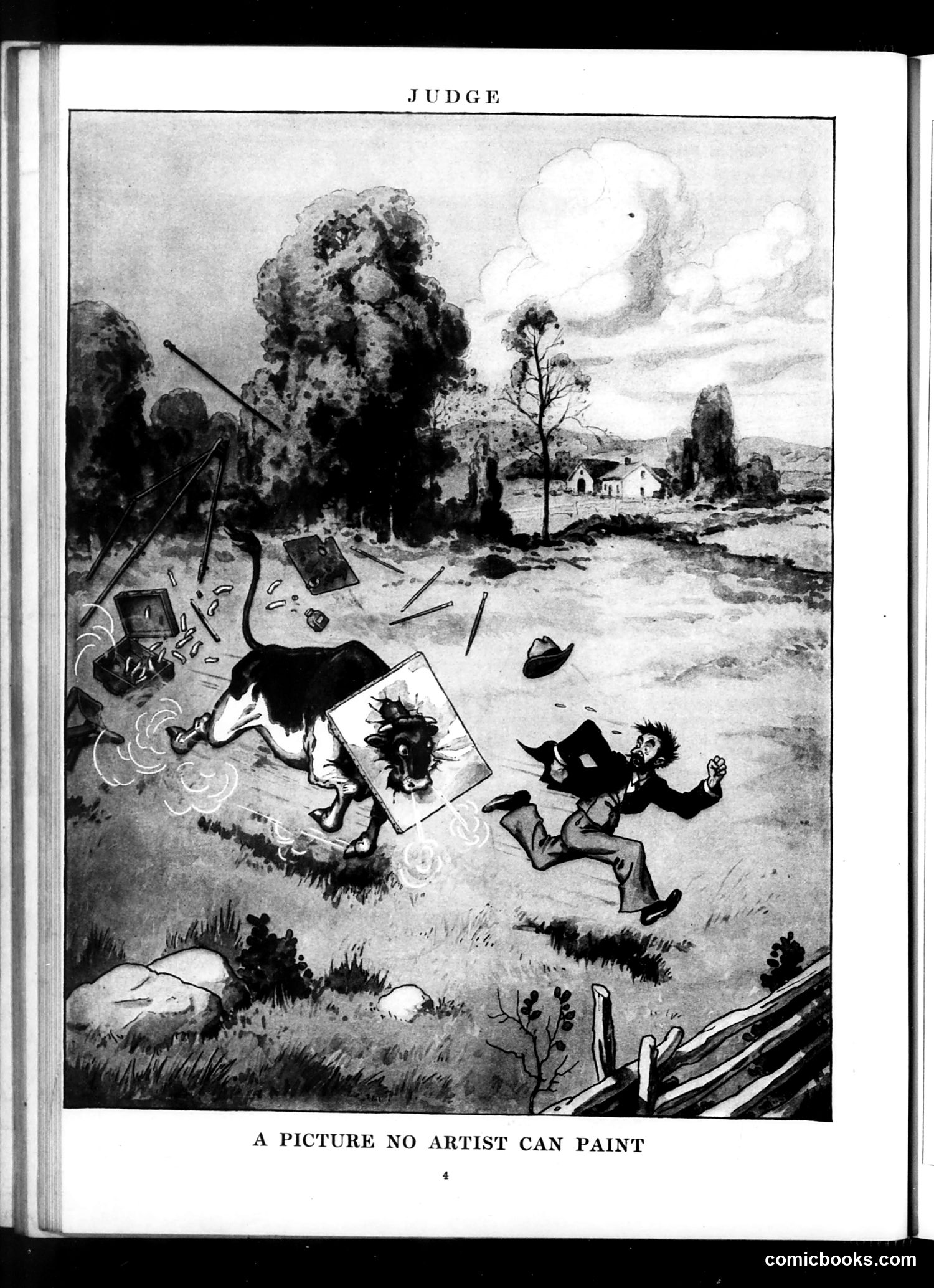
This Judge magazine illustration depicts a chaotic rural scene titled "A Picture No Artist Can Paint." A man in formal attire flees in panic from what appears to be a large, aggressive bull or ox in a pastoral landscape. The figure's exaggerated body language—sprawled running pose—emphasizes comedic terror. The satire likely critiques either a specific public figure or general urban pretension meeting rustic reality. The title suggests the cartoon's irony: that while artists attempt to capture idealized pastoral scenes, the messy, dangerous reality of farm life defies artistic romanticization. The scattered tools and abandoned hat reinforce this theme of civilization undone by nature's violence. Without additional context about Judge's publication date, the specific political references remain unclear.
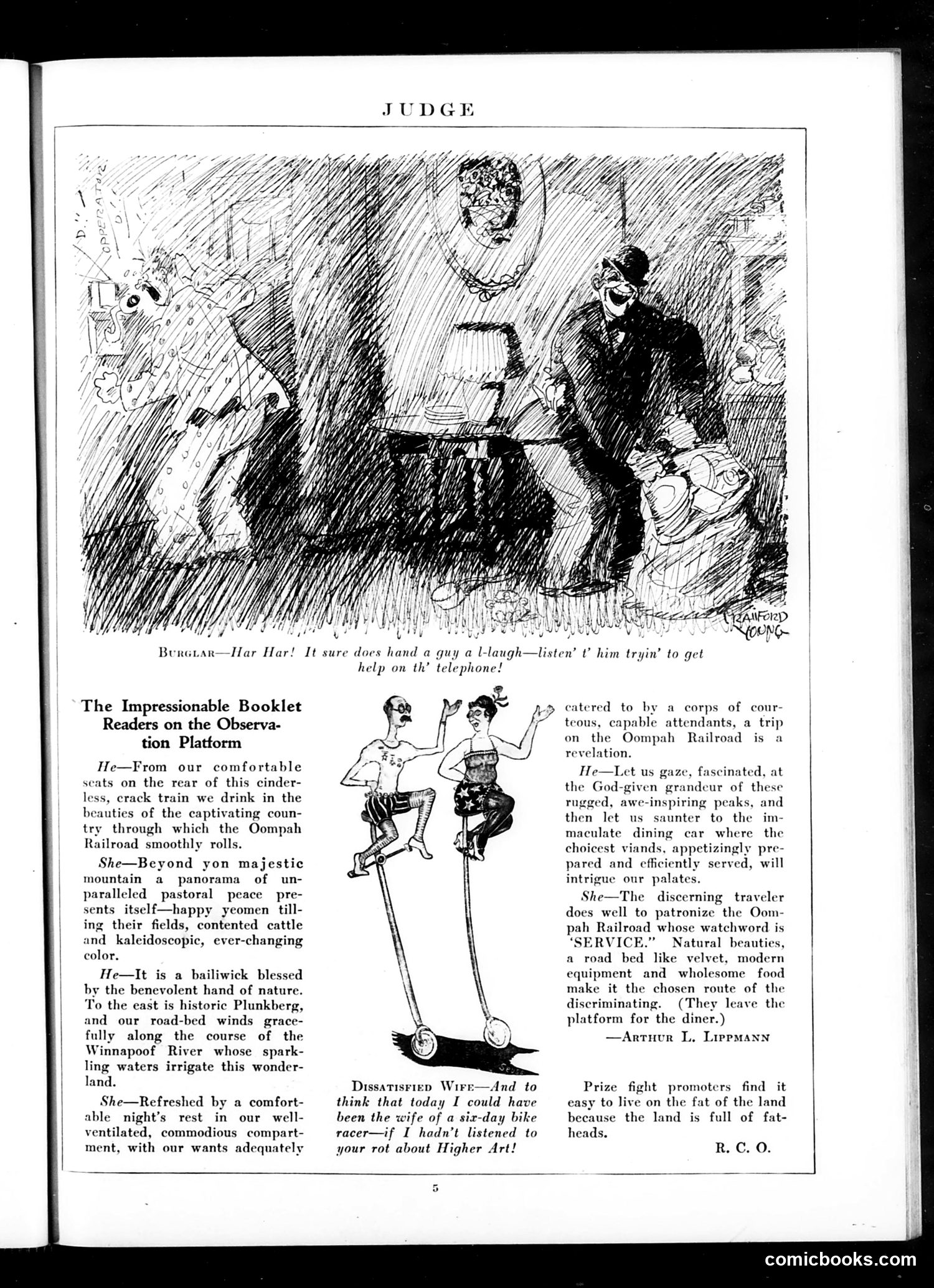
This page contains three distinct satirical pieces: **Top cartoon ("Judge")**: A burglar interrupts a couple's phone call, creating dark humor around the phrase "trying to get help on the telephone"—suggesting the couple's dramatic overreaction to minor troubles. **"The Impressionable Booklet"**: A couple on the Oompah Railroad observation platform exchange pretentious, flowery descriptions of scenery (referencing "Higher Art"). The satire mocks travelers who affect refined aesthetic appreciation while touring. The accompanying illustration shows couple doing exaggerated yoga/contortionist poses, furthering the mockery of affected sophistication. **"Dissatisfied Wife"**: A woman regrets marrying a "Higher Art" enthusiast (the bike racer comment is unclear) instead of pursuing practical security, suggesting satire of artistic pretension's real-world consequences. **Bottom quips**: Two unrelated humorous one-liners mocking prize fighters and their audiences as "fatheads." The page overall ridicules affectation, aesthetic pretension, and impractical romanticism—common Judge targets of the era.
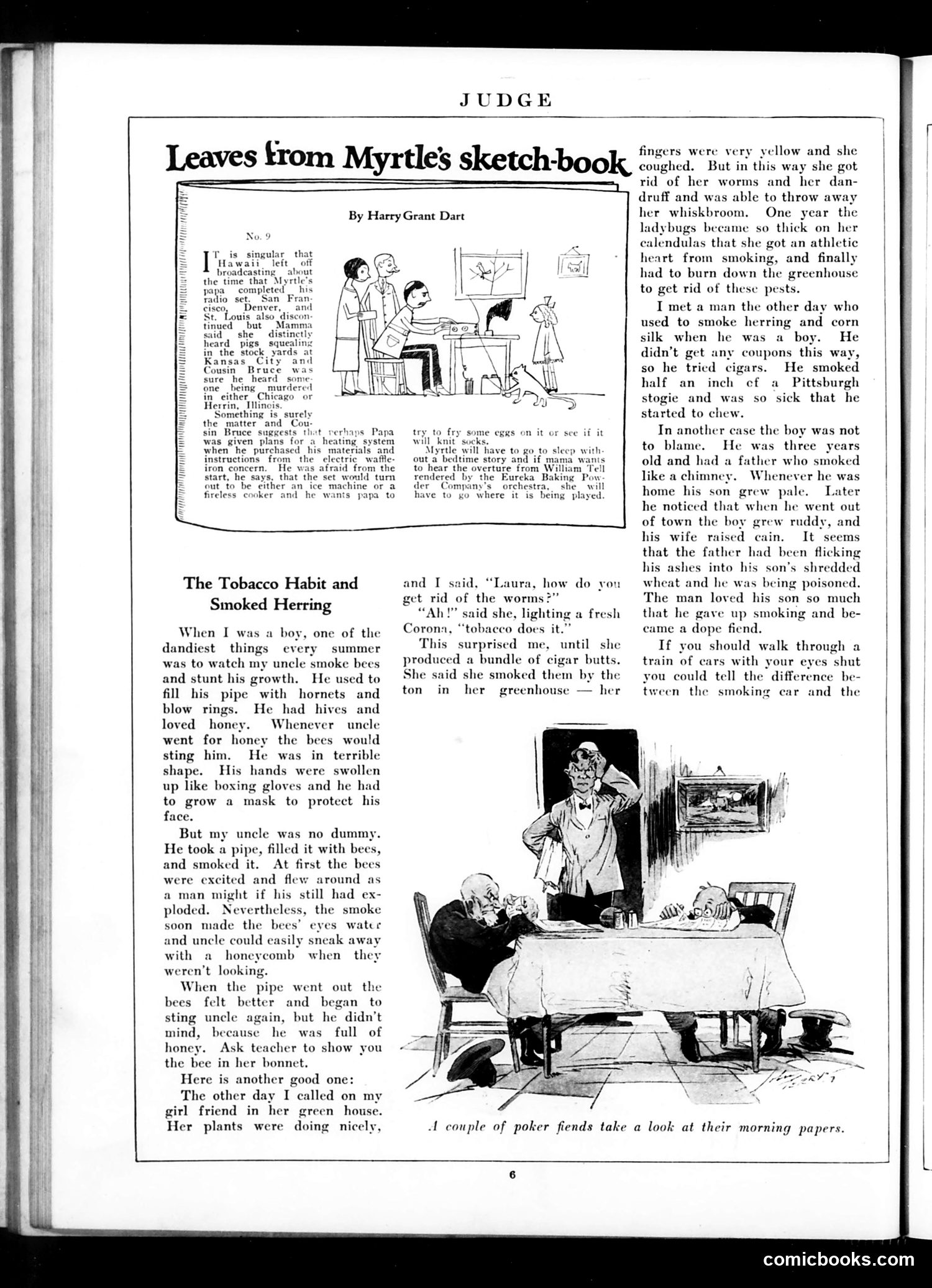
This page contains two unrelated humorous pieces typical of Judge magazine's satirical humor. **Top section**: A sketch about a malfunctioning radio set purchased from a heating company, poking fun at early 1920s radio technology and mail-order products. **Main article**: "The Tobacco Habit and Smoked Herring" is absurdist humor mocking smoking's prevalence and dangers. Dart recounts ridiculous anecdotes: smoking bees from a pipe to harvest honey, using cigar butts in a greenhouse to eliminate pests (making the plants' caretaker sick), and a man who smoked herring as a boy. The piece culminates in a dark joke about a father poisoning his young son by flicking cigarette ash into his breakfast cereal. **Bottom cartoon**: Two men examine newspapers at a table—likely "poker fiends" checking sports or racing results for gambling information. The satire critiques 1920s smoking culture's normalization and the era's acceptance of health risks. The absurd scenarios exaggerate real concerns about tobacco's harms.
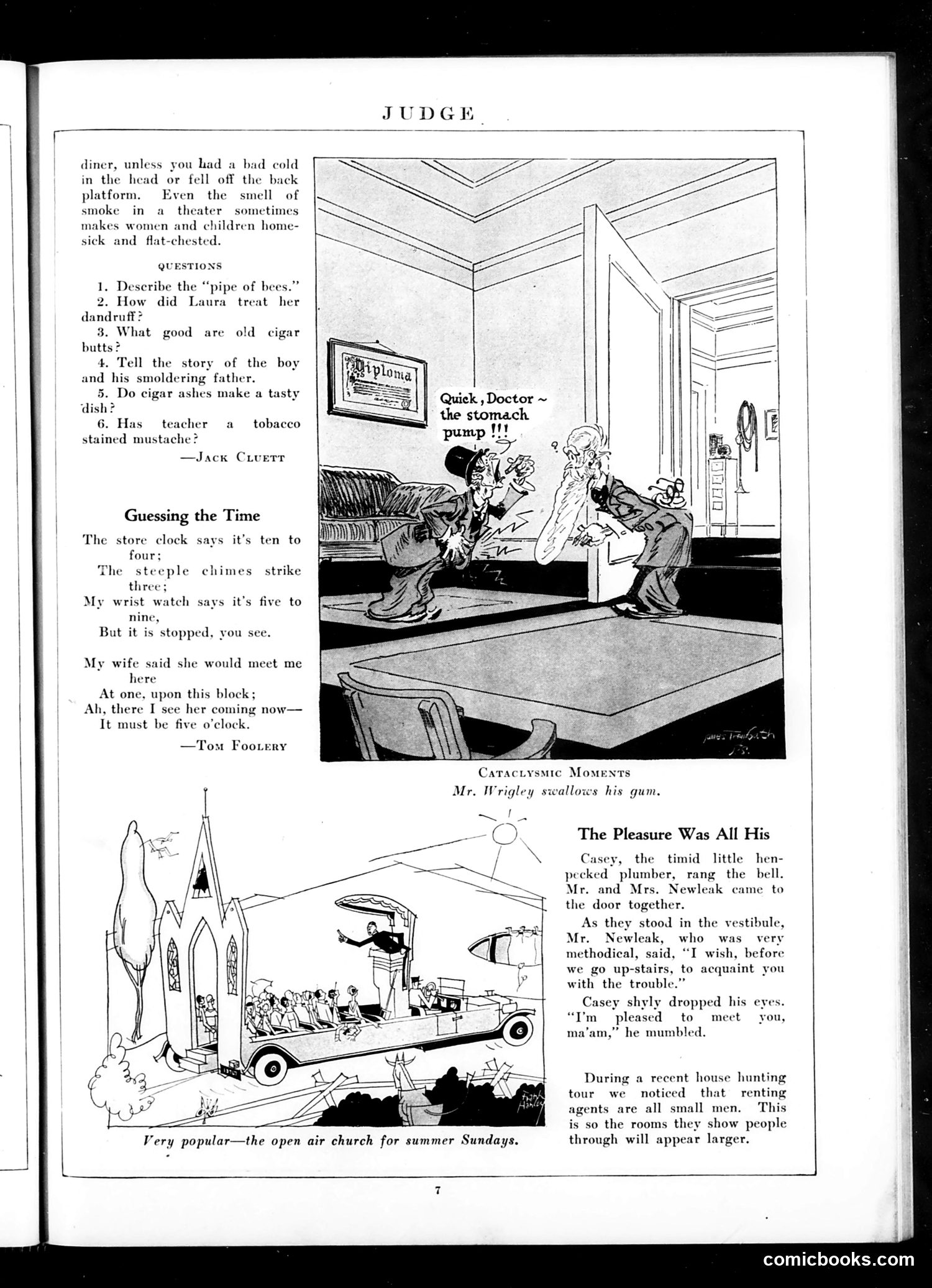
This page contains several brief humorous pieces typical of early 20th-century Judge magazine: **"Cataclymic Moments"** depicts a man (Mr. Wrigley) swallowing his gum—likely referencing the Wrigley chewing gum company, treating the incident as dramatic and absurd. **"The Pleasure Was All His"** satirizes a timid plumber (Casey) visiting clients about a plumbing problem. The joke's punchline—that small male real estate agents show apartments to make rooms appear larger—mocks deceptive marketing practices in housing rental. The **illustration of an "open air church"** appears to be satirizing a mobile, elaborate contraption as a novelty solution for summer religious services. The content reflects early 1900s concerns: consumer brands (Wrigley), workplace hierarchies (hen-pecked workers), housing market deceptions, and modern inconveniences. These are gentle, domestic satires rather than hard political commentary.
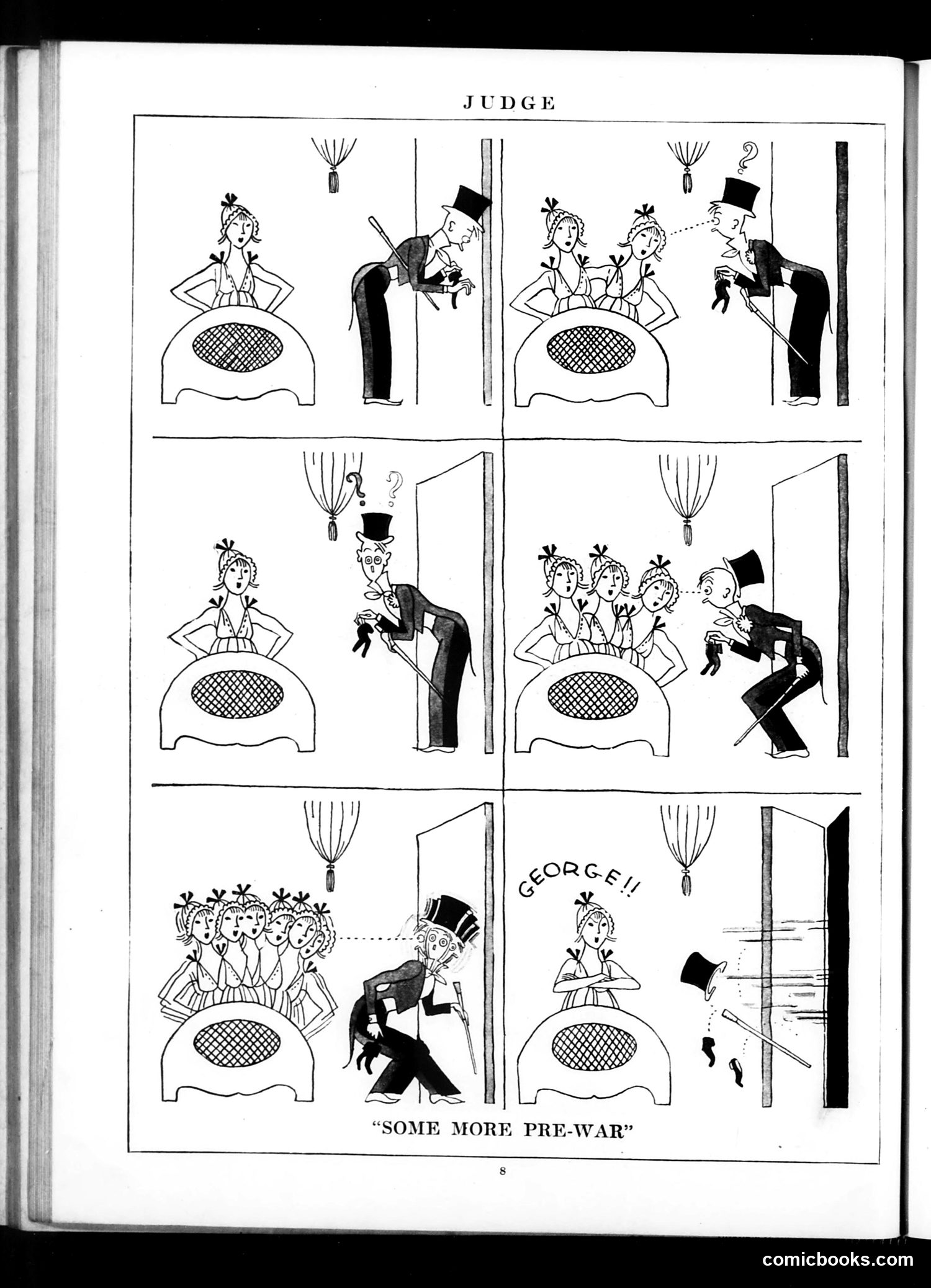
This comic strip titled "Some More Pre-War" appears to satirize a magician or entertainer attempting to produce romantic partners from a bed. In each panel, a man in formal attire (top hat, tails) performs magic tricks, initially producing one woman, then two, then multiple women from what appears to be a magic box or bed prop. The final panel shows the magician labeled "GEORGE" being ejected through a door, suggesting the trick has gone awry or become uncontrollable. The "pre-war" reference likely indicates this is satirizing entertainment or social behavior from before a specific conflict (possibly WWI, given Judge's era). The joke appears to center on the magician's inability to control his act's increasingly chaotic results—a commentary on either magical performance incompetence or romantic entanglement complications.
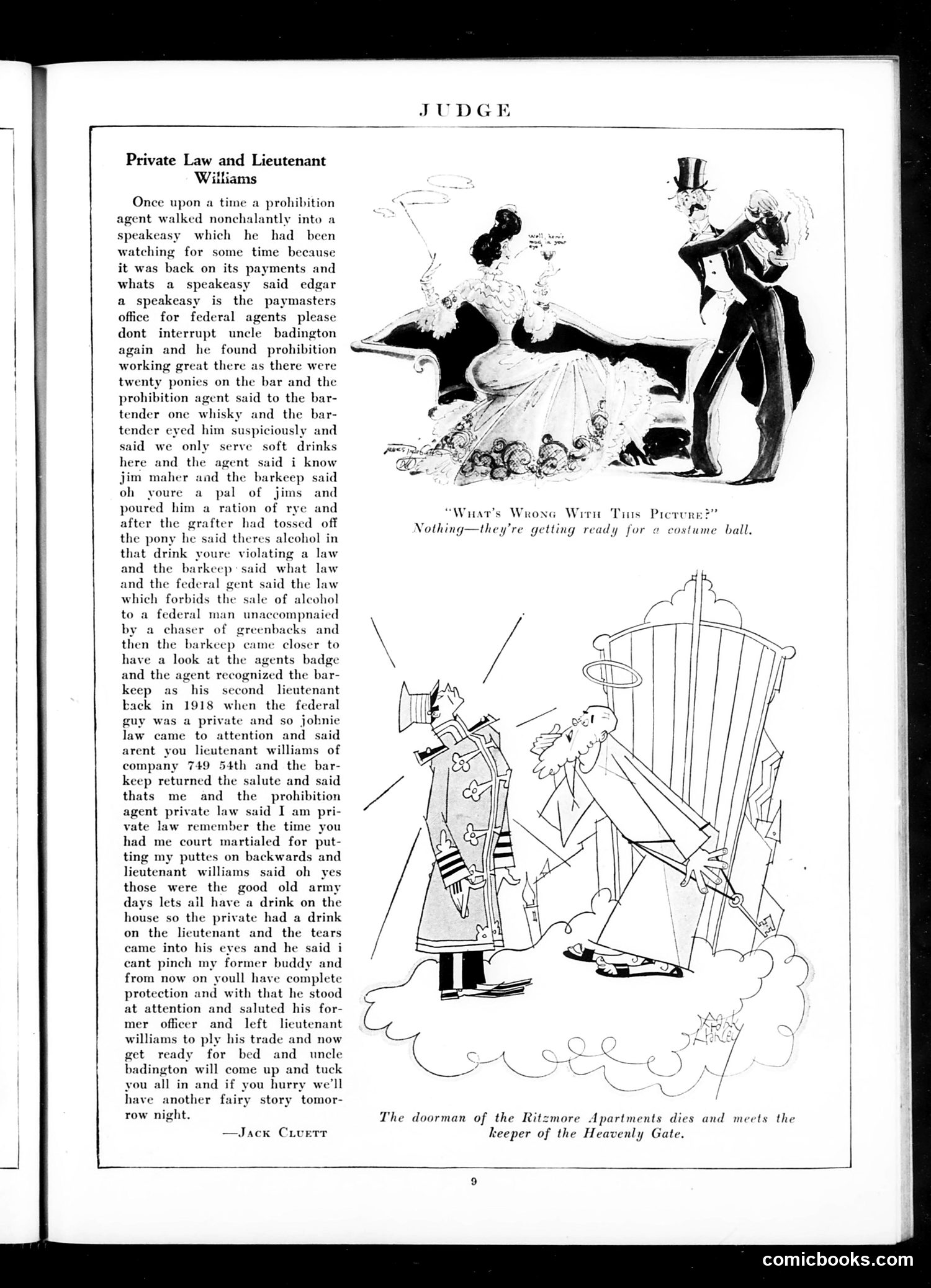
This 1920s satire mocks Prohibition enforcement corruption through two cartoons: **Top cartoon**: "Private Law and Lieutenant Williams" is a cynical fairy tale about a Prohibition agent who discovers his former military superior now runs a speakeasy. Instead of enforcing the law, the agent grants the bar protection in exchange for bribes—illustrated by the text's reference to "greenbacks" as the real "law." The joke: Prohibition agents were notoriously corrupt, accepting payments from speakeasy operators they were supposed to arrest. The military friendship provides cover for this obvious bribery. **Bottom cartoon**: Shows a doorman dying and meeting St. Peter at Heaven's gate, with the caption suggesting he's simply "getting ready for a costume ball"—implying the afterlife is a party. This appears to satirize either the frivolity of the wealthy (the Ritzmore Apartments reference suggests a luxury building) or the notion that even death brings no accountability. Both pieces mock Prohibition's failure and the widespread corruption it bred.
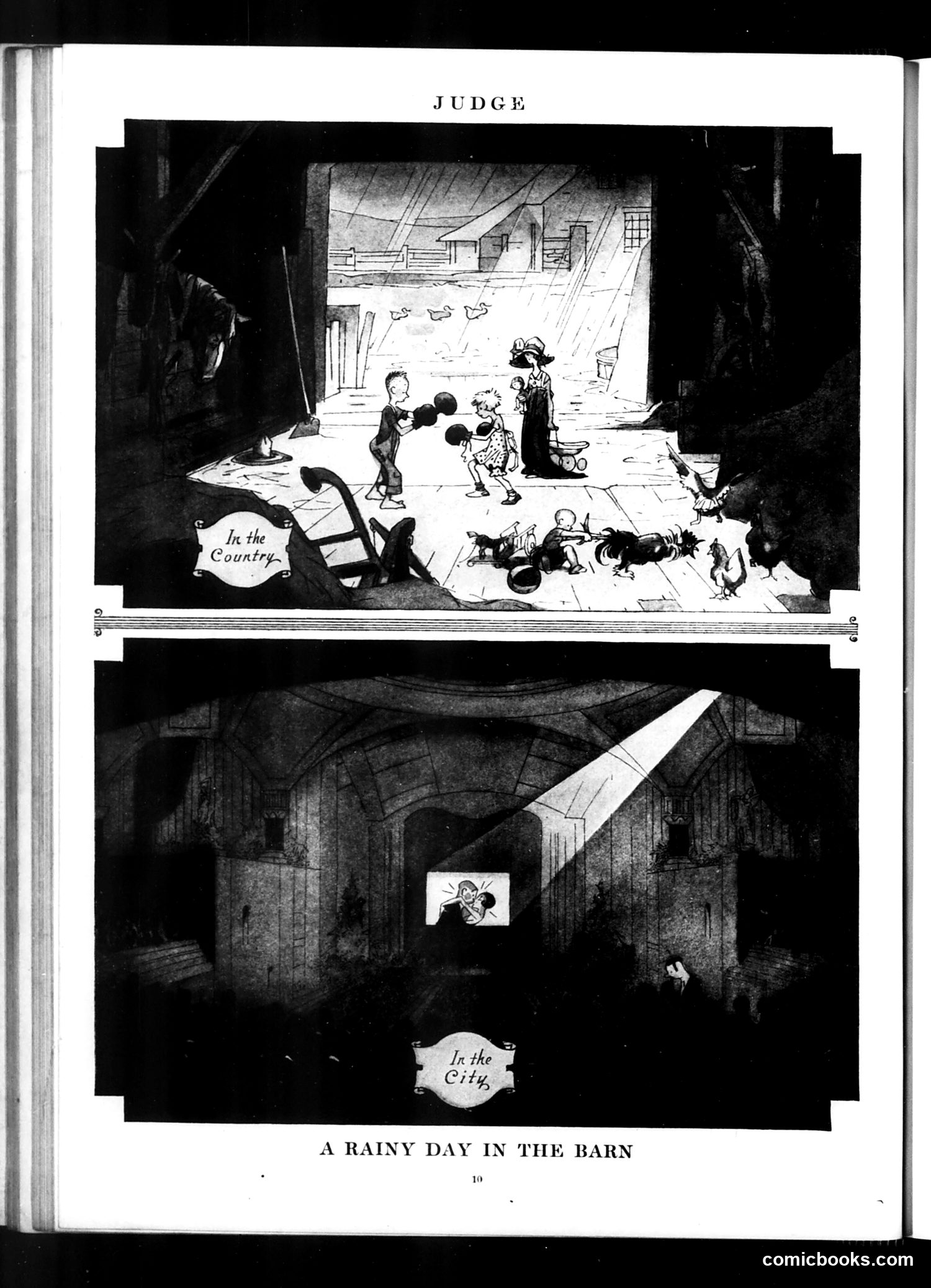
This appears to be a two-panel comparative cartoon from *Judge* magazine contrasting rural and urban leisure activities during bad weather. The **top panel** ("In the Country") shows children playing freely in a barn—boxing, playing with toys, and engaging in active games among farm animals and simple surroundings. The **bottom panel** ("In the City") depicts children in a dark, confined indoor space watching what appears to be a movie or projection on a screen—a more passive, sedentary entertainment form. The satire likely critiques urbanization and modern entertainment culture, suggesting that city children's rainy-day amusement is limited to passive consumption in dark theaters, whereas country children enjoy active, imaginative play. This reflects early 20th-century anxieties about urban life replacing traditional, healthier rural pastimes.
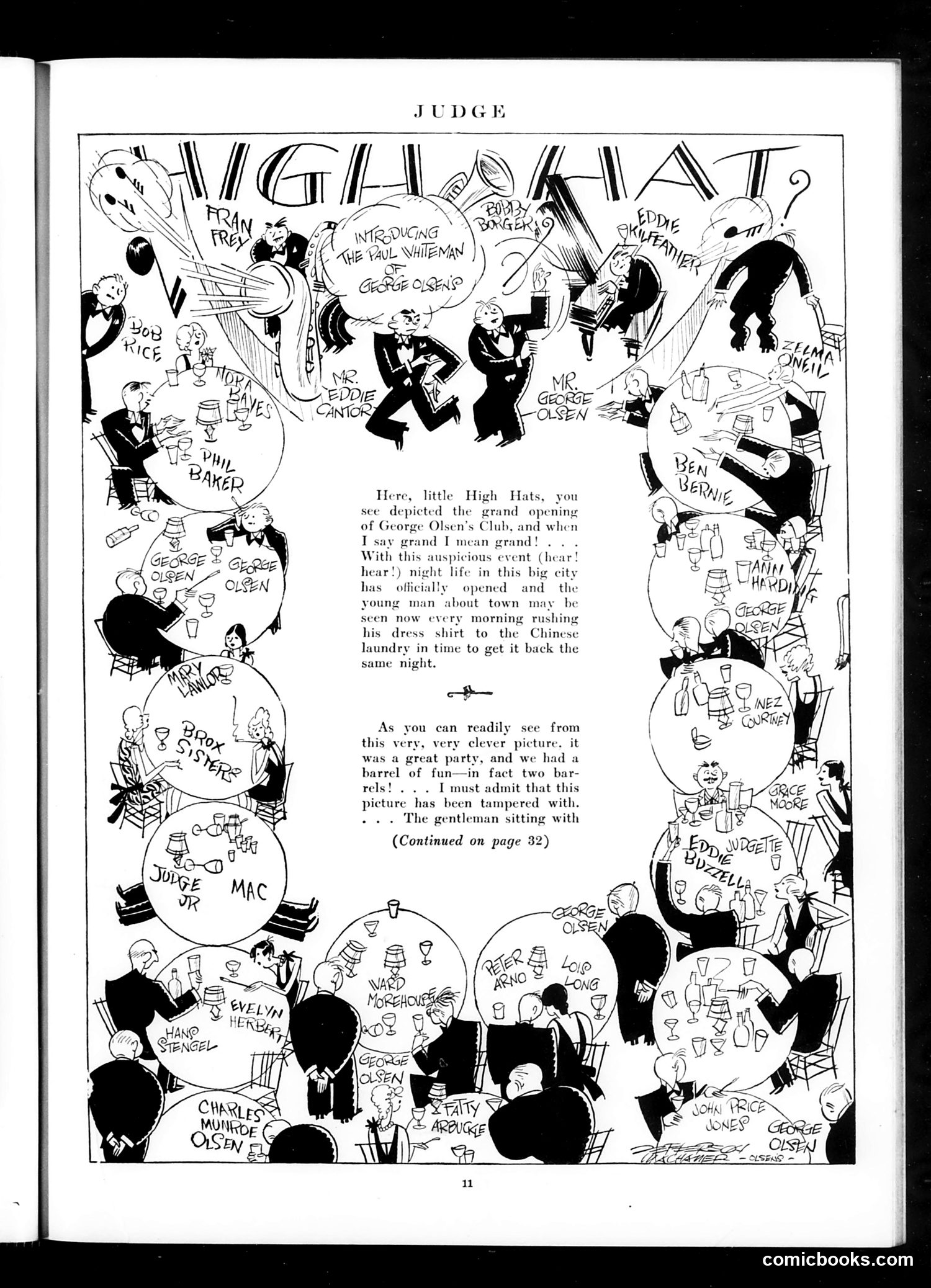
This cartoon depicts the grand opening of George Olsen's Club, a nightclub venue. The illustration shows a crowded party scene with numerous labeled figures representing New York socialites and "men about town" of the era. The satire targets the 1920s nightlife scene—specifically the affectation of wealthy young men who frequent fashionable clubs. The joke centers on a practical contradiction: these well-dressed gentlemen must rush their dress shirts to the Chinese laundry each morning to have them cleaned and returned the same night, allowing them to repeat their nightly revelries. The "High Hats" reference denotes the formal top hats these men wear. The cartoon mocks both the excessive partying culture and the dependency on laundry services it creates. The named figures appear to be actual socialites known to Judge's readership, making it a gossipy, insider commentary on Manhattan's nightclub scene during Prohibition-era revelry.
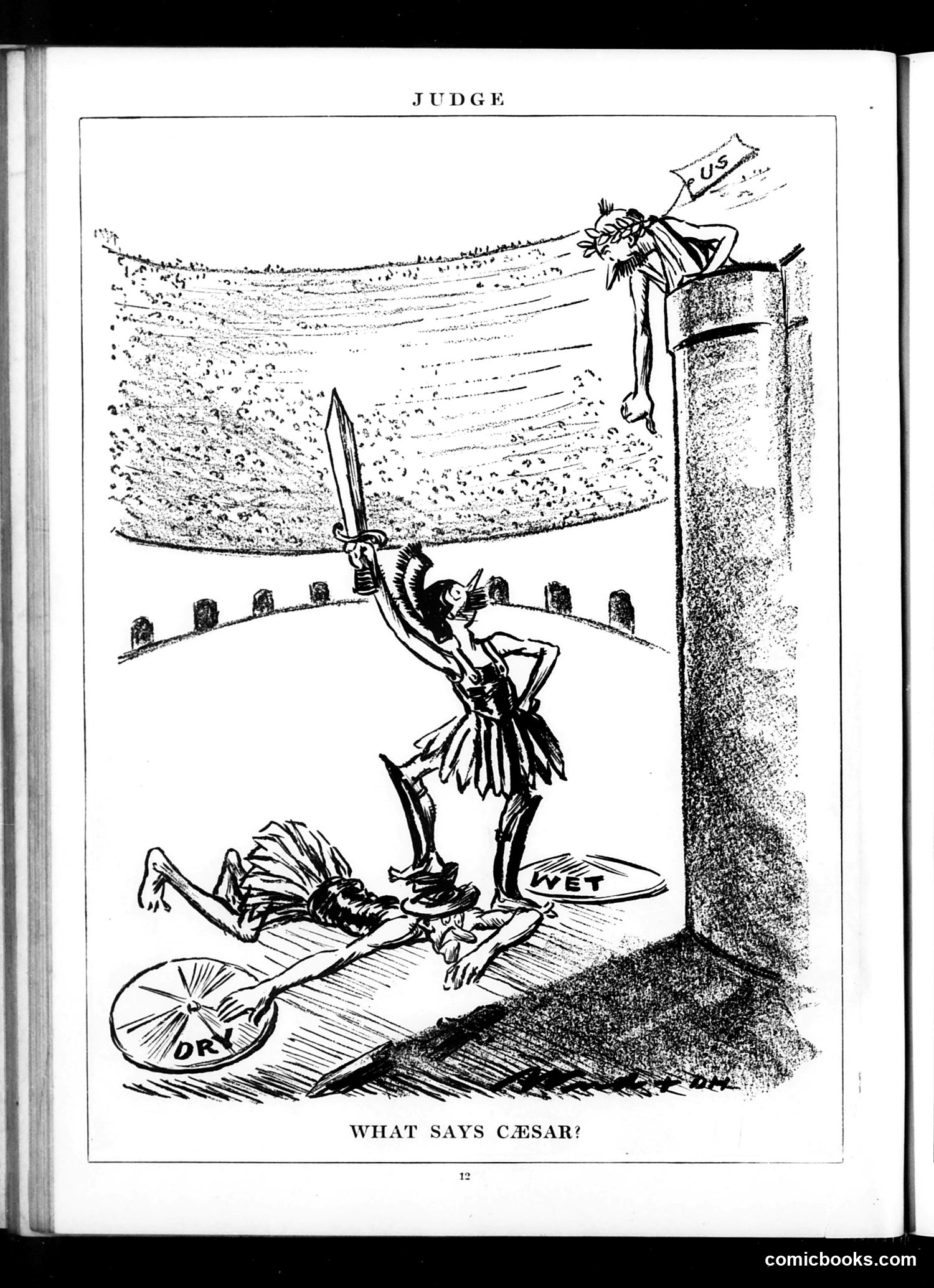
This political cartoon depicts Lady Justice (recognizable by her traditional iconography) wielding a sword above two prone figures labeled "DRY" and "WET." A torch labeled "U.S." shines from above, while a stone wall dominates the right side. The cartoon appears to address **Prohibition**—the ban on alcohol (1920-1933). The "DRY" and "WET" figures represent opposing factions in that heated debate: "drys" supported alcohol prohibition; "wets" opposed it. Lady Justice stands as arbiter between these conflicting positions. The title's reference to Caesar ("What says Caesar?") invokes authority and judgment, suggesting the cartoon questions what legal verdict will prevail in this bitter American political struggle.
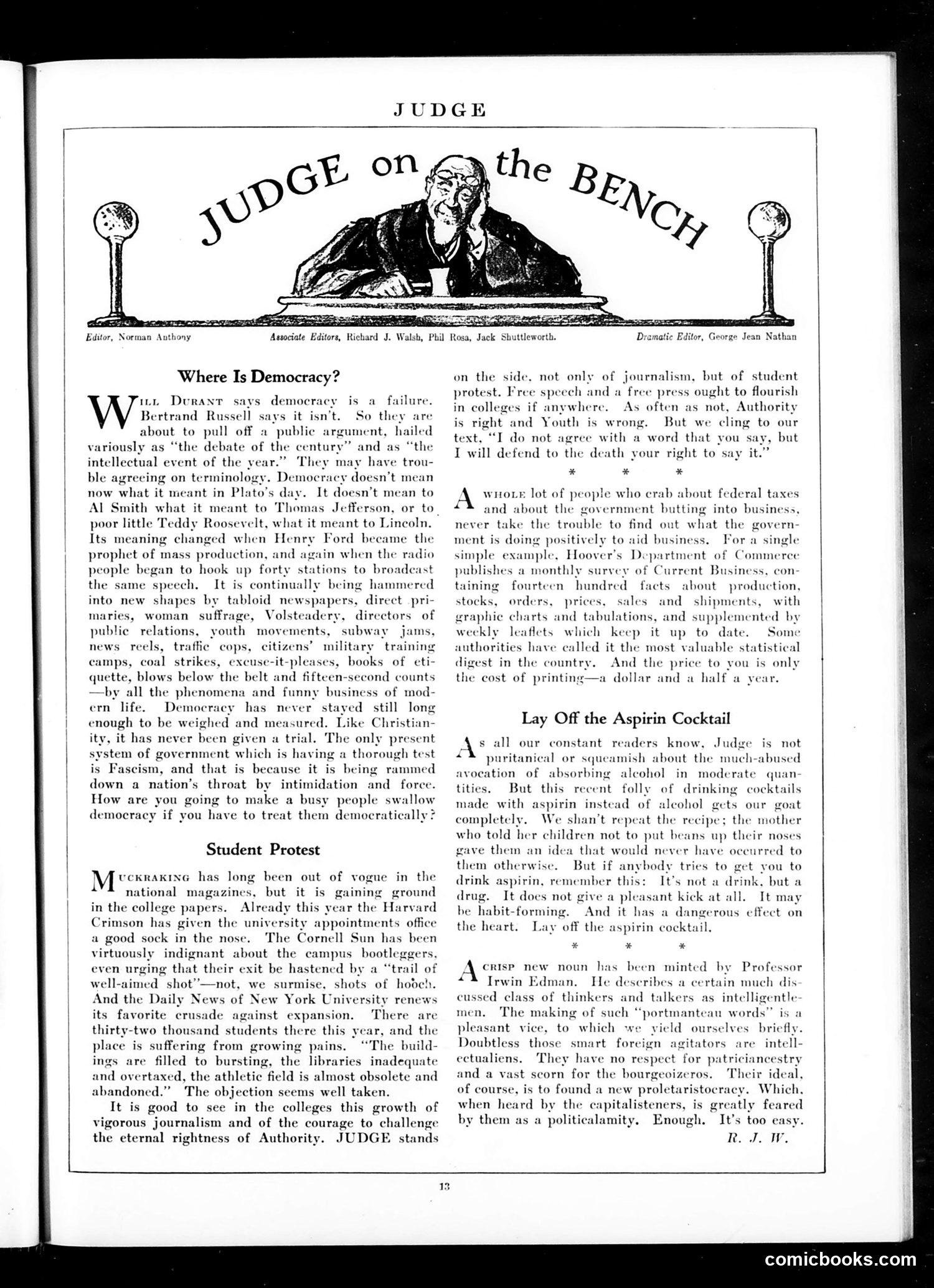
This page from *Judge* magazine features editorial commentary on contemporary American social and political issues, circa the 1920s-early 1930s (based on references to Hoover, Volstead Act, and Prohibition-era "bootleggers"). **Main Content:** The masthead cartoon shows a stern judge presiding, framing three opinion pieces: 1. **"Where Is Democracy?"** — Discusses an upcoming public debate between philosopher Bertrand Russell and scientist Will Durant about democracy's definition. The author argues democracy's meaning constantly shifts with technological and social change (mass production, radio, tabloids), making it impossible to pin down. It sardonically notes that only Fascism receives a "thorough test" because it's imposed by force. 2. **"Student Protest"** — Praises college newspapers (Harvard, Cornell, NYU) for boldly challenging university authority on issues like appointments and campus expansion. *Judge* defends free speech rights, invoking Voltaire's famous maxim. 3. **"Lay Off the Aspirin Cocktail"** — A brief warning against aspirin-based cocktails as a health hazard (Prohibition-era context). The tone is satirical but ultimately pro-democracy and pro-free-press.
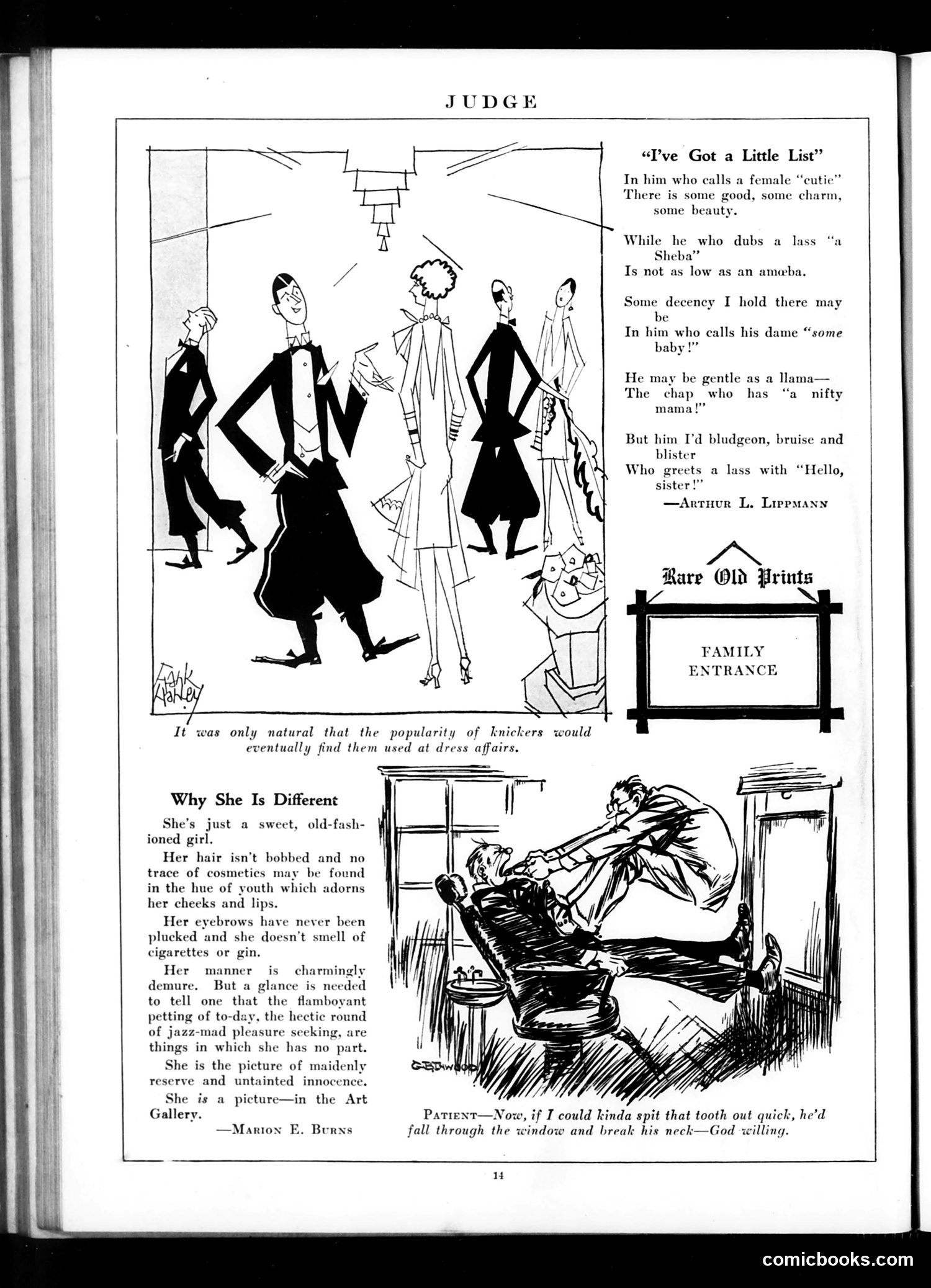
This page contains three satirical pieces commenting on 1920s social customs: **Top cartoon:** Depicts men in formal wear at what appears to be a dress affair, with the caption noting it's "natural" that knickers (a casual athletic garment) would eventually be worn to formal events. This mocks the era's loosening dress codes and changing social formality. **"I've Got a Little List" poem:** Arthur L. Lippmann ranks various slang terms for women by decency. He accepts "cutie," "Sheba," and "baby" as tolerable, but expresses violent disgust at "Hello, sister!"—suggesting this particular greeting represents an unacceptable level of casual, disrespectful familiarity between genders. **"Why She Is Different":** Marion E. Burns ironically describes an old-fashioned, makeup-free girl as a museum artifact—a "picture—in the Art Gallery." This satirizes how rapidly 1920s women's behavior had changed: bobbed hair, cosmetics, cigarettes, gin, and casual "petting" were now normal, making traditional femininity obsolete and quaint.
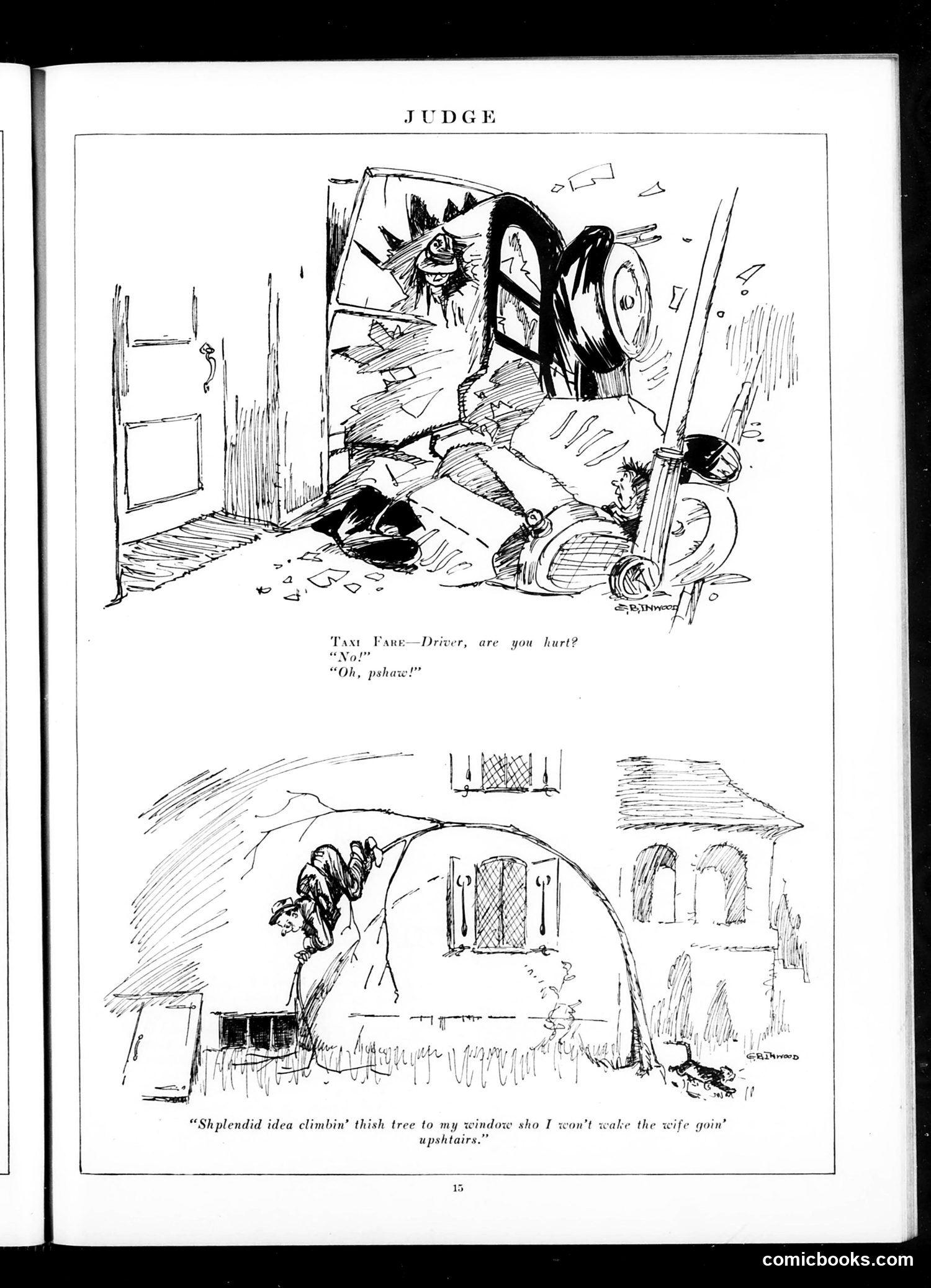
This page contains two separate gag cartoons satirizing domestic life. The top cartoon depicts a taxi accident—a crashed vehicle with debris scattered. The joke plays on a husband's relief that a car crash didn't injure him, seemingly unconcerned about the damage itself. The bottom cartoon shows a drunk man climbing a tree to reach his bedroom window to avoid waking his wife when coming home late. The humor derives from his intoxicated reasoning: he believes sneaking in via tree-climbing is a clever solution, when the obvious problem is his late arrival and drunkenness itself. His slurred speech ("Shplendid idea") emphasizes his inebriation. Both cartoons mock husbands' poor judgment regarding domestic responsibilities—prioritizing avoiding marital confrontation over addressing their actual misbehavior (reckless driving, coming home drunk). The satire targets early 20th-century male behavior and marriage dynamics.
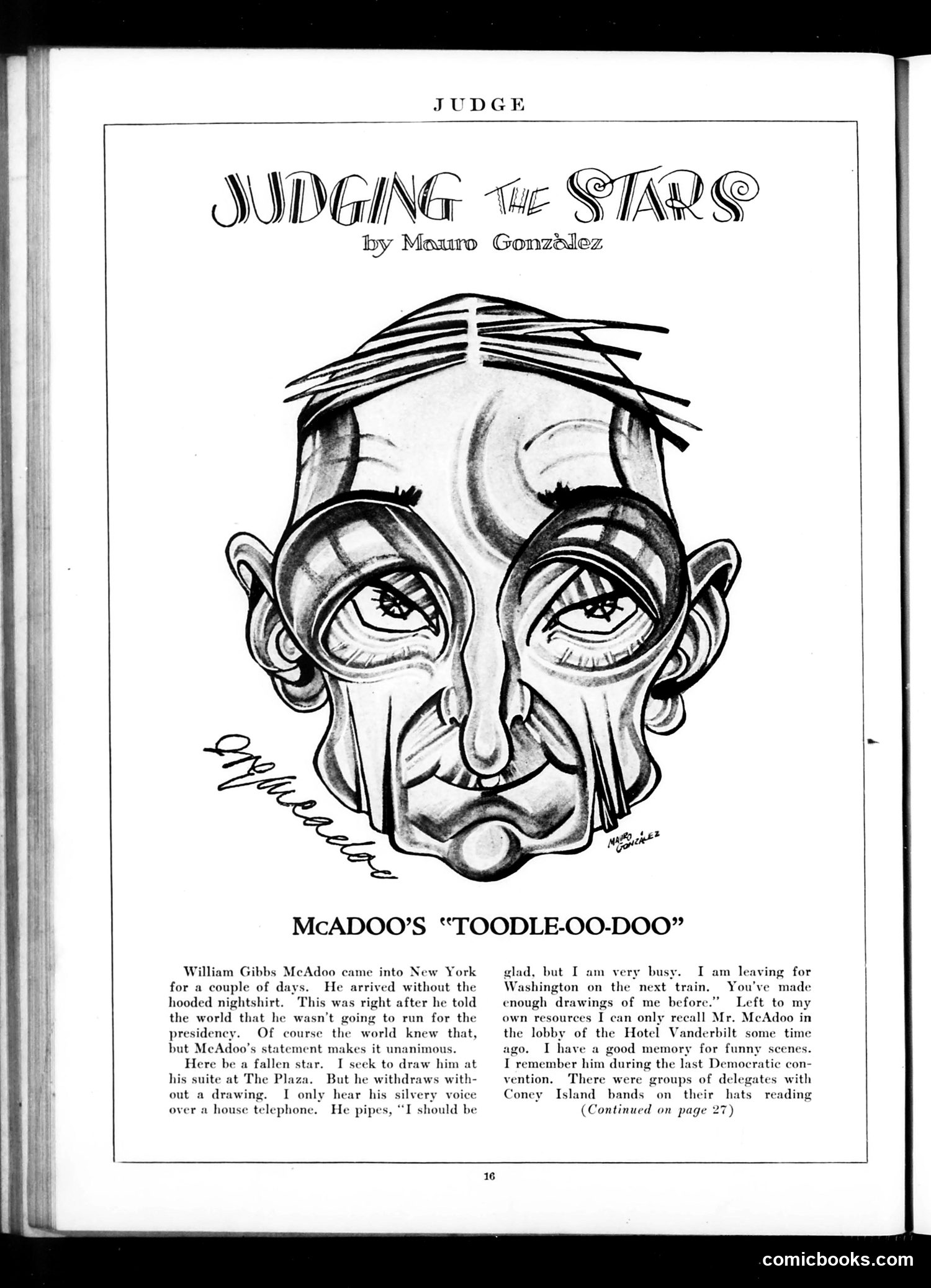
This caricature by Mauro González mocks **William Gibbs McAdoo**, a prominent Democratic politician who publicly announced he would not run for president. The exaggerated facial features—bulging eyes, prominent nose, drooping features—emphasize his diminishment as a "fallen star." The satire's point: McAdoo's denial about not running is treated as laughable ("makes it unanimous")—suggesting everyone already knew he had no chance anyway. The artist captures McAdoo refusing to sit for a portrait at his Plaza Hotel suite, a rebuff that adds to the mockery of his reduced status. The reference to Democratic convention delegates wearing "Coney Island bands" implies McAdoo's support had become absurdly small or ridiculous. The cartoon suggests a once-significant political figure has become irrelevant, and his withdrawal from the presidential race is less a noble decision than an admission of inevitable failure.
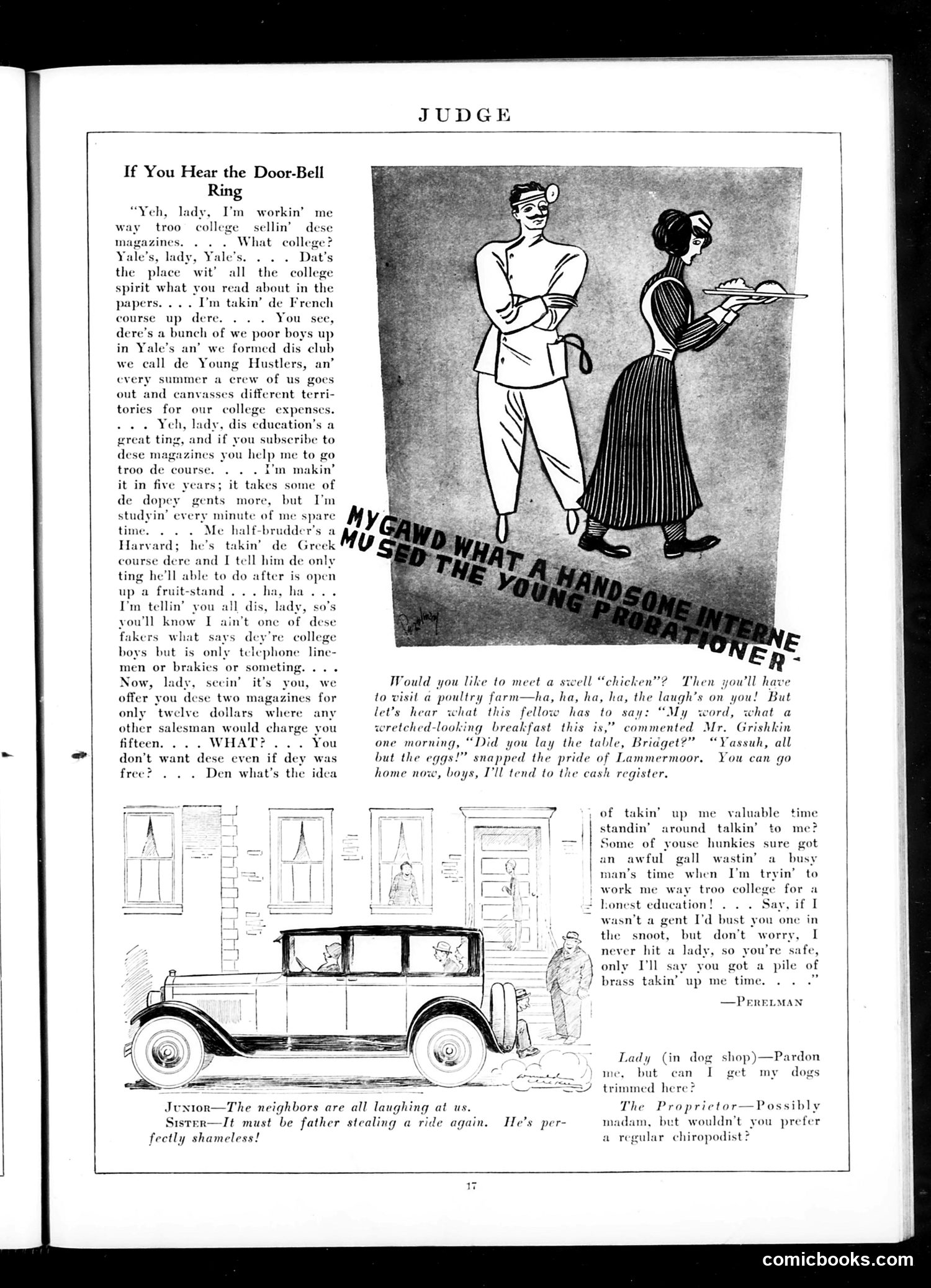
This 1920s Judge page satirizes aggressive college fundraising tactics through a brash Yale student's sales pitch. The main cartoon depicts a "Young Hustler" using high-pressure sales techniques to sell magazine subscriptions to a lady, claiming he's working his way through college. The satire targets both the student's transparent con-artist behavior (name-dropping Yale, invoking "college spirit," flattering the customer) and the broader phenomenon of college students using questionable door-to-door sales methods. The humor lies in the character's self-aware hypocrisy: he insists he's "not one of dese fakers" while clearly employing every manipulative tactic. His exaggerated working-class accent and aggressive final outburst ("brass takin' up me time") expose the scam's true nature. The secondary cartoons mock misunderstandings about "chickens" (poultry) and provide mild domestic humor unrelated to the main piece.
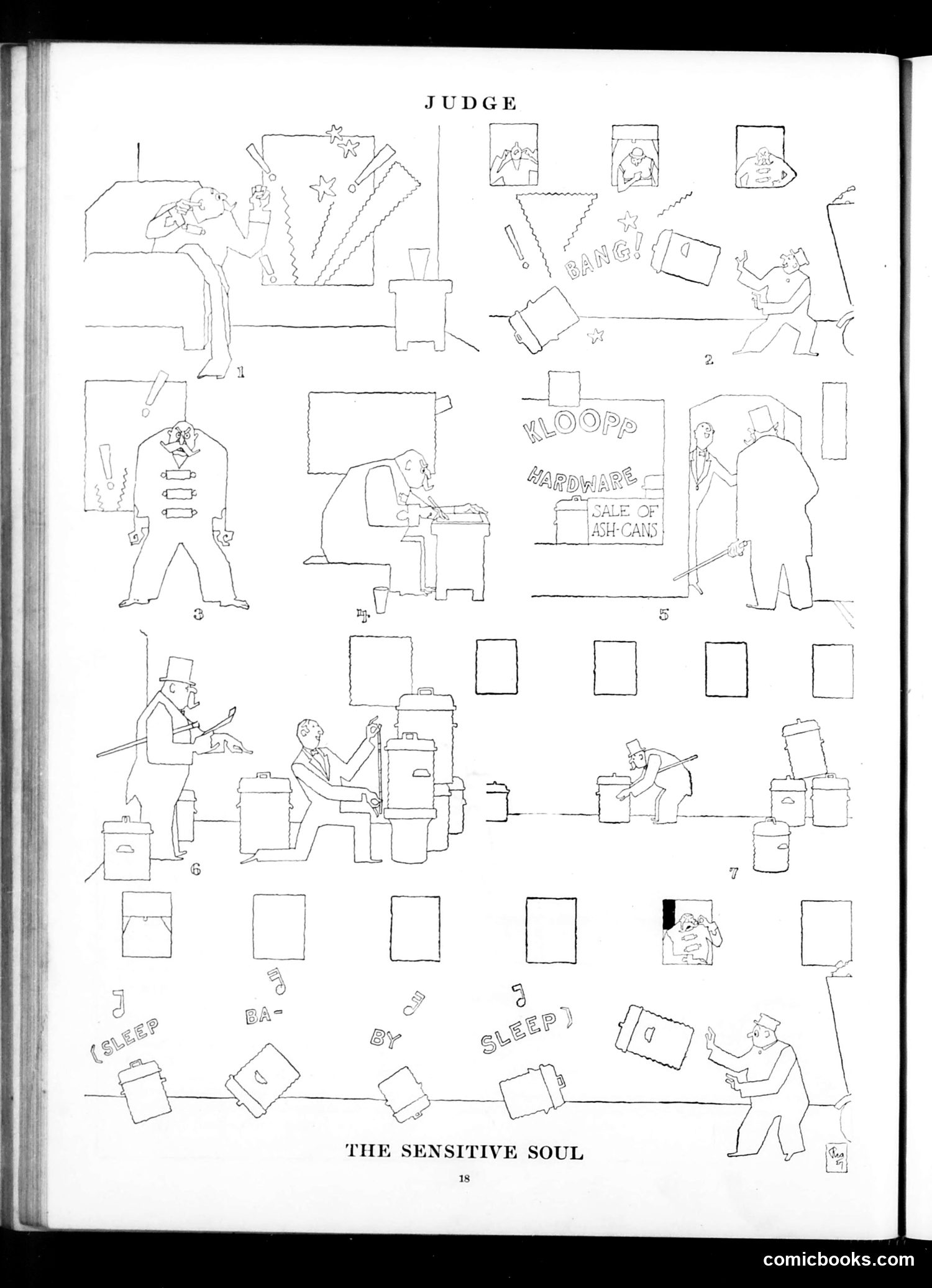
This page titled "The Sensitive Soul" appears to be a multi-panel satirical comic strip mocking an overly emotional or neurotic character. The panels depict various scenarios—a judge's courtroom, a hardware store (Klopp Hardware, "Sale of Ash-Cans"), workplace interactions, and domestic scenes involving boxes and sleeping arrangements. The recurring phrase "SLEEP BY" and imagery of someone constantly moving boxes or being disturbed suggests satire about an excessively sensitive person who cannot tolerate minor inconveniences. The hardware store reference and sleeping scenes may indicate commentary on lower-class living conditions or social pretension. Without the magazine's date or byline visible, the exact historical/political context remains unclear, but this appears to be general social satire about affectation and oversensitivity rather than specific political commentary.
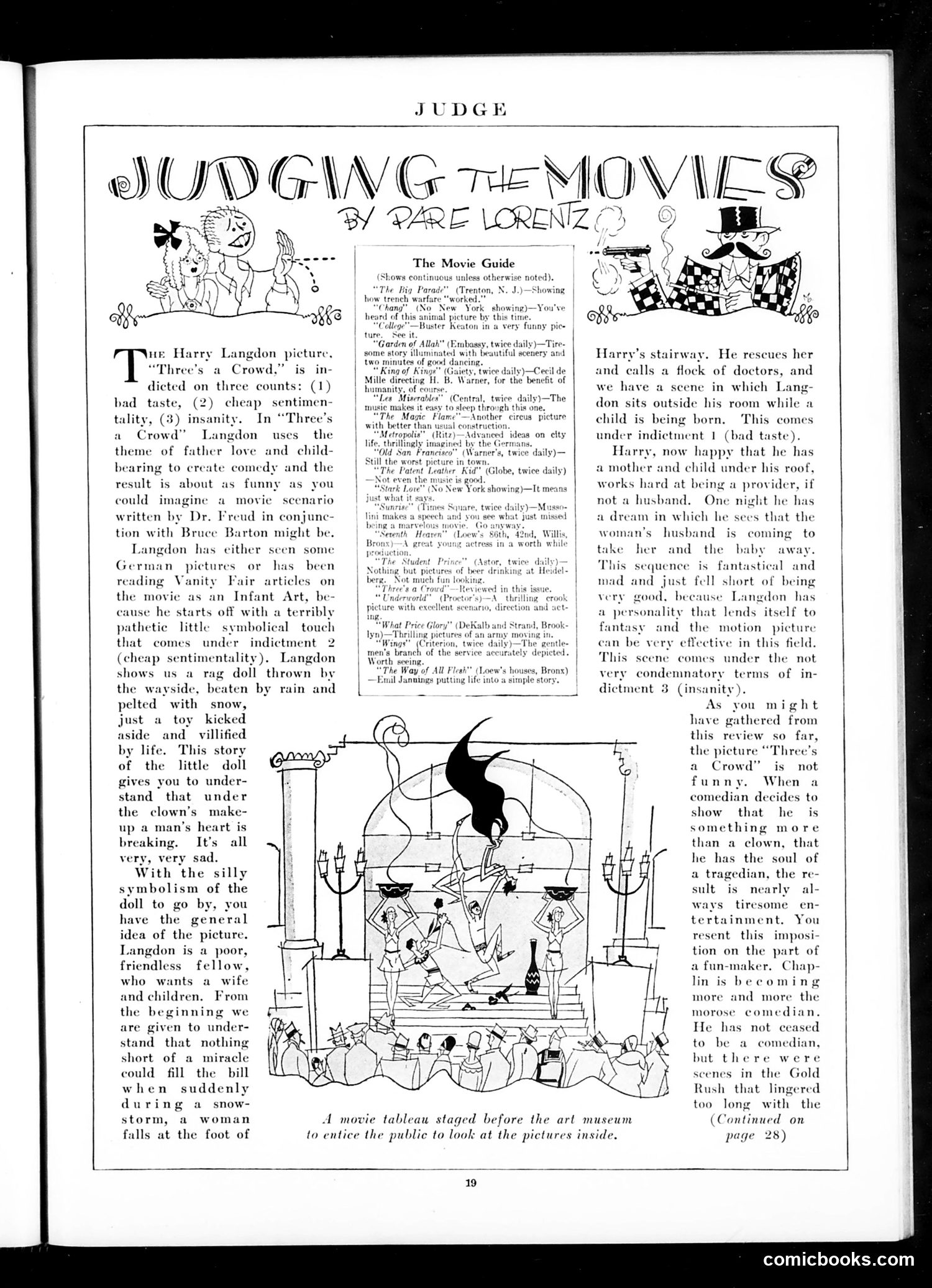
This page reviews Harry Langdon's silent film "Three's a Crowd," critiquing it harshly on three counts: bad taste, cheap sentimentality, and insanity. The critic objects to Langdon's attempt at dramatic depth—using symbolic imagery (a battered doll) and melodramatic plotting (rescuing a woman in labor, a dream sequence about her husband returning) to add pathos to his comedy. The reviewer argues this undermines his effectiveness as a comedian. The central complaint: comedians like Langdon and Charlie Chaplin are increasingly trying to be tragic artists, but their forced earnestness makes entertainment "tiresome." The satire targets Hollywood's trend toward "Infant Art" pretentiousness and Dr. Freud-influenced psychological depth in popular entertainment—suggesting comedians should stick to comedy rather than attempting serious drama.
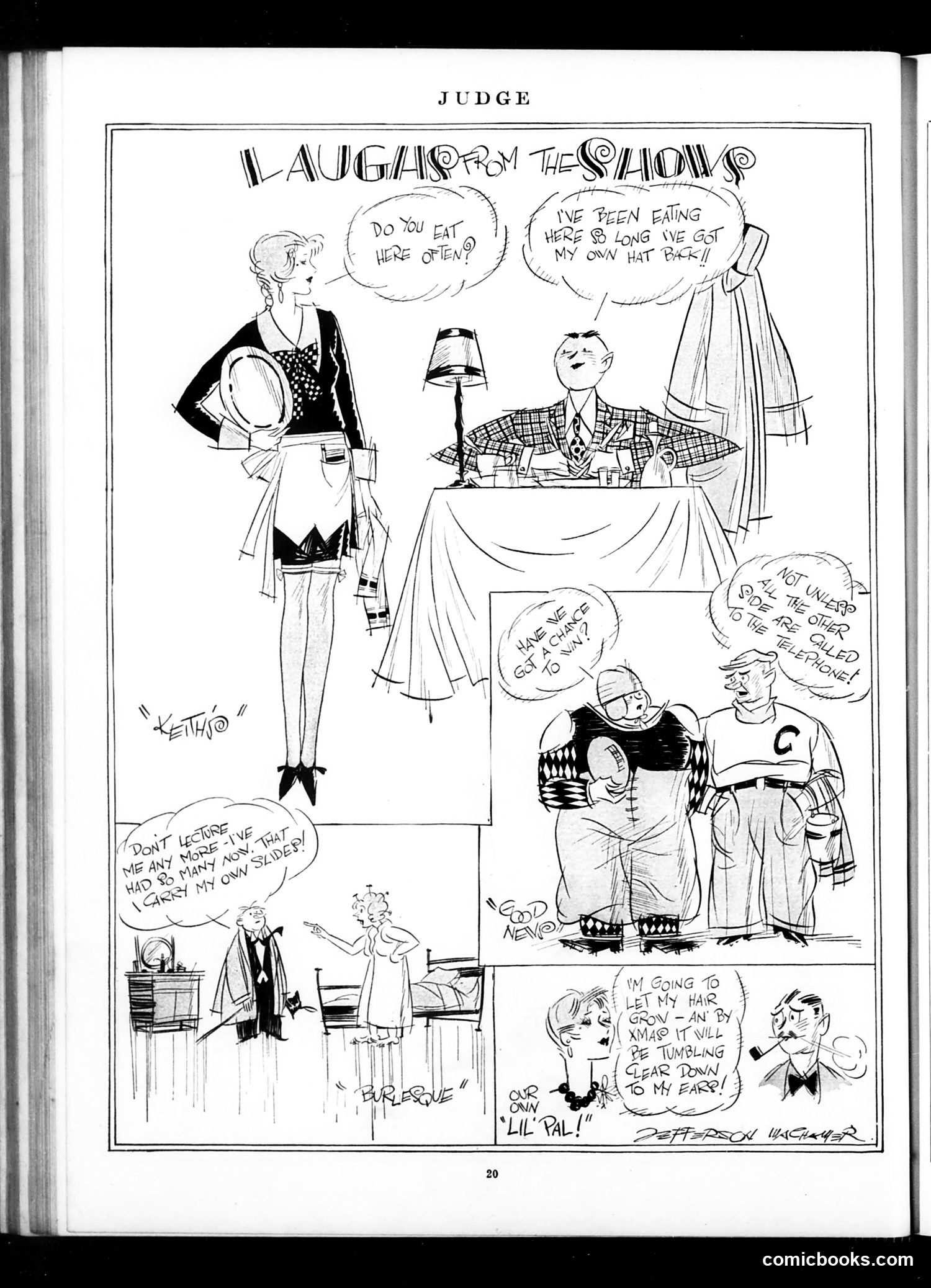
This is a comic strip satirizing domestic life and fashion anxieties, likely from the 1920s-30s based on the art style. The strip depicts several scenarios of women complaining about practical problems: - A woman worries about losing her hat at a restaurant - Another complains about her hat taking up space at home - A couple discusses the woman's hair-growing plans, with the man joking it will "tumble clear down to my barn" - The final panel shows a child ("Lil Pal") making a similar quip The humor targets women's preoccupation with appearance and fashion accessories (particularly hats, which were significant status symbols), while men respond with exasperation or crude jokes. The satire mocks both female vanity and male indifference to domestic concerns. The title "Laughs from the Shows" suggests this reflects scenarios recognizable from contemporary theater or vaudeville.
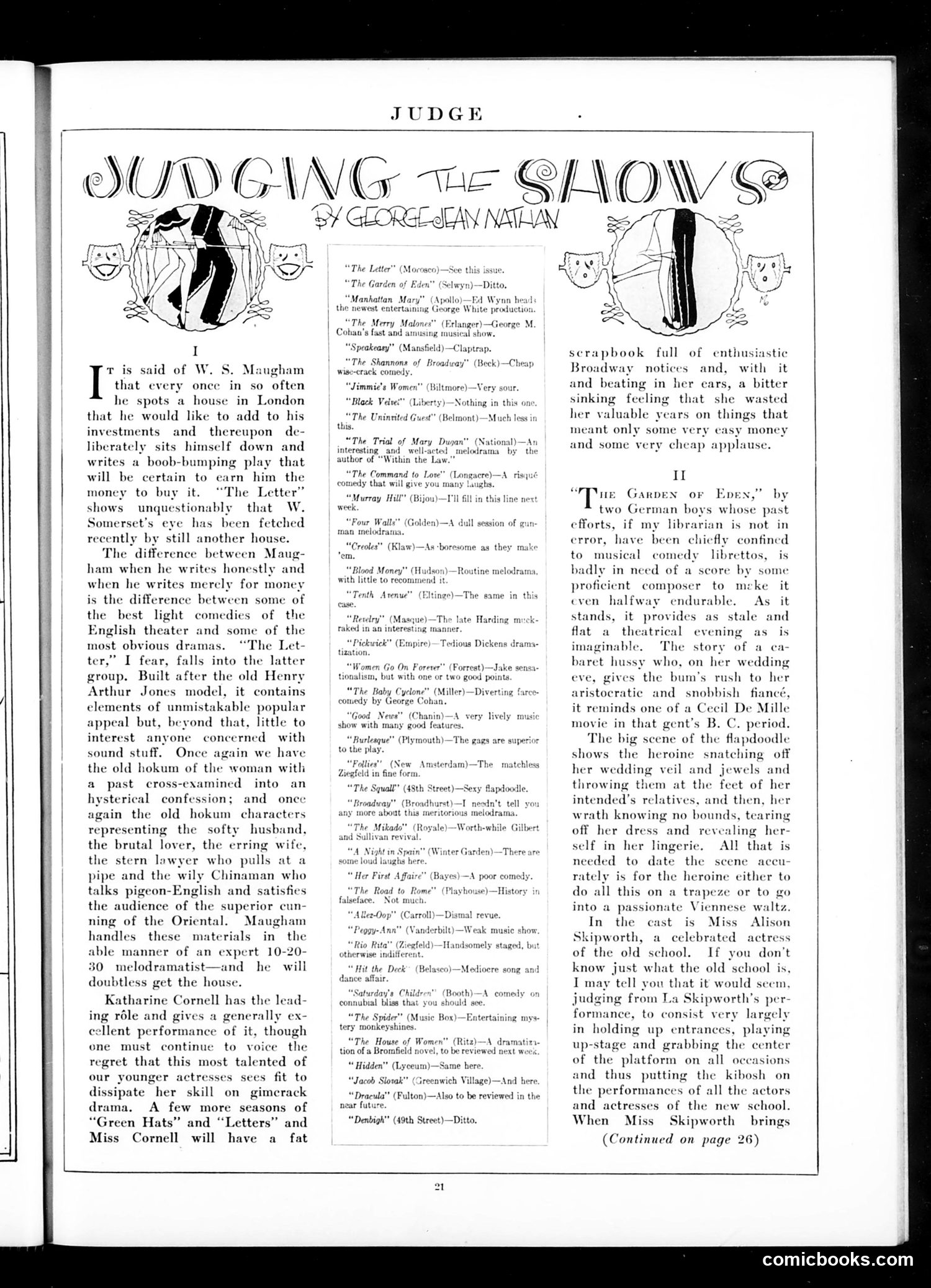
This page contains theater criticism by George Jean Nathan reviewing Broadway productions. The main critique focuses on W.S. Maugham's play "The Letter," performed by actress Katharine Cornell. **The Satire:** Nathan argues that Maugham deliberately writes commercial melodramas (not his honest work) solely to finance real estate purchases in London. He satirizes "The Letter" as old-fashioned hokum—featuring worn theatrical devices: a woman with a scandalous past, a brutal lover, stern lawyer, and a cunning Oriental character (stereotypical "pigeon-English" speaking Chinaman). **The Point:** Nathan laments that Cornell, a genuinely talented younger actress, wastes her skills on such "gimcrack drama" rather than serious work. He predicts she'll squander her career on trashy productions like "Green Hats" and "Letters" for easy money and cheap applause—a cautionary critique of commercial theater compromising artistic integrity. The second review addresses "The Garden of Eden," a German operetta needing a competent composer.
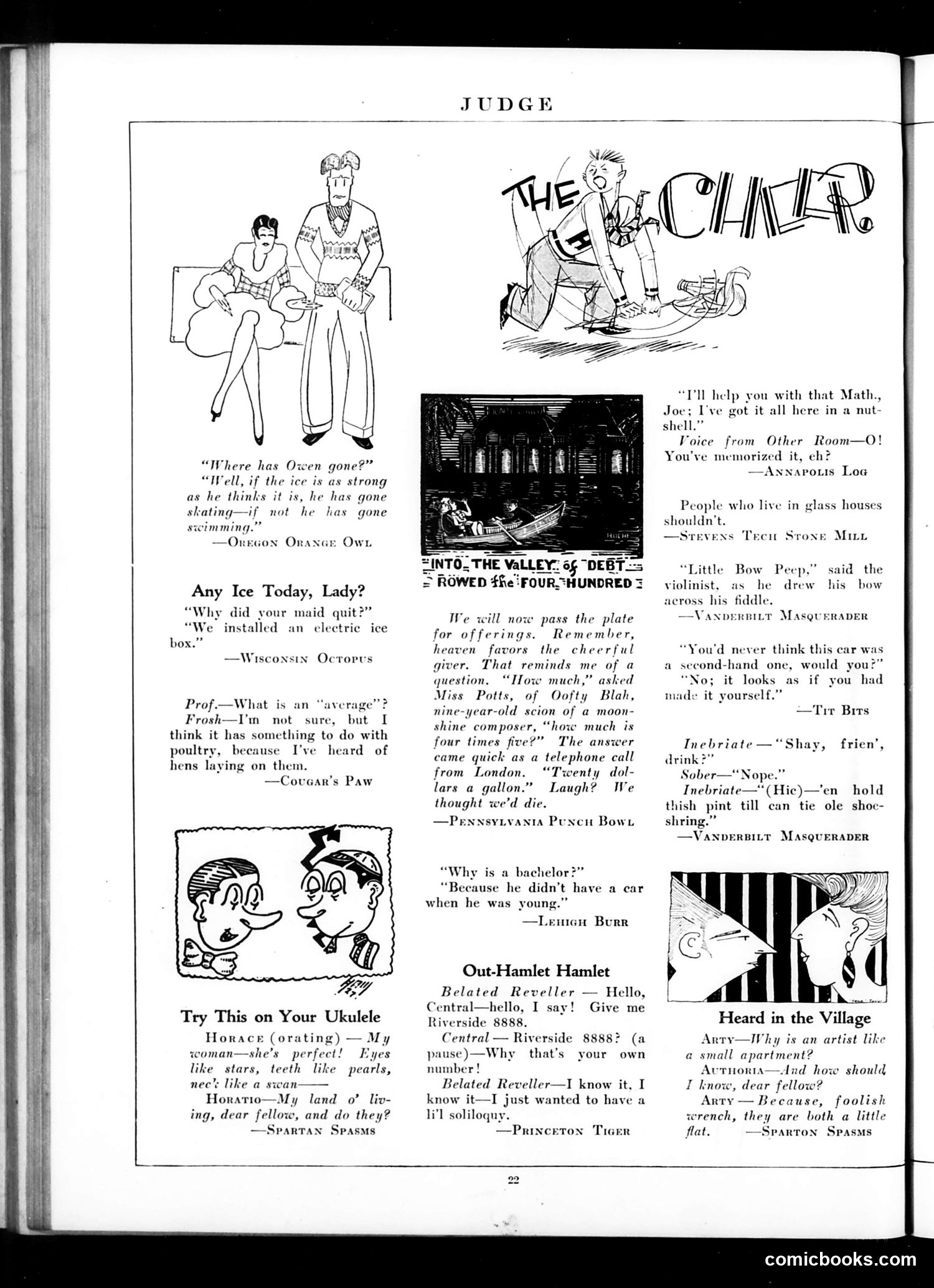
This page contains satirical humor typical of Judge magazine's early 20th-century style. The content includes: **Main jokes and references:** - "Where has Owen gone?" plays on the death of figure skater Owen (likely Maribel Vinson or similar contemporary skater) through a dark joke about thin ice - "Any Ice Today, Lady?" references electric refrigeration replacing ice delivery—a modern convenience joke - "Out-Hamlet Hamlet" mocks drunk men making theatrical phone calls, playing on Hamlet's famous soliloquies - Multiple short jokes about cars, bachelors, and social manners typical of 1920s-era humor **Illustrations** show flappers and period-dressed figures in comedic situations. One cartoon references "Into the Valley of Debt" (likely about financial troubles). **Overall tone:** Light, genteel satire aimed at educated readers, with references to contemporary technology (electric ice, automobiles, telephones) and theatrical culture. The humor relies on wordplay and social observation rather than political commentary.
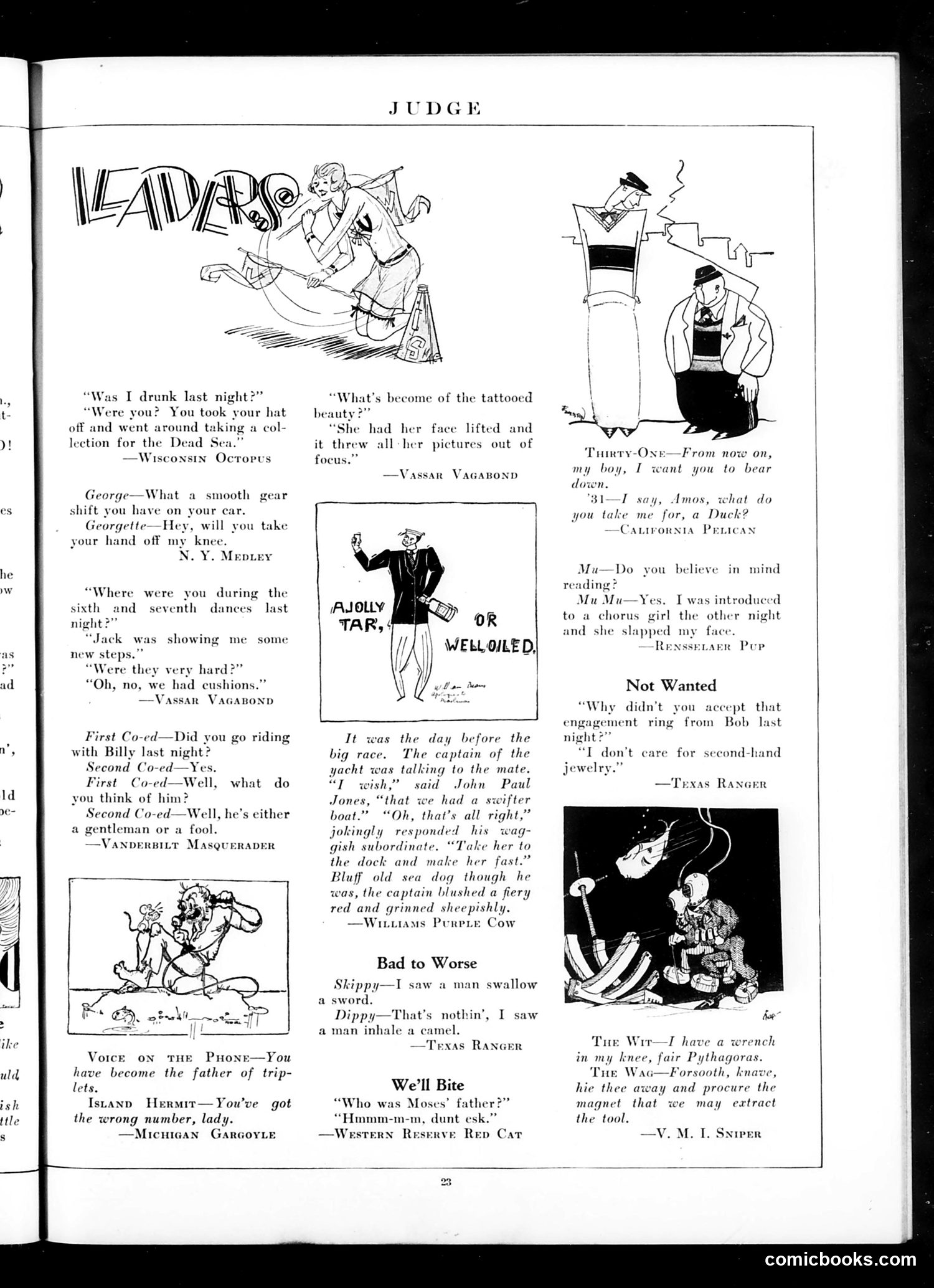
This page from *Judge* collects short humorous quips and cartoons typical of the magazine's satirical format. The jokes target early 20th-century social behavior and attitudes: **Key themes:** 1. **Gender/Dating dynamics**: Multiple jokes mock courtship rituals—women's modesty ("take your hand off my knee"), physical advances during dances, and engagement ring rejection of "second-hand jewelry." 2. **Class and education**: References to college life (Vassar, Vanderbilt) suggest humor aimed at educated, affluent readers. 3. **Period absurdism**: The "Bad to Worse" section uses exaggeration (swallowing swords, inhaling camels) for comedic effect. 4. **Visual gags**: Cartoons like "A Jolly Tar" and the phone mishap about triplets use physical comedy and wordplay. The humor assumes shared middle/upper-class values and social conventions—what would offend modern sensibilities regarding women and gender. The overall tone is lighthearted rather than biting political satire.
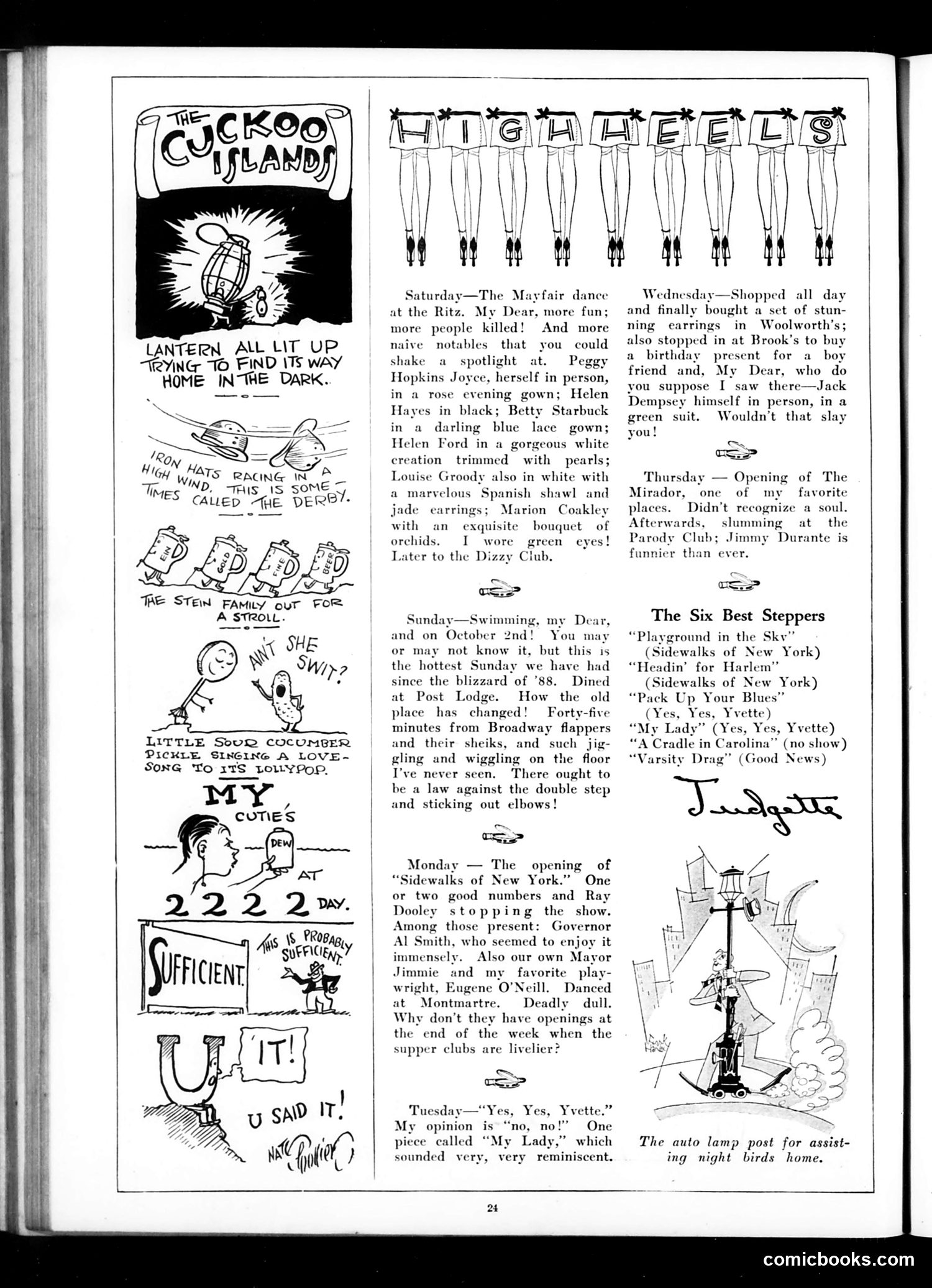
This page features a society gossip column ("Highheels") documenting a week of upper-class nightlife in 1920s New York, alongside cartoons mocking excess and frivolity. The column name-drops celebrities and venues (Peggy Hopkins Joyce, Jack Dempsey, Eugene O'Neill, Governor Al Smith) attending Broadway openings and supper clubs. It satirizes the shallow preoccupations of wealthy socialites: elaborate gowns, jewelry, dancing, and social status. The left-side cartoons reinforce this satire through crude humor: a "Cuckoo Islands" sketch about searching for home (mocking aimless nightlife), a "Little Sour Cucumber" love song, and jokes about extravagance ("My Cuties at 2222 Day"). The final cartoon mocking an "auto lamp post for assisting night birds home" directly ridicules the nocturnal excess depicted in the column. The "Six Best Steppers" list references contemporary dance steps and popular songs, capturing Jazz Age culture. Overall, *Judge* uses the column and cartoons to critique 1920s social excess and moral decline during Prohibition era.
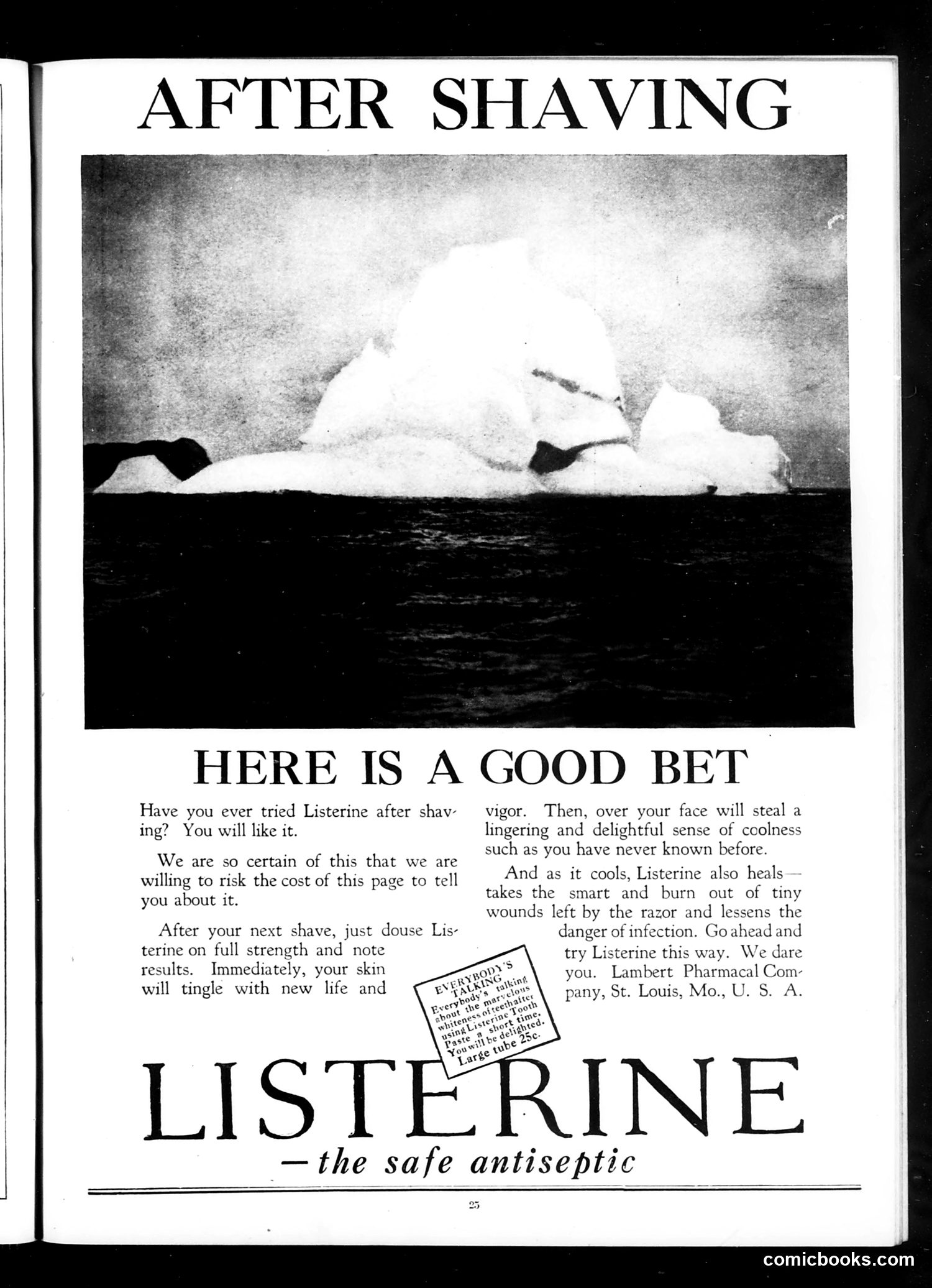
This is **not a political cartoon or satire**—it's a full-page **advertisement for Listerine** mouthwash/antiseptic, placed in Judge magazine. The image shows an iceberg, illustrating the product's cooling sensation after shaving. The ad copy uses aggressive marketing language typical of early 20th-century patent medicine advertising: it claims Listerine will provide tingling sensations, coolness, and healing of razor wounds while preventing infection. The "good bet" framing is a promotional challenge to readers to try the product themselves. Lambert Pharmacal Company (the manufacturer) stakes its credibility on the claim, daring consumers to test it. This represents the era when antiseptics like Listerine were heavily promoted for multiple uses beyond their original purpose, and before modern advertising regulations required substantiated medical claims.
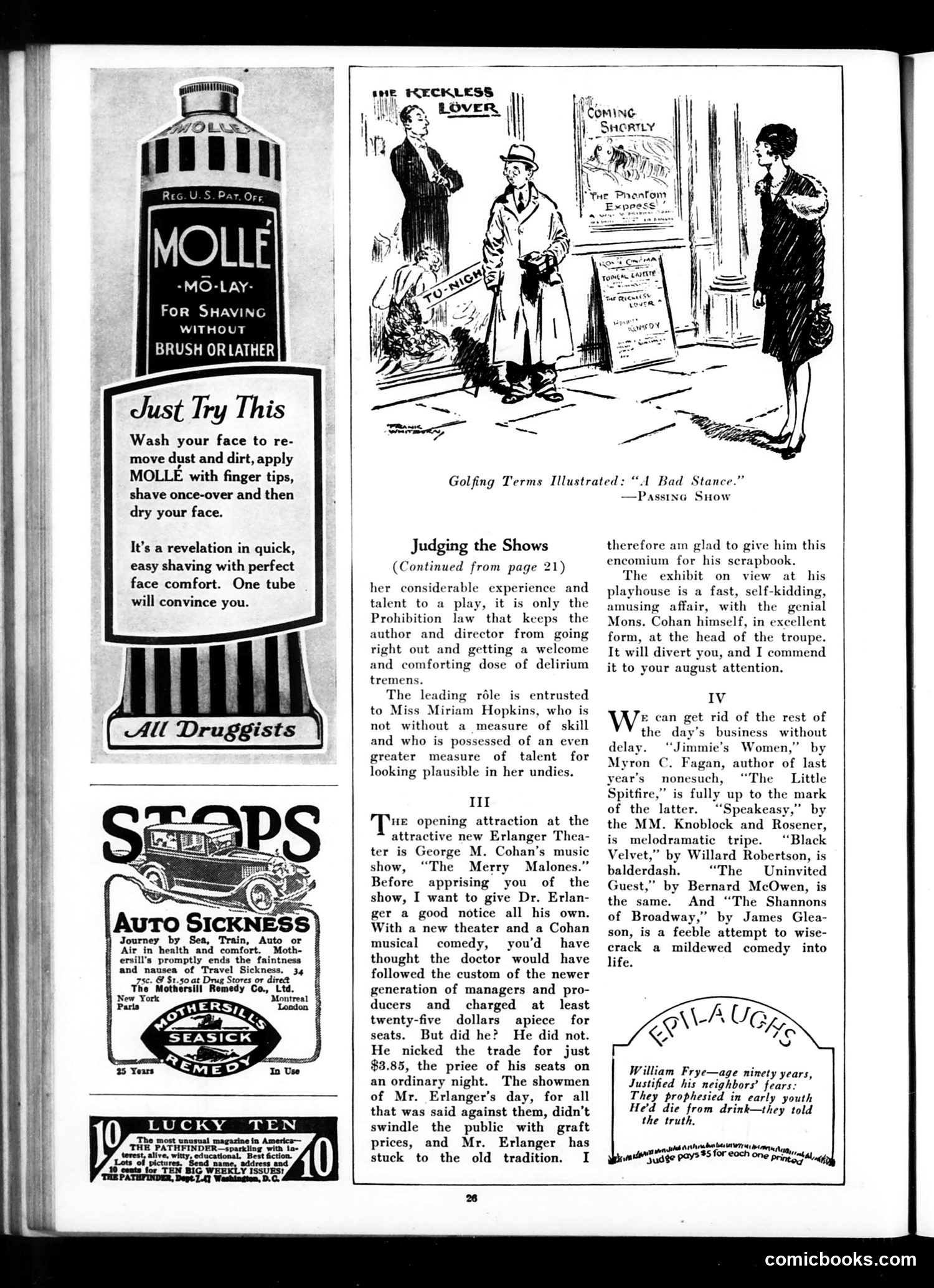
This page mixes **advertisements** (Mollé shaving cream, travel sickness remedy, Lucky Ten magazine) with **theater criticism**. The main content is a review column titled "Judging the Shows," critiquing Broadway productions. The critic discusses several plays including George M. Cohan's "The Merry Malones" (praised for affordable ticket prices—$3.85—under theater owner Dr. Erlanger) and dismisses other shows like "Jimmie's Women," "Speakeasy," and "Black Velvet" as mediocre or poor. The cartoon "Golfing Terms Illustrated" (upper right) depicts a scene titled "A Bad Stance"—a visual pun on golf terminology, showing what appears to be a street encounter, likely satirizing social awkwardness or improper behavior. The "Epilaughs" section offers a brief cautionary verse about a man named William Frye, whose neighbors predicted he'd die from drinking—and he did. The page reflects early 20th-century Judge content: theatrical gossip, advertising, and moralistic humor typical of the era.
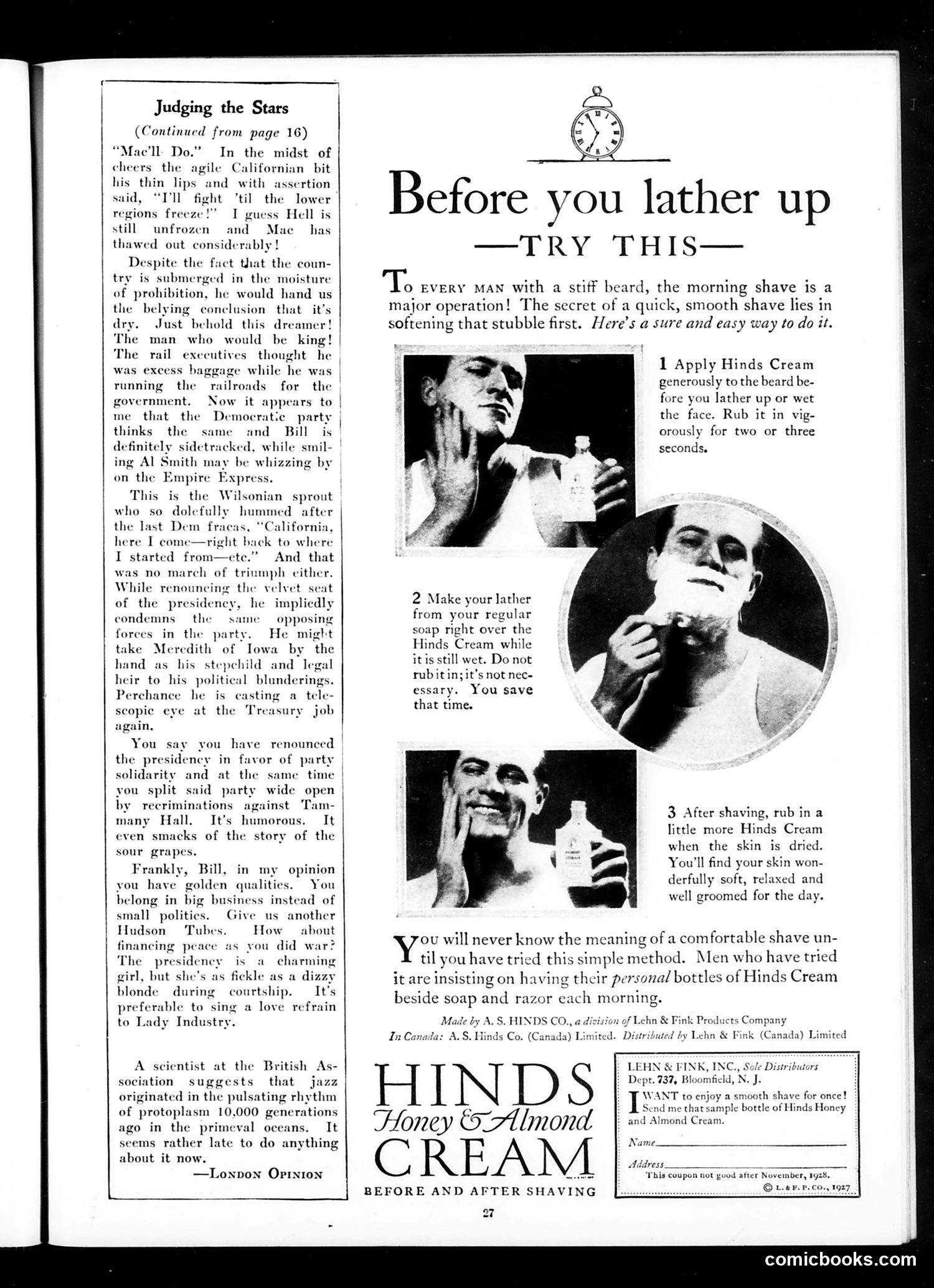
This page combines a political column with an advertisement. The "Judging the Stars" section critiques an unnamed Democratic politician (referred to as "Mac" and "Bill"), likely discussing the 1928 presidential race. The writer mocks this figure for renouncing the presidency while simultaneously attacking the Democratic Party (specifically Tammany Hall), accusing him of hypocrisy—like claiming to support party unity while splitting it apart. References to "the Wilsonian sprout" suggest a Wilson administration veteran whose political fortunes have declined. The satire targets his contradictions: he claims dry support despite Prohibition's failure, boasts he'll "fight til lower regions freeze," yet appears sidetracked while rival Al Smith advances on "the Empire Express." The rest of the page is a Hinds Cream shaving product advertisement featuring three instructional photographs demonstrating proper shaving technique.
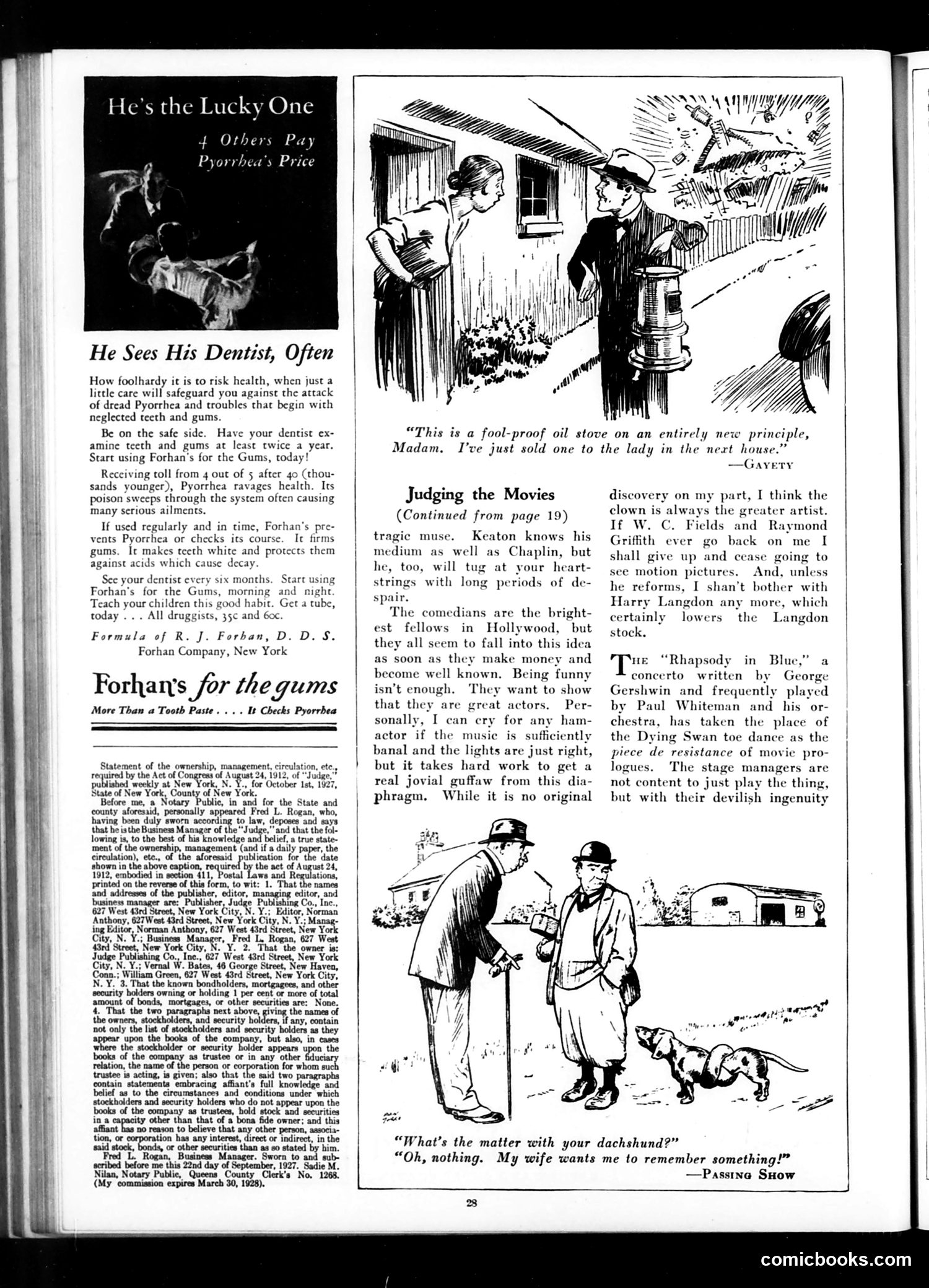
This page contains two main elements: **Left side:** A Forhan's toothpaste advertisement using fear-based marketing. "Pyorrhea" (gum disease) was a genuine health concern in the 1920s, and the ad exploits this by suggesting that neglecting dental care leads to serious illness. The headline "He's the Lucky One—4 Others Pay Pyorrhea's Price" implies that most people suffer from untreated gum disease. **Right side:** A "Judging the Movies" column discussing silent film comedians. The author argues that comedians like Buster Keaton prioritize making audiences laugh over serious acting. There's a cartoon showing what appears to be a rural scene with a man, woman, and dachshund—captioned as being from a film called "Passing Show," with a domestic joke about the wife wanting him to remember something while he's distracted. The page also includes corporate legal statements required by postal regulations—bureaucratic boilerplate.
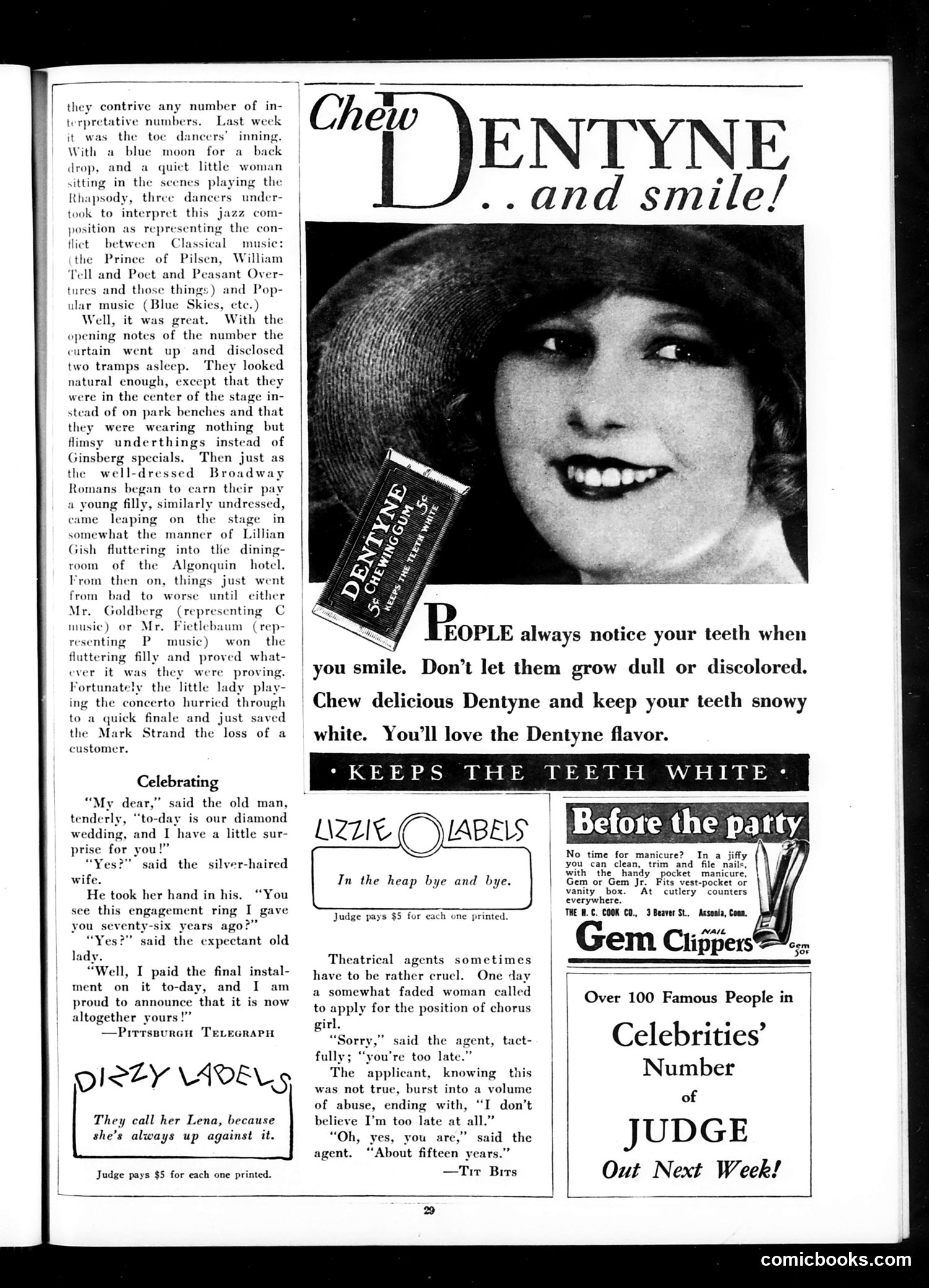
This page mixes entertainment criticism with advertising typical of 1920s Judge magazine. The main text critiques a modernist dance performance interpreting jazz composition. The piece mocks the pretentiousness: dancers attempted to represent "conflict between Classical music" and "Popular music" through nearly-nude performers and elaborate staging. The satire targets both the experimental dance movement and how Broadway audiences received such avant-garde work—the author notes the pianist playing the accompaniment had to hurry through to a "quick finale" to save the theater from losing customers, suggesting the performance was genuinely dull or uncomfortable. The supporting humor pieces include brief jokes about aging marriage ("diamond wedding" where the husband has only now finished paying for the engagement ring) and theatrical auditions (an older woman told she's "fifteen years too late" for chorus work). The advertisements—Dentyne chewing gum and Gem pocket manicure sets—are era-typical products marketed to maintain appearance and social polish, reinforcing Judge's focus on urban, middle-class concerns.
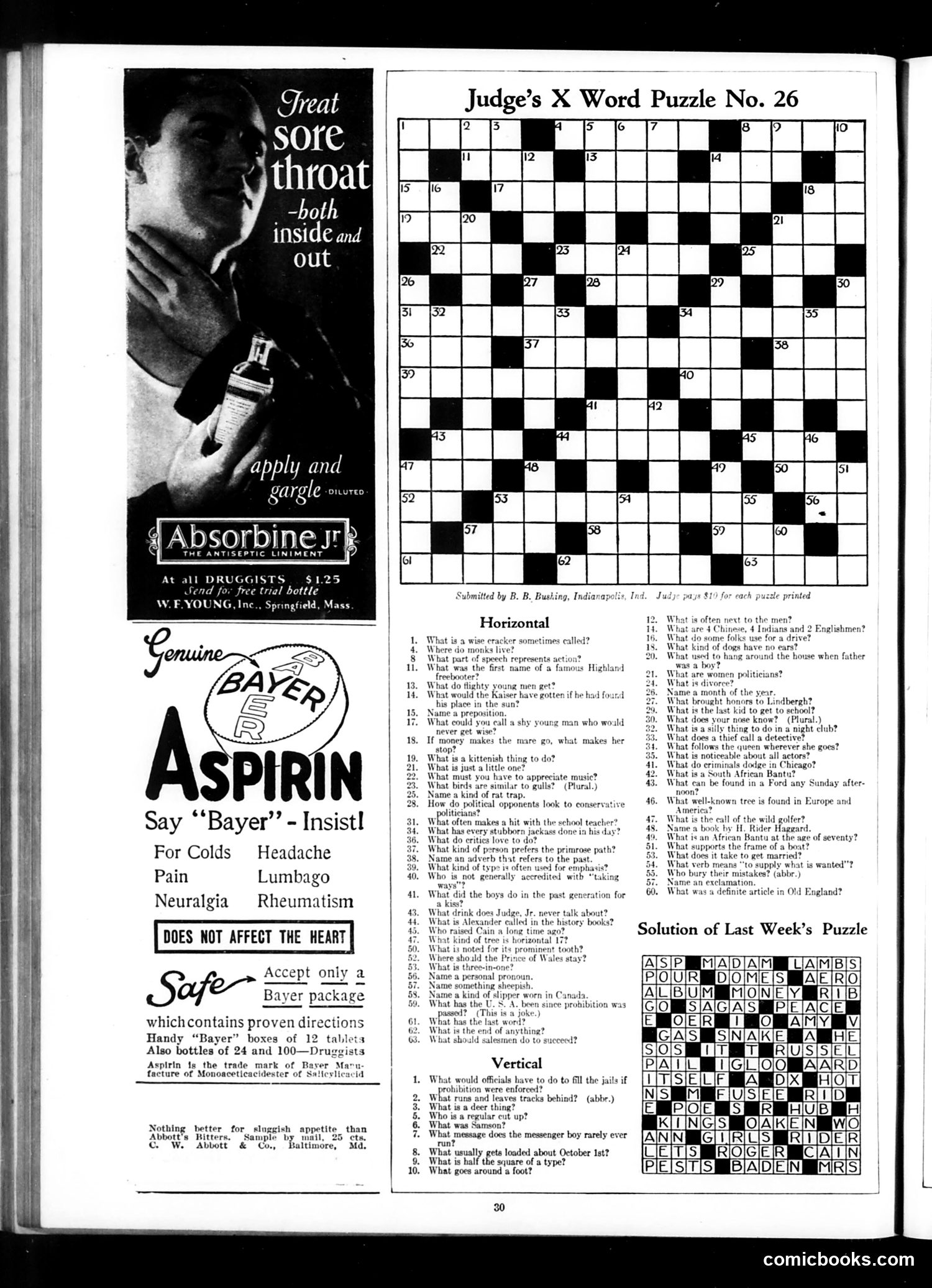
This page is primarily **advertising and puzzles**, not political satire or editorial cartooning. The left side features two vintage **product advertisements**: 1. **Absorbine Jr.** (sore throat remedy) - shows a man applying the product with copy emphasizing it works "both inside and out" when gargled or applied topically. 2. **Bayer Aspirin** - promotes the brand with emphatic "Say 'Bayer'—Insist!" messaging, listing uses (colds, headache, pain, etc.) and notably claiming it "DOES NOT AFFECT THE HEART"—likely addressing contemporary concerns about aspirin's safety. The right side is **Judge's X Word Puzzle No. 26**—a crossword puzzle with clues and a solution grid from the previous week's puzzle. These advertisements reflect early 20th-century marketing practices and medical product claims that would face modern FDA scrutiny. The aspirin warning reflects historical anxieties about the drug's cardiac effects.
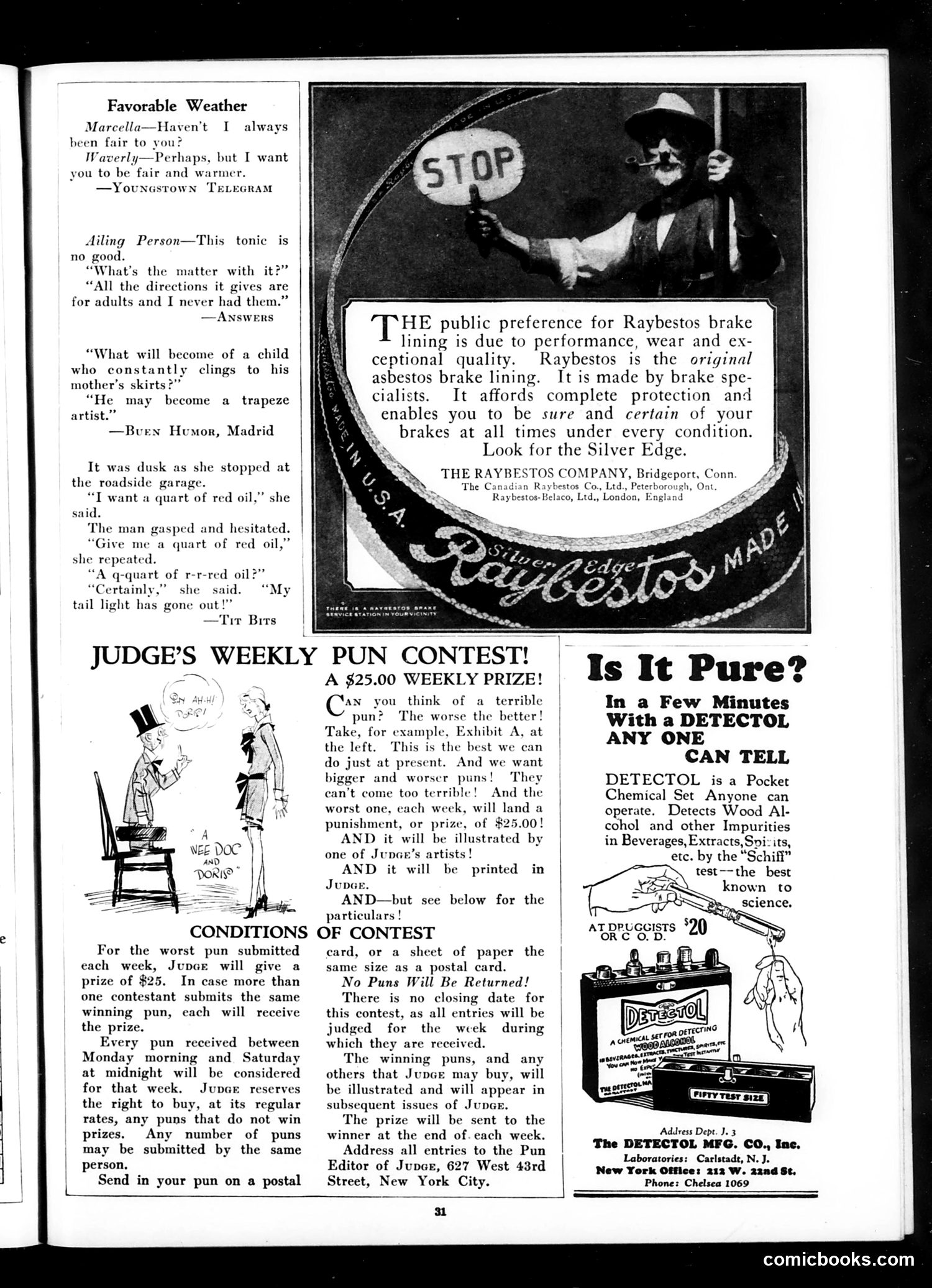
This page from Judge magazine (a satirical weekly) contains several humor sections typical of the era: **Top Left**: Brief jokes submitted by readers from various publications, showcasing wordplay and domestic humor common to early 20th-century magazines. **Main Cartoon (top right)**: A figure holding a STOP sign appears to be a traffic officer or safety advocate. The accompanying Raybestos brake lining advertisement uses the cartoon image to promote asbestos brake linings as reliable safety equipment—ironic given what we now know about asbestos dangers. **Pun Contest**: Judge's weekly competition inviting readers to submit deliberately bad puns for $25 prizes, with winning entries illustrated and published. This reflects the magazine's satirical mission and reader participation culture. **Right Column**: A Detectol chemical test kit advertisement for detecting alcohol impurities in beverages—likely referencing Prohibition-era concerns about bootleg liquor quality and safety. The page is primarily advertising and reader-submitted humor rather than editorial satire.
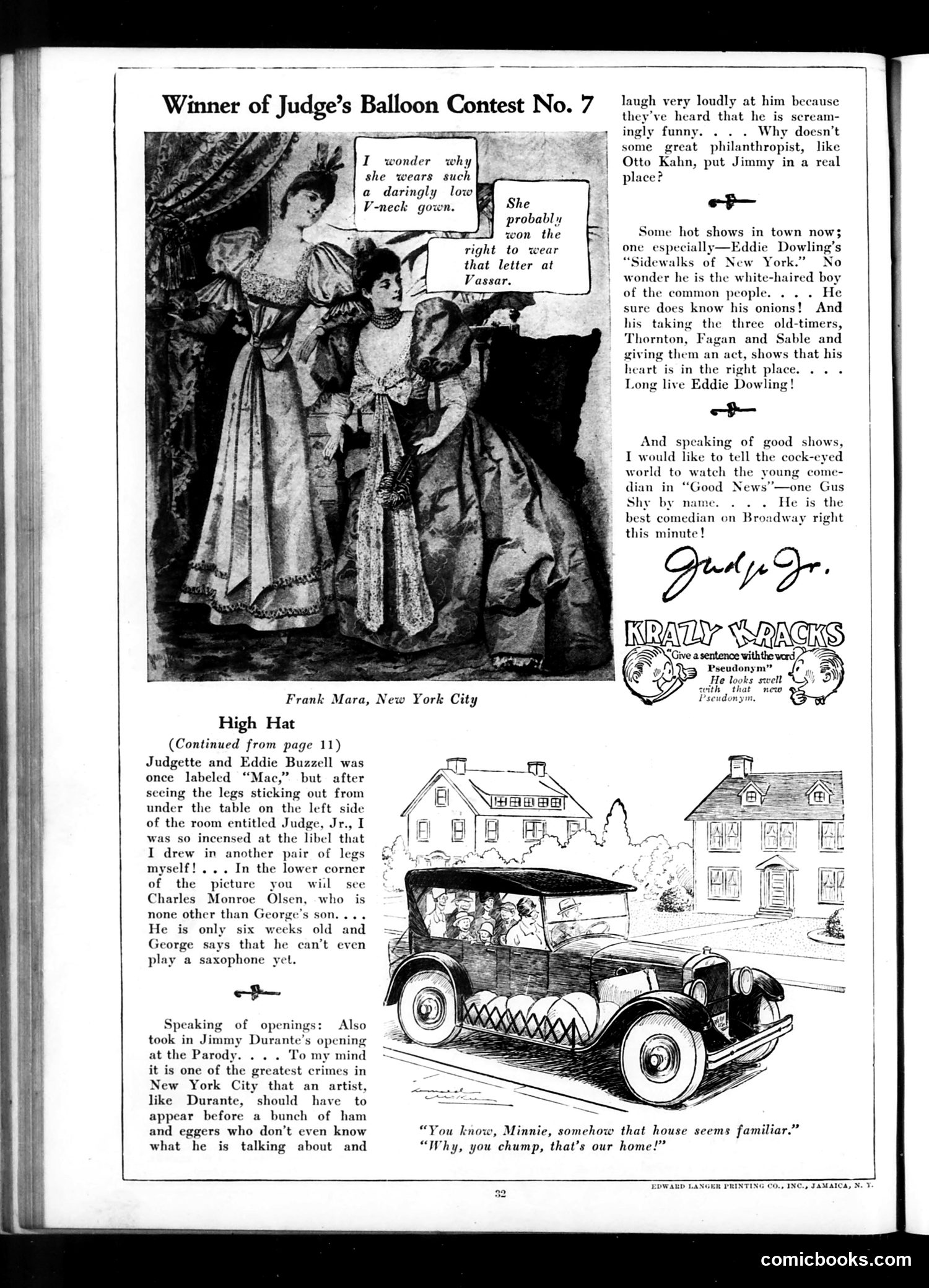
This page from Judge magazine contains theater gossip and commentary mixed with cartoons. The main content celebrates Broadway performers of the era: Eddie Dowling (praised for reviving "Sidewalks of New York" with veteran actors), Gus Shy (comedian in "Good News"), and Jimmy Durante (criticized for performing at the Parody theater before unappreciative audiences). The "Winner of Judge's Balloon Contest No. 7" shows Frank Mara's cartoon featuring a woman in a daringly low V-neck gown—social commentary on 1920s fashion becoming more revealing, with the joke suggesting women wear such styles to assert rights earned at Vassar (an elite women's college). The lower cartoon shows a family discovering their own house in a moving truck, playing on the Depression-era theme of people losing their homes. The overall page reflects Judge's focus on satirizing contemporary theater, fashion, and social change in 1920s-30s America.
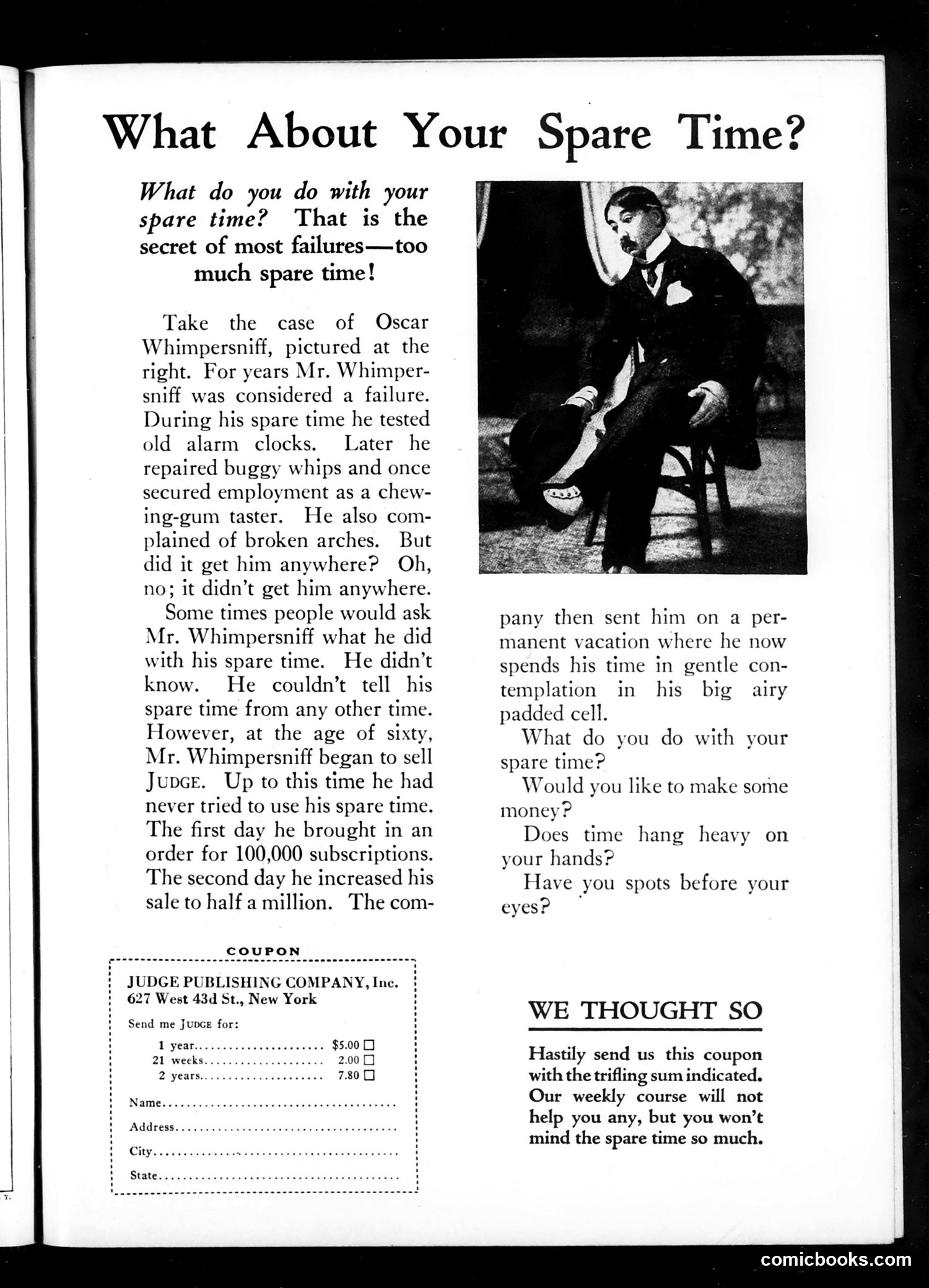
This is a satirical advertisement disguised as editorial content. The piece mocks both idle workers and dubious self-help schemes. **The Satire:** Oscar Whimpersniff is a fictional everyman who wastes decades in spare time on pointless hobbies (testing alarm clocks, repairing buggy whips). His only success comes selling "Judge" subscriptions at age sixty—but his reward is institutionalization ("padded cell"), implying he's driven mad by success or that the publication itself is worthless. **The Meta-Joke:** Judge then directly addresses readers, asking if they have spare time and money troubles, before admitting their "weekly course" won't help—but you'll be too distracted by it to notice. This is self-aware mockery of contemporary mail-order courses and magazine subscriptions that promised success but delivered nothing. **Historical Context:** Early 20th-century American periodicals frequently ran such schemes. Judge is simultaneously satirizing the culture of self-improvement fraud while participating in it, revealing the magazine's own cynical business practices to its readers.
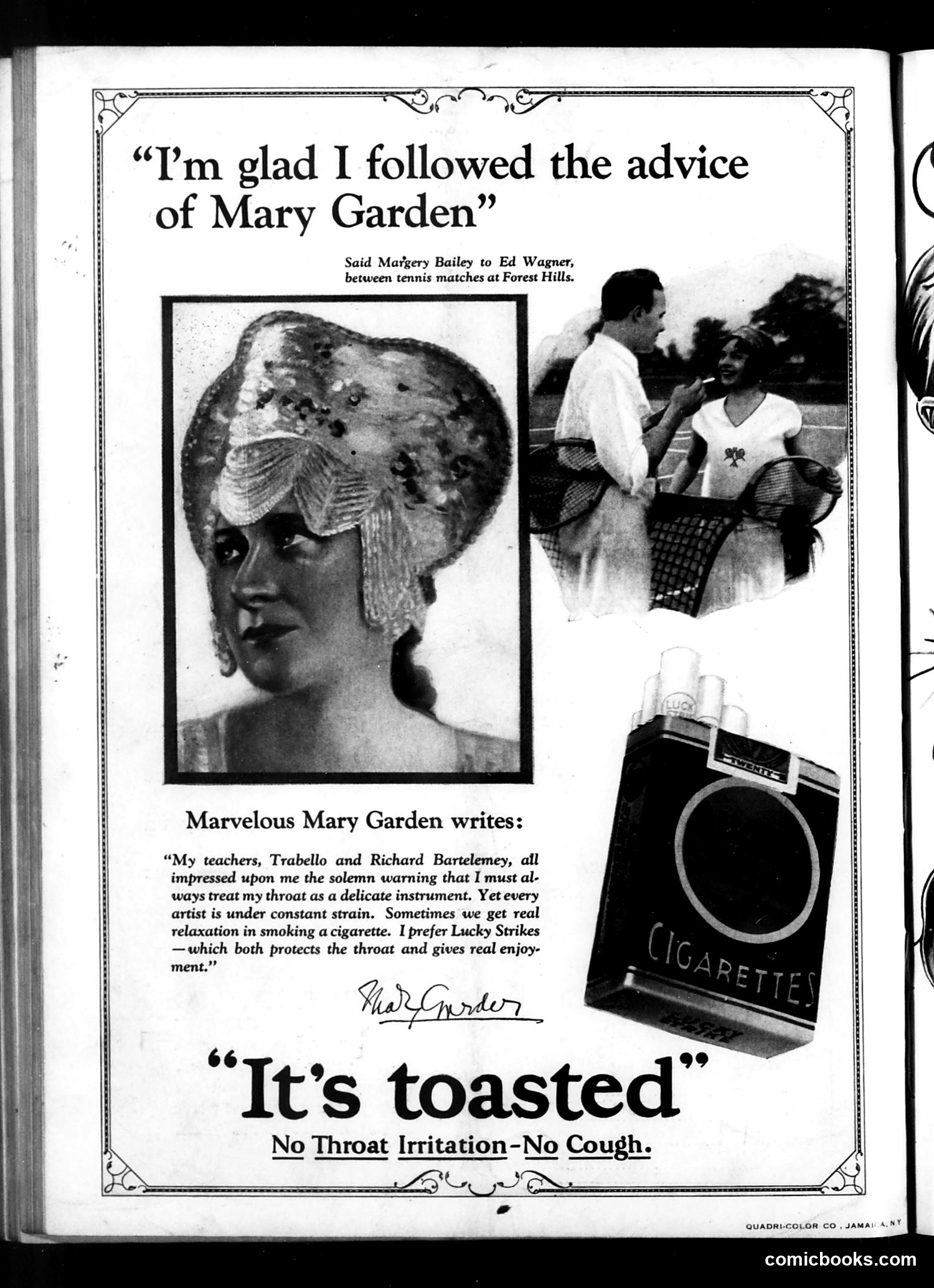
This is a **cigarette advertisement** masquerading as celebrity endorsement. Mary Garden was a famous opera singer known for her distinctive voice and appearance (visible in the glamorous portrait). The ad quotes her endorsing Lucky Strikes cigarettes as throat-protective and relaxing for performers. The satire lies in the absurdity: Garden claims cigarettes *protect* the throat while admitting artists face "constant strain"—the exact opposite of what one would expect. The tagline "It's toasted—No Throat Irritation-No Cough" contradicts basic health reality. This exemplifies early 20th-century advertising deception, when tobacco companies exploited celebrity testimonials and false health claims before regulation. The framing as overheard conversation between socialites at Forest Hills (a prestigious tennis venue) added false credibility to what was pure marketing fiction.