
Judge, 1927-10-15 · page 20 of 68
Judge — October 15, 1927 — page 20: what you’re looking at
What you’re looking at
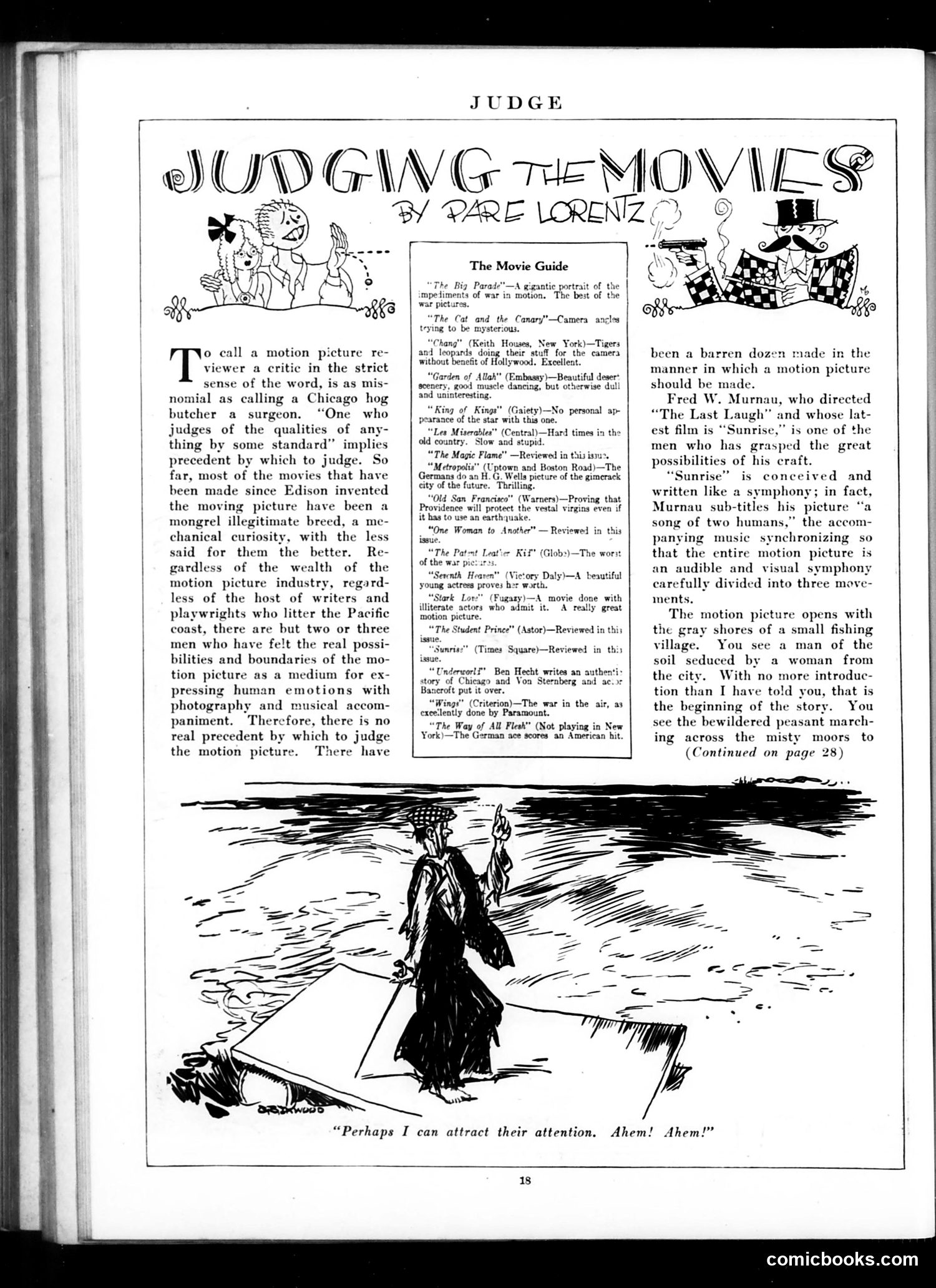
This page reviews silent films for Judge magazine's readers. The main article argues that most movies lack artistic merit because there's no established standard for evaluating them—comparing bad film criticism to calling a butcher a surgeon. The author praises director Fred W. Murnau's "Sunrise," calling it a masterpiece conceived like a symphony, with synchronized music and visual elements creating unified emotional expression. This represents cutting-edge filmmaking of the era. The "Movie Guide" sidebar reviews current releases, rating films like "The Big Parade," "Wings," and "Metropolis." Notable: the guide mocks "King of Kings" for hiding its star, and praises "Stark Love" despite using "illiterate actors who admit it." The illustration shows a figure with torches on misty moors—likely depicting the opening of "Sunrise" described in the article. The satire critiques Hollywood's general mediocrity while celebrating rare artistic achievement in this still-young medium.
📄 Transcribed text from this page (OCR, searchable)
Machine-transcribed from the original scan — historical spelling and the odd misread are preserved.
JUDGE motion picture re- critic in the strict nse of the word, is as mis- nomial as calling a Chicago hog butcher a surgeon. “One who judges of the qualities of any- thing by some standard” implies precedent by which to judge. So far, most of the movies that have been made since Edison invented the moving picture have been a mongrel illegitimate breed, a me- chanical curiosity, with the less said for them the better. Re- gardless of the wealth of the motion picture industry, regard- less of the host of writers and playwrights who litter the Pacific coast, there are but two or three men who have fe!t the real possi- bilities and boundaries of the mo- tion picture as a medium for ex- pressing human emotions with photography and musical accom- paniment. Therefore, there is no real precedent by whichit to judge the motion pictu have “Perhaps I can attract their attention. UW GANG THe MI OV I BY VARE LORENTZ r The Movie Guide “The Big Parade"—A gigantic portrait of the mpediments of war in motion. The best of the war pictures, “The Cat and the Canary"—Camera anclos trying to be mysterious. “Chang” (Keith Houses, New York)—Tigers and leopards doing their stuf for the camera without benefit of Hollywood. Excelle “Garden of Allah” (Embassy)—Beautiful deser* seenery, good muscle dancing, but otherwise dull and uninteresting. “King of Kings" (Gaiety)—No personal ap- ance of the star with this one. “Lea Miserables” (Central)—Hard times in the old country. Slow and stupid. “The Magic Flame" —Reviewed in this is “Metropolis” (Uptown and Boston Road)—The Germans do an H. G. Wells picture of the gimerack city of the future. Thrilling. “Old San Francisco” (Warners)—Proving that Providence will protect the vestal virgins even if it has to use an earthquake. _ “One Woman to Another” —Reviewed in this issue. “The Pat of the war “Serenth Hear ory Daly)—A beautiful young actress proves her worth. “Stark Love” (Fugary)—A movie done with illiterate actors who admit it. A really great motion picture. “The Student Prince” (Astor)—Reviewed in this ismue. unris:” (Times Square)—Reviewed in this Leatier Kit" (Glob>)—The worst Underwort?" Ben Hecht writes an authenti story of Chicago and Von Sternberg and ac.or Bancroft put it over. “Wings” (Criterion)—The war in the air, as lently done by Paramount. Way of All Flesh” (Not playing in New York)—-The German ace seares an Aacican hit, oe | been a barren doz Je in the manner in which a motion picture should be made. Fred W. Murnau, who directed “The Last Laugh” and whose lat- est film is “Sunrise,” is one of the men who has grasped the great bilities of his craft. Sunrise” is conceived and written like a symphony; in fact, Murnau sub-titles his picture “a song of two humans,” the accom- panying music synchronizing so that the entire motion picture is an audible and visual symphor carefully divided into three mo ments. The motion picture opens with the gray shores of a small fishing village. You see a man of the soil seduced by a woman from the city. With no more introduc- tion than I have told you, that is the beginning of the story. You see the bewildered peasant march- ing across the misty moors to (Continued on page 28) Ahem! Ahem!” comicbooks.com