
Judge, 1927-10-15 · page 18 of 68
Judge — October 15, 1927 — page 18: what you’re looking at
What you’re looking at
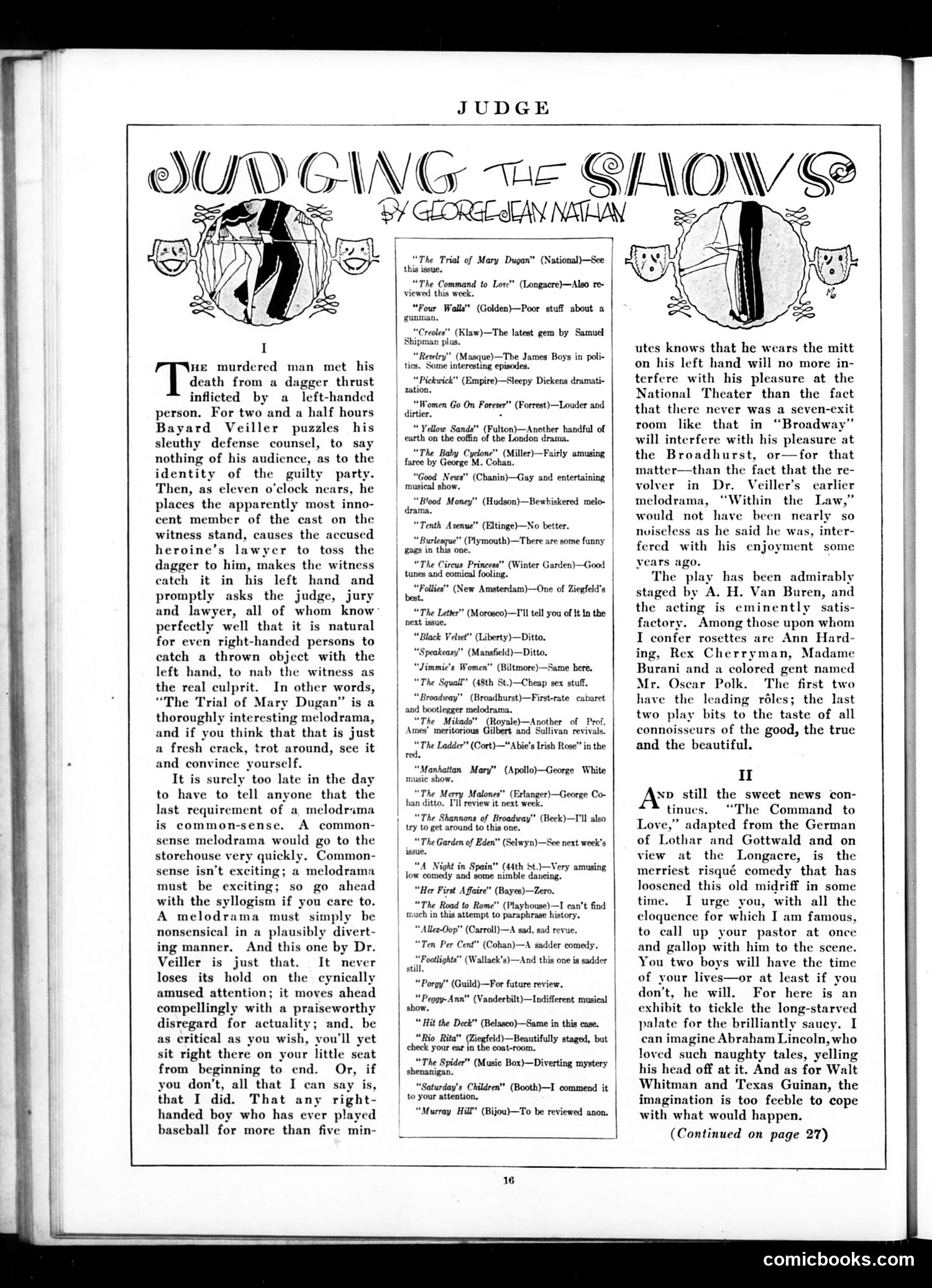
This page reviews Broadway theater productions. The main article discusses Bayard Veiller's melodrama *"The Trial of Mary Dugan,"* praising it as effectively entertaining despite—or because of—its logical absurdity. The plot hinges on a left-handed person catching a dagger, allowing the lawyer to falsely accuse an innocent witness. Nathan argues melodramas *must* be nonsensical to succeed; introducing realism would kill their appeal. He defends the genre's implausibility as necessary entertainment, declaring the play compulsively engaging regardless of critical objections. The surrounding text lists brief reviews of other Broadway shows opening that week, using Nathan's characteristic witty dismissals ("Poor stuff," "Cheap sex stuff"). The decorative header features theatrical masks, appropriate for theater criticism. This represents Judge magazine's cultural coverage—sophisticated drama criticism for educated readers.
📄 Transcribed text from this page (OCR, searchable)
Machine-transcribed from the original scan — historical spelling and the odd misread are preserved.
JUDGE this issue. “The Command to Lore” (Longacre}—Also re- viewed this week. “Four Walls” (Golden)—Poor stuff about a gunman. nscale (Klaw)—The latest gem by Samuel Shipm 7 “The Trial of Mary Dugan" (National)—Sce n plus. a utes knows that he wears the mitt : Reveiry" (Masque)—The James Boys in poli- | : ‘ , HE murdered man met his tics. Some interesting episodes. on left hand will no more in- q death from a dagger thrust | _ “Pickwick (Empire)—Sleepy Dickens dramati- terfere with his pleasure at the i mnfis zation. See er inflicted by a left-handed | : National Theater than the fact ] person. For two and a half hours iam OO Free Ronen Lonler and that there never was a seven-exit Bayard Veiller puzzles his q sleuthy defense counsel, to say “ Yellow Sands” (Fulton)—Another handful of earth on the coffin of the London drama. room like that in “Broadway will interfere with his pleasure at nothing of his audience, as to the PPE yn od vw ft al ad amusing the Broadhurst, or—for that identity of the guilty party. “Good News” (Chanin)—Gay and entertaining matter—than the fact that the re- ] Then, as eleven o'clock nears, he musical show. volver in Dr. Veiller’s earlier places the apparently most inno- “Blood Money" (Hudson)—Bewbiskered melo- | melodrama, “Within the Law,” cent member of the cast on the witness stand, causes the accused heroine’s lawyer to toss the dagger to him, makes the witness catch it in his left hand and promptly asks the judge, jury and lawyer, all of whom know perfectly well that it is natural | for even right-handed persons to -. 7 catch a thrown object with the left hand, to nab the witness as the real culprit. In other words, “The Trial of Mary Dugan” is a | thoroughly interesting melodrama, | and if you think that that is just a fresh crack, trot around, see it . and convince yourself. j It is surely too late in the day to have to tell anyone that the last requirement of a melodrama is common-sense. A common- sense melodrama would go to the | storehouse very quickly. Common- sense isn’t exciting; a melodrama must be exciting; go ahead with the syllogism if you care to. A melodrama must simply be nonsensical in a plausibly divert- ing manner. And this one by Dr. Veiller is just that. It never loses its hold on the cynically amused attention; it moves ahead compellingly with a praiseworthy disregard for actuality; and, be as critical as you wish, you'll yet sit right there on your little seat from beginning to end. Or, if you don’t, all that I can say is, rama. “Tenth Avenue” (Eltinge)—No better. “ Burlesque" (Plymouth)—There are some funny gags in this one. “The Circus Princess” (Winter Garden)—Good tunes and comical fooling. “Follies” (New Amsterdam)—One of Ziegfeld’s best. “The Letter” (Morosco)—I'll tell you of it in the next issue. “Black Velvet” (Liberty)—Ditto. “Speakeasy” (Mansfield)—Ditto. “Jimmie's Women" (Biltmore)—Same here. “The Squall” (48th St.)—Cheap sex stuff. “Broadway” (Broadburst)—First-rate cabaret and bootlegger melodrama. “The Mikado” (Royale)—Another of Prof. Ames’ meritorious Gilbert and Sullivan revivals. wd. The Ladder”* (Cort)—"*Abie’s Irish Rose’ in the “Manhattan Mary” (Apollo)—George White music show. “The Merry Malones” (Erlanger)—George Co- han ditto. I'll review it next week. “The Shannons of Broadway” (Beck)—I'll also try to get around to this one. “The Garden of Eden" (Selwyn)—See next week's issue. “A Night in Spain” (44th St.)—Very amusing low comedy and some nimble dancing. “Her First Affaire” (Bayes)—Zero. “The Road to Rome" (Playhouse)—I can't find much in this attempt to paraphrase history. “Allez-Oop” (Carroll)—A sad, sad revue. “Ten Per Cent" (Cohan)—A sadder comedy. siFeottiohts” (Wallack's)—And this one is sadder still. “Porgy” (Guild)—For future review. “Peggy-Ann” (Vanderbilt)—Indifferent musical show. “Hit the Deck’ (Belasco)—Same in this case. tio Rita” (Ziegfeld)—Beautifully staged, but check your ear in the coat-room. “The Spider” (Music Box)—Diverting mystery shenanigan. “Saturday's Children” (Booth)—I commend it would not have been nearly so nviseless as he said he was, inter- fered with his enjoyment some years ago. The play has been admirably staged by A. H. Van Buren, and the acting is eminently satis- factory. Among those upon whom I confer rosettes Ann Hard- ing, Rex Cherryman, Madame Burani and a colored gent named Mr. Oscar Polk. The first two have the leading réles; the last e connoisseurs of the good, the true and the beautiful. it p still the sweet news con- tinues. “The Command to Love,” adapted from the German of Lothar and Gottwald and on view at the Longacre, is the merriest risqué comedy that has loosened this old midriff in some time. I urge you, with all the eloquence for which I am famous, to call up your pastor at once and gallop with him to the scene. You two boys will have the time of your lives—or at least if you don’t, he will. For here is an exhibit to tickle the long-starved palate for the brilliantly saucy. I can imagine Abraham Lincoln, who loved such naughty tales, yelling his head off at it. And as for Walt Whitman and Texas Guinan, the - that I did. That any right- err eee ; imagination is too feeble to cope f | handed boy who has ever played “Murray Hill” (Bijou)—To be reviewed anon. with what would happen. | baseball for more than five min- _ (Continued on page 2'7) # | j 16 comicbooks.com