
Judge, 1927-10-15 · page 55 of 68
Judge — October 15, 1927 — page 55: what you’re looking at
What you’re looking at
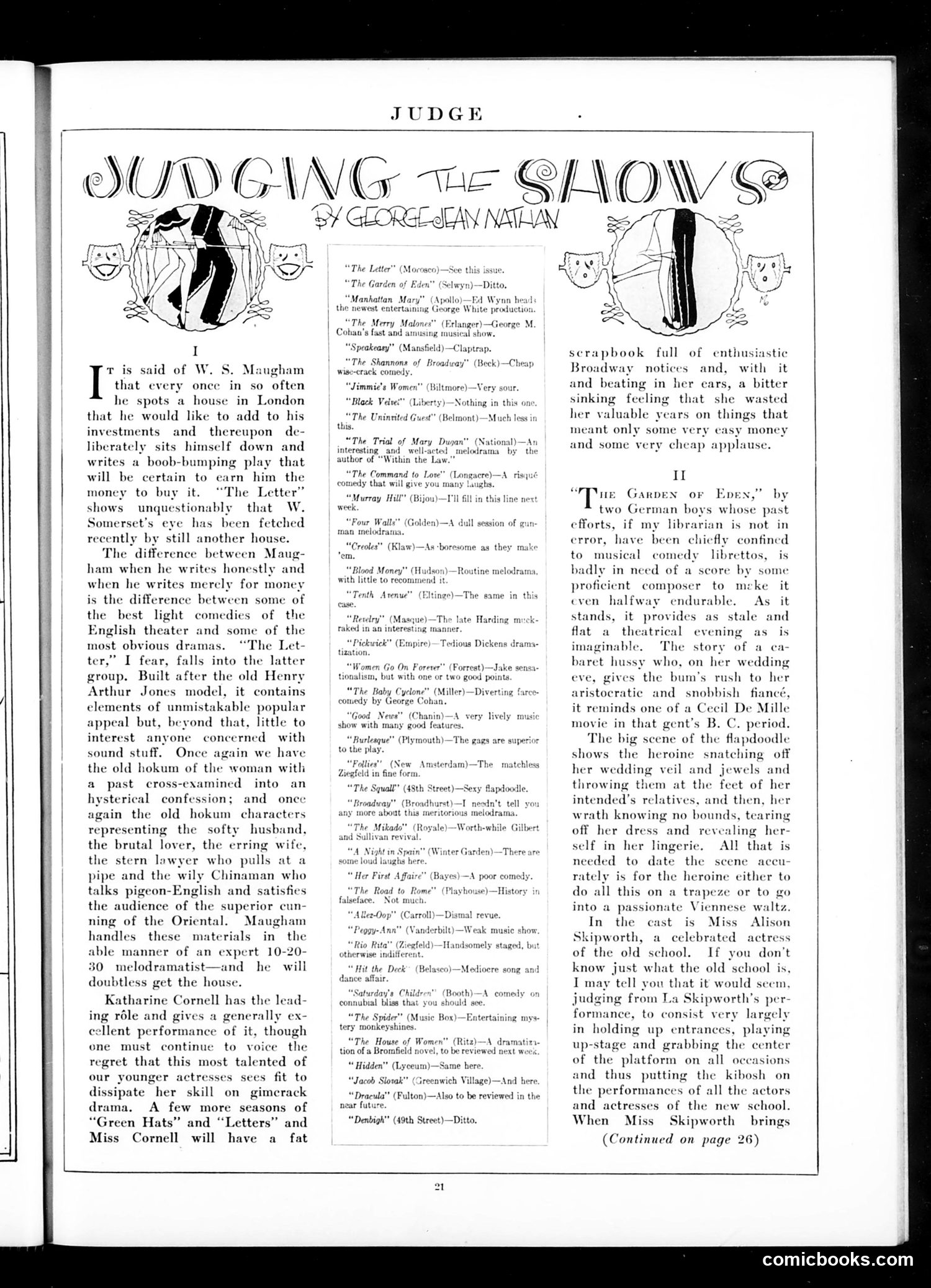
This page contains theater criticism by George Jean Nathan reviewing Broadway productions. The main critique focuses on W.S. Maugham's play "The Letter," performed by actress Katharine Cornell. **The Satire:** Nathan argues that Maugham deliberately writes commercial melodramas (not his honest work) solely to finance real estate purchases in London. He satirizes "The Letter" as old-fashioned hokum—featuring worn theatrical devices: a woman with a scandalous past, a brutal lover, stern lawyer, and a cunning Oriental character (stereotypical "pigeon-English" speaking Chinaman). **The Point:** Nathan laments that Cornell, a genuinely talented younger actress, wastes her skills on such "gimcrack drama" rather than serious work. He predicts she'll squander her career on trashy productions like "Green Hats" and "Letters" for easy money and cheap applause—a cautionary critique of commercial theater compromising artistic integrity. The second review addresses "The Garden of Eden," a German operetta needing a competent composer.
📄 Transcribed text from this page (OCR, searchable)
Machine-transcribed from the original scan — historical spelling and the odd misread are preserved.
JUDGE vt is said of W. S. Maugham I that every once in so often he spots a house in London that he would like to add to his investments and thereupon de- liberately sits himself down and writes a boob-bumping play that will be certain to earn him the money to buy it. “The Letter” shows unquestionably that W. Somerset's eye has been fetched recently by still another house. The difference between © ham when he writes honestly : when he writes merel 1g- nd for money n some of the best light comedies of the English theater and some of the most obvious dramas. ‘The Let- ter,” I fear, falls into the latter group. Built after the old Henry Arthur Jones model, it contains elements of unmistakable popular appeal but, beyond that, little to interest. anyone concerned with sound stuff. Once again we have the old hokum of the woman with a past cross-examined into an is the difference betw hysterical confession; and once again the old hokum characters representing the husband, the brutal lover, the erring wife, the stern lawyer who pulls at a pipe and the wily Chinaman who talks pigeon-English and satisfies the audience of the superior cun- ning of the Oriental. Maugham handles these materials in the able manner of an expert 10-20- 30 melodramatist—and he will doubtless get the house. Katharine Cornell has the lead- ing réle and gives a generally ex- cellent performance of it, though one must continue to voice the regret that this most talented of our younger actresses sees fit to dissipate her skill on gimerack drama. A few more seasons of “Green Hats” and “Letters” and Miss Cornell will have a fat softy “The Letter” (Moroseo)—See this issue. Garden of Eden" (Selwyn)—Ditto, “Manhattan Mary" (Apollo)—Fa Wynn he the newest entertaining George White production “The Merry Ma (Erlanger)—George M au’s fast and atnusing musical show. “Speakeasy” (Mansfield) —Clapt “The Shannons of Bro wise-crack comedy. De Beck)—Che “Jimmie's Women" “Black Velvei”” (Libe Nothing in this oni “The Unintited Guest” (Belmont)—M ueh less in this. “The Trial of Mar} interesting and well: author of “Within t more)—Very sour. “The Command to Low comedy that will give you m acre)—A_ ris) ny Laughs, “Murray Hill” (Bijou)—T'l fill in this line ne week. “Four Wall melodi “reoles"" (Klaw)—As “bores eas they make Blood Money"" (H with little to recomn e melodrama, “Tenth Avenue” (Eltinge)—The same in this ate Harding mick- Pickwick" (Empire tization. ious Dickens dra “Women Go On Forerer’ tionali “Th comedy Forrest) —Ja but with one or two good po * (Miller) —Divert ¢ Cobia Baby Cyclone by Ge “Good News” has show with many good A very lively music atures. “Burlesque” (Plym —The gags are superior lay. to the Jen) —There —A poor comedy “The Road to Rome* falseface. Not muc Playhouse) —Histor t)—Weak music show Hand: aged, but (Belasco) —Medioere Booth)—A cot Entertaining mys- “The House of Wome tion of a Bromfield nov “ Hidden (Lyceum)—S: “Jacob Slovak” (Green| tz)—A_dramatin- e reviewed next w e here. Village)—And here. (Fulton)—Also to be revi (49th Street)— ANG he GOW Se bY GLORGEATAN NATHAN scrapbook full of enthusiastic Broadw notices and, with it and beating in her ears, a bitter sinking feeling that she wasted her ant only some very easy money and some very cheap applause. aluable years on things that me: II “rTine Ganvex or Eves,” by two German boys whose past efforts, if my librarian is not in error, have been chiefly confined librettos, is badly in need of a score by some prof to musical comedy nt composer to meke it even halfway endurable. As. it stands, it provides as stale and flat a theatrical evening as is im ginable. The story of a ca- baret hussy who, on her wedding ev ives the bum’s rush to her aristocratic and snobbish fiancé it reminds one of a Cecil De Mille movie in that gent’s B. C. period. The big scene of the flapdoodle shows the heroine snatching off her wedding veil and jewels and throwing them at the feet of her intended’s relatives, and then, her wrath knowing no bounds, tearing off her dress and revealing her- self in her lingerie. All that is ded to date the scene accu- rately is for the heroine either to do all this on a trapeze or to go ne into a passionate Viennese waltz. In the cast is Miss Skipworth, a celebrated actress of the old school. If you don’t know just what the old school is, I may tell you that it would seem, judging from La Skipworth’s per formance, Alison to consist very largely in holding up entrances, pl ing up-stage and grabbing the center of the platform on all occa and thus putting the kibosh on the performances of all the actors and actresses of the new school. When Miss Skipworth — brings (Continued on page 26) ions comicbooks.com