
A complete issue · 36 pages · 1923
Judge — February 10, 1923
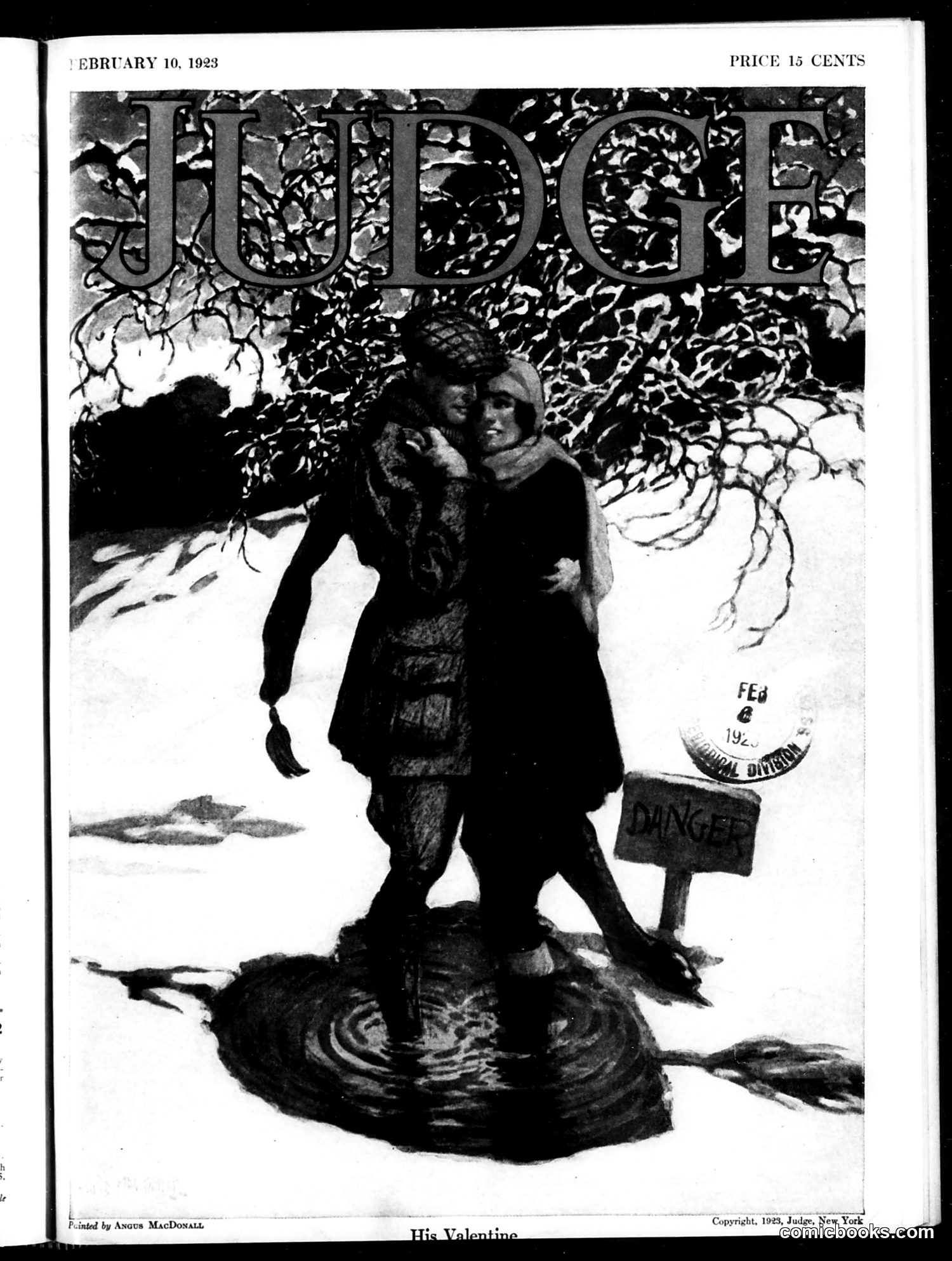
This cover illustration by Agnes MacDonald depicts a winter scene with a couple embracing beneath snow-laden evergreen branches. A sign reading "DANGER" is visible, and what appears to be a prone figure lies in the snow below them. The cartoon likely satirizes romantic folly or dangerous courtship during winter conditions. The "danger" sign and the body in the foreground suggest ironic commentary on Valentine's Day sentiment—perhaps mocking lovers who ignore practical hazards while absorbed in romance, or critiquing the risks of winter trysts. The artistic style and composition emphasize the contrast between the couple's intimate moment and the ominous elements surrounding them, creating dark humor typical of Judge's satirical approach to social behavior and romantic conventions of the 1920s.
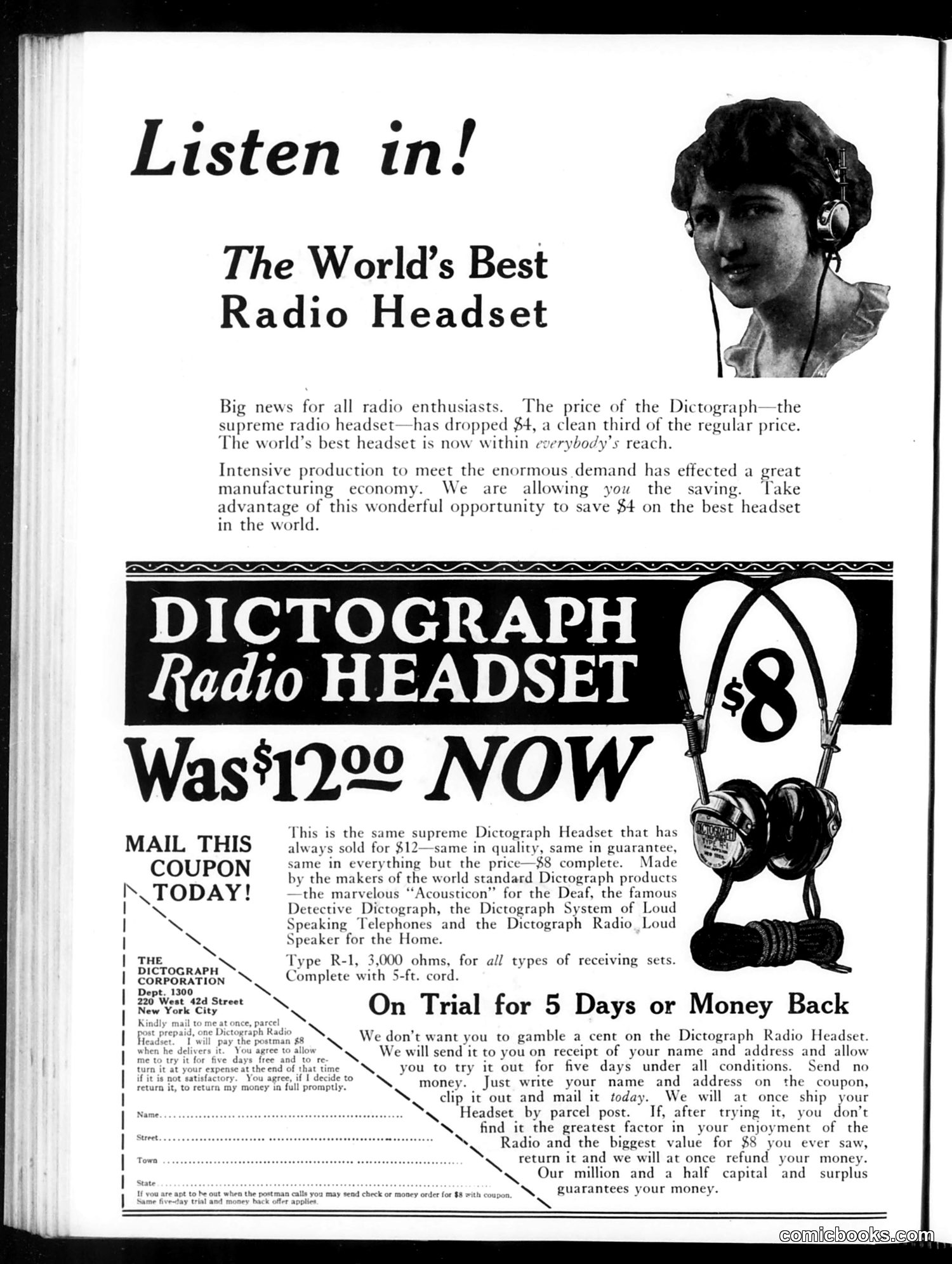
This page is primarily **advertising, not satire or political content**. It's a commercial advertisement for the Dictograph Radio Headset, priced at $8 (reduced from $12). The ad features a woman wearing headphones and claims the product is "The World's Best Radio Headset." The copy emphasizes mass production has lowered costs, allowing consumers to "save $4." Key selling points include: 3,000 ohms compatibility, 5-foot cord, a 5-day trial period, and a money-back guarantee. The ad targets "radio enthusiasts" during the early radio era. There is **no political satire or cartoon here**—just period marketing emphasizing affordability and consumer confidence through trial offers. The woman represents the typical consumer target demographic of the era.
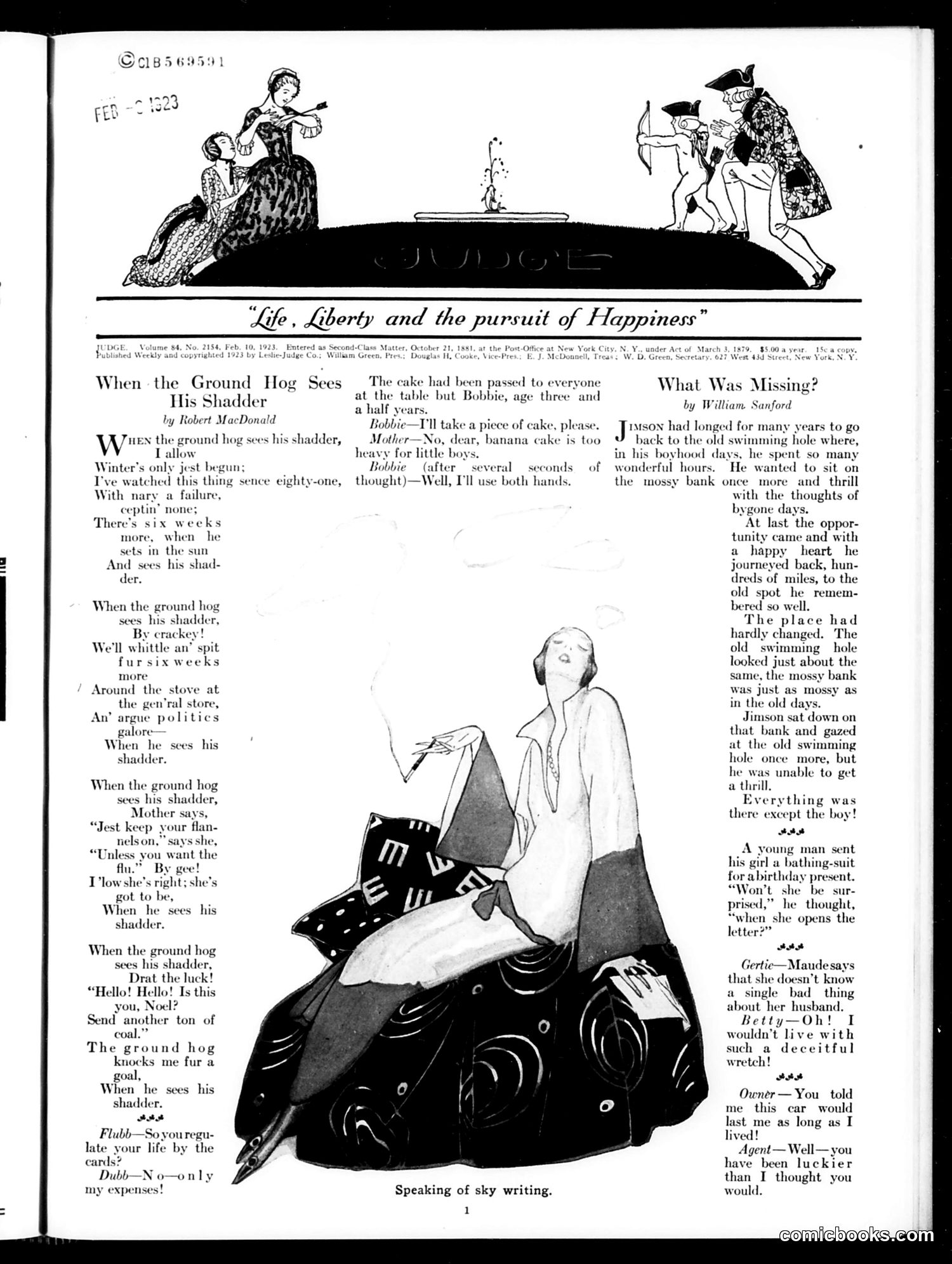
This page contains three separate pieces of humor typical of Judge magazine's satirical content: 1. **"When the Ground Hog Sees His Shadow"** (Robert MacDonald): A poem playing on Groundhog Day folklore, using the animal's shadow-spotting as metaphor for predicting winter's duration. 2. **Central illustration** titled "Speaking of sky writing": Shows a woman gazing upward, apparently moved by skywriting (a novelty aviation stunt that became popular in the 1920s). The satirical point concerns how this new advertising medium—messages written in smoke by airplanes—captures attention and emotion. 3. **"What Was Missing?"** (William Sanford): A short story about a man returning to his nostalgic childhood swimming hole, finding it unchanged except for the absence of a boy, suggesting loss or passage of time. The page reflects 1920s leisure activities and emerging technologies.
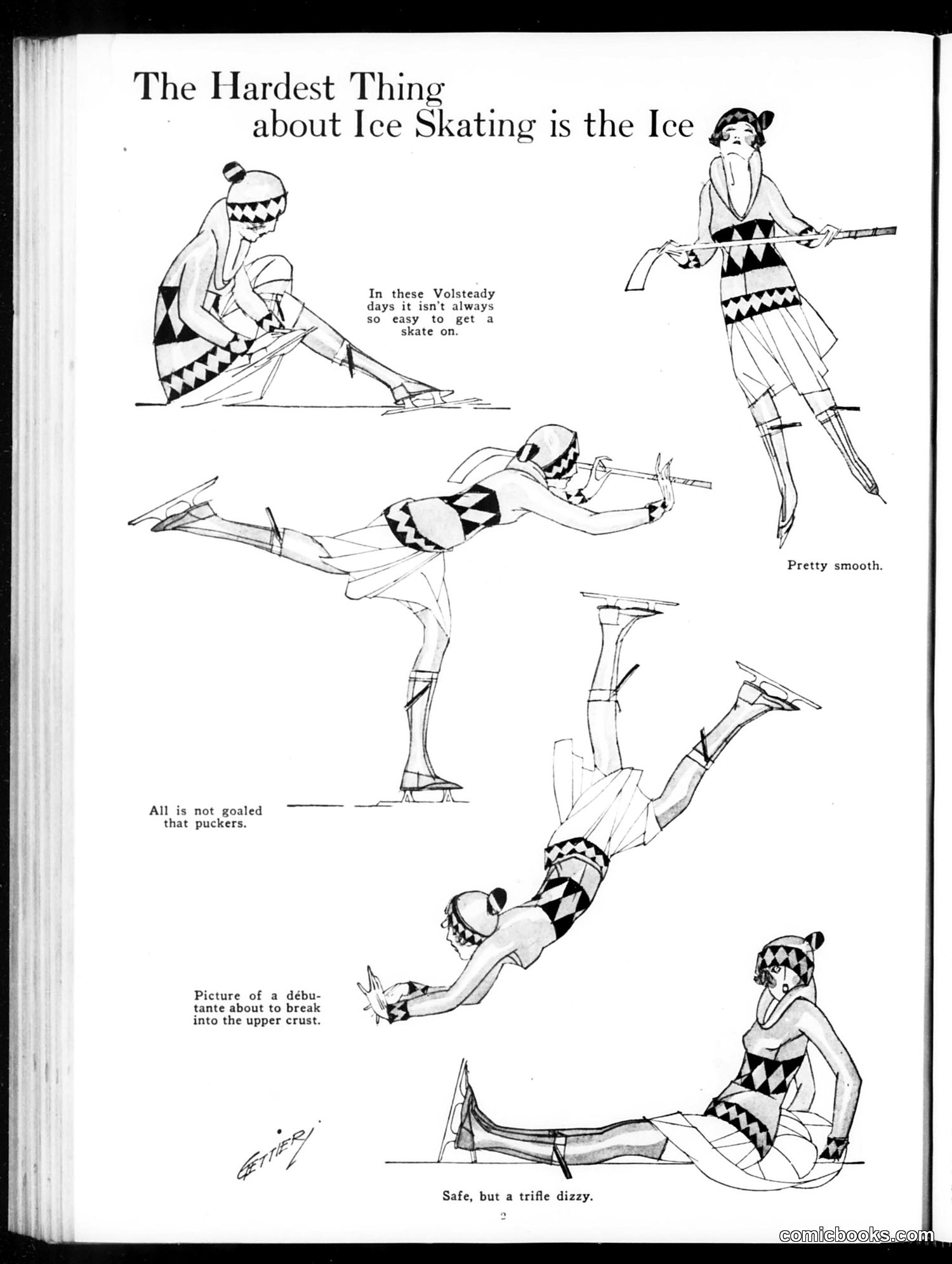
This is a humorous illustrated feature about women ice skating, not political satire. It depicts various female skaters in 1920s-style bathing suits and winter accessories experiencing mishaps on ice. The joke is straightforward: the page illustrates that despite skaters' attempts at graceful poses and technique, the ice itself—being slippery and unforgiving—causes falls and embarrassment. The captions underscore this: "All is not goaled that puckers," "Picture of a debutante about to break into the upper crust," and "Safe, but a trifle dizzy" humorously play on the contrast between aspiration and physical reality. This reflects 1920s recreational culture when ice skating was fashionable entertainment for young women. The satire gently mocks vanity and the gap between intended elegance and inevitable comedy of slipping on ice.
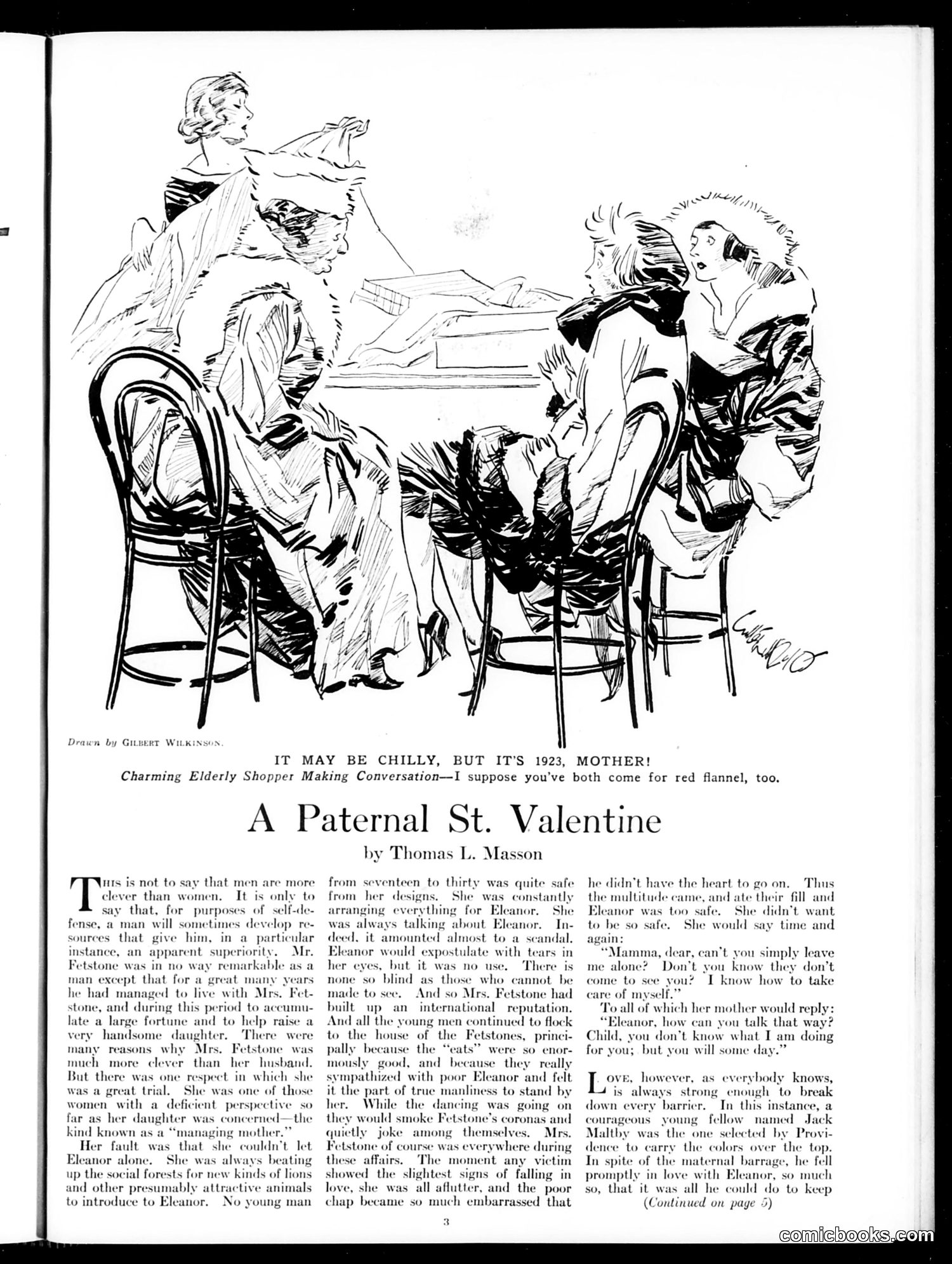
This 1923 Judge magazine story, illustrated by Gilbert Wilkinson, satirizes elderly courtship and parental disapproval. The cartoon caption depicts a mother interrupting an "elderly shopper making conversation," sarcastically noting both visitors came for red flannel, suggesting practical rather than romantic intentions. The accompanying short story mocks a wealthy man (Mr. Felstone) whose late-life romantic pursuits embarrass his adult daughter Eleanor. The satire targets the incongruity of aging men pursuing romance, which society considers undignified. The "St. Valentine" reference frames this as absurd romantic behavior in an older gentleman. The piece humorously explores class anxieties and generational conflict around propriety, wealth, and age-appropriate conduct in the 1920s, when such romantic pursuits by elderly men were deemed particularly ridiculous and socially inappropriate.
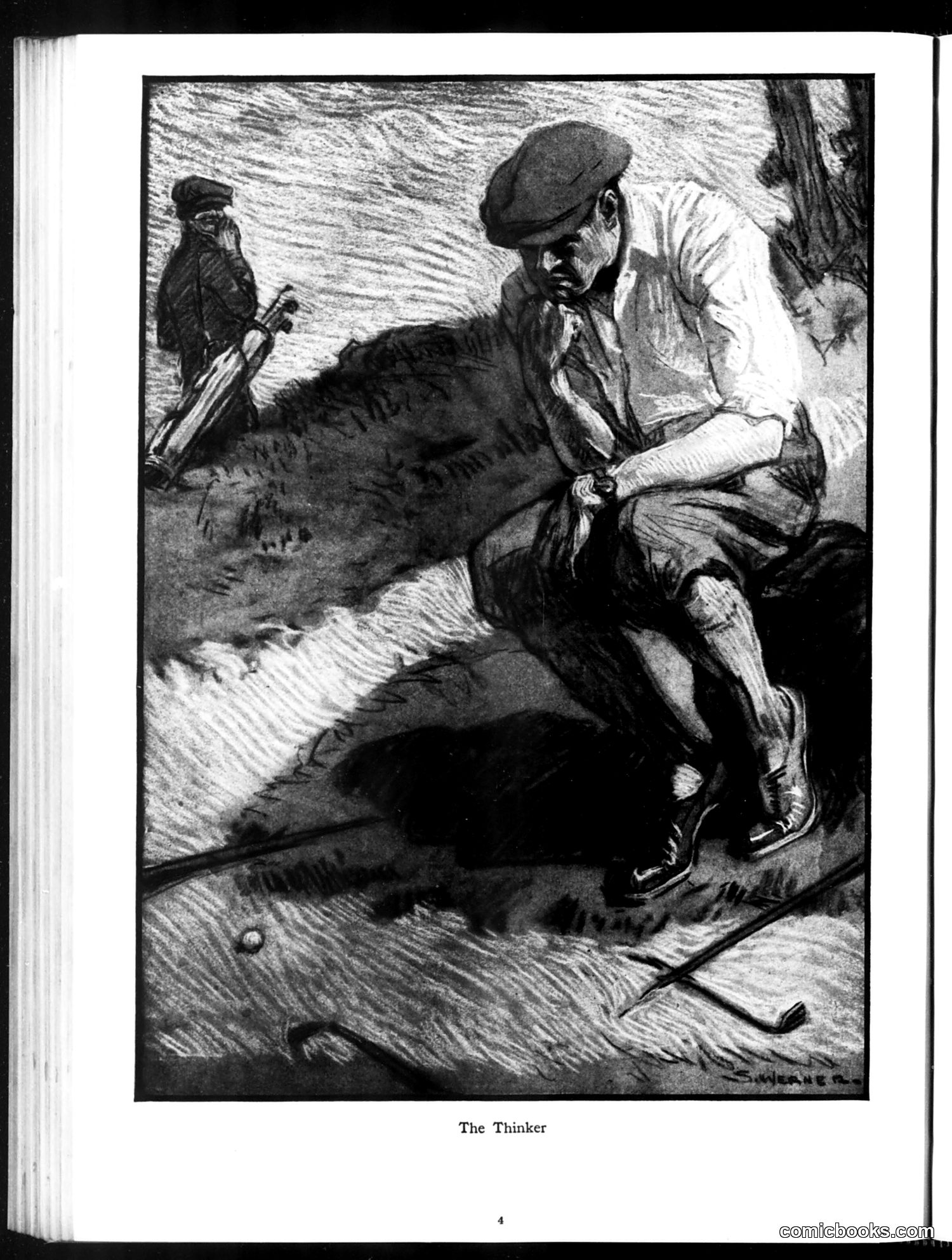
This illustration depicts a working-class man in a cap, seated in a contemplative pose reminiscent of Rodin's famous sculpture "The Thinker." The man appears to be a laborer or factory worker, based on his clothing and the industrial setting suggested by the water/dock in the background. The satire likely comments on labor or class issues of the era—possibly mocking or praising the intellectual capacity of working men, or satirizing the contrast between manual labor and philosophical thought. The title's reference to Rodin's sculpture suggests irony: that an ordinary working man is capable of serious contemplation, challenging assumptions about working-class intellect. The figure in the background holding what appears to be tools reinforces the labor context.
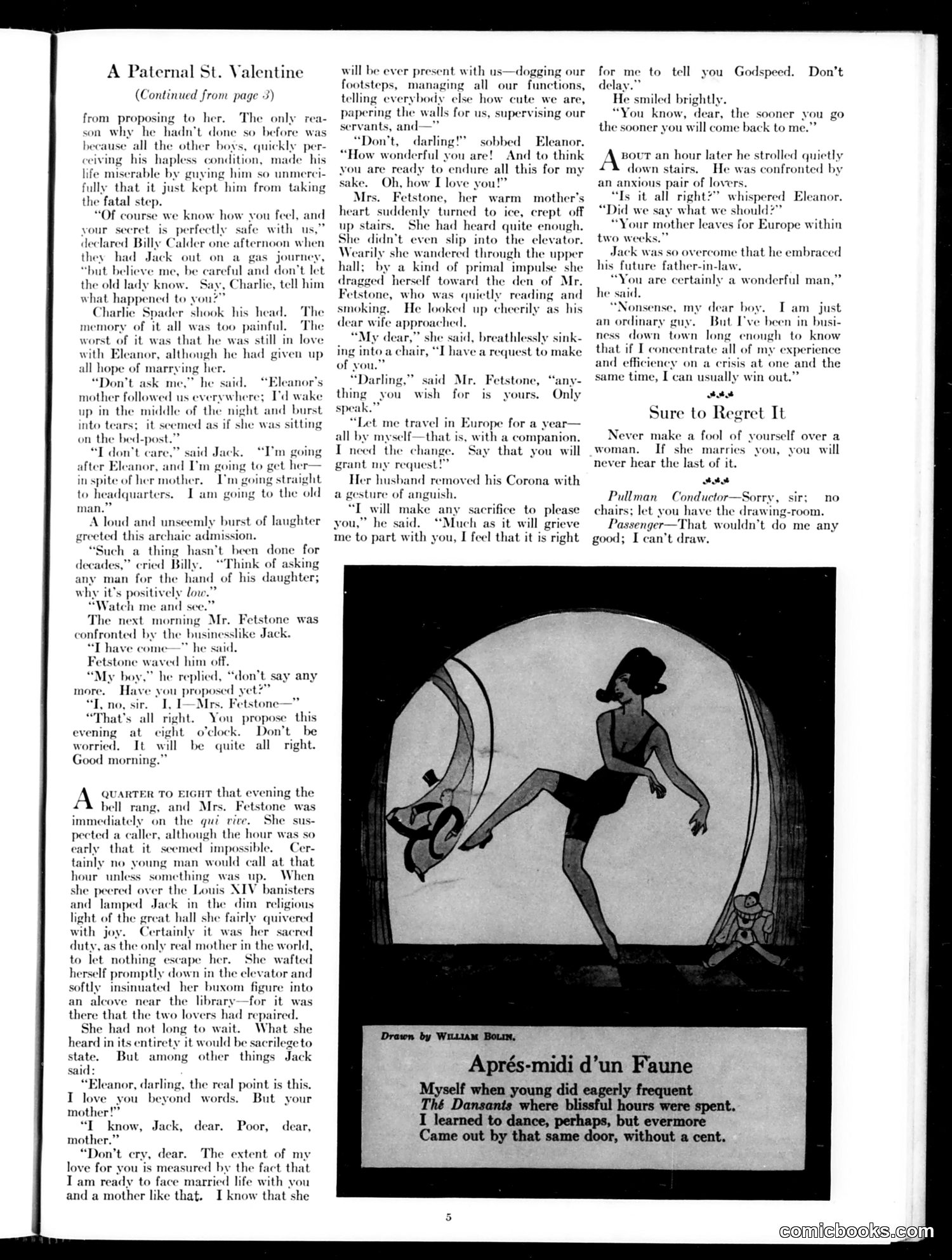
This is a romantic comedy story (not primarily a political cartoon) about a young man named Jack proposing to Eleanor despite her overbearing mother, Mrs. Fetstone. **The satire targets:** Intrusive, hovering mothers of the era who micromanaged their adult daughters' lives and relationships. Mrs. Fetstone eavesdrops on the couple, controls their social life, and meddles constantly. **The joke's point:** Jack's declaration of love includes admitting he'll endure "a mother like that"—describing how she'll supervise everything. Rather than being offended, Eleanor is moved by his willingness to tolerate her mother's interference. However, overhearing this unflattering description, Mrs. Fetstone is horrified and immediately demands a European vacation alone—implying she'll escape to avoid confronting her own meddling behavior. **The illustration** (titled "Après-midi d'une Faune") shows a couple dancing, presumably Eleanor and Jack, representing youthful romance contrasted with maternal interference. The humor reflects early 20th-century anxieties about maternal control in courtship.
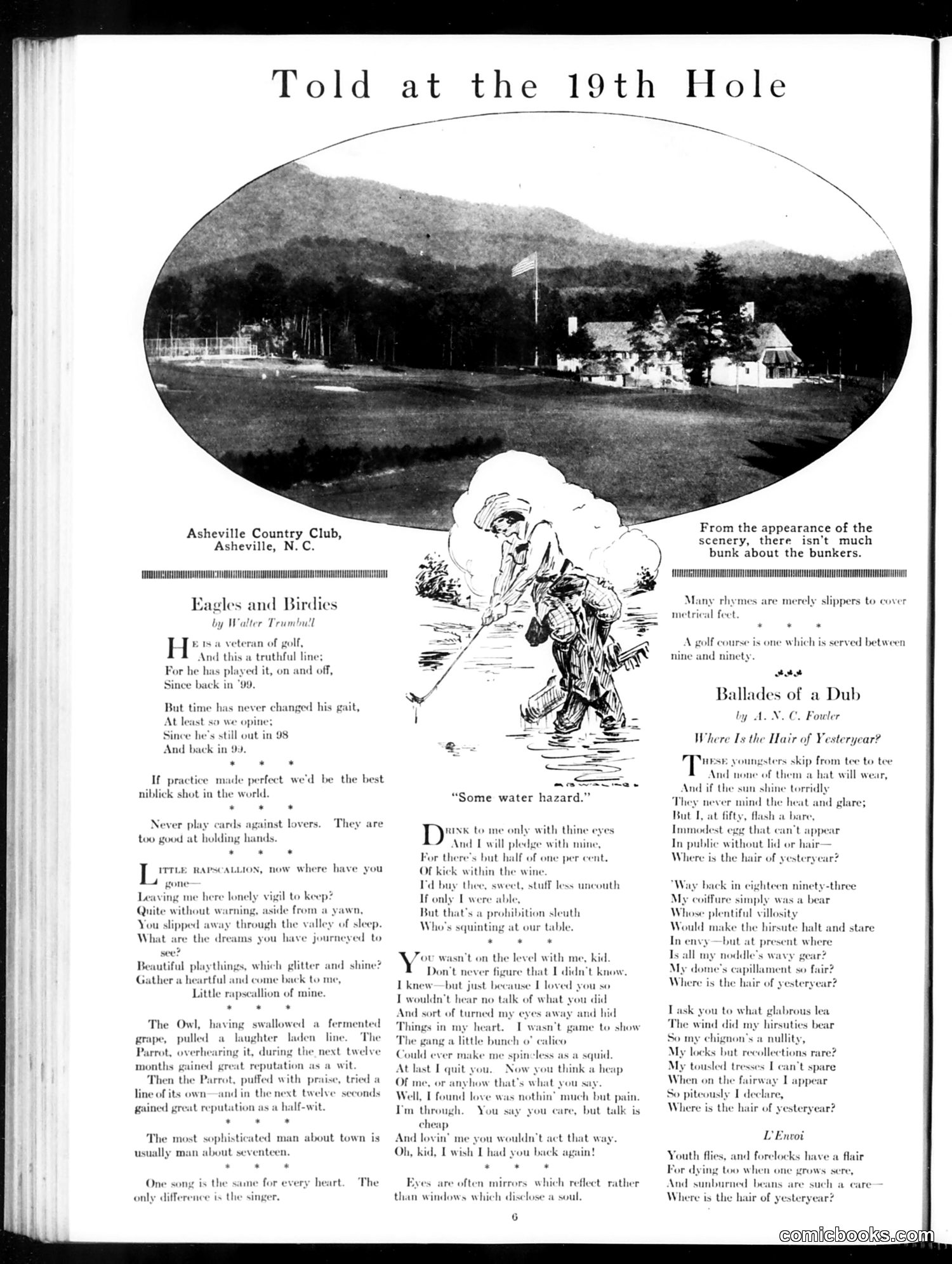
This page from *Judge* magazine presents humorous golf-themed content framed as stories "told at the 19th Hole"—the clubhouse bar where golfers gather after play at the Asheville Country Club. **The cartoons and verse satirize:** 1. **Golf culture stereotypes**: Poems mock golfers' vanity, poor play, and romantic entanglements. One verse jokes about prohibition-era drinking ("kick within the wine"), referencing the alcohol ban contemporaneous with this publication. 2. **Aging and baldness**: "Where Is the Hair of Yesteryear?" parodies medieval poetry while joking about male pattern baldness—contrasting a 50-year-old's lost hair with youngsters' carefree modernism (no hats, no concern for sun damage). 3. **The central cartoon** shows a couple at the golf course; the caption "Some water hazard" appears to be a double entendre about romantic/marital complications interrupting golf. The humor relies on golf-club insider jokes and the era's obsession with physical decline, vanity, and the tension between old propriety and youth's recklessness. The prohibition reference dates this squarely to the 1920s-early 1930s.
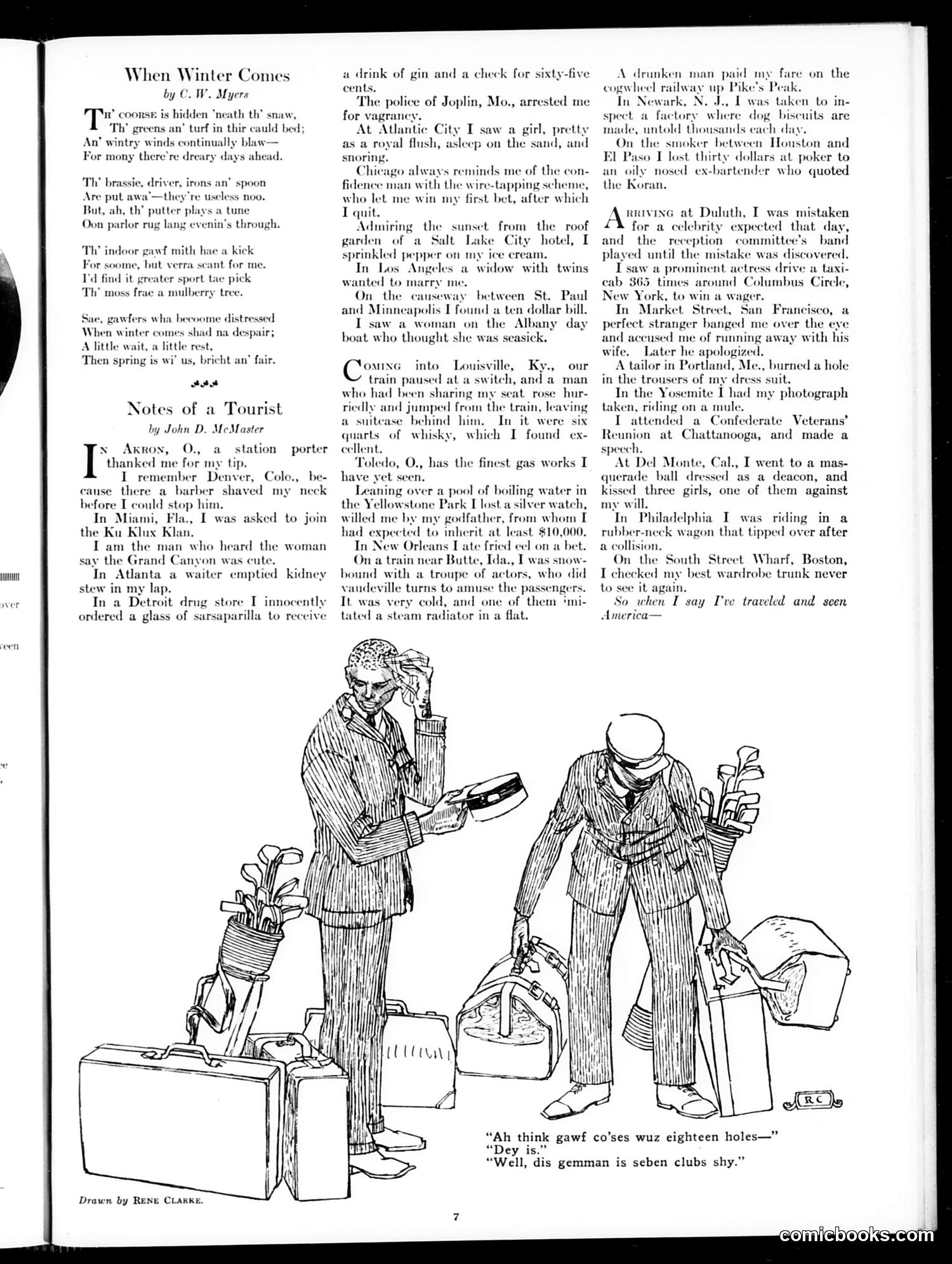
The bottom illustration depicts two men with golf bags discussing their golf game. One says "Ah think gawf co'ses wuz eighteen holes—" and the other responds "Dey is," followed by "Well, dis gemman is seben clubs shy." The cartoon is a visual punchline to the "Notes of a Tourist" article above it—a humorous travelogue cataloging the author's misadventures across America. The joke suggests that the tourist has lost or misplaced seven golf clubs during his travels, fitting the pattern of mishaps described (losing money, luggage, clothing, etc.). The dialect used appears intended as comic speech, typical of Judge magazine's era. The cartoon humorously concludes the article by illustrating one more small disaster befalling the hapless tourist through his golf equipment.
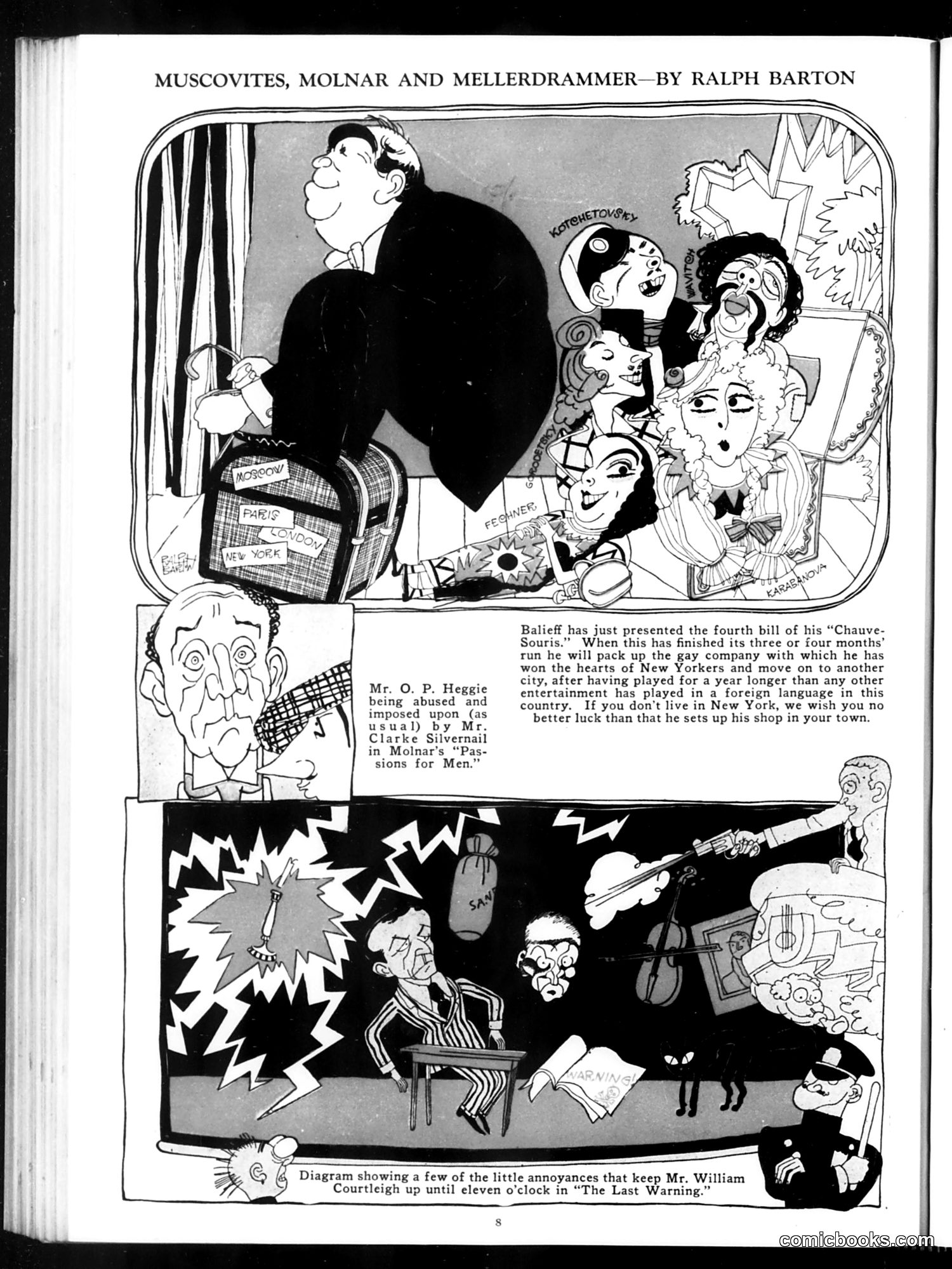
This Judge magazine page by Ralph Barton satirizes three theatrical productions then running in New York: **Top panel**: Depicts a scene from Molnár's "Passions for Men," showing actor O.P. Heggie being "abused and imposed upon" by Clarke Silvernail's character—a commentary on the play's dramatic content. **Middle text**: Celebrates Balieff's "Chauve-Souris" (Russian cabaret revue), praising its unprecedented year-long run in a foreign language. The tone is boastful about New York's cultural sophistication while wishing other cities less luck attracting such entertainment. **Bottom panel**: A diagram of "little annoyances" plaguing William Courtleigh in "The Last Warning"—depicting various theatrical mishaps (explosions, musical instruments, props) designed to show the play's reliance on slapstick comedy and technical complications for humor. The page essentially reviews current Broadway productions through Barton's distinctive caricature style, mixing theatrical criticism with entertainment-page gossip typical of Judge's approach.
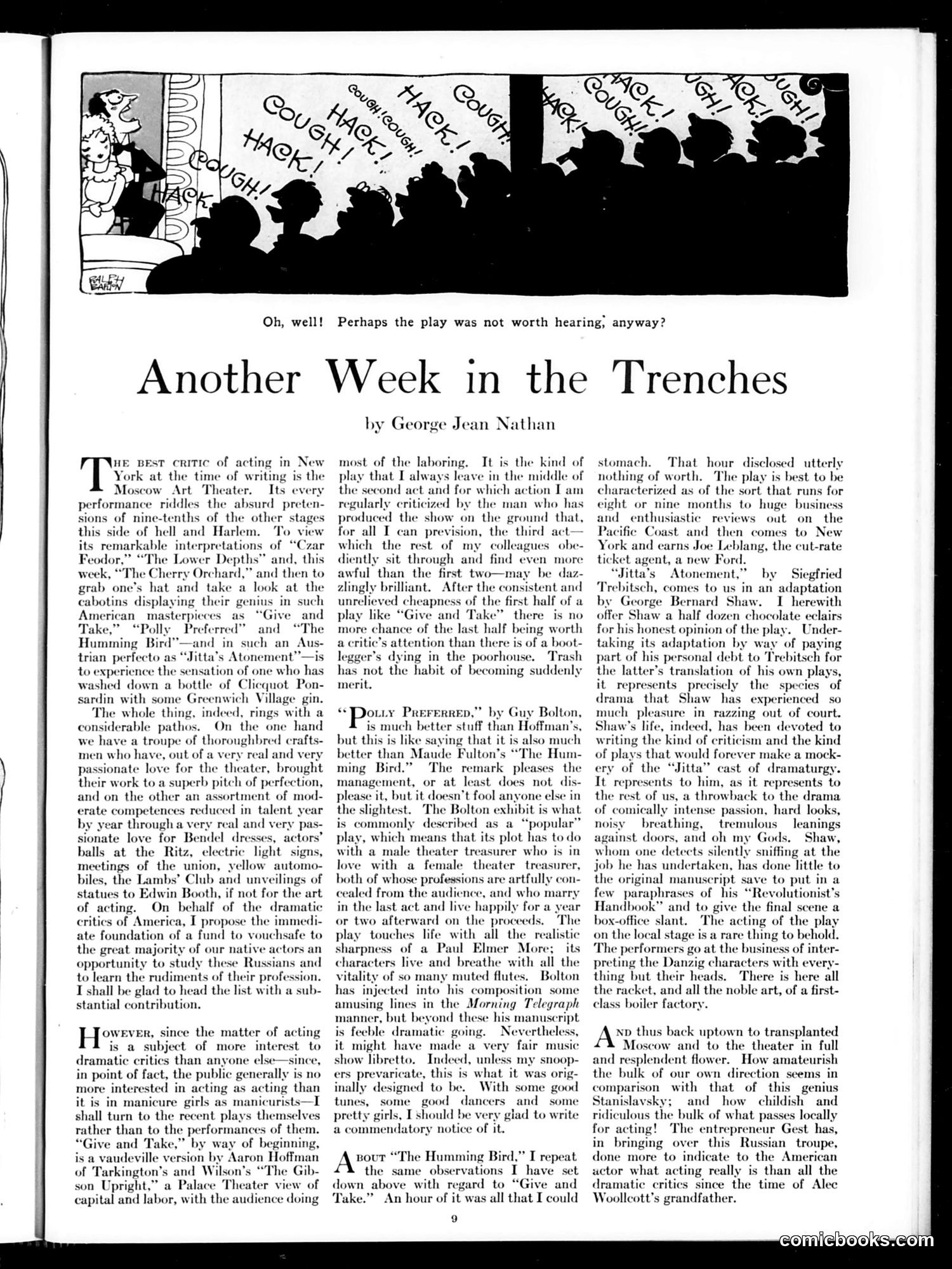
The cartoon depicts an audience in a theater viciously booing a stage performance, with silhouetted figures shouting "HACK!", "COUGH!", and "GO!" The caption reads: "Oh, well! Perhaps the play was not worth hearing, anyway?" This illustrates critic George Jean Nathan's accompanying article, which compares American theater unfavorably to the visiting Moscow Art Theater. Nathan argues that American plays like "Give and Take," "Polly Preferred," and "The Humming Bird" are artistically mediocre—mere commercial vehicles lacking the serious craftsmanship and passion of Russian productions. The cartoon satirizes both the harsh judgment of sophisticated critics and, implicitly, the poor quality of Broadway entertainment. The booing audience represents Nathan's viewpoint: that American theater deserves such contempt because it prioritizes profit and spectacle over genuine dramatic art. The silhouettes suggest this represents the collective voice of discerning theatrical observers rejecting inferior native productions.
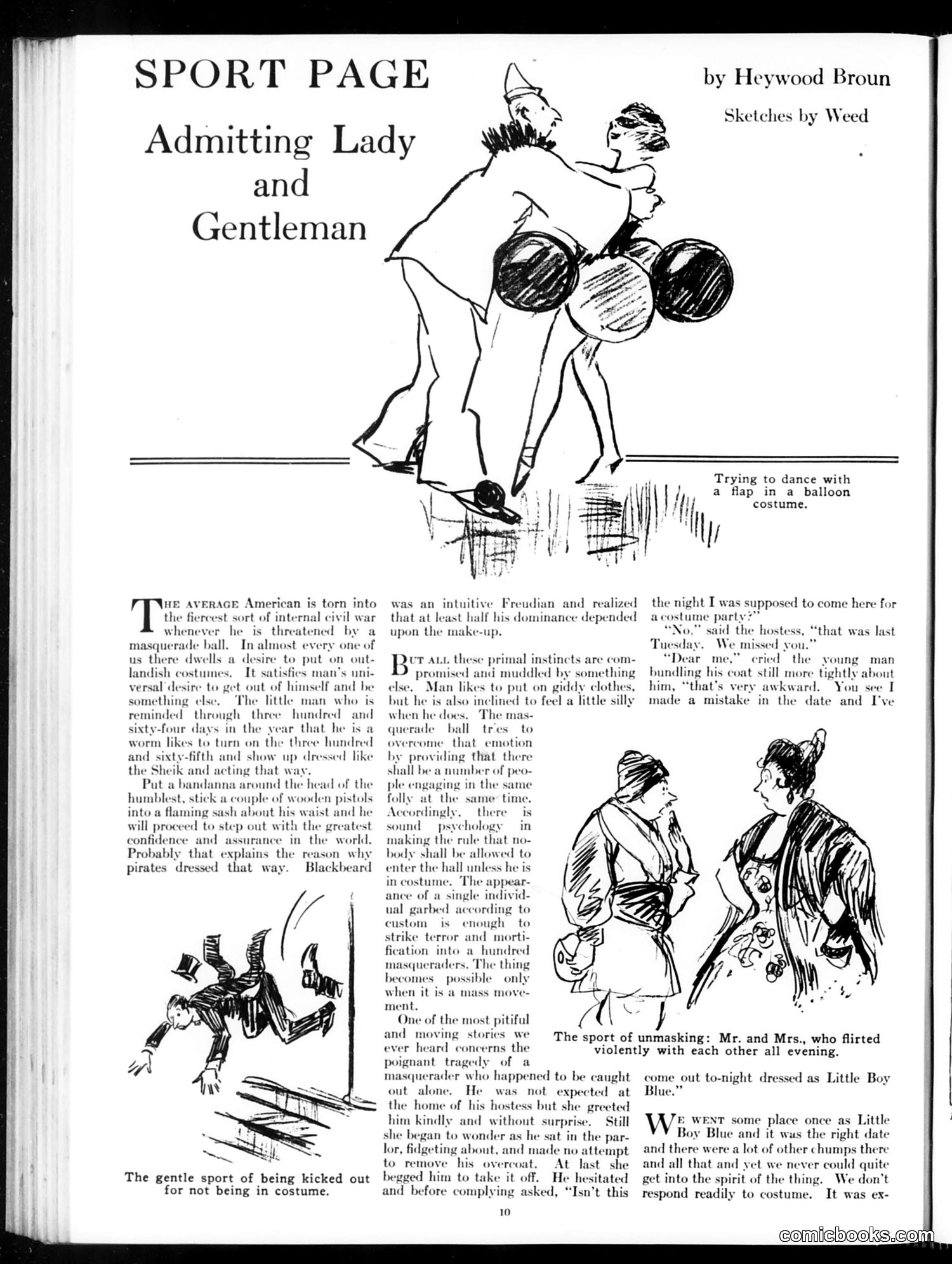
This is a humorous essay by Heywood Broun about masquerade balls and costume parties in early 20th-century America. The central joke explores the psychology of costume: ordinary people feel empowered wearing disguises, but paradoxically need *others* in costume too—a lone costumed guest becomes ridiculous rather than bold. The cartoons illustrate this tension: - Top: A couple awkwardly dancing in a balloon costume, highlighting how ridiculous costumes can be - Middle: Someone being ejected for not dressing up (enforcing the "everyone or no one" rule) - Bottom: A couple flirting while masked, suggesting costumes enable social behavior people wouldn't attempt otherwise The anecdote about the man who showed up dressed as "Little Boy Blue" on the wrong night satirizes this anxiety: surrounded by normally-dressed people, his costume becomes shameful rather than liberating. The piece gently mocks American self-consciousness and our need for collective permission to act outside social norms.
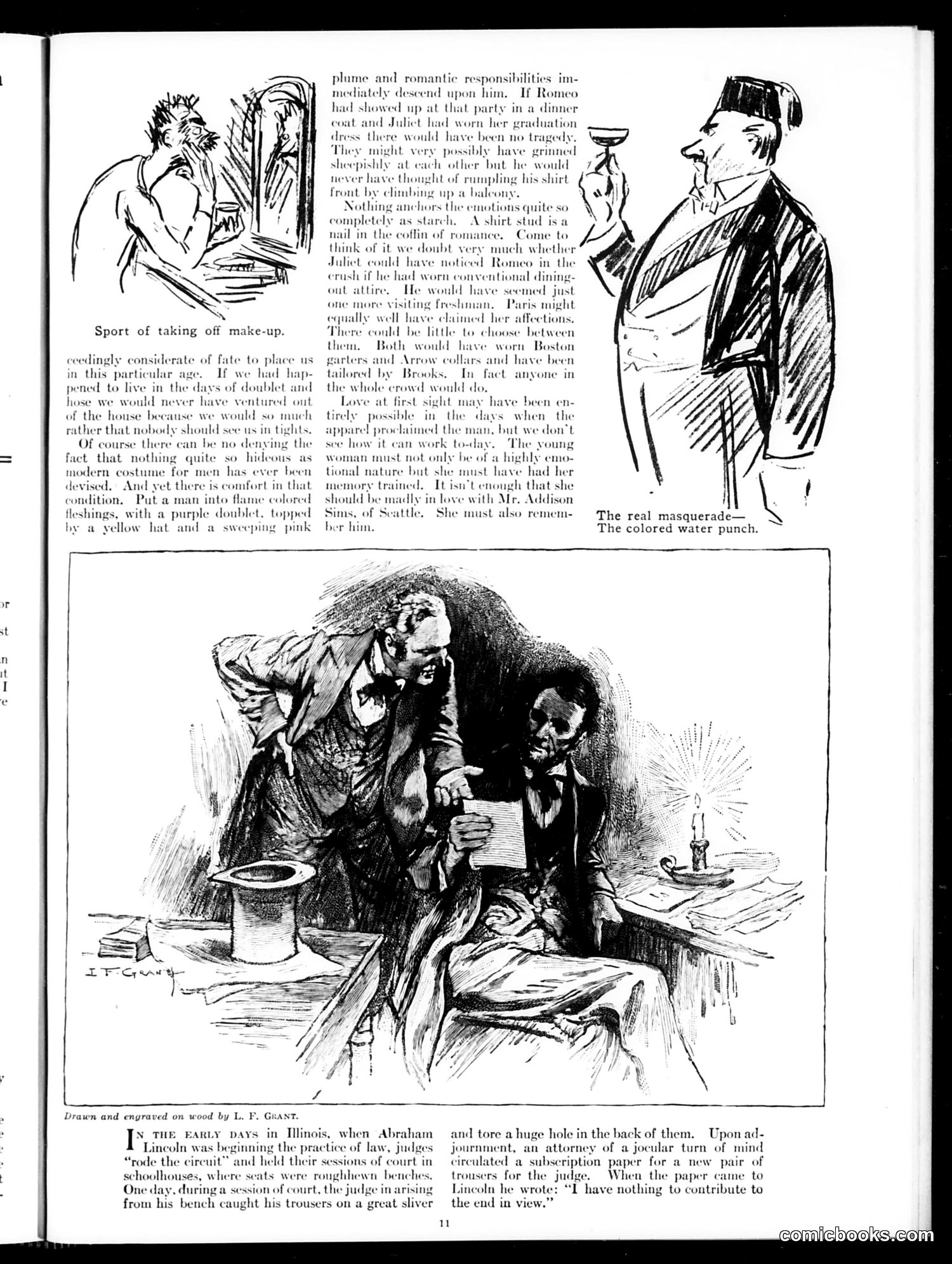
This page contains two distinct satirical pieces: **Upper cartoons:** Mockery of romantic pretense in modern dress. The text argues that standardized men's formal wear (Boston garters, Arrow collars, Brooks tailoring) makes all men indistinguishable, destroying the possibility of genuine romantic attraction. The joke: Romeo and Juliet couldn't have fallen in love today because formal dress codes eliminate individuality. "The real masquerade" caption suggests modern clothing is the true disguise. **Lower illustration:** An anecdote about young Abraham Lincoln practicing law in frontier Illinois. A judge's trousers tore badly during court; Lincoln humorously refused to contribute to a collection for replacement trousers, saying he had "nothing to contribute to the end in view"—a crude joke about the exposed tear. Both pieces satirize American social conformity and propriety: one lamenting how standardized fashion erases personality, the other celebrating frontier irreverence toward stuffy formality.
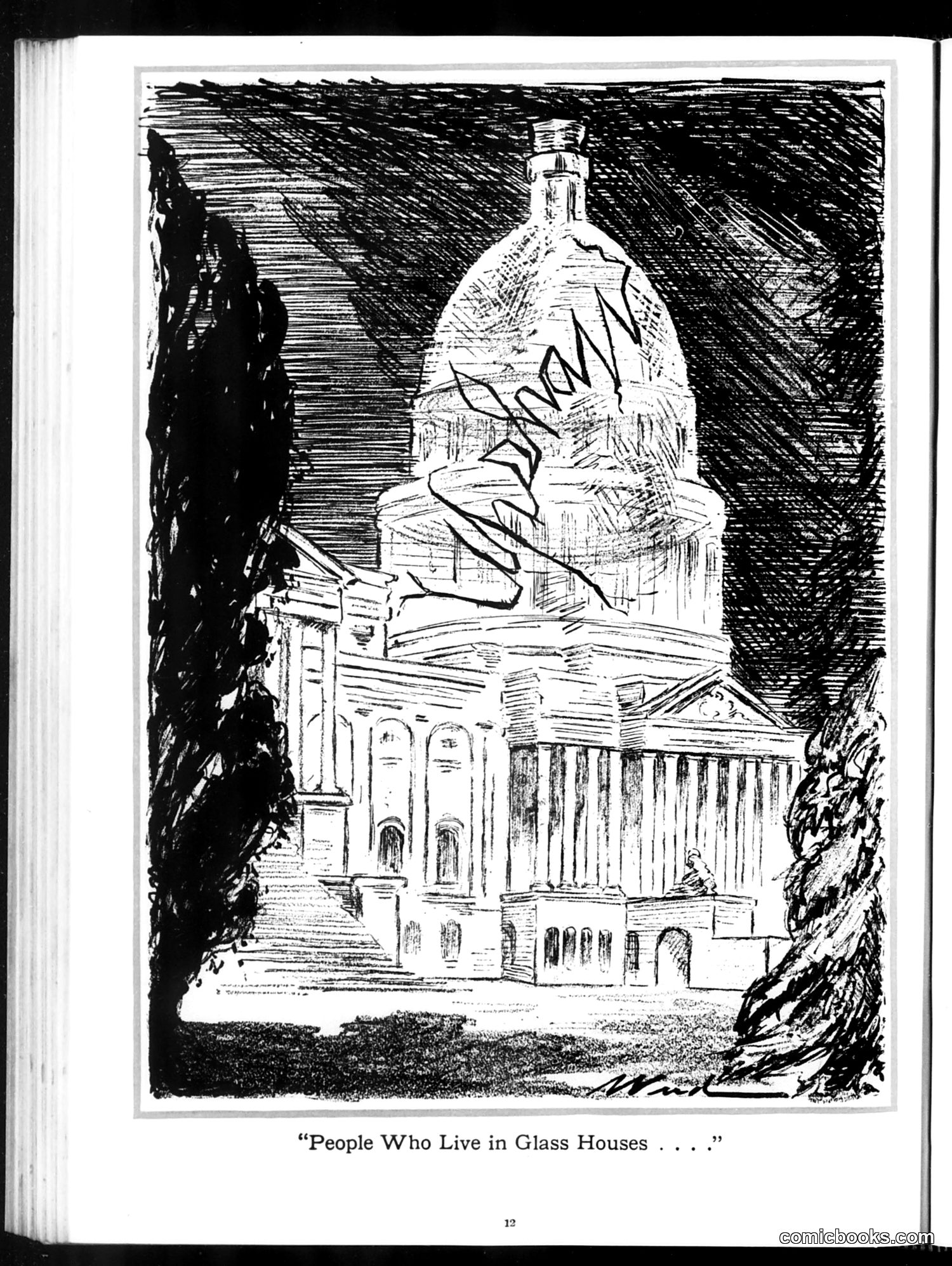
This political cartoon depicts the U.S. Capitol building enclosed within an enormous glass bottle or vessel, viewed through a cave-like opening. The caption references the proverb "people who live in glass houses shouldn't throw stones." The satire suggests that Congress—symbolized by the Capitol—operates under public scrutiny and transparency (the glass house), yet may still engage in questionable behavior or hypocrisy. The mountainous cavern framing implies Congress is isolated or removed from ordinary people's view despite its theoretical transparency. The cartoon likely critiques Congressional conduct or contradictions between public image and actual governance, though the specific political context requires additional dating to identify precisely which scandal or legislative controversy is targeted.
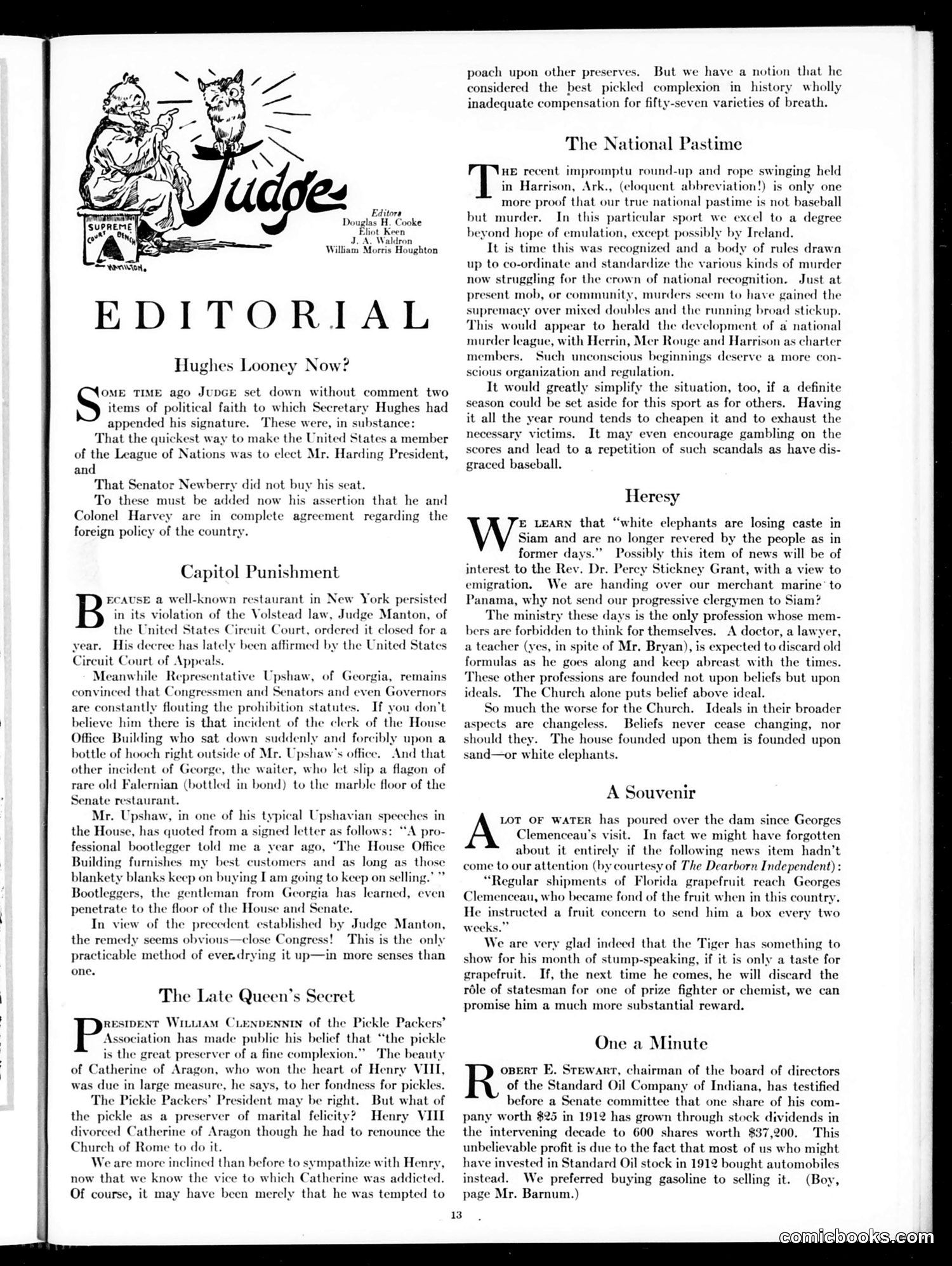
This editorial page from Judge satirizes prominent political figures of the early 1920s: **"Hughes Looney Now?"** mocks Secretary of State Charles Evans Hughes for contradictory political statements—claiming electing Harding would bring League of Nations membership (it wouldn't), defending Senator Newberry's contested election, and aligning with Colonel Harvey on foreign policy. **"Capitol Punishment"** attacks Prohibition enforcement hypocrisy: Judge Manton closed a restaurant for violating the Volstead Act, yet Representative Upshaw documents Congress members and even House Building staff openly buying bootleg liquor. The satire suggests closing Congress itself would be more effective than selective enforcement. **"The Late Queen's Secret"** jokes that pickle industry claims pickles preserved Catherine of Aragon's beauty—yet Henry VIII divorced her anyway, suggesting even "fifty-seven varieties of breath" (likely referencing Heinz pickles) couldn't save the marriage. **"The National Pastime"** grimly satirizes American lynching by proposing "standardized" murder leagues, referencing recent mob violence in Harrison, Arkansas, Herrin, and Mer Rouge—actual 1920s murder sites.
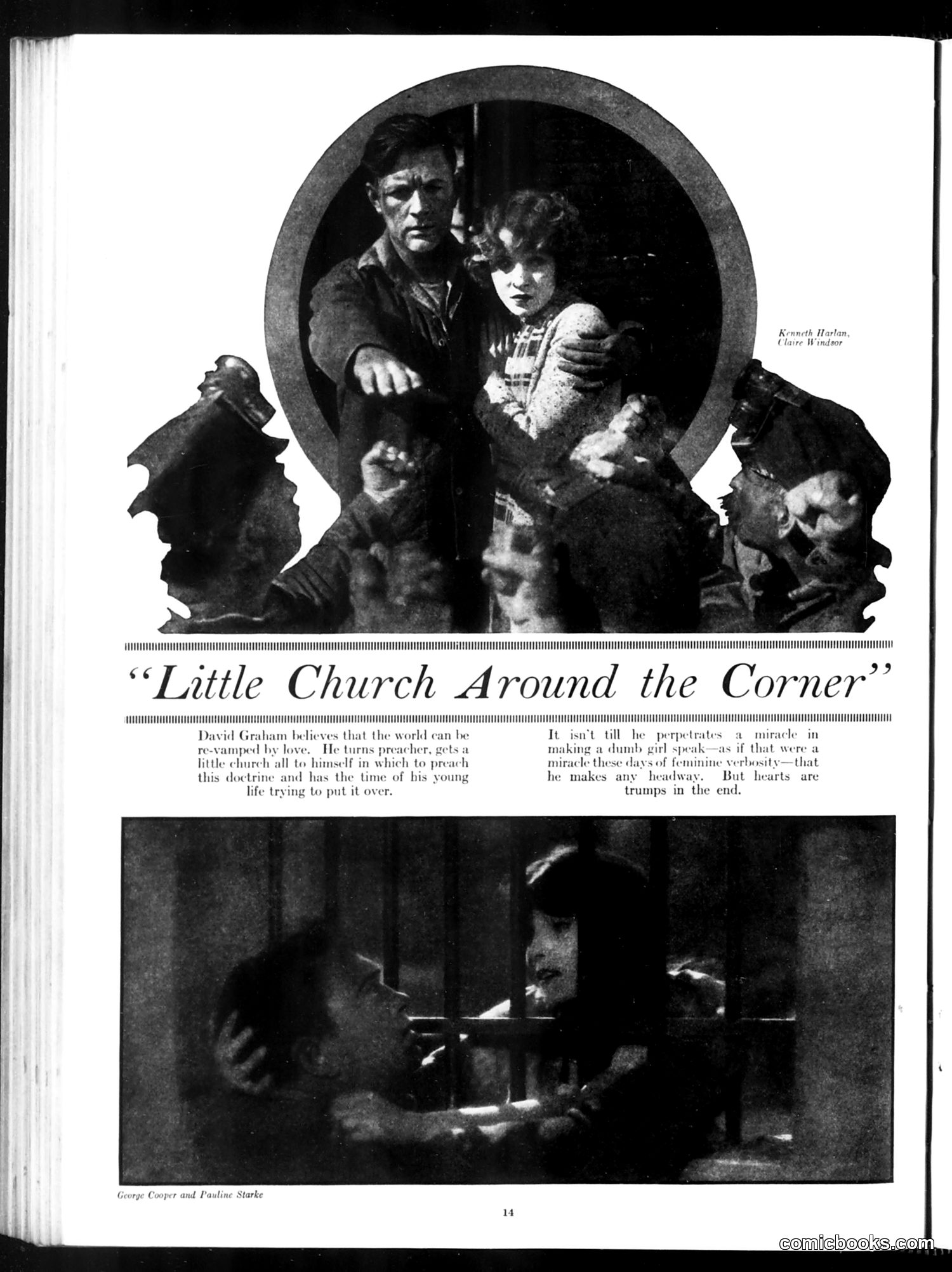
This page promotes a film featuring Kenneth Harlan and Claire Windsor. The title references an actual New York church known for performing unconventional weddings. The narrative concerns David Graham, who believes love can reform the world. He establishes a "little church" to preach this doctrine while dealing with life's challenges. The satire appears to mock his idealistic approach: the text suggests that while his preaching may seem naive (especially regarding "feminine verbosity"), ultimately "hearts are trumps"—sentiment wins out over logic. The accompanying photographs show scenes from the film, including what appears to be George Cooper and Pauline Starke. This is promotional material for a romantic comedy emphasizing the triumph of love over worldly cynicism—typical of 1920s popular entertainment values.
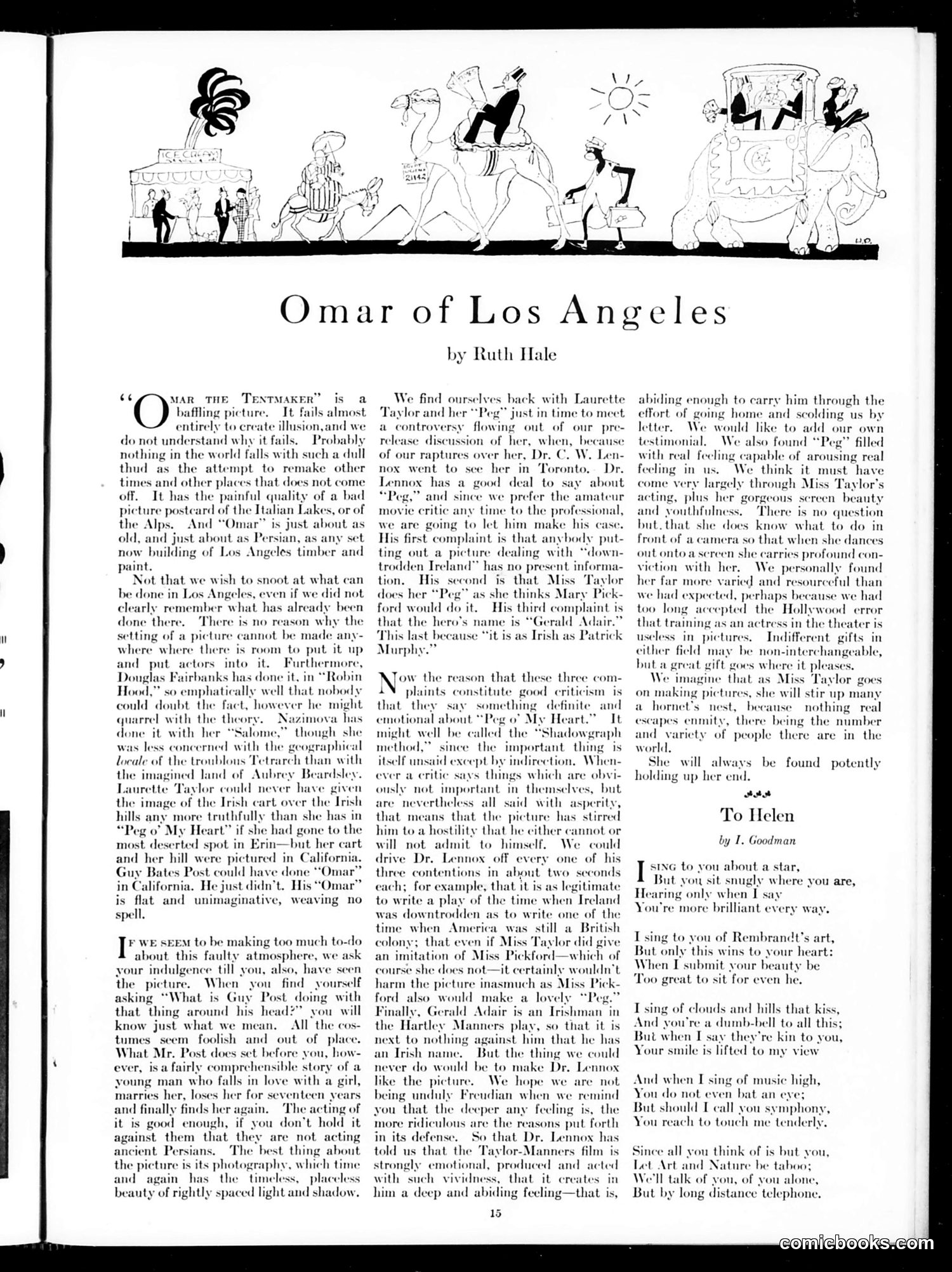
This page contains a film review of "Omar of Los Angeles" by Ruth Hale. The cartoon at the top appears to be a humorous illustration of an elaborate historical pageant or production, likely mocking the film's attempt to recreate an exotic, distant setting (ancient Persia) in contemporary Los Angeles. Hale criticizes the film for failing to create believable atmosphere—comparing it unfavorably to Douglas Fairbanks's "Robin Hood" and Laurette Taylor's "Peg o' My Heart." She argues the film's flat, uninspired execution undermines its story of a man who loses and retrieves his love after seventeen years. The secondary piece, "To Helen" by L. Goodman, appears to be poetry unrelated to the film review. The satire targets the pretentiousness of attempting ambitious historical dramas without genuine artistic vision or authentic detail—a recurring criticism of early Hollywood productions.
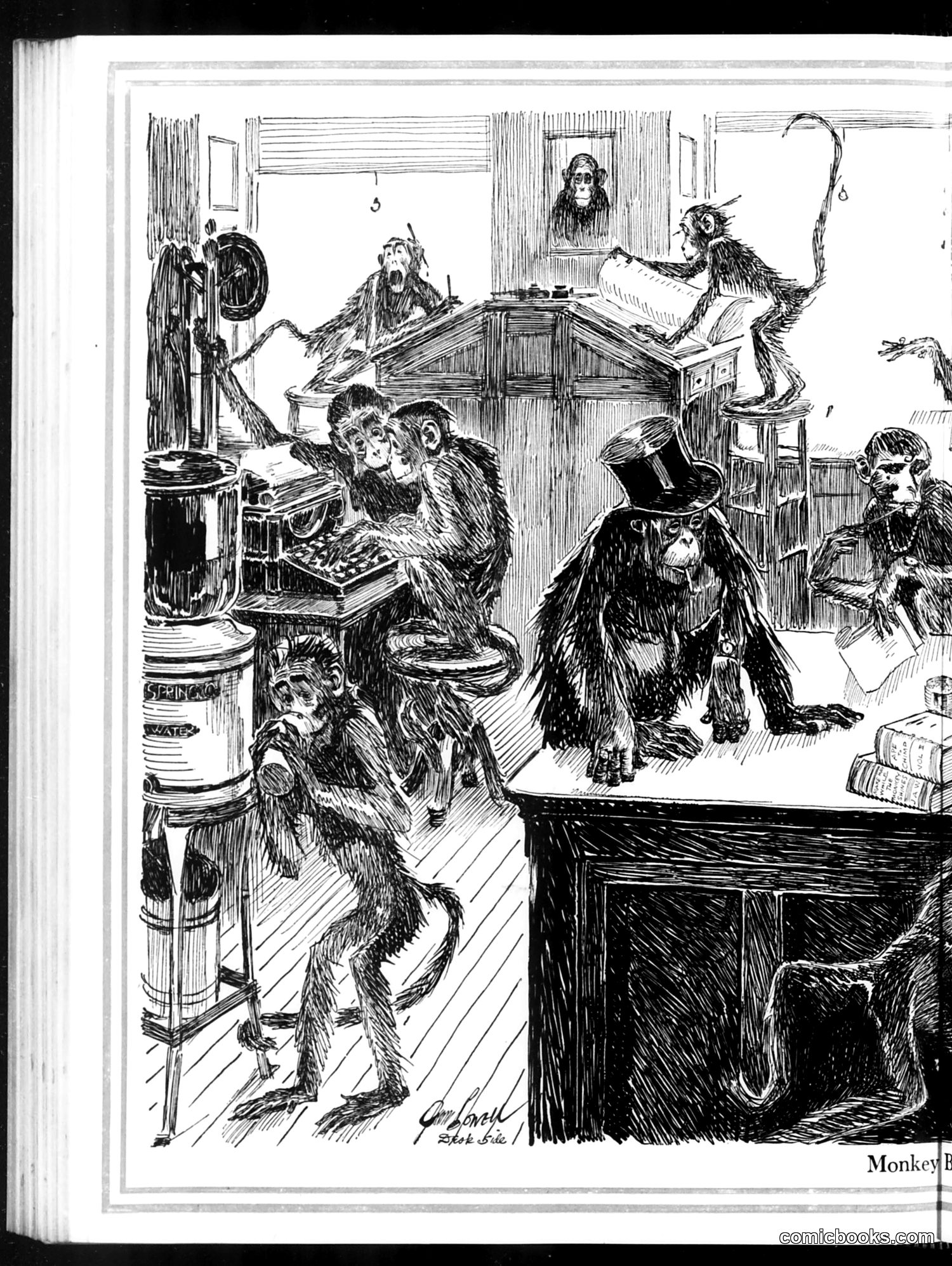
This appears to be a satirical cartoon from Judge magazine depicting a chaotic office or courtroom scene populated entirely by apes and monkeys in various states of activity. Several figures wear human clothing—notably one in a top hat—while others are shown at desks, typewriters, and engaged in typical office work. The satire likely mocks either: - Political incompetence or corruption (representing politicians/bureaucrats as "monkeys") - Legal proceedings or judicial absurdity - Workplace chaos or mismanagement The deliberate use of primates conducting "serious" human activities creates the humor through contrast. Without additional context about the publication date or specific political events referenced, the exact target remains unclear, though "monkey business" was a common idiom for dishonest or foolish conduct.
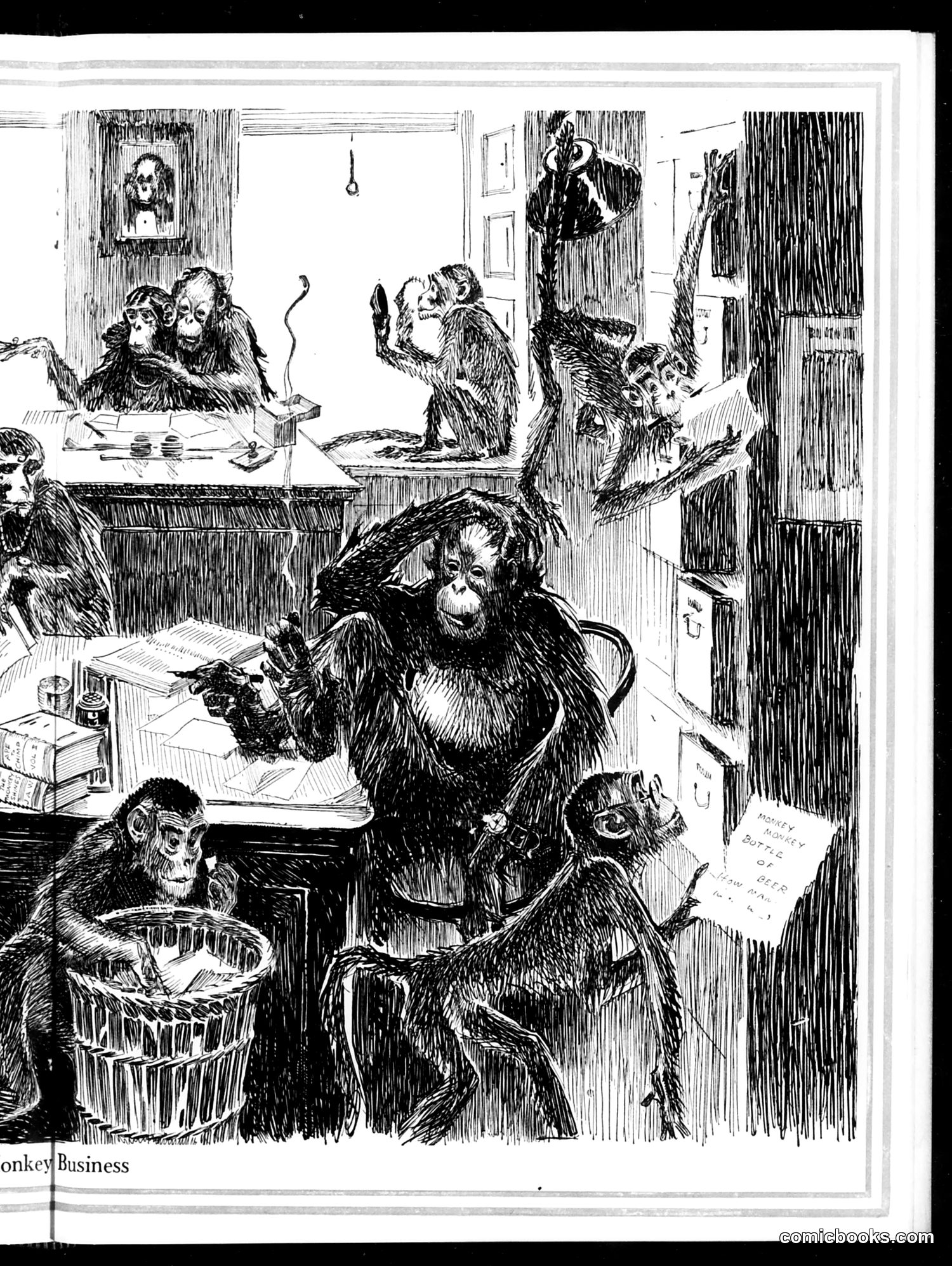
This satirical cartoon depicts a chaotic office scene populated entirely by anthropomorphic monkeys, suggesting organizational incompetence or corruption. The title "Monkey Business" is a period pun meaning dishonest dealings or foolish behavior. The central figure, a large monkey at a desk surrounded by papers and bottles, appears to be a business or government official conducting dubious operations. Other monkeys throughout the office engage in various activities—some handling documents, others gesturing wildly—implying administrative disorder and malfeasance. The satire likely critiques specific contemporary business practices or political administration (circa early 1900s based on Judge's era), using the monkey caricature to mock those in power as unintelligent or unfit for their positions. The dense, frenzied composition emphasizes chaos and mismanagement masquerading as legitimate business.
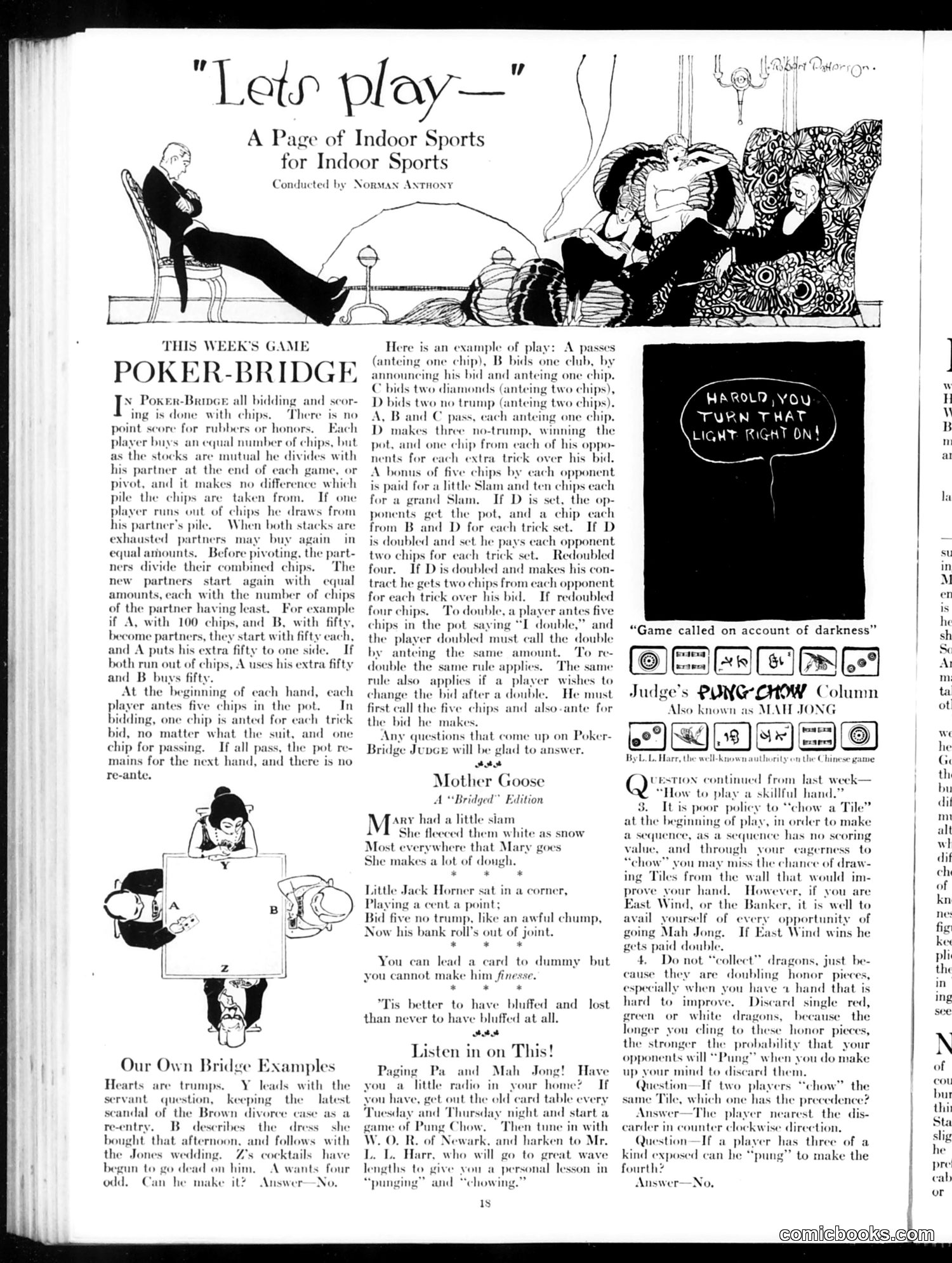
This page presents **indoor card games as entertainment for leisure time**, a topic befitting Judge's satirical focus on contemporary social habits. **Main Content:** The page explains "Poker-Bridge," a hybrid card game combining poker betting with bridge scoring, complete with detailed rules and examples. This reflects the 1920s-30s American leisure culture where card games were popular social activities. **Sidebar Features:** - A "Mother Goose: A 'Bridged' Edition" section parodies nursery rhymes with card-game humor ("Mary had a little slam / She fleeced them white as snow") - "Judge's Pung Chow Column" about Mah Jong, the Chinese tile game that became a fad among American society women in this era - A cartoon captioned "Game called on account of darkness" showing card players in dim lighting, likely satirizing either poor venues or extended gambling sessions **The Satire:** The page gently mocks upper-class leisure pursuits and the obsessive complexity surrounding these games. The detailed rule explanations and advice columns suggest both the games' popularity and their tendency toward needless elaboration—typical Judge fare targeting middle and upper-class social pretensions.
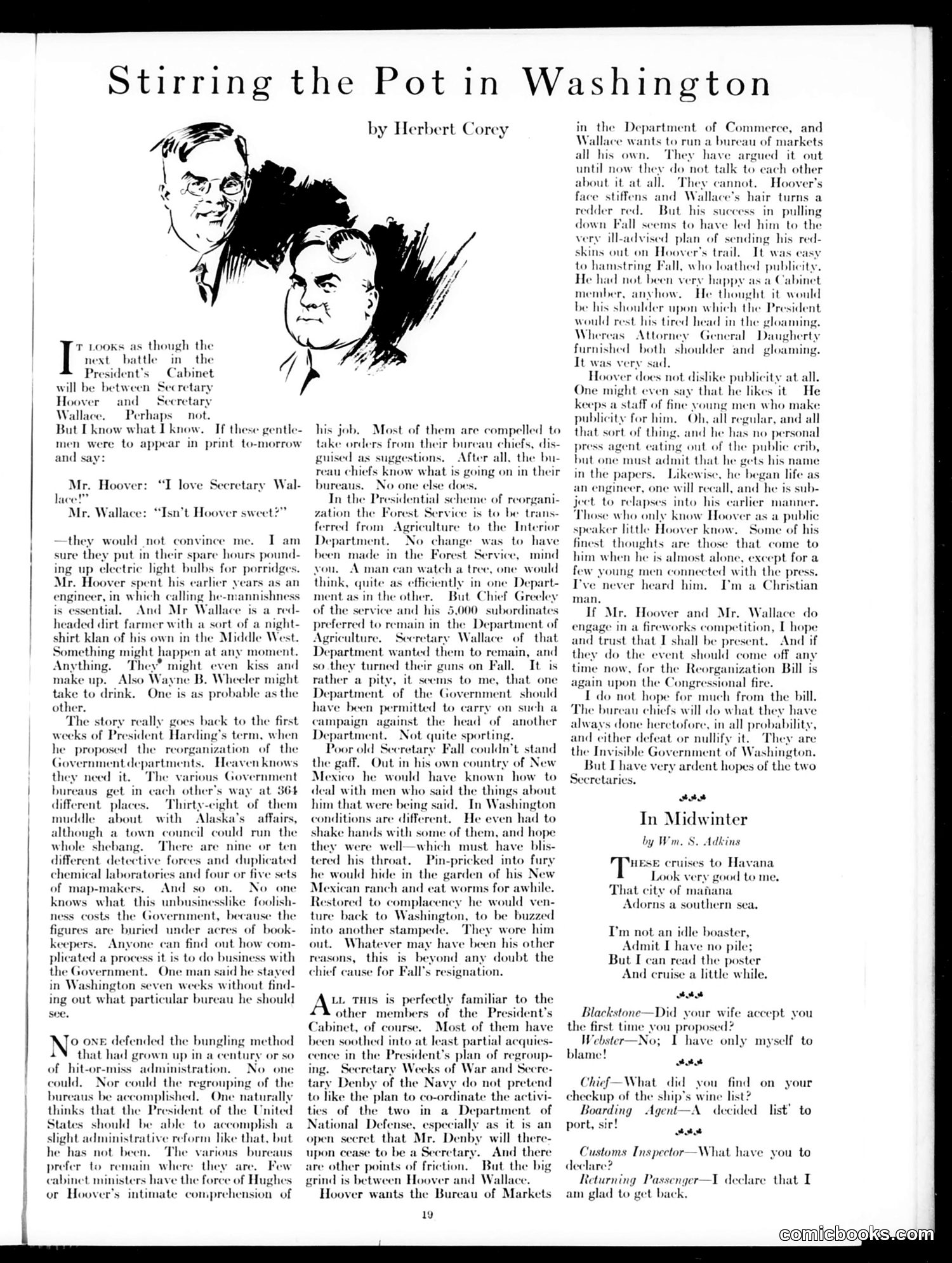
This article by Herbert Corey satirizes internal conflict within President Harding's Cabinet, specifically between **Secretary of Commerce Herbert Hoover** and **Secretary of Agriculture Henry Wallace** (depicted in the two caricatures). The piece concerns a Harding administration reorganization plan to transfer the Forest Service from Agriculture to Interior. Wallace and Forest Service Chief Greeley opposed this move, effectively campaigning against **Secretary of the Interior Albert Fall** (who would later face scandal). Corey mocks the petty bureaucratic infighting—claiming Hoover and Wallace publicly praise each other despite obvious mutual dislike, comparing their feud to unlikely scenarios like prohibitionist Wayne Wheeler drinking. The satire targets both the chaos of overlapping government departments and the Cabinet members' inability to resolve disputes professionally. Corey portrays Fall as emotionally fragile, retreating to his New Mexico ranch rather than handling the "pin-pricks" of Washington politics. The broader joke: even the President cannot reorganize the government because entrenched bureaucrats and ambitious Cabinet members obstruct reform.
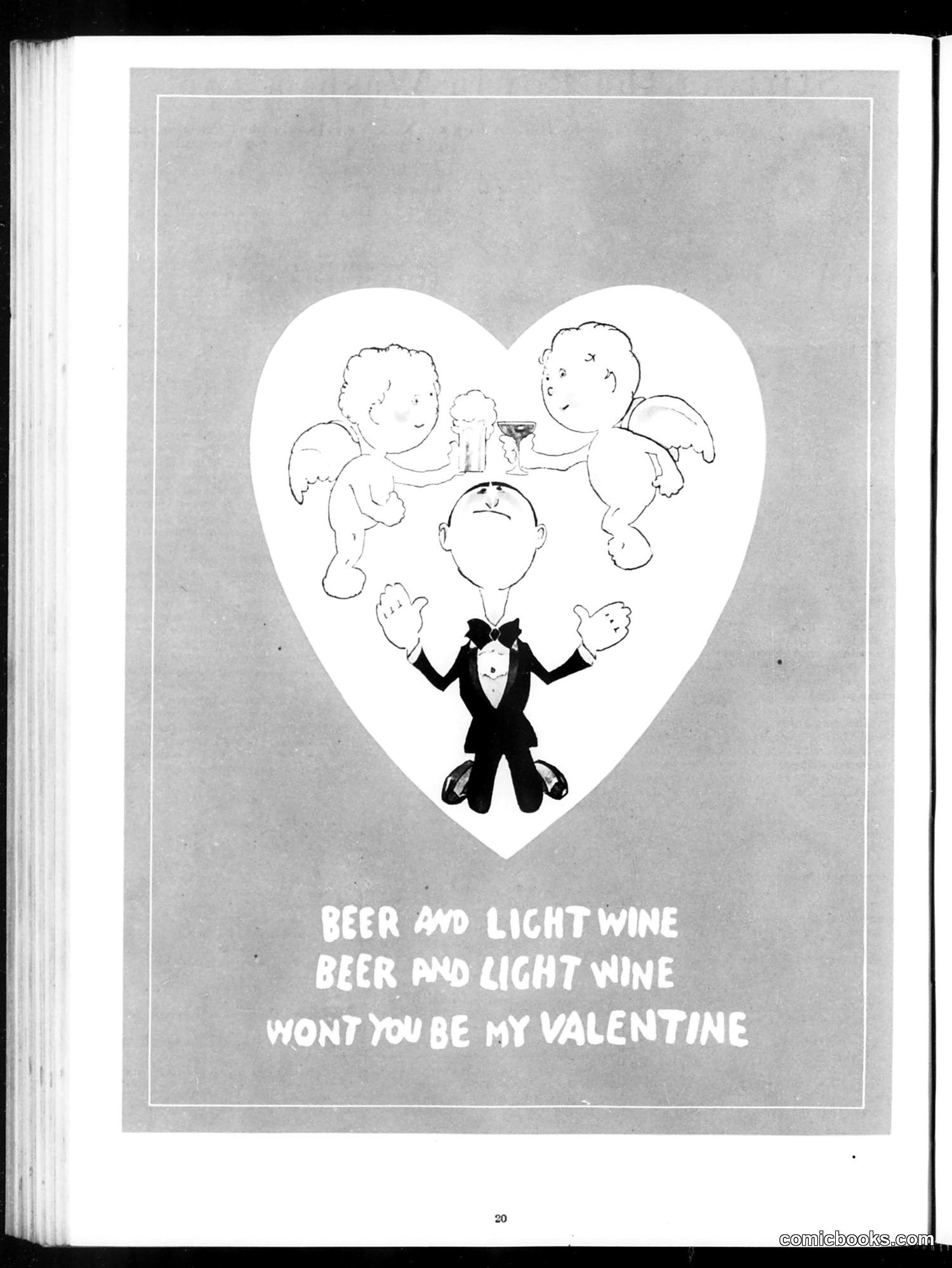
This appears to be a Valentine's Day greeting card or advertisement from *Judge* magazine. The image shows a formally dressed man in a tuxedo juggling four cherub-like babies within a large heart shape. The text reads: "BEER AND LIGHT WINE / BEER AND LIGHT WINE / WON'T YOU BE MY VALENTINE" The satire seems to mock the romantic pretensions of courtship by suggesting that alcohol—specifically beer and light wine—are the true "children" or creations of the suitor's affection. Rather than offering genuine romantic devotion, the figure offers beverages as tokens of love. This likely comments on 1920s-era attitudes toward drinking and courtship, possibly satirizing commercialized Valentine's Day or the superficiality of alcohol-fueled romance during Prohibition's era.
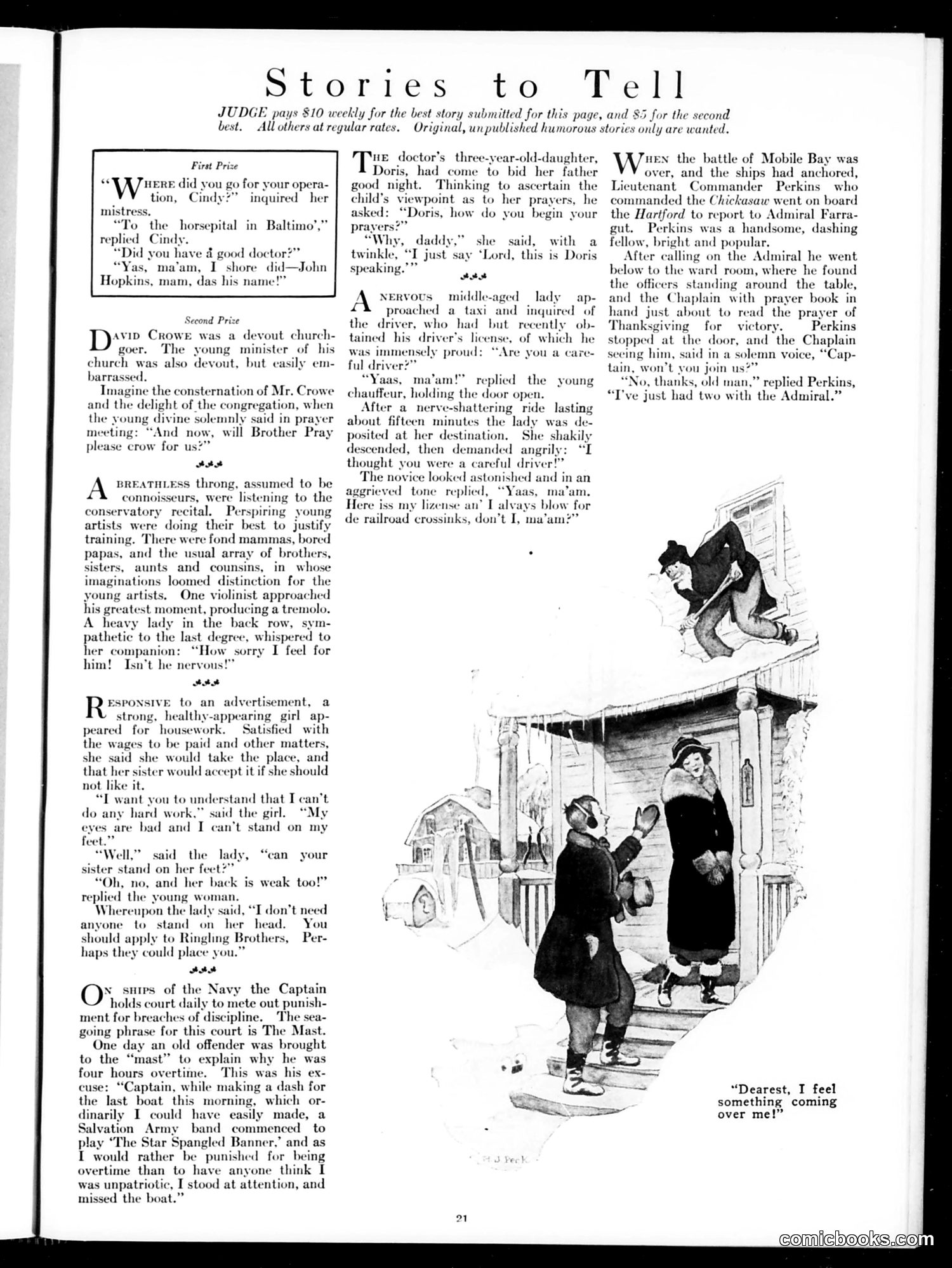
This page contains several brief humorous anecdotes typical of Judge's satirical humor: **"Horsepital" joke**: A dialect humor piece mocking African American speech patterns, where "Cindy" confuses "hospital" with "horsepital"—common in period humor using caricatured dialect for comedy. **"Brother Pray" anecdote**: A minister accidentally calls on "Brother Pray" (a man named Crow) to "crow" during prayer meeting—a pun exploiting the man's surname. **Conservatory recital**: Satire of pretentious concert audiences, where an anxious family member sympathizes with a nervous violinist. **Housework applicant**: Domestic labor satire where a girl unable to do physical work is mockingly told to apply to Ringling Brothers circus instead. **Naval court anecdote**: A sailor explains arriving late because he stopped at attention during "The Star-Spangled Banner," prioritizing patriotic duty over punctuality—likely satirizing either excessive patriotism or genuine military respect. The page exemplifies early-20th-century Judge humor: workplace absurdities, social pretension, dialect mockery, and gentle military satire.
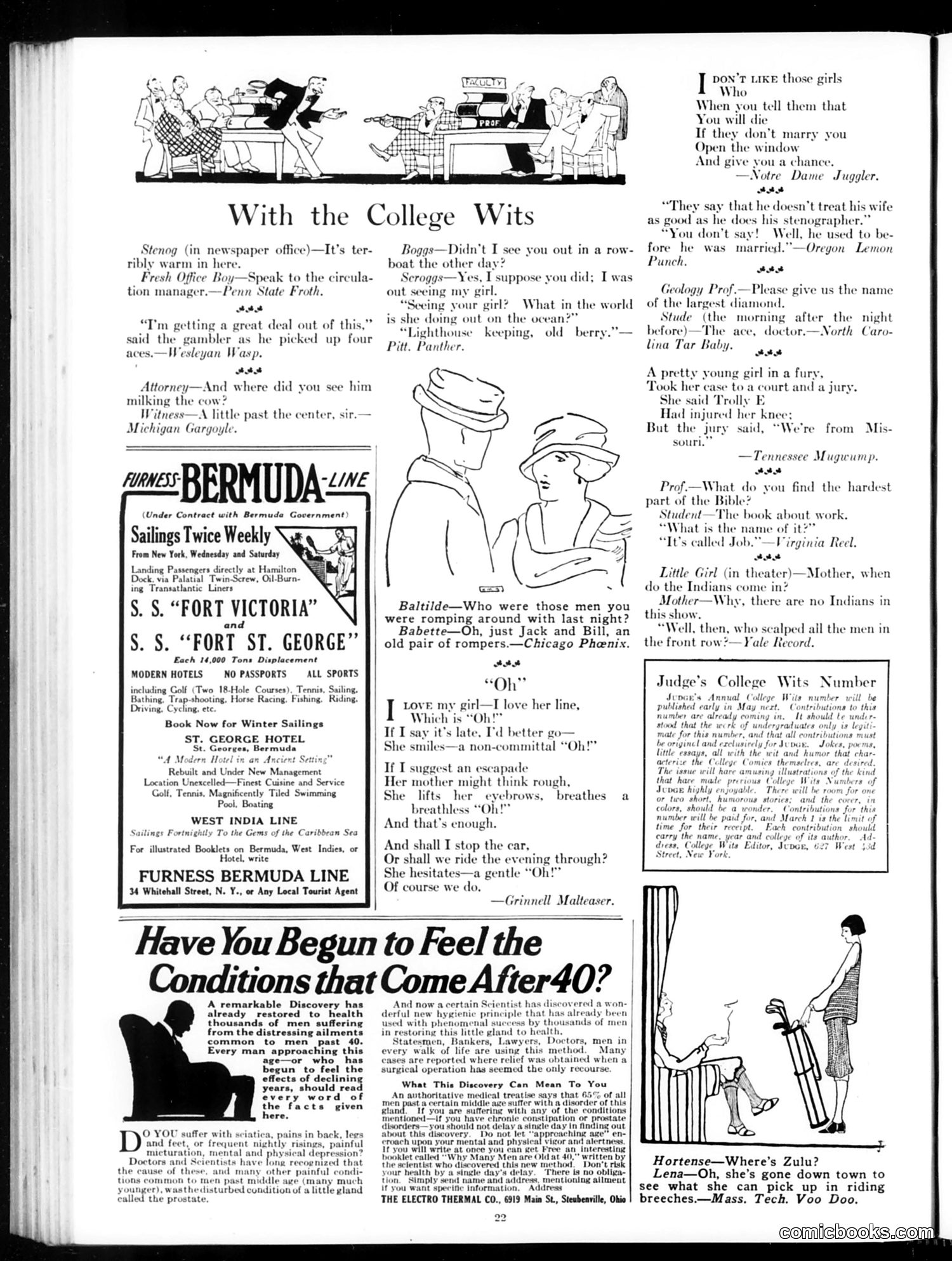
This page from **Judge** magazine features light collegiate humor from various college publications plus advertisements and medical advertising. **"With the College Wits"** collects short jokes reprinted from college humor magazines (Penn State Froth, Michigan Gargoyle, etc.). These are innocuous one-liners—a gambler finding four aces, a witness being asked where he saw someone milking a cow. The humor is gentle wordplay typical of 1920s-era college comedy. **The main illustration** shows a flirting couple; the accompanying poem "Oh" by Grinnell Malleaser depicts a young man's romantic advances repeatedly met with the girl's noncommittal response "Oh!"—portraying courtship as a game of male persistence and female evasion. **The large advertisement** for "Conditions that Come After 40" is a classic patent-medicine pitch promising to restore vigor to aging men through unspecified electrical/thermal treatments—quintessential early-20th-century quackery. The remaining jokes mock courtship, marriage, and workplace dynamics with conventional gendered stereotypes of the era.
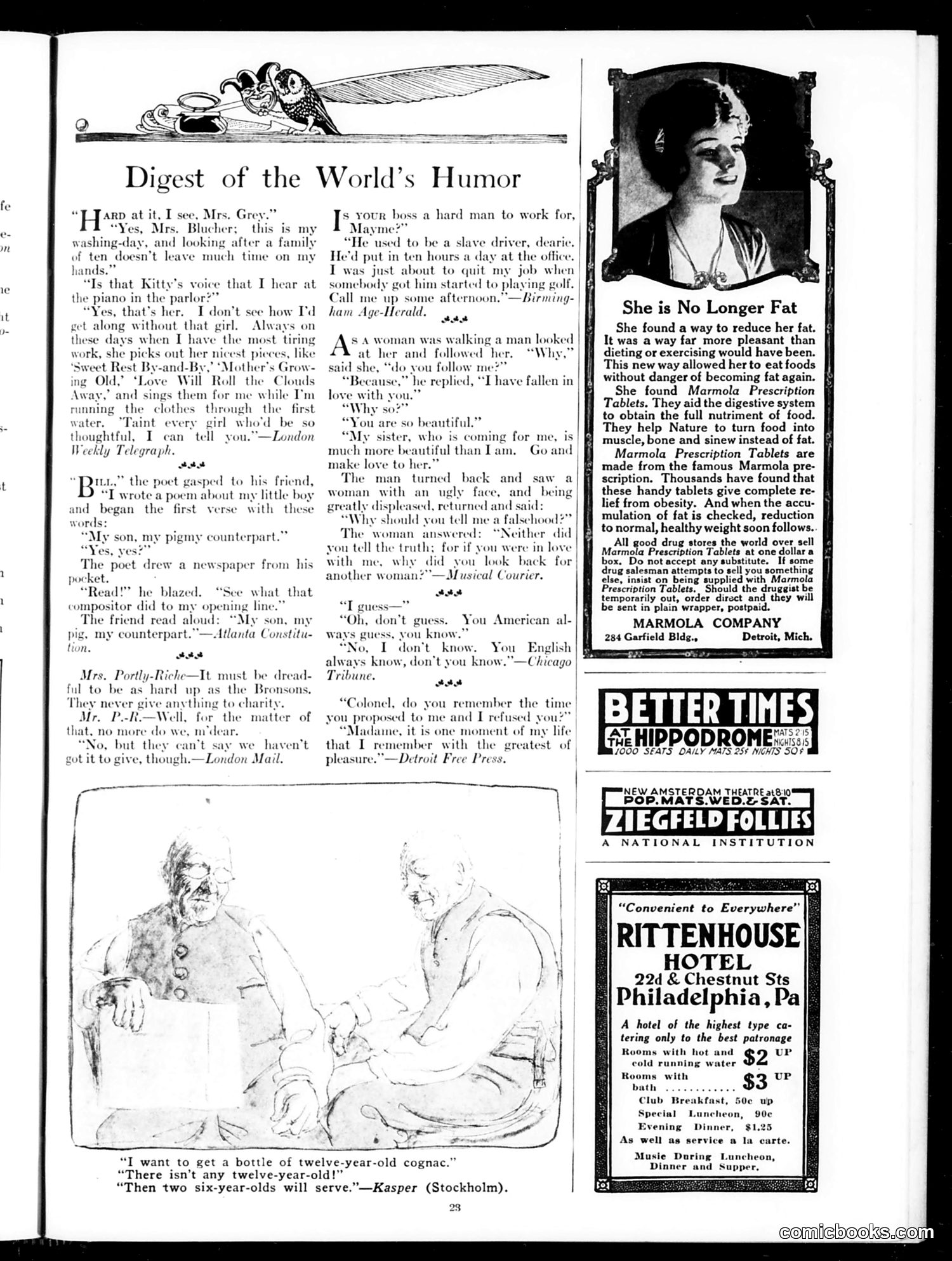
This page from *Judge* contains humor sketches and period advertisements typical of early 20th-century American satire magazines. **The Humor Section** features several brief anecdotes mocking everyday situations: a working-class woman praising her daughter's piano-playing during laundry day (satirizing genteel pretensions among the poor); a printing error converting a poet's "pygmy counterpart" to "pig"; a man pursuing a woman who redirects him to her "more beautiful" sister; and variations on courtship deceptions. The humor relies on misunderstandings, class ironies, and romantic comedy tropes common to the era. **The Advertisements** include a Marmola weight-loss tablet ad (featuring a woman's portrait and promising fat reduction without dieting), the Ziegfeld Follies theater notice, a Rittenhouse Hotel advertisement in Philadelphia, and the Hippodrome venue listing. The cartoons and text reflect turn-of-the-century American middle-class anxieties about propriety, romantic behavior, and consumer goods—with no overtly political content visible on this particular page.
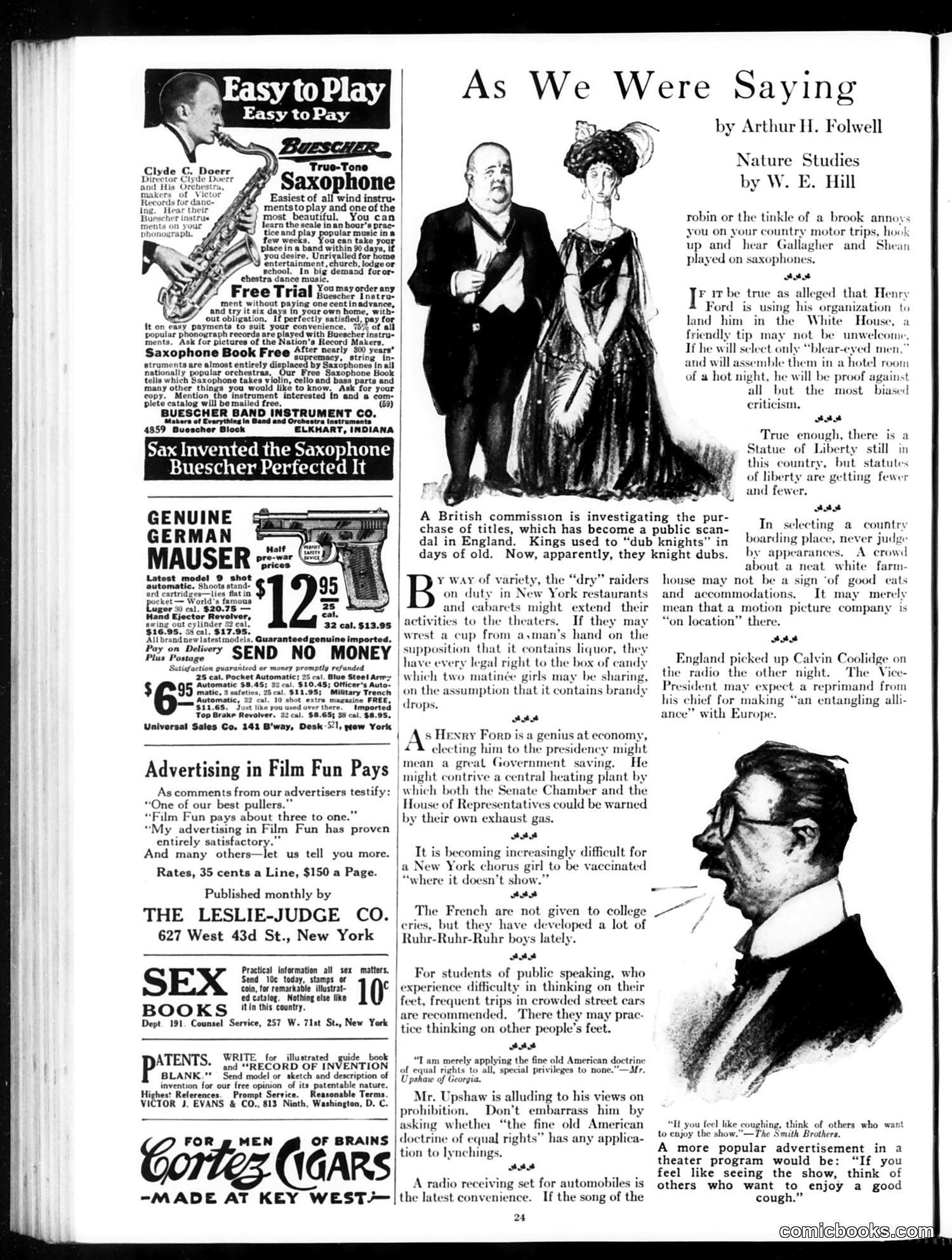
This page is primarily **advertisements and satirical commentary** rather than a unified cartoon. The main visual content shows two sketched figures (a man and woman) accompanying "As We Were Saying," a column of brief social satire by Arthur H. Folwell. The satirical items target contemporary issues: 1. **Title purchasing scandal**: References a British investigation into selling aristocratic titles, contrasting old "dubbing knights" with new commercial exchanges. 2. **Prohibition enforcement**: Mocks "dry raiders" (federal agents enforcing alcohol prohibition) for inconsistently seizing liquor while ignoring contraband candy. 3. **Henry Ford for president**: Satirizes Ford's reputation for cost-cutting, joking he'd heat government buildings with car exhaust. 4. **Women's rights hypocrisy**: Criticizes Georgia politician Upshaw for championing "equal rights" while supporting lynching—exposing the doctrine's hollow application. The page reflects 1920s concerns: Prohibition enforcement, women's public visibility (chorus girls), and racial violence—all contemporary hot-button issues for Judge's satirical commentary.
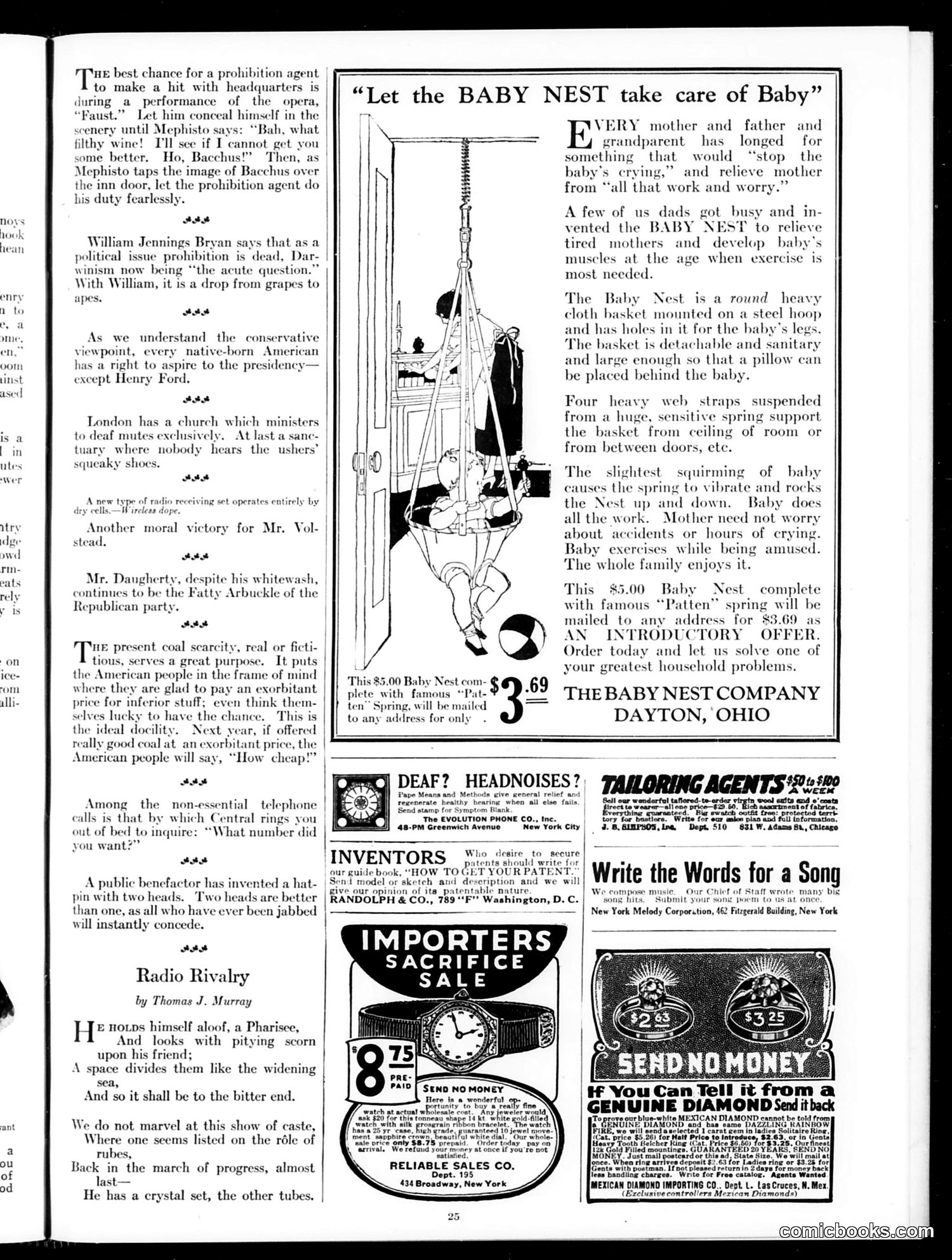
This page primarily consists of **editorial commentary and advertisements** rather than political cartoons. The editorial section contains **brief satirical observations** on current events: - **Prohibition enforcement**: A joke about raiding during opera performances, referencing the ongoing "dry" era - **William Jennings Bryan**: Mockery of the three-time presidential candidate's claim that prohibition is a dead political issue - **Henry Ford**: Criticism of his presidential ambitions - **Volstead Act**: Reference to Prohibition's chief architect - **Harry Daugherty**: The Attorney General is compared unfavorably to scandal-plagued silent film star Fatty Arbuckle - **Coal scarcity**: Satirizes public acceptance of price gouging during shortages The "Radio Rivalry" poem appears to reference **early radio technology** and the social divisions forming around who owns different types of receiving sets—a contemporary status marker. The bulk of the page is **product advertising**, including the "Baby Nest" contraption (a suspended cradle), hearing aids, imported watches, and song-writing services—typical Judge magazine fare of the era.
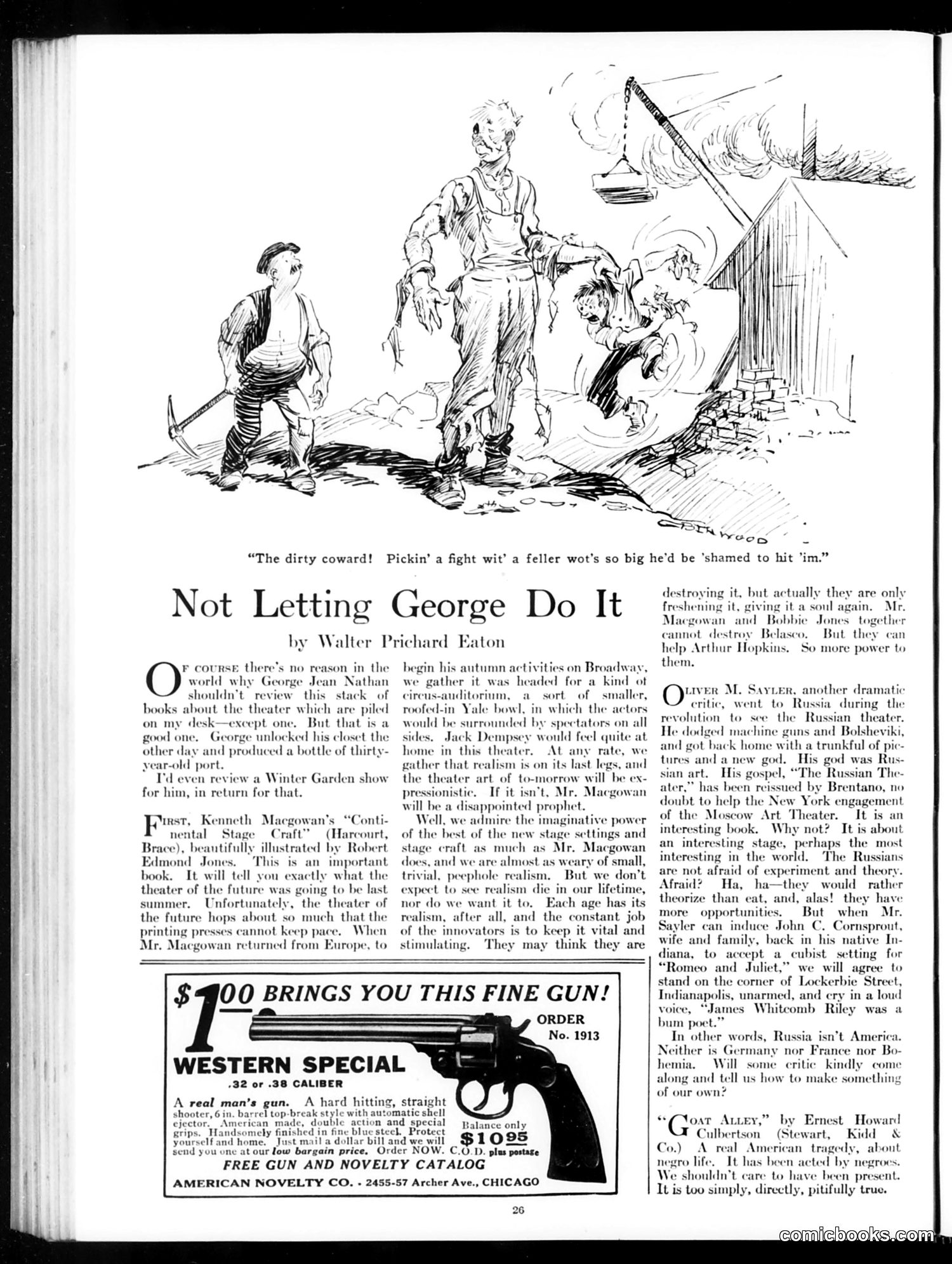
This page contains a theatrical critique essay titled "Not Letting George Do It" by Walter Prichard Eaton, discussing theater critic **George Jean Nathan** and debates over the future direction of American theater. The cartoon at top depicts working-class figures (likely laborers or dock workers based on the setting with boats) with the caption about a "dirty coward" picking a fight with someone too large to hit back—a visual metaphor for the essay's theme about unfair criticism. The text criticizes theater innovators (particularly **Kenneth Macgowan**, mentioned as having written about experimental stage design) for chasing European theatrical trends—expressionism, cubism, Russian theater techniques—while ignoring distinctly American theatrical forms. Eaton argues critics like **Oliver M. Sayler** romanticize Russian revolutionary theater without considering whether such avant-garde approaches suit American audiences. The satirical point: American theater critics are so enamored with European modernism that they're abandoning native theatrical traditions and realistic drama without justification. The page also includes period advertising for an inexpensive mail-order revolver ($7.00), typical of Judge's commercial content.
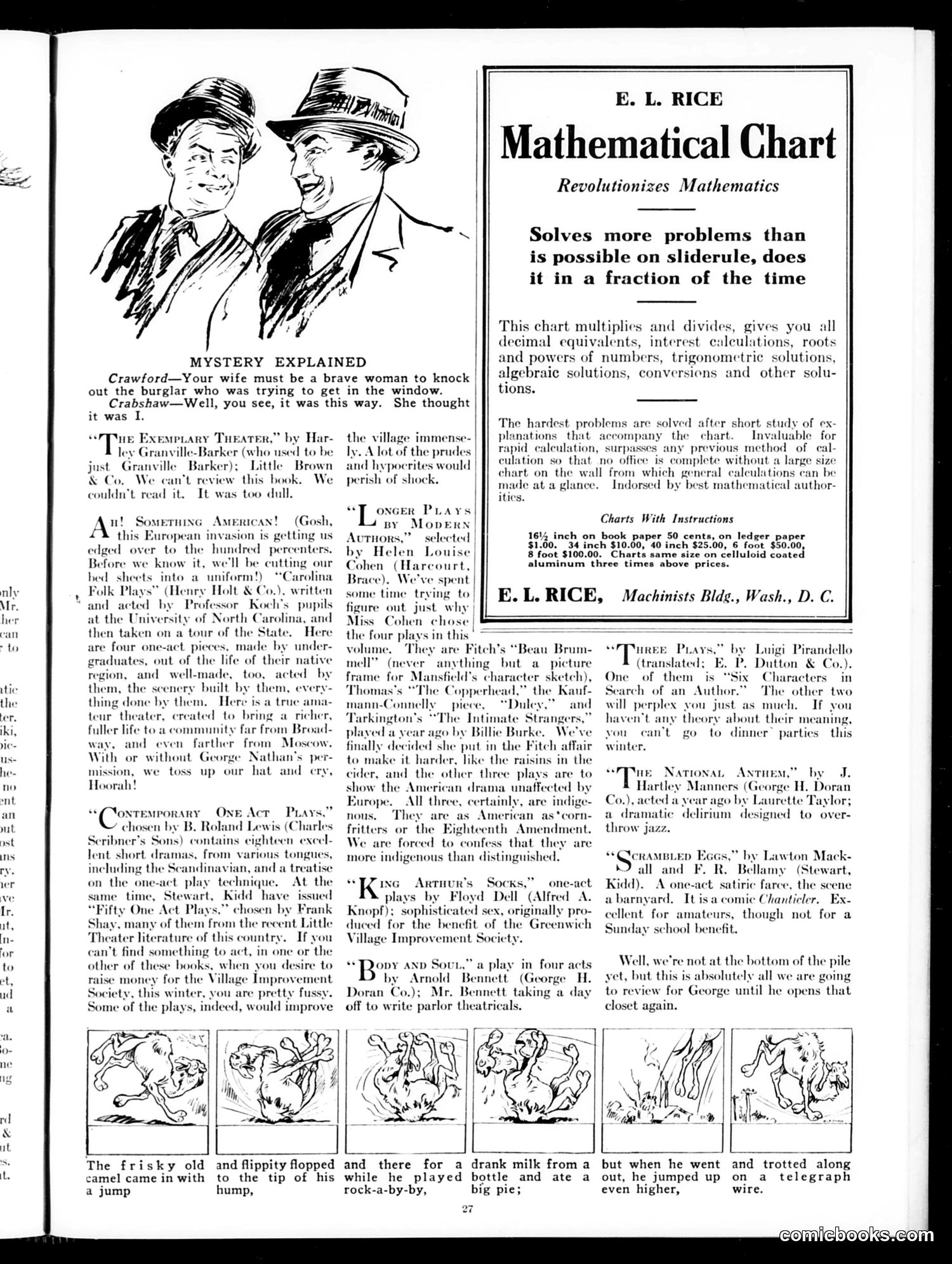
This page is primarily **advertising and book reviews**, not political satire. The cartoon at top ("Mystery Explained") is a domestic humor joke: a husband's wife mistakenly attacked an intruder, thinking it was her husband trying to enter—implying marital discord or that she'd welcome hitting him. The bulk of the page reviews American theatrical works, particularly celebrating native American drama. The tone is nationalist, mocking European cultural influence ("this European invasion"). There's mild satire of pretentiousness—the reviewer can't finish reading "The Exemplary Theatre" because it's "too dull," and notes that plays by Fitch and Tarkington, while authentically American as "cornfritters or the Eighteenth Amendment," are "more indigenous than distinguished." The large advertisement for **E. L. Rice's Mathematical Chart** dominates the right side—a tool claiming to revolutionize mathematics by solving problems faster than slide rules. The **camel comic strip** at bottom is unrelated humor about an animal's misadventures.
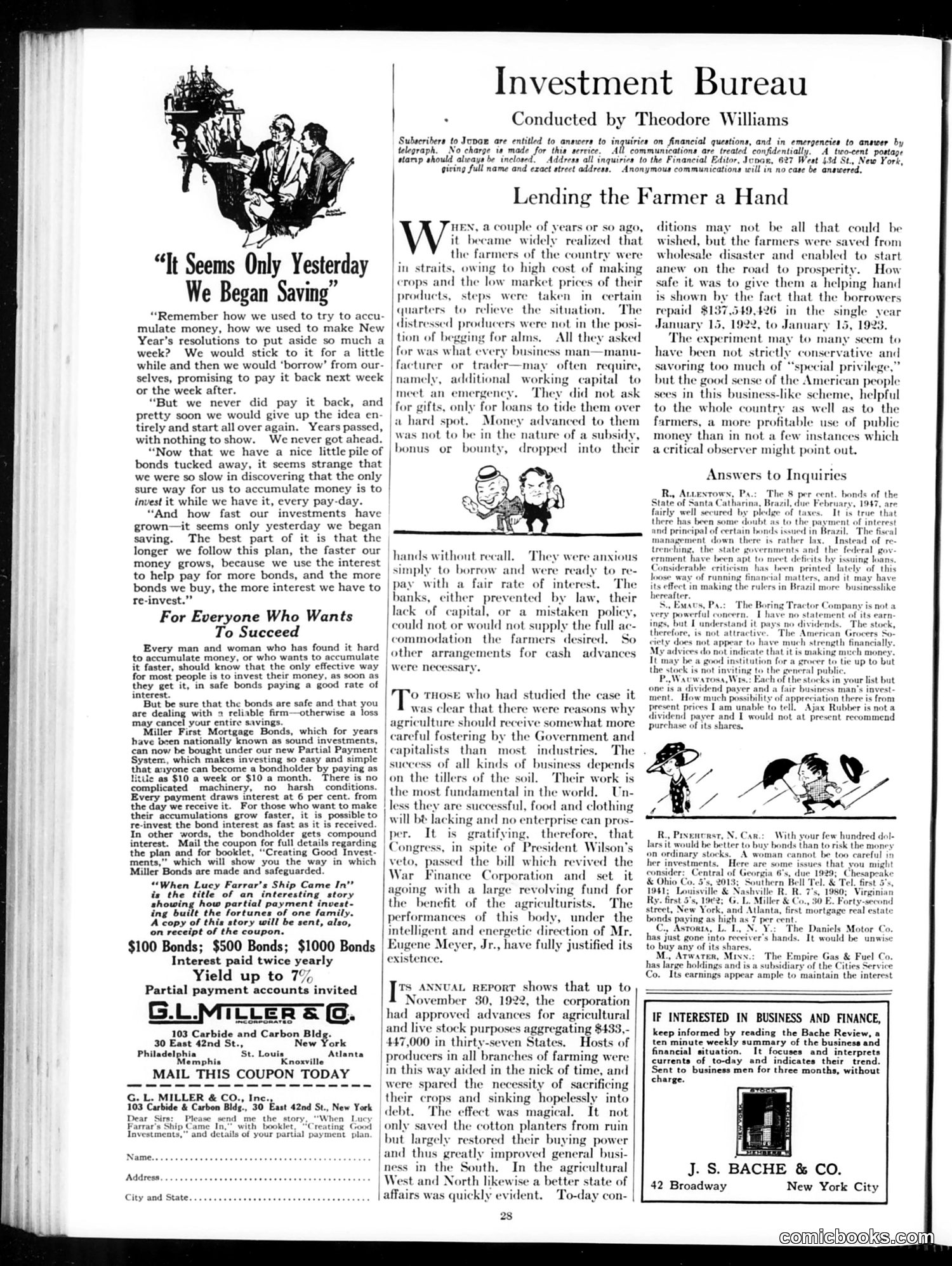
This page contains investment advertising alongside an article about Depression-era agricultural lending. The main content, "Lending the Farmer a Hand," discusses government and private efforts to provide emergency loans to struggling farmers around 1922-1923 (based on references to President Wilson and the War Finance Corporation). The key points: Farmers faced high production costs and low crop prices, creating a credit crisis. Rather than asking for charity, they sought working capital loans. Banks often refused due to legal restrictions or risk aversion. The War Finance Corporation eventually provided a revolving fund to help agriculturalists, which "saved the cotton planters from ruin" and improved Southern economic conditions. The surrounding advertisements (G.L. Miller & Co. bonds, J.S. Bache & Co.) promote investment schemes—notably ironic given the article's subject matter about credit access disparities between farmers and other businessmen. No political cartoon appears on this page; it's primarily text-based financial journalism and advertising reflecting early 1920s agricultural economic crisis.
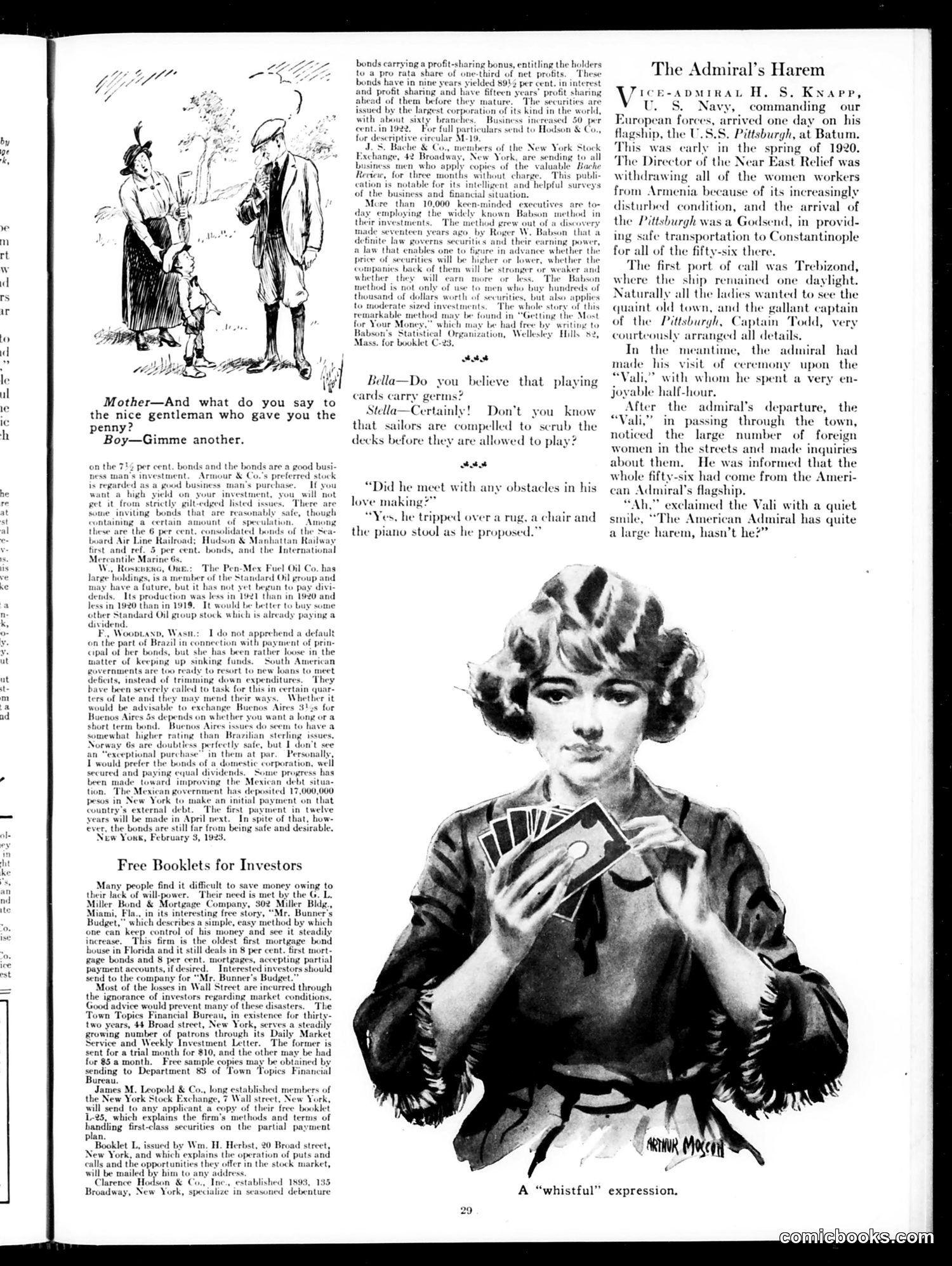
**The Cartoon (top left):** This depicts a social interaction between a well-dressed man and woman, illustrating a joke about manners. A boy has received a penny from a gentleman and, when his mother prompts him to thank the giver politely, the boy instead demands "Gimme another"—satirizing both poor manners and entitled greed among children. **The Featured Image:** A glamorous woman in 1920s styling holds playing cards with a "whistful expression"—likely referencing contemporary jazz-age femininity and the somewhat risqué cultural moment. **The Main Article:** "The Admiral's Harem" reports Vice-Admiral H.S. Knapp's arrival in Philadelphia in spring 1920 aboard the USS Pittsburgh. The title sarcastically refers to the fifty women workers who arrived with him, having been displaced from an American naval facility—the humor deriving from calling this group of female employees an "admiral's harem." **Overall Context:** The page mixes light social satire (child behavior, gender dynamics) with 1920s financial investment advertising, typical of Judge magazine's format blending humor with business content.
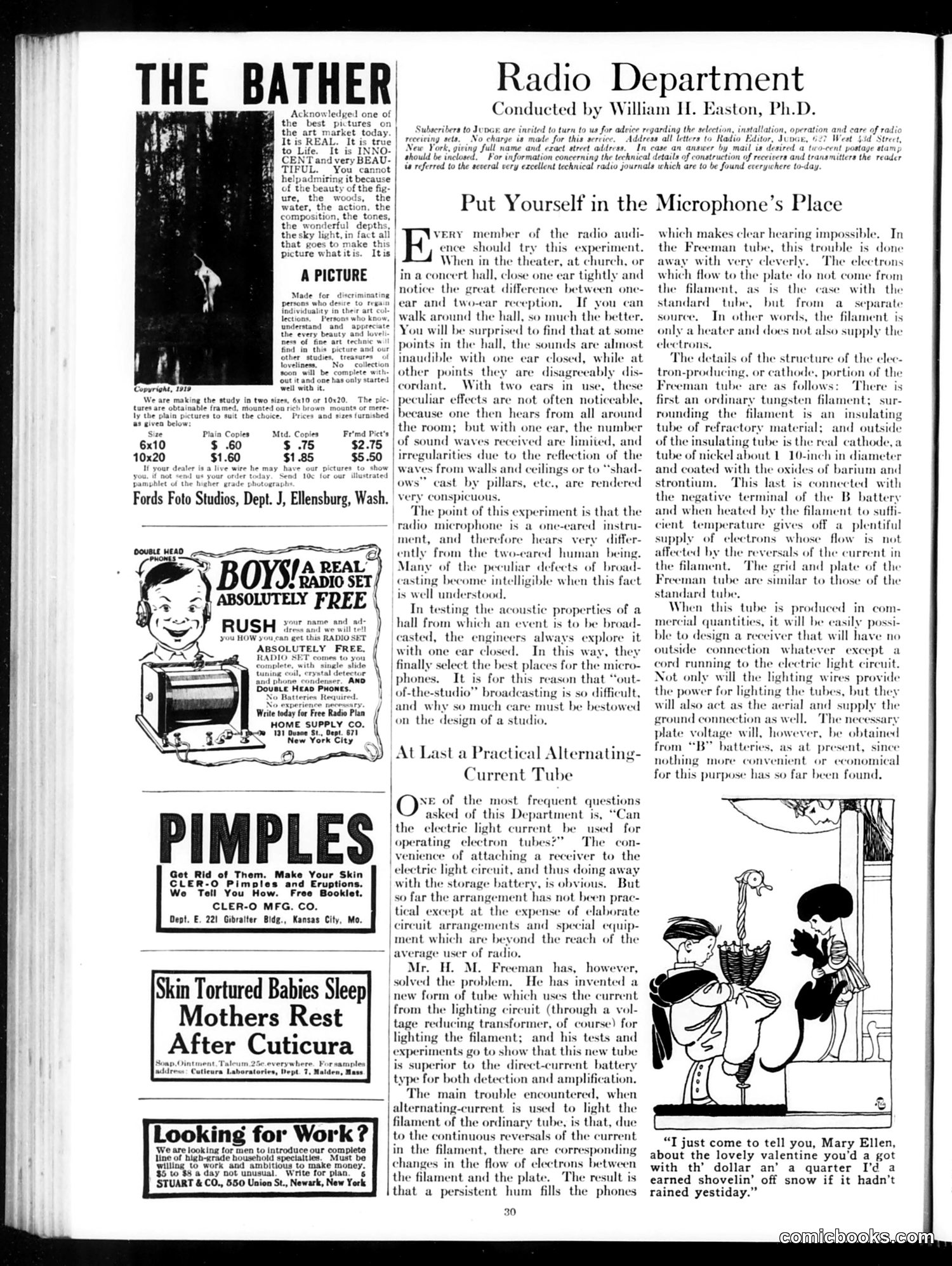
This page is primarily **technical/educational** rather than satirical. It features a Radio Department column by William H. Easton, Ph.D., explaining early radio science to a general audience. The main article, "Put Yourself in the Microphone's Place," describes an acoustic experiment: comparing one-eared versus two-eared hearing to demonstrate why radio microphones (which operate like single ears) produce inferior sound quality compared to human hearing. This explains to readers why early radio broadcasts sounded distorted—the microphone couldn't capture spatial sound the way two human ears could. A secondary article addresses practical radio technology: making alternating-current tubes viable for powering radios without storage batteries, a convenience that hadn't yet been achieved. The page also contains vintage advertisements (pimple cream, radio kits, job solicitation), typical of early-20th-century magazine padding. **No political satire is present.** This is a straightforward technical education piece aimed at radio enthusiasts and curious readers during the early wireless era.
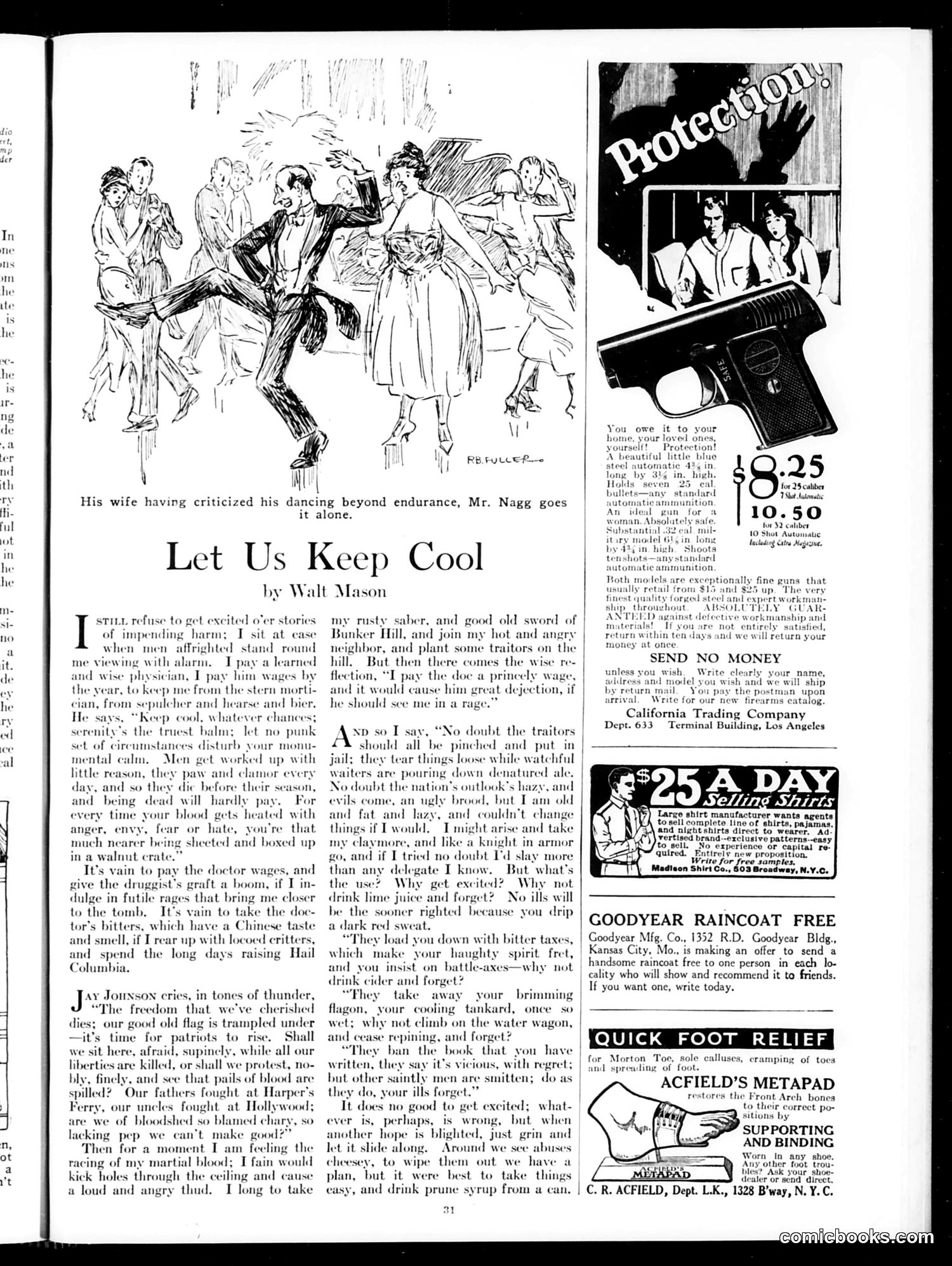
This page features Walt Mason's poem satirizing American response to social and political turmoil, likely from the World War I era. The cartoon shows "Mr. Nagg" dancing alone after his wife criticizes him—a visual metaphor for the poem's central argument. Mason's satire mocks those who express outrage about national problems (traitors, taxation, censorship) yet do nothing. He presents a cynical "keep cool" philosophy: stay calm, don't get excited, accept injustice passively. The repeated refrain suggests drinking to forget troubles rather than addressing them. The poem ridicules this passivity as cowardly, contrasting it with patriotic forebears who fought at Harper's Ferry and other conflicts. Mason critiques both the angry blusterers AND those who counsel apathetic acceptance—exposing the paralysis of American civic life during this turbulent period. The surrounding advertisements (firearms, raincoats, foot relief) are typical period commercial clutter.
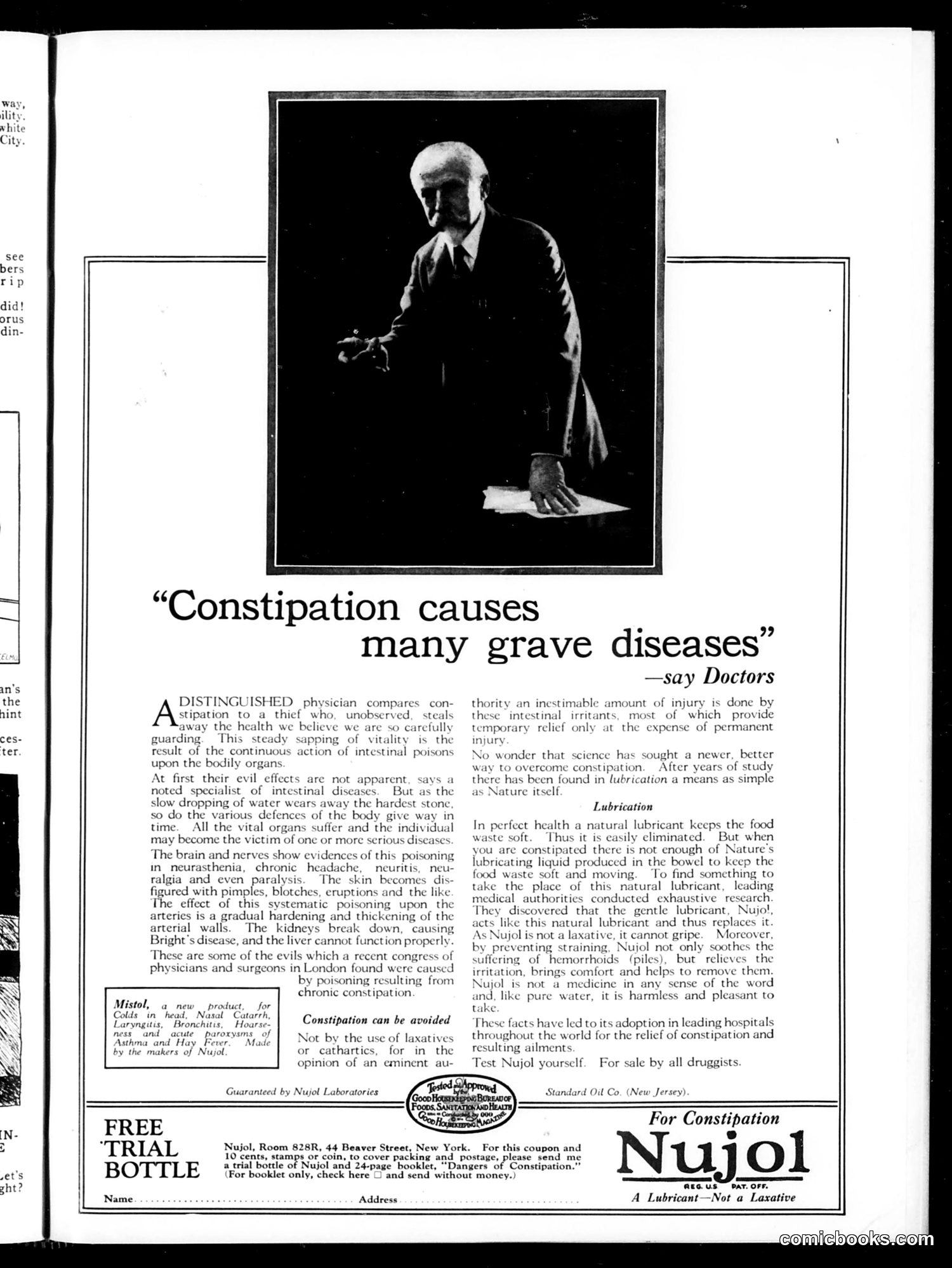
This is a **full-page advertisement for Nujol**, a mineral oil laxative product made by Standard Oil Company. The content masquerades as medical journalism but is fundamentally a marketing piece. The central image shows a distinguished-looking physician in formal attire, appearing to deliver authoritative medical guidance. The ad claims that prominent doctors warn constipation causes serious diseases—neurasthenia, paralysis, skin eruptions, hardened arteries, and kidney failure. **The satire/pitch**: The ad argues that harsh laxatives and cathartics cause more harm than good. Instead, Nujol offers "lubrication"—positioning mineral oil as a gentle, natural solution mimicking the body's own lubricating mechanisms. **Modern context we'd miss**: This reflects early 20th-century medical anxiety about constipation as a supposed root cause of numerous ailments (a common belief then). The advertisement's pseudoscientific tone and appeal to unnamed "doctors" and "medical authorities" was typical of patent medicine marketing before FDA regulations and advertising standards. The free trial coupon at bottom was standard practice for building consumer adoption of proprietary products.
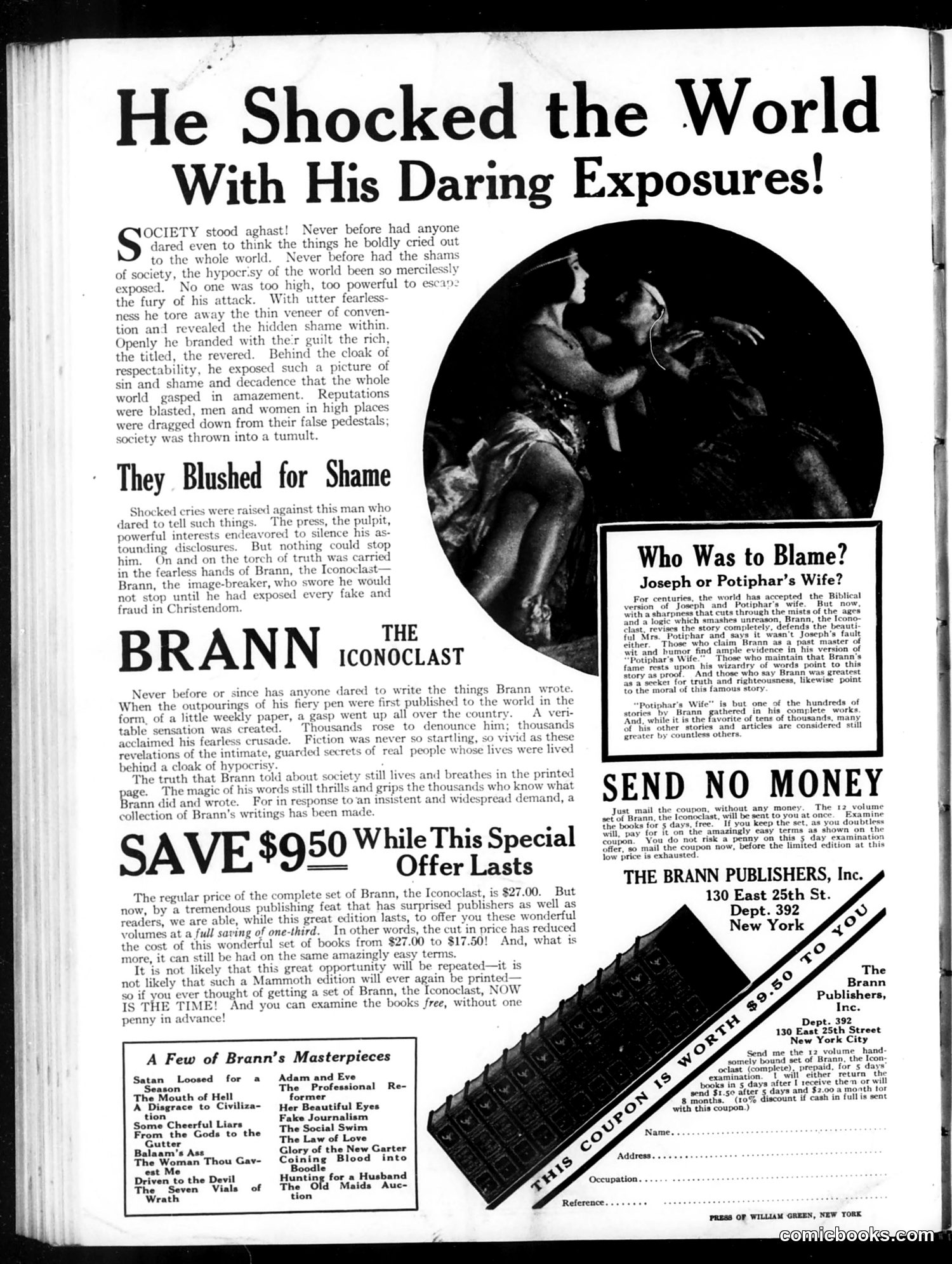
This page advertises a collected edition of writings by **Brann, the Iconoclast**, a real figure (William Cowper Brann, 1855-1905) known for his sensationalist weekly newspaper attacking social hypocrisy, religious fraud, and powerful institutions. The advertisement uses hyperbolic language—"shocked the world," "daring exposures"—to market Brann as a fearless truth-teller who exposed corruption among the wealthy and titled classes. The rhetoric frames him as persecuted by "the press, the pulpit, powerful interests" for his attacks. The page includes a sidebar about one of Brann's pieces, "Potiphar's Wife," suggesting Brann reexamined biblical narratives to challenge conventional morality and established interpretations. This is primarily **advertising copy** rather than satire—*Judge* is promoting a discounted collected edition ($17.50, down from $27.00) as an opportunity unlikely to be repeated. The "daring" persona was apparently marketable to readers interested in muckraking social criticism.