
Judge, 1923-02-10 · page 32 of 36
Judge — February 10, 1923 — page 32: what you’re looking at
What you’re looking at
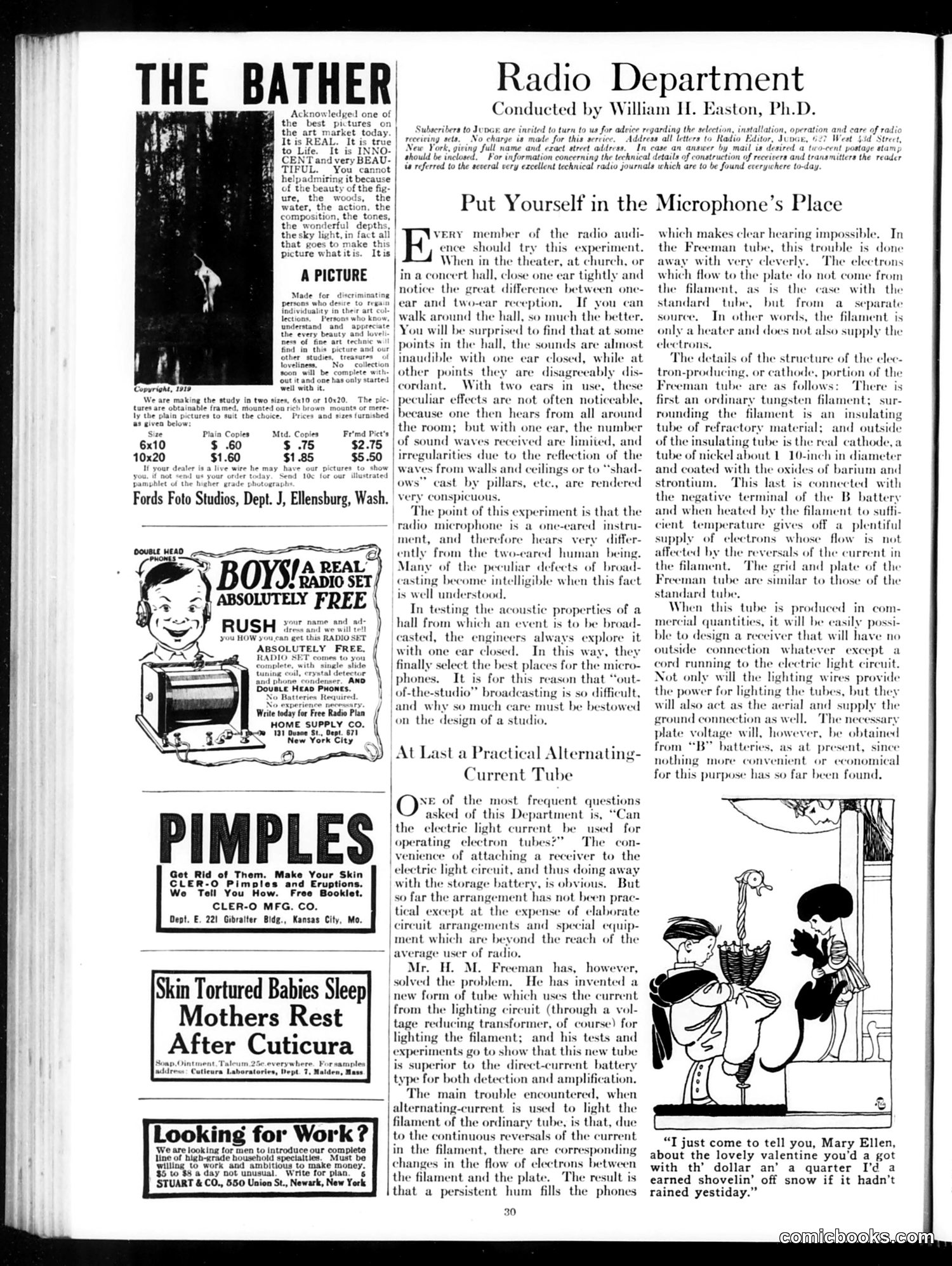
This page is primarily **technical/educational** rather than satirical. It features a Radio Department column by William H. Easton, Ph.D., explaining early radio science to a general audience. The main article, "Put Yourself in the Microphone's Place," describes an acoustic experiment: comparing one-eared versus two-eared hearing to demonstrate why radio microphones (which operate like single ears) produce inferior sound quality compared to human hearing. This explains to readers why early radio broadcasts sounded distorted—the microphone couldn't capture spatial sound the way two human ears could. A secondary article addresses practical radio technology: making alternating-current tubes viable for powering radios without storage batteries, a convenience that hadn't yet been achieved. The page also contains vintage advertisements (pimple cream, radio kits, job solicitation), typical of early-20th-century magazine padding. **No political satire is present.** This is a straightforward technical education piece aimed at radio enthusiasts and curious readers during the early wireless era.
📄 Transcribed text from this page (OCR, searchable)
Machine-transcribed from the original scan — historical spelling and the odd misread are preserved.
THE BA " 4 Acknowledged one of the best pictures | ¢ and love tectinie w ure and 6 Copyright, 1919 ‘well with it We are making the study in two sizes, 6x10 or 10x20. tures are obtainable framed, mounted brown mounts of m ly the plain pictures to suit the ch ‘and sizes furnis a3 given below 6x10 10x20 1 your de Mtd. Copies $ .75 Fr'md Pict’ $2.75 $8.50 Plain Copies Fords F Foto Studios, Dept. ‘I, Ellensburg, Wash. oust ee ¢ y BO RUSH i cers tht RADIO SET No ext Fy Write today for Free Radio Plan // HOME SUPPLY co. | 121 Dusoe St, Dept. 671 New York City THER n de for this servic and ezact atreet address Put Yourself in the verY member of the radio audi- ence should try this experiment. When in the theater, at church, or concert hall, close one ear tightly and ice the great aulte srence between one- If you can You will be surprised to find that at some points in the hall, the sounds are almost inaudible with one ear closed, while at other points they are disagreeably dis- cordant. With two ears in use, these ur effects are not often noticeable, i|because one then hears from all around the room; but with one ear, the number of sound waves received are limited, and irregularities due to the reflection of the +s from walls and ceilings or to “shad- vast. by pillars, ete., are rendered very conspicuous. The point of this experiment is that the radio microphone is a one-eared instru- ment, and therefore hears very differ- ently from the two-eared human being Many of the peculiar defects of broad- casting become intelligible when this fact is well unders In testing the acoustic properties of hall from which an event is to be bre casted, the engincers always explore it they ‘lect the best places for the micro- It is for this reason that “out- he-studio” broadcasting is so difficult, and why so much care must be bestowed on the design of a studio. use ows” ¢ At Last a Practical Alternating- Current Tube oe. Rid of Them. Make Your Skin R-O Pimples and Eruptions. Wor Tell You How. Free Booklet. CLER-O MFG. CO. Dept. E. 221 Gibralter Bidg., Kansas City, Mo. Mothers Rest . After Cuticura Oe of the most frequent questions Oe of this Department is, “Can | the electric light current be used for operating electron tubes?” The con- venience of attaching a receiver to the ‘electric light circuit, and thus doing away with the storage battery, But so far the arrangement has not been prac- is obvious. ait arvanacmienta: afi special equip- it which are beyond the reach of the rage user of radio. Mr. H. M. Freeman has, however, solved the problem. He has invented a new form of tube which uses the current |from the lighting circuit (through a vol- tage reducing transformer, of course) for \lighting the filament; and his tests and experiments go to show that this new tube is superior to the direct-current battery | type for both detection and amplification. | The main trouble encountered, when Looking for Work? ‘We are looking for men to Introduce our complete line of high-grade household specialties. Must be willing to work and ambitious to make money. $5 to $8 a day not unusual. Write for plan. § STUART & CO., 550 Union St., Newark, New York alternating-current is used to light the filament of the ordinary tube, is that, due | to the continuous reversals of the current jin the filament, there are corresponding changes in the flow of electrons between the filament and the plate. The result is that a persistent hum fills the phones 30 Radio Department Conducted by William IH. Easton, Ph.D. ited to turn to us for adeice regarding th Address all letters to In case an answer by mail is desi mation concerning the technical details of conatructi a referred to the acceral very excellent technical radio journals which are to be found ecerywhere to-day. Place which makes clear hearing impossible. Tn the Freeman tube, this trouble is done away with very cleverly. The electrons which flow to the plate do not come from the filament, is t ase with the standard tube, but from a separate source. In other words, the filament is only a heater and does not also supply the Microphone’s electrons. The details of the structure of the elec- tron-producing, or cathode, portion of the Freeman tube are as follows: There first an ordinary tungsten filament; sur- rounding the filament insulating tube of refractory materi nd culsile of the insulating tube is the real athode, a tube of nickel about L 10-inch in diame’ tor and coated with the oxides of ium and strontium. This last is connected with the negative terminal of the B battery and when heated by the filament to suffi- cient’ temperature gives off a_ plentiful supply of electrons whose flow is not affected by the reversals of the current in the filament. The grid and plate of the Freeman tube are similar to those of the standard tube, When this tube mercial quantities, is an is produced in com- it will be easily possi- ble to design a receiver that will have no outside connection whatever except a cord running to the electric light circuit. Not only will the lighting wires provide the power for lighting the tubes, but they will also act as the aerial and supply the ground connection as well. The necessary plate voltage will, however, be obtained from “B” batteries, at present, since nothing more convenient or economical for this purpose has so far been found. “TI just come to tell you, Mary Ellen, about the lovely valentine you'd a got with th’ dollar an’ a quarter I'd a earned shovelin’ off snow if it hadn't rained yestiday.”