
Judge, 1923-02-10 · page 21 of 36
Judge — February 10, 1923 — page 21: what you’re looking at
What you’re looking at
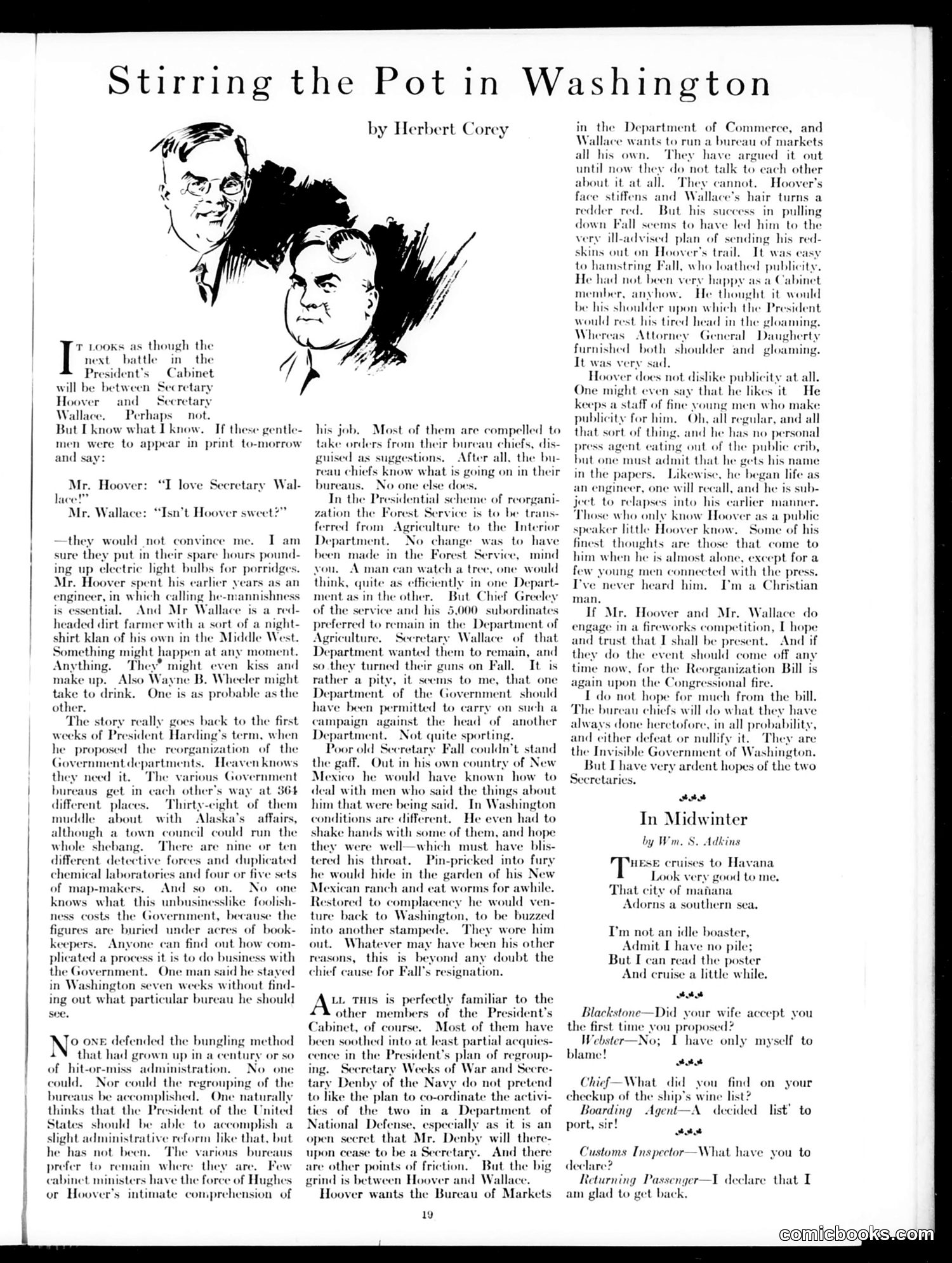
This article by Herbert Corey satirizes internal conflict within President Harding's Cabinet, specifically between **Secretary of Commerce Herbert Hoover** and **Secretary of Agriculture Henry Wallace** (depicted in the two caricatures). The piece concerns a Harding administration reorganization plan to transfer the Forest Service from Agriculture to Interior. Wallace and Forest Service Chief Greeley opposed this move, effectively campaigning against **Secretary of the Interior Albert Fall** (who would later face scandal). Corey mocks the petty bureaucratic infighting—claiming Hoover and Wallace publicly praise each other despite obvious mutual dislike, comparing their feud to unlikely scenarios like prohibitionist Wayne Wheeler drinking. The satire targets both the chaos of overlapping government departments and the Cabinet members' inability to resolve disputes professionally. Corey portrays Fall as emotionally fragile, retreating to his New Mexico ranch rather than handling the "pin-pricks" of Washington politics. The broader joke: even the President cannot reorganize the government because entrenched bureaucrats and ambitious Cabinet members obstruct reform.
📄 Transcribed text from this page (OCR, searchable)
Machine-transcribed from the original scan — historical spelling and the odd misread are preserved.
Stirring the Pot in Washington T Looks as though the next tle in’ the President's Cabinet will be between Secretary Hoover and — Secretary Wallace. Perhaps not. But I know what I know. If these gentle- men were to appear in print to-morrow and say: Mr. *T love Secretary Wal- pe lace! Mr. Wallace: Hoover: “Isn't Hoover sweet?” they would not convince me. Tam sure they put in their spare hours pound- ing up electric light bulbs for porridges. Mr. Hoover spent his earlier years as an engineer, in which calling he-mannishness is essential. And Mr Wallace is a red- headed dirt farmer with a sort of a night- shirt klan of his own in the Middle West. Something might happen at any moment. Anything. They might e ss and make up. Also Wayne B. Wheeler might take to drink. One is as probable as the other. The story really goes back to the first weeks of President Harding’s term, when he proposed the reorganization of the Governmentdepartments. Heaven knows they need it. The various Government bureaus get in cach other's way at 364 different places. Thirty-eight ‘of them muddle about) with Alaska’s affairs, although a town council could run the whole shebang. There are nine or ten different detective forces and duplic chemical laboratories and four or fi of map-makers. And so on. No one knows what this unbusinesslike foolish- ness costs the Government, because the figures are buried under of book- keepers. Anyone can find out how com- plicated a process it is to do business with the Government. One man said he stayed in Washington seven weeks without find- ing out what particular bureau he should see. N°? ONE defended the bungling method 4° that had grown up ina century or so of hit-or-miss administration, could. bu No one Nor could the regrouping of the aus be accomplished. One naturally nks that the President of the United States should be able to accomplish a slight administrative reform like that, but he has not been, The various: bureaus prefer (o ‘reniain: wliere ‘iliey cabinet ministers have the for or Hoover's intimate comprehension of } by Herbert Corey his job. Most of them are compelled to take orders from their bureau chiefs, dis- guised as suggestions. After all, the bu- reau chiefs know what is going on in their bureaus. No one else does. In the Presidential scheme of reorgani- zation the Forest Service is to be trans- ferred from Agriculture to the Interior Departmer No change was to have been made in the Forest Service, mind you. A man can watch a tree, one would think, quite as efficiently in one Depart- ment as in the other. But Chief Gree of the service and his 5,000. subordinates preferred to remain in the Department of Agriculture. Secretary Wallace of that Department wanted them to remain, and so they turned their guns on Fall. It is rather a pity, it scems to me, that one Department. of the Government. should have been permitted to carry on such a campaign against the head of another Department. Not quite sporting. Poor old Secretary Fall couldn't stand the gaff. Out in his own country of New Mexico he would have known how to deal with men who said the things about him that were being said. In Washington conditions are different. He even had to shake hands with some of them, and hope they were well—which must have blis- tered his throat. Pin-pricked into fury he would hide in the garden of his New Mexican ranch and eat worms for awhile. Restored to complacency he would ven- ture back to Washington, to be buzzed into another stampede. They wore him out. Whatever may have been his other reasons, this is bey Joubt. the chief cause for Fall's resignation. L Tis is perfectly familiar to the A‘ President's other members of the Cabinet, of course. Most of them have been soothed into at acquies- cence in the President's plan of regroup- ing. Secretary Weeks of War and Secre- tary Denby of the Navy do not pretend to like the plan to co-ordinate the activi- ties of the two in a Dei of National Defense, es open secret that Mr, Denby will ther upon cease to be a Secretary. And there are other points of friction. But the big grind is between Hoover and Wall: Hoover wants the Bureau of 19 in the Department of Commerce, and Wallace wants to run a bureau of markets all his own. They have argued it out until now they do not talk to each other about it at all. They cannot. Hoover's face stiffens and Wallace’s hair turns a redder red. But his success in pulling down Fall seems to have led him to the very ill-advised plan of sending his re skins out on Hoover's trail. It was to hamstring Fall, who loathed publicity. He had not been very happy asa Cabinet member, anyhow. He thought it would be his shoulder upon which the President would rest his tired head in the gloamin Whereas Attorney General Daugherty furnished both shoulder and gloaming. It was very sad. Hoover does not dislike publicity at all. One might even say that he likes it He keeps a staff of fine young men who make publicity for him. Oh, all regular, and all that sort of thing, and he has no personal press agent eating out of the publi erib, but one must admit that he gets his name in the papers. Likewise, he began life as an engineer, one will recall, and he is sub- to relapses into his earlier manner. Those who only know Hoover as a public speaker little Hoover know. Some of his finest thoughts are those that come to him when he is almost alone, except for a few young men connected with the press. I've never heard him. I'm a Christian man, If Mr. Hoover and Mr. Wallace do engage in a fireworks competition, I hope and trust that I shall be present. And if they do the event should come off any time now, for the Reorganization Bill is again upon the Congressional fire. I do not hope for much from the bill. The bureau chiefs will do what the: s done heretofore, in all prot and cither defeat or nullify it. 7 the Invisible Government of Washington. But I have very ardent hopes of the two Secretaries. sae In Midwinter by Wm. S. Adkins HESE cruises to Havana Look very good to me. That city of manana Adorns a southern sea. I'm not an idle boaster, Admit I have no pile; But I can read the poster And cruise a little while. ry Blackstone—Did your wife accept you the first time vou proposed? Webster—No; 1 have only myself to ania! blame! ois Chief —What did you find on your checkup of the ship's wine list? Boarding Agent—A_ decided list’ to port, sir! rm Customs Inspector—What have you to declare? Returning Passenger—1 declare that I am glad to get back.