
Judge, 1923-02-10 · page 5 of 36
Judge — February 10, 1923 — page 5: what you’re looking at
What you’re looking at
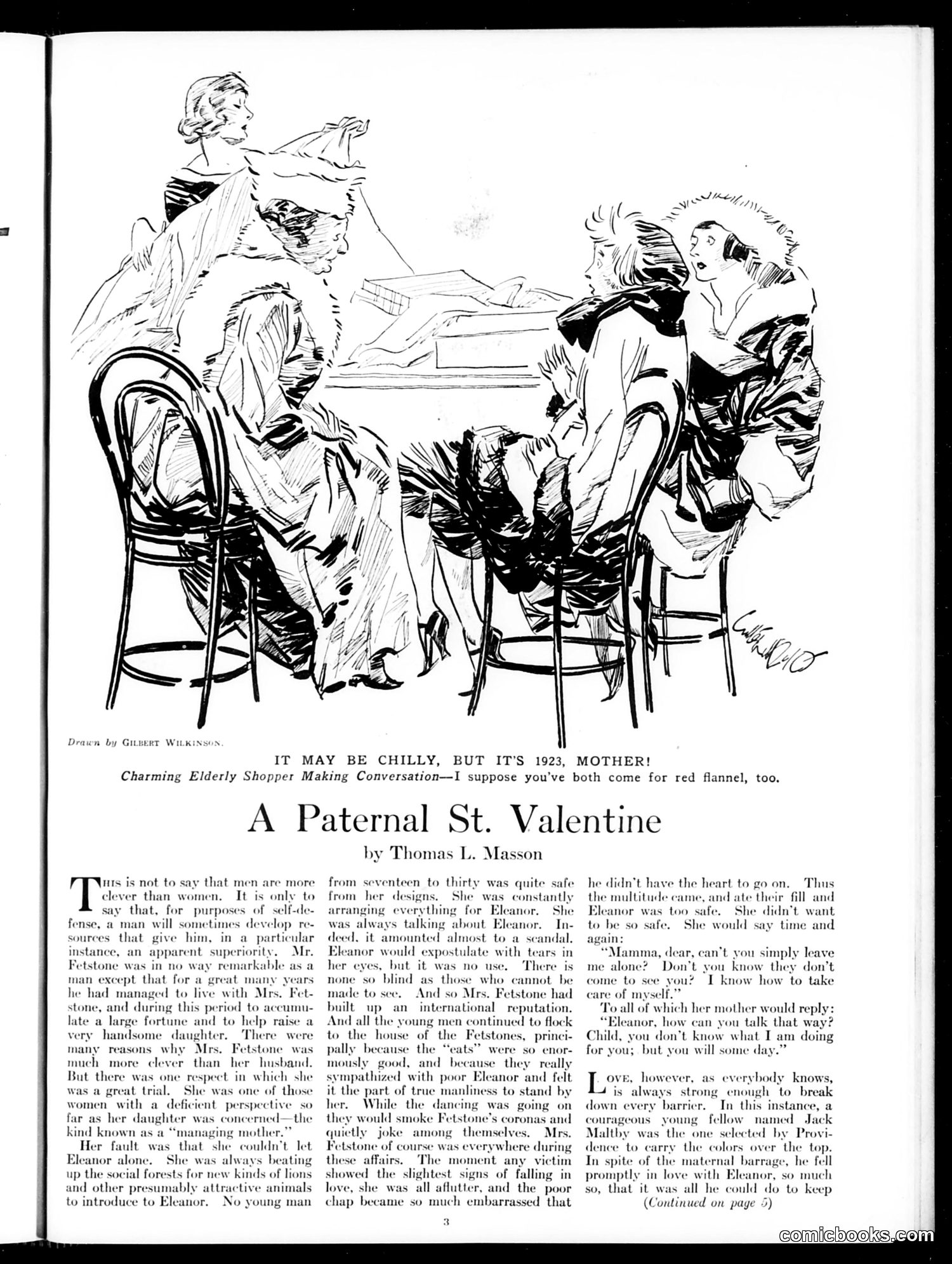
This 1923 Judge magazine story, illustrated by Gilbert Wilkinson, satirizes elderly courtship and parental disapproval. The cartoon caption depicts a mother interrupting an "elderly shopper making conversation," sarcastically noting both visitors came for red flannel, suggesting practical rather than romantic intentions. The accompanying short story mocks a wealthy man (Mr. Felstone) whose late-life romantic pursuits embarrass his adult daughter Eleanor. The satire targets the incongruity of aging men pursuing romance, which society considers undignified. The "St. Valentine" reference frames this as absurd romantic behavior in an older gentleman. The piece humorously explores class anxieties and generational conflict around propriety, wealth, and age-appropriate conduct in the 1920s, when such romantic pursuits by elderly men were deemed particularly ridiculous and socially inappropriate.
📄 Transcribed text from this page (OCR, searchable)
Machine-transcribed from the original scan — historical spelling and the odd misread are preserved.
Drawn by GILBERT WILKINSON IT MAY BE CHILLY, BUT IT’S 1923, MOTHER! Charming Elderly Shopper Making Conversation—I suppose you've both come for red flannel, too, A Paternal St. Valentine urs is not to say that men are more clever than women, It mly to say that, for purposes of self-de- fense, a man will sometimes develop re- sourees that give him, in a particular 1 apparent superiority. Mr. was in no way remarkable as a ot that for at many 3 d managed to live with Mrs. Fet- nd during this period to aecumu- arge fortune and to help raise handsome daughter. There were any reasons why Mrs. Fetstone was much more clever than her husband. But there was one respect in which she was a great trial. 1e was one of those women with a deficient perspective so far as her daughter was concerned—the kind known as a “managing mother.” Her fault that couldn't let Eleanor alone. She was always beating up the social forests for new kinds of lions and other presumably attractive animals to introduce to Eleanor. No young man instaned Fetsti man ¢ she by Thomas L. Masson from seventeen to thirty was quite safe from her designs, arranging everything for was always talking @ deed, it amounted almost. tc ‘d Eleanor would expostulate with te her . but it was no use. none so blind as those who cannot be made to see. And so Mrs. Fetstone had built up an_ international reputation, And all the young men continued to flock to the house of the Fetstones, princi- pally because the “eats” were so enor- mously good, and because they real sympathized with pov ror and felt it the part of true manliness to stand by her. While the dancing was going on they would smoke Fetstone’s coronas and quietly joke among themselves. Mrs. Fetstone of course was everywhere during these affairs. The moment any victim showed the slightest signs of falling in love, she was all aflutter, and the poor chap became so much embarrassed that 3 the heart to goon. Thus id ate their fill and She didn’t: want She would say time and he didn’t ha to be so si again: “Mamma, dear, can’t you simply leave me alone? Don’t you know they don’t come to s¢ 1? I know how to take care of my ‘To all of which her mother would reply: . or, how can you talk that wa Chile you don’t know what I am doing for you; but you will some day.” 3, however, as everybody knows Iways strong cnough to br down every barrier. In this instar courageous young. fellow named Jack Maltby was the one selected by Provi- dence to carry the colors over the top. In spite of the maternal barrage, he fell promptly in love with Eleanor, so much so, that it was all he could do to keep (Continued on page 5) comichooks com