
Judge, 1923-02-10 · page 7 of 36
Judge — February 10, 1923 — page 7: what you’re looking at
What you’re looking at
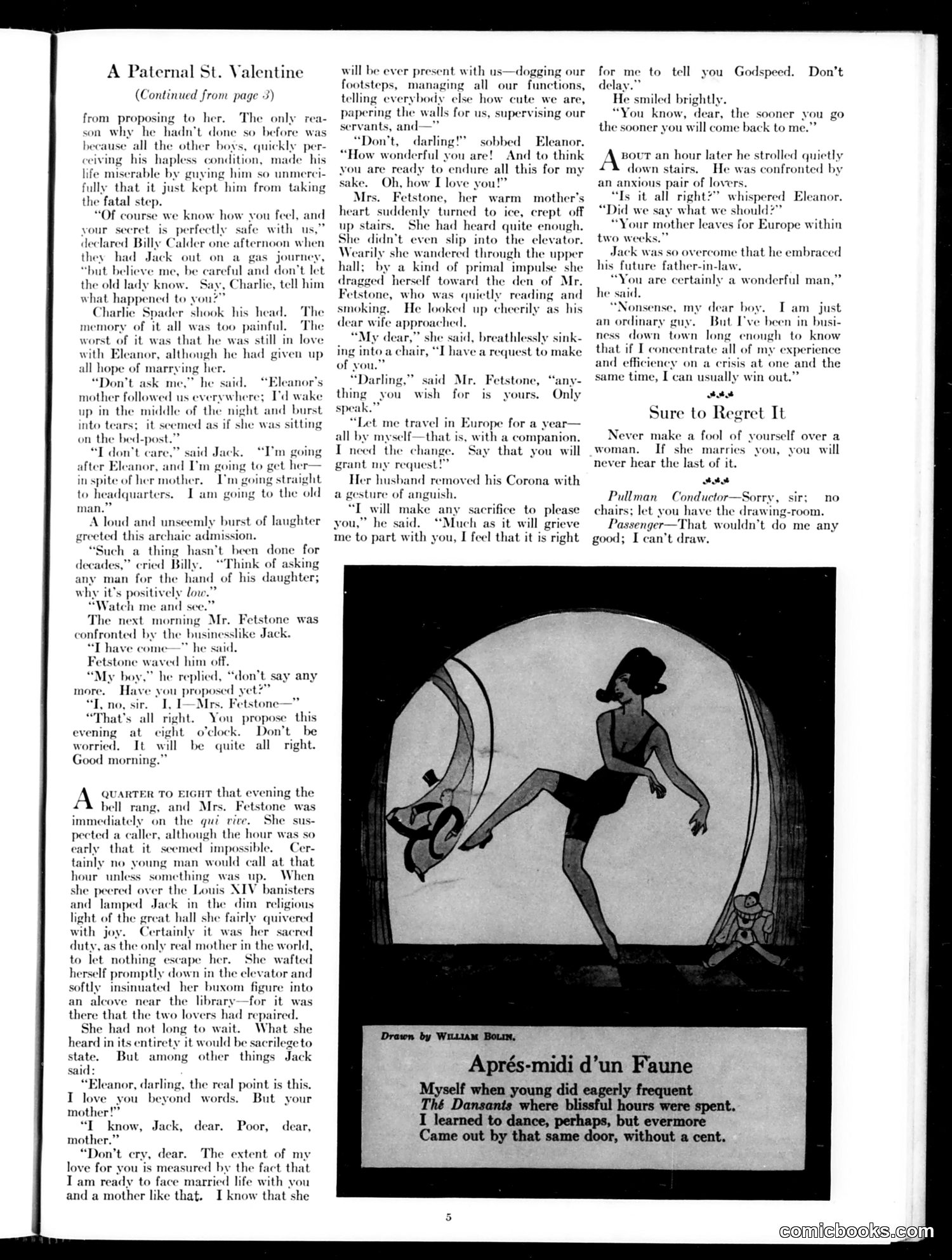
This is a romantic comedy story (not primarily a political cartoon) about a young man named Jack proposing to Eleanor despite her overbearing mother, Mrs. Fetstone. **The satire targets:** Intrusive, hovering mothers of the era who micromanaged their adult daughters' lives and relationships. Mrs. Fetstone eavesdrops on the couple, controls their social life, and meddles constantly. **The joke's point:** Jack's declaration of love includes admitting he'll endure "a mother like that"—describing how she'll supervise everything. Rather than being offended, Eleanor is moved by his willingness to tolerate her mother's interference. However, overhearing this unflattering description, Mrs. Fetstone is horrified and immediately demands a European vacation alone—implying she'll escape to avoid confronting her own meddling behavior. **The illustration** (titled "Après-midi d'une Faune") shows a couple dancing, presumably Eleanor and Jack, representing youthful romance contrasted with maternal interference. The humor reflects early 20th-century anxieties about maternal control in courtship.
📄 Transcribed text from this page (OCR, searchable)
Machine-transcribed from the original scan — historical spelling and the odd misread are preserved.
A Paternal St. Valentine (Continued from page 3) from proposing to her. The only res son why he hadn’t done so before w because all the other boys, quickly per- ceiving his hapless ition, made his life miserable by guying him so unmerei- fully that it just kept him from taking the fatal step. “Of course we know how you feel, and your secret is perfectly safe with us,” declared Billy Calder one afternoon when they had Jack out on a gas j “but believe me, be careful and d the old lady know. Say, Charlie, tell him what happened to you?” Charlie Spader shook his head. The memory of it all was too painful. The worst of it was that he was still in love with Eleanor, although he had given up all hope of marrying her. “Don't ask me,” he said. mother followed us everywhere; up in the middle of the night and burst into tears; it seemed as if she was sitting on the bed-post.” “T don’t care,” said Jack. “I'm going after Eleanor, and I'm going to get her— in spite of her mother. I'm going str to headquarters. I am going to the old man, A loud and unseemly burst of laughter greeted this archaic admission. Such a thing hasn't been done for decades,” cried Billy. “Think of asking any man for the dof his daughter; why it’s positively low “Watch me and see.” The next morning Mr. Fetstone was confronted by the businesslike Jack. “T have come—" he said. Fetstone waved him off. “My boy,” he replied, “don’t say any more. Have you proposed yet?” “I, no, sir. 1, I—Mrs. Fetstone—” “That's all right. You propose this eight Don’t be will be right. o'clock evening at quite all worried. It Good morning.” QUARTER TO EIGHT that evening the LY bell rang, and Mrs. Fetstone was immediately on the qui vice. She sus- pected a caller, although the hour was so early that it) seemed impossible. Cer- tainly no young man would call at that hour unless something was up. When she peered over the Louis XIV banisters and lamped Jack in the dim religious light of the great hall she fairly quivered with joy. Certainly it was her sacred duty, as the only real mother in the world, to let nothing escape her. She wafted herself promptly down in the elevator and softly insinuated her buxom figure into an alcove near the library—for it was there that the two lovers had repaired. She had not long to wait. What she ard in its entirety it would be sacrilege to But among other things Jack SJeanor, darling, the real point is this. I love you beyond words. But your mother “I know, Jack, mother.” “Don’t cry, dear. The extent of my love for you is measured by the fact that I am ready to face married life with you and a mother like that. I know that she dear. Poor, dear, will be ever present with us—dogging our footsteps, 1 vg all our functions, telling everybody else how cute we are, papering the walls for us, supervising our servants, and—" “Don't, darling!’ sobbed — Eleanor, “How wonderful you are! And to think you are ready to endure all this for my sake. Oh, how I love you!” Mrs. Fetstone, her warm mother’s heart suddenly turned to ice, crept off up stairs. She had heard quite enough. She didn’t even slip into the elevator. Wearily she wandered through the upper hall; by a kind of primal impulse she dragged herself toward the den of Mr. Fetstone, who was quietly reading and He looked up cheerily as his 3 breathlessly sink- ing into a chair, “I have a request to make of you.” “Darling,” thing you speak.” “Let me travel in Europe for a all by myself—that is, with a companion. I need the change. Say that you will grant my request! Her husband removed his Corona with a gesture of anguish. “I will make any sacrifice to please you,” he said. “Much as it will grieve me to part with you, I feel that it is right said Mr, Fetstone, “any- wish for is yours. Only r— Drawn by WitiaM Bouin, for me to tell you Godspeed. Don’t delay.” He smiled bri; “You know, di the sooner you will come At" an hour later he strolled quietly down stairs. He was confronted by an anxious pair of lovers. “Is it all righ whispered Eleanor. “Did we say what we shoulc “Your mother leaves for Europe within two weeks.” Jack was so overcome that he embraced his future father-in-law. “You are certainly a wonderful man,” he said. “Nonsense, my dear boy. Tam just an ordinary guy. But I've been in busi- ness down town long enough to know that if I concentrate all of my experience and efficiency on a crisis at one and the same time, I can usually win out.” atly. the sooner you go vack to me.” ty Sure to Regret It Never make a fool of yourself over a woman, If she marries you, you will never hear the last of it. tae Pullman Conductor—Sorry, sir; no chairs; let you have the drawing-room. Passenger—That wouldn't do me any good; I can’t draw. Aprés-midi d’un Faune Myself when young did eagerly frequent Thé Dansants where blissful hours were spent, I learned to dance, perhaps, but evermore Came out by that same door, without a cent. comichooks.couy)