
Judge, 1923-02-10 · page 13 of 36
Judge — February 10, 1923 — page 13: what you’re looking at
What you’re looking at
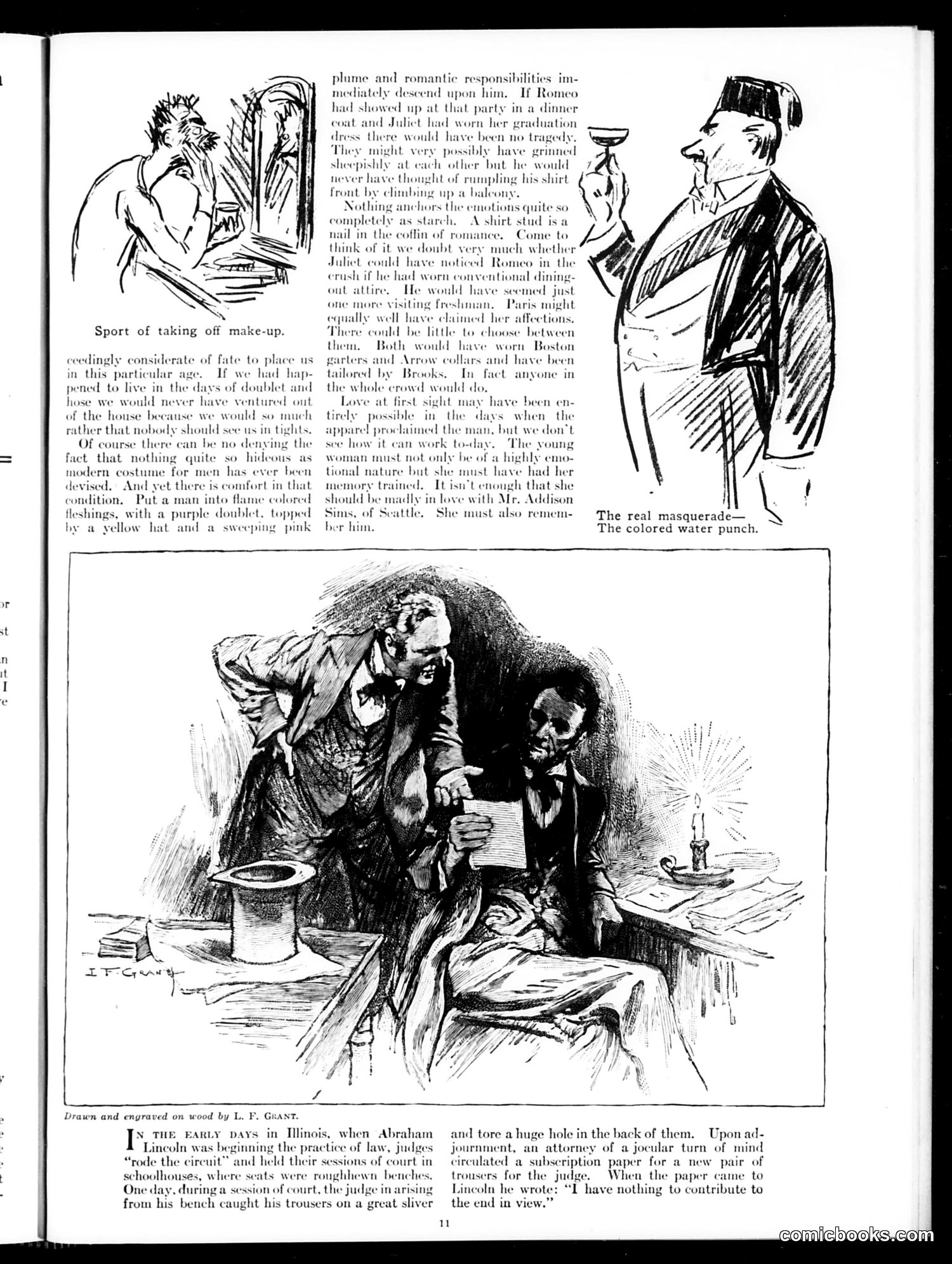
This page contains two distinct satirical pieces: **Upper cartoons:** Mockery of romantic pretense in modern dress. The text argues that standardized men's formal wear (Boston garters, Arrow collars, Brooks tailoring) makes all men indistinguishable, destroying the possibility of genuine romantic attraction. The joke: Romeo and Juliet couldn't have fallen in love today because formal dress codes eliminate individuality. "The real masquerade" caption suggests modern clothing is the true disguise. **Lower illustration:** An anecdote about young Abraham Lincoln practicing law in frontier Illinois. A judge's trousers tore badly during court; Lincoln humorously refused to contribute to a collection for replacement trousers, saying he had "nothing to contribute to the end in view"—a crude joke about the exposed tear. Both pieces satirize American social conformity and propriety: one lamenting how standardized fashion erases personality, the other celebrating frontier irreverence toward stuffy formality.
📄 Transcribed text from this page (OCR, searchable)
Machine-transcribed from the original scan — historical spelling and the odd misread are preserved.
Sport of taking off make-up. ceedingly considerate of fate to place us in this particular If we had hap- pened to live in th ys of doublet and and romantic responsibilities im- ly deseend upon him. If Romeo »ved up at that party ina dinner ind Juliet had worn her gradug there would have been no tr They n sheepishly atc: never have thought of rumpling his shirt front by climbing up a baleony. Nothing anchors the emotions quite so completely as starch. A shirt stud is a nail in the coffin of romance. Come to think of it we doubt very much whether Juliet could have noticed Romeo in the erush if he had worn conventional dining- attir He would have j + more visiting freshman. Ily well have claimed her There could be little to choose between them. Both would have worn Boston garters and Arrow collars and have been Pby Brooks. [In fact anyone in the whole crowd would do, plume mediate had s| out on One da from b furing a session of court, the judge in arising S bench caught his trousers on a great sliver the end in view.” hose we would never have ventured out Love at first sight may have been en- of the house because we would so much tirely possible in’ the days when the rather that nobody should see us in tights. apparel proclaimed the man, but we don’t Of course there can be no denying the see how it can work to-day. The young = fact that nothing quite so hideous as woman must not only be of a highly emo- modern costume for men has ever been tional nature but she must e had her devised. And yet there is comfort in that memory trained. It is ough that she condition. Put a man into flame colored should be madly in love with Mr. Addison fleshings, with a purple doublet, topped Sims, of Seattle, She must also remem- The real masquerade— by a yellow hat and a sweeping pink ber him. The colored water punch. or st n it I Drawn and engraved on wood by L. F. G&anT. I; THE EARLY Days in Illinois, when Abraham — and tore a huge hole in the back of them. Upon ad- Lincoln was beginning the practice of law, judges — journment jocular turn of mind . rode the circuit” and held their sessions of court in circulated a subscription paper for a new pair of schoolhouses, where seats were roughhewn benches, trousers for the judge. When the paper came to Lincoln he wrote: “I have nothing to contribute to