
Judge, 1923-02-10 · page 17 of 36
Judge — February 10, 1923 — page 17: what you’re looking at
What you’re looking at
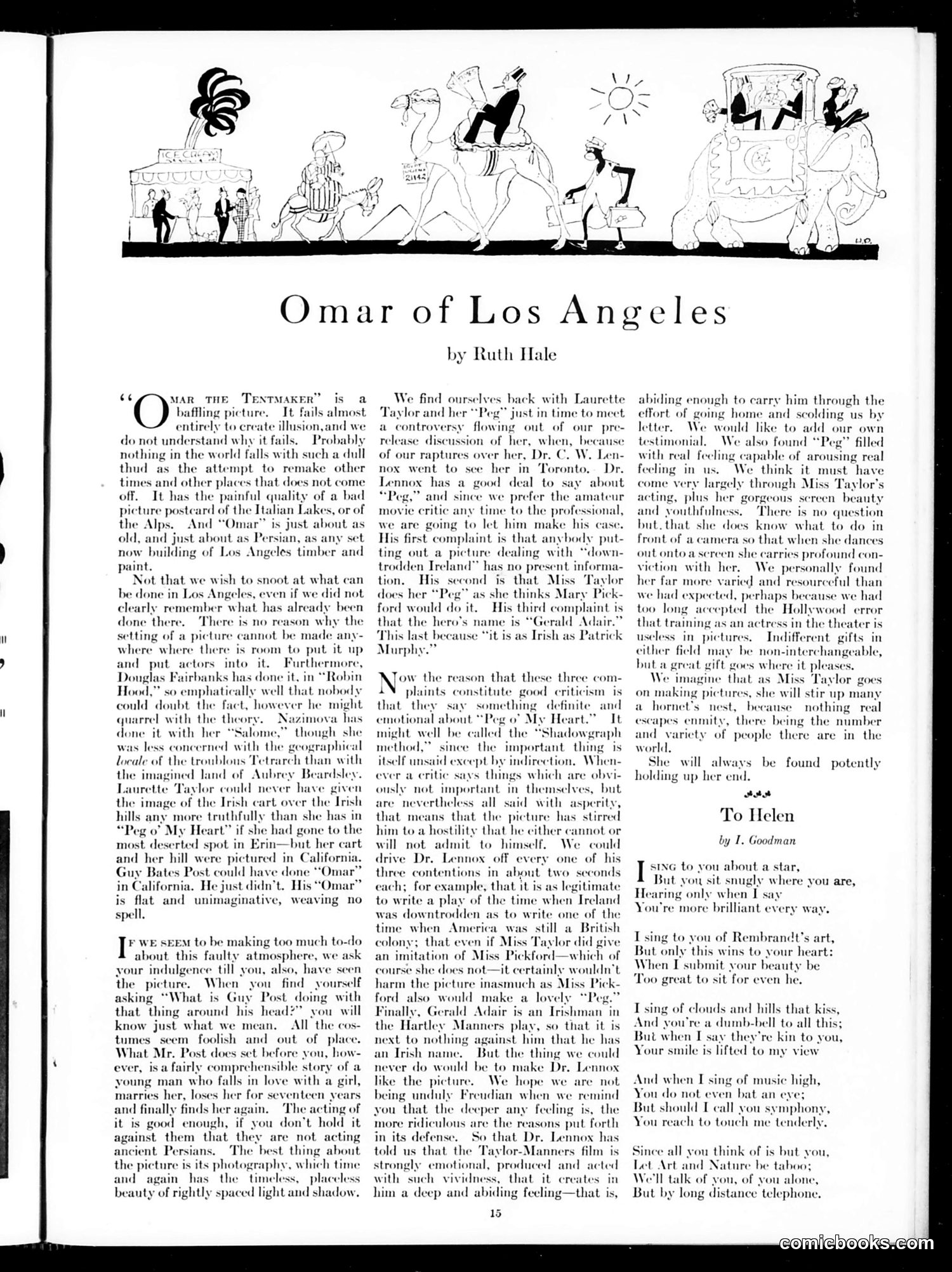
This page contains a film review of "Omar of Los Angeles" by Ruth Hale. The cartoon at the top appears to be a humorous illustration of an elaborate historical pageant or production, likely mocking the film's attempt to recreate an exotic, distant setting (ancient Persia) in contemporary Los Angeles. Hale criticizes the film for failing to create believable atmosphere—comparing it unfavorably to Douglas Fairbanks's "Robin Hood" and Laurette Taylor's "Peg o' My Heart." She argues the film's flat, uninspired execution undermines its story of a man who loses and retrieves his love after seventeen years. The secondary piece, "To Helen" by L. Goodman, appears to be poetry unrelated to the film review. The satire targets the pretentiousness of attempting ambitious historical dramas without genuine artistic vision or authentic detail—a recurring criticism of early Hollywood productions.
📄 Transcribed text from this page (OCR, searchable)
Machine-transcribed from the original scan — historical spelling and the odd misread are preserved.
Omar of Los Angeles 6s MAR THE TENTMAKER” is a baffling picture. It fails almost entirely to create illision,and we do not understand why it fails. Probably nothing in the world falls with such a dull thud as the attempt to remake other times and other places that does not come off. It has the painful quality of a bad picture posteard of the Italian Lakes, or of the Alps. And “Omar” is just about as old, and just about as Persian, as any set now building of Los Angeles timber and paint. Not that we wish to snoot at what can be done in Los Angeles, even if we did not already been is no reason why the nnot be made any- is room to put it up and put actors into it. Furthermore, Douglas Fairbanks has done it, in “Robin Hood,” so emphatically well that nobody could doubt the fact, however he mig quarrel with the the imova has done it with her though she was less concerned with the geographical locale of the troublous Tetrarch than with the imagined land of Aubrey Beardsley. tte Taylor could never have given ge of the Irish cart over the Irish There setting of a pictur where where there “Peg oY My Heart” if sh most deserted spot in and her hill were pictu y Bates Post could have done “Omar in California. He just didn’t. His “Omar” is flat and unimaginative, weaving no spell. [oe stat te be making too mu h to-do about this faulty atmosphere, we ask your indulgence till you, also, have seen the picture. When’ you find yourself asking “What is Guy Post doing with that thing around his head?” you will know just what we n ‘AI’ the cos- seem foolish and out of place. at Mr. Post does set before you, how- ever, isa fairly comprehensible story of a young man who falls in love with a girl, imarries her, loses her for seventeen years and finally finds her again. ‘The acting of it is good enough, if you don’t hold it the picture is its are apy, which time and again has the timeless, placeless beauty of rightly spaced light and shadow. by Ruth Hale hack with Laurette just in time to meet a controversy flowing out of our_ pre- release discussion of her, when, because of our raptures over her, Dr. C. W. Len- nox went to see her in Toronto. Dr. Lennox has a good deal to say about “Pog,” and since we prefer the amateur movie critic any time to the professional, we are going to let him make his ease. His first complaint is that anybody put- ting out a picture dealing with “down- trodden Ireland” has no present informa- tion, His second is that Miss ‘lor does her “Pi as she thinks Mary Pick- ford would do it. His third complaint i is that the hero’s name is “Gerald Adair. This last because “it is as Irish as Patrick Murphy.” We find ours Taylor and her * Jow the reason that these three com- AN plaints constitute good criticism. is that they say something definite and emotional about “Peg o” My Heart.” It might wel alled the “Shadowgraph method,” since the important. thing is itself unsaid except by indirection, When- ever a critic says things which are obvi- ously not important in themselves, but are nevertheless all said with asperity, that means that the picture has stirred him to a hostility that he cither cannot or will not admit to himself. We could drive Dr. Lennox off every one of his three contentions in about two seconds each; for example, that it is as legitimate to write a play of the time when Ireland was downtrodden as to write one of the time when America was still a British colony; that even if Miss Taylor did give imitation of Miss Pickford—which of course she does not—it certainly wouldn't harm the picture inasmuch as Miss Bi ick- ford also would make a lovely Finally, Gerald Adair is an aan 1 the Hartley iners play, so that it is next to nothi ainst him that he has. an Trish name. But the thing we could never do would be to make Dr. Lennox » We hope we not being unduly Freudian when we remind you that the deeper any feeling is, the ridiculous asons put forth Dr. Lennox has strongly emotional, produce and acted with such vividness, that it creates in him a deep and abiding feeling—that is, 15 igh to carry him through the ng home and scolding us by lett We would like to add our own testimonial. We also found “Peg” filled with real feeling capable of arousing real feeling in us. We think it must. h come very largely through Miss Taylor's acting, plus her gorgeous screen beauty and youthfulness. ‘There is no question it she does know what to do in t when she dances out onto 4 -arries profound con- viction with her. We personally found her far more varied and resourceful than we had expected, perhaps because we had too long accepted the Hollywood error that training as an actress in the theater is useless in pictures. Indifferent gifts. in either field may be non-interchangeable, abiding enc effort of gc imagine that as Miss ‘T on waking pictures, she will stir up many a hornet’s nest, because nothing real escapes enmity, there being the number and varicty of people there are in the world, She will always be holding up her end. found potently To Helen by I. Goodman I SING to you about a star, But you sit snugly whe ring only when I say ‘ae more brilliant every way, I sing to you of Rembrandt's art, But only this wins to your heart: When I submit your beauty be Too great to sit for even he. I sing of clouds and hills that kiss, And youre a dumb-bell to all this; But when I say they're kin to you, Your smile is lifted to my view And when I sing of musie high, You do not even bat an eye; But should I call you symphony, You reach to touch me tenderly. Since all you think of is but you, Let Art and Nature be ta We'll talk of you, of you But by long distance telephone.