
Judge, 1923-02-10 · page 11 of 36
Judge — February 10, 1923 — page 11: what you’re looking at
What you’re looking at
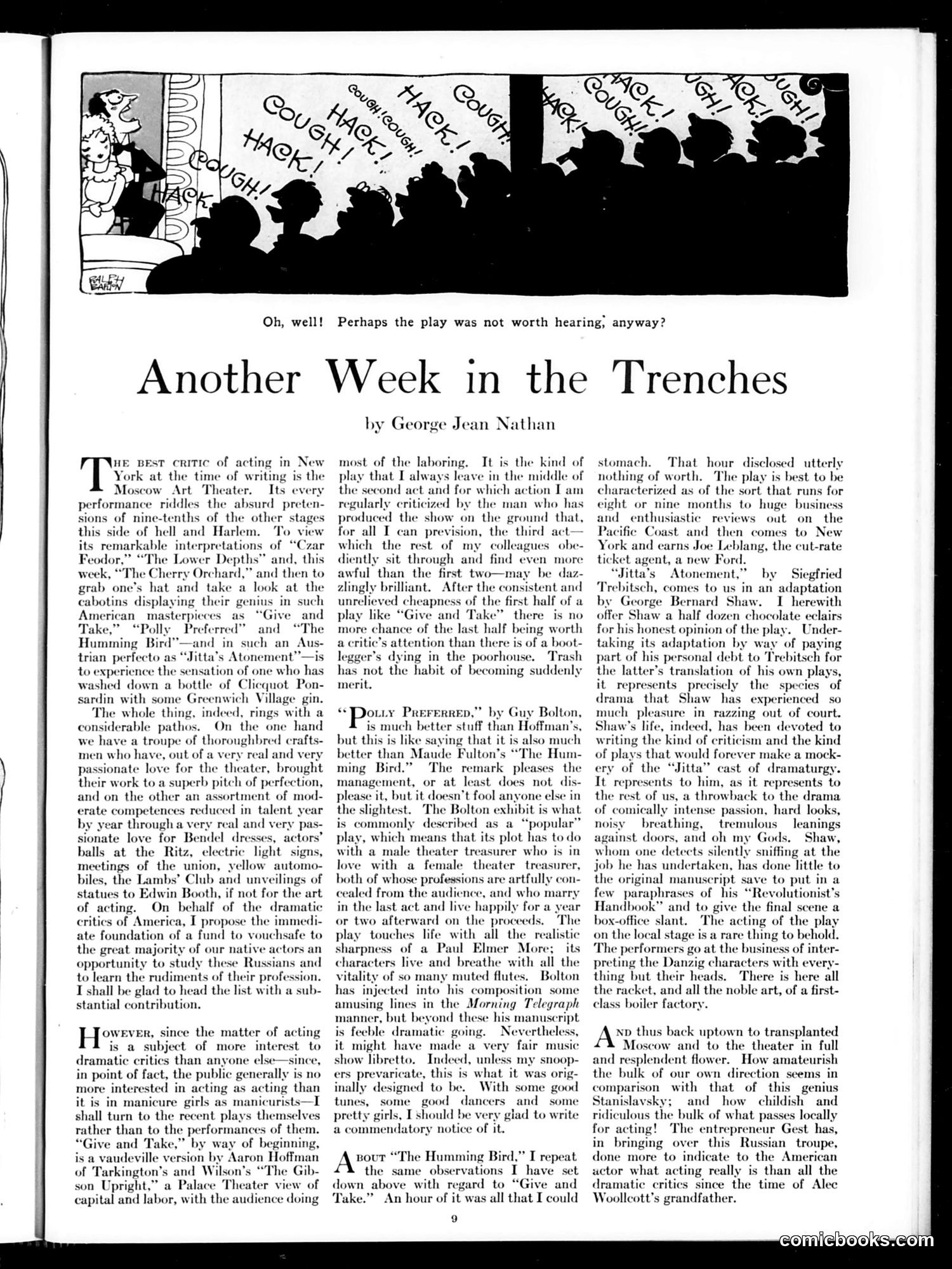
The cartoon depicts an audience in a theater viciously booing a stage performance, with silhouetted figures shouting "HACK!", "COUGH!", and "GO!" The caption reads: "Oh, well! Perhaps the play was not worth hearing, anyway?" This illustrates critic George Jean Nathan's accompanying article, which compares American theater unfavorably to the visiting Moscow Art Theater. Nathan argues that American plays like "Give and Take," "Polly Preferred," and "The Humming Bird" are artistically mediocre—mere commercial vehicles lacking the serious craftsmanship and passion of Russian productions. The cartoon satirizes both the harsh judgment of sophisticated critics and, implicitly, the poor quality of Broadway entertainment. The booing audience represents Nathan's viewpoint: that American theater deserves such contempt because it prioritizes profit and spectacle over genuine dramatic art. The silhouettes suggest this represents the collective voice of discerning theatrical observers rejecting inferior native productions.
📄 Transcribed text from this page (OCR, searchable)
Machine-transcribed from the original scan — historical spelling and the odd misread are preserved.
Oh, well! Perhaps the play was not worth hearing, anyway? Another Week in the Trenches HE BEsT critic of acting in New | York at the time of writing is the Moscow Art Theater. Its every performance riddles the absurd preten- sions of nine-tenths of the other stages this side of hell and Harlem. To view its remarkable interpretations of “Czar Feodor,” “The Lower Depths” and, this week, “The Cherry Orchard,” and then to grab one’s hat and take a look at the cabotins displaying their genius in such American masterpieces as “Give and Take,” “Polly Preferred” and “The Humming Bird”—and in such an Aus- trian perfecto as “Jitta’s Atonement”—is to experience the sensation of one who has washed down a bottle of Clicquot Pon- sardin with some Greenwich Village gin. The whole thing, indeed, rings with a considerable pathos. On the one hand we have a troupe of thoroughbred crafts- men who have, out of a very real and very passionate love for the theater, brought their work to a superb pitch of perfection, and on the other an assortment of mod- erate competences reduced in talent y by year through a very real and sionate love for Bendel dresses, actors’ balls at the Ritz, electric light signs, meetings of the union, yellow automo- biles, the Lambs’ Club and unveilings of statues to Edwin Booth, if not for the art of acting. On behalf of the dramatic critics of America, I propose the immedi- ate foundation of a fund to vouchsafe to the great majority of our native actors an opportunity to study these Russians and to learn the rudiments of their profession. I shall be glad to head the list with a sub- stantial contribution. He since the matter of acting is a subject of more interest to dramatic critics than anyone else—since, in point of fact, the public generally is no more interested in acting as acting than it is in manicure girls as manicurists—I Il turn to the recent plays themselves her than to the performances of them. Take,” by way of beginning, ille version by Aaron Hoffman rkington’s and Wilson’s “The Gib- son Upright,” a Palace Theater view of capital and labor, with the audience doing by George Jean Nathan most of the laboring. It is the kind of ay that I always leave in the middle of and for which action I am f d by the man who has produced the show on the ground that, for all I can prevision, the third act which the rest of my colleagues obe- diently sit through and find even mo awful than the first two—may be « zlingly brilliant. After the consistent and unrelieved cheapness of the first half of a play like “Give and Take” there is no more chance of the last half being worth acritic’s attention than there is of a boot- legger’s dying in the poorhouse. Trash has not the habit of becoming suddenly merit. “Pour Prererrep,” by Guy Bolton, is much better stuff than Hoffman's, but this is like saying that it is also much better than Maude Fulton’s “The Hum- ming Bird.” The remark pleases the management, or at least does not dis- please it, but it doesn’t fool anyone else in the slightest. The Bolton exhibit is what is commonly described as a “popular” play, which means that its plot has todo with a male theater treasurer who is in love with a female theater treasurer, cealed from the audien¢ in the last act and liv or two afterward on the proceeds. play touches life with all the. realistic sharpness of a Paul Elmer More; its characters live and breathe with all the vitality of so many muted flutes. Bolton has injected into his composition some amusing lines in the Morning Telegraph manner, but beyond these his manuscript is feeble dramatic going. Nevertheless, it might have made a very fair music show libretto. Indeed, unless my snoop- crs prevaricate, this is’ what it was orig- inally designed to be. With some good tunes, some good dancers and some pretty girls, I should be very glad to write a commendatory notice of it. Azert “The Humming Bird,” T repeat the same observations I have set down above with regard to “Give and Take.” An hour of it was all that I could 9 stomach. That hour disclosed utterly nothing of worth. The play is best to be characterized as of the sort that runs for ight or nine months to huge business and enthusiastic reviews out on the Pacific Coast and then comes to Ne York and earns Joe Leblang, the cut-rate ticket agent, a new Ford. “Jitta’s Atonement,” by — Siegfried Trebitsch, comes to us in an adaptation by George Bernard Shaw. I herewith offer Shaw a half dozen chocolate ecl for his honest opinion of the play. taking its adaptation by way of paying part of his personal debt to Trebitsch for the latter’s translation of his own plays, it represents precisely the species of drama that Shaw has experienced so much pleasure in razzing out of court. Shaw’s life, indeed, has been devoted to writing the kind of criticism and the kind of plays that would forever make a mock- ery of the “Jitta” cast of dramaturgy. It represents to him, as it represents to the rest of us, a throwback to the drama of comically intense passion, hard looks, noisy breathing, tremulous — leanings against doors, and oh my Gods. Shaw, whom one detects silently sniffing at the job he has undertaken, has done little to the original manuscript save to put in a few paraphrases of his “Revolutionist’s Handbook” and to give the final scene a box-office slant. The acting of the play on the local stage is a rare thing to behold. The performers go at the business of inter- preting the Danzig characters with every- thing but their hea There is here the racket, and all the noble art, of a first- class boiler factory. A nv thus back uptown to transplanted Mosce dd to the theater in full and resplendent flower. How amateurish the bulk of our own direction seems in comparison with that of this genius Stanislavsky; and how childish and ridiculous the bulk of what passes locally for acting! The entrepreneur Gest has, in bringing over this Russian troupe, done more to indicate to the American auctor what acting really is than all the dramatic critics since the time of Alec Woollcott’s grandfather.