
Judge, 1923-02-10 · page 12 of 36
Judge — February 10, 1923 — page 12: what you’re looking at
What you’re looking at
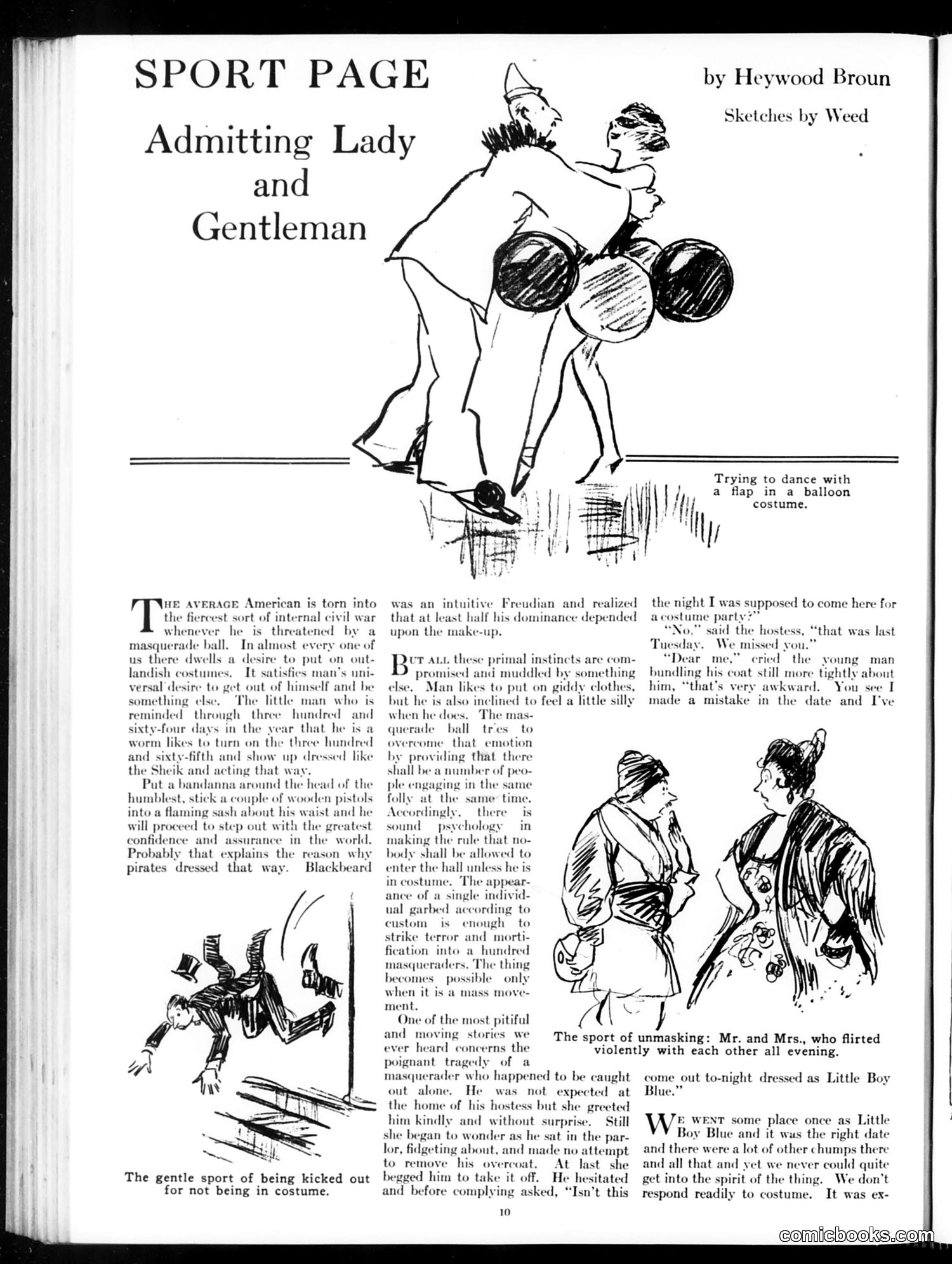
This is a humorous essay by Heywood Broun about masquerade balls and costume parties in early 20th-century America. The central joke explores the psychology of costume: ordinary people feel empowered wearing disguises, but paradoxically need *others* in costume too—a lone costumed guest becomes ridiculous rather than bold. The cartoons illustrate this tension: - Top: A couple awkwardly dancing in a balloon costume, highlighting how ridiculous costumes can be - Middle: Someone being ejected for not dressing up (enforcing the "everyone or no one" rule) - Bottom: A couple flirting while masked, suggesting costumes enable social behavior people wouldn't attempt otherwise The anecdote about the man who showed up dressed as "Little Boy Blue" on the wrong night satirizes this anxiety: surrounded by normally-dressed people, his costume becomes shameful rather than liberating. The piece gently mocks American self-consciousness and our need for collective permission to act outside social norms.
📄 Transcribed text from this page (OCR, searchable)
Machine-transcribed from the original scan — historical spelling and the odd misread are preserved.
SPORT PAGE Admitting Lady and Gentleman HE AVERAGE American is torn into the fiercest sort of internal civil war whenever he is’ th ed by a masquerade ball. In almost every one of us there dwells a desire to put on out- landish costum: It satisfies man’s uni- out of himself and be something else. The little man who is reminded through three hundred and sixty-four days in the year that he is a worm likes to turn on the three hundred and sixty-fifth and show up dressed like the Sheik and acting that way, Put a bandanna around th humblest, stick a couple of wo« into a flaming sash about his w will proceed to step out with the greatest confidence and assurance in the world. Probably that explains the reason why pirates dressed that way. Blackbeard versal desire tc ad of the n pistols stand he The gentle sport of being kicked out for not being in costume. was an intuitive Freudian and realized that at least half his dominance depended upon the make-up. i UT ALL these primal instincts are com- promised and muddled by something else. Man likes to put on giddy clothes, but he is also inclined to feel a little silly when he does. The mas- querade ball tres to overcome that emotion by providing that there shall be a number of peo- aging in the same y at the same: time. wrdingly, there — is sound — psychology — in making the rule that no- body shall be allowed to enter the hall unless he is in costume. The appear- ance of a single individ- ual garbed according to custom is) enough to strike terror and morti- fication into a hundred masqueraders, The thing becomes possible only when it is a mass move- ment, One of the most pitiful and moving stories we c heard concerns the poignant tragedy of a masquerader who happened to be caught out He was not expected at the home of his hostess but she greeted him kindly and without surprise. — Still she began to wonder as he sat in the par- lor, fidgeting about, and made no attempt to remove his o at, At last she begged him to take it off. He hesitated and before complying asked, “Isn't this 10 by Heywood Broun Sketches by Weed Trying to dance with a flap in a balloon costume, the night I yas supposed to come here for acostume g rty? id the hostess, “that was last We missed you.” cried” the young) man bundling his coat still more tightly about him, “that’s y awkward. You see I made a mistake in the date and I’ve Tuesd “Dear om The sport of unmasking: Mr. and Mrs., who flirted violently with each other all evening. come out to-night dressed as Little Boy Blue.” E WENT some place once as Little Boy Blue and it was the right date and there were a lot of other chumps there and all that and yet we never could quite get into the spirit of the thing. We don’t respond readily to costume. It was ex- comichooks.