
Judge, 1923-02-10 · page 3 of 36
Judge — February 10, 1923 — page 3: what you’re looking at
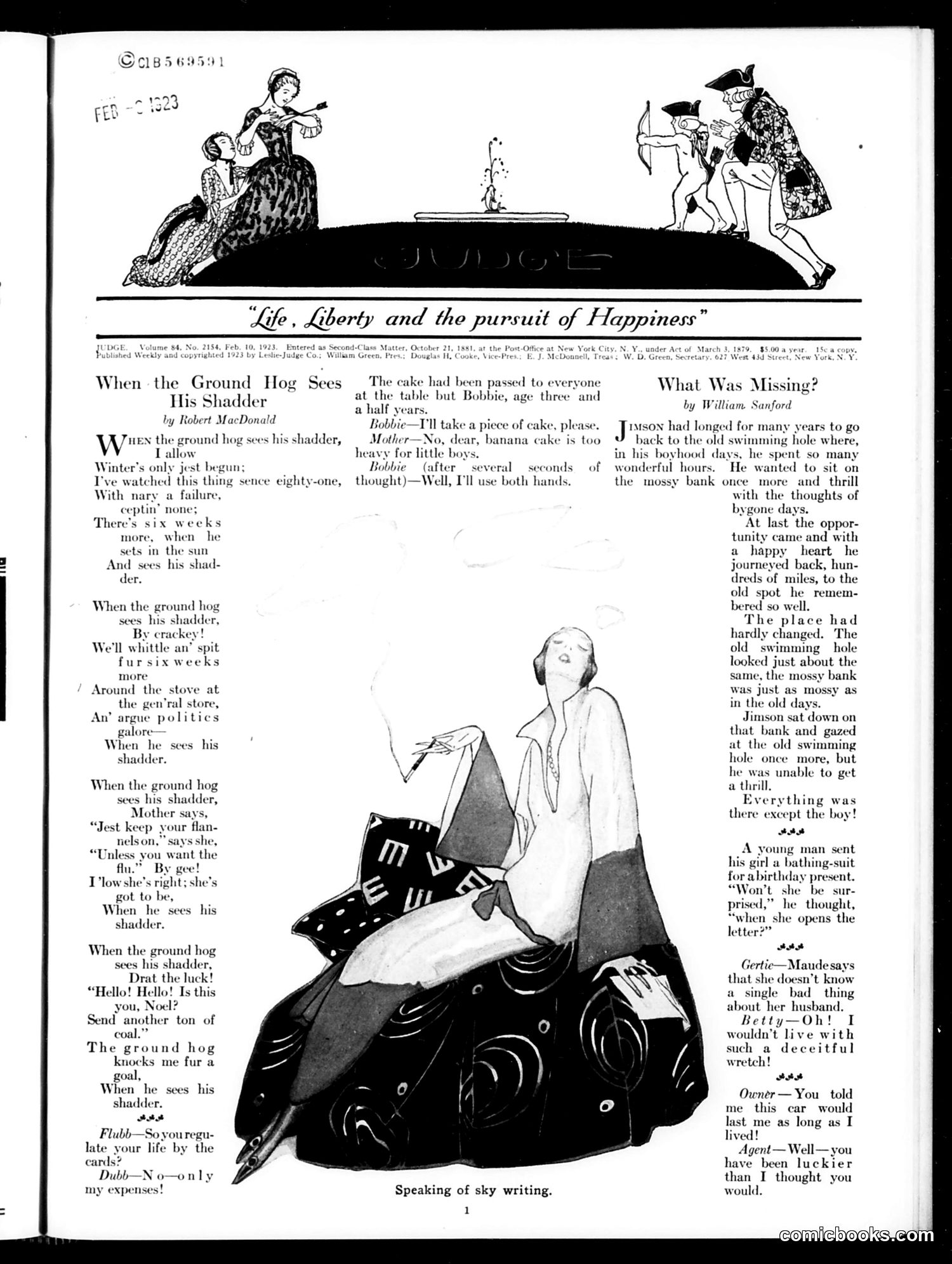
What you’re looking at
This page contains three separate pieces of humor typical of Judge magazine's satirical content: 1. **"When the Ground Hog Sees His Shadow"** (Robert MacDonald): A poem playing on Groundhog Day folklore, using the animal's shadow-spotting as metaphor for predicting winter's duration. 2. **Central illustration** titled "Speaking of sky writing": Shows a woman gazing upward, apparently moved by skywriting (a novelty aviation stunt that became popular in the 1920s). The satirical point concerns how this new advertising medium—messages written in smoke by airplanes—captures attention and emotion. 3. **"What Was Missing?"** (William Sanford): A short story about a man returning to his nostalgic childhood swimming hole, finding it unchanged except for the absence of a boy, suggesting loss or passage of time. The page reflects 1920s leisure activities and emerging technologies.
📄 Transcribed text from this page (OCR, searchable)
Machine-transcribed from the original scan — historical spelling and the odd misread are preserved.
> . . 1 Ocp5s69591 Feb. 10, 192 as eslie-Judge Co.; Will When the Ground Hog Sees His Shadder hy Robert MacDonald Wits the ground hog sees his shadder, I allow Winter's only jest begun; I've watched this thing sence eighty-one, With nary a failure, ceptin’ none; There’s six weeks more, when he sets in the sun And sees his shad- der. When the ground hog sees his shader, By crackey! We'll whittle an’ spit fur six weeks more Around the stove at the gen’ral store, An’ argue politics galore When he sees his shadder. When the ground hog sees his shadder, “Jest keep your flan- nels on,” says she, “Unless you want the flr By gee! T low she’s right; she’s got to be, When he sees his shadder. When the ground hog sees his shadder, Drat the luck! “Hello! Hello! Is this Send another ton of coal.” The ground hog knocks me fur a goal, When ‘he sees his shadder. rrr Flubb—So youregu- late your life by the cards? Dubb—N o—o nly my expenses! Lie, Liberty Matter, October 21 fn, Pres: Dougla: The cake had been passed to everyone able but Bobbie, age three and a half Bobbie—I'll take a piece of cake, please. Mother—No, dear, banana cake is too heavy for little boys. Bobbie (after several — seconds thought)—Well, Pll use both hands. Speaking of sky writing. it and the pursuit of Flappiness” ty. NLY.. under Act 3.1879, $5.00 W. B. Green, Se Wes 430 St What Was Missing? by William Sanford imson had longed for many years to go Y back to the old swimming hole where, in his boyhood days, he spent so many wonderful hours. He wanted to sit on the mossy bank once more and_ thrill with the thoughts of bygone days. At last the oppor- tunity came and with a happy heart he journeyed back, hun- dreds of miles, to the old spot he remem- bered so well. The place had hardly changed. The old swimming _ hole looked just about the same, the mossy bank was just as mossy as in the old da Jimson sat down on that bank and gazed at the old swimming hole once more, but he was unable to get a thrill. iverything was there except the boy! a8 A young man sent his girl a bathing-suit for abirthday present. “Won't she be sur- prised,” he thought, “when she opens the letter?” tas Gertie—Maude says that she doesn’t know a single bad thing about her husband. Betty—Oh! I wouldn't live with such a deceitful wretch! chad Owner — You told me this car would last me as long as I lived! Agent —Well—you have been luckier than I thought you would.