
A complete issue · 36 pages · 1922
Judge — July 8, 1922
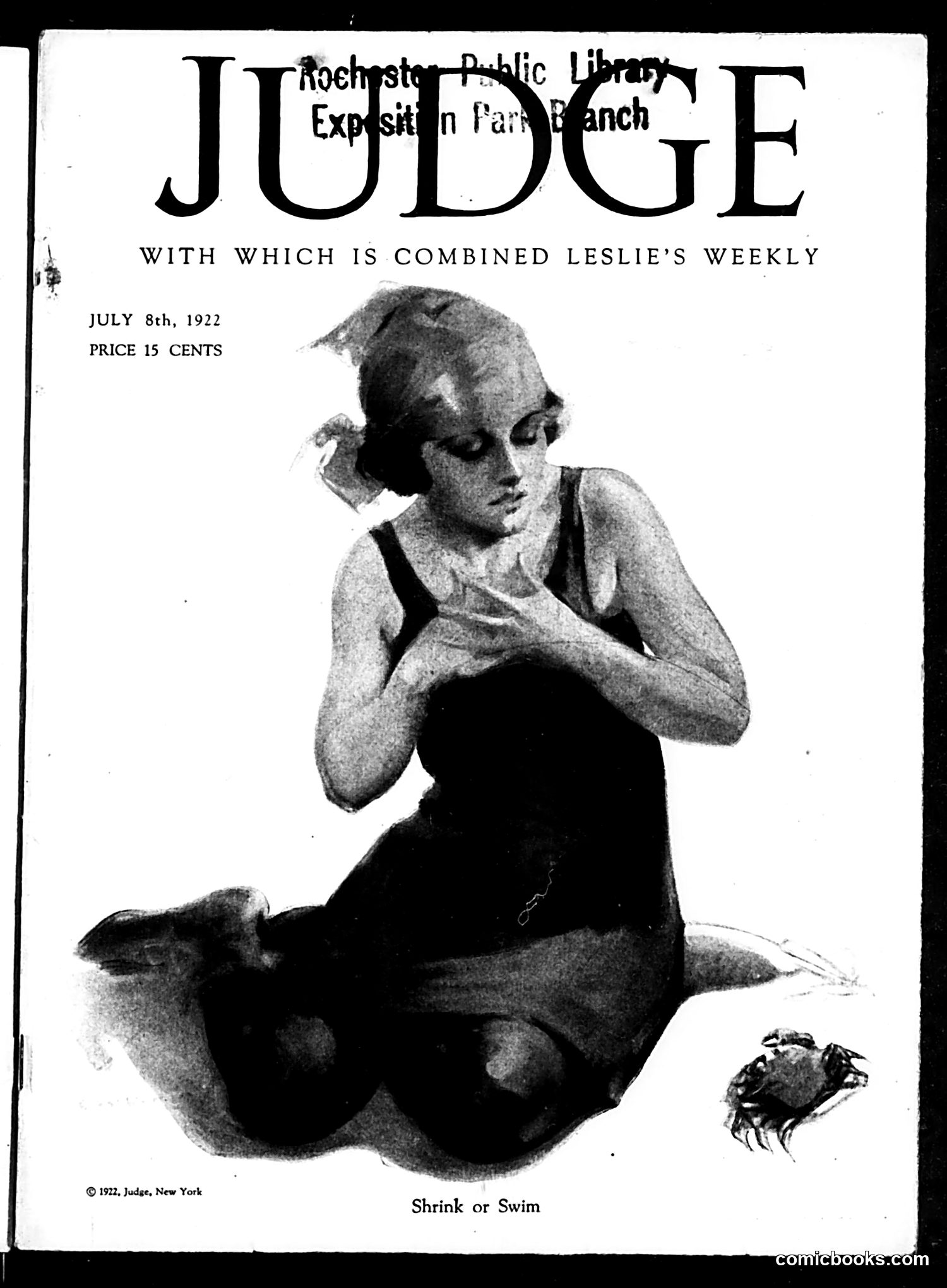
This cover depicts a woman in a bathing suit sitting with a crab nearby, titled "Shrink or Swim." The image satirizes 1920s concerns about women's swimwear and body modesty. The caption suggests women faced a choice: either their swimsuits would shrink when wet (revealing more of the body), or they'd need to learn to swim regardless of exposure. This reflects contemporary anxieties about the "New Woman" of the Jazz Age—women wearing increasingly revealing bathing suits that shocked conservative society. The humor targets both women's changing fashion choices and the public's prudish reactions to them. The crab appears to represent the natural dangers women might face while swimming, adding to the satirical commentary on women's newfound recreational freedoms.
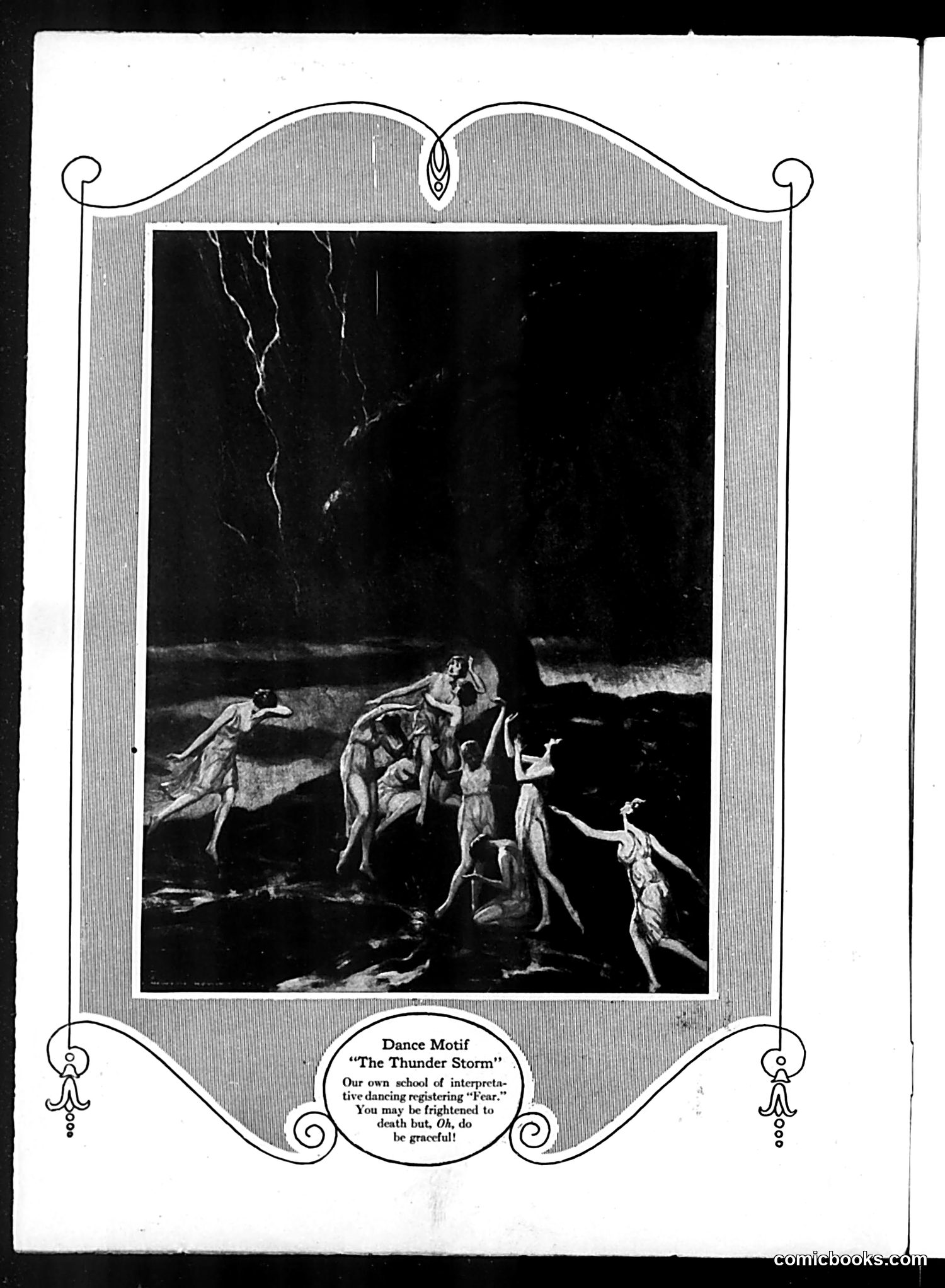
This page from *Judge* magazine presents a classical dance interpretation titled "The Thunder Storm." The caption explains that this represents "our own school of interpretive dancing registering 'Fear.'" The image depicts multiple nude or semi-nude figures in dramatic poses against a dark, stormy background with a large tree. The satire appears to mock the early 20th-century trend of "interpretive" or "modern" dance—particularly the movement associated with dancers like Isadora Duncan—which emphasized emotional expression through abstract movement rather than traditional ballet technique. The humor lies in *Judge's* skeptical view of this avant-garde art form: the exaggerated, contorted poses of the dancers embodying "fear" are presented as pretentious or absurdly overwrought. The warning "You may be frightened to death but, Oh, do be graceful!" suggests the magazine found such performances more comical than artistically meaningful.
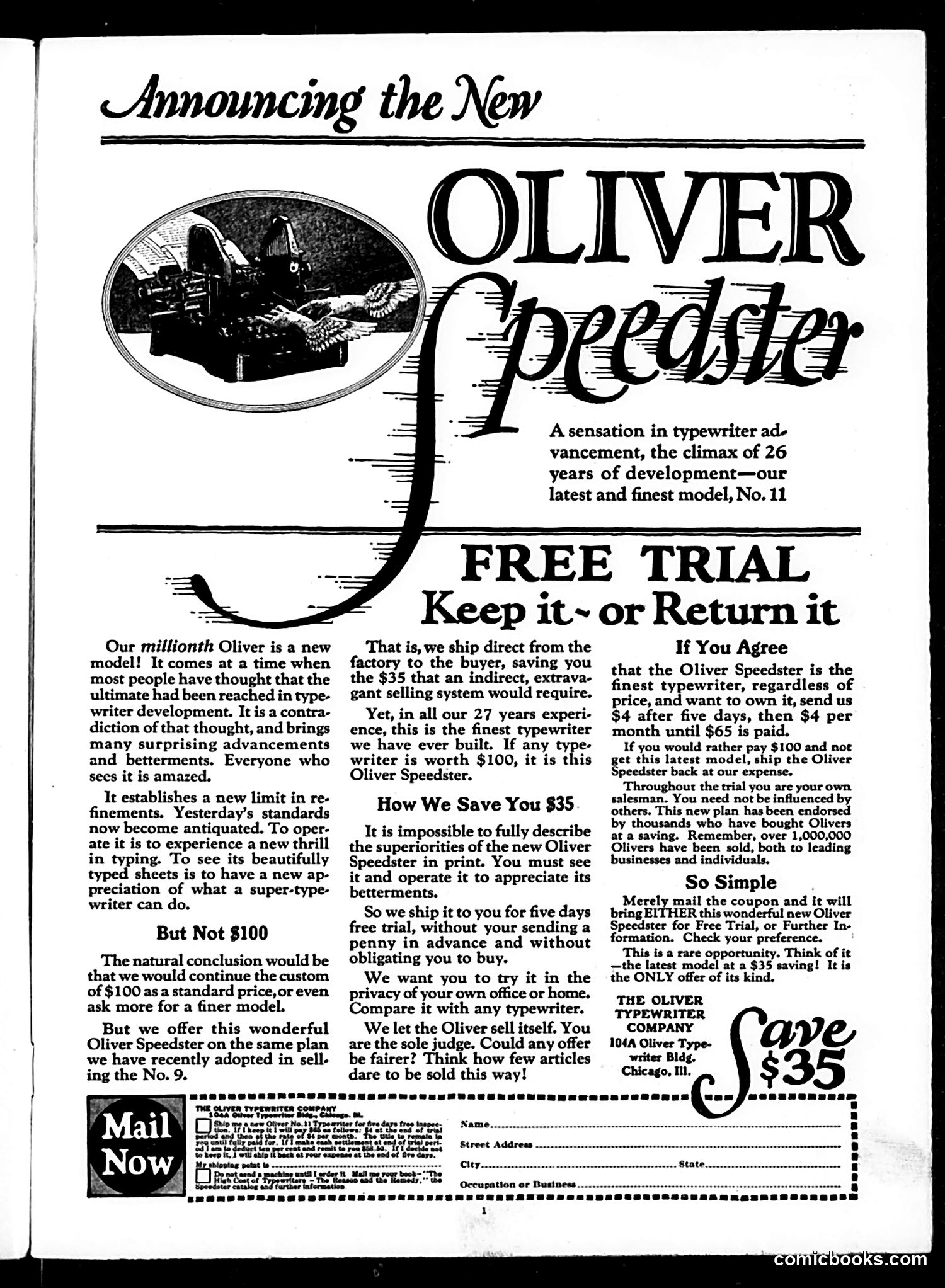
This is primarily a **product advertisement**, not political satire. The page promotes the Oliver Speedster typewriter (Model No. 11), marketed as "a sensation in typewriter advancement" after "26 years of development." The ad employs standard early-20th-century marketing tactics: emphasizing innovation, offering a free five-day trial, and claiming superiority over competitors. The "$35" price point is positioned as affordable for a "super-typewriter." The circular vignette illustration shows the typewriter's mechanical components in action. The accompanying text encourages readers to compare it against other brands, suggesting competitive market positioning among typewriter manufacturers—a significant industry before digital technology. No political figures or satire are evident; this is commercial advertising within Judge magazine's pages.
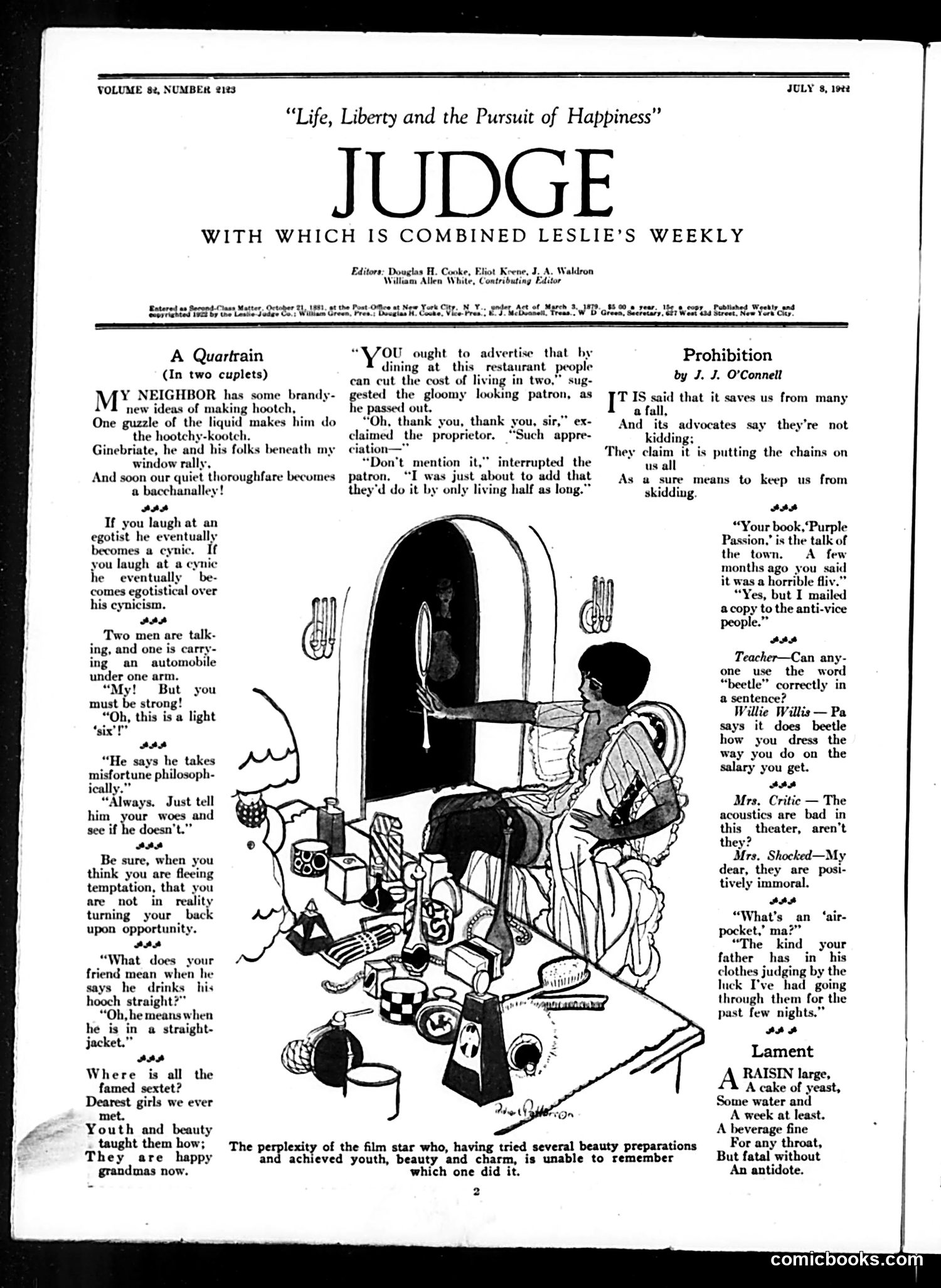
This page contains **satirical poetry and humor columns** rather than political cartoons. The central illustration depicts a **film star's chaotic dressing room**, cluttered with beauty products and preparations. The accompanying caption mocks how a film star, despite "tried several beauty preparations," still cannot remember "which one it is"—satirizing Hollywood's obsession with cosmetics and the actress's shallow vanity. The text sections ("A Quartain," "Prohibition," "Lament") offer light social commentary on everyday topics: drinking, prohibition enforcement, and rationing during WWII (the raisin cake reference suggests wartime scarcity). The Q&A "Teacher" section provides gentle wordplay humor. Overall, this represents **wartime-era civilian satirical humor**, not political commentary.
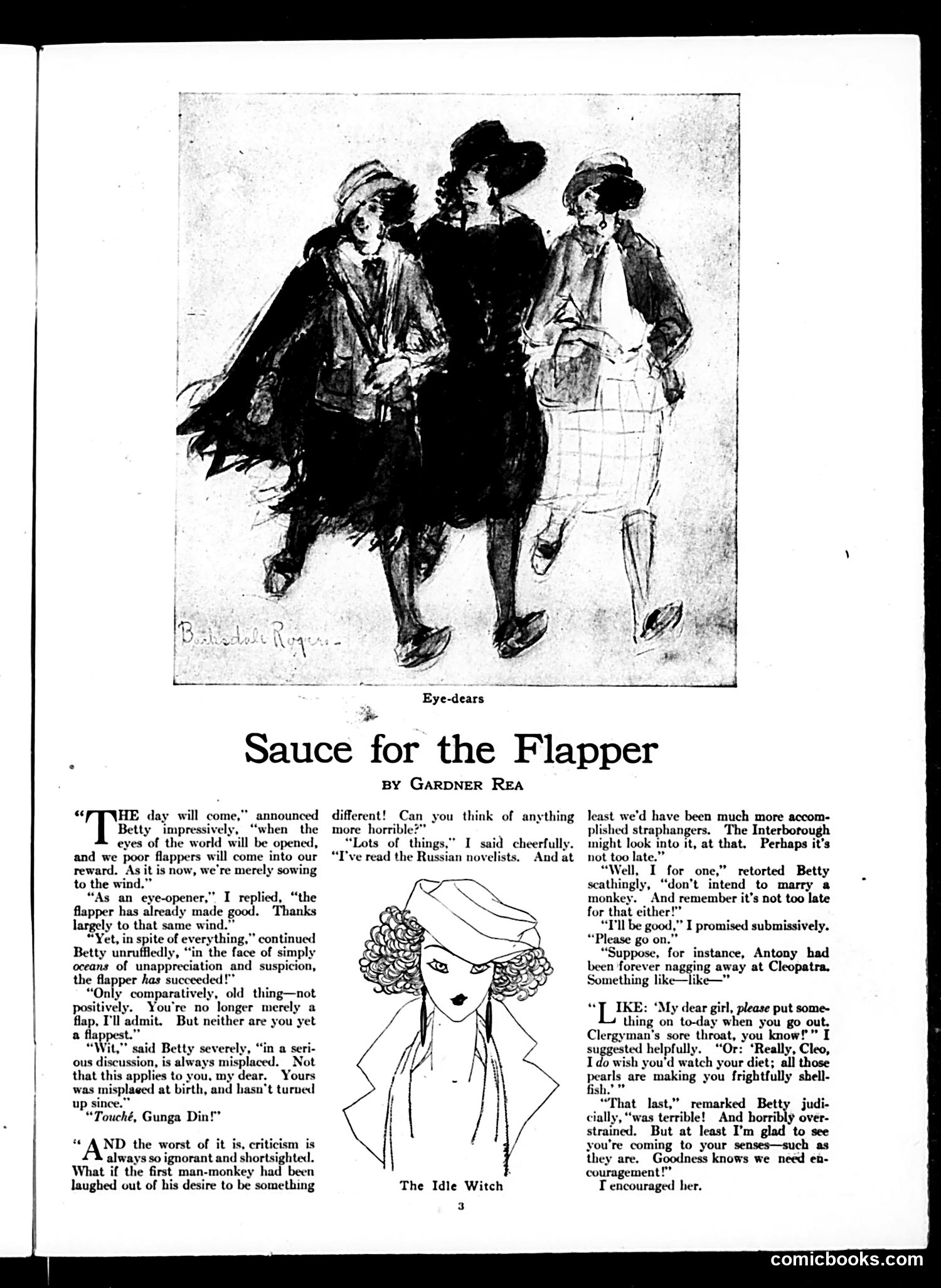
This page satirizes 1920s flapper culture through a dialogue between Betty (representing modern young women) and an older character ("The Idle Witch"). The humor targets the generational clash: Betty defends flappers against criticism, while her elder warns that modern girls' behavior—staying out late, rejecting traditional propriety—will lead to scandal. The cartoon illustration labeled "The Idle Witch" depicts a fashionable woman in 1920s style. The satire suggests that critics (represented as witches) unfairly condemn flappers for simply embracing contemporary freedoms. The piece mocks both the older generation's moral panic and their tendency to dismiss young women's independence as mere frivolity rather than genuine social change.
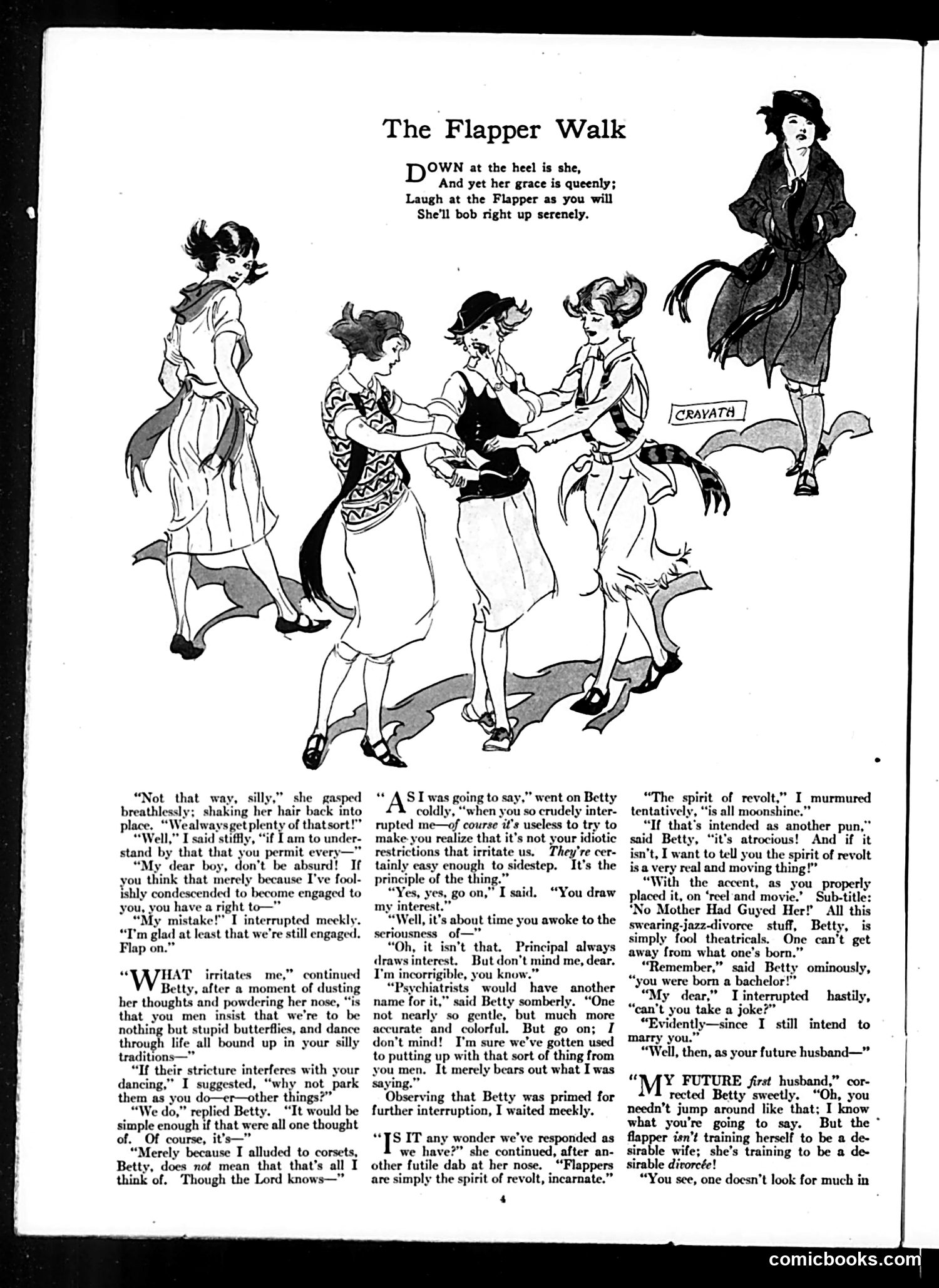
This page satirizes the "flapper" — the modern young woman of the 1920s who challenged Victorian conventions. The comic illustrates debates about flapper behavior through dialogue between Betty and her friend. The satire targets: 1. **The "flapper walk"** — the exaggerated hip movement visible in the illustrations, which conservative critics mocked as undignified 2. **Corset rebellion** — flappers abandoned restrictive corsetry, which traditionalists viewed as scandalous 3. **Dating and engagement** — Betty's casual attitude toward marriage and her criticism of men as "stupid butterflies" 4. **Social "spirit of revolt"** — the generational conflict, with older society viewing flappers as dangerously rebellious The humor comes from Betty's unapologetic defense of modern female independence, directly challenging her companion's concerns about propriety. Judge presents both perspectives while clearly favoring the conservative critique.
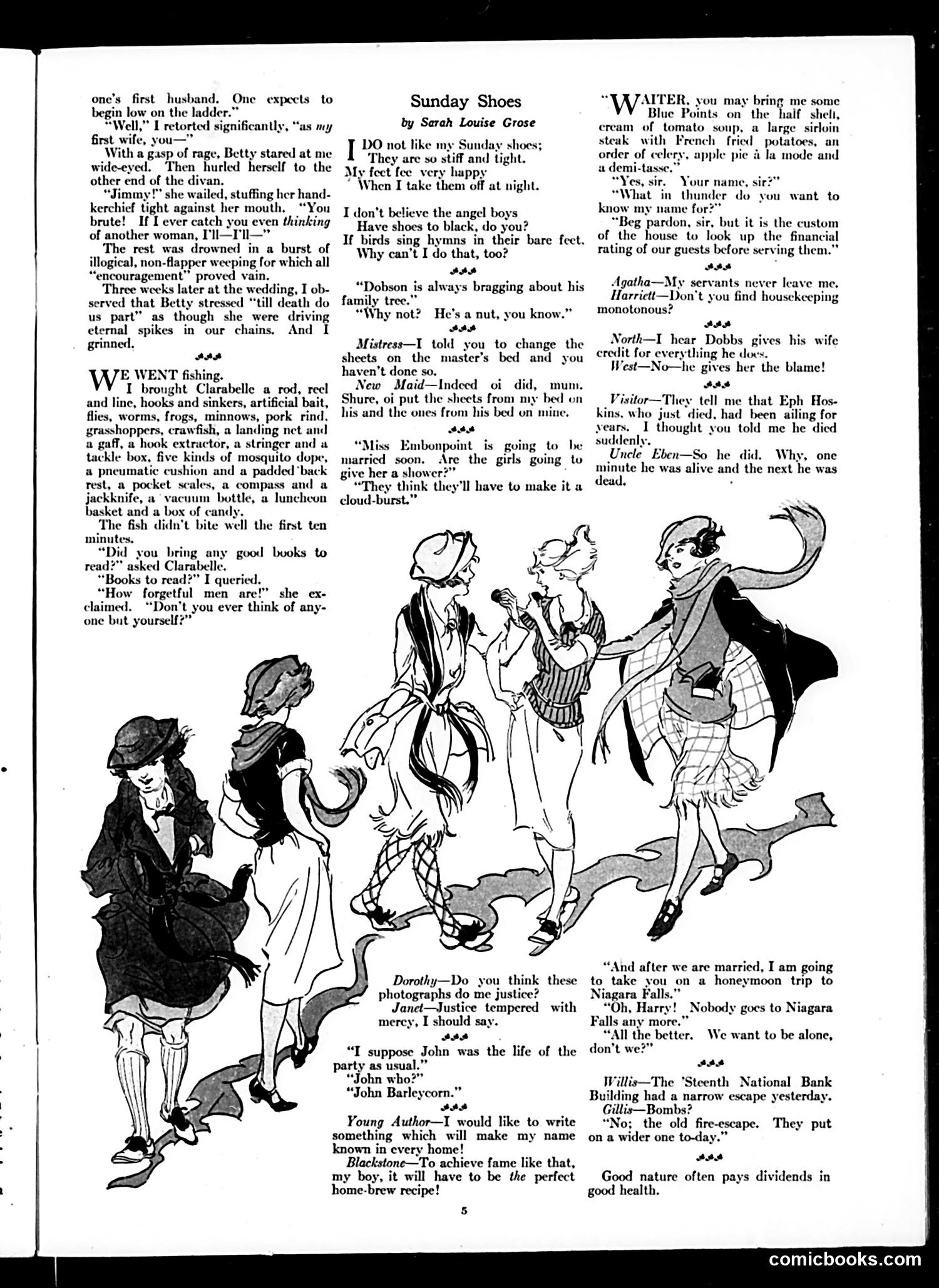
This page from *Judge* contains several disconnected satirical pieces typical of the era: **"Sunday Shoes"** is a children's poem mocking rigid social conventions—specifically that children must wear uncomfortable formal shoes to church while animals and angels supposedly go barefoot. The satire targets arbitrary propriety rules. **The marriage/courtship dialogue** satirizes the emotional contradictions of modern relationships, particularly the "new woman" (flapper era). Betty demands exclusivity while simultaneously being illogical and manipulative—poking fun at both romantic melodrama and gender dynamics of the 1920s. **The fishing scene** mocks forgetful husbands and demanding wives. **Scattered jokes** target Prohibition ("John Barleycorn"), servants, financial status anxiety (the waiter checking credit ratings), and marital dynamics. **The illustration** shows fashionably-dressed young women—likely flappers—in animated conversation, representing modern femininity that the text often mocks. Overall, the page reflects *Judge's* satirical focus on contemporary social anxieties: changing gender roles, modern marriage expectations, and urban middle-class pretensions during the 1920s.
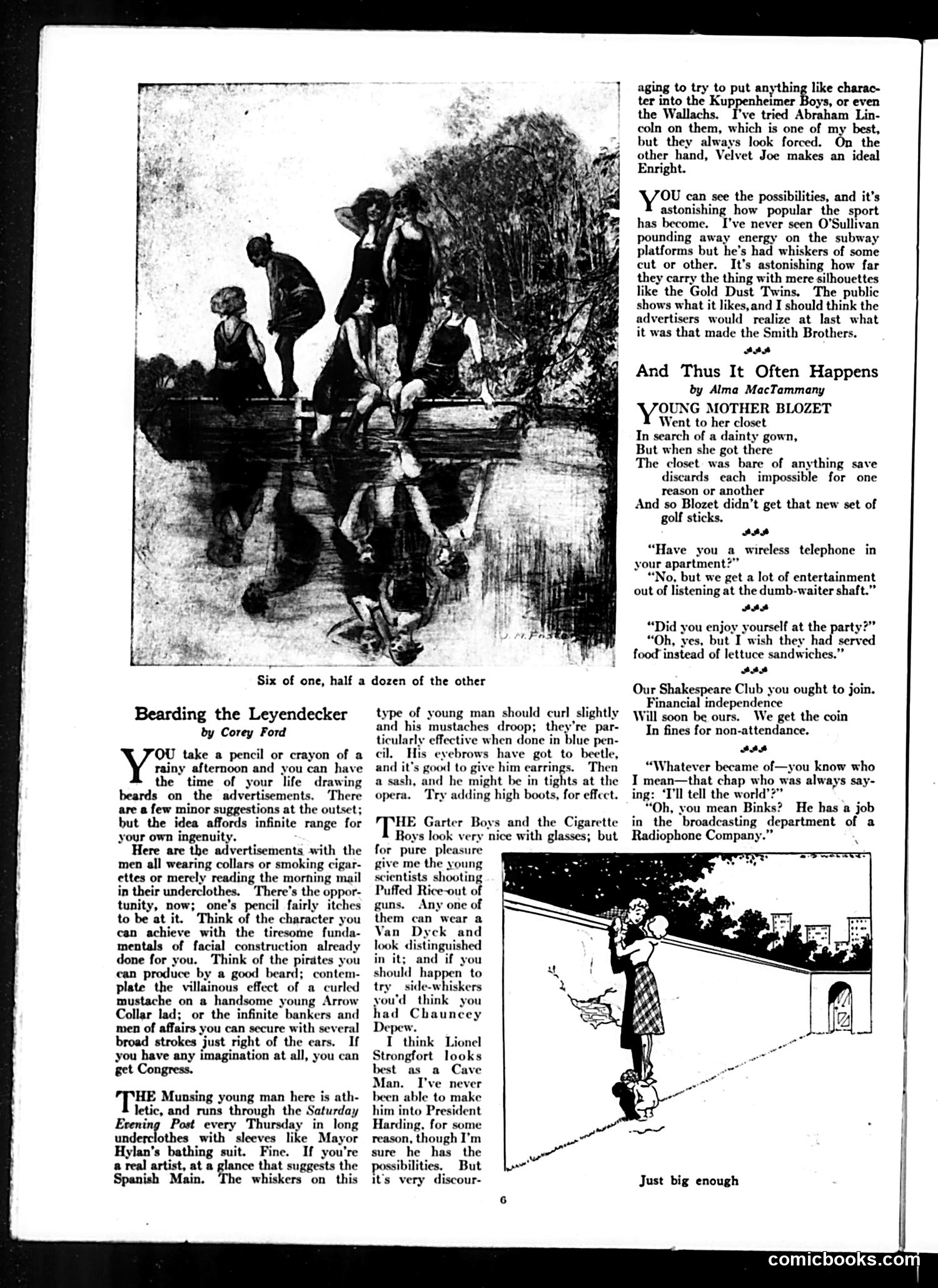
This page contains two satirical pieces from Judge magazine mocking 1920s advertising culture. **"Bearding the Leyendecker"** by Corey Ford is a humorous essay about a popular pastime: drawing beards and mustaches on male models in magazine advertisements. Ford catalogs specific ad campaigns (Arrow Collar, Munsing underwear, Gold Dust Twins, Smith Brothers) and suggests that adding facial hair—particularly pirates' beards or Abraham Lincoln whiskers—improves these clean-shaven advertising images. He notes that advertisers apparently learned their lesson from the Smith Brothers cough drops campaign, which featured bearded men and became wildly popular. The satire targets the sanitized, artificial masculinity of 1920s advertising. **"And Thus It Often Happens"** by Alma MacTammany is lighter satirical verse about everyday domestic disappointments and social absurdities—a woman's empty closet, dumb-waiter eavesdropping as entertainment, a Shakespeare Club that fines members for non-attendance. The cartoons illustrate these texts with period-appropriate imagery of children by water and urban scenes.
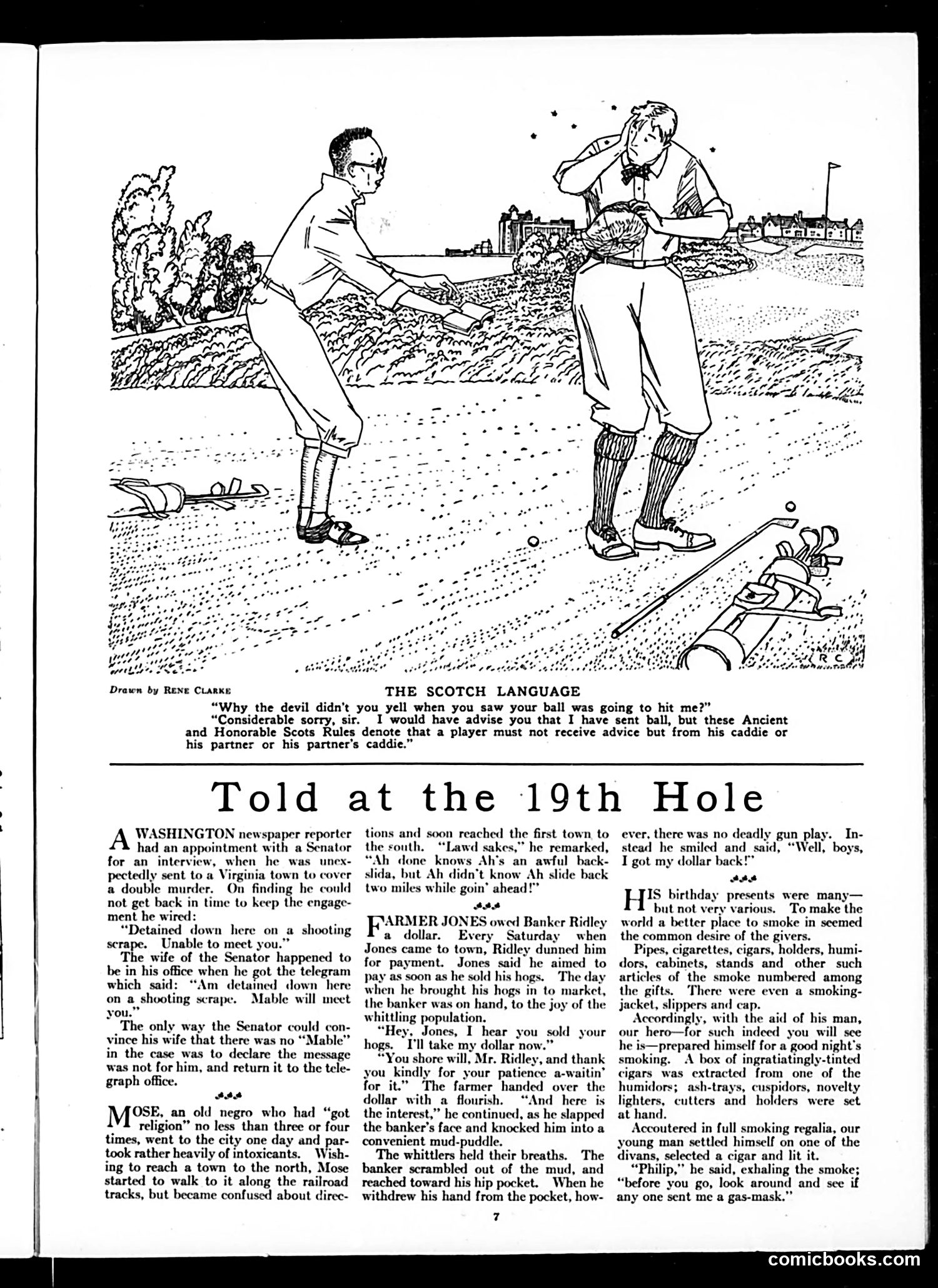
This page contains three unrelated humorous anecdotes from *Judge* magazine, typical of early 20th-century American humor: 1. **"The Scotch Language"** (top cartoon): A golf joke mocking Scottish accent and rules. A golfer apologizes for nearly hitting someone but claims Scottish golf rules forbid receiving advice except from a caddie—a thin excuse delivered in exaggerated dialect. 2. **"Told at the 19th Hole"** (main text): Three short stories told in a golf clubhouse setting: - A senator's wife misreads a telegram about a reporter's "shooting scrape," creating comedic misunderstanding - A Black man ("Mose") gets drunk and walks south instead of north, using dialect humor - A farmer humorously "pays interest" on a debt by hitting a banker into mud—which the banker accepts good-naturedly 3. **Birthday gifts story** (right column): A man receives so many smoking accessories that he jokes he needs a gas mask. The satire relies on racial stereotypes, dialect humor, and gentle social comedy typical of the era—elements modern readers would find dated or offensive.
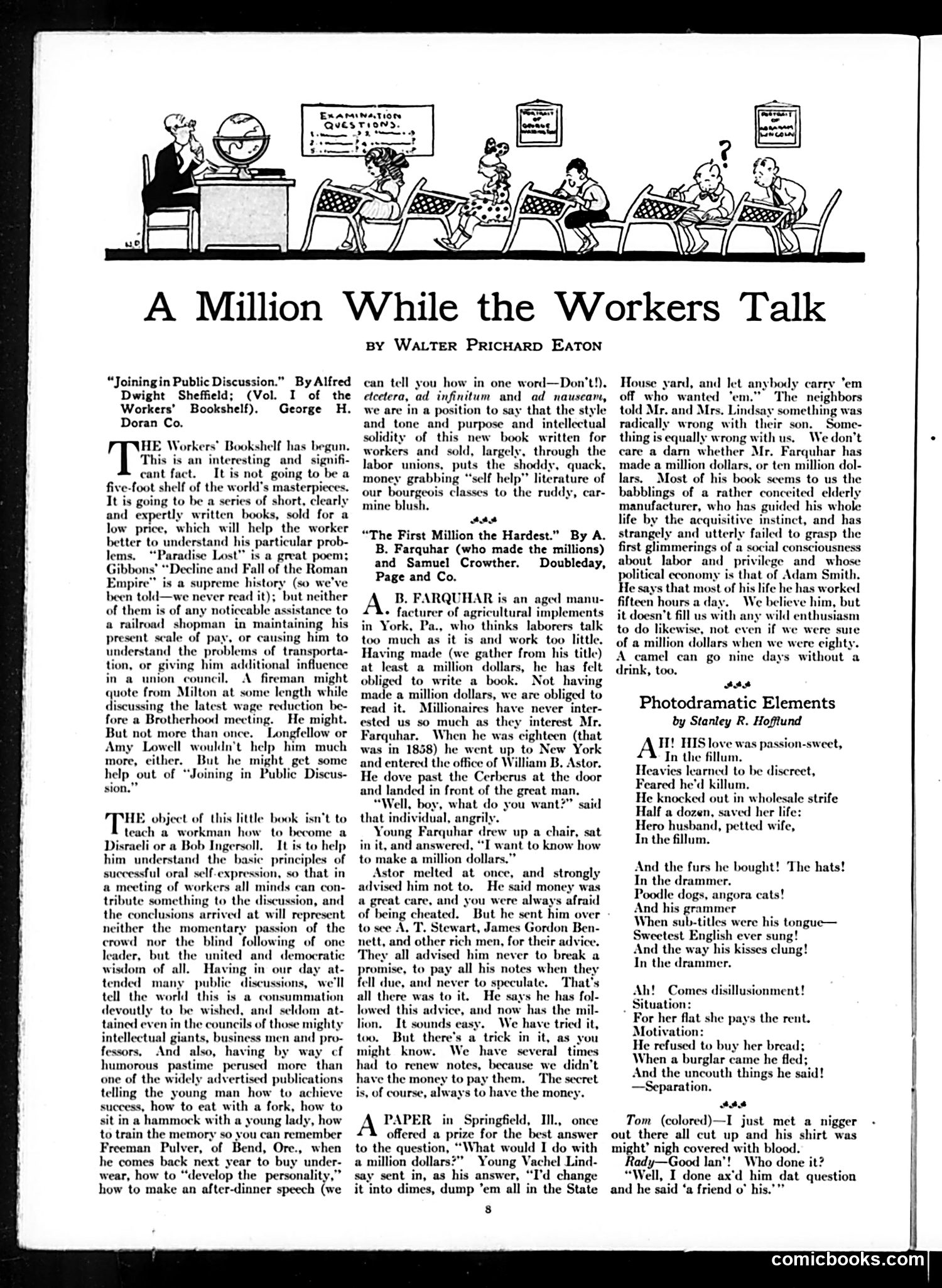
This page reviews two contrasting labor-themed books. The top cartoon shows an employer (left) at a desk while workers sit in chairs taking an examination—satirizing how workers are expected to be passive and tested rather than empowered. The review praises *"Joining in Public Discussion,"* a Workers' Bookshelf volume teaching laborers democratic debate skills. The critic argues practical books for workers matter more than classic literature, which won't help a railroad worker maintain wages or union influence. By contrast, the review mocks *"The First Million the Hardest"* by A.B. Farquhar, a wealthy manufacturer who believes workers talk too much and work too little. Farquhar's narrative about entering William B. Astor's office as a young man exemplifies the "self-help" genre the critic despises—celebrating individual ambition over collective worker interests. The satire's point: workers need education in *collective action*, not millionaire success stories promoting individual scrambling.
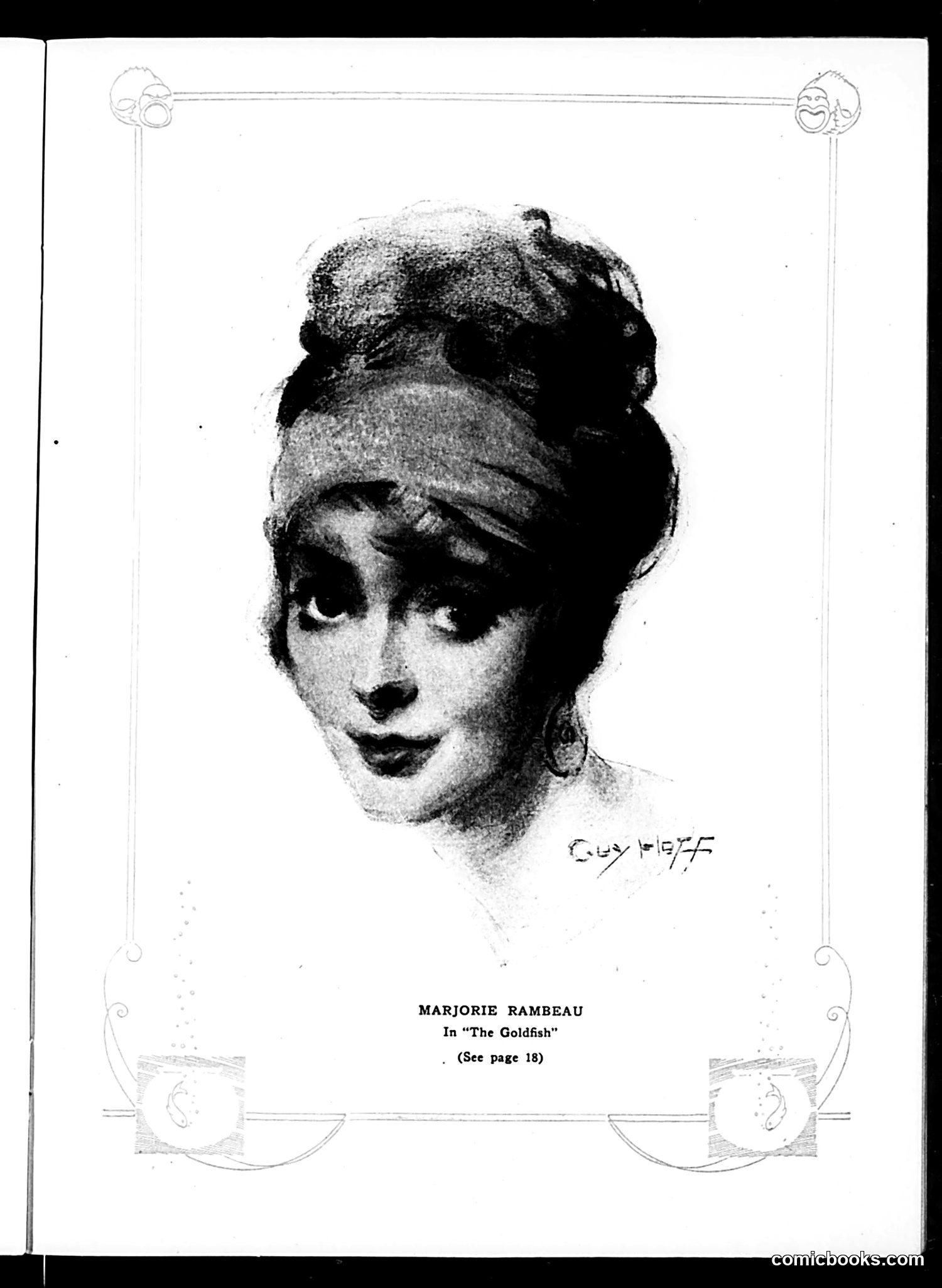
This page features a portrait photograph of actress **Marjorie Rambeau**, credited to her role in a theatrical production or film titled **"The Goldfish."** The reference to "See page 18" indicates this image accompanied a longer article or review within the Judge magazine issue. The decorative border with theatrical masks (comedy and tragedy) signals this is entertainment-related content rather than political satire. This appears to be a **promotional or review feature** rather than a cartoon or satirical commentary. Judge magazine regularly included such entertainment coverage alongside its humor and political content to appeal to readers interested in contemporary theater and film.
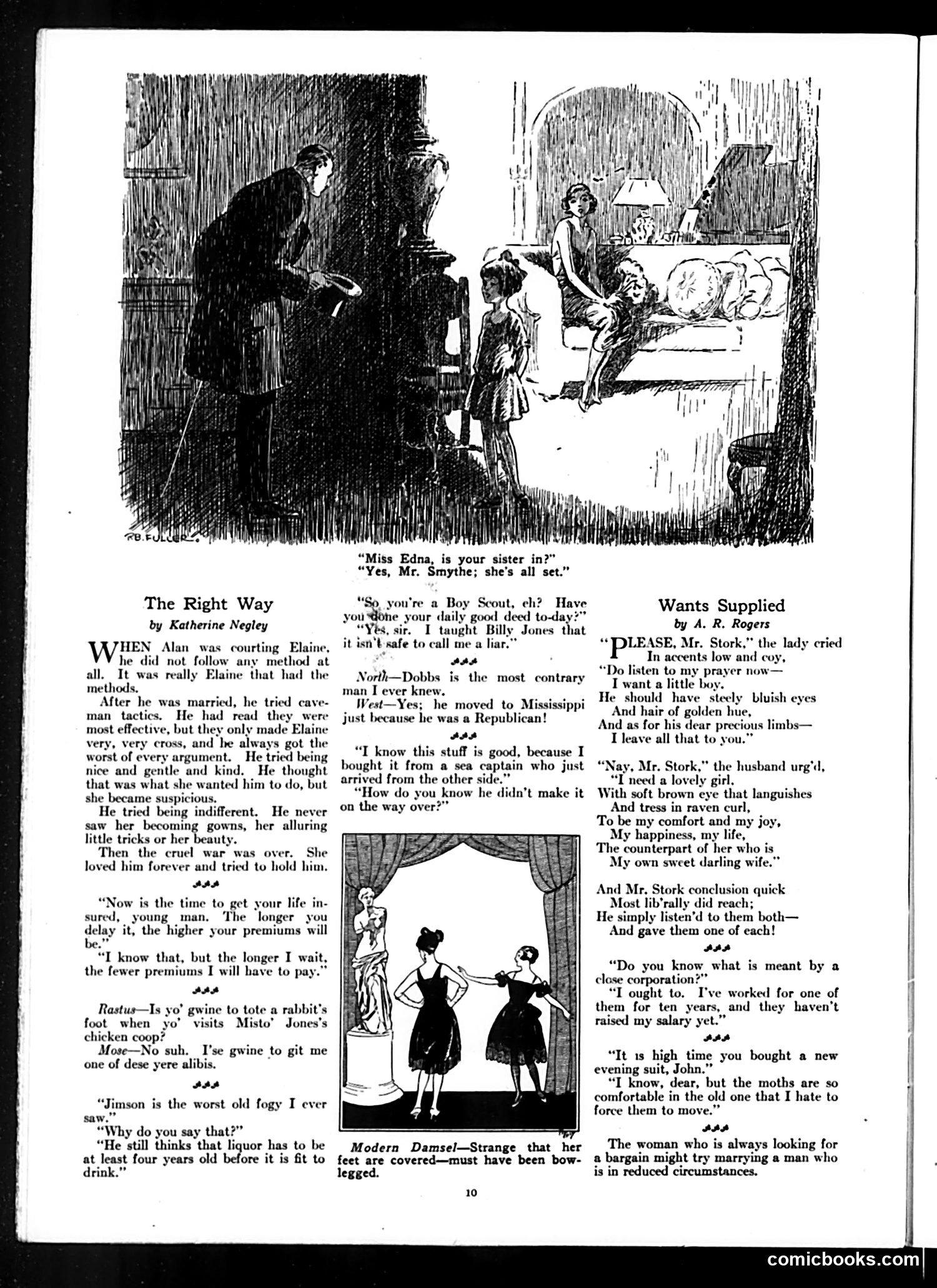
This page contains several short humorous pieces typical of early 20th-century American satirical magazines: **"The Right Way"** (by Katherine Negley) satirizes marital dynamics: a husband tries various tactics—caveman methods, niceness, indifference—to manage his wife, only succeeding when he becomes genuinely caring after "the cruel war" (likely WWI). **"Wants Supplied"** (by A.R. Rogers) is a poem about a couple's requests to Mr. Stork (the traditional symbol of childbirth). Each parent wants opposite-gendered children; the stork humorously grants both wishes. The page also contains **brief joke snippets** mocking: - Insurance premiums and life insurance logic - Racial stereotypes (crude dialect humor about alibis and theft) - Prohibition-era bootlegging and aging liquor - Republican politics ("contrary man" moves to Mississippi for being Republican) - Workplace exploitation ("close corporation" hasn't raised salary in ten years) - Marital complaints about clothing moths The humor reflects period attitudes: casual racism, anti-Republican sentiment, Prohibition anxieties, and domestic comedy centered on marriage dynamics.
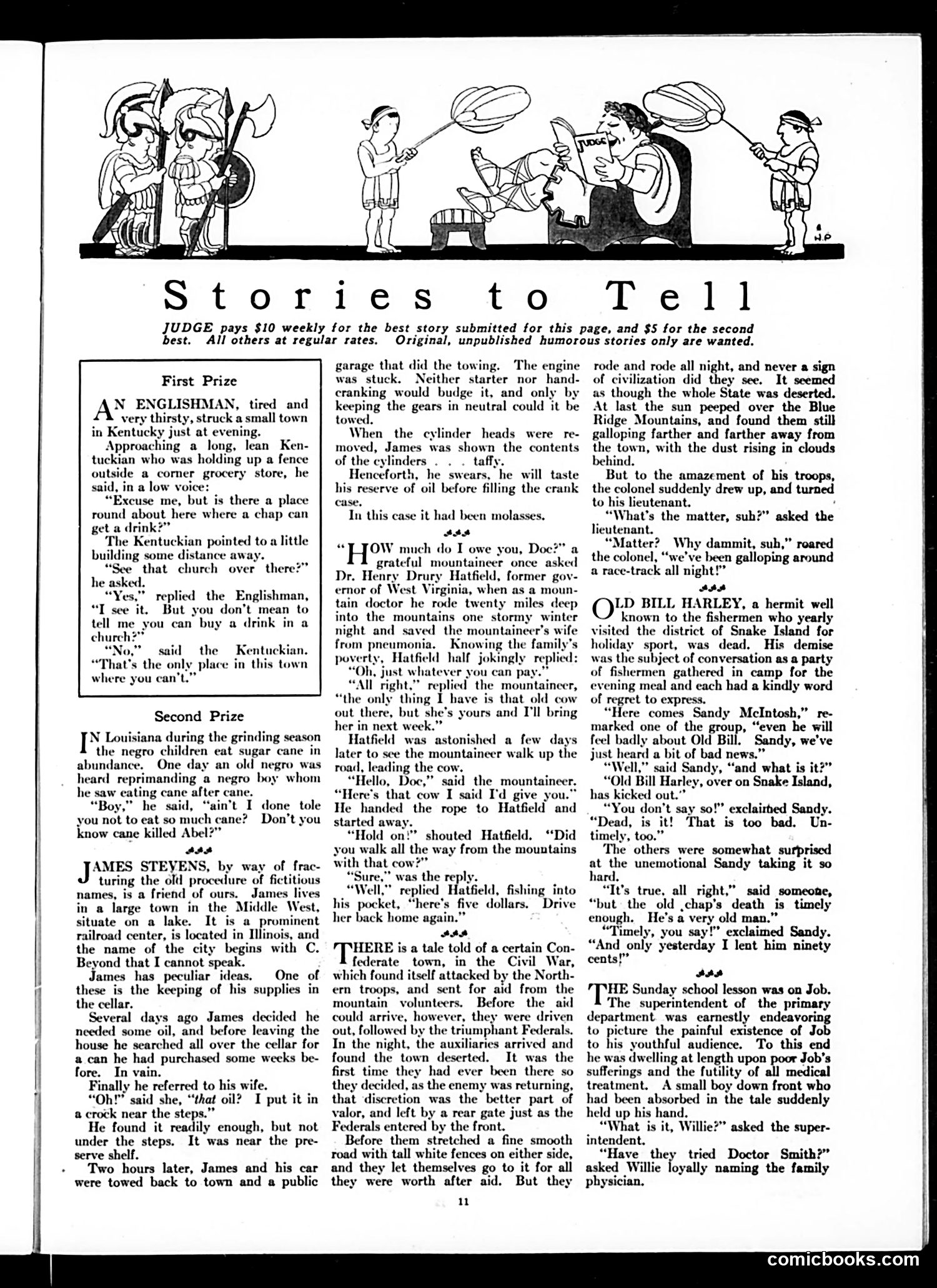
This page is a **story submission section**, not political satire. Judge paid readers $10 for the best humorous story published here. The illustrated header shows figures in classical dress telling stories—a generic visual pun on the page's title, not specific political commentary. The three prize-winning stories are lighthearted anecdotes: 1. **First Prize**: A joke about a dry Kentucky town where the only gathering place is a church (implying Prohibition or religious strictness). 2. **Second Prize**: A folk humor piece with a Black child and an elder, playing on dialect and wordplay ("cane killed Abel"). 3. **Third Prize**: Stories about a West Virginia doctor (appears to reference a real Dr. Henry Drury Hatfield, a historical figure) and a Civil War town anecdote. These are **genteel, mainstream humor**—no sharp political edge. They represent the magazine's lighter content balancing its satirical cartoons elsewhere.
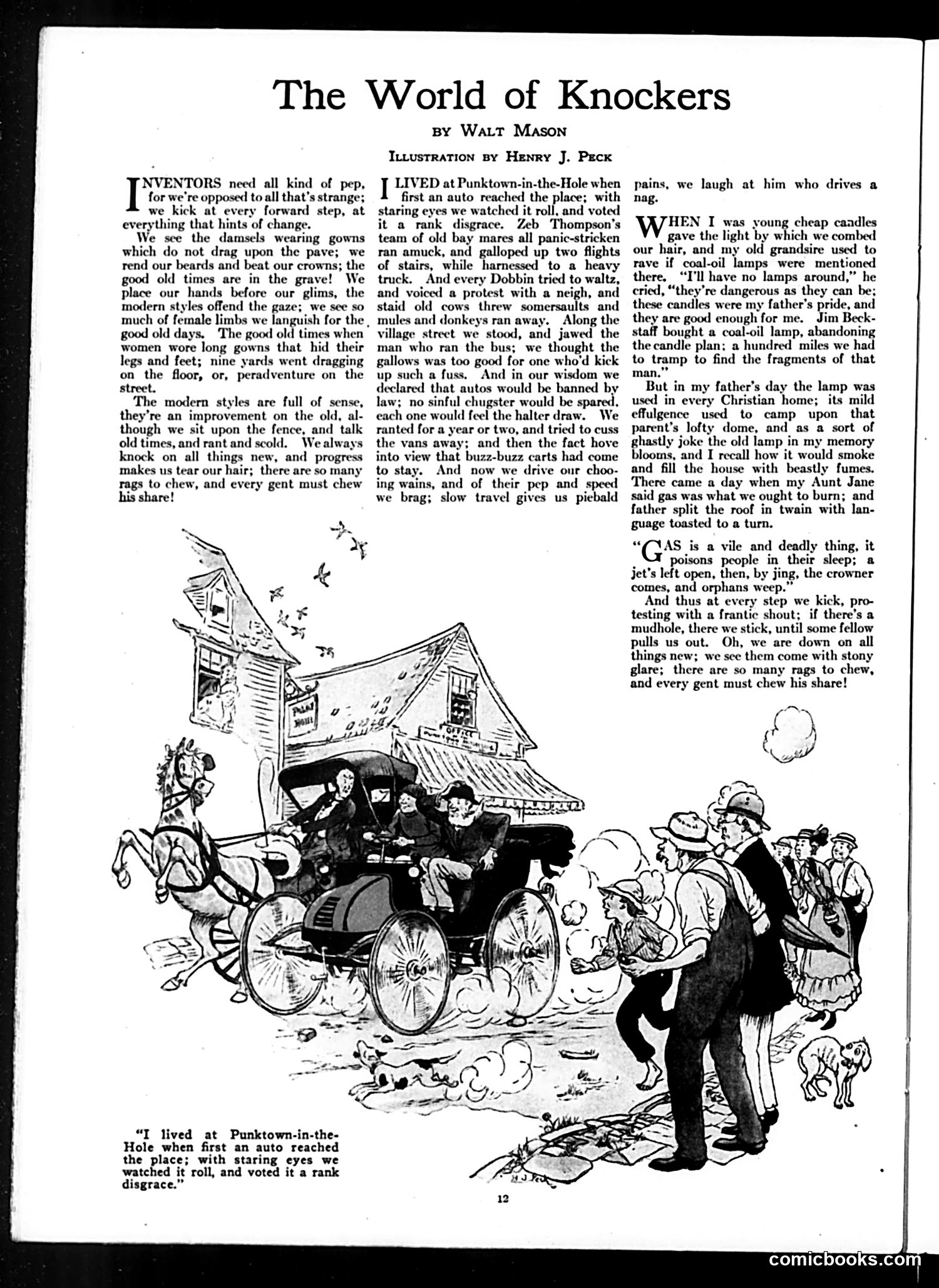
This satirical piece by Walt Mason mocks people who reflexively oppose progress and change. The central joke is that chronic complainers ("knockers") criticized automobiles, gas lamps, and modern women's fashion when first introduced—yet now enthusiastically embrace these same innovations while finding new things to condemn. The illustration shows an early automobile causing commotion in a village, with traditional townspeople reacting with shock and disapproval. The narrative recalls how they opposed cars (claiming they'd be banned by law), gas lighting, and shorter women's skirts—all now accepted as normal. The satire's point: there's a perpetual class of people who resist every forward step, claiming "good old times" were better, yet eventually adopt the very conveniences they once denounced. Mason suggests this reflexive opposition to novelty is foolish and endless—there will always be "rags to chew" for those committed to complaining about progress.
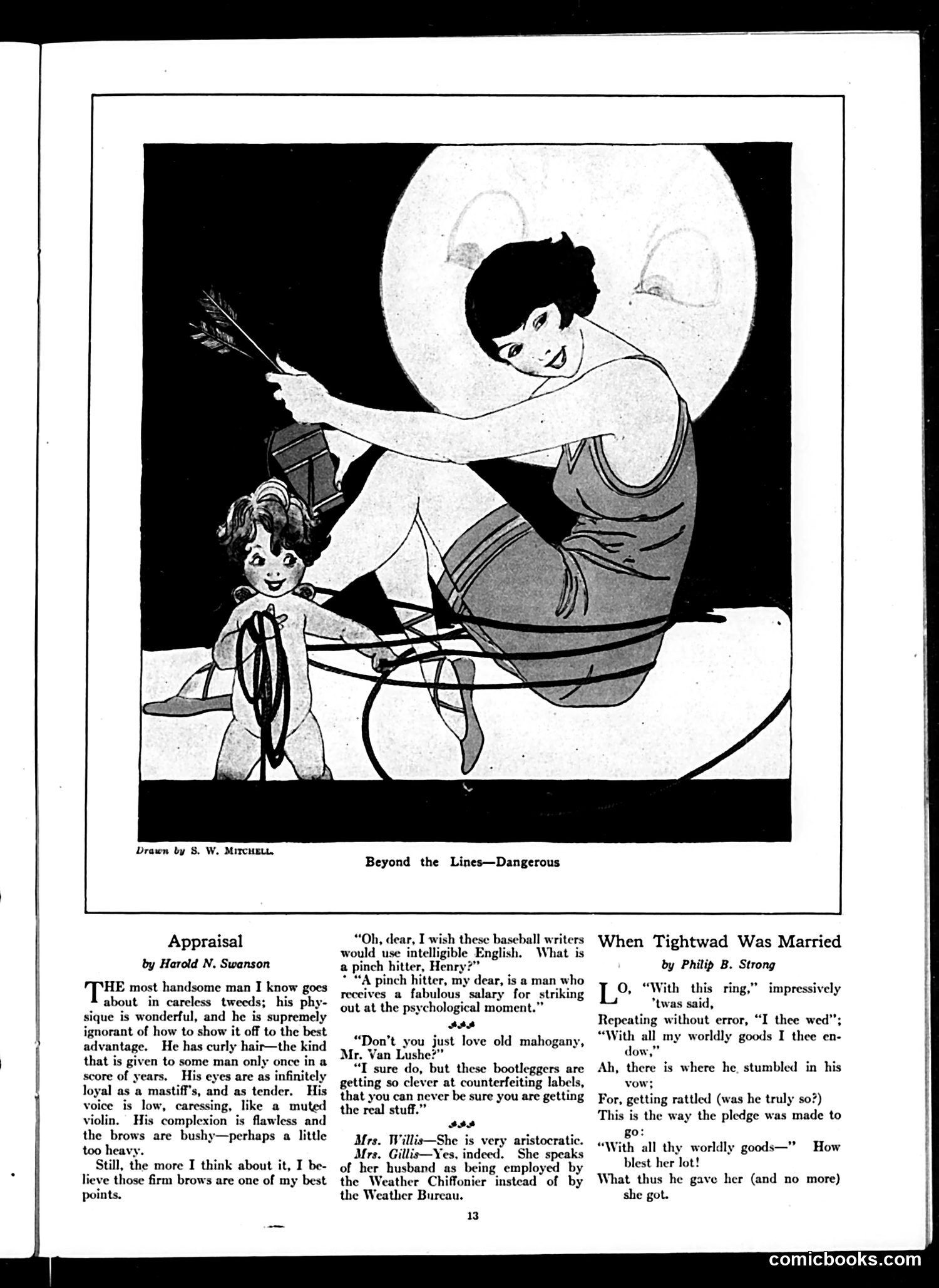
This page contains three separate humorous pieces typical of early-20th-century satirical magazines: **"Beyond the Lines—Dangerous"** (top cartoon by S.W. Mitchell): Shows a woman and child with a large hoop, likely satirizing women's fashions or behavior deemed risky or improper. **Three brief comedy sketches** below address contemporary concerns: 1. **Baseball terminology**: A wife doesn't understand what a "pinch hitter" is; her husband jokes it's a highly-paid player who strikes out at crucial moments—mocking both baseball's absurdities and sports writers' jargon. 2. **Prohibition-era bootlegging**: A man fears counterfeit liquor labels, referencing the ongoing difficulty of verifying alcohol quality during Prohibition (1920-1933). 3. **Aristocratic affectation**: A woman pretentiously calls the "Weather Bureau" the "Weather Chiffonier" (a furniture piece), mocking upper-class pretension. 4. **"When Tightwad Was Married"**: A miserly groom accidentally (or deliberately) limits his marriage vows to only "worldly goods" he actually gives—essentially nothing—satirizing stinginess.
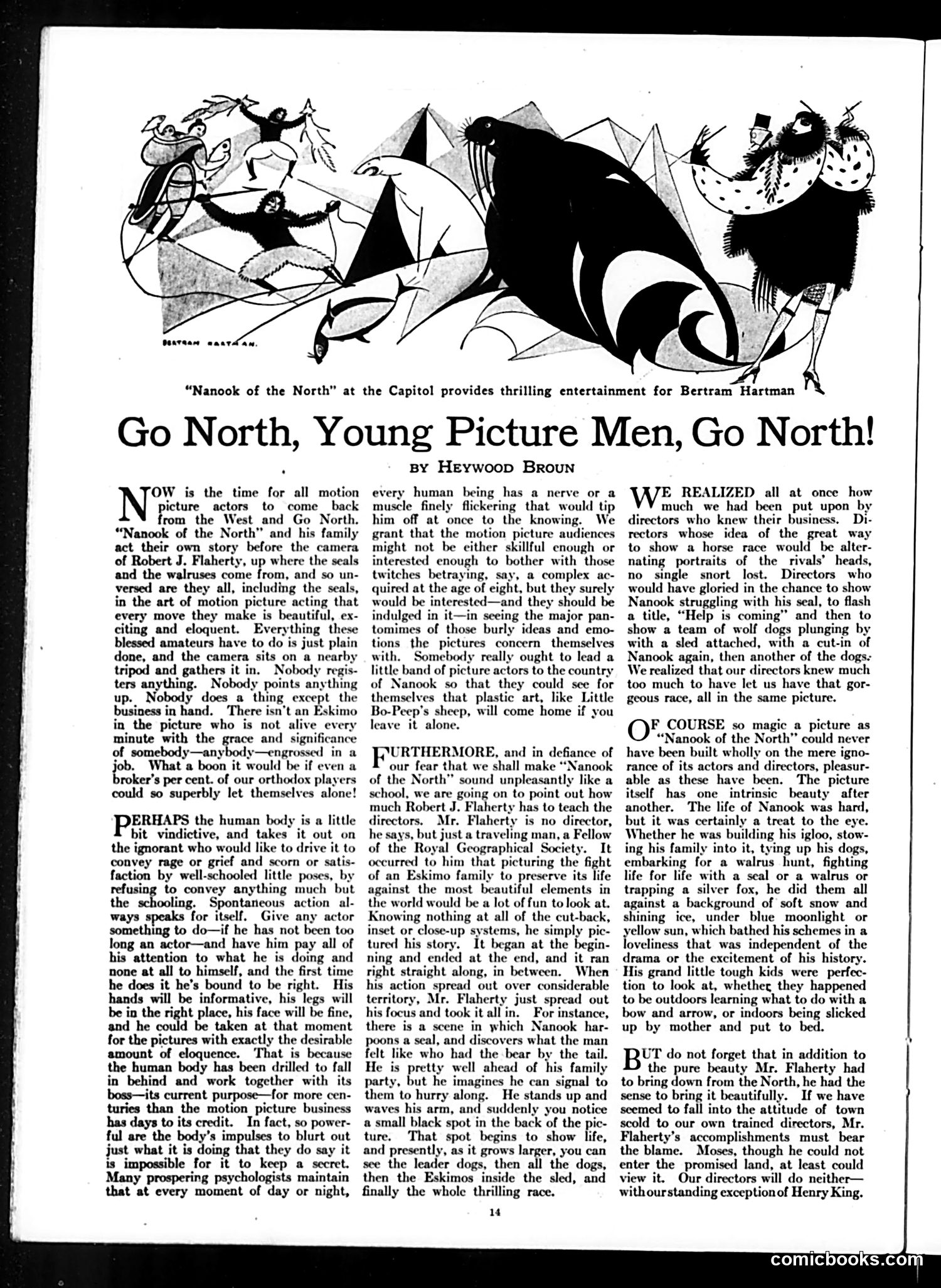
This is a **film criticism essay** by Heywood Broun praising the documentary "Nanook of the North" (1922) and its director Robert Flaherty. **The Point:** Broun argues that professional actors are *over-trained* and self-conscious, making their performances artificial. By contrast, Nanook and his Inuit family—untrained amateurs simply living their lives before the camera—deliver authentic, compelling performances. Their natural movements and genuine engagement in hunting/survival activities create better cinema than skilled actors can manage. **The Satire:** The essay mocks Hollywood's trained actors for being *worse* at their job than non-actors. Broun suggests their technique-obsessed approach ("well-schooled little poses") produces wooden results, while Flaherty's "non-director" approach—simply filming reality without cinematic tricks (no "cut-back, inset or close-up systems")—produces superior art. **The Cartoon** (top) illustrates Flaherty with his camera capturing Nanook and Eskimo characters amid seals and ice, visually emphasizing the documentary's authentic Arctic setting versus studio artificiality.
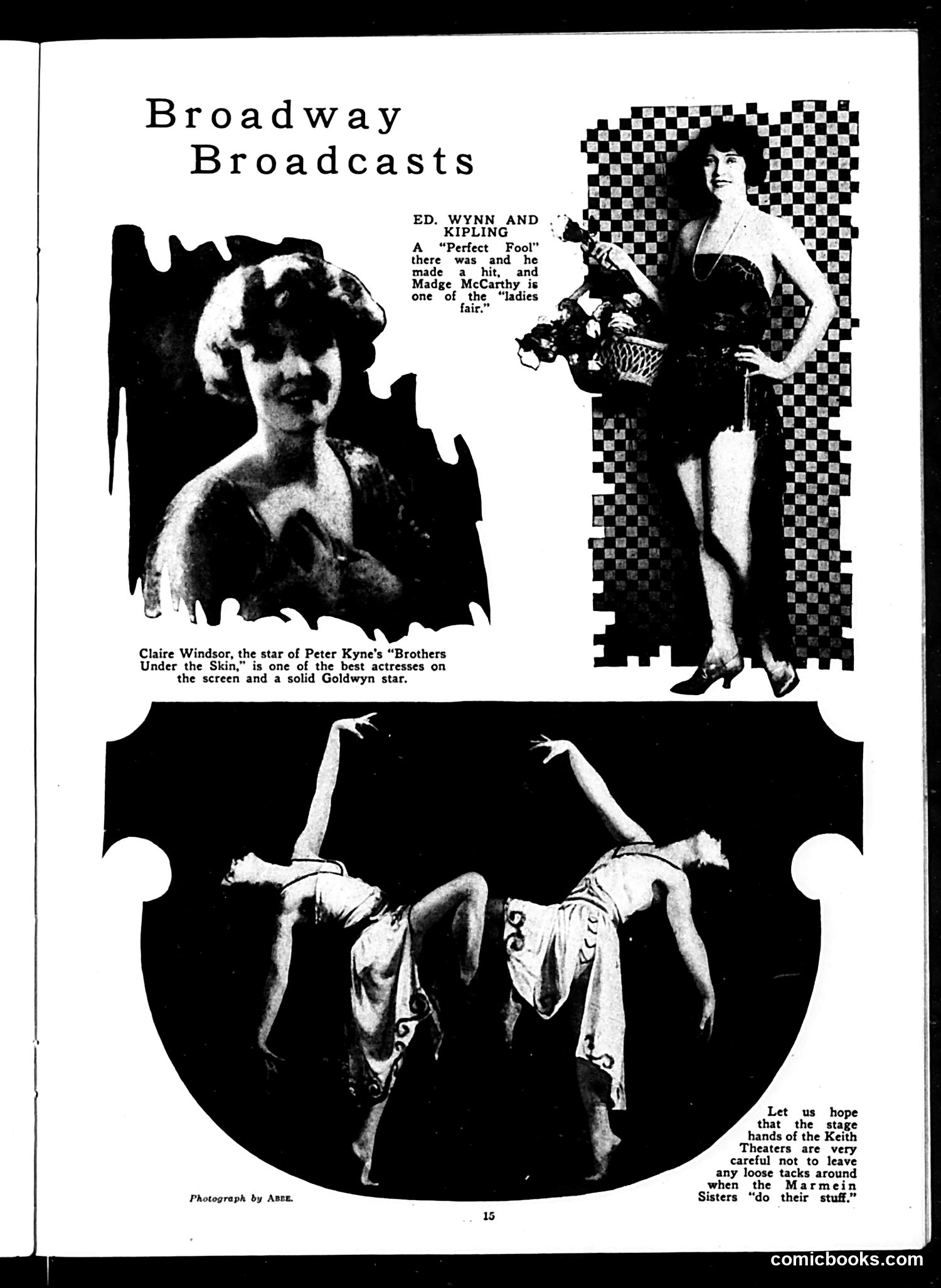
This page is a **theater/entertainment gossip column** with photographs of stage and film performers, not political satire. The "Broadway Broadcasts" section reviews current theatrical productions and performers. The content references: - **Ed Wynn** and a production called "A Perfect Fool" (likely a 1920 Wynn comedy) - **Claire Windsor**, a Goldwyn film actress in "Brothers Under the Skin" - **The Marmein Sisters**, acrobatic performers The humor is light and backstage-focused: the final joke warns Keith Theater stagehands to remove loose tacks before the Marmein Sisters perform their acrobatics, implying the danger of the sisters landing on exposed nails during their routines. This is **entertainment journalism**, not political commentary—typical filler content for Judge magazine alongside advertisements and satirical cartoons.
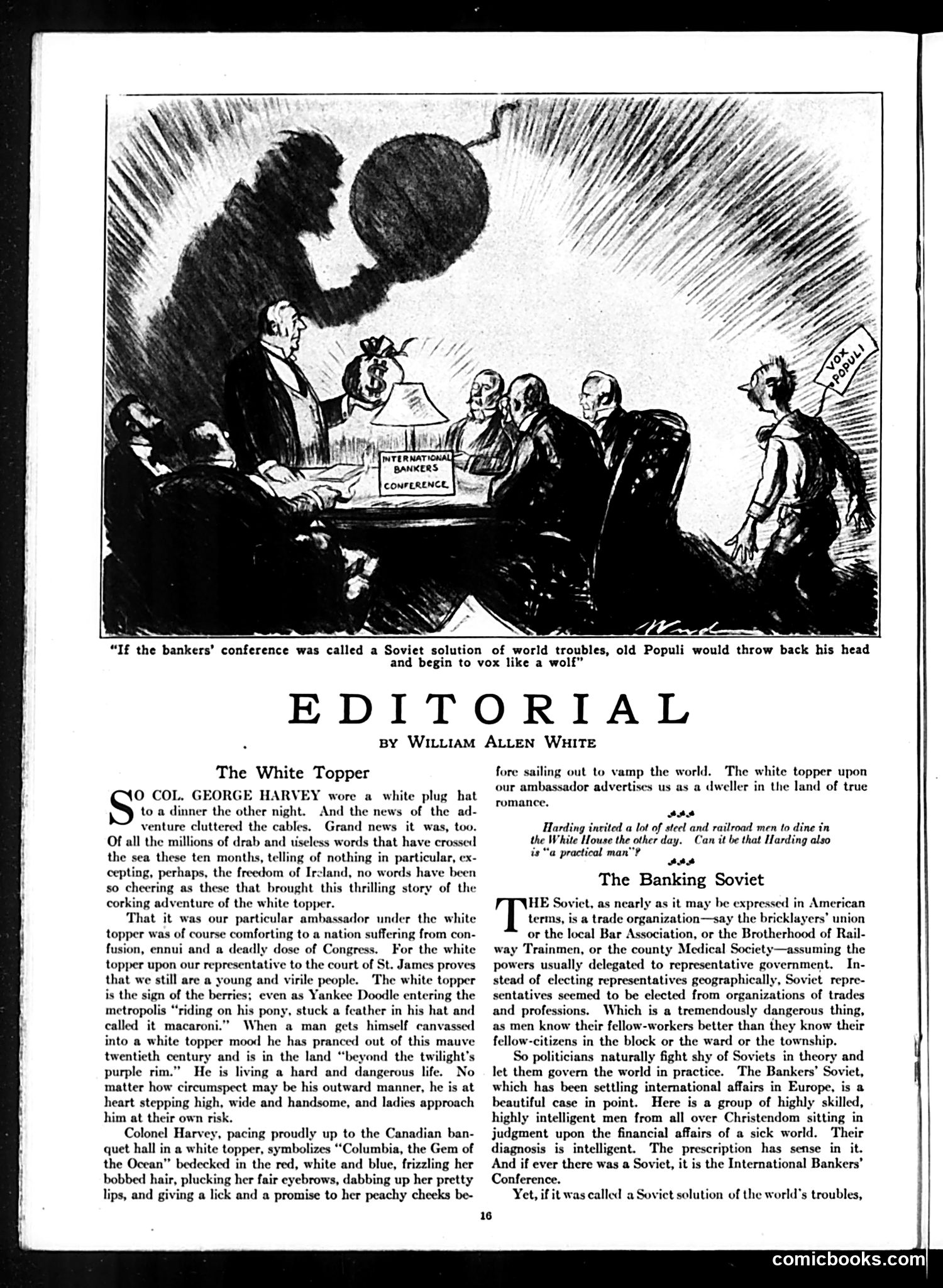
This page contains two satirical editorials by William Allen White, a prominent Progressive-era commentator. **"The White Topper"** mocks Col. George Harvey, U.S. Ambassador to Britain, for wearing formal attire (a white top hat) to a dinner—treating this mundane sartorial choice as major news. White ironically celebrates it as proof America remains "young and virile," contrasting it with the drab coverage of serious issues like Irish independence. The satire critiques both American vanity and the absurdity of what passes for important news. **"The Banking Soviet"** addresses an International Bankers' Conference settling European financial affairs post-WWI. White defines "Soviet" as professional/trade organizations exercising governmental power—dangerous because members know colleagues better than constituents. He argues politicians fear Soviets ideologically but allow bankers to govern globally unchecked. The top cartoon warns that if this banking arrangement were labeled "Soviet," public opinion ("old Populi") would howl in protest, exposing the hypocrisy of accepting banker rule while fearing political Soviets. Both pieces critique postwar leadership and institutional power structures.
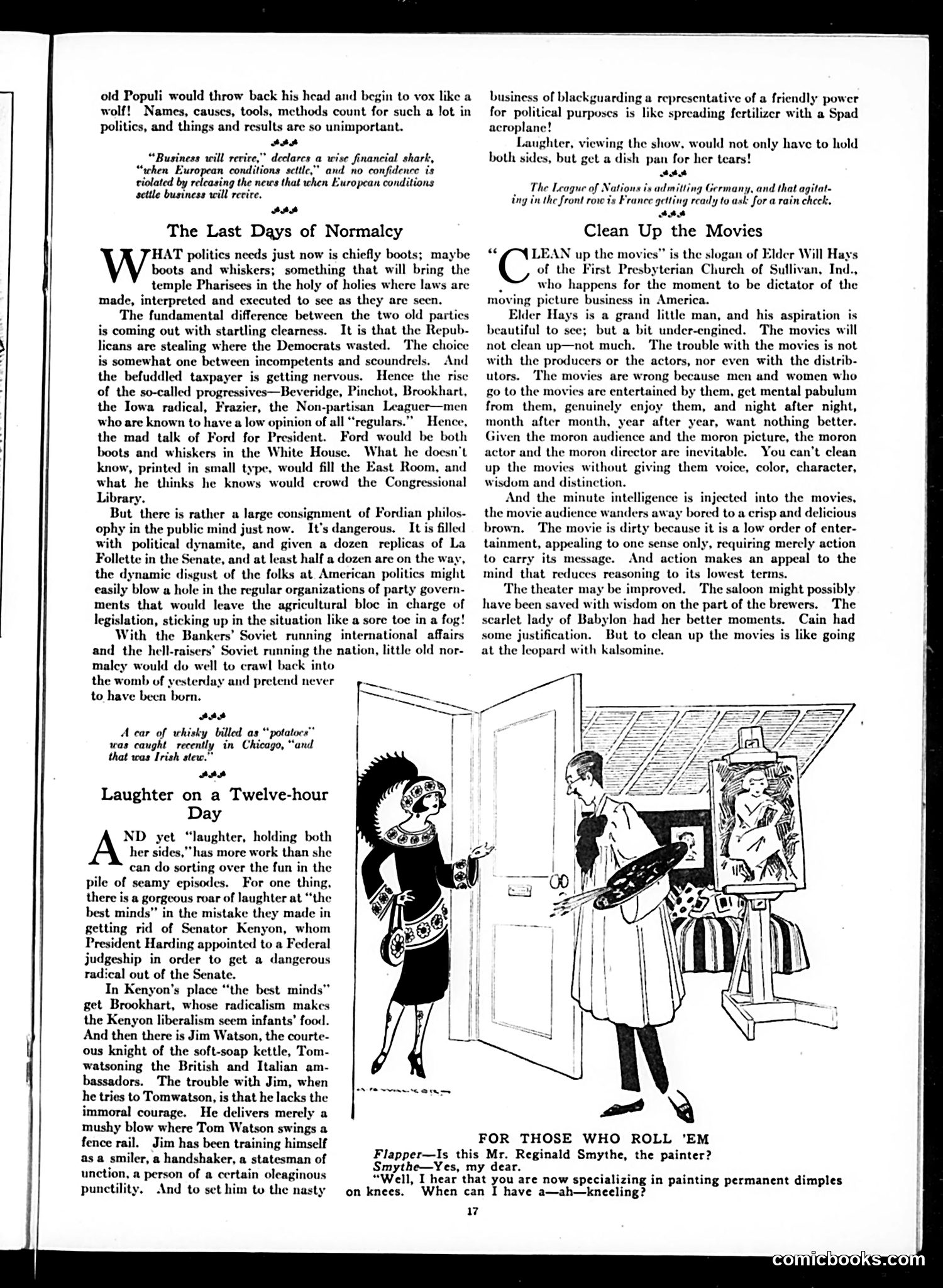
This page satirizes American politics in the early 1920s, likely during the Harding administration. The main editorial attacks both major parties—Republicans for "stealing" where Democrats "wasted"—while expressing alarm at growing radical movements (mentioning progressives like Beveridge, Pinchot, and Brookhart, plus Ford's presidential prospects). The author fears these reformers could destabilize party government, leaving agricultural interests and radical "Soviets" in control. The piece mocks President Harding's judicial appointments: replacing radical Senator Kenyon with even MORE radical Brookhart backfired. It also ridicules Jim Watson's ineffectual diplomacy ("Tomwatsoning")—attempting charm where tougher tactics are needed. The cartoon below depicts a woman at a movie set, with humor about actors and producers. The final joke references League of Nations admission of Germany while France (anxious about security) prepares to withdraw.
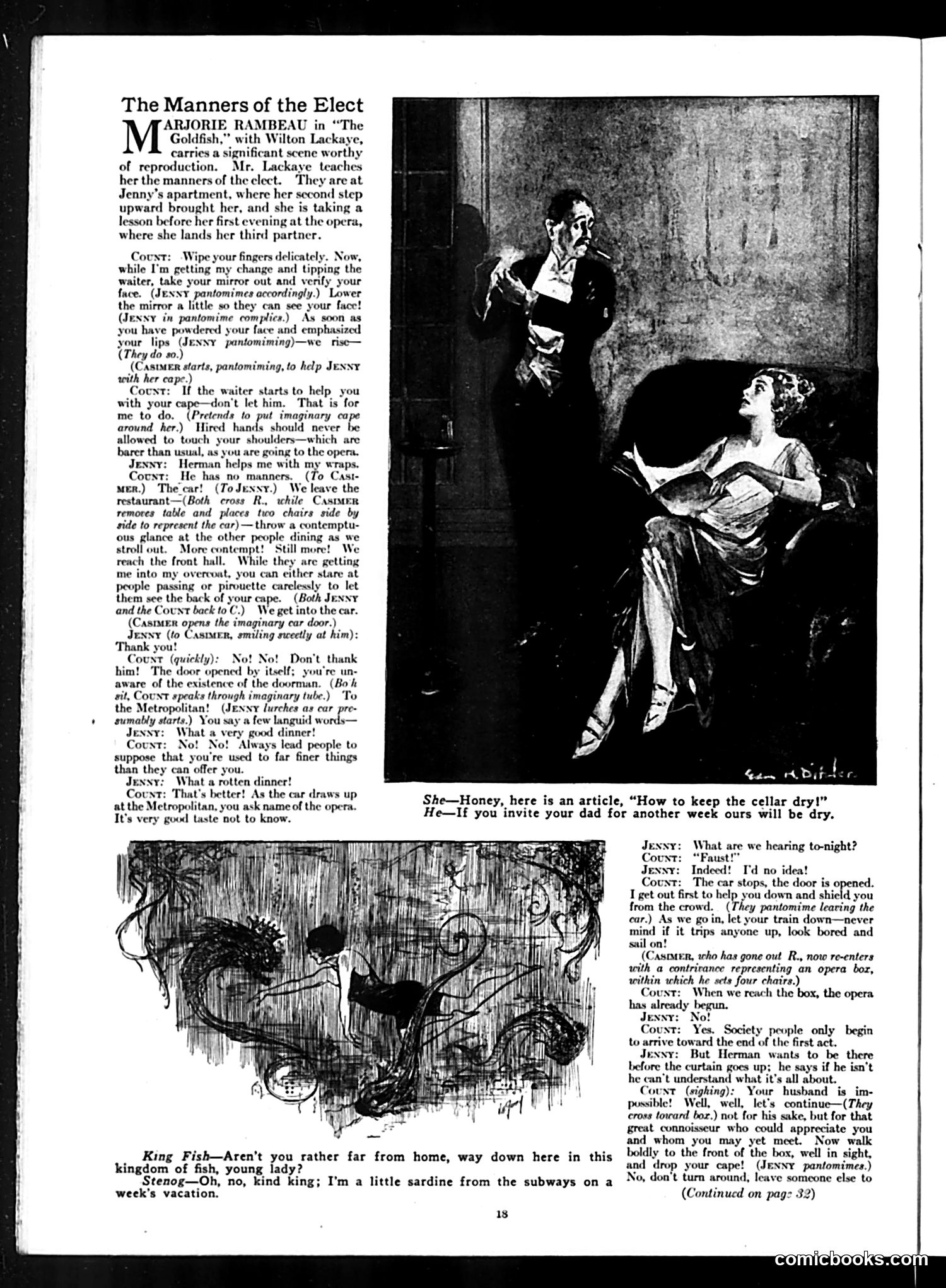
This satirical scene from the play "The Goldfish" mocks nouveau riche social climbing. A Count instructs "Jenny" (played by Marjorie Rambeau) on upper-class etiquette before her opera debut—teaching her to ignore servants, display contempt for ordinary people, and arrive fashionably late. The humor lies in how exaggerated and performative these "manners" are: Jenny must verify her face in public, pirouette to show her cape, and feign indifference to doormen. The satire targets two groups: wealthy elites obsessed with meaningless status rituals, and aspiring social climbers desperate to mimic them. Jenny's husband "Herman" serves as the comic foil—his earnest desire to understand the opera plot is presented as hopelessly middle-class. The piece ridicules both the artificiality of high society and the anxiety of those trying to join it.
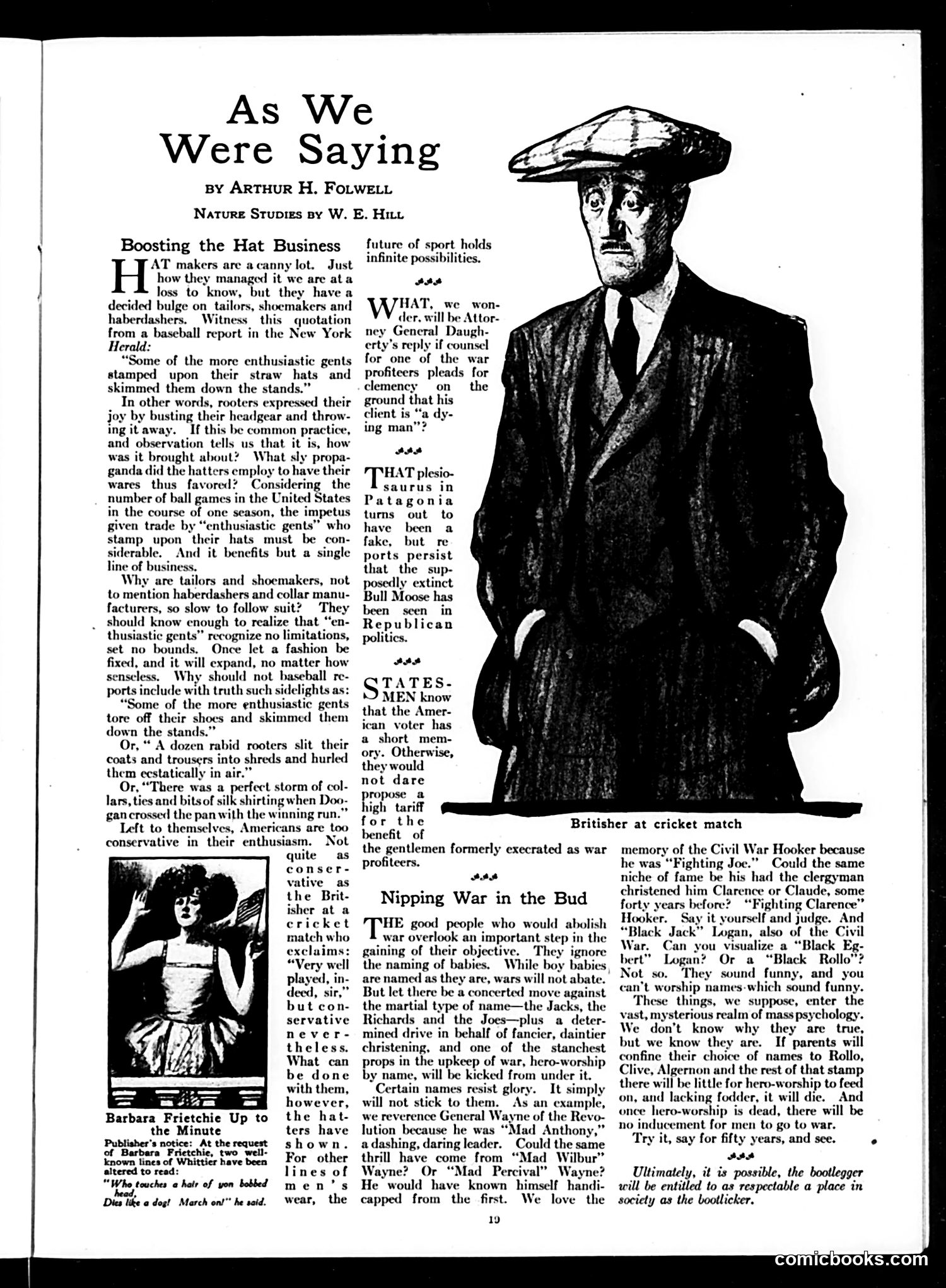
This *Judge* magazine page contains three satirical pieces: **"Boosting the Hat Business"** mocks how American sports fans destroy their hats at baseball games to express enthusiasm, while other industries (tailors, shoemakers) fail to capitalize similarly on consumer passion. The satire critiques American wastefulness and marketing opportunism. **The cricket illustration** contrasts reserved British sports fans ("Very well played, indeed, sir") with boisterous Americans—a common Anglo-American cultural comparison of the era. **"Nipping War in the Bud"** argues that abolishing war requires eliminating martial-sounding baby names (Jack, Richard, Joe). Daintier names like "Mad Wilbur" or "Mad Percival" wouldn't inspire heroic glory-seeking. This post-WWI satire blames war on the romanticization of military names and hero-worship. **"War Profiteers"** references Attorney General Daugherty and implies he won't prosecute wealthy war profiteers claiming hardship—contemporary criticism of Roaring Twenties corruption. The "Bull Moose in Republican politics" alludes to Theodore Roosevelt's Progressive Party, now seemingly extinct.
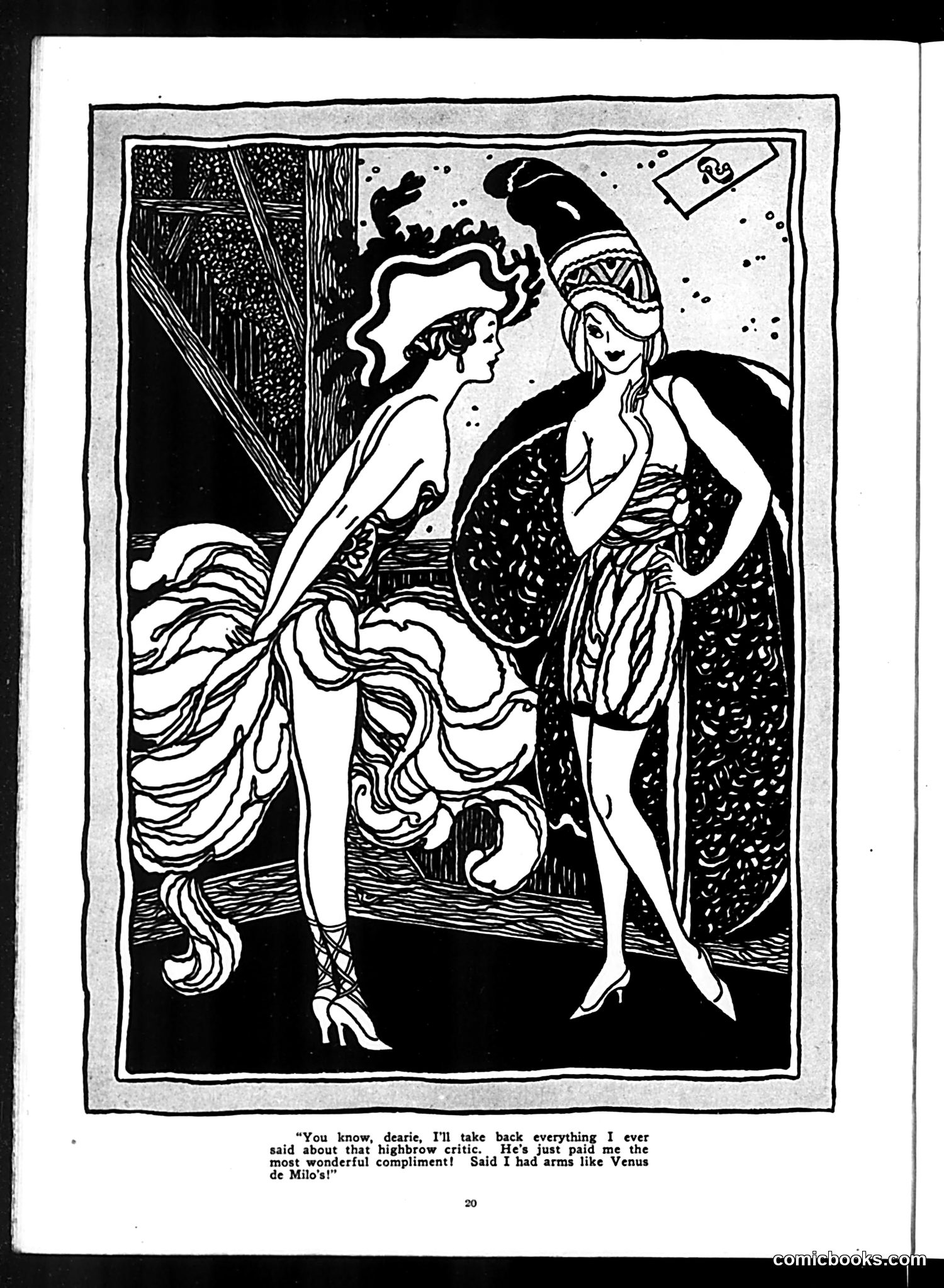
This illustration depicts two women in an intimate indoor scene, apparently discussing a compliment from a critic. One woman, wearing an ornate headpiece and fur stole, tells the other that a "highbrow critic" complimented her arms by comparing them to Venus de Milo (the famous classical sculpture). The joke plays on the irony that Venus de Milo is famously *armless*—missing both arms. The critic's supposed compliment is therefore backhanded or nonsensical, yet the woman takes it as genuine praise, demonstrating either her obliviousness or her vanity in accepting flattery without scrutiny. This satirizes both pretentious art criticism and women's susceptibility to empty flattery dressed in classical or intellectual language.
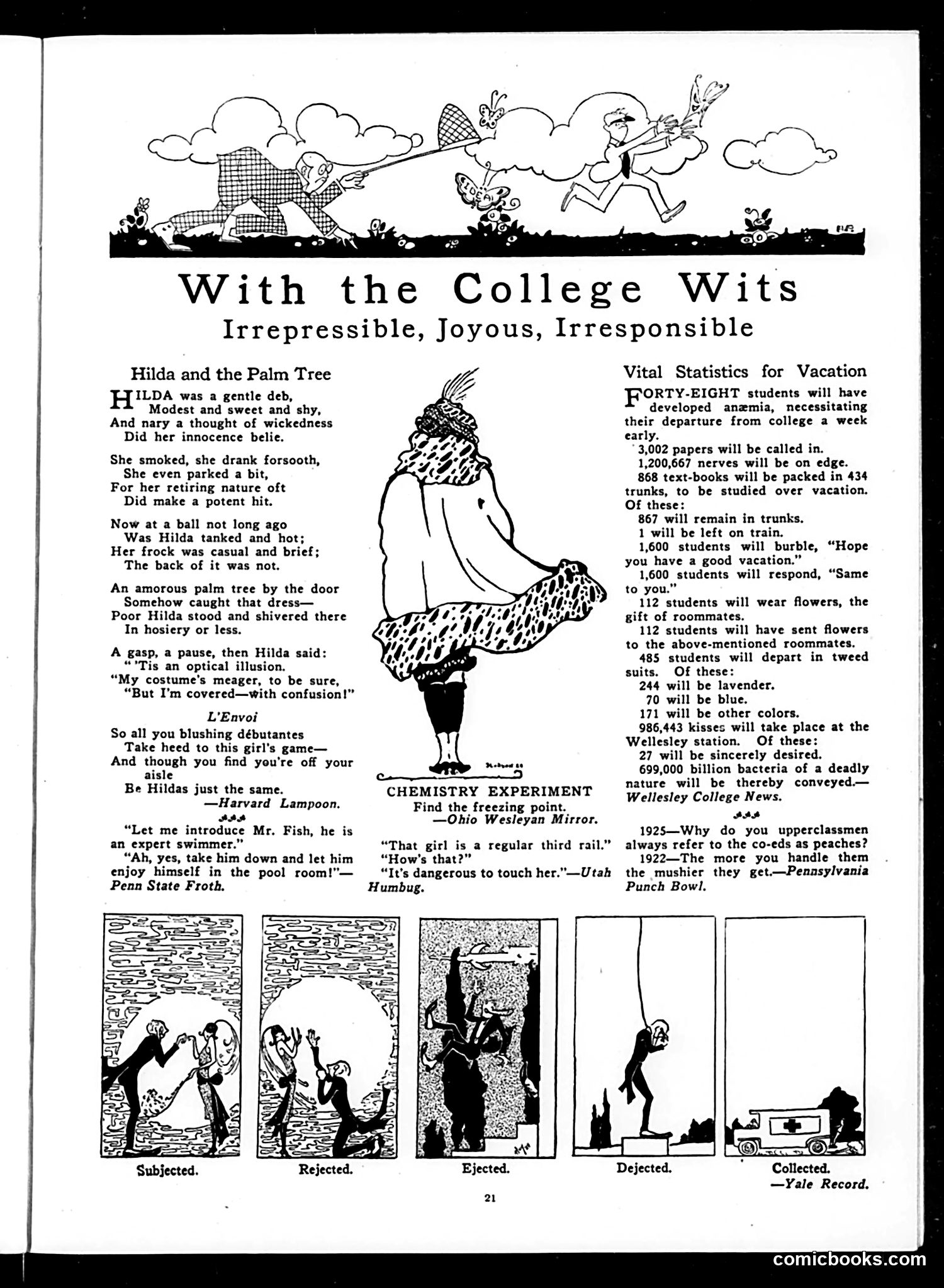
This page collects humorous sketches and jokes from various college humor magazines (Harvard Lampoon, Penn State Froth, Ohio Wesleyan Mirror, etc.), targeting the behavior of 1920s college students—particularly young women ("co-eds") and their newfound social freedoms. **Key themes:** The "Hilda" poem satirizes the contradiction between debutantes' public personas (modest, innocent) and their actual behavior (smoking, drinking, "parking"—necking in cars). The punchline plays on her embarrassment when a palm tree strips her dress. Other jokes mock dating rituals, attraction as "dangerous," and the messy logistics of vacation travel. The "Vital Statistics" section uses absurdist humor about exam anxiety and romance—notably the joke that of 986,443 kisses at the train station, only 27 are "sincerely desired," reflecting cynicism about perfunctory farewells. The final "peaches" joke references attractive women as fruit, with a dark implication about how physical contact degrades them—typical period sexism disguised as humor.
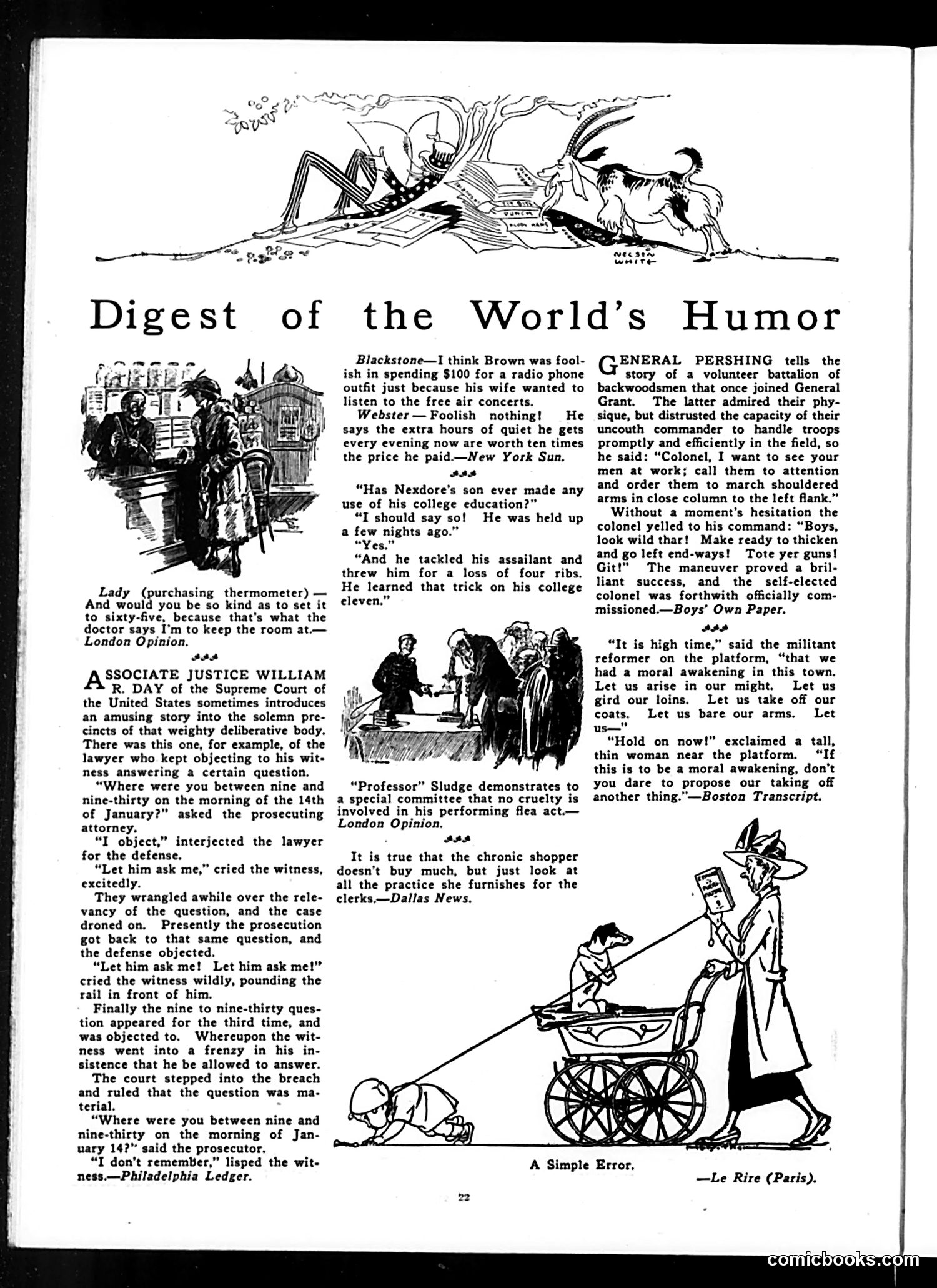
This is a humor compilation page from *Judge* magazine featuring satirical anecdotes and cartoons. Key items include: **Supreme Court Justice Story**: A joke about legal obstruction—a witness desperately wants to answer a question repeatedly objected to by defense counsel, but when finally allowed, admits he doesn't remember. The satire mocks excessive legal formalism. **Radio Phone Anecdote**: A man's $100 radio purchase annoys his wife until he realizes the device gives him peaceful evenings of quiet—satirizing both marital dynamics and consumer technology. **College Education Joke**: A son proves his education "useful" by applying a football tackle to an assailant—mocking the practical value of higher education. **General Pershing Story**: Backwoods soldiers execute a military command using rustic dialect ("tote yer guns") yet succeed brilliantly—satirizing both rough frontier competence and military decorum. **Reform Platform Cartoon**: A woman interrupts a male reformer's rousing moral call-to-action, sardonically requesting he stop before suggesting women remove *more* clothing—satirizing both earnest reform rhetoric and gender dynamics.
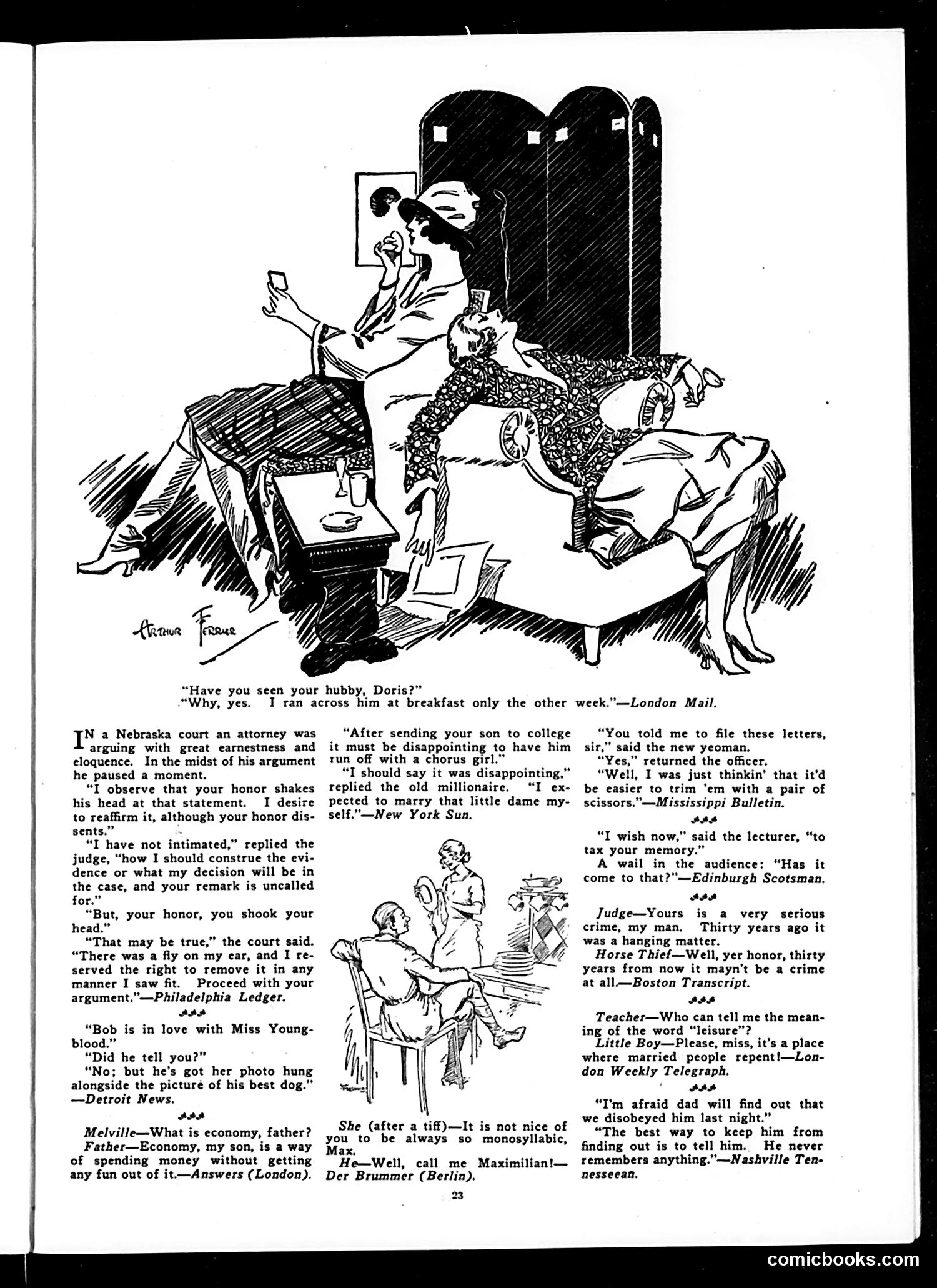
This page from Judge presents a collection of brief humorous anecdotes and one cartoon, typical of the magazine's satirical format. **The Main Cartoon** (top) depicts a woman on a telephone with scattered papers and belongings around her, illustrating the London Mail joke about a husband rarely seen—she encounters him "at breakfast only the other week," suggesting marital disconnection through busy modern life. **The Jokes** reflect early 20th-century social preoccupations: - A Nebraska courtroom scene mocking judicial pomposity - A young man's romantic devotion indicated by displaying his girlfriend's photo alongside his dog's picture (satirizing misplaced priorities) - Economic hardship disguised as virtue - Generational disappointment (wealthy father wanting to marry his son's chorus-girl girlfriend) - Bureaucratic absurdity (filing documents with scissors) - Social anxieties about marriage, education costs, and moral decline The humor relies on wordplay, exaggeration, and gentle mockery of middle-class anxieties and institutional failings rather than sharp political commentary. The international datelines (London, Berlin, Boston) reflect Judge's cosmopolitan readership.
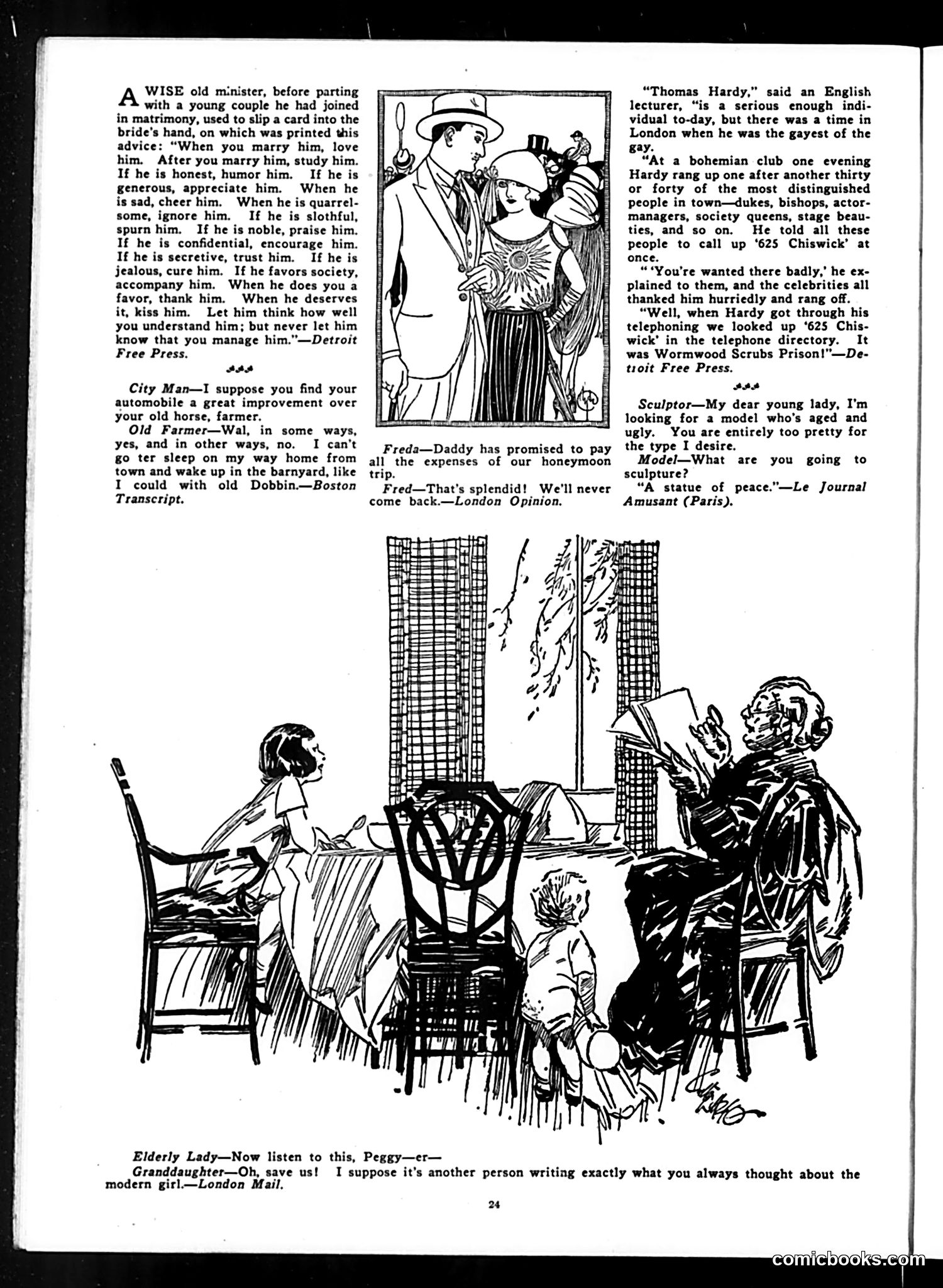
This page from *Judge* contains multiple short humorous pieces typical of early 20th-century American satirical magazines: **The Minister's Marriage Advice** presents traditional gender dynamics—a bride is counseled to subtly "manage" her husband while letting him believe he's in control, reflecting period anxieties about marriage and women's influence. **Three Short Jokes** follow: a farmer prefers horses to automobiles (poking fun at rural resistance to modernity); a couple planning a honeymoon funded by the bride's father, joking they won't return; and a sculptor seeking an ugly model for a "peace" statue (ironic commentary on artistic values or war's ugliness). **The Thomas Hardy Anecdote** mocks the famous writer by claiming he once orchestrated a prank calling forty distinguished people to a prison phone number—satirizing both Hardy's reputation and pretentious society figures. **The Bottom Cartoon** shows an elderly woman reading to a granddaughter, commenting that the letter describes exactly what the modern girl thinks—suggesting generational anxiety about women's changing attitudes and independence. The overall tone reflects early 20th-century concerns about modernity, gender roles, and social propriety.
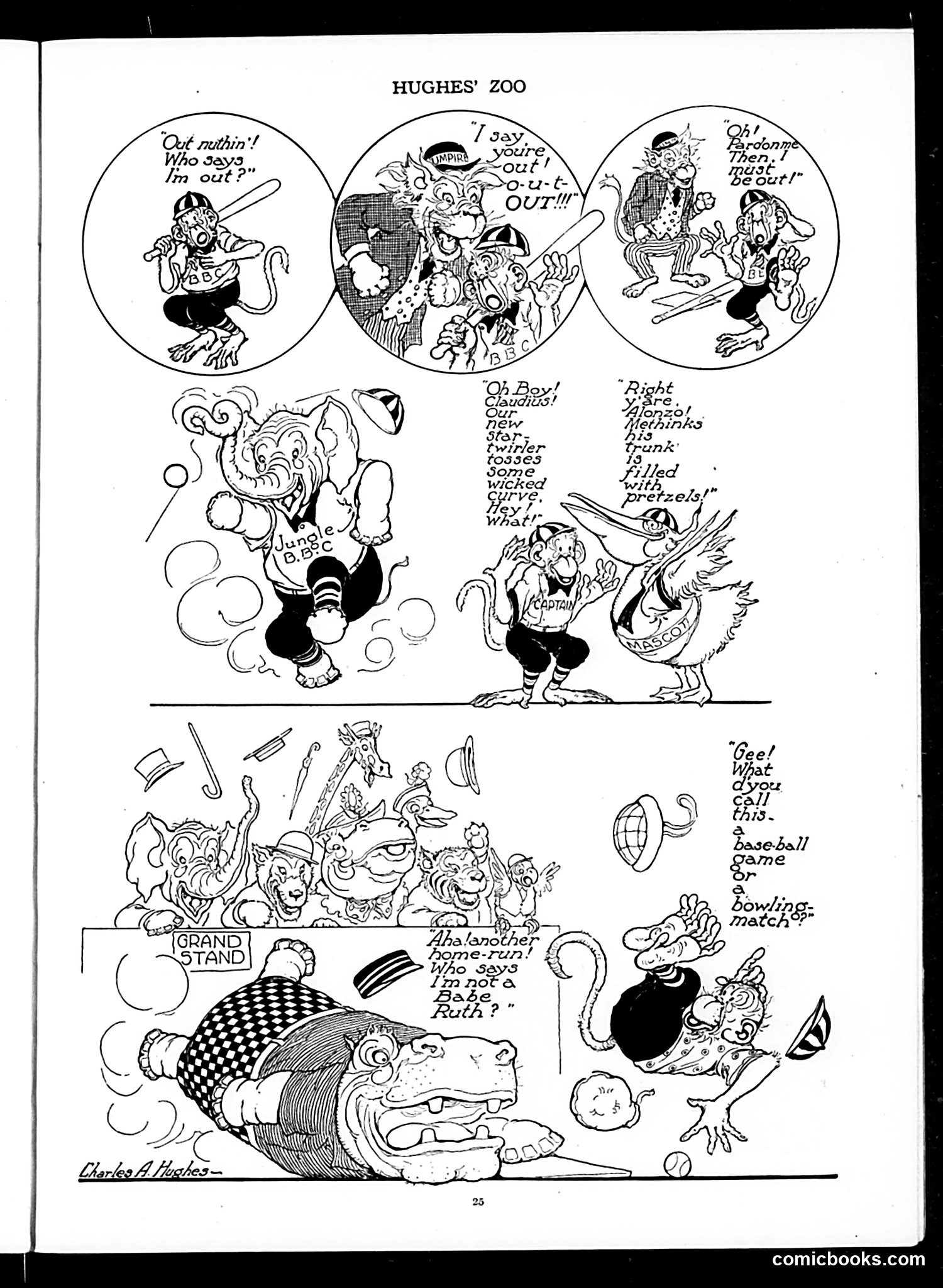
This appears to be a satirical cartoon about Charles Hughes, likely from his 1916 presidential campaign against Woodrow Wilson. The "zoo" metaphor presents Hughes surrounded by chaotic animal characters and political figures, suggesting his campaign or administration was disorganized or populated by dubious characters. The dialogue references baseball ("home run," "Babe Ruth") and bowling, mixing sports vernacular with political chaos. One figure insists "I'm out?" despite apparent removal, possibly mocking Hughes's campaign inconsistencies or his difficulty gaining political traction. The cartoonist (Clarke A. Hughes, per signature) uses animal caricatures—a common device for depicting political opponents as base or foolish. Without clearer identification of specific figures, the precise targets remain unclear, but the overall message portrays Hughes's political operation as a disorderly spectacle worthy of mockery.
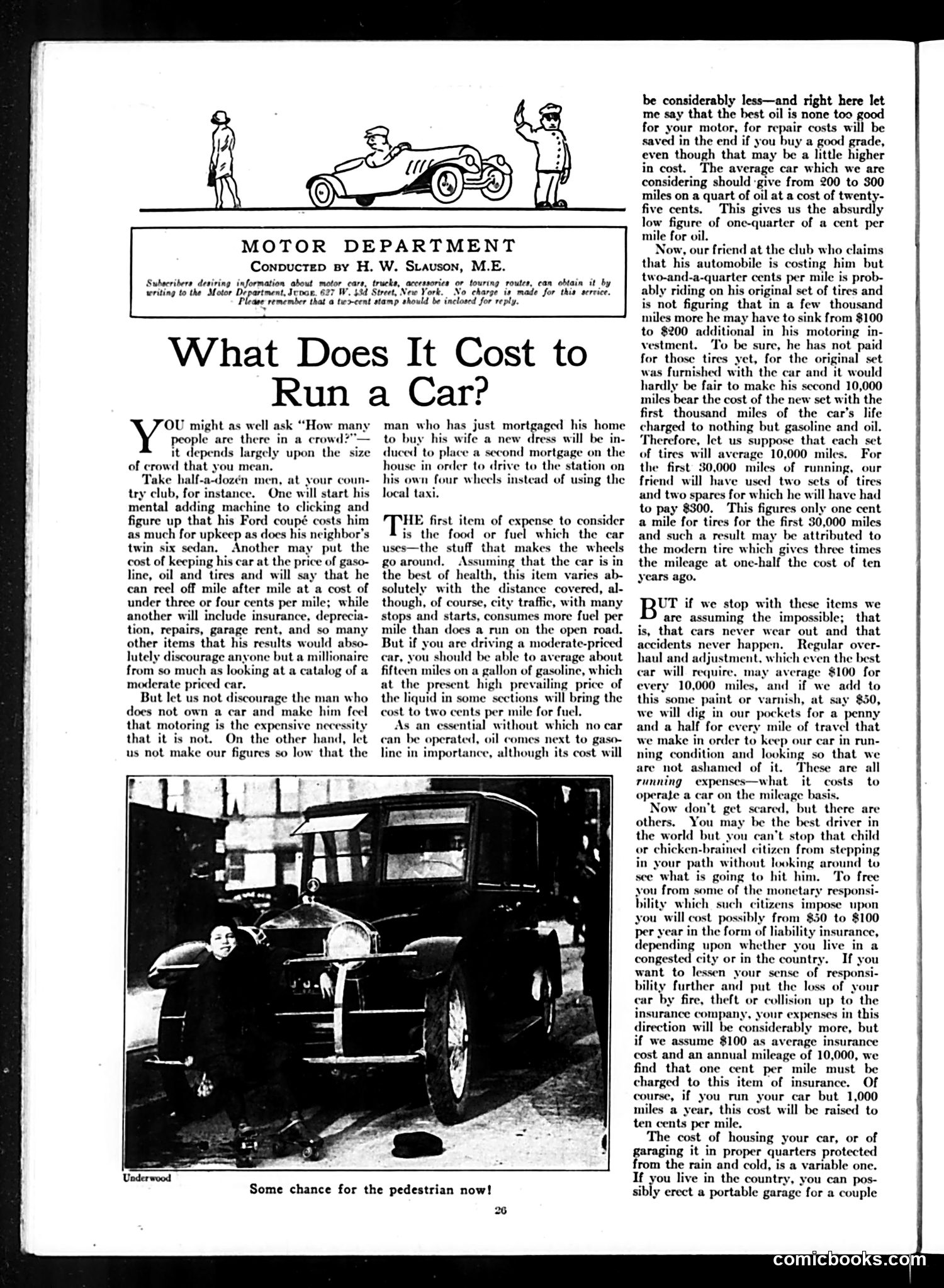
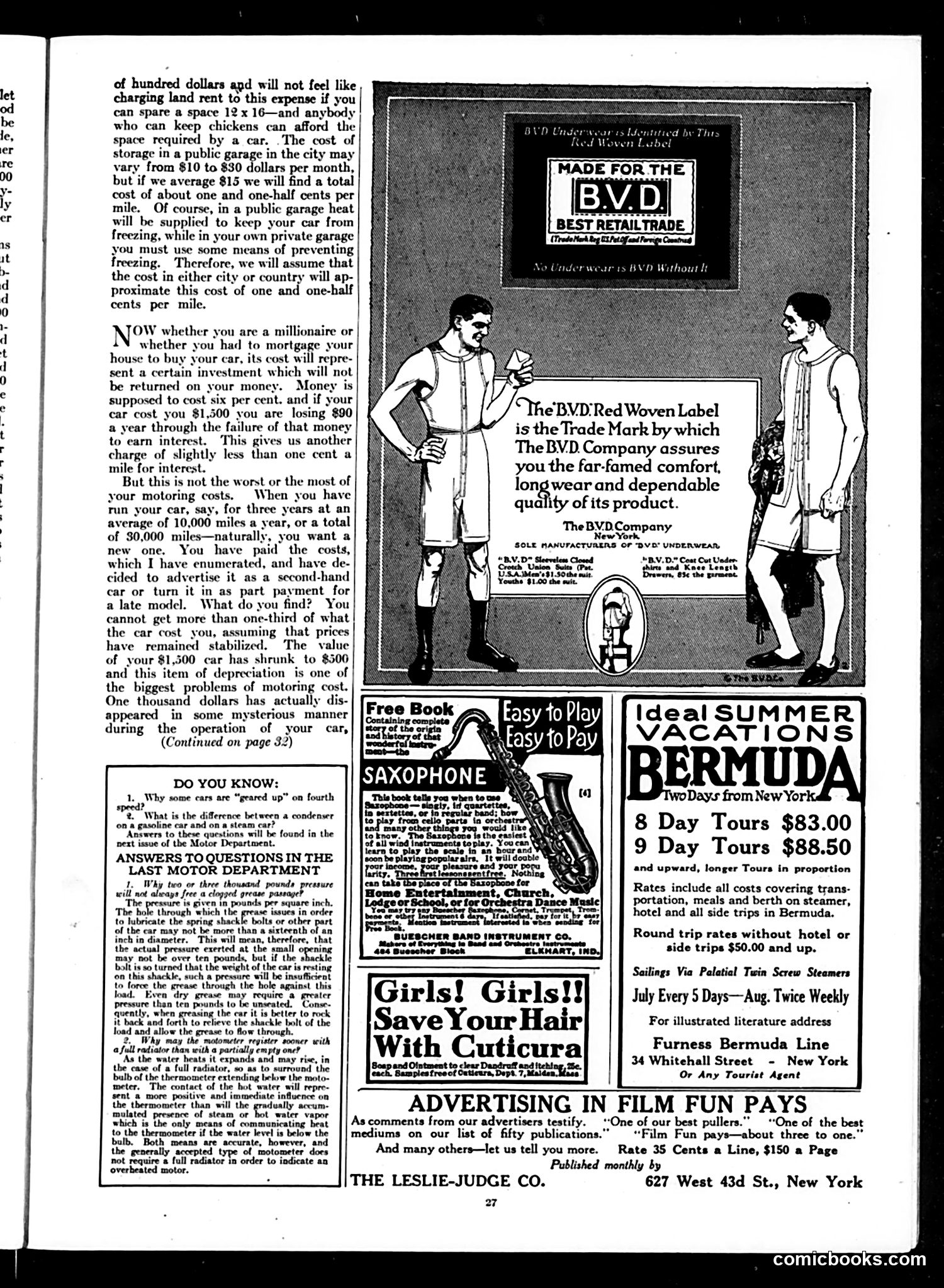
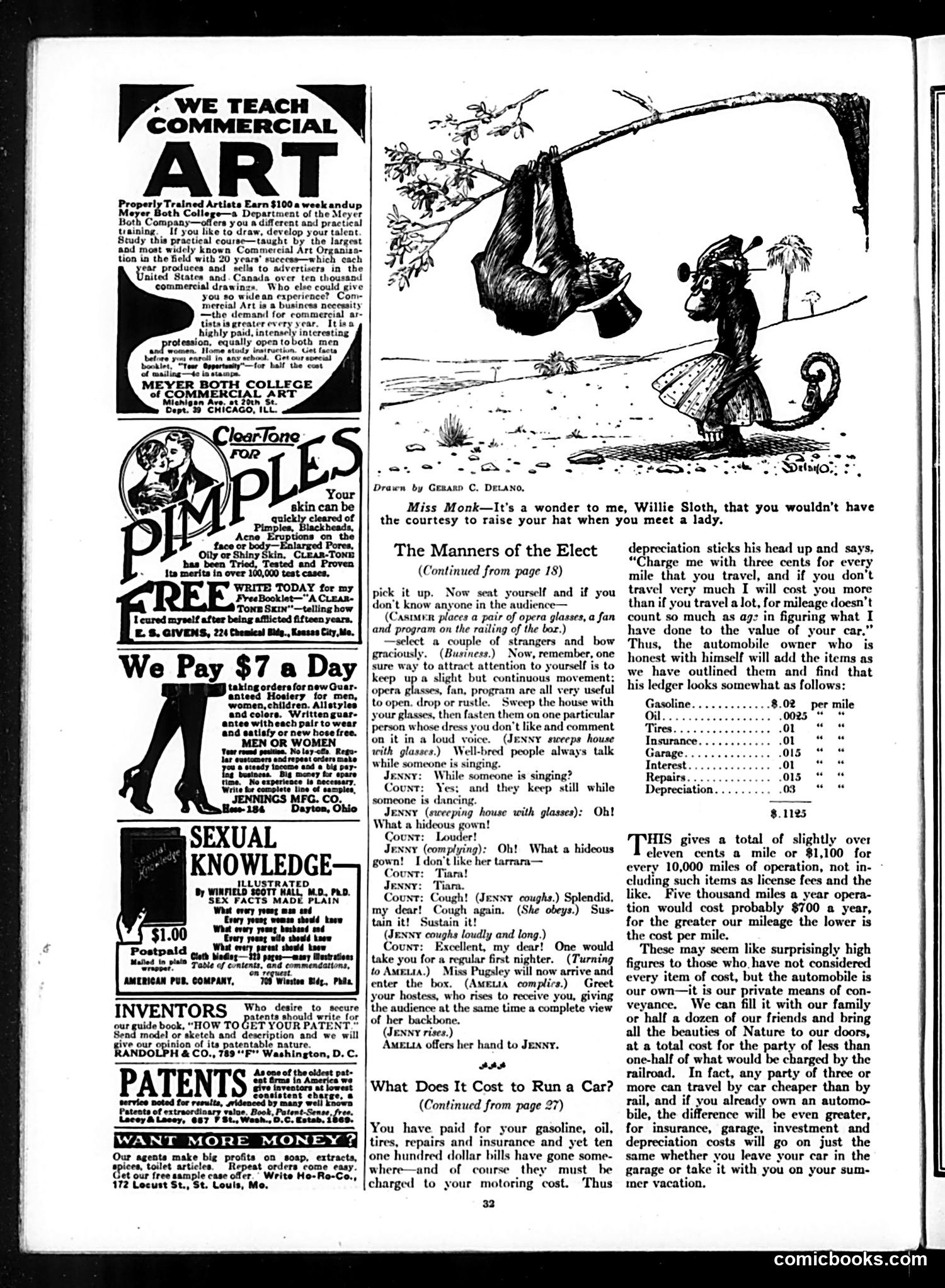
This page is primarily **educational automotive content** mixed with period advertisements. The main text discusses the true costs of car ownership—storage, depreciation, and interest—explaining why a $1,500 automobile loses two-thirds its value after three years. This was relevant to 1920s readers questioning whether car ownership was economically practical. The page includes **technical Q&A about automobile mechanics** (greasing, pressure systems, radiator function), addressing common owner concerns. The **advertisements** are era-typical: BVD underwear with a "Red Woven Label" trademark; Cuticura hair care; a Bermuda vacation package; and saxophone/music instruction books. These reflect 1920s consumer culture. **No political cartoons appear here.** The page functions as a practical motorist's guide combined with commercial pitches—characteristic of Judge's mix of satire, education, and advertising revenue.
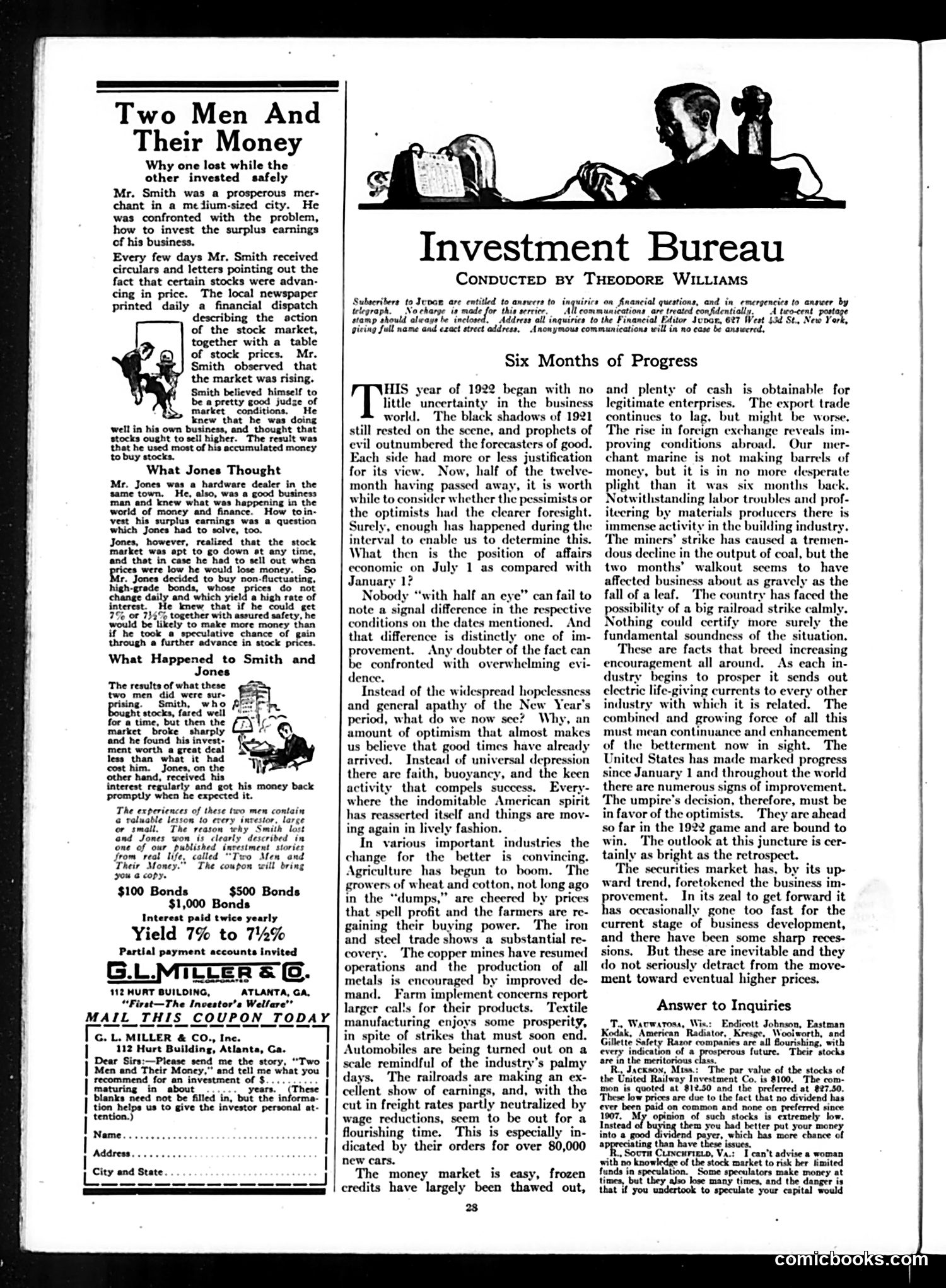
This is a financial advice piece disguised as a morality tale, appearing during the 1922 economic recovery after the 1921 recession. **The Satire:** The cartoon contrasts two businessmen's investment strategies. Mr. Smith, confident from his retail success, assumes stocks will rise and invests his savings in the booming market. Mr. Jones, more cautious, purchases stable bonds yielding 7-7.5% interest. **The Point:** When the stock market crashes, Smith loses substantially while Jones collects regular, reliable returns. The implicit criticism targets overconfident speculators who conflate business acumen with market knowledge—a common pitfall during speculative bubbles. **Historical Context:** Published before the 1929 crash, this reflects genuine 1920s tension between cautious (older) and speculative (newer) investment philosophies. It's essentially an advertisement for G. L. Miller & Co.'s bonds, promoting "safe" fixed-income investments over stock speculation—a position that would seem prescient after 1929, though actually representing conservative, traditional finance advice of the era. The artwork shows the comfortable businessman (Smith) versus the hardware dealer (Jones)—both respectable middle-class figures.
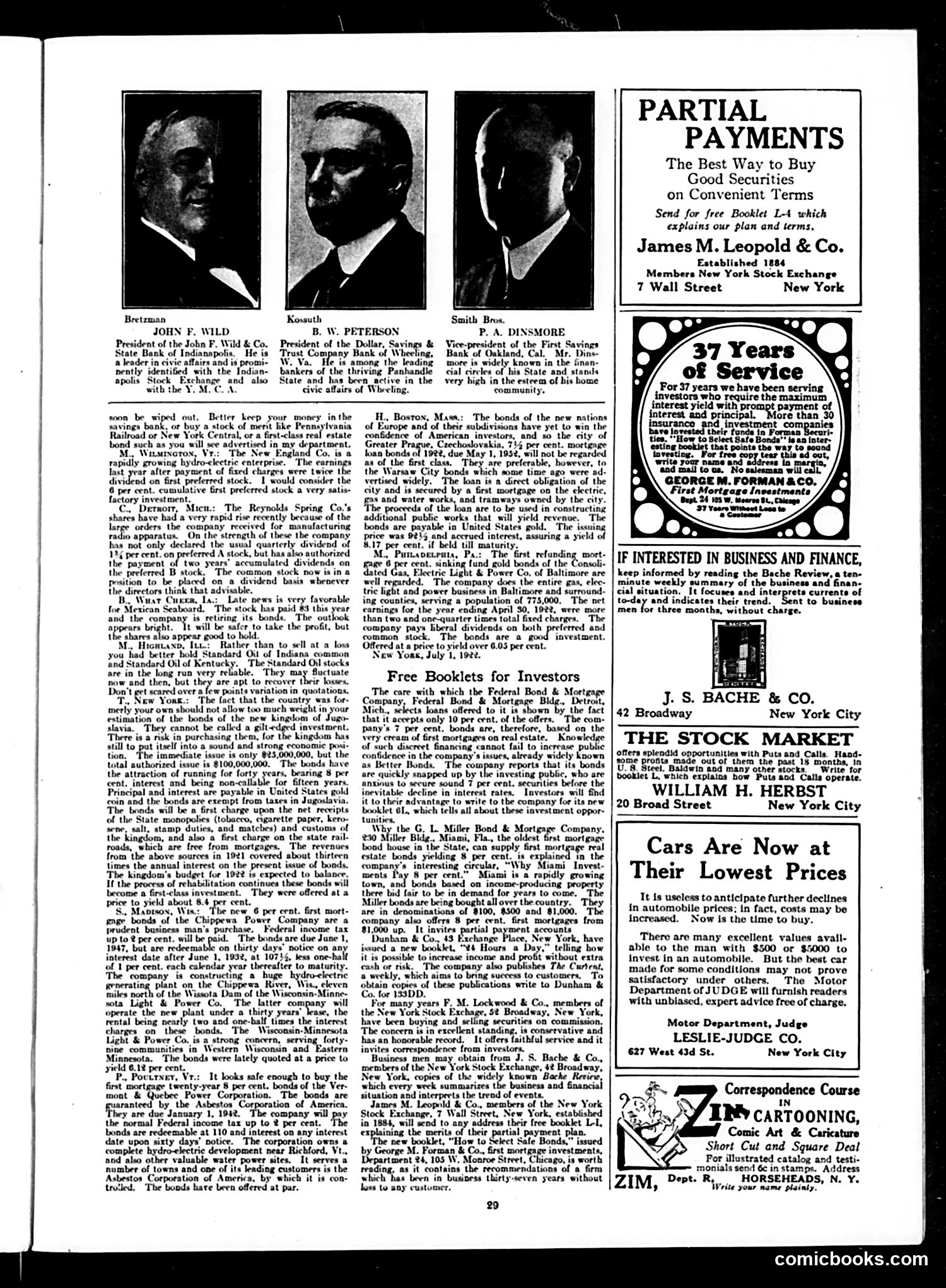
This page is primarily **financial advice and advertising**, not political satire. The three photographs at top show businessmen identified as presidents of savings banks and financial institutions (John F. Wild, B. W. Peterson, P. A. Dinsmore). The bulk of the page consists of an **investment advice column** answering readers' questions about bonds, stocks, and financial instruments popular in the 1920s—Pennsylvania Railroad shares, Mexican Seaboard stock, Standard Oil shares, and Yugoslavian government bonds. The advertisements below promote financial services: partial payment stock purchases, investment advisory services, and automobiles ("Cars Are Now at Their Lowest Prices"). **For modern readers:** This reflects the 1920s investment culture before the 1929 crash, when ordinary citizens actively traded stocks and bonds. The casual tone suggesting which investments to hold or sell shows pre-Depression confidence in markets. The page's focus on financial matters over humor indicates Judge's dual role as both satirical magazine and business-focused publication.
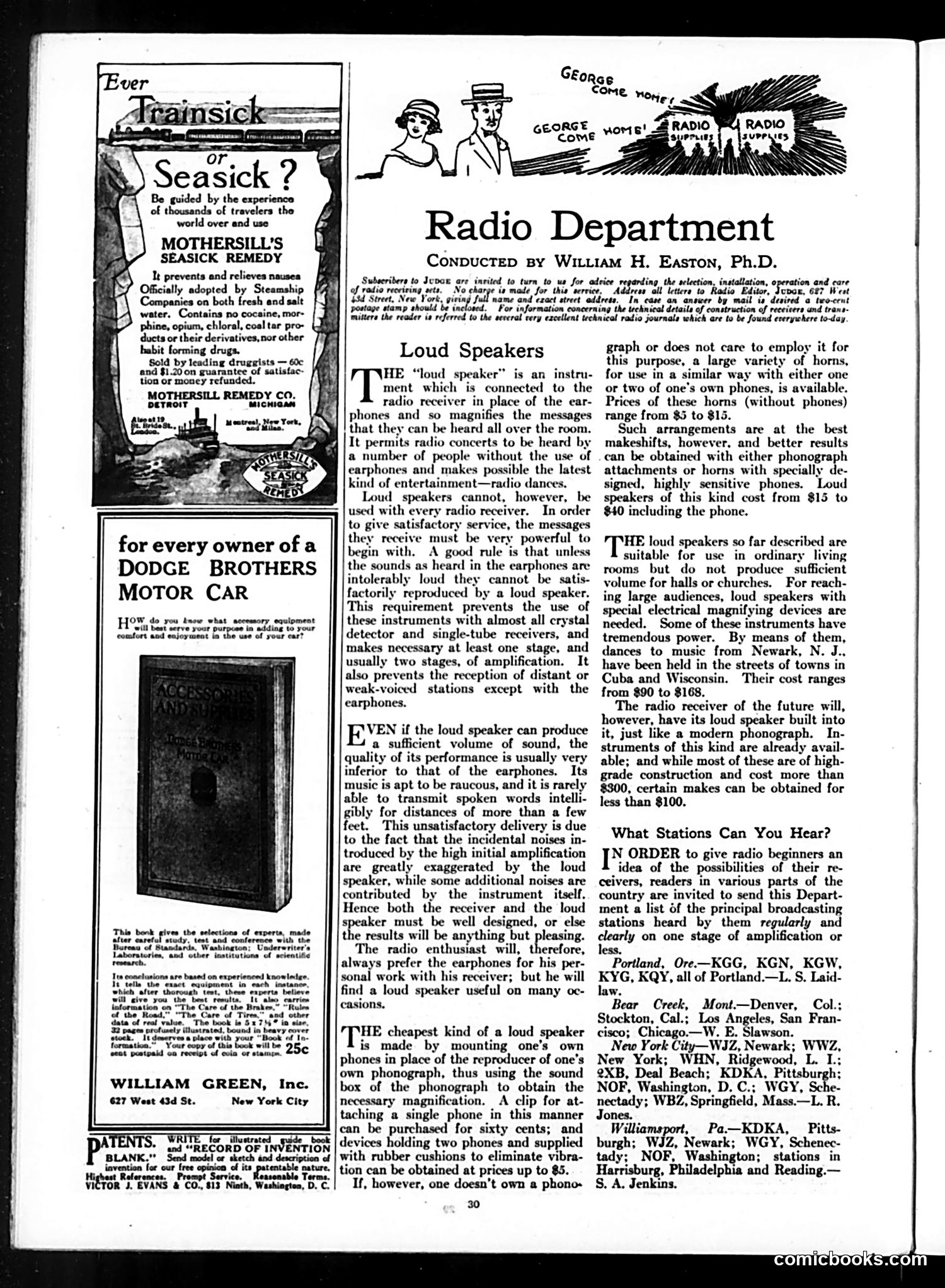
This page is primarily **educational advertising and technical content** rather than satirical cartooning. The small cartoon at top shows a couple calling "George, come home!" while radios broadcast "Radio Supplies"—a humorous reference to early radio's popularity as domestic entertainment that could distract people from family life. The bulk of the page is a **"Radio Department" advice column** by William H. Easton, Ph.D., explaining loud speakers to Judge readers interested in the new radio technology. This was the 1920s radio boom era. The surrounding advertisements (Mothersill's Seasick Remedy, Dodge Brothers automobiles, William Green's accessory guide) represent typical consumer goods marketed to Judge's middle-class readership. **Context for modern readers**: This reflects early radio's novelty—still exotic enough to require expert explanation in a major magazine—and how radio was marketed as family entertainment, competing with other leisure activities and purchases for consumer attention and dollars.
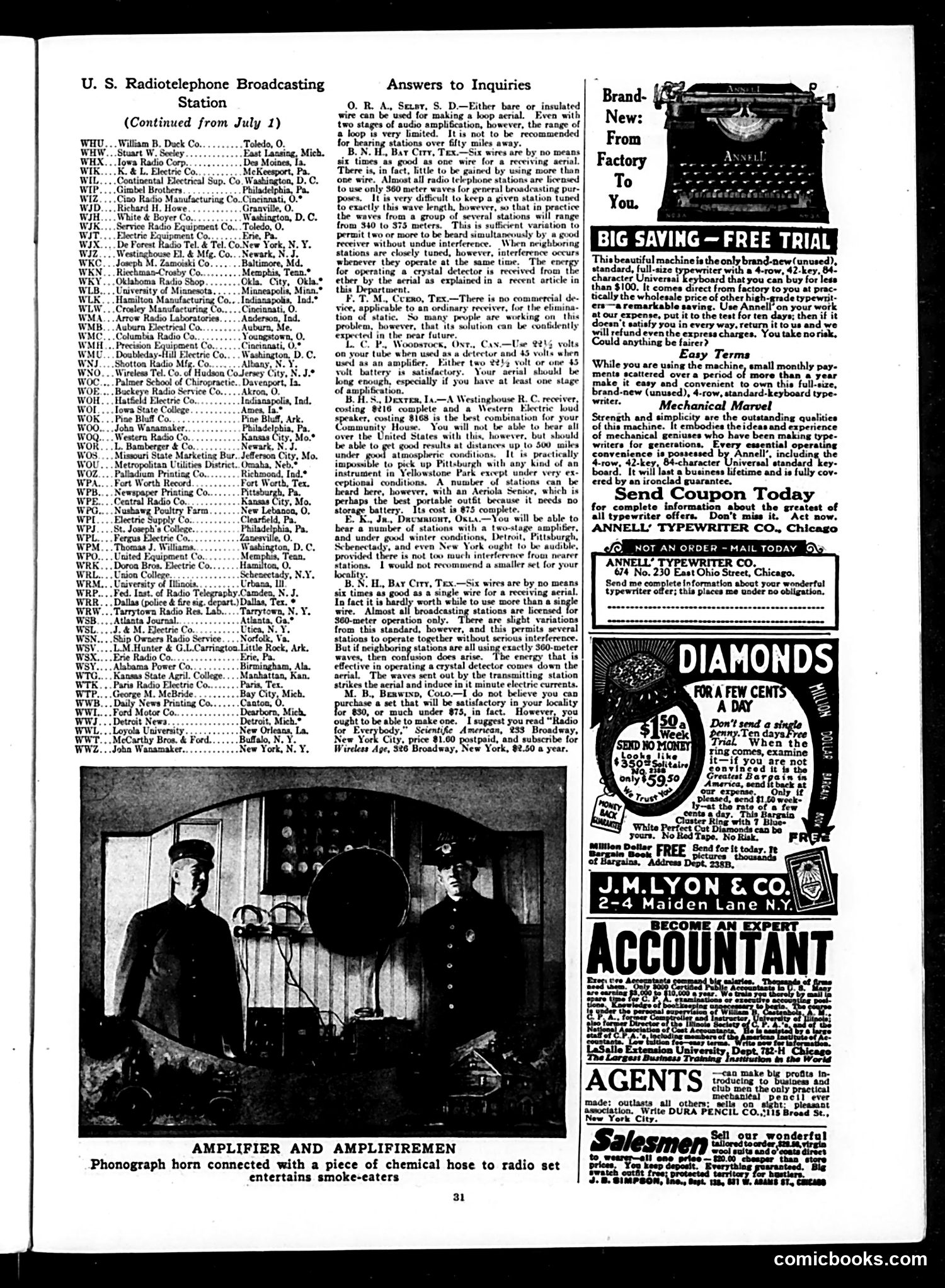
This is primarily a **directory page** from an early radio magazine, listing U.S. broadcasting stations and radio manufacturers, along with a Q&A column answering reader inquiries about radio equipment and reception. The bottom photograph shows two men operating an early radio amplifier connected to a phonograph via a chemical hose—a humorous technical demonstration of early broadcast technology's awkward mechanics. The advertisements are period-typical: typewriter sales, correspondence courses for accountants, and a diamond investment scheme promising quick profits ("Diamonds for a Few Cents a Day"). **Key context for modern readers**: This appears to be from the early 1920s, capturing radio's infancy when broadcasting was still novel technology. The technical questions (aerial types, static elimination, receiver sensitivity) reflect the experimental nature of home radio reception. The mix of legitimate manufacturers and questionable ventures (cheap diamond schemes) shows how emerging technology attracted both serious entrepreneurs and opportunists.
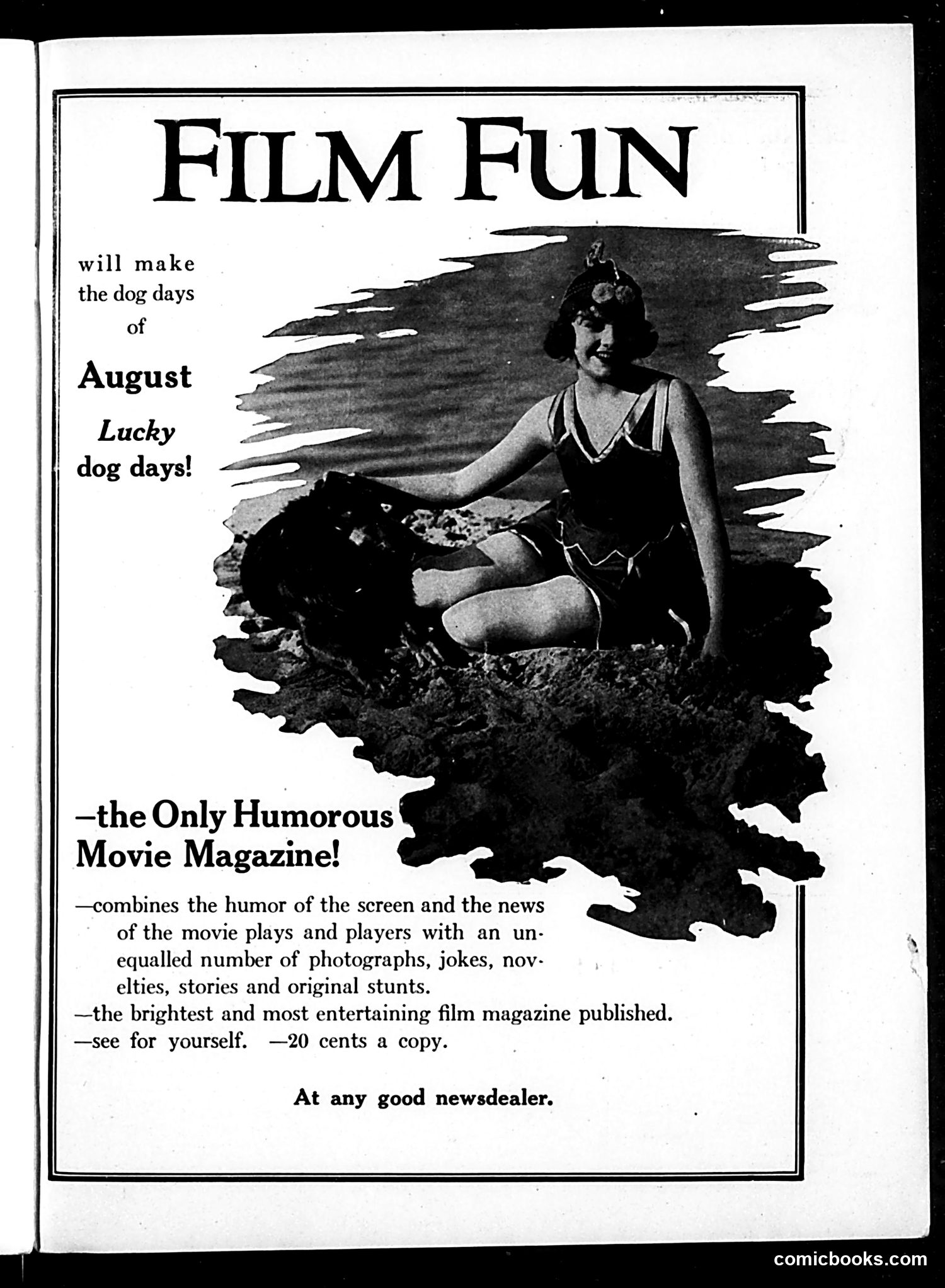
This is a full-page advertisement for *Film Fun*, a humorous movie magazine. The image shows a woman in a bathing suit posing with a dog during August's "dog days" (the hottest part of summer). The ad is straightforward promotion, not satire. It pitches *Film Fun* as "the Only Humorous Movie Magazine," emphasizing its combination of screen humor, celebrity news, photographs, jokes, and novelties. The 20-cent price and newsdealer availability indicate this is a mass-market publication. The "lucky dog days" pun plays on the expression "dog days of August" (oppressively hot weather), suggesting the magazine provides entertaining relief during uncomfortable summer months. This represents typical early-20th-century magazine advertising targeting leisure readers seeking entertainment and celebrity gossip.
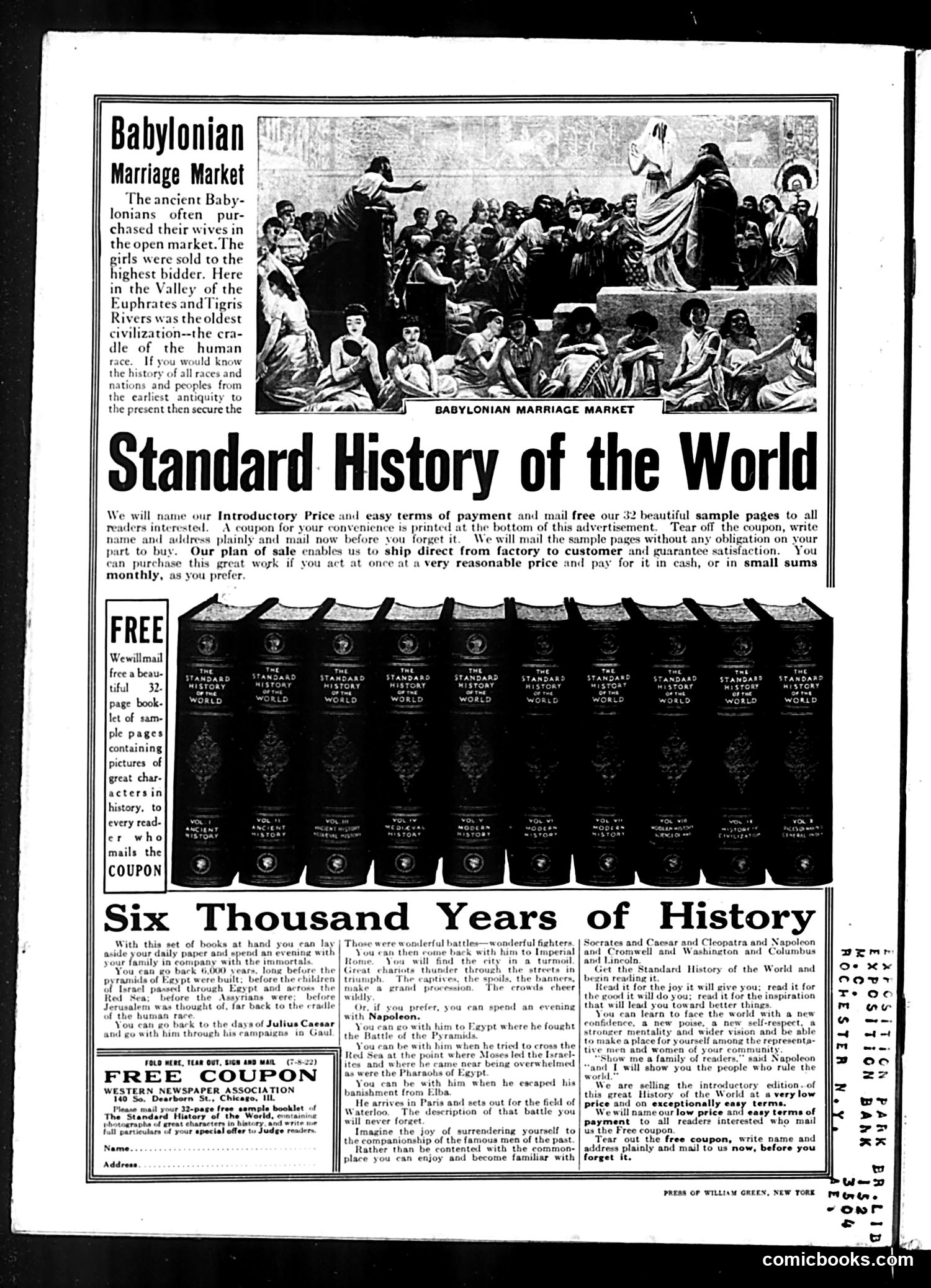
This page is primarily **advertising**, not political satire. The illustration at top depicts the ancient Babylonian practice of auctioning women as wives to the highest bidder—a historical fact presented here to grab readers' attention for a mail-order encyclopedia set called *Standard History of the World*. The "Babylonian Marriage Market" image shows women on display before a crowd of bidders, meant to shock and intrigue early 20th-century American readers. The advertisement leverages this exotic historical practice as a hook, promising that readers who purchase this encyclopedia can explore "six thousand years of history"—from ancient civilizations through Napoleon and Lincoln. The satirical *Judge* magazine likely included this advertisement because its sensational imagery (women as commodities) creates an ironic contrast with the earnest, self-improving promise of historical education. The ad's emphasis on easy payment plans and free samples targets working-class readers seeking cultural literacy.