
Judge, 1922-07-08 · page 20 of 36
Judge — July 8, 1922 — page 20: what you’re looking at
What you’re looking at
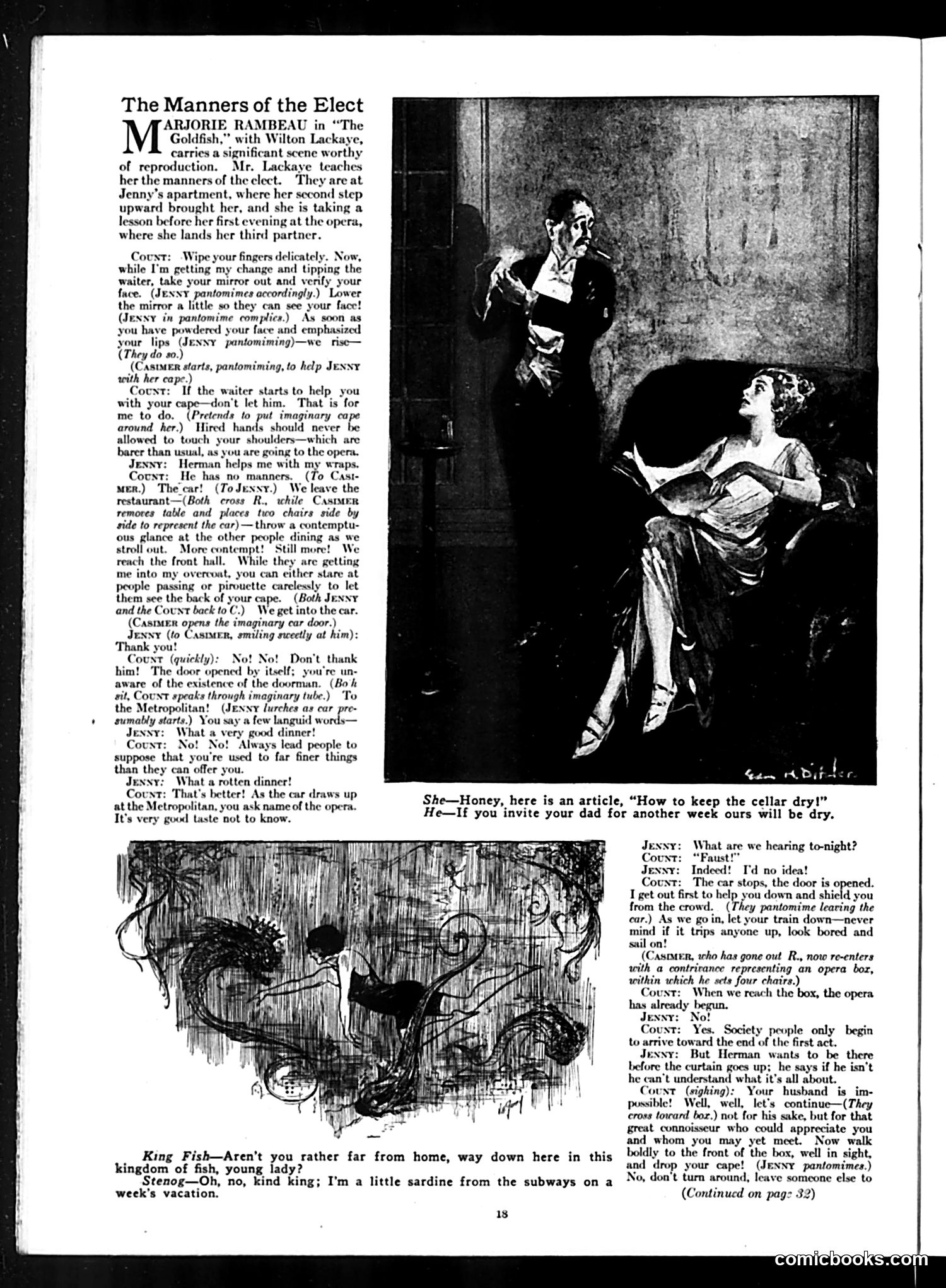
This satirical scene from the play "The Goldfish" mocks nouveau riche social climbing. A Count instructs "Jenny" (played by Marjorie Rambeau) on upper-class etiquette before her opera debut—teaching her to ignore servants, display contempt for ordinary people, and arrive fashionably late. The humor lies in how exaggerated and performative these "manners" are: Jenny must verify her face in public, pirouette to show her cape, and feign indifference to doormen. The satire targets two groups: wealthy elites obsessed with meaningless status rituals, and aspiring social climbers desperate to mimic them. Jenny's husband "Herman" serves as the comic foil—his earnest desire to understand the opera plot is presented as hopelessly middle-class. The piece ridicules both the artificiality of high society and the anxiety of those trying to join it.
📄 Transcribed text from this page (OCR, searchable)
Machine-transcribed from the original scan — historical spelling and the odd misread are preserved.
The Manners of the Elect ARJORIE RAMBEAU in “The Goldfish,” with Wilton Lackaye, carries a significant scene worthy of reproduction. Mr. Lackaye teaches her the manners of the clect. They are at Jenny’s apartment, where her second step upward brought her, and she is taking a lesson before her first evening at the opera, where she lands her third partner. Count: ‘Wipe your fingers delicately. Now, while I'm getting my change and tipping the waiter, take your mirror out and verify your face. (JENNY pantomimes accordingly.) Lower the mirror a little so they can see your face! (Jexxy in pantomime complics.) As soon as you have powdered your face and emphasized Your lips (Jenny pantomiming)—we rise— (They do so.) (Caster starts, pantomiming, to help Jexsy with her cape.) Covent: If the waiter starts to help you with your cape—don't let him. That is for me to do. (Pretends to put imaginary cape around her.) Hired hands should never be allowed to touch your shoulders—which are barer than usual, as you are going to the opera. Jexxy: Herman helps me with my wraps. Cocnt: He has no manners. (To Cast- mer.) The car! (ToJexxy.) We leave the restaurant—(Both cross R., while Caster remotes table and places two chairs side by side to represent the car)— throw a contemptu- ous glance at the other people dining as we stroll out. More contempt! Still more! Wi reach the front hall. While they are getting me into my overcoat, you can either stare at people passing or pirouette carelessly to them see the back of your cape. (Both J and the Count back toC.) We get into the car. (Casnter opens the imaginary car door.) Jenny (to Casiaen, smiling sweetly at him): "Thank you! Coust (quickly): Not Not Don’t thank him! The door opened by itself; you're un- aware of the existence of the doorman. (Boh sit, Count speaks through imaginary tube.) To the Metropolitan! (Jenny lurches sumably starts.) You sa Jexxy: What rt Coust: No! Always lead people to suppose that you're used to far finer things than they can offer you. Jexxy: What a rotten dinner! Couner: That's better! As the car draws up She—Honey, here is an article, “How to keep the cellar dry!” t the Metropolitan, you ask f the opera. Bhd ty It's vay eo lastenok ‘c oe c.opers, He—If you invite your dad for another week ours will be dry. What are we hearing to-night? “Faust!” Indeed! I'd no idea! Count: The car stops, the door is opened. I get out first to help you down and shield you from the crowd. (They pantomime leaving the car.) As we go in, let your train down—never mind if it trips anyone up, look bored and sail on! (Casnter, who has gone out R., now re-enters with a contrivance representing an opera bor, within which he sets four chairs.) Count: When we reach the box, the opera has already begun. Jew: No! Yes. Society people only begin to arrive toward the end of the first act. Jexxy: But Herman wants to be there before the curtain goes up;_he says if he isn’t he can’t understand what it’s all about. Count (sighing): Your husband is _im- possible! Well, well, let's continue—(They cross toward bor.) not for his sake, but for that great connoisseur who could appreciate you and whom you may yet meet. Now walk boldly to the front of the box, well in sight, and drop your cape! (JENNY pantomimes.) ‘i King Fish Aren't you rather far from home, way down here in this ngdom of Ssh, young jady? No, don't tum around, leave someone else to Stenog—Oh, no, kind king; I'm a little sardine from the subways on a week's vacation. (Continued on pag: 32) 18