
Judge, 1922-07-08 · page 21 of 36
Judge — July 8, 1922 — page 21: what you’re looking at
What you’re looking at
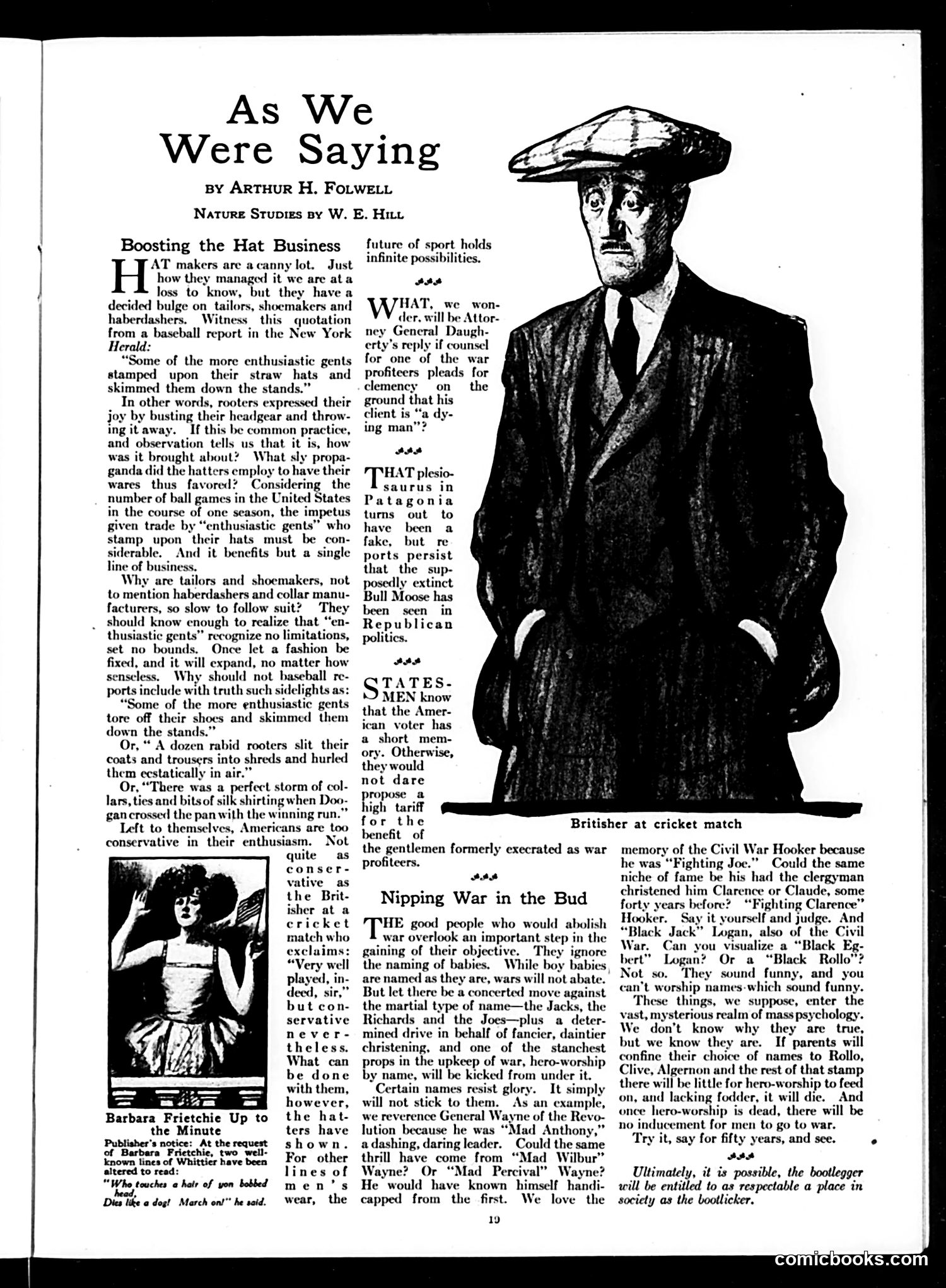
This *Judge* magazine page contains three satirical pieces: **"Boosting the Hat Business"** mocks how American sports fans destroy their hats at baseball games to express enthusiasm, while other industries (tailors, shoemakers) fail to capitalize similarly on consumer passion. The satire critiques American wastefulness and marketing opportunism. **The cricket illustration** contrasts reserved British sports fans ("Very well played, indeed, sir") with boisterous Americans—a common Anglo-American cultural comparison of the era. **"Nipping War in the Bud"** argues that abolishing war requires eliminating martial-sounding baby names (Jack, Richard, Joe). Daintier names like "Mad Wilbur" or "Mad Percival" wouldn't inspire heroic glory-seeking. This post-WWI satire blames war on the romanticization of military names and hero-worship. **"War Profiteers"** references Attorney General Daugherty and implies he won't prosecute wealthy war profiteers claiming hardship—contemporary criticism of Roaring Twenties corruption. The "Bull Moose in Republican politics" alludes to Theodore Roosevelt's Progressive Party, now seemingly extinct.
📄 Transcribed text from this page (OCR, searchable)
Machine-transcribed from the original scan — historical spelling and the odd misread are preserved.
Were Saying BY ARTHUR H. Fotwe.i Nature Srupies sy W. E. Hitt Boosting the Hat Business AT makers are acanny lot. Just how they managed it we are ata loss to know, but they have a decided bulge on_ tailors, shoemakers and haberdashers. Witness this quotation from a baseball report in the New York Herald: “Some of the more enthusiastic gents stamped upon their straw hats and skimmed them down the stands.” In other words, rooters expressed their joy by busting their headgear and throw- ing itaway. If this be common practice, and observation tells us that it is, how was it brought about? What sly propa- ganda did the hatters employ to have their wares thus favored? Considering the number of ball games in the United States in the course of one season, the impetus given trade by “enthusiastic gents” who stamp upon their hats must be con- siderable. And it benefits but a single line of busi Why are tailors and shoemakers, not to mention haberdashers and collar manu- facturers, so slow to follow suit? They should know enough to realize that “en- thusiastic gents” recognize no limitations, set no boun Once let a fashion be fixed, and it will expand, no matter how senseless. Why should not baseball re- ports include with truth such sidelights as: “Some of the more enthusiastic gents tore off their shoes and skimmed them down the stands.” Or, * A dozen rabid rooters slit their coats and trousers into shreds and hurled them ecstatically in air.” Or, “There was a perfect storm of col- lars, ties and bitsof silk shirting when Doo- gan crossed the pan with the winning run.” Left to themselves, Americans are too conservative in their enthusiasm. Not quite as conser- vative as the Brit- isher at a cricket match who exclaims: “Very well played, in- deed, sir,” but con- servative never- theless. What can be done with them, however, the hat- Barbara Frietchie Up to ters have the Minute Publisher's notice: at the request wn. of Barbara Frietchie, two well- oho re known lines of Whittier have been For other altered to read: lines of “Whe touches @ halr of von belied men’ s Dies like a dog! March on!” he soid. wear, the future of sport holds infinite possibilities. sae HAT, we won- der, will be Attor- ney Gencral Daugh- erty’s reply if counsel for one of the war profiteers pleads for clemency on the ground that his client is “ta dy- ing man”? Canal THT plesio- saurus in Patagonia turns out to have been a fake, but re ports persist that the sup- posedly extinct Bull Moose has been seen in Republican politics. PAF TATES- MEN know that the Amer- ican voter has a short mem- the: y would not dare ropose a high tariff for the benefit of the gentlemen formerly execrated as war profiteers. ery Nipping War in the Bud THE good people who would abolish war overlook an important step in the gaining of their objective. i They ignore the naming of babies. While boy babies are named as they are, wars will not abate. But let there be a concerted move against the martial type of name—the Jacks, the Richards and the Joes—plus a deter- mined drive in behalf of fancier, daintier christening, and one of the stanchest props in the upkeep of war, hero-worship by name, will be kicked from unde Certain names resist glory. It simply will not stick to them. As an example, we reverence General Wayne of the Revo- lution because he was “Mad Anthony,” adashing, daring leader. Could the same thrill have come from “Mad Wilbur” Wayne? Or “Mad Percival” Wayne? He would have known himself handi- capped from the first. We love the 19 Britisher at cricket match memory of the Civil War Hooker because he was “Fighting Joe.” Could the same niche of fame be his had the clergyman christened him Cla ¢ or Claude, some forty years before? “Fighting Clarence” Hooker. it yourself and judge. And “Black Jack” Logan, also of the Civil War. Can you visualize a “Black Eg- bert” Logan? Or a “Black Rollo”? Not so. They sound funny, and you can’t worship names-which sound funny. These things, we suppose, enter the vast, mysterious realm of mass psychology. We don’t know why they are true, but we know they are. If parents will confine their choice of names to Rollo, Clive, Algernon and the rest of that stamp there will be little for hero-worship to feed on, and lacking fodder, it will die. And once hero-worship is dead, there will be no inducement for men to go to war. Try it, say for fifty years, and see. Real Ultimately, it is possible, the bootlegger will be entitled to as respectable a place in society as the bootlicker.