
Judge, 1922-07-08 · page 30 of 36
Judge — July 8, 1922 — page 30: what you’re looking at
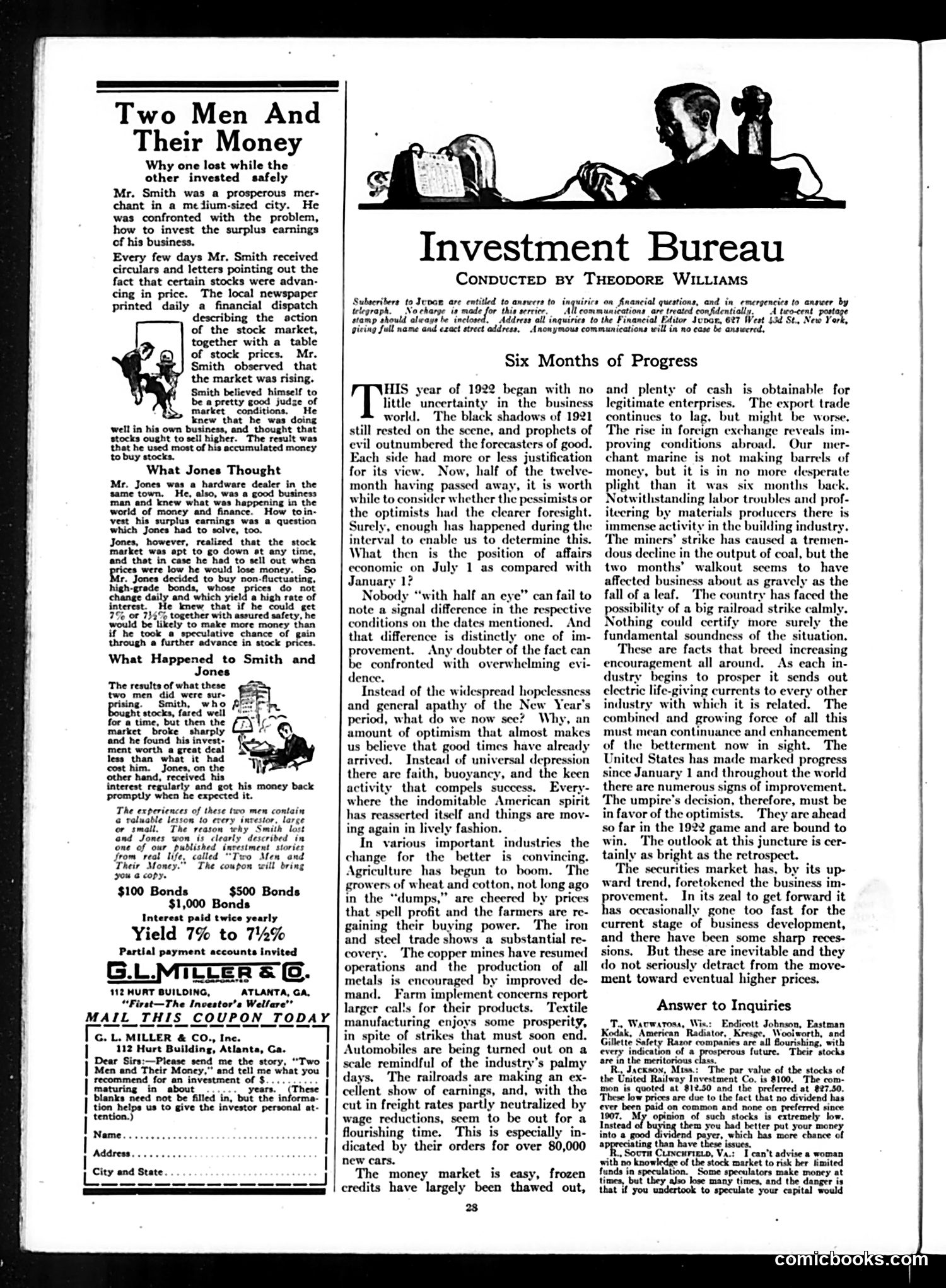
What you’re looking at
This is a financial advice piece disguised as a morality tale, appearing during the 1922 economic recovery after the 1921 recession. **The Satire:** The cartoon contrasts two businessmen's investment strategies. Mr. Smith, confident from his retail success, assumes stocks will rise and invests his savings in the booming market. Mr. Jones, more cautious, purchases stable bonds yielding 7-7.5% interest. **The Point:** When the stock market crashes, Smith loses substantially while Jones collects regular, reliable returns. The implicit criticism targets overconfident speculators who conflate business acumen with market knowledge—a common pitfall during speculative bubbles. **Historical Context:** Published before the 1929 crash, this reflects genuine 1920s tension between cautious (older) and speculative (newer) investment philosophies. It's essentially an advertisement for G. L. Miller & Co.'s bonds, promoting "safe" fixed-income investments over stock speculation—a position that would seem prescient after 1929, though actually representing conservative, traditional finance advice of the era. The artwork shows the comfortable businessman (Smith) versus the hardware dealer (Jones)—both respectable middle-class figures.
📄 Transcribed text from this page (OCR, searchable)
Machine-transcribed from the original scan — historical spelling and the odd misread are preserved.
Two Men And Their Money Why one lost while the other invested safely Mr. Smith was a prosperous mer- chant in a medium-sized city. He was confronted with the problem, how to invest the surplus earnings of his business. Every few days Mr. Smith received circulars and letters pointing out the fact that certain stocks were advan- cing in price. The local newspaper printed daily a financial dispatch describing the action of the stock market, together with a table of stock prices. Mr. Smith observed that the market was rising. Smith believed himself to be a pretty good judze of market conditions. He knew that he was doing well in his own business, and thought that stocks ought to sell higher. The result was that he used most of his accumulated money to buy stocks. What Jones Thought Mr. Jones was a hardware dealer in the same town. He, also, was a good business man and knew what was happening in the world of money and finance. How toin- vest his surplus earnings was a question wi Jones had to solve, too. Jones, however, realized that the stock market was apt to go down st any time, and thet in case he had to sell out whea were low he would lose money. So Jones decided to buy non-fuctuating, high-re bonds, bert pig change er aily rand which yield a high rate of interest. He knew that if he could get 7% or 734% together with assured safety, he would be likely to make more money than if he took a speculative chance of gai ‘@ further advance in stock prices. What Happened to Smith and Jones The results of what these two, men did, were sure Smith, who dght stocks, fazed well for a time, but then the market broke sharply and he found his invest- ment worth a great deal less than what it had cost him. Jones, on the hand, received his and got his money back 1e expected it. interest regular!; promptly when The experiences of these two men contain @ raluable lesson to every investor. large or small. The reason why Smith lost and Jones won is clearly described in one of our published investment stories from reat life, called “Two Men and Their Money.” The coupon will bring you a copy. $100 Bonds $500 Bonds $1,000 Bonds Interest paid twice yearly Yield 7% to 742% Partial payment accounts invited 112 HURT BUILDING, ATLANTA, GA. “Firat—The Incest: Welfare"” MAIL THIS COUPON TODAY G. L. MILLER & CO., Inc. | 112 Hurt Building, Atlanta, Ga. Dear Sirs:—Please send me the story, “Two | Men and Their Money,” and tell me what you recommend for an investment of $ maturing sce | years. about blanks Need not be filled in, ‘putt the informa- tion helps us to give the investor personal at- | tention.) City and State. Par Investment Bureau ConpucTED BY THEODORE WILLIAMS Sulveritere to Jeooe are entitled to anrvcr in telegraph. No charge te made for this service. All tlamp should always be incl Giving full name and eaact strect address, Six Months Ti year of 1922 began with no little uncertainty in the business world, The black shadows of 1921 still rested on the scene, and prophets of evil outnumbered the forecasters of good. Each side had more or less justification for its view. Now, half of the twelve- month having passed away, it i: worth while to consider whether the the optimists had the clearer foresight. Surely, enough has happened during the interval to enable us to determine this. What then is the position of affairs economic on July 1 as compared with January 1? Nobody “with half an eye” can fail to note a signal difference in the respective conditions on the dates mentioned. And that difference is distinctly one of im- provement. Any doubter of the fact can be confronted with overwhelming evi- dence. Instead of the widespread hopelessness and general apathy of the New Year's period, what do we now see? Why, an amount of optimism that almost makes us believe that good times have already arrived. Instead of universal depression there are faith, buoyancy, and the keen activity that compels success. Every- where the indomitable American spirit has reasserted itself and things are mov- ing again in lively fashion. In various important industries the change for the better is convincing. Agriculture has begun to boom. The growers of wheat and cotton, not long ago in the “dumps,” are cheered by prices that spell profit and the farmers are re- gaining their buying power. The iron and steel trade shows a substantial re- covery. The copper mines have resumed operations and the production of all metals is encouraged by improved de- mand, Farm implement concerns report larger cal!s for their products. Textile manufacturing enjoys some prosperity, in spite of strikes that must soon end. Automobiles are being turned out on a scale remindful of the industry's palmy days. The railroads are making an ex- cellent show of earnings, and, with the cut in freight rates partly neutralized by wage reductions, seem to be out for a flourishing time. This is especially in- dicated by their orders for over 80,000 new cars. The money market is easy, frozen credits have largely been thawed out, 23 irice on Sne All communicat Address all ingutrice to the Financial Elitor voor, 681 West Gd St. New York, Anonymous communications will in no case be ansiecred. ial questions, and in. emergenccs to annecer by are treated confidentially, of Progress and plenty of cash is obtainable for legitimate enterprises. The export trade continues to lag, but might be worse. The rise in foreign exchange reveals im- proving conditions abroad. Our mer- chant marine is not making barrels of money, but it is in no more despera' plight than it was six months bac! Notwithstanding labor troubles and prof- itecring by materials producers there is immense activi in the building indust ‘The miners’ strike has caused a treme dous decline in the output of coal, but the two months’ walkout scems to have affected business about as gravely as the fall of a leaf. The country has faced the pos bility of a big railroad strike calmly. Nothing could certify more surely the fundamental soundness of the situation. These are facts that breed increasing encouragement all around. As each in- dustry begins to prosper it sends out electri -giving currents to every other industry with which it is related. The combined and growing force of all this must mean continuance and enhancement of the betterment now in sight. The United States has made marked progress since January 1 and throughout the world there are numerous signs of improvement. The umpire’s decision, therefore, must be in favor of the optimists. They are ahead so far in the 1922 game and are bound to win. The outlook at this juncture is cer- tainly as bright as the retrospect. The securities market has, by its up- ward trend, foretokened the business im- rovement. In its zeal to get forward it as occasionally gone too fast for the current stage of business development, and there have been some sharp reces- sions. But these are inevitable and they do not seriously detract from the move- ment toward eventual higher prices. Answer to Inquiries T.. Wacwaross, Wis: Endicott Jobneos Eastman Kodak, American Radiator, Kresge, V Gillette Safety Razor companies are all a every indication of a promerors: future. Their stocks are in the meritorious cl R., Jackson, Miss.: The par value of the stocks of the United Railway Investment Co. is $100. com: mon is quoted at $12.50 and the ob ear at 827.50. ‘These low prices are due to the fact a no dividend has ever been paid on common and none on preferred since 1907, My, opinion, ° of such stocks is extremely low. Instead pezing ts them you had better put your money into a good vidced payer which bas more chance of appreciating than have these issues. . Sovrm Cancers, Va.: Ican't advise a woman Fabre. Knowkige of te cto market to risk Ber limited junds in speculation. Some speculators make money at times, but they also lose many times, and the danger is that if you undertook to speculate your capital would