
Judge, 1922-07-08 · page 28 of 36
Judge — July 8, 1922 — page 28: what you’re looking at
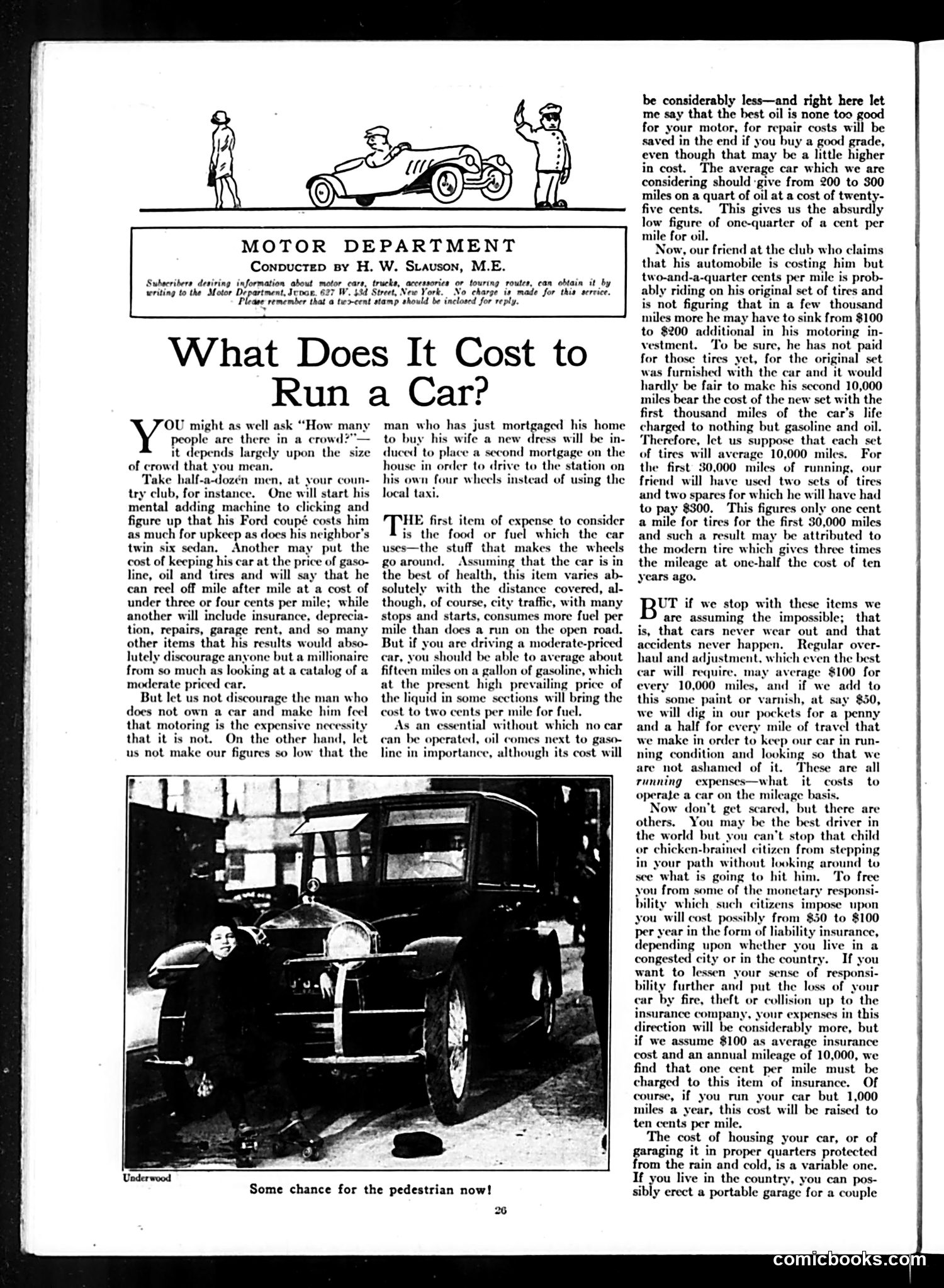
A restored page from Judge, 1922-07-08. Page through the whole issue in the reader above.
📄 Transcribed text from this page (OCR, searchable)
Machine-transcribed from the original scan — historical spelling and the odd misread are preserved.
MOTOR DEPARTMENT Conpuctep sy H. W. Stauson, M.E. Suheeribers desiring information about motor cars, trucks, accessories or touring router, can obtain it by writing to the Motor Department, Jvoar. 627 W. 48d Street, ‘we York. No charge is made for this service. Please remember that a te>-cent stamp should be inclosed for reply. What Does It Cost to Run a Car? ‘OU might as well ask “How many people are there in a crowd it depends largely upon the size of crowd that you mean. Take half-a-dozén men, at your coun- try club, for instance. One will start his mental adding machine to clicking and figure up that his Ford coupé costs him as much for upkeep as does his neighbor's twin six sedan, Another may put the cost of keeping his car at the price of gaso- line, oil and tires and will say that he can reel off mile after mile at a cost of under three or four cents per mile; while another will include insurance, deprecia- tion, repairs, garage rent, and so many other items that his results would abso- lutely discourage anyone but a millionaire from so much as looking at a catalog of a moderate priced car. But let us not discourage the man who does not own a car and make him f that motoring is the expensive neces that it is not. On the other hand, let us not make our figures so low that the man who has just mortgaged his home to buy his wife a new dress will be in- duced to place a second mortgage on the house in order to drive to the station on his own four wheels instead of using the local taxi. HE first item of expense to consider is the food or fuel which the car uses—the stuff that makes the wheels go around. Assuming that the car is in the best of health, this item varies ab- solutely with the distance covered, al- though, of course, city traffic, with many stops and starts, consumes more fuel per mile than does a run on the open road. But if you are driving a moderate-priced car, you should be able to average about fifteen miles on a gallon of gasoline, which at the present high prevailing price of the liquid in some sections will bring the cost to two cents per mile for fuel. As an essential without which no car can be operated, oil comes next to gaso- line in importance, although its cost will Some chance for the pedestrian now! 26 be considerably less—and right here let me say that the best oil is none too good for your motor, for repair costs will be saved in the end if you buy a good grade, even though that may be a little higher in cost. The average car which we are considering should ‘give from 200 to 300 miles on a quart of oil at a cost of twenty- five cents. This gives us the absurdly low figure of one-quarter of a cent per mile for oil. Now, our friend at the club who claims that his automobile is costing him but two-and-a-quarter cents per mile is prob- ably riding on his original set of tires and is not figuring that in a few thousand miles more he may have to sink from $100 to $200 additional in his motoring in- vestment. To be sure, he has not paid for those tires yet, for the original set was furnished with the car and it would hardly be fair to make his second 10,000 miles bear the cost of the new set with the first thousand miles of the car’s life charged to nothing but gasoline and oil. Therefore, let us suppose that cach set of tires will average 10,000 miles. For the first 30,000 miles of running, our friend will have used two sets of tires and two spares for which he will have had to pay $300. This figures only one cent a mile for tires for the first 30,000 miles and such a result may be attributed to the modern tire which gives three times the mileage at one-half the cost of ten years ago. Burt if we stop with these items we are assuming the impossible; that is, that cars never wear out and that accidents never happen. Regular over- haul and adjustment, which even the best car will requir verage $100 for every 10,000 miles, and if we add to this some paint or varnish, at say $50, we will dig in our pockets for a penny and a half for every mile of travel that we make in order to keep our car in run- ning condition and looking so that we are not ashamed of it. These are all running expenses—what it costs to operate a car on the mileage basis. Now don’t get scared, but there are others. You may be the best driver in the world but you can’t stop that child or chicken-brained citizen from stepping in your path without looking around to see what is going to hit him. To free you from some of the monetary respons bility which such citizens impose upon you will cost possibly from $50 to $100 per year in the form of liability insurance, depending upon whether you live in a congested city or in the country. If you want to lessen your sense of respons bility further and put the loss of your car by fire, theft or collision up to the insurance company, your expenses in this direction will be considerably more, but if we assume $100 as average insurance cost and an annual mileage of 10,000, we find that one cent per mile must be charged to this item of insurance. Of course, if you run your car but 1,000 miles a year, this cost will be raised to ten cents per mile. The cost of housing your car, or of garaging it in proper quarters protected from the rain and cold, is a variable one. If you live in the country, you can pos- sibly erect a portable garage for a couple