
Judge, 1922-07-08 · page 16 of 36
Judge — July 8, 1922 — page 16: what you’re looking at
What you’re looking at
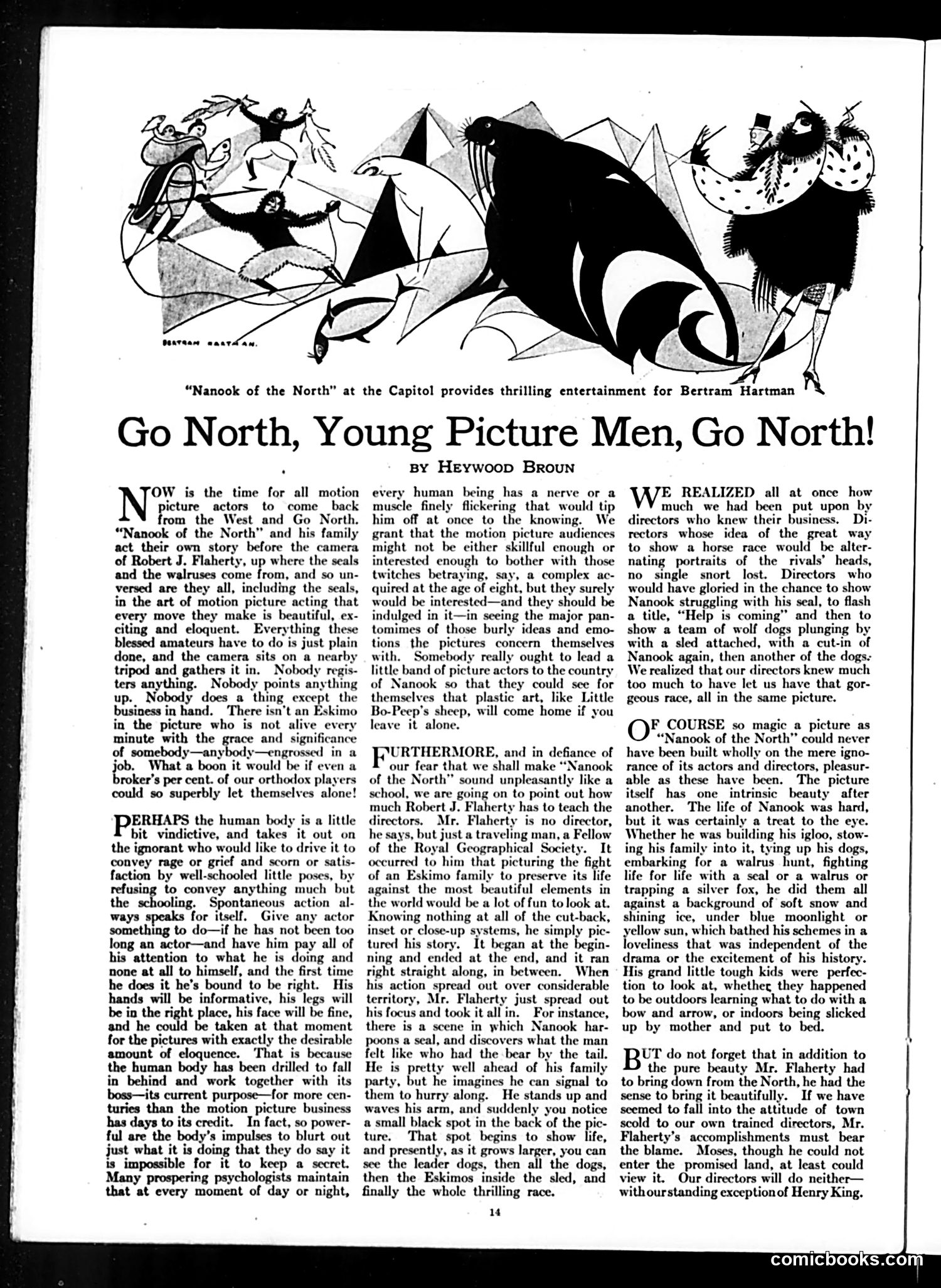
This is a **film criticism essay** by Heywood Broun praising the documentary "Nanook of the North" (1922) and its director Robert Flaherty. **The Point:** Broun argues that professional actors are *over-trained* and self-conscious, making their performances artificial. By contrast, Nanook and his Inuit family—untrained amateurs simply living their lives before the camera—deliver authentic, compelling performances. Their natural movements and genuine engagement in hunting/survival activities create better cinema than skilled actors can manage. **The Satire:** The essay mocks Hollywood's trained actors for being *worse* at their job than non-actors. Broun suggests their technique-obsessed approach ("well-schooled little poses") produces wooden results, while Flaherty's "non-director" approach—simply filming reality without cinematic tricks (no "cut-back, inset or close-up systems")—produces superior art. **The Cartoon** (top) illustrates Flaherty with his camera capturing Nanook and Eskimo characters amid seals and ice, visually emphasizing the documentary's authentic Arctic setting versus studio artificiality.
📄 Transcribed text from this page (OCR, searchable)
Machine-transcribed from the original scan — historical spelling and the odd misread are preserved.
envaan aaatdan, “Nanook of the North” at the Capitol provides thrilling entertainment for Bertram Hartman Go North, Young Picture Men, Go North! ‘OW is the time for all motion picture actors to comeback from the West and Go North. “Nanook of the North” and his family act their own story before the camera of Robert J. Flaherty, up where the seals and the walruses come from, and so un- versed are they all, including the seals, in the art of motion picture acting that every move they make is beautiful, ex- citing and eloquent. Everything these blessed amateurs have to do is just plain done, and the camera sits on a nearby tripod and gathers it in. Nobody regis- ters anything. Nobody points anything up. Nobody does a thing except the business in hand. There isn’t an Eskimo in the picture who is not alive every minute with the and significance of soaichody-— ang bedy—-engrosscd ina job. What a boon it would be if even a roker’s per cent. of our orthodox players could so superbly let themselves alone! ERHAPS the human body is a little bit vindictive, and takes it out on the ignorant who would like to drive it to convey rage or grief and scorn or satis- faction by well-schooled little poses, by refusing to convey anything much but the ooling. Spontaneous action al- ways 8] for itself. Give any actor something to do—if he has not been too long an actor—and have him pay all of his attention to what he is doing and none at all to himself, and the first time he does it he’s bound to be right. His hands will be informative, his legs will be in the right place, his face will be fine, and he could be taken at that moment for the pictures with exactly the desirable amount of eloquence. That is because the human body has been drilled to fall in behind and work together with its boss—its current purpose—for more cen- turies than the motion picture business has days to its credit. In fact, so power- ful are the body’s impulses to blurt out just what it is doing that they do say it is impossible for it to keep a secret. Many prospering psychologists maintain that at every moment of day or night, By Heywoop Broun every human being has a nerve or a muscle finely flickering that would tip him off at once to the knowing. We grant that the motion picture audiences might not be either skillful enough or interested enough to bother with those twitches betraying, say, a complex ac- quired at the age of eight, but they surely would be interested—and they should be indulged in it—in seeing the major pan- tomimes of those burly ideas and emo- tions the pictures concern themselves with. Somebody really ought to lead a little band of picture actors to the country of Nanook so that they could see for themselves that plastic art, like Little Bo-Peep’s sheep, will come home if you leave it alone. URTHERMORE, and in defiance of our fear that we shall make “Nanook of the North” sound unpleasantly like a school, we are going on to point out how much Robert J. Flaherty has to teach the directors. Mr. Flaherty is no director, he says, but just a traveling man, a Fellow of the Royal Geographical Society. It occurred to him that picturing the fight of an Eskimo family to preserve its life against the most beautiful elements in the world would be a lot of fun to look at. Knowing nothing at all of the cut-back, inset or close-up systems, he simply pic- tured his story. It began at the begin- ning and ended at the end, and it ran right straight along, in between. When his action spread out over considerable territory, Mr. Flaherty just spread out his focus and took it all in. For instance, there is a scene in which Nanook har- poons a seal, and discovers what the man felt like who had the bear by the tail. He is pretty well ahead of his family party, but he imagines he can signal to them to hurry along. He stands up and waves his arm, and suddenly you notice a small black spot in the back of the pic- ture. That spot begins to show life, and presently, as it grows larger, you can see the leader dogs, then all the dogs, then the Eskimos inside the sled, and finally the whole thrilling race. 4 E REALIZED all at once how much we had been put upon by directors who knew their business. Di- rectors whose idea of the great way to show a horse race would be alter- nating portraits of the rivals’ heads, no single snort lost. Directors who would have gloried in the chance to show Nanook struggling with his seal, to flash a title, “Help is coming” and then to show a team of wolf dogs plunging by with a sled attached, with a cut-in of Nanook again, then another of the dogs. We realized that our directors knew much too much to have let us have that gor- geous race, all in the same picture. OF COURSE so magic a picture as “Nanook of the North” could never have been built wholly on the mere igno- rance of its actors and directors, pleasur- able as these have been. The picture itself has one intrinsic beauty after another. The life of Nanook was hard, but it was certainly a treat to the eye. Whether he was building his igloo, stow- ing his family into it, tying up his dogs, embarking for a walrus hunt, fighting life for life with a seal or a walrus or trapping a silver fox, he did them all against a background of soft snow and shining ice, under blue moonlight or yellow sun, which bathed his schemes in a loveliness that was independent of the drama or the excitement of his history. His grand little tough kids were perfec- tion to look at, whether they happened to be outdoors learning what to do with a bow and arrow, or indoors being slicked up by mother and put to bed. Bt do not forget that in addition to the pure beauty Mr. Flaherty had to bring down from the North, he had the sense to bring it beautifully. If we have seemed to fall into the attitude of town scold to our own trained directors, Mr. Flaherty’s accomplishments must bear the blame. Moses, though he could not enter the promised land, at least could view it. Our directors will do neither— with ourstanding exception of Henry King. comicbooks.com