
Judge, 1922-07-08 · page 9 of 36
Judge — July 8, 1922 — page 9: what you’re looking at
What you’re looking at
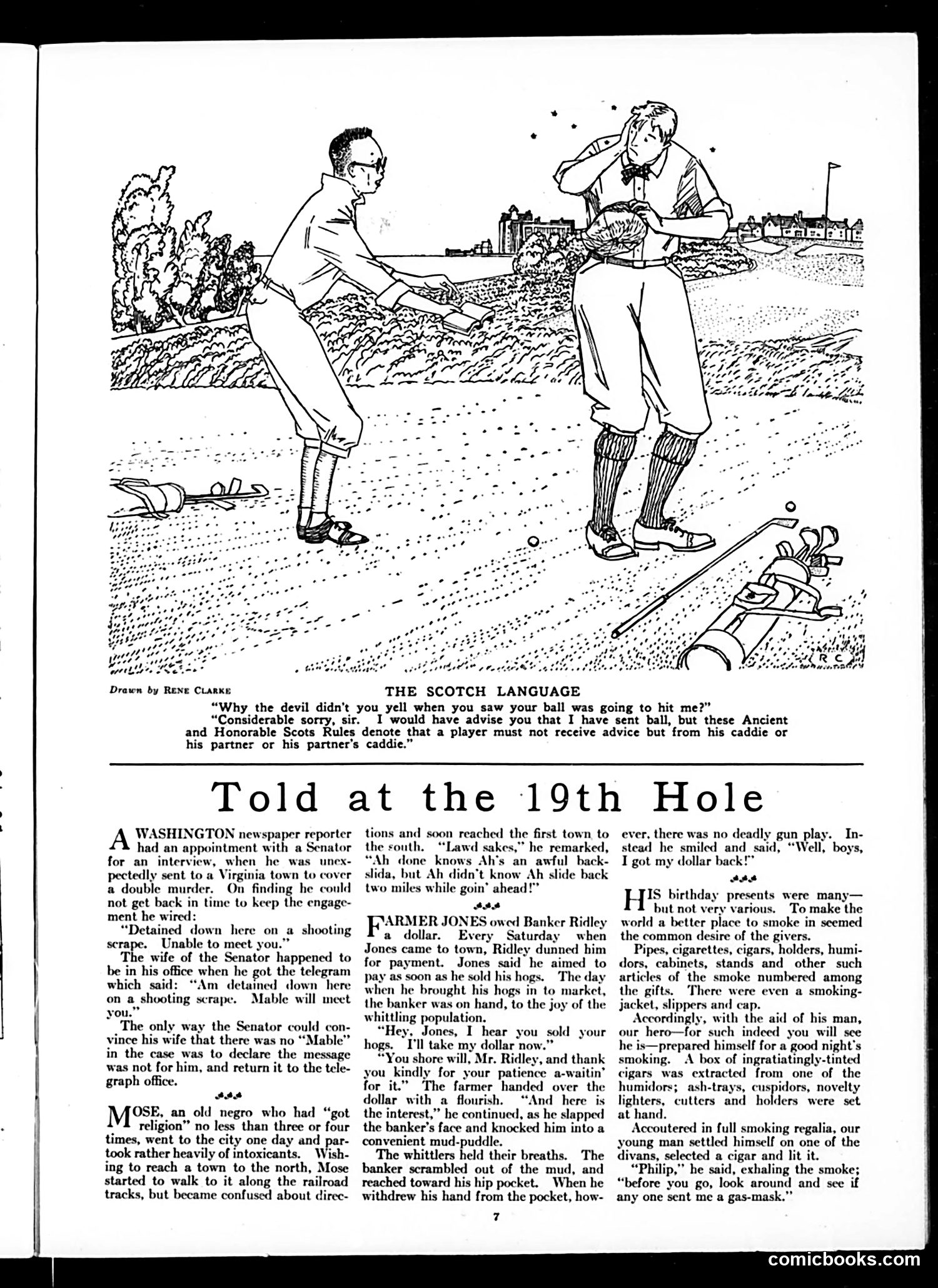
This page contains three unrelated humorous anecdotes from *Judge* magazine, typical of early 20th-century American humor: 1. **"The Scotch Language"** (top cartoon): A golf joke mocking Scottish accent and rules. A golfer apologizes for nearly hitting someone but claims Scottish golf rules forbid receiving advice except from a caddie—a thin excuse delivered in exaggerated dialect. 2. **"Told at the 19th Hole"** (main text): Three short stories told in a golf clubhouse setting: - A senator's wife misreads a telegram about a reporter's "shooting scrape," creating comedic misunderstanding - A Black man ("Mose") gets drunk and walks south instead of north, using dialect humor - A farmer humorously "pays interest" on a debt by hitting a banker into mud—which the banker accepts good-naturedly 3. **Birthday gifts story** (right column): A man receives so many smoking accessories that he jokes he needs a gas mask. The satire relies on racial stereotypes, dialect humor, and gentle social comedy typical of the era—elements modern readers would find dated or offensive.
📄 Transcribed text from this page (OCR, searchable)
Machine-transcribed from the original scan — historical spelling and the odd misread are preserved.
Drawn by RENE CLARKE “Considerable sorry, sir. his partner or his partner's THE SCOTCH LANGUAGE “Why the devil didn’t you yell when you saw your ball was going to hit me?” Bee a hag Suge . ee * 5 Lh L la ap ik I would have advise you that I have sent ball, but these Ancient and Honorable Scots Rules denote that a player must not receive advice but from his caddie or caddie.” Told at the 19th Hole WASHINGTON newspaper reporter had an appointment with a Senator for an interview, when he was unex- pectedly sent to a Virginia town to cover a double murder. On finding he could not get back in time to keep the engage- ment he wired: “Detained down here on a shooting scrape. Unable to mect you.” The wife of the Senator happened to be in his office when he got the telegram which said: “Am detained down here on a shooting scrape. Mable will meet you.’ The only way the Senator could con- vince his wife that there was no “Mable” in the case was to declare the message was not for him, and return it to the tele- graph office. tae OSE, an old negro who had “got religion” no less than three or four times, went to the city one day and par- took rather heavily of intoxicants. Wish- ing to reach a town to the north, Mose started to walk to it along the railroad tracks, but became confused about direc- tions and soon reached the first town, to the south. “Lawd sakes,” he remarked, “Ah done knows Ah’s an awful back- slida, but Ah didn’t know Ah slide back two miles while goin’ ahead!” aoe 'ARMER JONES owed Banker Ridley a dollar. Every Saturday when Jones came to town, Ridley dunned him for payment. Jones said he aimed to pay as soon as he sold his hogs. The day when he brought his hogs in to market, the banker was on hand, to the joy of the whittling population. “Hey, Jones, I hear you sold your hogs. I'll take my dollar now.” “You shore will, Mr. Ridley, and thank you kindly for your patience a-waitin’ for it.” The farmer handed over the dollar with a flourish. “And here is the interest,” he continued, as he slapped the banker’s face and knocked him into a convenient mud-puddle. The whittlers held their breaths. The banker scrambled out of the mud, and reached toward his hip pocket. When he withdrew his hand from the pocket, how- 7 ever, there was no deadly gun play. In- stead he smiled and said, “Well, boys, I got my dollar back!” IS birthday ceed E but not ve presents were many— arious. To make the world a better place to smoke in seemed the common desire of the givers. Pipes, cigarettes, cigars, holders, humi- dors, cabinets, stands and other such es of the smoke numbered among gifts. There were even a smoking- jacket, slippers and cap. Accordingly, with the aid of his man, our hero—for such indeed you will see he is—prepared himself for a good night's smoking. A box of ingratiatingly-tinted cigars was extracted from one of the humidors; ash-trays, cuspidors, novelty lighters, cutters and holders were set at hand. Accoutered in full smoking regalia, our young man settled himself on one of the divans, selected a cigar and lit it. “Philip,” he said, exhaling the smoke; “before you go, look around and see if any one sent me a gas-mask.” comicbooks.com