
Judge, 1922-07-08 · page 13 of 36
Judge — July 8, 1922 — page 13: what you’re looking at
What you’re looking at
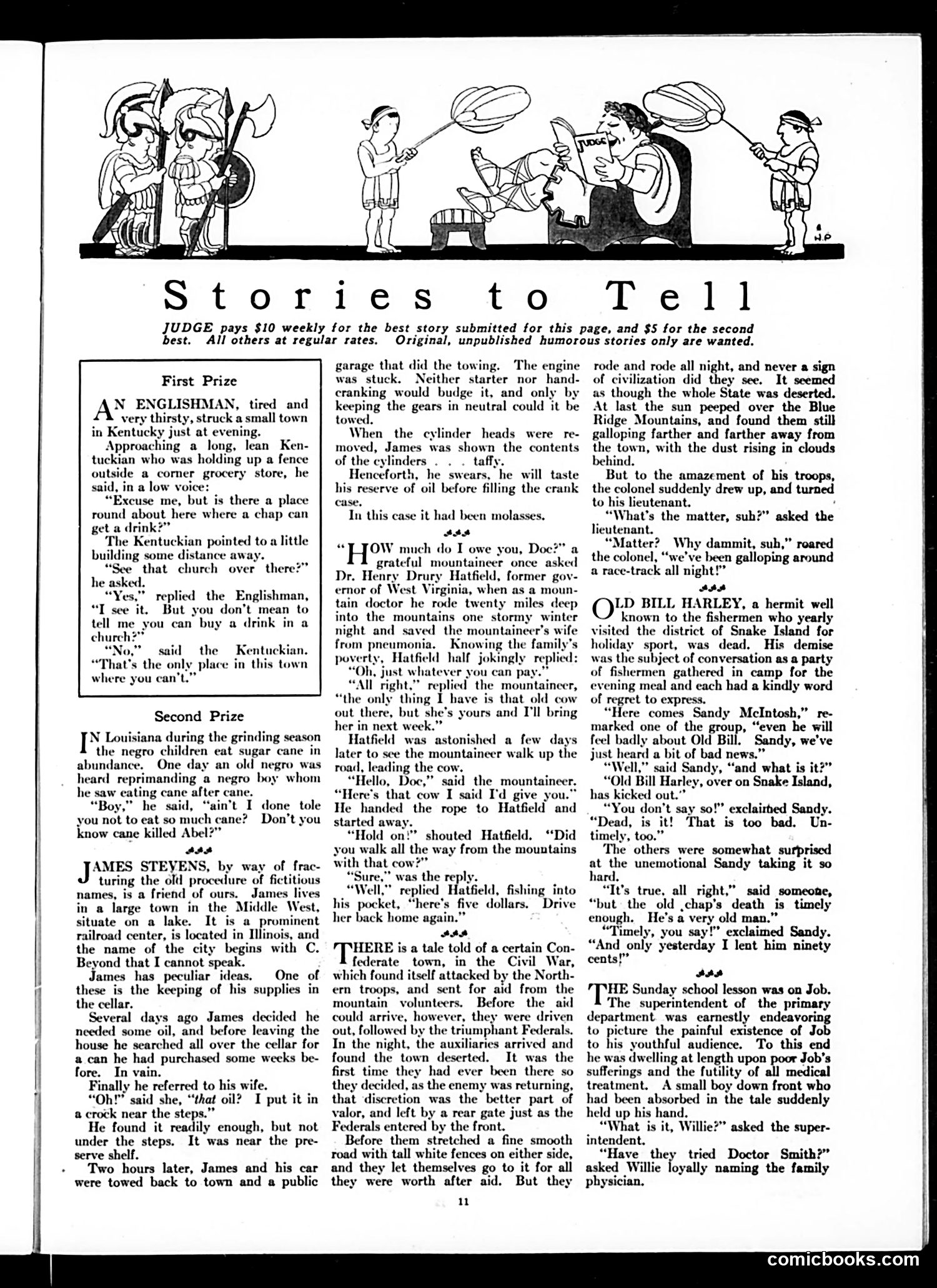
This page is a **story submission section**, not political satire. Judge paid readers $10 for the best humorous story published here. The illustrated header shows figures in classical dress telling stories—a generic visual pun on the page's title, not specific political commentary. The three prize-winning stories are lighthearted anecdotes: 1. **First Prize**: A joke about a dry Kentucky town where the only gathering place is a church (implying Prohibition or religious strictness). 2. **Second Prize**: A folk humor piece with a Black child and an elder, playing on dialect and wordplay ("cane killed Abel"). 3. **Third Prize**: Stories about a West Virginia doctor (appears to reference a real Dr. Henry Drury Hatfield, a historical figure) and a Civil War town anecdote. These are **genteel, mainstream humor**—no sharp political edge. They represent the magazine's lighter content balancing its satirical cartoons elsewhere.
📄 Transcribed text from this page (OCR, searchable)
Machine-transcribed from the original scan — historical spelling and the odd misread are preserved.
Stor ies to JUDGE pays $10 weekly for the best story submitted for this page, and $5 for the second best. First Prize N ENGLISHMAN, tired and very thirsty, struck a small town just at evening. Approaching a long, lean Ken- tuckian who was holding up a fence outside a corner grocery store, he said, in a low voice: “Excuse me, but is there a place round about here where a chap can geta drink?” The Kentuckian pointed to a little building some distance away. ee that church over there?” he asked. “Yes,” replied the Englishman, “I see it. But you don’t mean to you can buy a drink in a No,” said the Kentuckian, That's the only place in this town where you can’t.” Second Prize IX Louisiana during the grinding season the negro children eat sugar cane in abundance. One day an old negro was heard reprimanding a negro boy whom he saw eating cane after cane. “Boy,” he said, “ain't I done tole you not to eat so much cane? Don’t you know cane killed Abel?” fae AMES STEYENS, by way of frac- turing the old procedure of fictitious names, is a friend of ou James lives in a large town in the Middle West, situate on a lake. It is a prominent railroad center, is located in Illinois, and the name of the city begins with C. Beyond that I cannot speak. James has peculiar ideas. One of these is the keeping of his supplies in the cellar. Several days ago James decided he needed some oil, and before leaving the house he searched all over the cellar for a_can he had purchased some weeks be- fore. In vain. Finally he referred to his wife. “Oh!” said she, “that oil? I put it in a crock near the steps.” He found it readily enough, but not under the steps. It was near the pre- serve shelf. + Two hours later, James and his car were towed back to town and a public All others at regular rates. garage that did the towing. The engine was stuck. Neither starter nor hand- cranking would budge it, and only by keeping the gears in neutral could it be towed. When the cylinder heads were re- moved, James was shown the contents of the cylinders . . . taffy. Henceforth, he swears, he will taste his reserve of oil before filling the crank case, In this case it had been molasses, sas “ET TOW much do I owe you, Doc?” a grateful mountaineer once asked Dr. Henry Drury Hatfield, former gov- ernor of West Virginia, when as a moun- tain doctor he rode twenty miles deep into the mountains one stormy winter night and saved the mountainee! i from pneumonia. Knowii poverty, Hatfiel “Oh, just whatever you can pay.” “All right.” replied the mountaineer, “the only thing I have is that old cow out there, but she’s yours and I'll bring her in next week.” Hatfield was astonished a few days later to see the mountaineer walk up the road, leading the cow. “Hello, Doc,” said the mountaineer. “Here's that cow I said I'd give you.” He handed the rope to Hatfield and started away. “Hold on!" shouted Hatfield. ‘Did you walk all the way from the mountains with that cow?” “Sure,” was the reply. “Well,” replied Hatfield, fishing into his pocket, “here's five dollars, Drive her back home again.” PIs HERE is a tale told of a certain Con- federate town, in the Civil War, which found itself attacked by the North- ern troops, and sent for aid from the mountain voluntee: Before the aid could arrive, however, out, followed by the tri In the night, the auxiliaries arrived and found the town deserted. It was the first time they had ever been there so they decided, as the enemy was returning, that discretion was the better part of valor, and left by a rear gate just as the Federals entered by the front. Before them stretched a fine smooth road with tall white fences on either side, and they let themselves go to it for all they were worth after aid. But they il Original, unpublished humorous stories only are wanted. rode and rode all night, and never a sign of civilization did they see. It seemed as though the whole State was deserted. At last the sun peeped over the Blue Ridge Mountains, and found them still galloping farther and farther away from the town, with the dust rising in clouds behind. But to the amazement of his troops, the colonel suddenly drew up, and turned to his lieutenant. “What's the matter, suh?” asked the lieutenant. “Matter? Why dammit, sub,” roared the colonel, “we've been galloping around a race-track all night!” tae LD BILL HARLEY, a hermit well known to the fishermen who yearly visited the district of Snake Island for holiday sport, was dead. His demise was the subject of conversation as a party of fishermen gathered in camp for the evening meal and each had a kindly word of regret to express. “Here comes Sandy McIntosh,” re- marked one of the group, “even he will feel badly about Old Bill Sandy, we've just heard a bit of bad news.” “Well,” said Sandy, “‘and what is it?” “Old Bill Harley, over on Snake Island, has kicked out.” “You don’t say so!” exclairhed Sandy. “Dead, is it! That is too bad. Un- timely, too.” The others were somewhat surprised at fhe unemotional Sandy taking it so hard, “It's true, all right,” said someone, “but the old ,chap’s death is timely enough. He's a very old man.” “Timely, you say!" exclaimed Sandy. “And only yesterday I lent him ninety cents!” sas HE Sunday school lesson was on Job. The superintendent of the primary department was earnestly endeavoring to picture the painful existence of Job to his youthful audience. To this end he was dwelling at length upon Job's sufferings and the futility of all medical treatment. A small boy down front who had been absorbed in the tale suddenly held up his hand. “What is it, Willie?” asked the super- intendent. “Have they tried Doctor Smith?” asked Willie loyally naming the family physician, comicbooks.com