
Judge, 1922-07-08 · page 10 of 36
Judge — July 8, 1922 — page 10: what you’re looking at
What you’re looking at
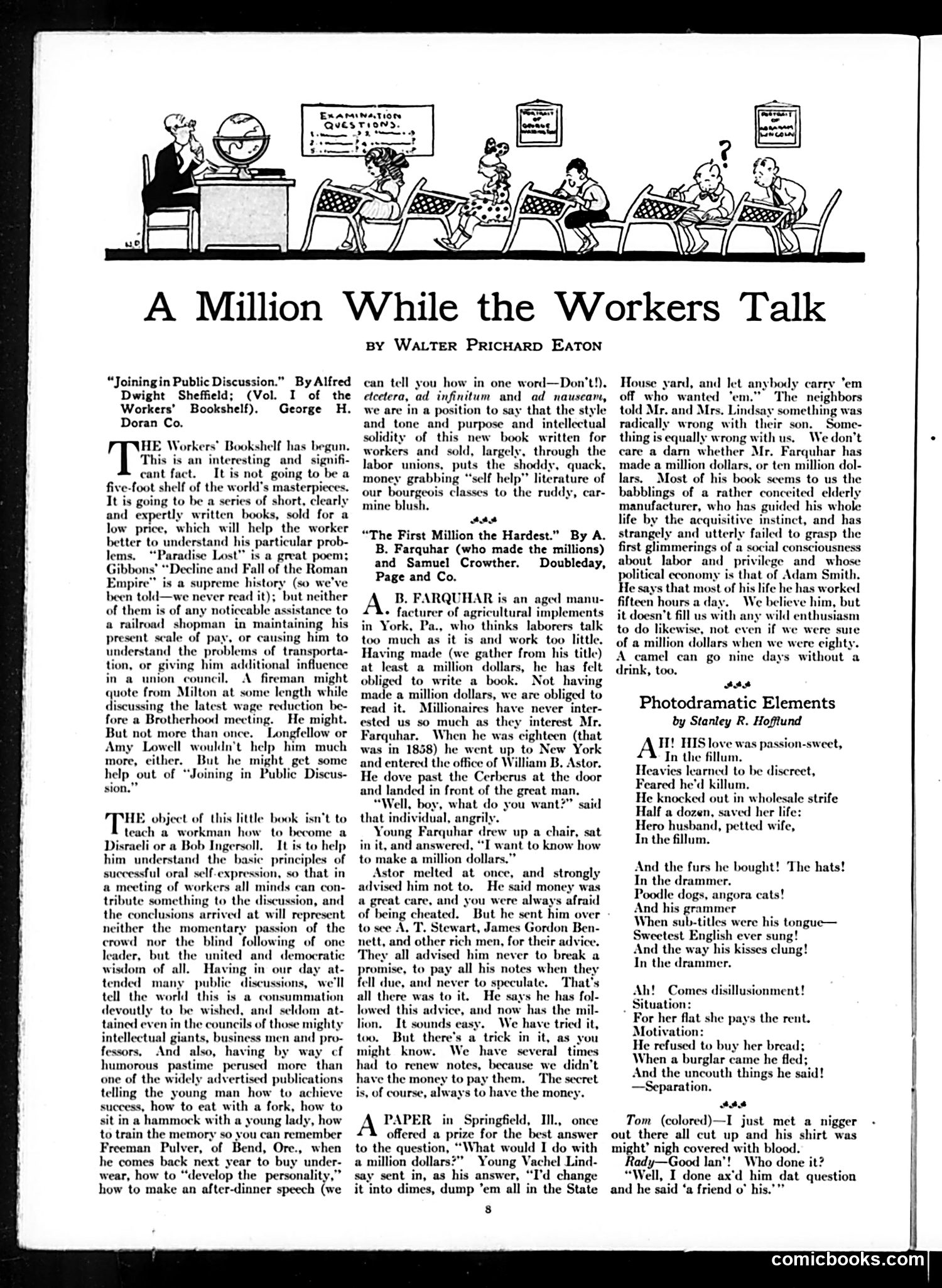
This page reviews two contrasting labor-themed books. The top cartoon shows an employer (left) at a desk while workers sit in chairs taking an examination—satirizing how workers are expected to be passive and tested rather than empowered. The review praises *"Joining in Public Discussion,"* a Workers' Bookshelf volume teaching laborers democratic debate skills. The critic argues practical books for workers matter more than classic literature, which won't help a railroad worker maintain wages or union influence. By contrast, the review mocks *"The First Million the Hardest"* by A.B. Farquhar, a wealthy manufacturer who believes workers talk too much and work too little. Farquhar's narrative about entering William B. Astor's office as a young man exemplifies the "self-help" genre the critic despises—celebrating individual ambition over collective worker interests. The satire's point: workers need education in *collective action*, not millionaire success stories promoting individual scrambling.
📄 Transcribed text from this page (OCR, searchable)
Machine-transcribed from the original scan — historical spelling and the odd misread are preserved.
Examination aves THON. pa ecer A Million While the Workers Talk “Joiningin Public Discussion.” By Alfred Dwight Sheffield; (Vol. I of the Workers’ Bookshelf). George H. Doran Co. r | NHE Workers’ Bookshelf has begun. This is an interesting and_ signifi- cant fact. It is not going to be a five-foot shelf of the world’s masterpieces. It is going to be a series of short, clearly and expertly written books, sold for a low price, which will help the worker better to understand his particular prob- le “Paradise Lost” is a great poem; Gibbons’ “Decline and Fall of the Roman Empire a supreme history (so we've been told—we never read it); but neither of them is of any noticeable assistance to a railroad shopman in maintaining his present scale of pay, or causing him to understand the problems of transporta- tion, or giving him additional influence in a union council. A fireman might quote from Milton at some length while discussing the latest wage reduction be- fore a Brotherhood mecting. He might. But not more than once. Longfellow or Amy Lowell wouldn't help him much more, either. But he might get some help out of “Joining in Public Discus- sion,” HE object of this little book isn’t to teach a workman how to become a Disraeli or a Bob Ingersoll. It is to help him understand the basic principles of successful oral self-expression, so that in a meeting of workers all minds can con- tribute something to the discussion, and the conclusions arrived at will represent neither the momentary passion of the crowd nor the blind following of one leader, but the united and democratic wisdom of all. Having in our day at- tended many. public discussions, we'll tell the world this is a consummation devoutly to be wished, and seldom at- tained even in the councils of those mighty intellectual giants, business men and pro- fessors, And also, having by way cf humorous pastime perused more than one of the widely advertised publications telling the young man how to achieve success, how to eat with a fork, how to sit in a hammock with a young lady, how to train the memory so you can remember Freeman Pulver, of Bend, Ore., when he comes back next year to buy under- wear, how to “develop the personality,” how to make an after-dinner speech (we BY WALTER PRICHARD EATON can tell you how in one word—Don't!). etcetera, ad infinitum and ad nauseam, we are in a position to say that the style and tone and purpose and intellectual solidity of this new book written for workers and sold, largely, through the labor unions, puts the shoddy, quack, money grabbing “self help” literature of our bourgeois classes to the ruddy, car- mine blush. “The First Million the Hardest.” By A. B. Farquhar (who made the millions) and Samuel Crowther. Doubleday, Page and Co. A B. FARQUHAR is an aged manu- + facturer of agricultural implements in York, Pa., who thinks laborers talk too much as it is and work too little. Having made (we gather from his title) at least a million dollars, he has felt obliged to write a book. Not having made a million dollars, we are obliged to read it. Millionaires have never inter- ested us so much as they interest Mr. Farquhar. When he was cighteen (that was in 1858) he went up to New York and entered the office of William B, Astor. He dove past the Cerberus at the door and landed in front of the great man. “Well, boy, what do you want?” said that individual, angrily. Young Farquhar drew up a chair, sat in it, and answered, “I want to know how to make a million dollars.” Astor melted at once, and strongly advised him not to. He said money was a great care, and you were always afraid of being cheated. But he sent him over to see A, T. Stewart, James Gordon Ben- nett, and other rich men, for their advice. They all advised him never to break a promise, to pay all his notes when they fell due, and never to speculate. That's all there was to it. He says he has fol- lowed this advice, and now has the mil- lion, It sounds easy. We have tried it, too. But there's a trick in it, as you might know. We have several times had to renew notes, because we didn’t have the money to pay them. The secret is, of course, always to have the money. PAPER in Springfield, IIL, once offered a prize for the best answer to the question, “What would I do with a million dollars?” Young Vachel Lind- say sent in, as his answer, “I'd change it into dimes, dump ’em all in the State 8 House yard, and let anybody carry "em off who wanted ‘em. The neighbors told Mr. and Mrs, Lindsay something was radically wrong with their son, Some- thing is equally wrong with us. We don’t care a darn whether Mr. Farquhar has made a million dollars, or ten million dol- lars, Most of his book scems to us the babblings of a rather conceited elderly manufacturer, who has guided his whole life by the acquisitive instinct, and has strangely and utterly failed to grasp the first glimmerings of a social consciousness about labor and privilege and whose political economy is that of Adam Smith. He says that most of his life he has worked fifteen hours a day. We believe him, but it doesn’t fill us with any wild enthusiasm to do likewise, not even if we were sure of a million dollars when we were cighty. A camel can go nine days without a drink, too. tae Photodramatic Elements by Stanley R. Hofflund IT! HIS love was passion-sweet, In the fillum. Heavies learned to be discreet, Feared he'd killum. He knocked out in wholesale strife Half a dozen, saved her life: Hero husband, petted wife, In the fillum. And the furs he bought! The hats! In the drammer. Poodle dogs, angora cats! And his grammer When sub-titles were his tongue— Sweetest English ever sung! And the way his kisses clung! In the drammer. Ah! Comes disillusionment! _ Situation: For her flat she pays the rent. Motivation: He refused to buy her bread; When a burglar came he fled; And the uncouth things he said! —Separation. sae Tom (colored)—I just met a_ nigger out there all cut up and his shirt was might’ nigh covered with blood. Rady—Good lan’! Who done it? “Well, I done ax'd him dat question and he said ‘a friend 0° his.’”” comicbooks.com