
A complete issue · 36 pages · 1922
Judge — June 10, 1922
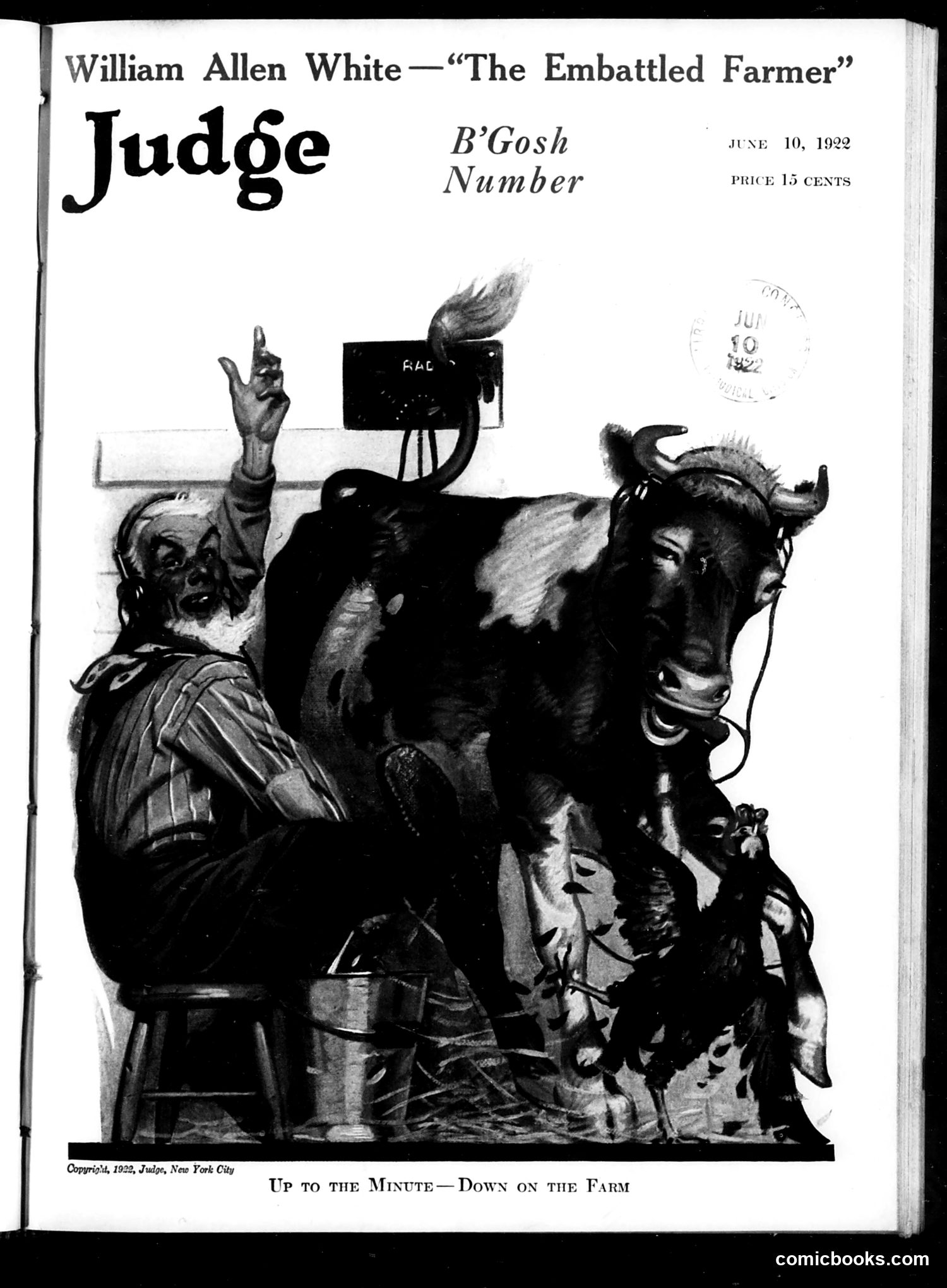
This June 1922 *Judge* cover illustrates "The Embattled Farmer" by William Allen White. The image shows a farmer operating a movie camera mounted on cattle, with the caption "Up to the Minute—Down on the Farm." The satire appears to target the gap between rural and modern life. The juxtaposition of cutting-edge film technology with farm animals and traditional agricultural work mocks either: 1. Farmers' attempts to adopt modern technology inappropriately, or 2. The false modernization of rural America presented in popular media The reference to William Allen White—a prominent Kansas editor and progressive voice—suggests commentary on rural political consciousness or the tension between agricultural tradition and technological progress during the 1920s modernization era.
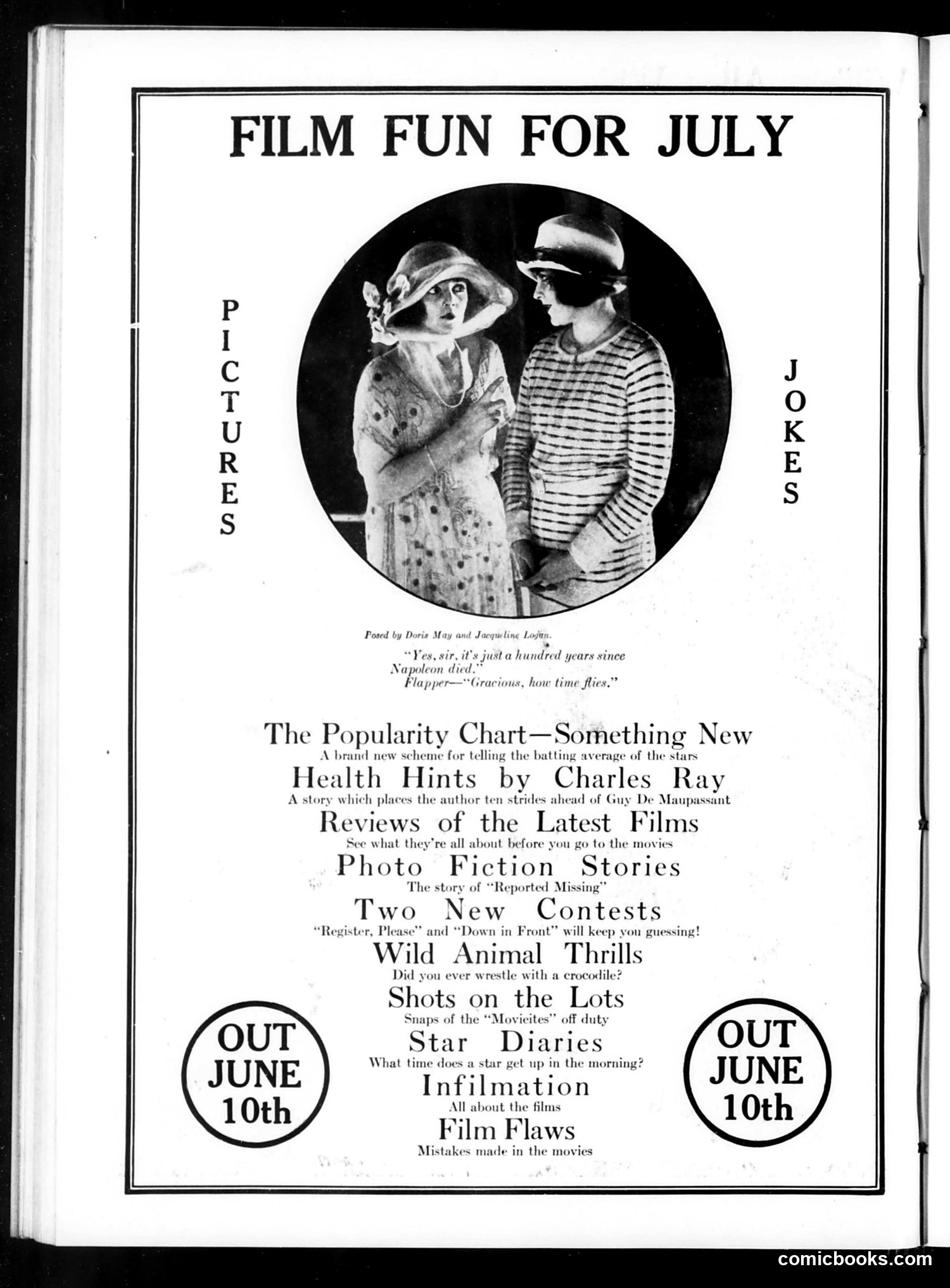
This appears to be primarily **advertising/promotional content** for an upcoming magazine issue rather than political satire. The page announces the July issue's contents, "OUT JUNE 10th." The circular photograph shows **two people in 1920s attire** (a woman in a wide-brimmed hat and patterned dress, a man in a striped shirt and fedora), labeled as "Pictures" and "Jokes." The caption references Napoleon humorously ("Yes, sir, it's just a hundred years since Napoleon died"). The bulk of the page **lists entertainment features**: popularity charts, health hints, film reviews, photo fiction stories, contests, animal footage, celebrity gossip, and "Film Flaws" (movie mistakes). This reflects Judge magazine's shift toward general entertainment content in the 1920s, targeting readers interested in emerging Hollywood celebrity culture.
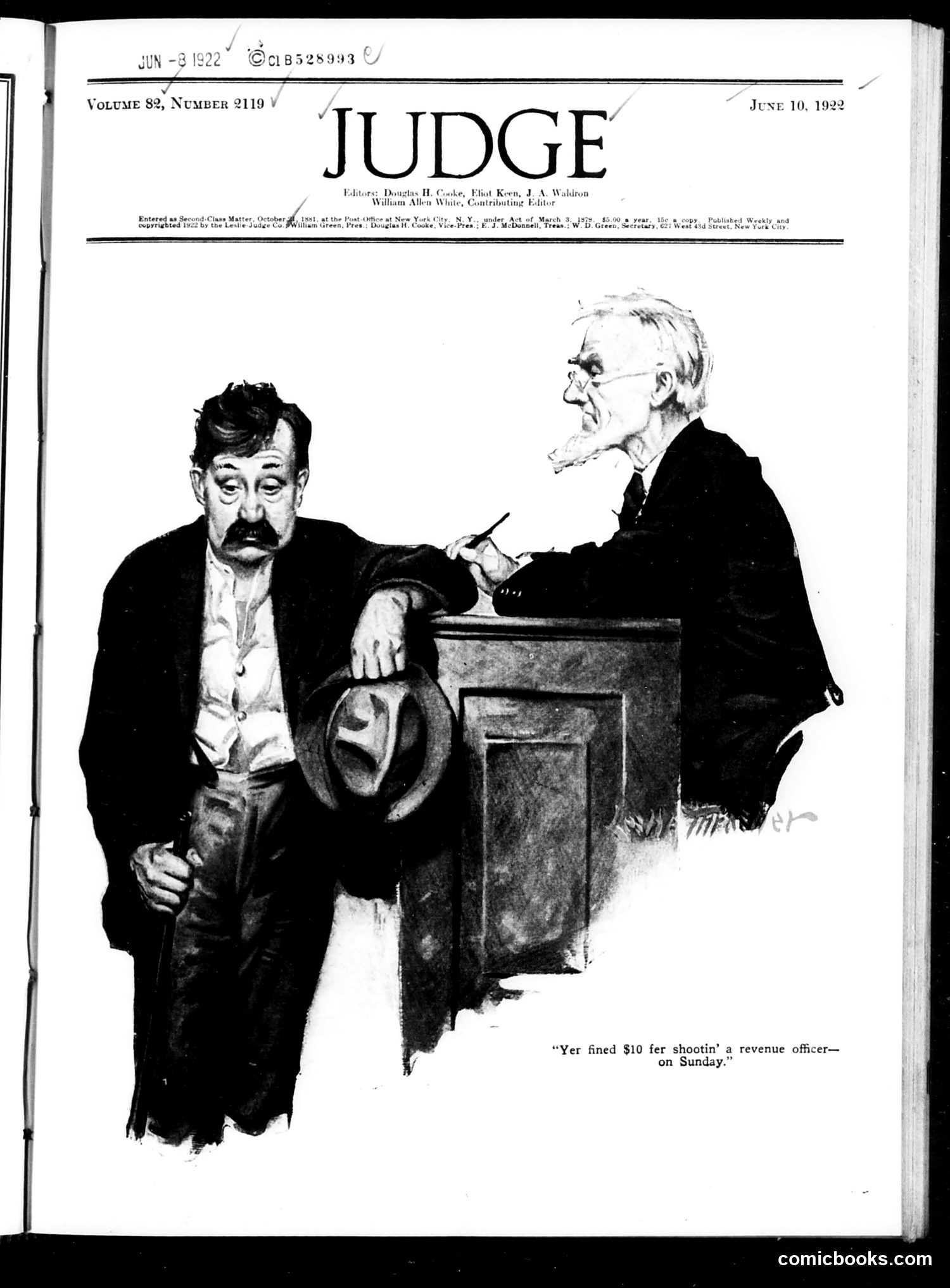
This **Judge** magazine cover from June 10, 1922 shows a satirical scene captioned: "Yer fined $10 fer shootin' a revenue officer—on Sunday." The cartoon depicts two men: one seated (appearing disheveled or rough), the other standing as an authority figure smoking a cigar, apparently a judge or official. The joke plays on **Prohibition-era enforcement** (1920-1933). The humor relies on the absurdity that shooting a federal revenue officer—a serious crime—merits only a minor $10 fine, but the *real* offense emphasized is committing this crime on Sunday, a sacred day. This satirizes both the era's Prohibition enforcement and the selective moral outrage about breaking religious observance versus actual violence. The caption's dialect suggests rural or working-class speech.
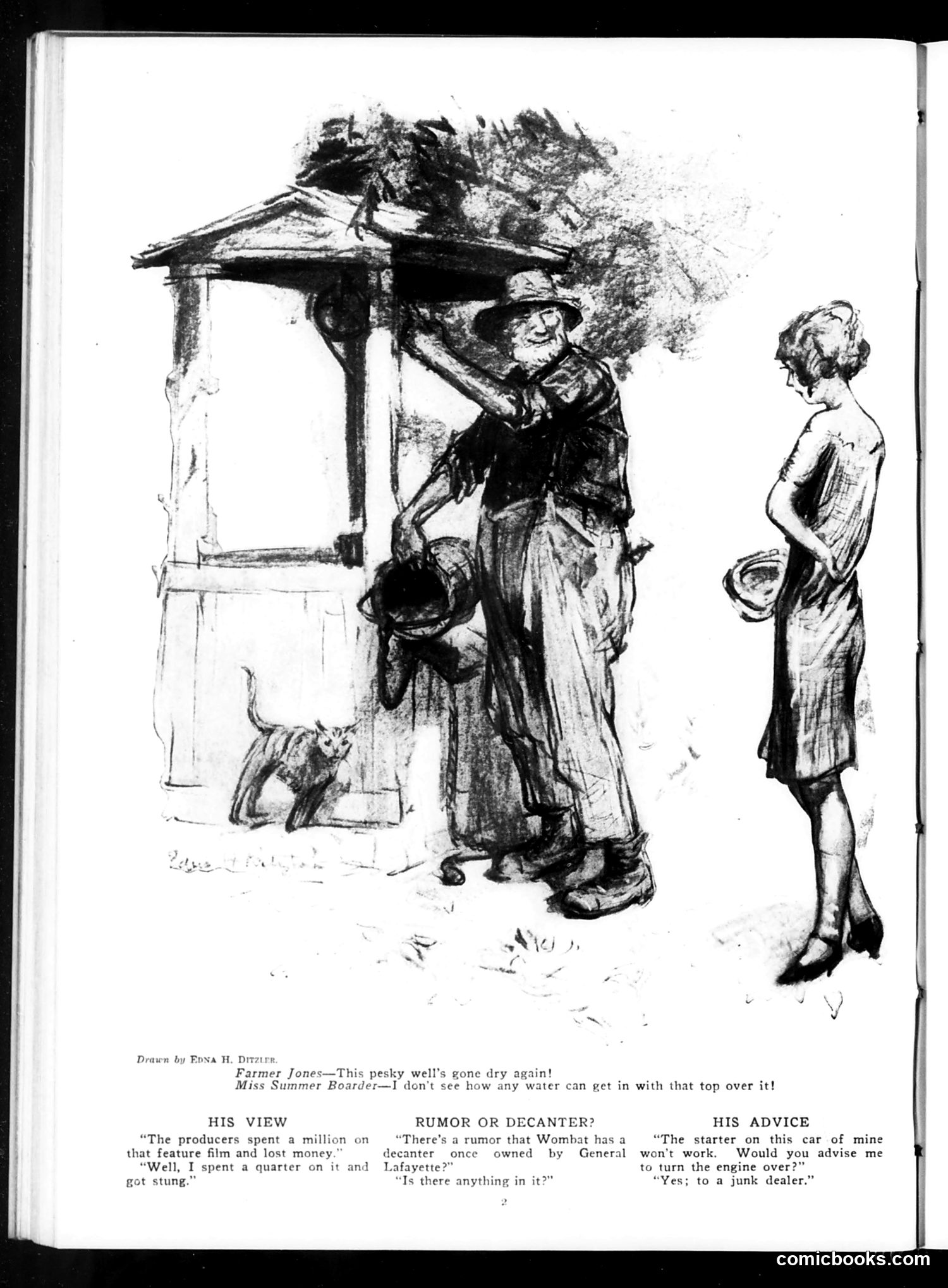
This page contains three separate captioned vignettes drawn by Edna H. Ditzler, each mocking different aspects of 1920s American life. **"The Pesky Well"** shows a farmer complaining about a dried well to a summer boarder—satirizing rural hardship and urban visitors' naiveté about country life. **"Rumor or Decanter?"** appears to reference Wombat (likely a film or product) with jokes about a "decanter" once owned by General Lafayette, mocking both film industry extravagance and dubious historical claims used in marketing. **"His Advice"** ridicules a man's suggestion to sell a broken car engine to a junk dealer rather than repair it—satirizing disposable consumer culture and poor practical judgment. The humor relies on wordplay, class differences, and contemporary absurdities recognizable to 1920s readers.
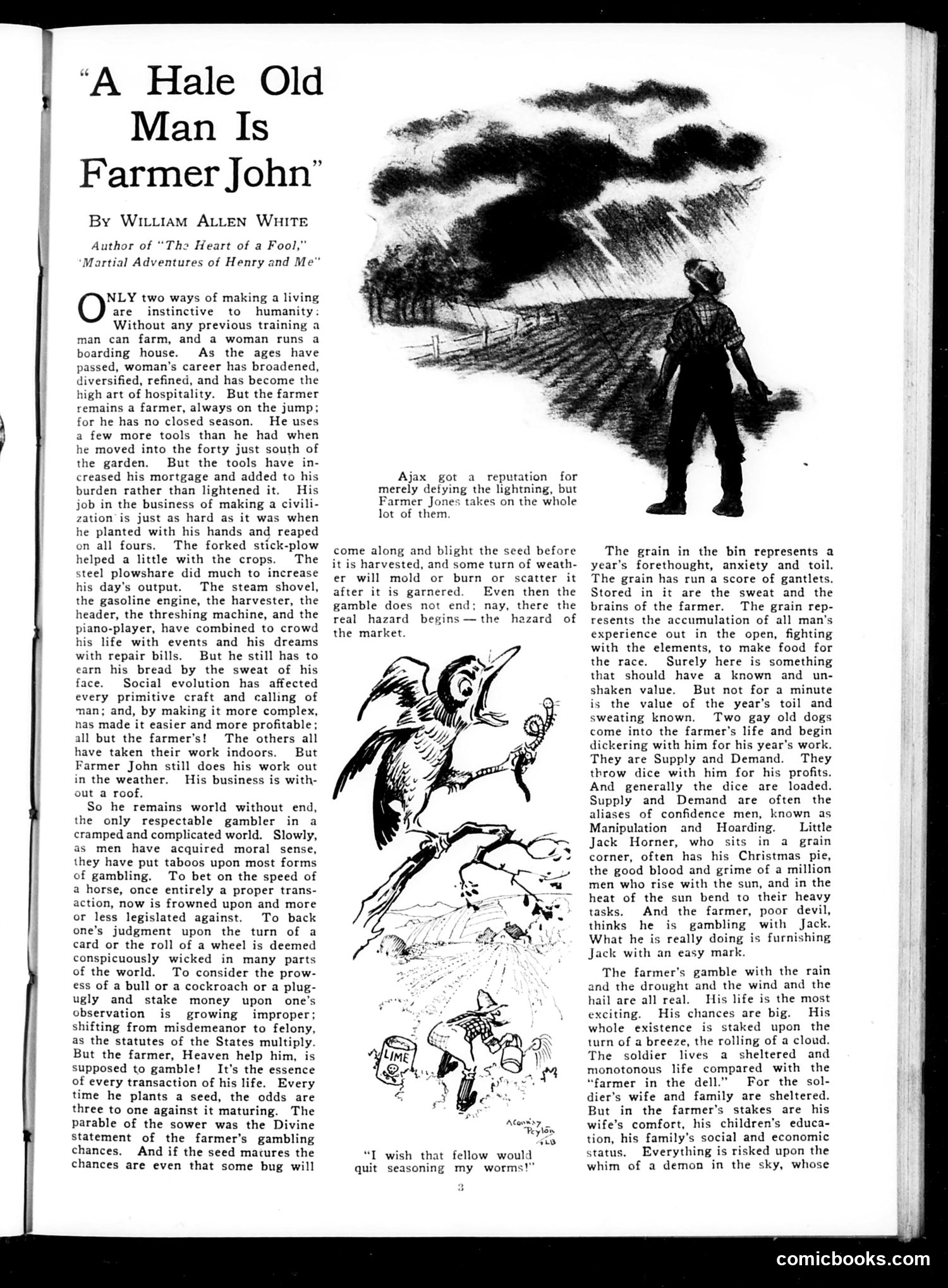
This William Allen White essay uses farming as metaphor for life's fundamental work. The illustrations satirize the farmer's gamble against nature: lightning threatening crops, dice-playing (referencing "Supply and Demand"), and a character named "Jack Horner" manipulating grain prices. The satire targets commodity speculation and market manipulation by traders who profit from farmers' labor while bearing none of the actual risk. The farmer genuinely gambles with weather, pests, and soil—real stakes. Meanwhile, speculators like Jack Horner gamble with loaded dice in "a grain corner," rigging markets through information advantages. The piece critiques industrial capitalism's exploitation of agricultural workers and argues farmers deserve recognition as society's only "respectable gamblers" since they face authentic, uncontrollable hazards.
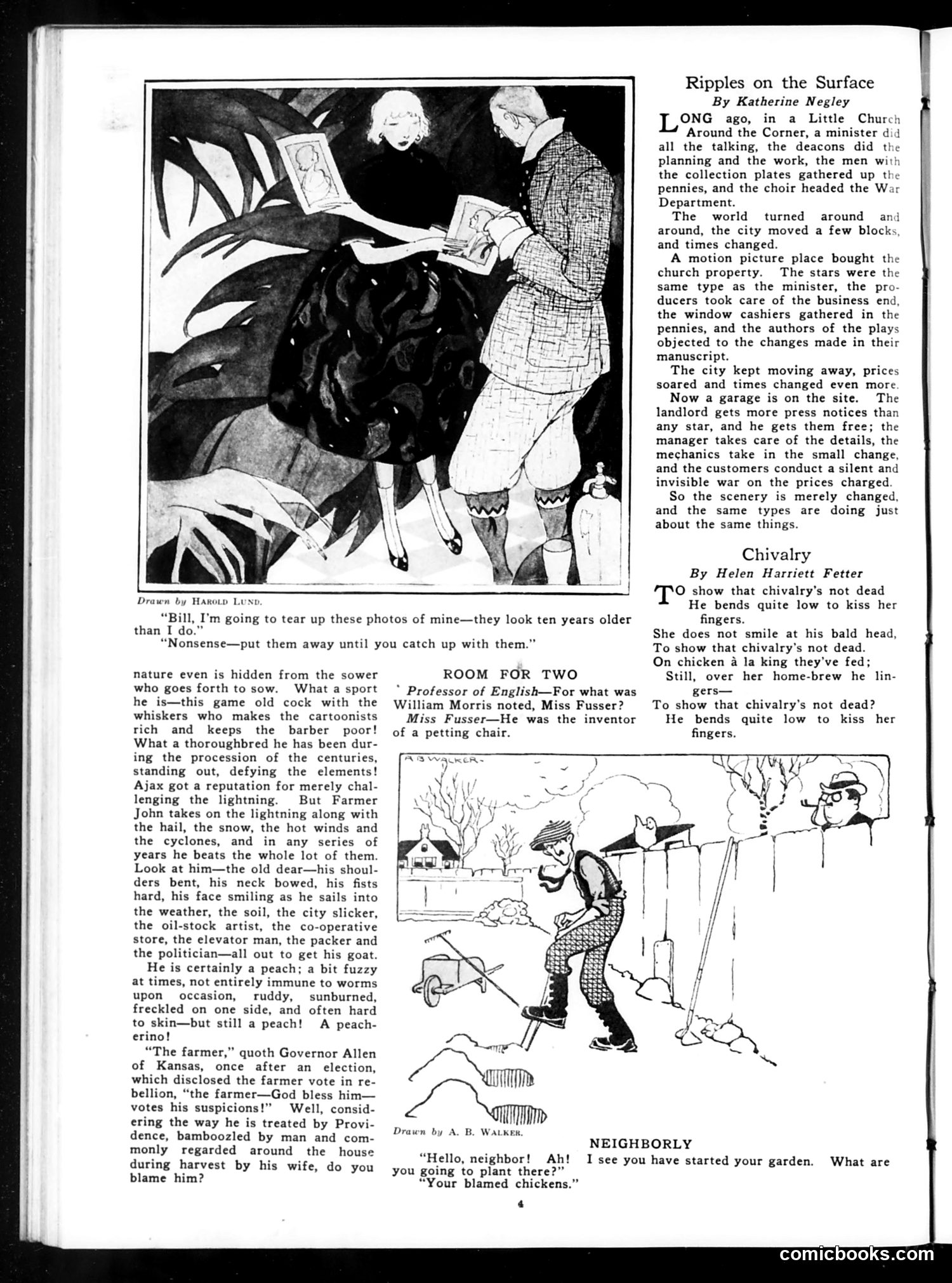
The page contains three distinct pieces: 1. **"Ripples on the Surface"** (top): A short story about a church property that was sold to a movie studio. The narrative describes how entertainment industry figures replaced clergy, illustrating urbanization and cultural change in early 20th-century America. 2. **"Chivalry"** (middle): A poem by Helen Harriett Fetter playfully questioning whether chivalry survives, using domestic scenes as evidence. 3. **"Neighborly"** (bottom cartoon): A humorous exchange where one neighbor discovers another's chickens have invaded his garden—a rural/suburban domestic humor piece typical of Judge's content. The page reflects Judge's satirical approach to contemporary American life, mixing social commentary with light domestic humor rather than sharp political satire.
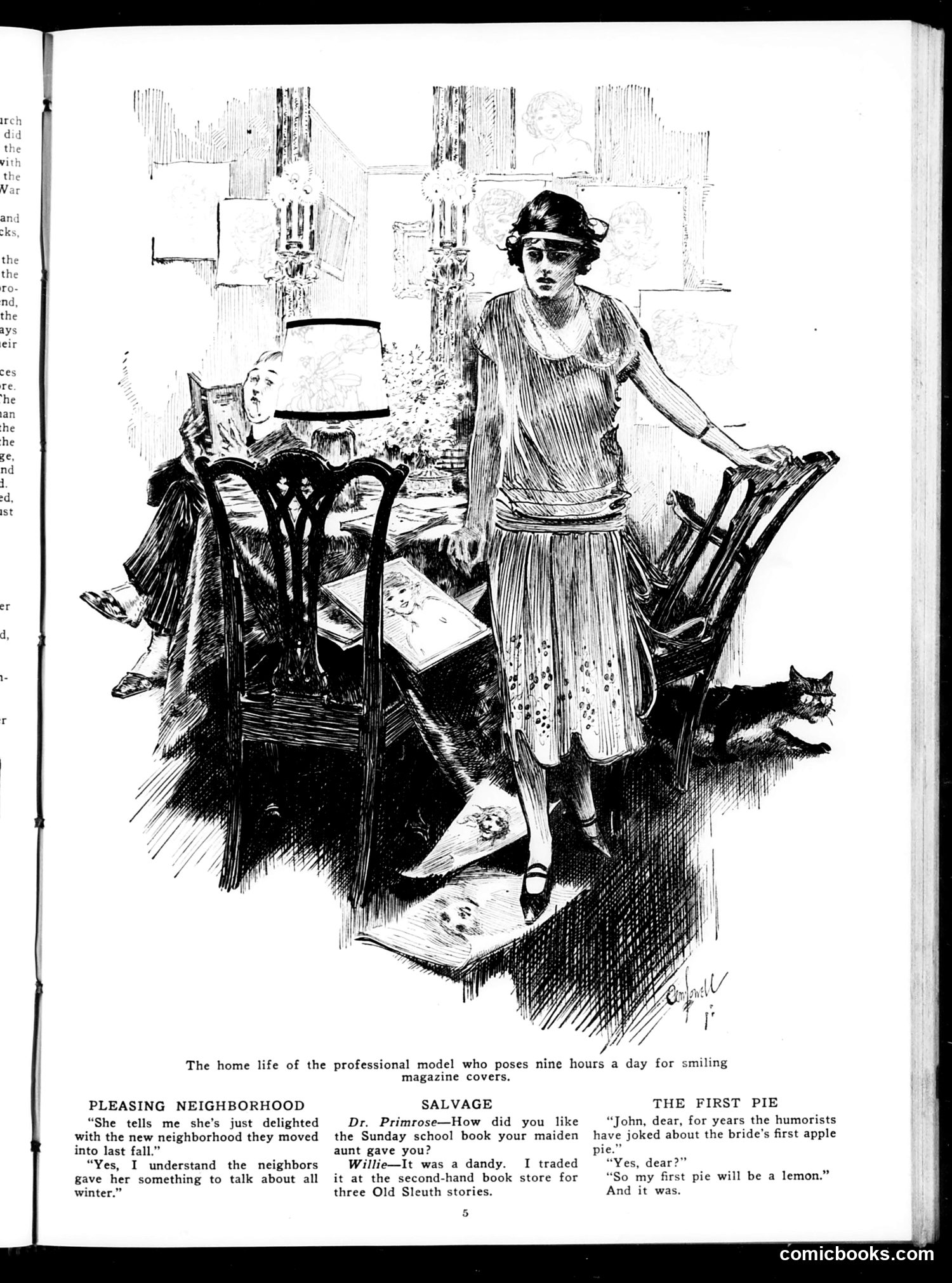
This page contains three separate short comic sketches satirizing early 20th-century domestic life and social conventions. **Main illustration**: Shows a professional model at home with her family and cat. The satire concerns the disconnect between her public persona (smiling for magazine covers nine hours daily) and her private exhaustion—the caption suggests she's worn out from forced cheerfulness. **"Pleasing Neighborhood"**: Jokes that a woman who moved to a new neighborhood had nothing interesting to discuss until the neighbors provided "something to talk about"—implying neighborhood gossip or scandal became her social currency. **"Salvage"**: A boy trades a wholesome Sunday school book from his aunt for adventure pulp stories, satirizing children's rejection of improving literature for entertainment. **"The First Pie"**: Plays on the clichéd joke about brides' failed first pies by having a newlywed deliberately make a lemon pie—subverting expectations and joking about domestic incompetence. The humor targets modeling work, gossip culture, children's reading habits, and marriage stereotypes.
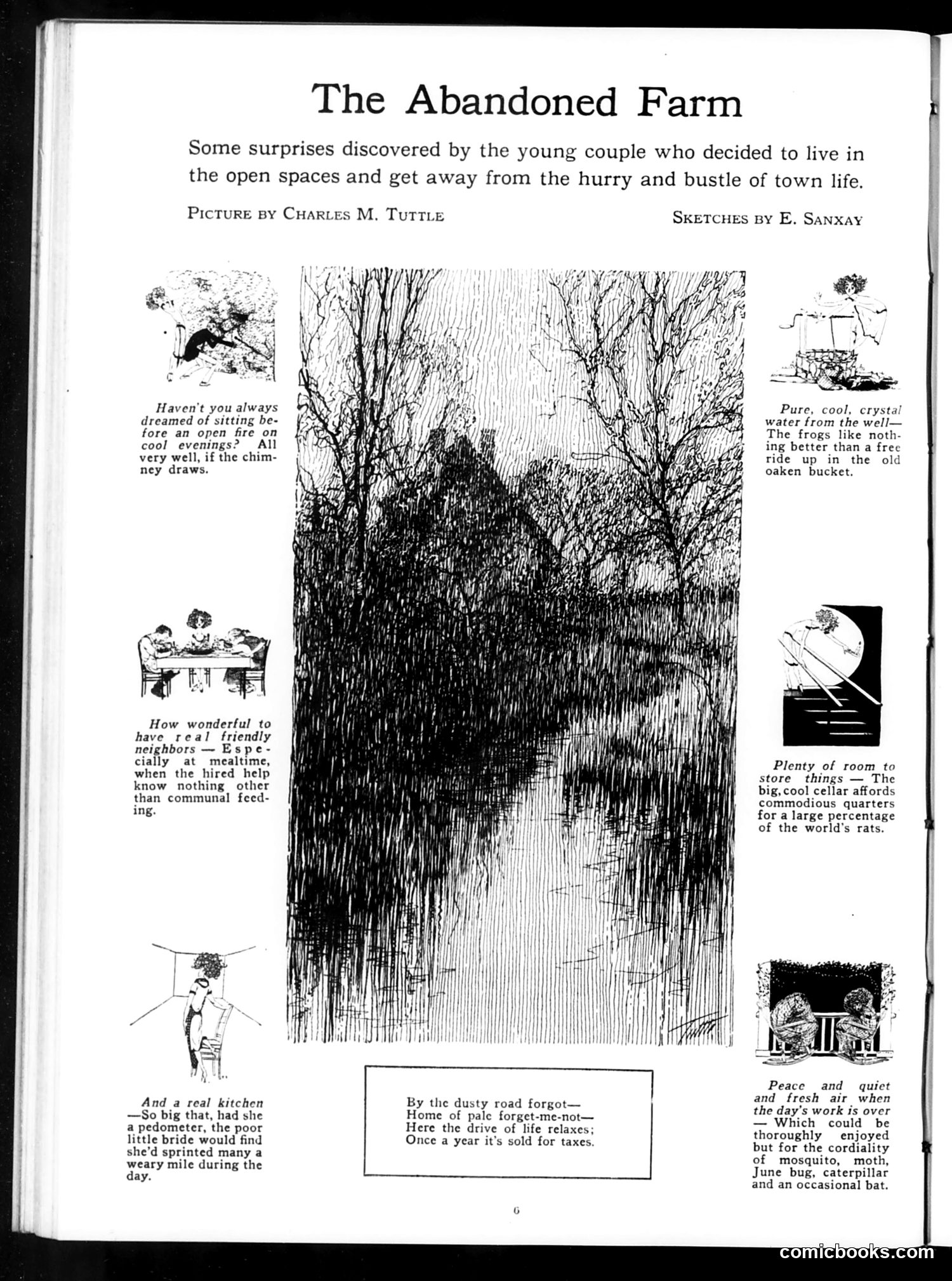
This is satirical commentary on the back-to-nature movement and urban flight. A young couple romanticizes rural farm life as an escape from city congestion, but the cartoon systematically debunks their idealistic expectations through dark humor. Each sketch reveals the harsh reality behind pastoral fantasies: a charming fireplace that doesn't draw properly; "friendly neighbors" who intrude during meals; a massive kitchen requiring exhausting labor; well water contaminated by frogs; a cellar infested with rats; and peaceful evenings plagued by insects. The final ironic couplet—noting the property is "sold for taxes" annually—suggests financial precarity. The satire targets not farmers (portrayed as practical) but rather sentimental urbanites unprepared for rural hardship. It reflects early 20th-century skepticism about romantic notions of country living, implying that those seeking escape often lack the actual skills and tolerance for genuine agricultural life.
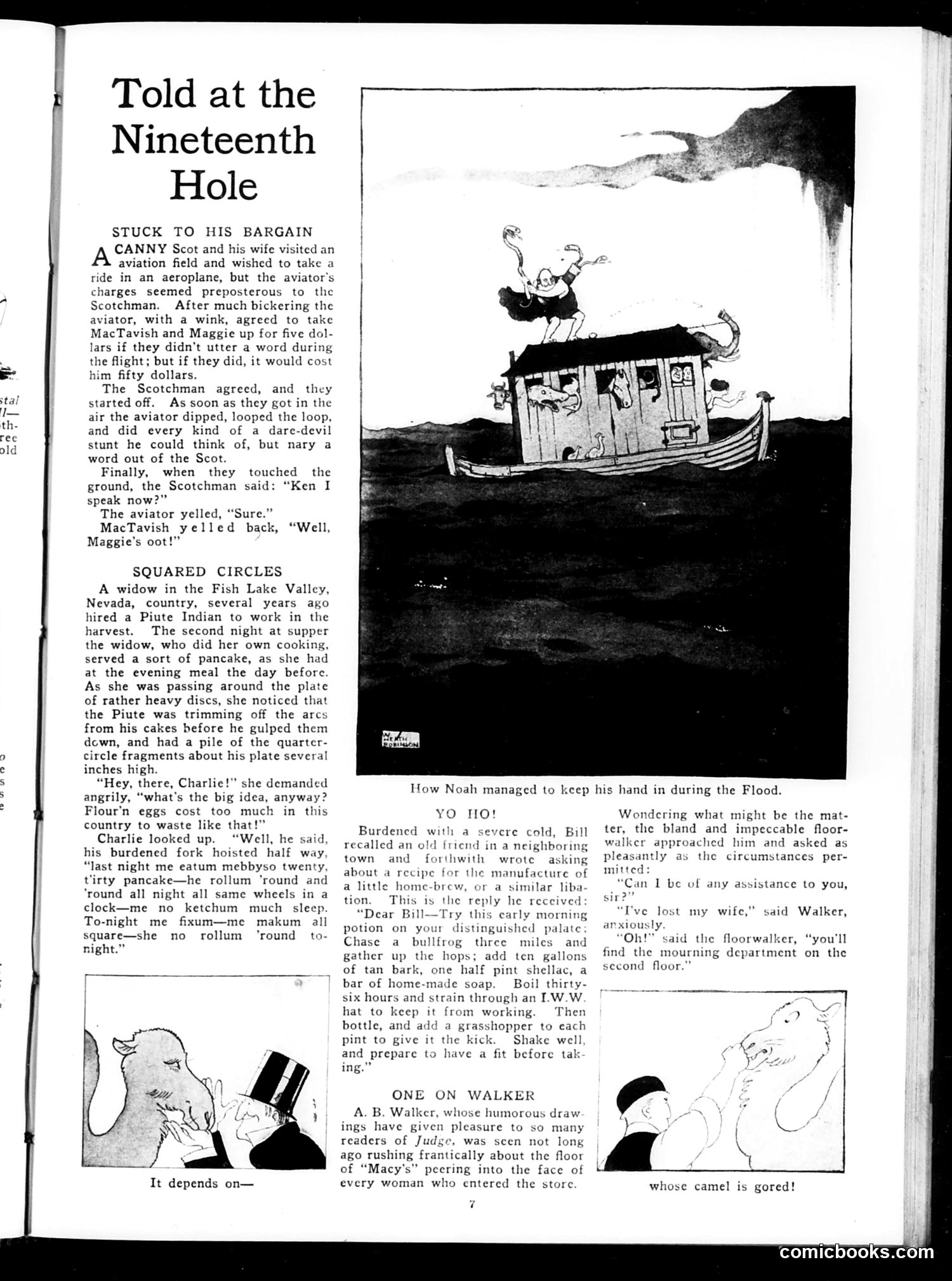
This page collects three humorous anecdotes typical of early-20th-century American humor: **"Stuck to His Bargain"**: A Scottish couple takes an airplane ride for $5 if silent, $50 if they speak. The aviator performs dangerous stunts, but the Scot stays silent. Upon landing, he says "Ken I speak now?"—then reveals his wife fell out mid-flight. The joke plays on Scottish frugality stereotypes and absurdist humor. **"Squared Circles"**: A Native American (Piute) worker eats pancakes by trimming off the curved edges, wasting flour and eggs. When the widow protests, he explains he's been "squaring" them because they "roll 'round" at night like wheels. This plays on ethnic stereotyping and malapropism humor. **"One on Walker"**: A brief joke about A.B. Walker (a Judge cartoonist) frantically searching Macy's for his lost wife by peering at women's faces. The final caption, "whose camel is gored!", suggests surprise or humiliation. The page reflects period attitudes toward ethnic and gender humor now considered offensive.
This is a theater review column by George Jean Nathan, a prominent drama critic. The cartoon header depicts various theatrical performers and props in exaggerated, comedic style—typical Judge magazine satirical illustration. Nathan reviews several recently-closed Broadway productions with withering dismissal. He mocks plays that were once hailed as serious social documents—particularly Stanley Houghton's "Hindle Wakes" and Shaw's "Mrs. Warren's Profession"—arguing they've aged poorly and now seem quaint or unintentionally funny rather than provocative. His central critique targets plays recycling tired formulaic plots: women abandoning careers for love, or the "business woman discovers she needs perfume and lace collars" narrative that Nathan claims appears interchangeably in cheap magazines and Broadway theaters alike. He's particularly harsh on Annie Nathan Meyer's "The Advertising of Kate," dismissing it as derivative 1910s-era material presented as new. The satire targets both lazy playwrights and critics who once overpraised didactic drama as "Great Documents"—suggesting theatrical fashion and critical judgment both age badly.
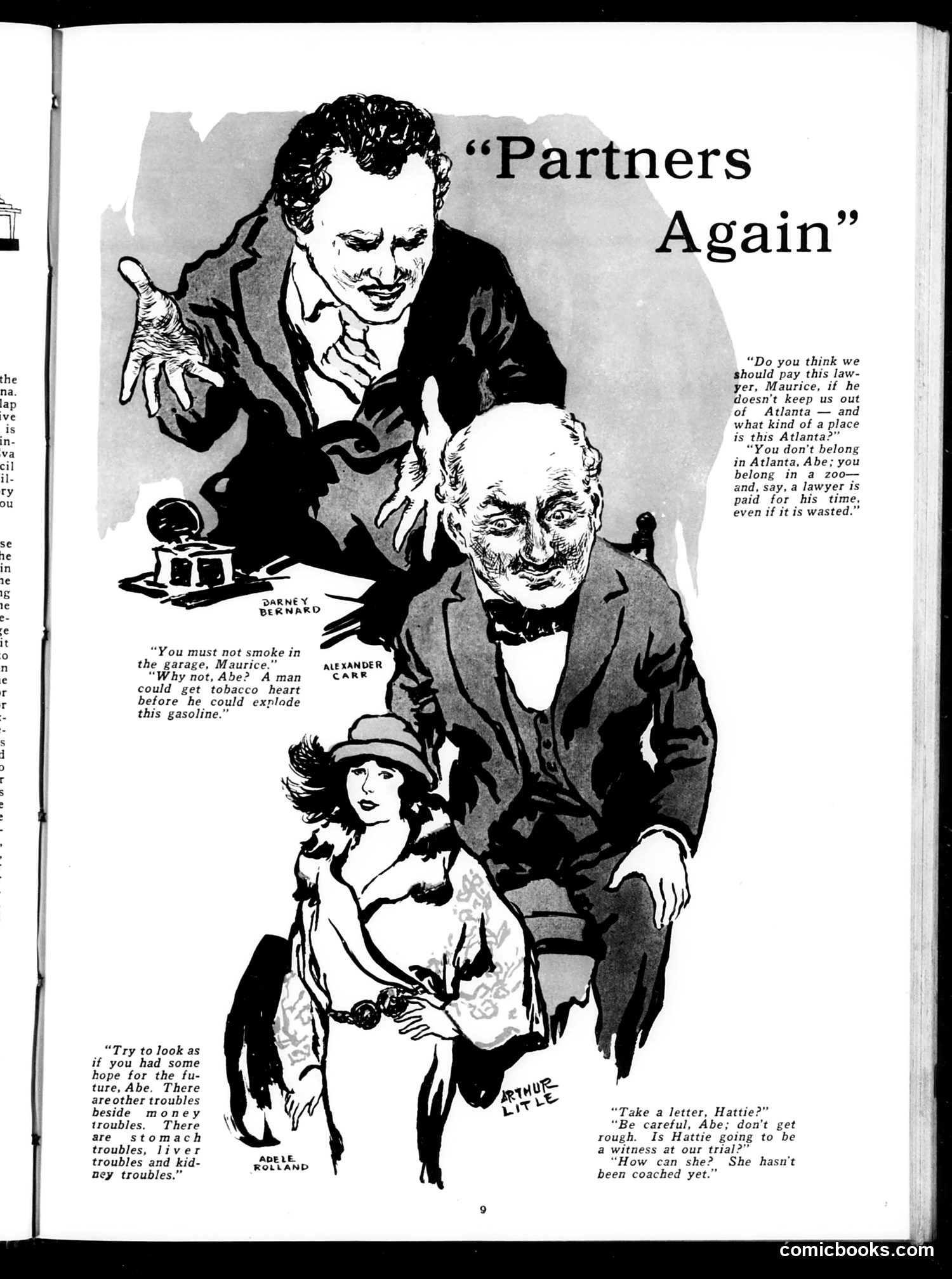
This page from *Judge* magazine features a comedic skit about two characters, Abe and Maurice (played by Alexander Carr and Darney Bernard respectively), reuniting as partners. The humor derives from their bickering Jewish vaudeville-style dialogue—typical of early 20th-century American comedy that relied heavily on ethnic caricature and exaggerated accents (evident in the phonetic spelling and comedic timing of the written exchanges). The jokes center on financial anxieties (lawyer fees, Atlanta travel), hypochondria (tobacco heart, stomach troubles), and workplace dynamics with their secretary Hattie. The final exchange about "coaching" a witness is a mild reference to jury manipulation or testimony preparation. This represents period entertainment that would have appealed to theater audiences familiar with Jewish-American vaudeville performers. The caricatures and dialect humor reflect entertainment conventions now considered offensive, though the content itself is relatively mild—focusing on everyday domestic and professional frustrations rather than explicit stereotyping.
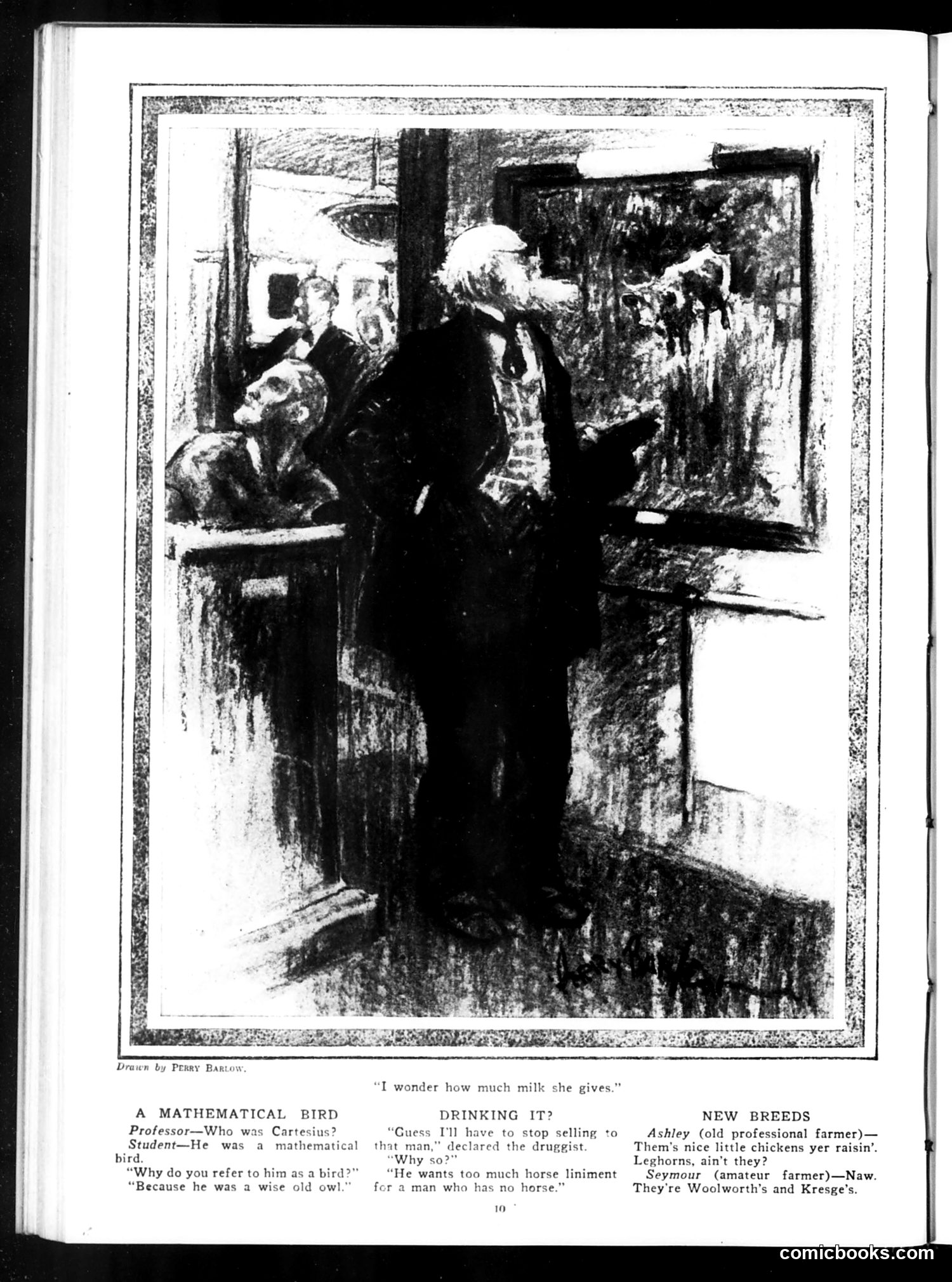
This page contains three separate jokes typical of early 20th-century American humor: **"A Mathematical Bird"**: A pun on Descartes (Cartesius), the philosopher. The student calls him a "bird" because he was a "wise old owl"—a play on the phrase "wise old owl." **"Drinking It?"**: A joke about a druggist selling horse liniment to a customer. The implication is that the customer appears so unhealthy or decrepit that he'd need liniment, yet claims he has no horse—suggesting the druggist is overcharging him for a product meant for animals. **"New Breeds"**: Rural humor contrasting old and new. An experienced farmer asks about "Leghorns" (a chicken breed), but the amateur farmer reveals his chickens are "Woolworth's and Kresge's"—cheap five-and-dime store varieties, suggesting either he bought inferior quality birds or is making a joke about their worthlessness as modern, mass-produced goods rather than proper farm stock.
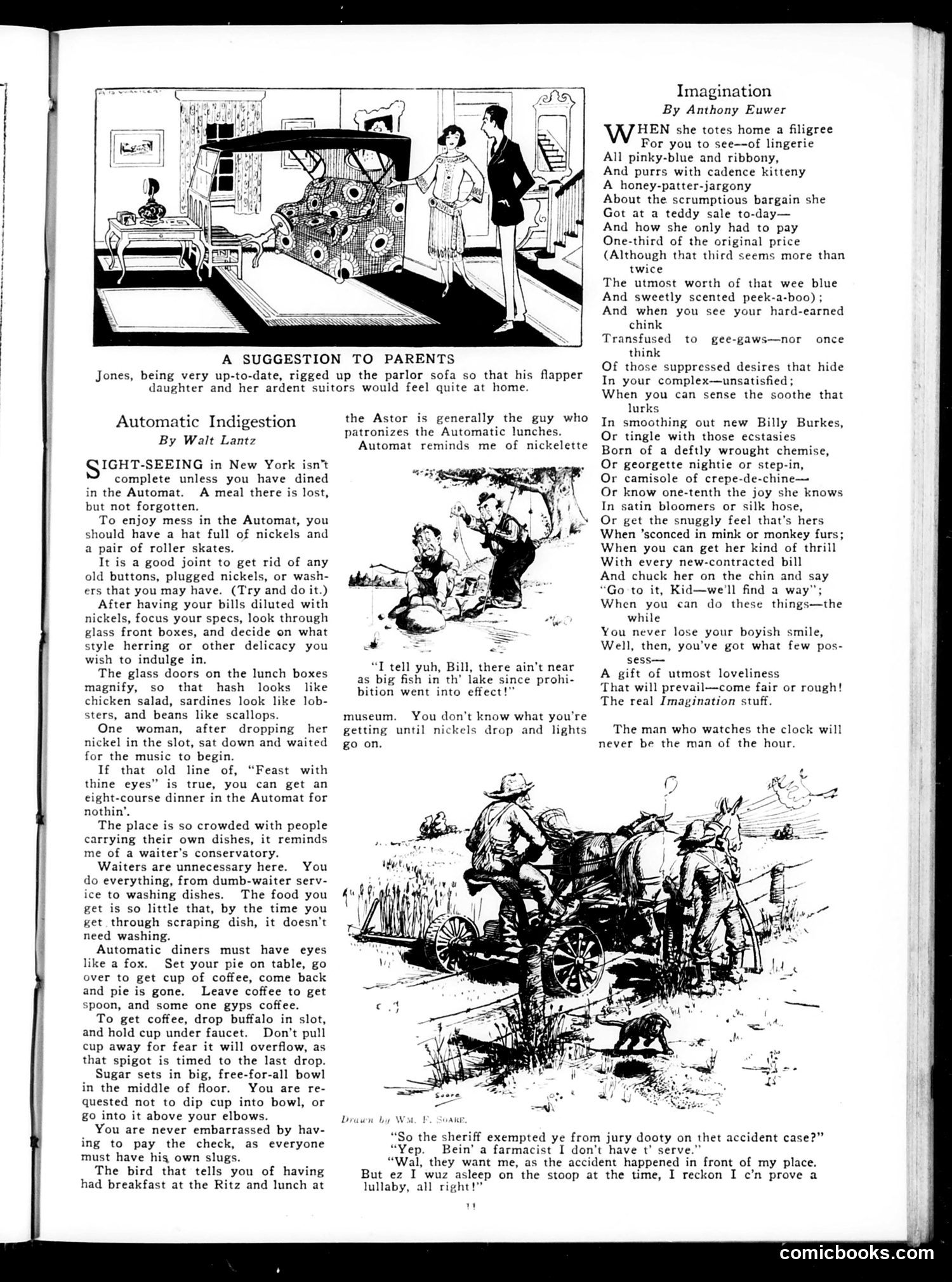
This page contains three satirical pieces mocking 1920s American consumer culture and gender dynamics: **"A Suggestion to Parents"** (top cartoon): The illustration shows a modernized parlor sofa designed to accommodate young couples. The satire targets parents adopting trendy ideas about youth socializing, suggesting they're naively enabling flirtation. **"Automatic Indigestion"** by Walt Lantz mocks New York's Automat restaurants—coin-operated food dispensaries that were novel innovations. The humor ridicules the experience: cramped conditions, mediocre food magnified by glass, customers stealing each other's meals, and the irony that diners do all the work themselves while paying for "service." **"Imagination"** by Anthony Euwer is a poem satirizing men's attitudes toward women's shopping. It portrays a husband indulging his wife's lingerie purchases despite inflated prices, suggesting that masculine "imagination" means tolerating women's consumption while maintaining a cheerful facade—the satirical point being that this performative patience constitutes romantic devotion. All three pieces reflect Jazz Age anxieties about changing social customs, consumerism, and gender relations.
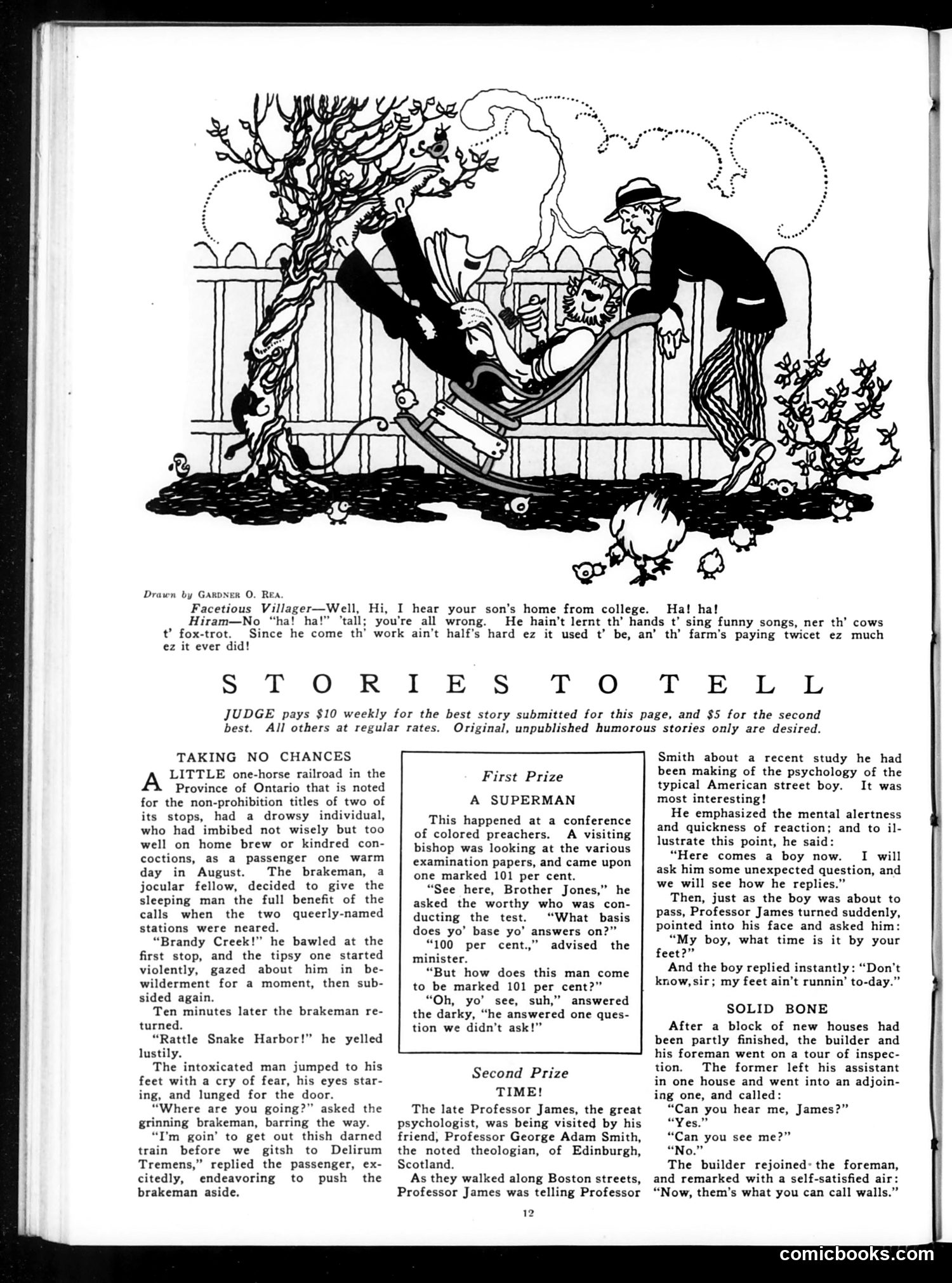
This page contains a cartoon and three humorous stories typical of early 20th-century American satire. **The Cartoon** (by Gardner O. Rea): A rural farmer deflates a visitor's assumption that college ruins farm boys. The joke inverts expectations: the son has actually made the farm more efficient and profitable. The satire mocks anti-education prejudice common in rural America—the assumption that schooling makes young people useless for manual labor. **The Stories** humorously play on: - Ethnic/regional dialect humor (a drunk man and a Black preacher) - Misunderstandings and wordplay - Professional anecdotes (psychology professor William James, apparently a real reference) The "Superman" story uses period racial stereotypes while the drunk-passenger tale pokes fun at Prohibition-era drinking culture and Canadian place names ("Brandy Creek," "Rattle Snake Harbor"). These represent Judge's typical blend of social commentary through exaggeration and dialect humor—approaches that reflect both the era's comedic style and its prejudices.
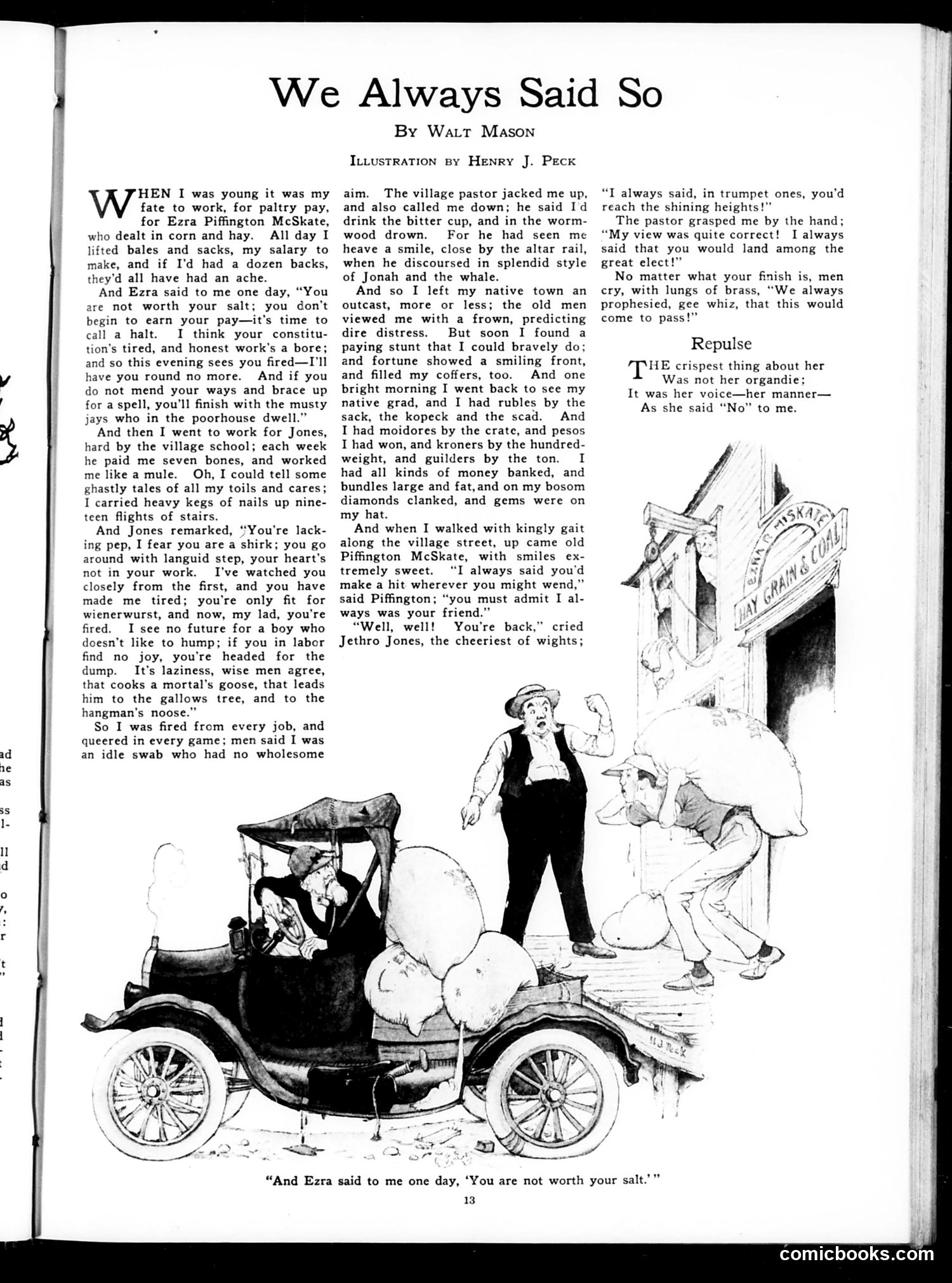
This is a satirical short story by Walt Mason with illustrations by Henry J. Peck. The narrative mocks human hypocrisy and opportunism. The protagonist is fired repeatedly from jobs by harsh employers (Ezra Piffington McSkate, Jones, and others) who criticize his work ethic. He eventually becomes wealthy through unspecified means and returns to his hometown. Suddenly, the same people who condemned him now claim they "always said" he'd succeed—taking credit for predicting his fortune. The satire targets social climbers and fair-weather friends who pretend prescience after the fact. The repeated refrain "We always said so" exposes how people falsely claim they knew someone would succeed only after that success is visible and profitable. The small illustration "Repulse" at bottom right appears unrelated—a woman coolly rejecting a suitor—possibly commenting on selective judgment based on status.
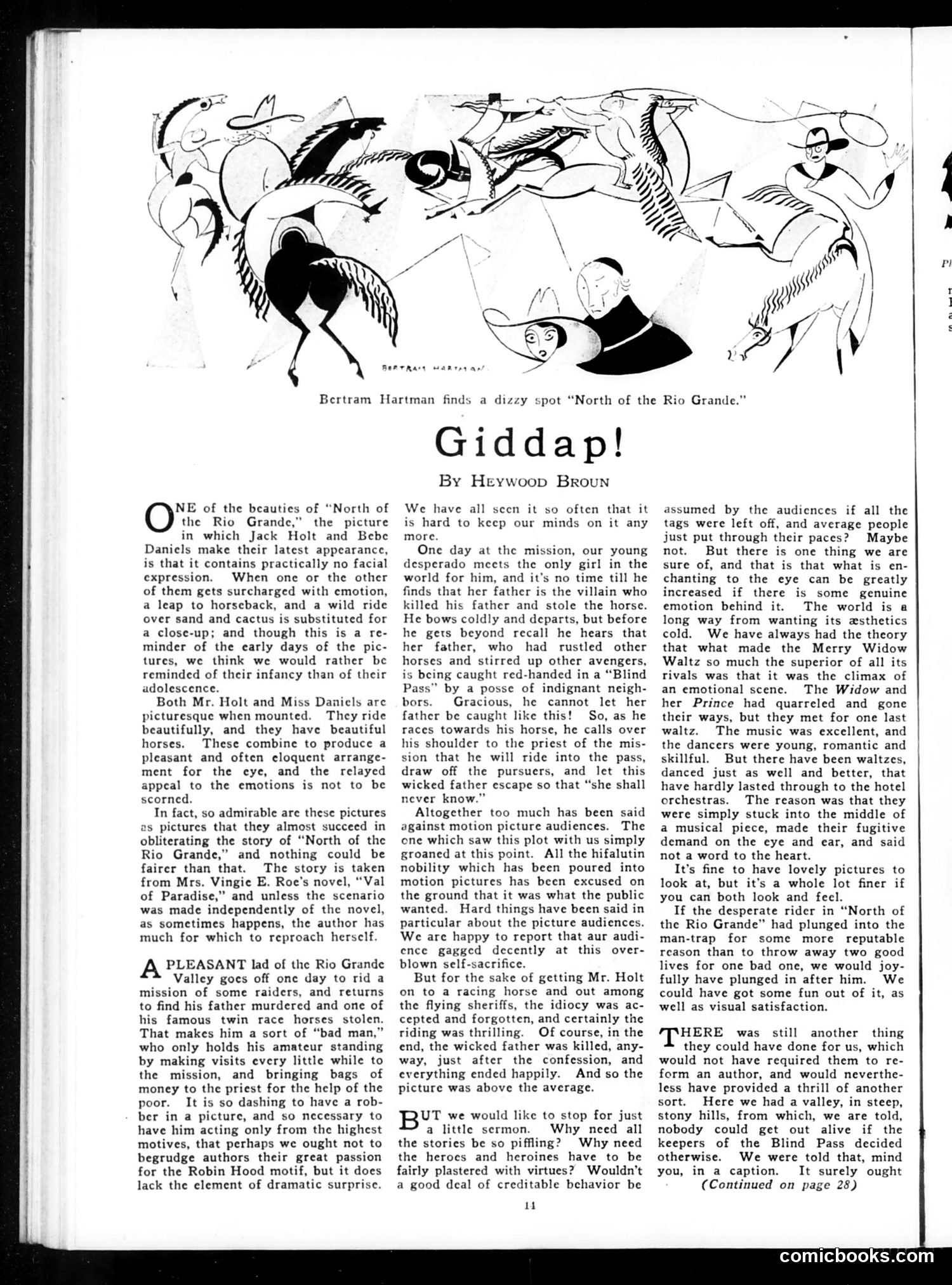
This is a film review by Heywood Broun critiquing "North of the Rio Grande" (1924), starring Jack Holt and Bebe Daniels. **The Film's Plot Problem:** Broun mocks the predictable "Robin Hood outlaw" trope—a hero who steals to help the poor, appearing noble but ultimately lacking dramatic surprise. **The Central Absurdity:** The protagonist encounters the villain's daughter, learns her father killed his own father and stole his horse, then *heroically* helps the villain escape so "she shall never know" the truth. Broun notes the audience literally groaned at this contrived nobility. **Broun's Critique:** While praising the cinematography and horsemanship, he argues Hollywood relies on excessive "hifalutin nobility" and implausible moral posturing to excuse weak storytelling. He suggests filmmakers need better plots and less reliance on emotional manipulation through spectacular action sequences. The review advocates for more intelligent screenwriting rather than substituting horse chases for character development.
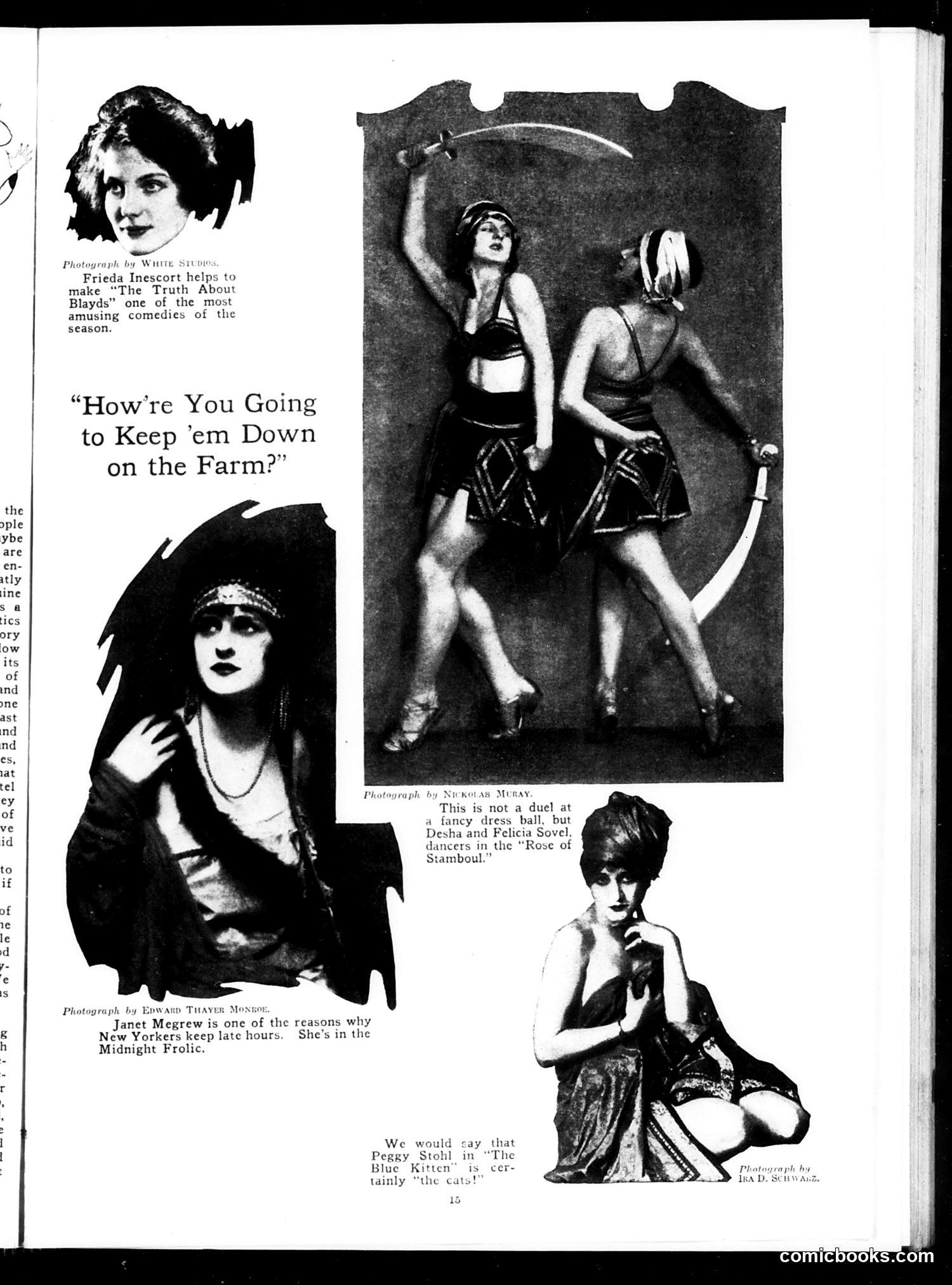
This page features theatrical publicity photographs and promotes Broadway shows of the era. The title "How're You Going to Keep 'em Down on the Farm?" references a famous 1919 song expressing concern that soldiers returning from WWI wouldn't settle for rural life after urban excitement. The satire works by applying this anxiety to actresses: the photographs showcase glamorous performers in popular stage productions ("The Truth About Blayds," "Rose of Stamboul," "Midnight Frolic," "The Blue Kitten"), suggesting they represent the alluring urban entertainment distracting young people—particularly women—from traditional domestic/rural life. The "cat's" reference uses period slang meaning "attractive" or "excellent." This is essentially entertainment advertising dressed as social commentary, reflecting Jazz Age concerns about modernity, urbanization, and changing social norms.
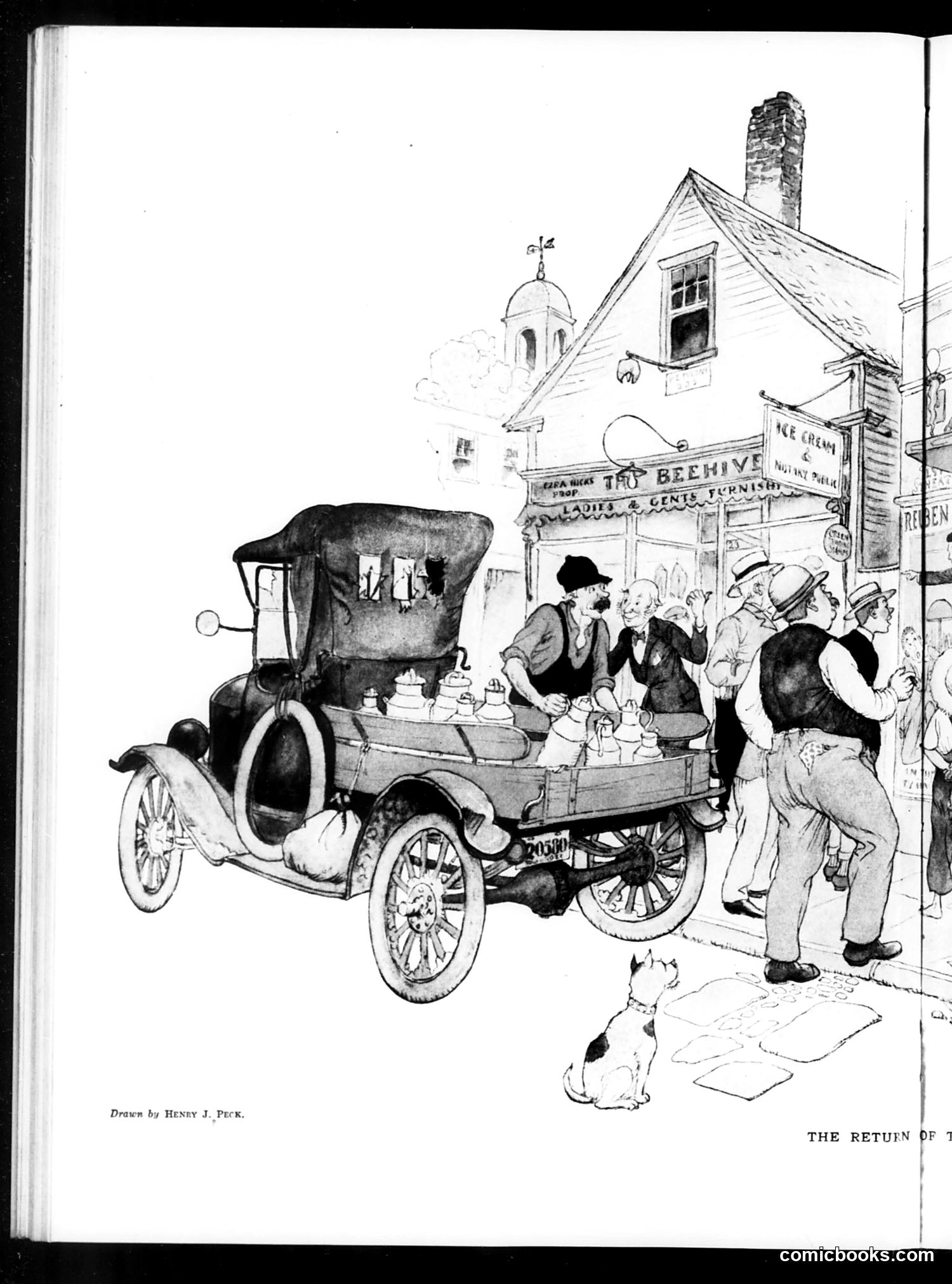
This cartoon by Henry J. Peck depicts an early automobile (appears to be from the 1900s-1910s era) that's been converted into a mobile ice cream and refreshment vendor. The vehicle displays signs reading "THE BEEHIVE" and advertises "ICE CREAM," "LADIES & GENTS FURNISHED" [with refreshments]. The satire likely mocks the rapid commercialization and industrialization of American street commerce during the automobile age. What was traditionally a stationary shop ("The Beehive") has become mobile, suggesting both entrepreneurial innovation and the encroachment of commerce into public spaces. The well-dressed gentlemen and other figures gathered around it represent the novelty and curiosity of this modern business practice. A small dog in the foreground adds humorous detail to the street scene. The cartoon captures early-20th-century anxieties about modernization and changing urban life.
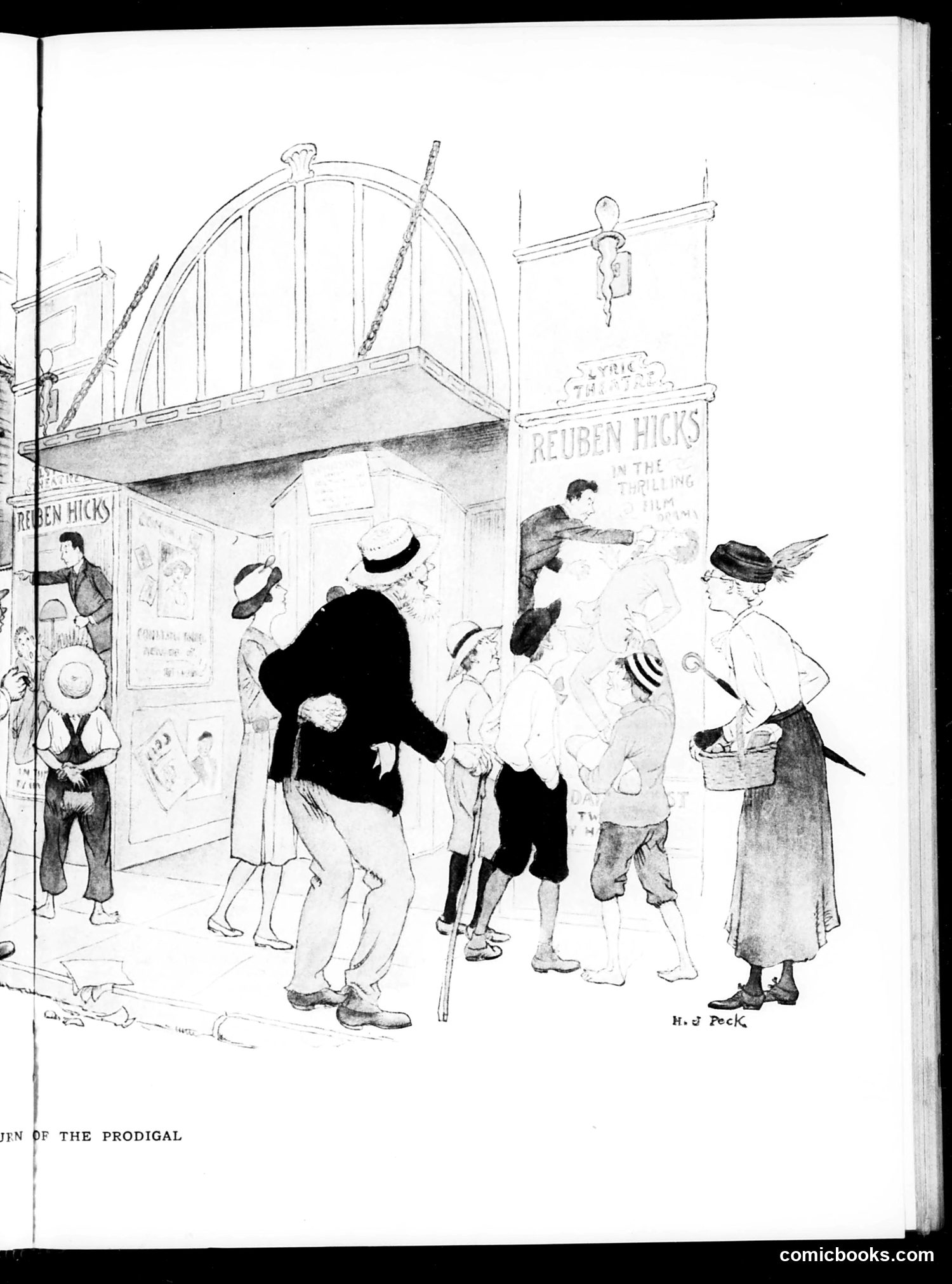
This cartoon by H.J. Peck depicts a scene outside a movie theater showing "Reuben Hicks" films. A woman on the right (likely representing a wife or female relative) greets a man returning home, while other figures gather around what appears to be a movie theater entrance with promotional posters. The title "Return of the Prodigal" references the biblical parable of a wayward son's homecoming. The satire likely comments on how cinema—particularly popular films featuring actors like "Reuben Hicks"—distracted men from their domestic responsibilities, drawing them away from home. The woman's welcoming gesture suggests she's relieved to see the man back, implying he'd been absent, absorbed in entertainment rather than family duties. This reflects early 20th-century anxieties about movies' social impact on family life and traditional values.
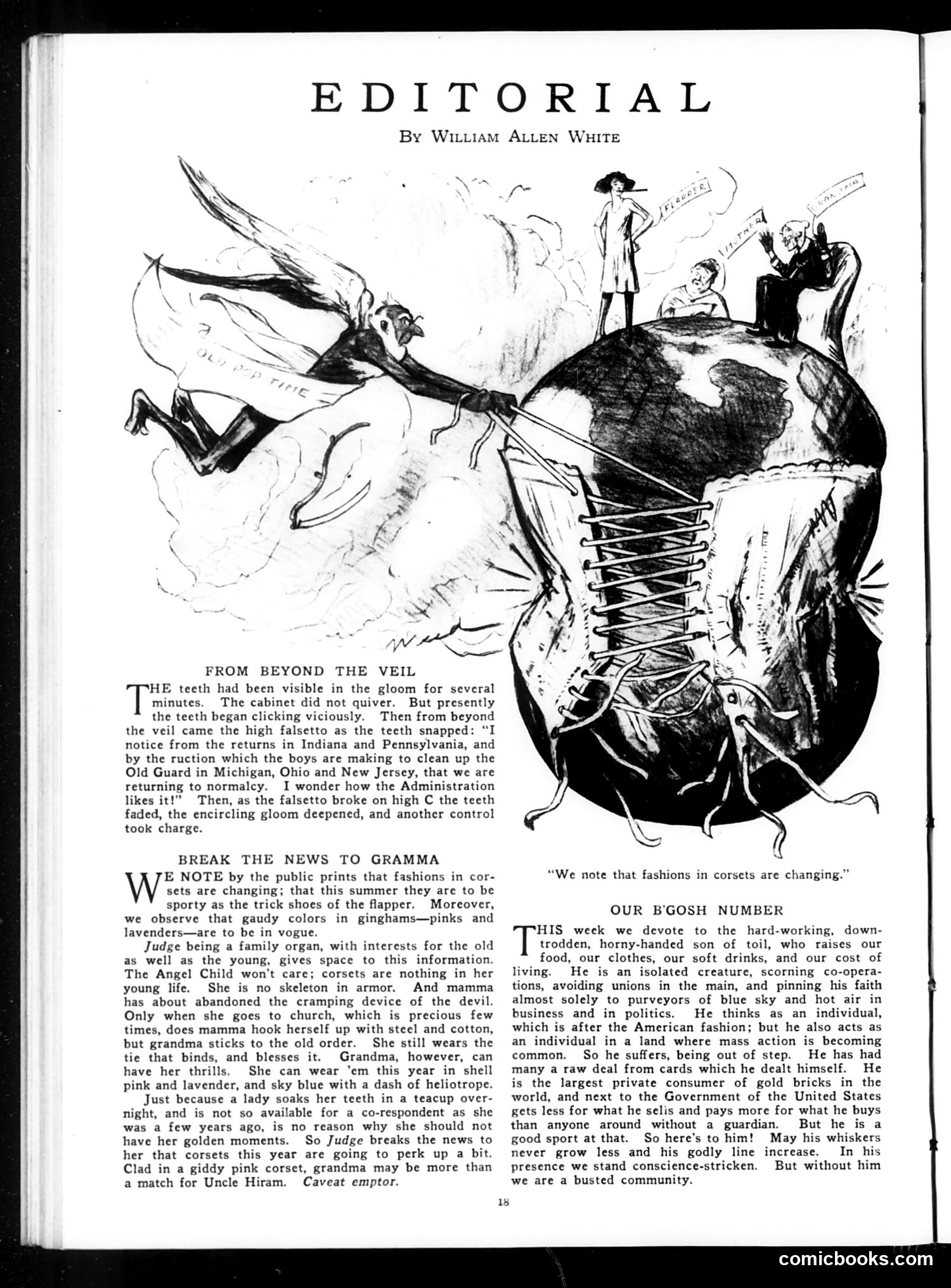
This editorial page contains two satirical pieces: **"From Beyond the Veil"** depicts a ghostly, skeletal figure with prominent teeth emerging from darkness to address a silent Cabinet. The specter appears to represent Warren G. Harding's administration (indicated by references to "normalcy" and electoral "returns in Indiana and Pennsylvania"). The commentary criticizes GOP corruption and the "Old Guard" machine politics in Michigan, Ohio, and New Jersey—suggesting the administration's claimed return to normalcy masks ongoing political scheming. **"Break the News to Gramma"** and **"Our B'Gosh Number"** are lighter pieces about fashion trends for older women and a satirical tribute to the hardworking American laborer—described as gullible, anti-union, and easily defrauded ("largest private consumer of gold bricks"), yet still considered essential to society's functioning. The overall tone mixes political criticism with social commentary on class and generational divides in post-WWI America.
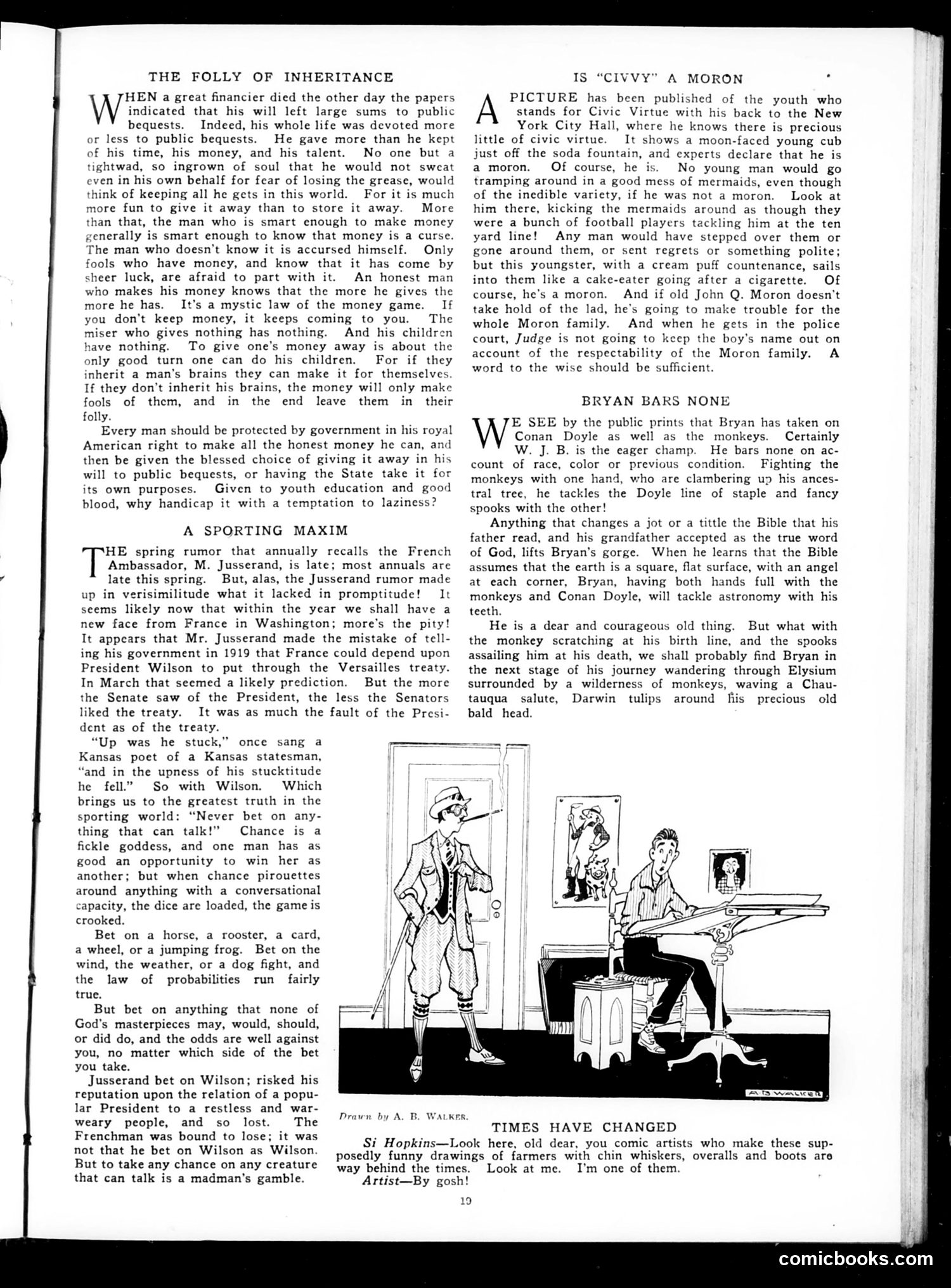
This page contains three satirical pieces: **"The Folly of Inheritance"** argues wealthy financiers should give away their money rather than pass it to heirs, claiming inherited wealth makes fools of children. The piece advocates government protection of wealth-earning but encourages philanthropic giving. **"A Sporting Maxim"** criticizes French Ambassador Jusserand for betting his reputation that President Wilson would secure Senate ratification of the Versailles Treaty (1919). The satire mocks Wilson's political incompetence, comparing him to a stuck Kansas politician. The section argues "never bet on anything that can talk"—implying unpredictable human behavior makes negotiation impossible. Jusserand lost his position over this miscalculation. **"Is 'Civvy' a Moron"** (partially visible) appears to mock a statue or representation of "Civic Virtue" near New York City Hall, suggesting irony about virtue's presence in politics. The accompanying cartoon by A.D. Walker depicts what appears to be a domestic or workplace scene with multiple figures.
This page contains book reviews from Judge magazine's literary section. The lead review critiques John V.A. Weaver's novel "Margey Wins the Game," which depicts 1920s youth culture—specifically the "flapper" phenomenon and collegiate excess. The reviewer dismisses the book as trivial literature, arguing that youthful indiscretion and sexual behavior aren't new phenomena deserving serious literary treatment. The reviewer notes that rapid slang obsolescence undermines the book's relevance. The secondary review discusses John Dos Passos's "Rosinante to the Road Again," praising it as genuinely thoughtful despite its impressionistic style. The contrast suggests Judge's editors valued substance over trendy subject matter when evaluating contemporary literature.
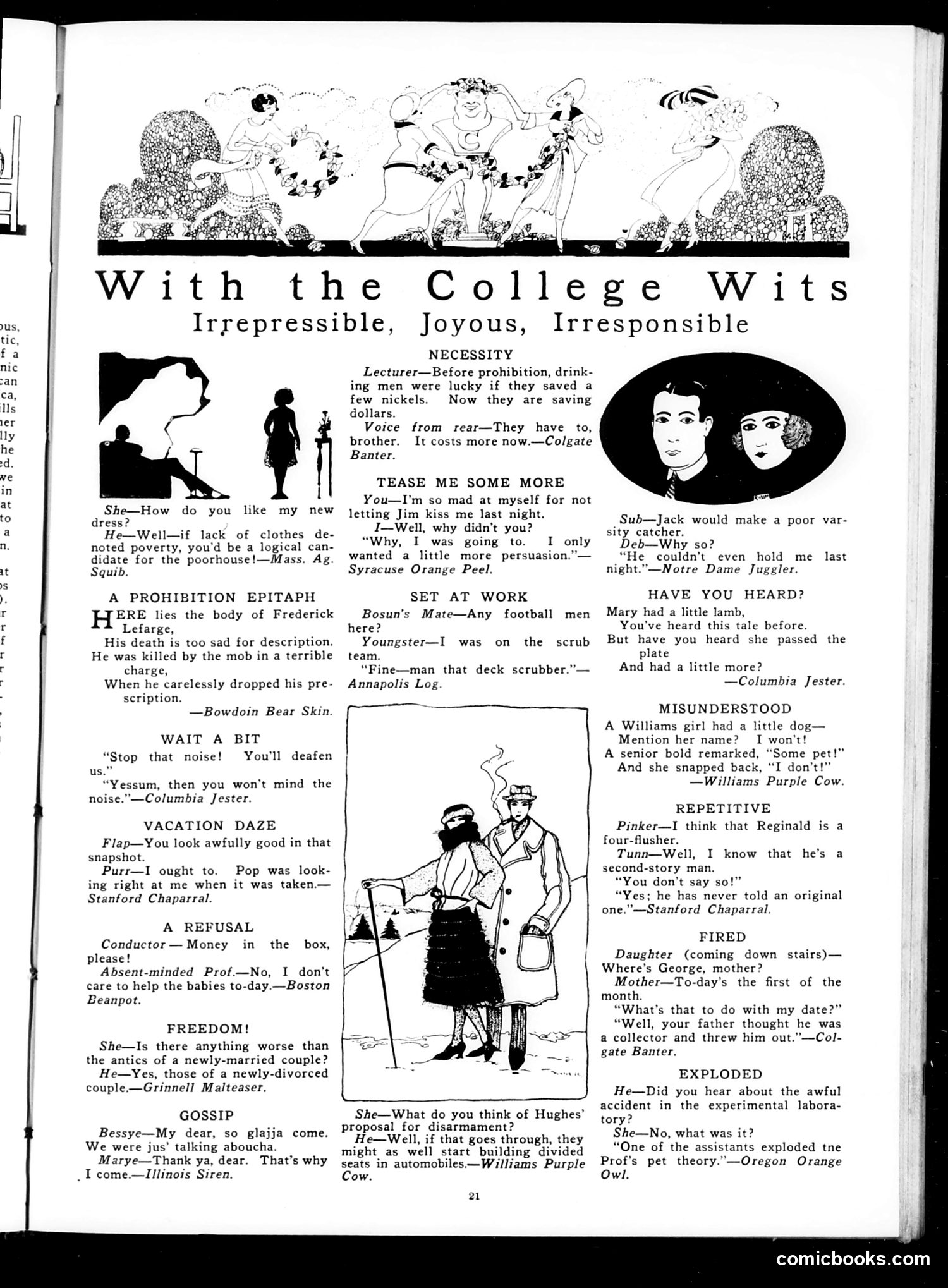
This is a collection of short jokes and witty exchanges typical of 1920s college humor magazines. The page satirizes contemporary social issues through brief dialogues: **Prohibition** is mocked repeatedly—one joke notes that drinking men now save *dollars* instead of nickels because alcohol costs more illegally. Another epitaph describes a man killed by a mob after dropping his "prescription" (coded language for alcohol). **Gender and dating dynamics** appear in multiple jokes playing on women's behavior and romantic expectations, reflecting 1920s courtship anxieties. **Class and authority** are targets—a professor refusing to contribute to charity, a father mistaking his daughter's boyfriend for a debt collector. The humor relies on wordplay, double meanings, and observational comedy about college life, domesticity, and current events. The cartoons accompanying the text feature simple line drawings of typical scenarios. This represents mainstream, collegiate-oriented satire of the era—relatively gentle mockery of social conventions and Prohibition-era circumstances.
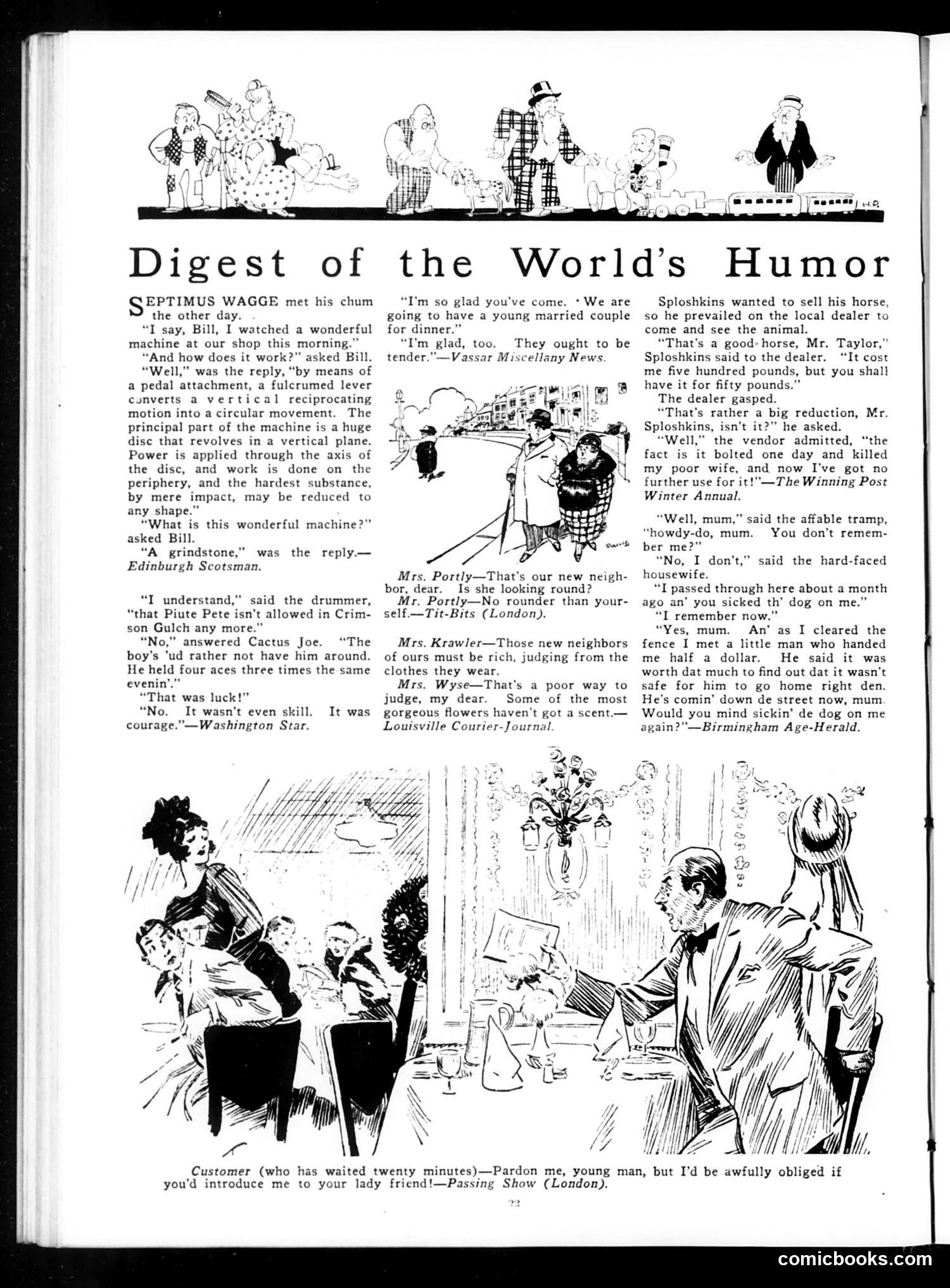
This page collects brief humorous anecdotes from various publications, presented as international humor samples. The jokes rely on verbal wit and situational irony typical of early-20th-century periodical humor. Key items include: a man comically over-explaining a grindstone using technical jargon; a widow selling a horse cheaply because it killed her (dark humor about an inconvenient problem); a tramp returning to a house that sicced dogs on him, hoping for another dollar; and a frustrated restaurant customer waiting 20 minutes, sarcastically asking for an introduction to his server's girlfriend. The illustrations—showing the tramp scene and an impatient diner—visualize selected jokes. The humor emphasizes wordplay, unexpected punchlines, and class-based comedy (beggars, household disputes, customer service complaints). These represent typical Judge magazine fare: accessible, punchy humor with minimal commentary, designed for quick laughs rather than social critique.
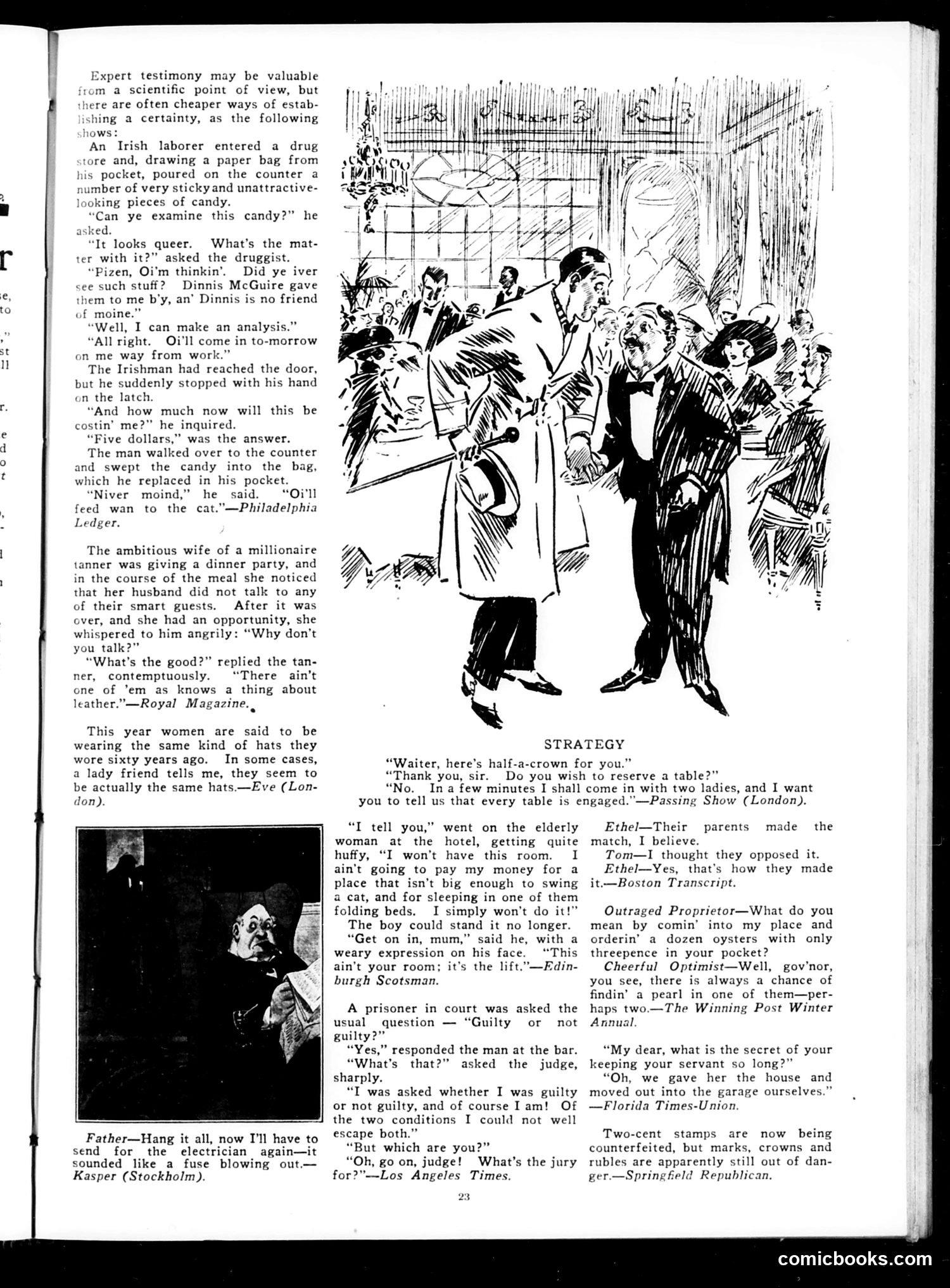
This page contains several short humorous anecdotes typical of early 20th-century satirical magazines, plus one illustration labeled "Strategy." **The main cartoon** depicts a waiter receiving a half-crown tip with instructions to later claim all tables are "engaged" when the tipper returns with two women. It satirizes the transactional nature of restaurant service and class-conscious social maneuvering—the tipper essentially bribes the waiter to facilitate what appears to be an illicit romantic arrangement by creating a false excuse for privacy. **The surrounding text anecdotes** mock working-class characters and their logic: an Irishman testing poison candy on a cat rather than paying for analysis; a tanner's wife frustrated her husband won't discuss leather with dinner guests; a hotel guest complaining about tiny rooms. These rely on ethnic stereotypes (Irish accent) and class humor common to the era. **The social commentary** reflects early 1900s attitudes: contempt for the working poor, amusement at their supposed ignorance, and normalization of bribery and deception among the better classes. The humor assumes readers share these prejudices.
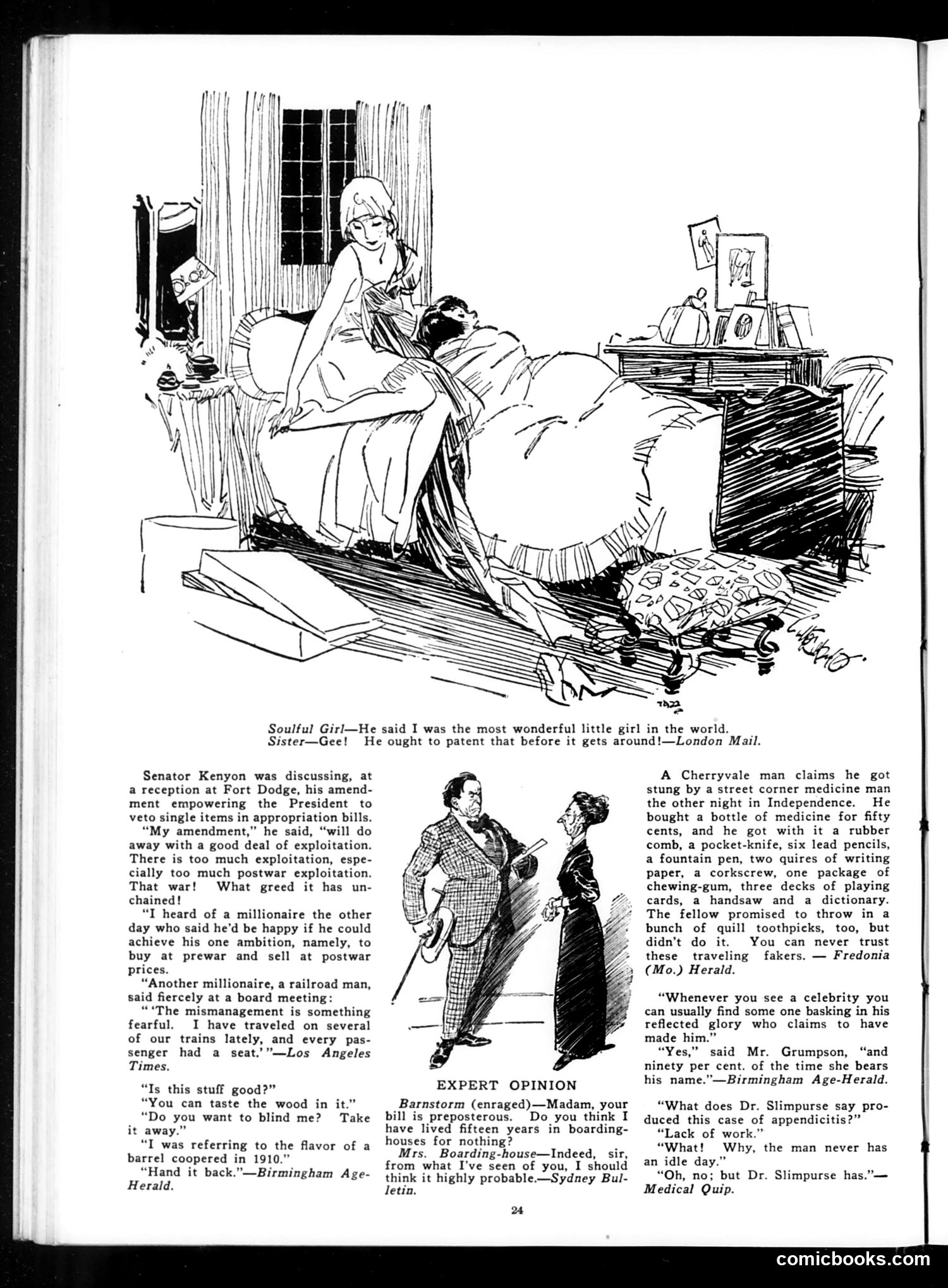
This page contains humor pieces satirizing post-WWI American society, circa early 1920s. **Top illustration**: A bedroom scene captioned about a "soulful girl"—likely mocking romantic sentimentality and the notion that flattery ("most wonderful little girl") passes for genuine affection. **Senator Kenyon anecdote**: References a real senator's proposal for presidential line-item veto power. The satire targets post-war profiteering—millionaires exploiting price inflation by buying prewar goods cheap and selling at inflated postwar rates. One railroad magnate ironically complains about "mismanagement" while praising trains where every passenger has a seat (implying overcrowding was normal). **Other pieces mock**: - Bootleg whiskey quality (post-Prohibition, though Prohibition began 1920) - Street-corner medicine man scams - Celebrity hangers-on (often spouses) claiming credit for success - Dishonest doctors billing for unnecessary procedures The humor reflects 1920s cynicism about commercialism, fraud, and exploitation during the economically turbulent postwar period.
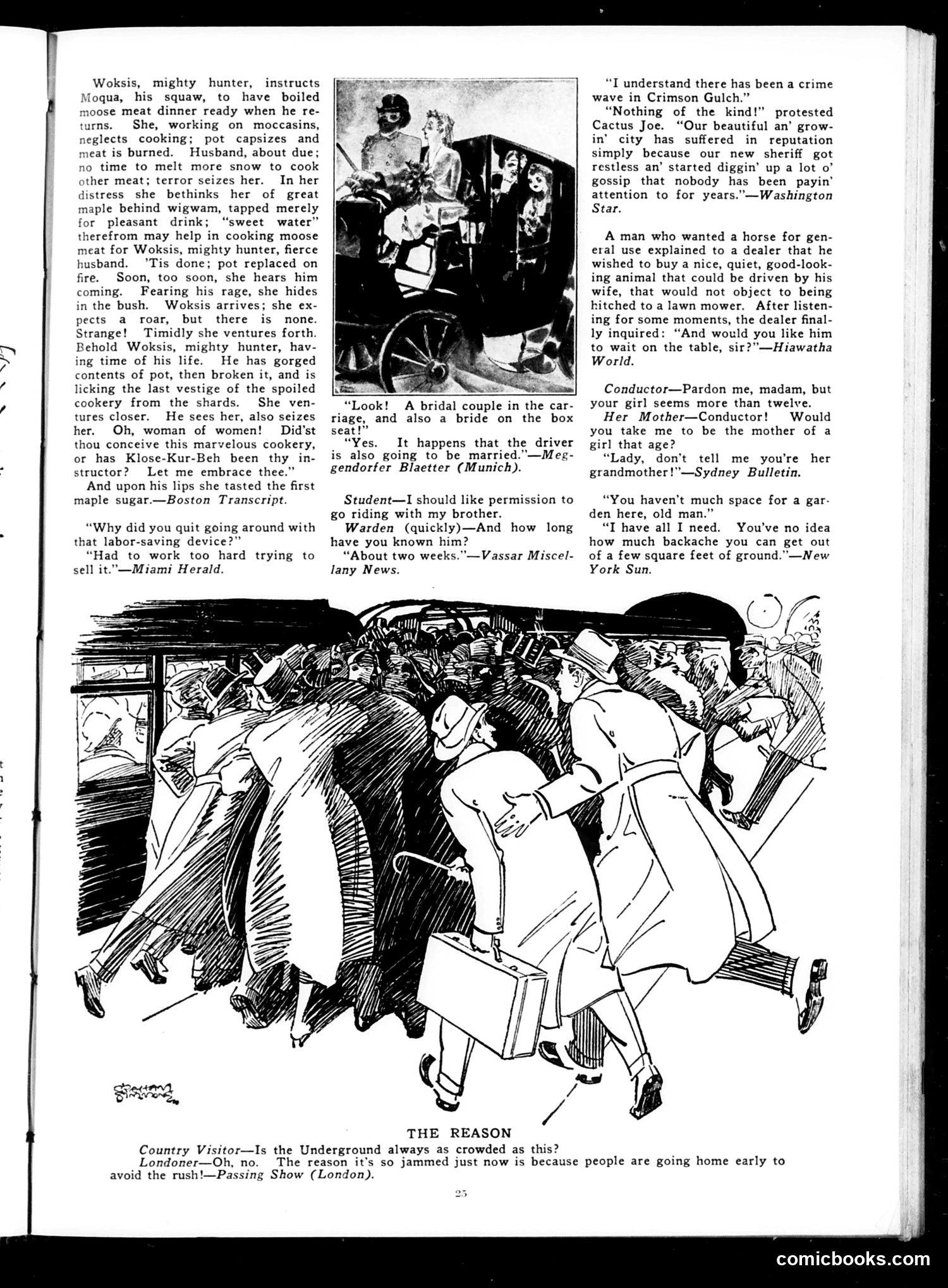
This page contains multiple brief humorous anecdotes typical of early 20th-century Judge magazine, rather than political cartoons. The main illustrated story depicts a Native American narrative ("Woksis" and "Moqua") explaining the origin of maple sugar—a wife accidentally creates it while trying to salvage burnt moose meat using maple sap, delighting her husband. This reflects the era's use of Indigenous peoples as exotic subjects for lighthearted folklore. The other items are short jokes from various sources addressing relatable frustrations: a labor-saving device that requires too much work to sell; overcrowded London Underground; a small-town sheriff creating crime problems by investigating old gossip; and various domestic humor about horses, children's ages, and gardening. The page's humor relies on wordplay, irony, and everyday middle-class anxieties—crowded transit, domestic mishaps, awkward social situations—rather than pointed political satire. The recurring theme is incompetence or unintended consequences.
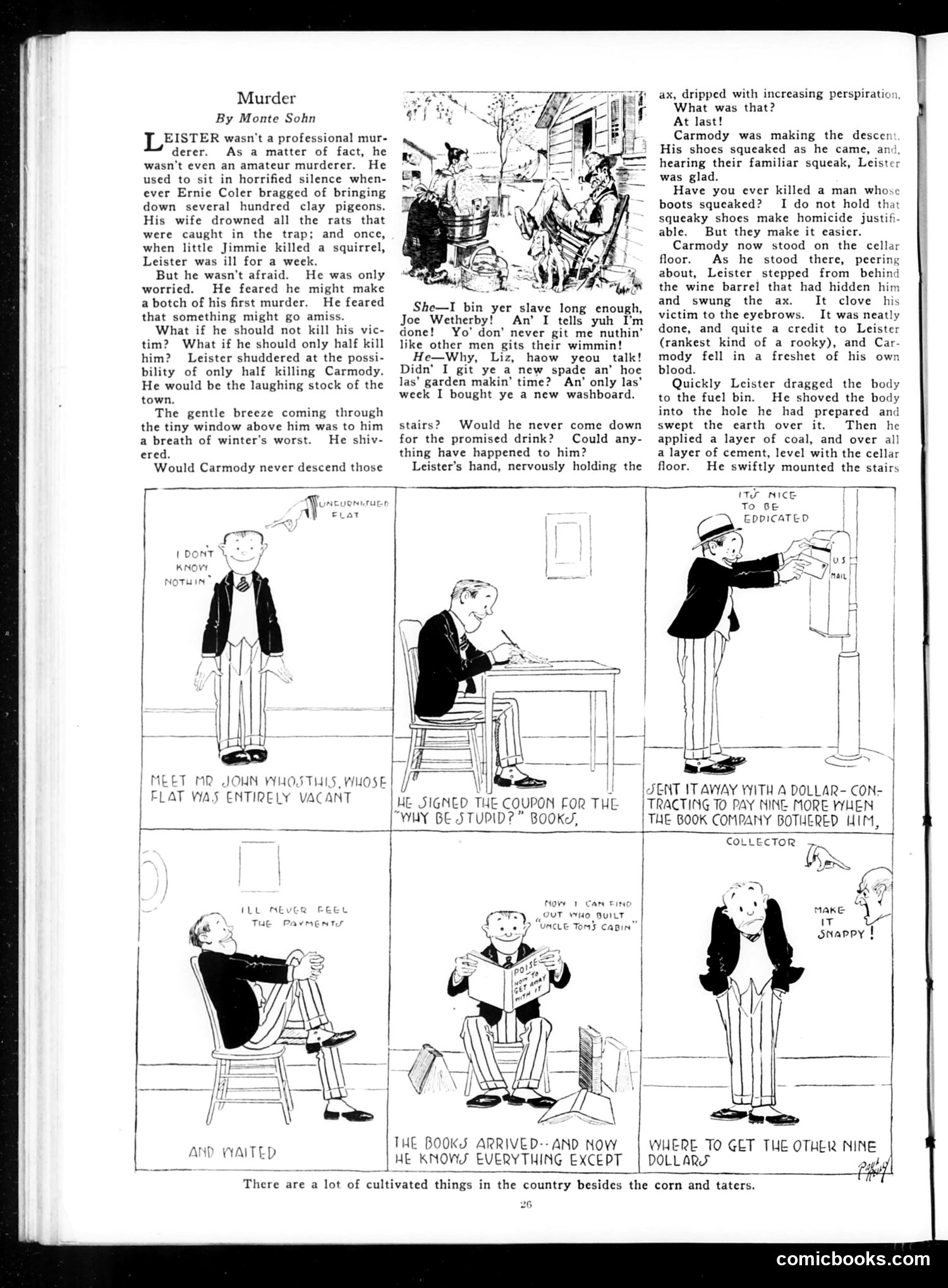
This page contains two satirical pieces: **"Murder" (main story):** A dark comedy about Leister, a timid man planning to murder his neighbor Carmody in the cellar. The satire mocks both Leister's squeamishness (he's ill when a child kills a squirrel) and his anxiety about "botching" his first murder—treating homicide like a social performance where failure means becoming "the laughing stock of the town." The story is grotesquely straightforward about the actual murder, creating darkly absurdist humor. **"The Books" (comic strip below):** Satirizes mail-order self-education schemes popular in the era. A man purchases a "Why Be Stupid?" correspondence course for one dollar, commits to paying nine more installments, and receives books. The final panel's caption ("There are a lot of cultivated things in the country besides the corn and taters") mocks rural Americans' aspirations for self-improvement through such dubious programs—and the scheme's predatory nature: the collector must locate him to extract the remaining payments. Both pieces target American anxieties and commercial exploitation of the period.
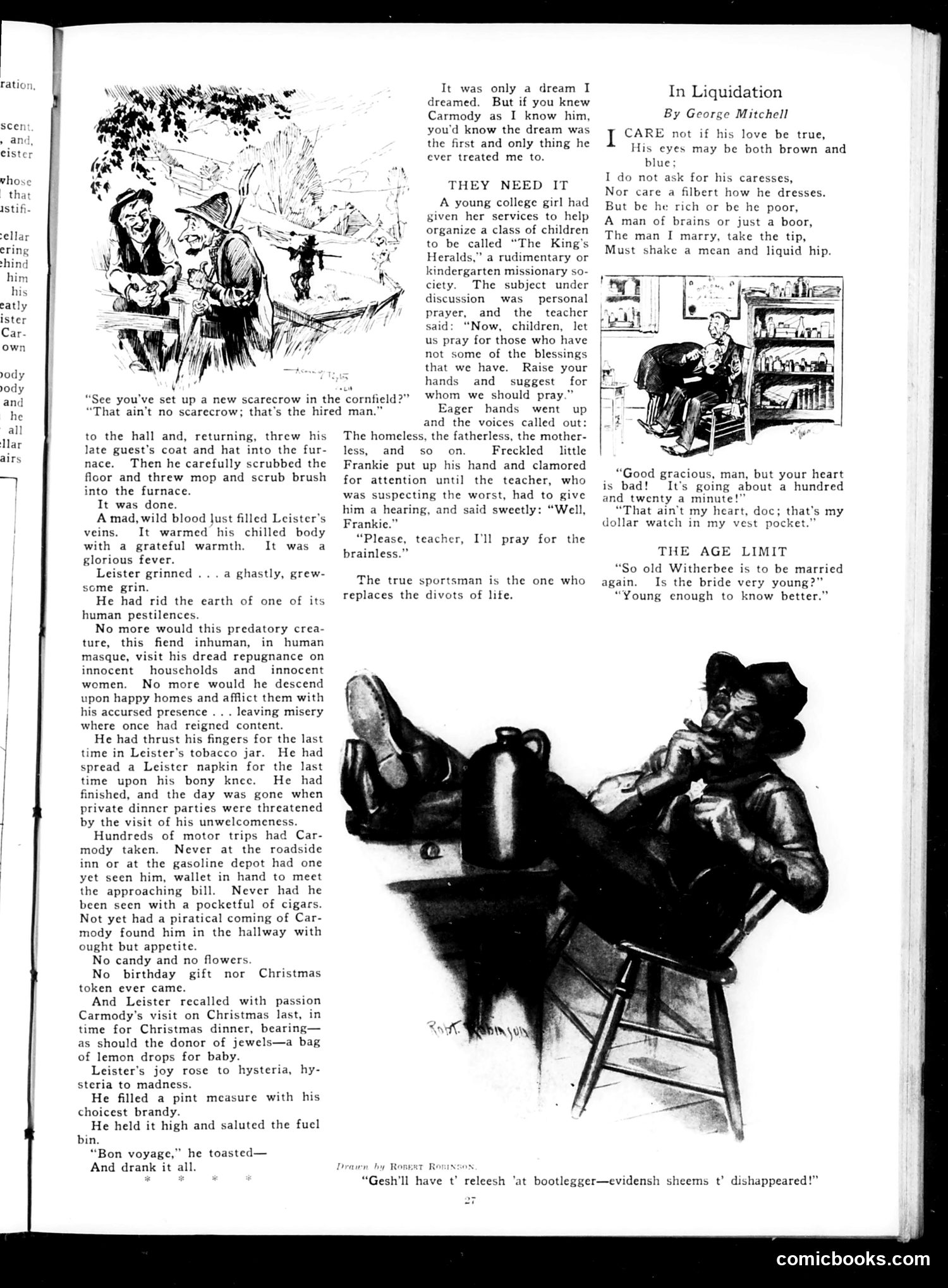
This page contains two distinct pieces of satirical content: **"In Liquidation"** (top right): A poem by George Mitchell mocking materialistic marriage values. The speaker declares indifference to a suitor's appearance, character, or wealth—caring only that he can "shake a mean and liquid hip," meaning drink well during Prohibition. The accompanying illustration shows a man drinking, and a doctor's dialogue joke about a "heart" condition that's actually a pocket watch suggests the man's real ailment is alcoholism, not health problems. The satire targets both the era's drinking culture and women portrayed as gold-diggers. **"They Need It"** (center): A brief anecdote satirizing missionary charity work. A kindergarten "missionary society" prays for the unfortunate—homeless, fatherless, motherless—until a freckled boy earnestly requests prayer "for the brainless." The joke implies even charity workers lack intelligence. The page also includes a cartoon joke about a scarecrow that's actually a poorly-fed hired man, reflecting Depression-era economic hardship and exploitation of laborers. All content reflects 1920s-30s American social attitudes and concerns.
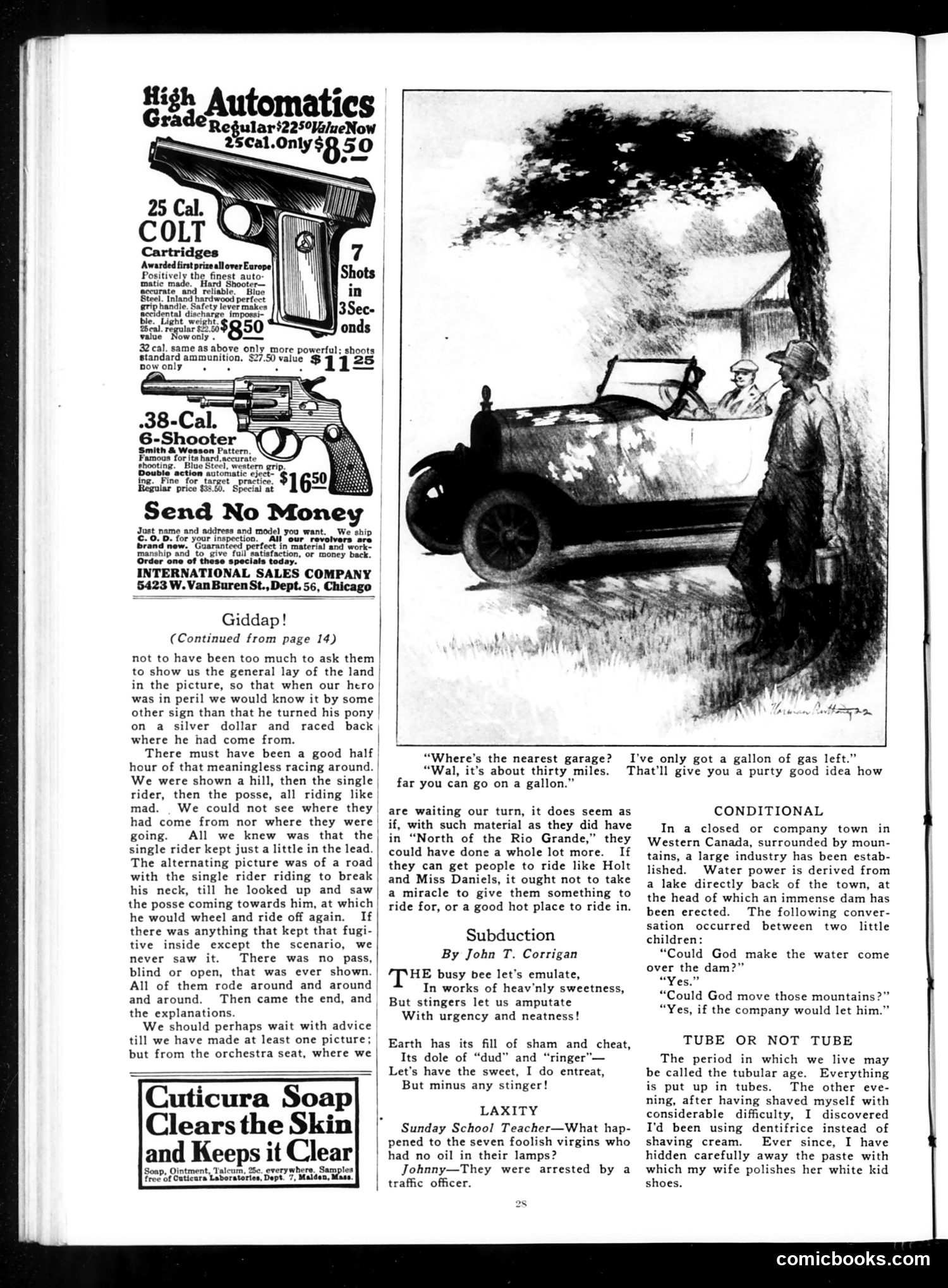
This Judge magazine page contains advertisements and satirical pieces reflecting early 20th-century American concerns. **The Main Cartoon ("Giddap!")** depicts a motorist asking rural pedestrians about gasoline availability—likely commentary on automobiles' still-novel presence in rural America and unreliable fuel infrastructure. The joke hinges on the contrast between modern transportation and frontier conditions. **The Advertisements** (firearms, Cuticura Soap) are period-typical, showing what manufacturers marketed to Judge's readers. **The Satirical Pieces** include: - "Subduction" by Corrigan: a poem mocking superficial morality ("remove the sting" from industry/society) - "Laxity": A joke where a child confuses Biblical virgins with traffic violations—satirizing modern bureaucracy replacing religious instruction - "Tube or Not Tube": Humor about dentifrice tubes replacing traditional shaving cream, poking fun at over-commercialized convenience culture Overall, the page reflects early-1900s anxieties about modernization, mechanization, and commercialization transforming traditional American life.
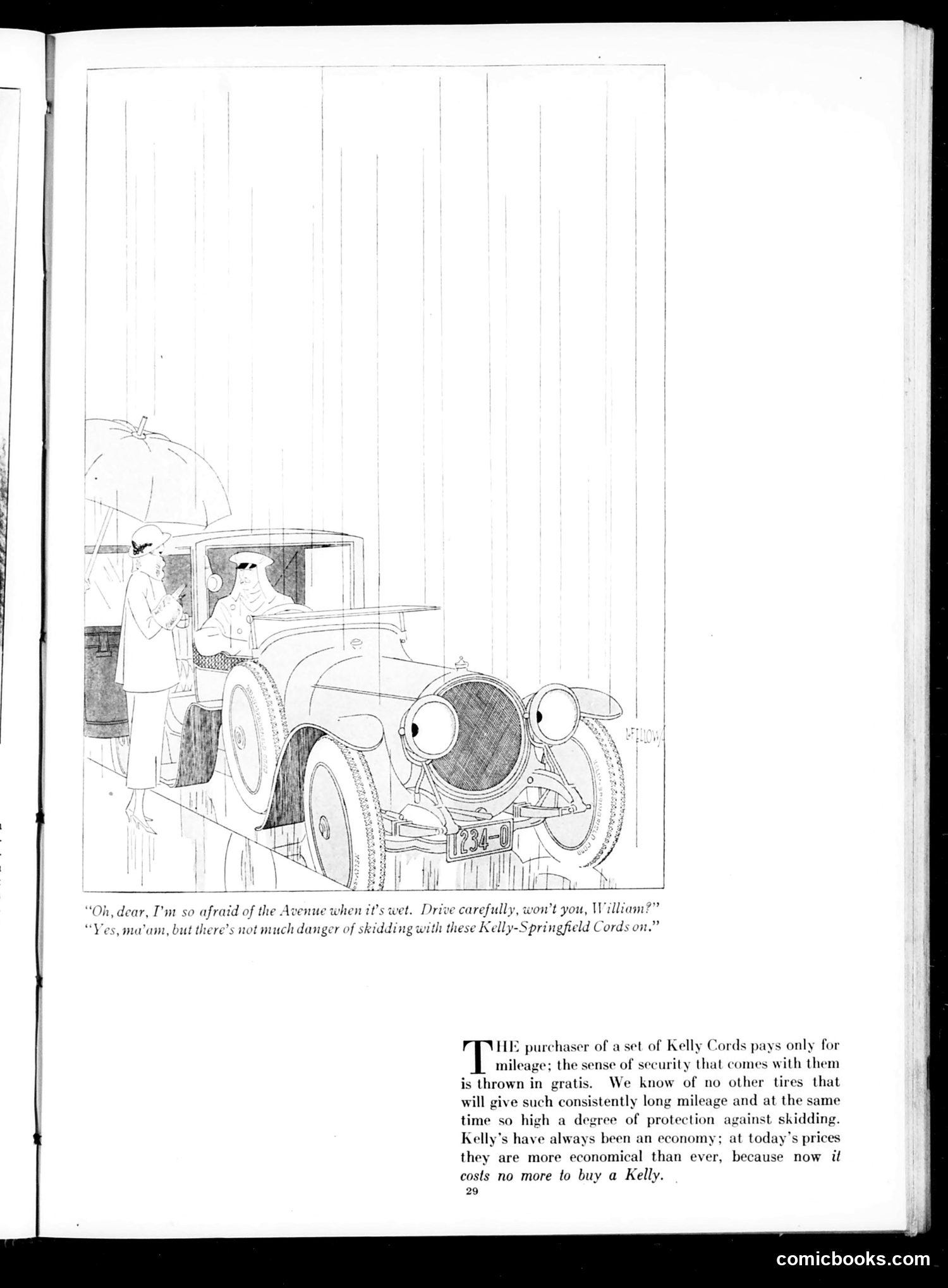
This is a **tire advertisement**, not political satire. The cartoon shows a wealthy couple in an early automobile (1920s era) during rain. The woman expresses anxiety about wet road conditions; the male driver reassures her that Kelly-Springfield Cord tires prevent skidding. The ad's pitch emphasizes that Kelly tires offer safety ("protection against skidding") and economy—you pay only for mileage used, with security "thrown in gratis." The closing claim that "it costs no more to buy a Kelly" positions the brand as competitively priced while superior. The cartoon's humor is gentle domestic comedy: the anxious wife contrasted with the confident (and brand-loyal) husband. The appeal targets affluent automobile owners concerned with both safety and value during the 1920s automotive boom.
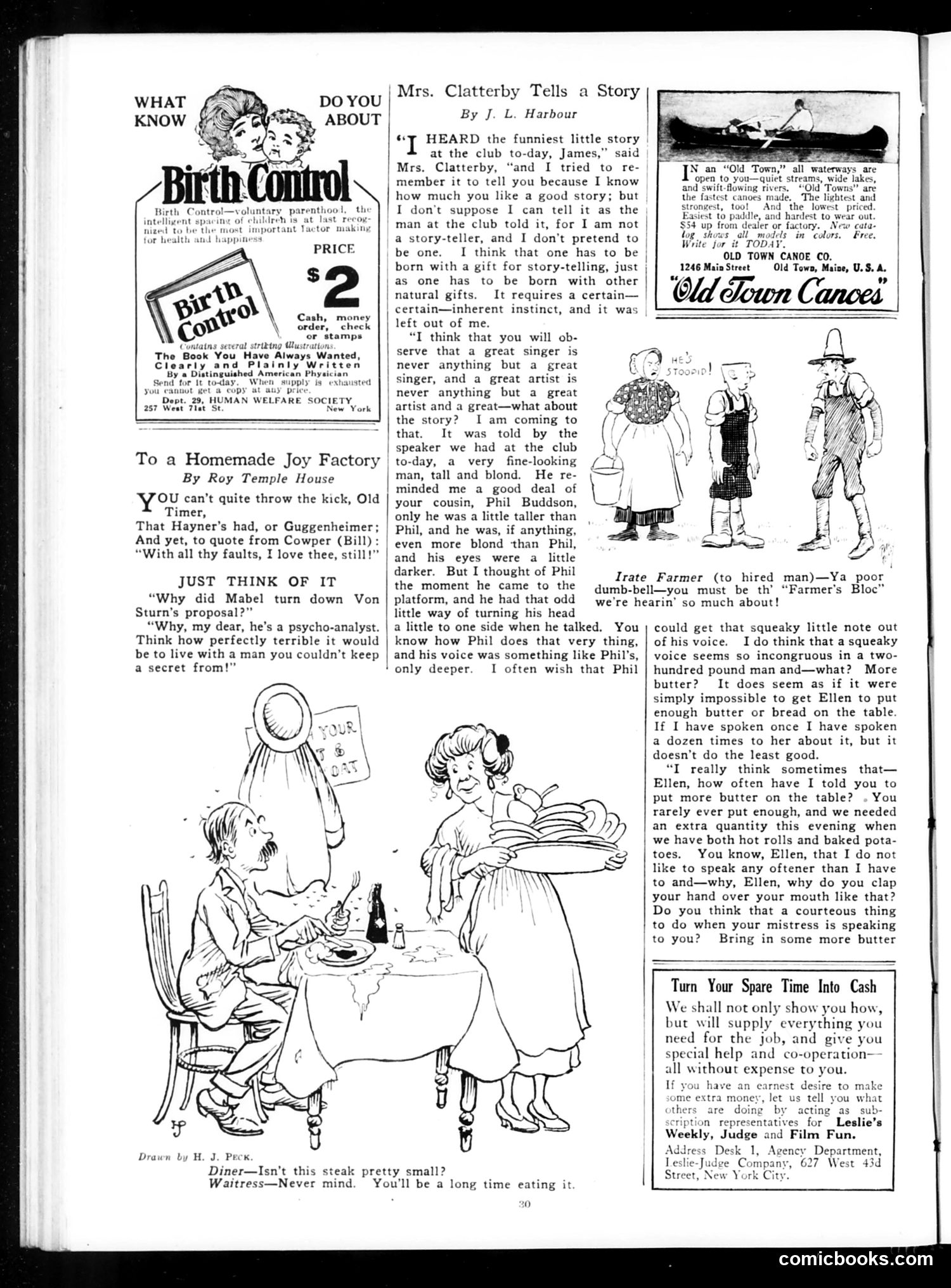
This page contains several distinct satirical pieces: **"Mrs. Clatterby Tells a Story"** mocks verbose, self-absorbed storytellers. Mrs. Clatterby begins narrating an anecdote but becomes endlessly distracted—digressing about the speaker's appearance (comparing him to her cousin Phil), then abruptly shifting to scolding her servant Ellen about butter. The satire targets upper-class women who lack self-awareness and the ability to communicate concisely, constantly interrupting themselves with tangential complaints and social comparisons. **"To a Homemade Joy Factory"** (by Roy Temple House) is a light verse nostalgically praising old homemade alcohol during Prohibition, contrasting it with commercial bootleg whiskey. **"Just Think of It"** presents a brief joke about psychoanalysts—mocking the then-trendy profession as threatening to marriage because husbands couldn't keep secrets. The **diner cartoon** shows a waitress sarcastically assuring a customer complaining about a tiny steak portion that he'll "be a long time eating it"—simple working-class humor. The page is primarily satirical social commentary on contemporary American manners and foibles.
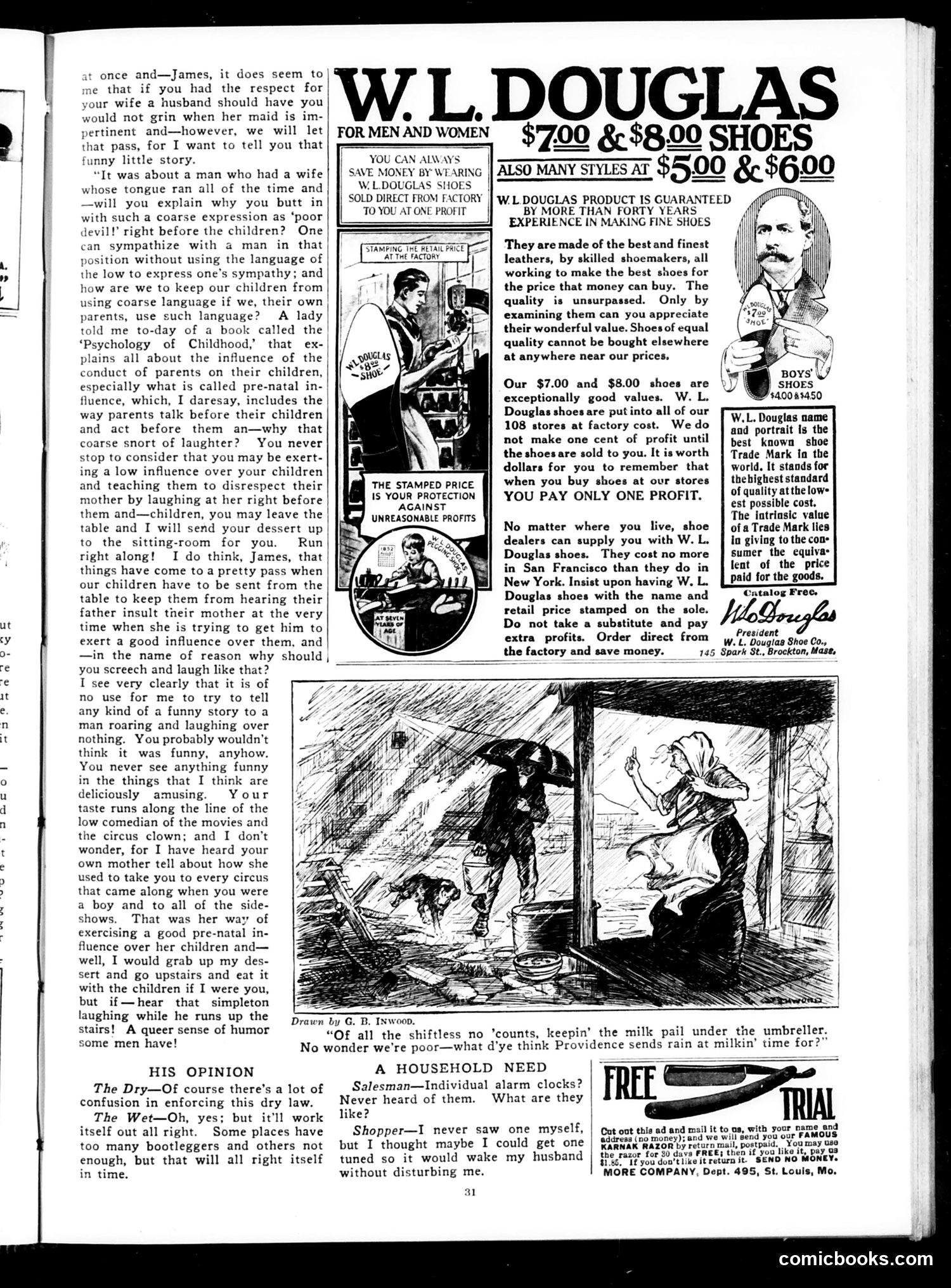
This page contains **primarily advertising** for W.L. Douglas shoes, with a small satirical article/cartoon at the top. The **main cartoon** depicts a domestic scene: a nagging wife berating her husband ("James") for his coarse language and disrespectful behavior toward her, while lecturing him about the psychological influence parents exert on children. The husband's silent, bemused expression (he appears to be grinning despite her complaints) undercuts her sermon. The wife's monologue grows increasingly tedious and self-righteous. **The satire targets**: Long-suffering husbands and their verbose, moralistic wives. The joke hinges on the wife's obliviousness—she's so absorbed in lecturing him about respect and parental influence that she becomes the very thing she's criticizing: tedious, domineering, and disrespectful of her husband's dignity. The husband's quiet amusement at her endless complaints becomes the punchline. This reflects early 20th-century gender tensions and the "henpecked husband" trope common in period humor magazines.
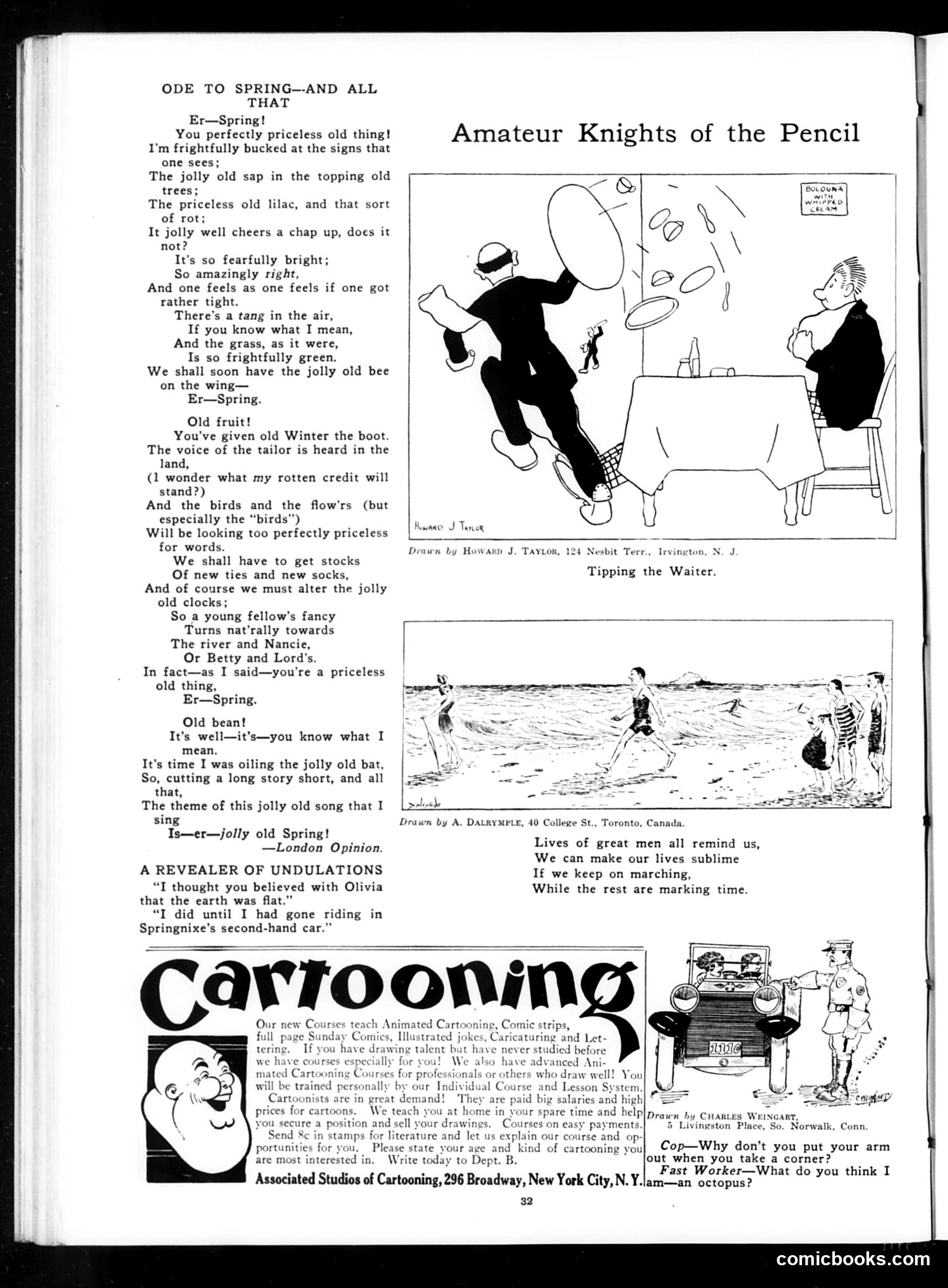
This page contains poetry and humor celebrating spring, plus instructional advertising. **"Ode to Spring"** is a lighthearted British-inflected poem (credited to *London Opinion*) using exaggerated upper-class slang ("jolly," "priceless," "old fruit") to catalog spring's pleasures: new clothing, romance, and outdoor activities. The humor lies in treating mundane seasonal changes with mock-serious enthusiasm. **"A Revealer of Undulations"** is a brief joke: a man claims to have believed the earth was flat until riding in someone's "second-hand car"—implying the vehicle bounces so badly it made him experience the earth's curvature as physical sensation. **Two cartoon illustrations** accompany the content: one shows a man tipping a waiter with exaggerated gestures; another depicts beachgoers. **The bottom half** is a large advertisement for "Associated Studios of Cartooning," promoting correspondence courses in animation and cartooning for aspiring artists, with testimonials about earning potential. The page is primarily entertainment and advertising rather than political satire.
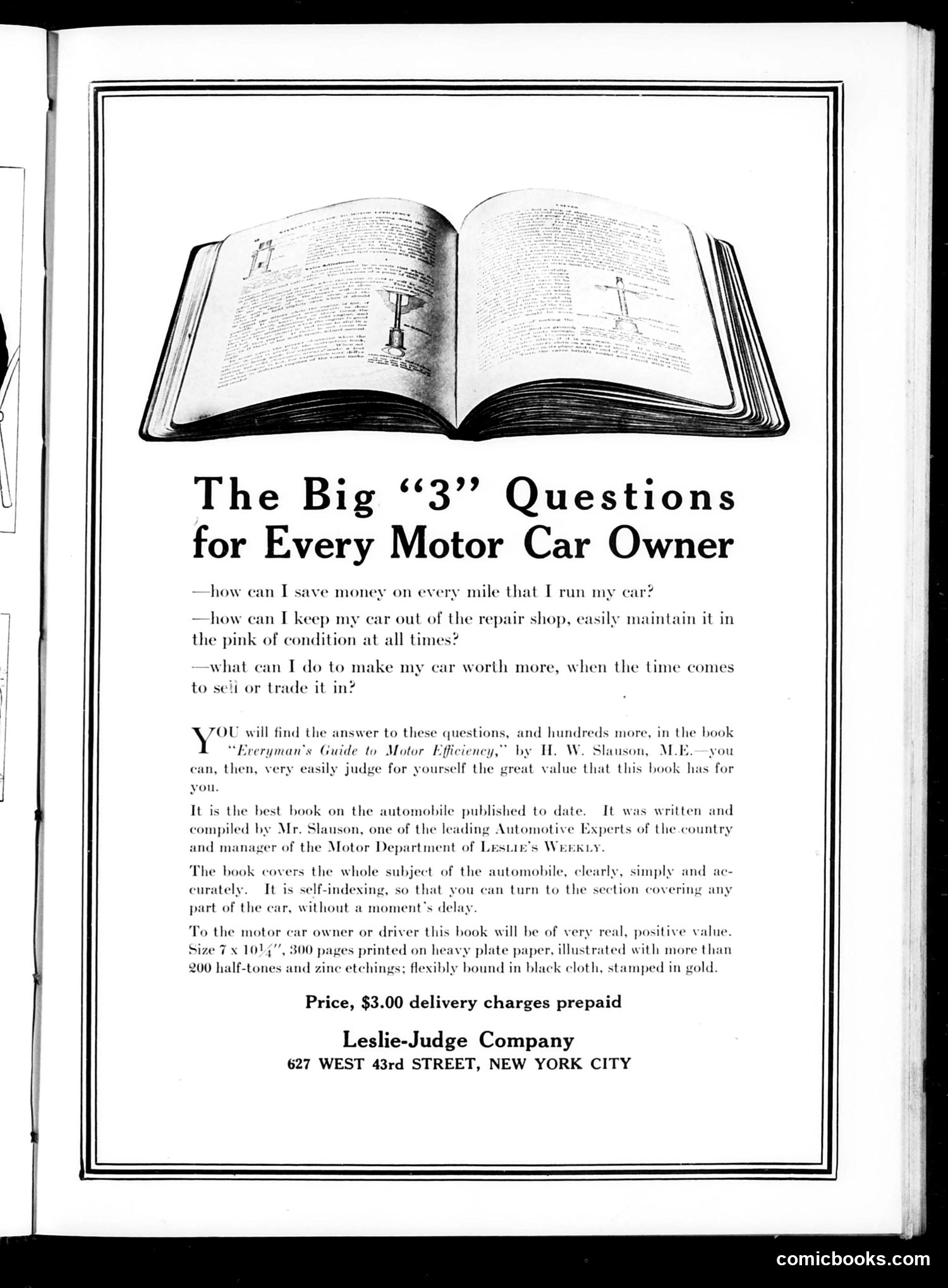
This is a book advertisement, not a cartoon or satire. It promotes "Everyman's Guide to Motor Efficiency" by H.W. Slauson, positioned as the definitive automobile manual for car owners. The ad addresses three practical concerns of early motorists: fuel economy, maintenance, and resale value—relevant in an era when automobiles were still relatively new and expensive. The book's authority derives from Slauson's credentials as automotive expert and manager of Leslie's Weekly's Motor Department. Published by Leslie-Judge Company at $3.00, the 300-page illustrated guide appears aimed at middle-class car owners seeking accessible technical knowledge. The ad's placement in Judge magazine (a satirical publication) suggests even humor-focused media carried serious consumer advertising during this period.
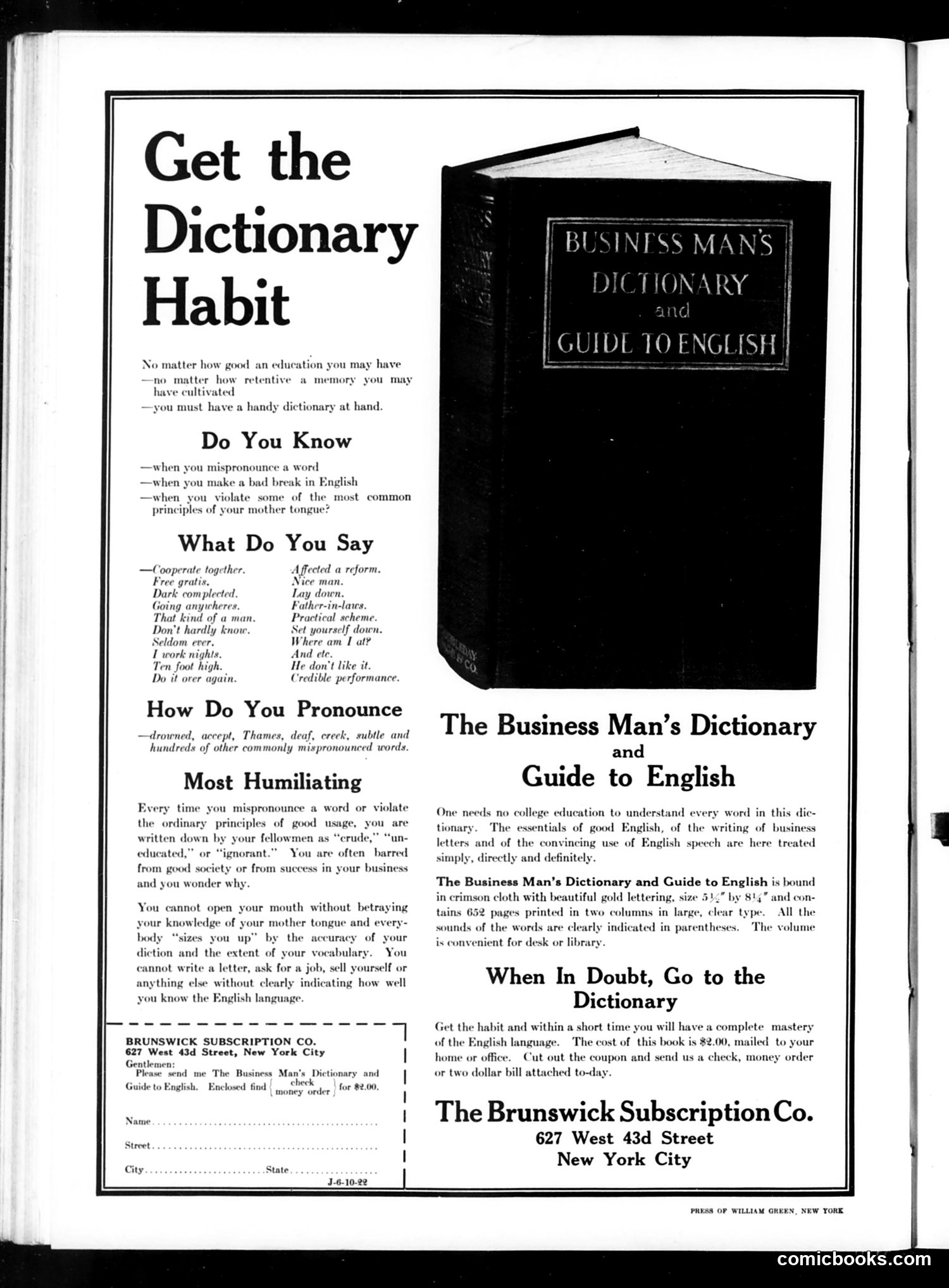
This page is entirely a **product advertisement**, not a political cartoon. It promotes "The Business Man's Dictionary and Guide to English" by the Brunswick Subscription Co. The ad targets early-20th-century businessmen by exploiting anxieties about social and professional status. It lists common English errors (mispronunciation, grammar mistakes like "cooperate together" or "lay down" instead of "lie down") to shame readers into buying the dictionary. The messaging suggests that poor English betrays one's education and class position, potentially barring entry to "good society" or business success. The rhetorical strategy is clear: convince readers that dictionary ownership is essential for professional advancement and social acceptance. The $2.00 price and mail-order subscription coupon emphasize accessibility. This reflects genuine early-20th-century concerns about linguistic correctness as a class marker and business necessity.