
Judge, 1922-06-10 · page 16 of 36
Judge — June 10, 1922 — page 16: what you’re looking at
What you’re looking at
This is a film review by Heywood Broun critiquing "North of the Rio Grande" (1924), starring Jack Holt and Bebe Daniels. **The Film's Plot Problem:** Broun mocks the predictable "Robin Hood outlaw" trope—a hero who steals to help the poor, appearing noble but ultimately lacking dramatic surprise. **The Central Absurdity:** The protagonist encounters the villain's daughter, learns her father killed his own father and stole his horse, then *heroically* helps the villain escape so "she shall never know" the truth. Broun notes the audience literally groaned at this contrived nobility. **Broun's Critique:** While praising the cinematography and horsemanship, he argues Hollywood relies on excessive "hifalutin nobility" and implausible moral posturing to excuse weak storytelling. He suggests filmmakers need better plots and less reliance on emotional manipulation through spectacular action sequences. The review advocates for more intelligent screenwriting rather than substituting horse chases for character development.
📄 Transcribed text from this page (OCR, searchable)
Machine-transcribed from the original scan — historical spelling and the odd misread are preserved.
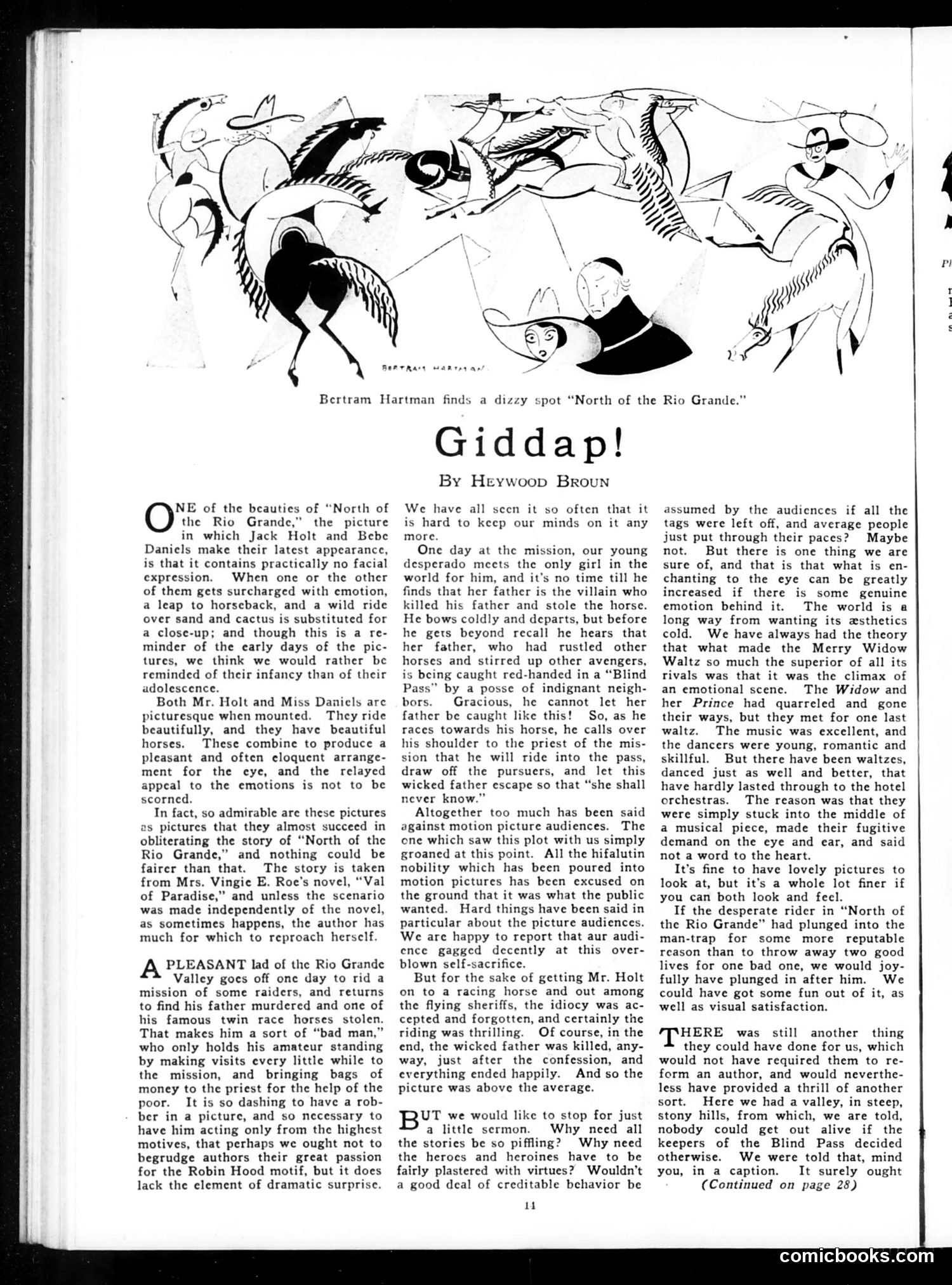
NE of the beauties of “North of the Rio Grande,” the picture in which Jack Holt and Bebe Daniels make their latest appearance, is that it contains practically no facial expression. When one or the other of them gets surcharged with emotion, a leap to horseback, and a wild ride over sand and cactus is substituted for a close-up; and though this is a re- minder of the early days of the pic- tures, we think we would rather be reminded of their infancy than of their adolescence. Both Mr. Holt and Miss Daniels are picturesque when mounted. They ride beautifully, and they have beautiful horses. These combine to produce a pleasant and often eloquent arrange- ment for the eye, and the relayed appeal to the emotions is not to be scorned. In fact, so admirable are these pictures as pictures that they almost succeed in obliterating the story of “North of the Rio Grande,” and nothing could be fairer than that. The story is taken from Mrs. Vingie E. Roe’s novel, “Val of Paradise,” and unless the scenario was made independently of the novel, as sometimes happens, the author has much for which to reproach herself. PLEASANT lad of the Rio Grande Valley goes off one day to rid a mission of some raiders, and returns to find his father murdered and one of his famous twin race horses stolen. That makes him a sort of “bad man,” who only holds his amateur standing by making visits every little while to the mission, and bringing bags of money to the priest for the help of the poor. It is so dashing to have a rob- ber in a picture, and so necessary to have him acting only from the highest motives, that perhaps we ought not to begrudge authors their great passion for the Robin Hood motif, but it does lack the element of dramatic surprise. Bertram Hartman finds a dizzy spot “North of the Giddap! By Heywoop Broun We have all scen it so often that it is hard to keep our minds on it any more. One day at the mission, our young desperado meets the only girl in the world for him, and it’s no time till he finds that her father is the villain who killed his father and stole the horse. He bows coldly and departs, but before he gets beyond recall he hears that her father, who had rustled other horses and stirred up other avengers, is being caught red-handed in a “Blind Pass” by a posse of indignant neigh- bors. Gracious, he cannot let her father be caught like this! So, as he races towards his horse, he calls over his shoulder to the priest of the mis- sion that he will ride into the pass, draw off the pursuers, and let this wicked father escape so that “she shall never know.” Altogether too much has been said against motion picture audiences. The one which saw this plot with us simply groaned at this point. All the hifalutin nobility which has been poured into motion pictures has been excused on the ground that it was what the public wanted. Hard things have been said in particular about the picture audiences. We are happy to report that aur audi- ence gagged decently at this over- blown self-sacrifice. But for the sake of getting Mr. Holt on to a racing horse and out among the flying sheriffs, the idiocy was ac- cepted and forgotten, and certainly the riding was thrilling. Of course, in the end, the wicked father was killed, any- way, just after the confession, and everything ended happily. And so the picture was above the average. UT we would like to stop for just a little sermon. Why need all the stories be so piffling? Why need the heroes and heroines have to be fairly plastered with virtues? Wouldn't a good deal of creditable behavior be i Rio Grande.” assumed by the audiences if all the tags were left off, and average people just put through their paces? Maybe not. But there is one thing we are sure of, and that is that what is en- chanting to the eye can be greatly increased if there is some genuine emotion behind it. The world is a long way from wanting its esthetics cold. We have always had the theory that what made the Merry Widow Waltz so much the superior of all its rivals was that it was the climax of an emotional scene. The Widow and her Prince had quarreled and gone their ways, but they met for one last waltz. The music was excellent, and the dancers were young, romantic and skillful. But there have been waltzes, danced just as well and better, that have hardly lasted through to the hotel orchestras. The reason was that they were simply stuck into the middle of a musical piece, made their fugitive demand on the eye and ear, and said not a word to the heart. It’s fine to have lovely pictures to look at, but it’s a whole lot finer if you can both look and feel. If the desperate rider in “North of the Rio Grande” had plunged into the man-trap for some more reputable reason than to throw away two good lives for one bad one, we would joy- fully have plunged in after him. We could have got some fun out of it, as well as visual satisfaction. HERE was still another thing they could have done for us, which would not have required them to re- form an author, and would neverthe- less have provided a thrill of another sort. Here we had a valley, in steep, stony hills, from which, we are told, nobody could get out alive if the keepers of the Blind Pass decided otherwise. We were told that, mind you, in a caption. It surely ought (Continued on page 28) comicbooks.com